

Quick Summary: SellerApp, Sellics, and WisePPC offer distinct approaches to Amazon selling. SellerApp delivers comprehensive all-in-one analytics and PPC automation with plans starting at $24.99/month (STARTER plan) with core features, scaling to $66.99/mo (PRO plan), Sellics (now part of Perpetua) focuses on keyword research and listing optimization, while WisePPC specializes in lightweight PPC campaign management with transparent 1% ad spend fees and real-time performance tracking for sellers prioritizing advertising efficiency.
Choosing the right Amazon seller platform can make or break your profit margins. With hundreds of tools competing for attention, three names consistently surface in seller conversations: SellerApp, Sellics, and WisePPC.
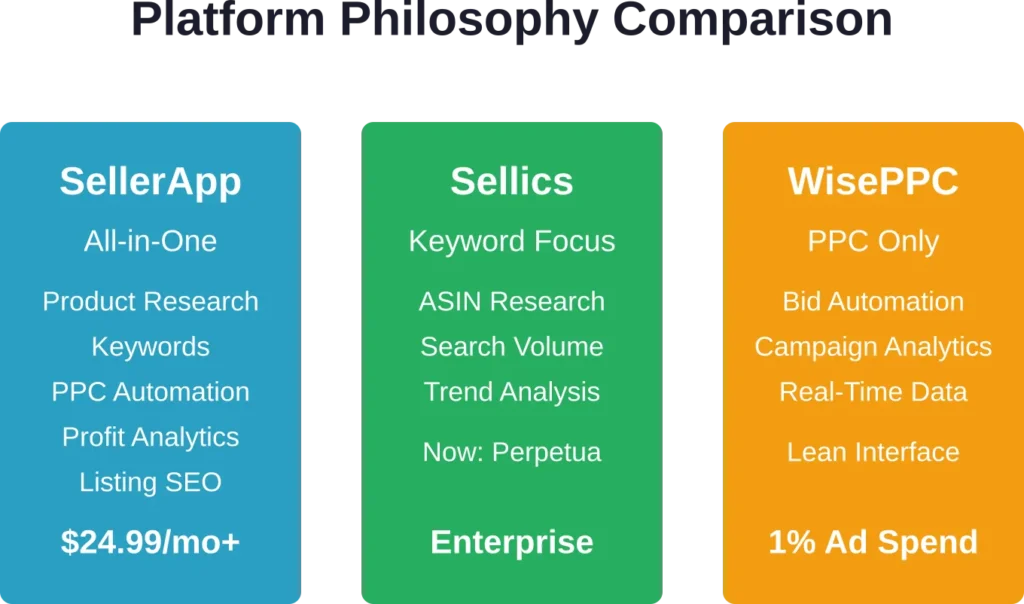
Each takes a different philosophy. SellerApp positions itself as the Swiss Army knife—product research, keyword tracking, PPC automation, and profit analytics bundled into one subscription. Sellics carved out a reputation for keyword discovery before merging into the Perpetua ecosystem. WisePPC stays lean, focusing exclusively on ad campaign optimization without the feature bloat.
But philosophy doesn’t pay the bills. Performance does.
This comparison cuts through marketing claims and examines what each platform actually delivers: pricing structures, core features, automation quality, and the practical realities sellers face when managing campaigns at scale.
Platform Positioning and Core Philosophy
Understanding what each tool optimizes for reveals whether it matches your business model.
SellerApp: The All-in-One Approach

SellerApp built its platform around a central premise: sellers shouldn’t need five subscriptions to run one business. The dashboard consolidates product research, keyword intelligence, listing optimization, PPC automation, and profit tracking into a unified interface.
According to the official website, SellerApp’s STARTER plan begins at $24.99/month, with ESSENTIAL at $41.99/mo and PRO at $66.99/mo, all including core features such as product research, keyword data, SEO, listing and PPC optimizer. The platform updates data every 24 hours and supports Amazon marketplaces globally.
SellerApp offers a free 7-day trial with access to up to 20 products. Real functionality starts with paid plans.
The comprehensive approach appeals to sellers who value workflow integration. Instead of exporting keyword data from one tool, importing it to another for bid management, then cross-referencing profit calculations in a third spreadsheet, everything lives in one ecosystem.
That integration comes with complexity. The learning curve is steeper than single-purpose tools, and some sellers report the interface feels overwhelming during initial setup.
Sellics: Keyword Specialists Turned Enterprise

Sellics entered the market as Sonar, a free keyword research tool that became the go-to resource for finding search terms Amazon’s own tools wouldn’t reveal. That keyword DNA still runs through the platform.
The free Sonar tool remains available for basic keyword discovery. But the full Sellics platform expanded into PPC management, inventory tracking, and profit analytics before Perpetua acquired the technology in recent years.
Post-acquisition, Sellics functionality migrated into Perpetua’s enterprise advertising platform. The transition left some long-time users searching for alternatives as pricing shifted toward larger brands and agencies rather than individual sellers.
The keyword research remains powerful—reverse ASIN lookups, search volume estimates, and trend analysis that helped thousands of sellers optimize listings. But the standalone Sellics product as sellers knew it has largely dissolved into Perpetua’s broader offering.
WisePPC: Advertising-First Simplicity

WisePPC rejects the all-in-one model entirely. No product research. No listing optimization. No inventory forecasting.
Just PPC campaign management, stripped down and focused.
The platform targets sellers who already know what they’re selling and need surgical control over ad spend without paying for features they won’t use. Real-time bid adjustments, granular performance analytics, and campaign structure recommendations comprise the core offering.
Pricing follows a straightforward model: 1% of ad spend with no hidden platform fees or tiered subscriptions. According to data from authoritative sources, this matches the transparent pricing approach of tools like Scale Insights while undercutting platforms that layer subscription fees on top of percentage charges.
The simplicity is both strength and limitation. Sellers managing complex catalogs across multiple marketplaces might find the feature set too narrow. But for businesses laser-focused on advertising efficiency, the lean approach eliminates distractions.
Transform Your Marketplace Strategy with Technical Precision
In 2026, comparing SellerApp, Sellics (now integrated into Perpetua), and WisePPC highlights a shift toward specialized technical control. While integrated platforms focus on broad automation across multiple marketplaces, WisePPC delivers a high-precision analytics layer designed for brands that prioritize granular execution and long-term data ownership.
- Enhanced Data Continuity: WisePPC retains performance data for several years, providing a significant advantage over platforms that rely on Amazon’s limited 60–90 day historical windows.
- Granular Placement Analysis: Users can evaluate advertising efficiency at the campaign, product, and keyword levels, ensuring budgets are focused on the highest-converting placements.
- High-Speed Bulk Management: The platform enables thousands of bid and target updates simultaneously, allowing teams to react to market changes faster than manual or basic automated systems.
- Technical Value and Support: As an Amazon Ads Verified Partner, the solution bridges technical skill gaps by offering advanced tools for deep analysis and sustainable account scaling.
To access professional-grade analytics and optimize your advertising strategy, register at WisePPC.
Pricing Structures and True Costs
Platform fees represent recurring expenses that compound monthly. Understanding the actual cost—not just the advertised rate—matters for margin calculations.
SellerApp Pricing Breakdown
According to the official SellerApp pricing page, the STARTER plan begins at $24.99/month, with ESSENTIAL at $41.99/mo and PRO at $66.99/mo, with annual subscriptions offering 50% savings compared to monthly billing.
SellerApp offers a free 7-day trial with access to up to 20 products—functional for testing but insufficient for active catalog management. Paid plans unlock the full feature set including PPC automation, keyword tracking, and profit analytics.
Agency pricing operates differently. The starting fee sits at $300 plus a percentage of Amazon ad spend ranging between 0.5% and 2.5%, according to official documentation. This hybrid model—base fee plus performance percentage—can scale costs quickly for agencies managing six-figure monthly ad budgets.
Payment flexibility includes Stripe, PayPal, and bank transfer options. Auto-renewal activates by default but can be managed through the billing dashboard.
Hidden costs emerge in the details. Some advanced features require higher-tier plans. Multi-marketplace support might trigger additional fees. And while the platform bundles many tools, sellers still need external solutions for tasks like inventory management or customer service automation.
Sellics and Perpetua Economics
The Sellics transition to Perpetua fundamentally changed the pricing model. The original Sellics plans catered to individual sellers with predictable monthly subscriptions.
Perpetua (which acquired Sellics) operates on enterprise pricing—custom quotes based on ad spend volume, number of ASINs, and required features. According to authoritative industry sources, platforms in this tier typically start around $500 to $1,000+ per month plus ad spend percentages.
The free Sonar keyword tool remains available without subscription requirements. But accessing the full suite of advertising automation, analytics, and optimization features now requires engaging with Perpetua’s sales process.
This shift priced out many small-to-medium sellers who relied on Sellics for affordable keyword research and basic PPC management. The enterprise focus serves brands spending $50,000+ monthly on advertising but leaves a gap for sellers operating at smaller scales.
WisePPC Cost Transparency
WisePPC pricing follows a single variable: 1% of monthly ad spend.
No base subscription fee. No tiered plans. No feature gates based on payment level. Spend $10,000 on Amazon ads, pay $100 to WisePPC. Spend $100,000, pay $1,000.
This model aligns platform costs directly with advertising scale. Sellers testing new products with modest budgets pay proportionally less. Established brands spending aggressively pay more but receive the same feature access.
The transparency simplifies budgeting. No surprise charges for exceeding ASIN limits or adding team members. The cost calculation fits on one line of a spreadsheet.
But percentage-based pricing can become expensive at scale. A seller spending $200,000 monthly on ads pays $2,000 to WisePPC—substantially more than flat-rate tools charging $199 regardless of spend. The crossover point where percentage models exceed flat fees varies by business but typically occurs around $20,000 in monthly ad spend.
| Platform | Base Cost | Ad Spend Fee | Best For |
|---|---|---|---|
| SellerApp | $24.99/mo (50% off annual) | 0.5-2.5% (agency only) | Sellers wanting all-in-one tools |
| Sellics/Perpetua | Custom (enterprise) | Varies by contract | Large brands, $50k+ ad budgets |
| WisePPC | $0 | 1% of ad spend | PPC-focused sellers, any scale |
Feature Depth and Practical Functionality
Marketing pages list features. Real work happens when those features actually solve daily seller problems.
Product Research Capabilities
SellerApp includes dedicated product research tools designed to identify profitable opportunities before committing inventory capital. The feature set covers market analysis, competitor revenue estimates, and niche identification.
Users can filter by category, price range, estimated sales volume, and competition metrics. The tool surfaces products gaining traction—rising BSR, increasing review velocity, growing search volume—that might indicate emerging demand.
Accuracy depends on Amazon’s data transparency. Revenue estimates use algorithmic modeling rather than actual sales figures, introducing margin for error. But for directional intelligence—this niche looks promising versus that one looks saturated—the data proves useful.
Sellics never emphasized product research. The platform assumed sellers already knew what to sell and needed help optimizing listings and ads. Post-Perpetua, product discovery tools exist within the broader suite but aren’t the primary value proposition.
WisePPC offers zero product research functionality. The platform enters the picture after product selection, focusing exclusively on advertising existing inventory.
Keyword Intelligence and Search Term Discovery
All three platforms address keyword research, but implementation varies significantly.
SellerApp’s keyword explorer provides search volume estimates, competition scores, and recommended bid ranges. The reverse ASIN lookup reveals which keywords competitors rank for—valuable intelligence for gap analysis.
The keyword tracker monitors ranking positions over time, alerting sellers when critical terms drop below page one. Integration with listing optimization means recommended keywords flow directly into title, bullet, and backend keyword workflows.
Sellics built its reputation on Sonar, which remains one of the most comprehensive free keyword databases available. Enter any seed keyword or ASIN, receive hundreds of related search terms with volume estimates.
The depth exceeds what Amazon’s own Brand Analytics provides for many queries. Long-tail variations, seasonal trends, and cross-category connections surface regularly. For sellers optimizing organic rankings, Sonar delivers exceptional value at zero cost.
WisePPC approaches keywords through the PPC lens exclusively. The platform doesn’t provide broad keyword discovery tools. Instead, it analyzes which keywords in existing campaigns drive conversions versus which burn budget without returns.
The search term reports highlight performing queries buried in auto campaigns that deserve dedicated exact-match targeting. Negative keyword recommendations identify wasteful spend. But discovering entirely new keyword opportunities requires external tools.
PPC Automation and Bid Management
Here’s where operational philosophy diverges sharply.
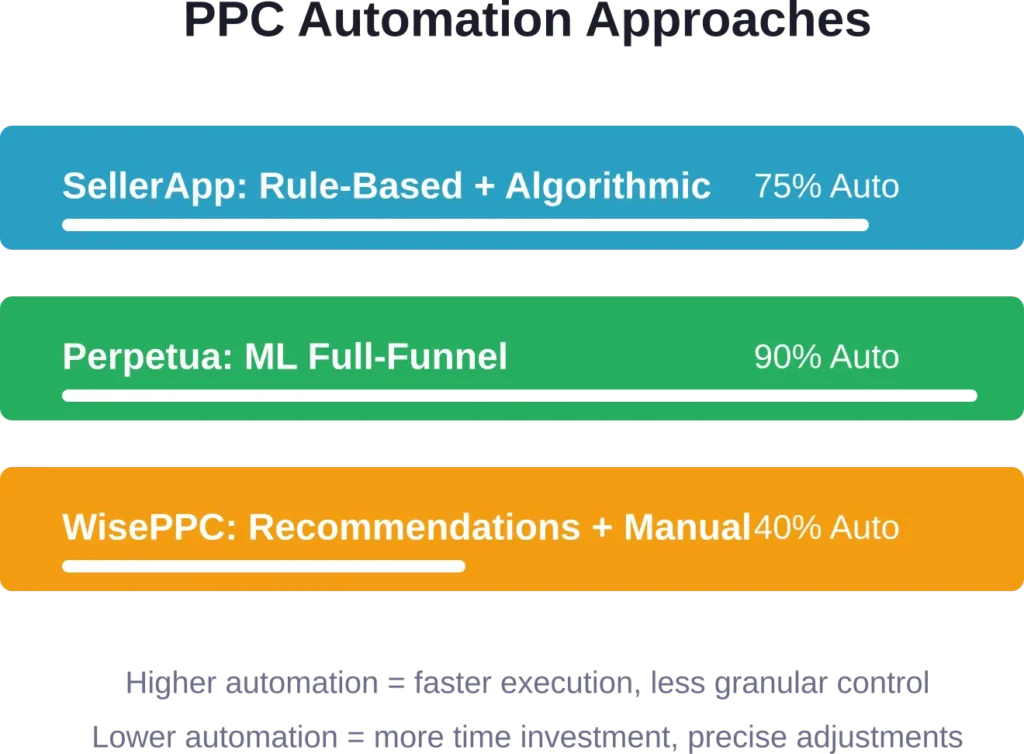
SellerApp’s PPC automation applies rule-based and algorithmic bid adjustments. Users set target ACoS parameters, the system modifies bids to hit those targets while maximizing impression share for profitable keywords.
The automation handles campaign structure recommendations—suggesting when to split auto campaigns, promoting performing search terms to exact match, creating negative keyword lists to reduce waste.
Dayparting controls when ads run most aggressively. If data shows conversion rates spike between 7-10 PM, the automation increases bids during those windows and reduces them during low-converting hours.
Performance depends on configuration. Conservative sellers report steady efficiency gains. Aggressive sellers occasionally see volatility when algorithms overcorrect on limited data. The system works best with substantial historical performance to analyze.
Perpetua (the Sellics successor) operates at the enterprise tier with machine-learning bid optimization. The algorithms process massive datasets across client portfolios to predict optimal bid levels for specific products, keywords, and market conditions.
Automation spans full-funnel strategies—coordinating Sponsored Products, Sponsored Brands, and Sponsored Display campaigns to guide customers through awareness, consideration, and conversion stages.
The sophistication matches the price point. Brands spending six figures monthly gain meaningful advantages from predictive bidding. Smaller sellers might find the complexity outweighs the incremental performance lift.
WisePPC emphasizes transparency over black-box automation. The platform provides real-time bid recommendations based on current performance but leaves execution control with the seller.
Want to see which keywords should increase bids by 15% to capture more impression share without exceeding target ACoS? The system flags them. But it won’t automatically change bids without explicit approval.
This manual-hybrid approach appeals to sellers who’ve been burned by aggressive automation tanking profitability. The tools accelerate decision-making without removing human judgment from the loop.
Profit Analytics and Financial Reporting
Revenue vanity dies when FBA fees, PPC spend, and returns erode margins to nothing. Accurate profit tracking separates sustainable businesses from ticking time bombs.
SellerApp calculates profit by ingesting Amazon settlement reports, PPC invoices, and product costs entered by sellers. The dashboard displays net profit after accounting for referral fees, FBA fulfillment costs, storage fees, advertising spend, and refunds.
Real-time alerts notify sellers when profit margins dip below configured thresholds—useful for catching pricing errors or unexpected fee increases before they compound.
The challenge lies in data accuracy. If sellers don’t update product costs when suppliers raise prices, profit calculations drift from reality. Garbage in, garbage out applies fully.
Sellics offered profit dashboards in its original incarnation, tracking similar metrics with clean visualizations. The Perpetua transition maintained these capabilities within the enterprise analytics suite.
WisePPC doesn’t provide comprehensive profit tracking. The platform focuses narrowly on advertising performance—ACoS, ROAS, conversion rates, cost per click.
Sellers using WisePPC typically run profit calculations in external tools like Seller Legend, HelloProfit, or custom spreadsheets. The PPC data exports cleanly for integration with those systems.
User Experience and Interface Design
Tools get used—or abandoned—based on how quickly sellers can execute daily tasks without friction.
Dashboard Navigation and Learning Curves
SellerApp packs substantial functionality into its interface. New users face a learning period navigating between product research, keyword tools, PPC dashboards, and profit analytics.
The comprehensive approach means any given task requires 3-4 clicks from the home screen. Power users memorize navigation paths and move efficiently. Casual users sometimes get lost hunting for specific features.
Training resources help. Video tutorials, documentation, and email support walk users through setup and optimization workflows. But expect 2-3 weeks before the interface feels intuitive.
Sellics historically emphasized clean design with fewer features presented at once. The interface prioritized keyword research and basic PPC controls, making initial setup straightforward.
Perpetua’s enterprise platform introduces complexity matching its expanded capabilities. Multi-channel campaign coordination, cross-retailer analytics, and advanced attribution modeling require steeper learning investment.
WisePPC delivers the flattest learning curve. The dashboard shows campaign performance metrics front and center. Bid recommendations populate clearly. No buried features or hidden menus.
First-time users typically grasp core functionality within 30 minutes. The limited scope means fewer places to get confused. Sellers who value speed over breadth appreciate the focused design.
Mobile Access and Remote Management
Sellers don’t work exclusively from desktop workstations. Monitoring campaigns during commutes, travel, or away from office setups matters for responsive management.
SellerApp offers mobile apps for iOS and Android with core features accessible on smaller screens. Campaign performance, keyword rankings, and profit snapshots load cleanly. Complex tasks like restructuring campaigns work better on desktop but monitoring and quick bid tweaks function adequately mobile.
Perpetua provides mobile access through responsive web design rather than dedicated apps. The interface adapts to phone screens but some advanced features compress awkwardly on limited real estate.
WisePPC’s lean interface translates well to mobile browsers. Campaign dashboards, bid recommendations, and performance charts render clearly on phones. The focused feature set avoids cramming excessive data onto small screens.
Customer Support and Problem Resolution
When campaigns malfunction or data looks wrong, response time determines whether issues become minor hiccups or revenue disasters.
Support Channels and Availability
SellerApp provides email support for all paid plans with typical response times under 24 hours for non-urgent inquiries. Higher-tier plans include priority support with faster turnaround and dedicated account management for enterprise clients.
The managed service plan—where SellerApp teams actively run campaigns on behalf of sellers—includes regular strategy calls and proactive optimization. This hands-on approach suits sellers lacking time or expertise to manage PPC themselves.
Community resources include a knowledge base, video tutorials, and blog content addressing common optimization scenarios. Self-service troubleshooting resolves many routine questions without waiting for support tickets.
Perpetua operates with dedicated account teams for enterprise clients. Onboarding includes strategy sessions, campaign architecture planning, and ongoing performance reviews. The white-glove service matches the premium pricing.
Support availability during U.S. business hours is standard, with some enterprise contracts including extended coverage for global brands managing campaigns across time zones.
WisePPC offers email and chat support during business hours. Response times vary by issue complexity but routine questions typically resolve within a few hours.
The platform’s narrow focus simplifies support interactions. Most inquiries involve campaign performance questions or bid recommendation clarifications rather than navigating complex feature sets.
Integration Ecosystem and Tool Compatibility
No single platform does everything. The question becomes which tools play nicely together versus which create data silos.
Amazon API Connectivity
All three platforms connect to Amazon via Advertising API and Selling Partner API, pulling campaign data, sales metrics, and inventory levels directly from source systems.
SellerApp’s integration spans Sponsored Products, Sponsored Brands, and Sponsored Display campaigns across multiple marketplaces. The system syncs data every 24 hours according to official documentation, providing near-real-time performance visibility.
Perpetua accesses the same API endpoints with additional integrations for Walmart, Instacart, and other retail media platforms. The multi-channel capability centralizes advertising across ecosystems for brands selling beyond Amazon.
WisePPC focuses exclusively on Amazon Advertising API connections. The platform doesn’t support Walmart or other channels, maintaining its specialized positioning.
Third-Party Tool Connections
SellerApp integrates with common seller tools through data exports and API connections. Campaign data exports to Excel or CSV for external analysis. Some users connect SellerApp metrics to Google Data Studio or Tableau for custom reporting dashboards.
Direct native integrations with tools like Inventory Lab, RestockPro, or Feedback Genius remain limited. Most cross-tool workflows require manual data transfers or custom API development.
Perpetua’s enterprise positioning includes integrations with major commerce platforms—Shopify, BigCommerce, Salesforce Commerce Cloud—for brands managing omnichannel operations. The data flows support attribution modeling across direct-to-consumer websites and marketplace sales.
WisePPC exports campaign data in standard formats compatible with profit analytics tools, accounting software, and BI platforms. The lightweight integration approach avoids lock-in while supporting essential workflow connections.
Real-World Performance and Seller Experiences
Marketing promises versus daily reality determines whether a tool delivers value or collects dust.
What SellerApp Users Report
SellerApp’s platform consolidates comprehensive data across product research, keywords, PPC, and profit analytics. Having these functions in one place reduces tool sprawl and subscription fatigue.
The automation delivers mixed results depending on configuration. Conservative sellers applying moderate automation report steady ACoS improvements over 60-90 day periods. Aggressive automation occasionally triggers bid wars or budget overruns when algorithms react to anomalous data.
Customer support may receive feedback for responsiveness through various channels, though some users note that complex technical issues require escalation and extended resolution timelines.
The managed service option earns praise from sellers lacking PPC expertise or time. Having experienced teams handle campaign optimization removes a significant operational burden, though the additional cost impacts overall profitability calculations.
Sellics and Perpetua Transition Feedback
Some sellers who used Sellics previously note the transition to Perpetua’s enterprise model represented a pricing and positioning change. The affordable, seller-friendly platform they relied on shifted to enterprise pricing beyond many budgets.
The free Sonar tool remains valuable for keyword research, maintaining a loyal user base that extracts significant value without paid subscriptions. But sellers seeking the full Sellics experience face a different product at a different price point.
Brands using Perpetua at enterprise scale report sophisticated optimization capabilities and strong account management. The machine learning bid optimization shows measurable performance gains for large ad budgets where percentage improvements translate to substantial absolute dollar returns.
Smaller sellers generally migrated to alternative platforms rather than scaling up to Perpetua pricing.
WisePPC User Perspectives
Sellers using WisePPC may value transparency in pricing and simplicity of interface design. The 1% ad spend fee with no hidden charges creates predictable budgeting.
PPC-focused sellers may appreciate the depth of advertising-specific features within the focused scope. Rather than surface-level ad controls buried in a broader platform, WisePPC provides granular campaign analytics and actionable bid recommendations.
The manual-hybrid automation philosophy resonates with experienced sellers who’ve tested aggressive automation elsewhere and prefer maintaining control. Recommendations accelerate decisions without removing oversight.
Limitations emerge for sellers wanting comprehensive business intelligence. WisePPC won’t identify new product opportunities, optimize listings, or calculate total business profitability. It does one job well but requires complementary tools for full-stack operations.
| Aspect | SellerApp | Sellics/Perpetua | WisePPC |
|---|---|---|---|
| Strength | All-in-one consolidation | Enterprise ML optimization | PPC transparency and control |
| Weakness | Interface complexity | High price point | Narrow feature scope |
| Best User | Sellers wanting one platform | Large brands, agencies | PPC specialists, any scale |
| Learning Curve | 2-3 weeks | 4-6 weeks (enterprise) | 30 minutes |
Choosing the Right Platform for Your Business
No universal answer exists. The right choice depends on business model, budget, and operational priorities.
When SellerApp Makes Sense
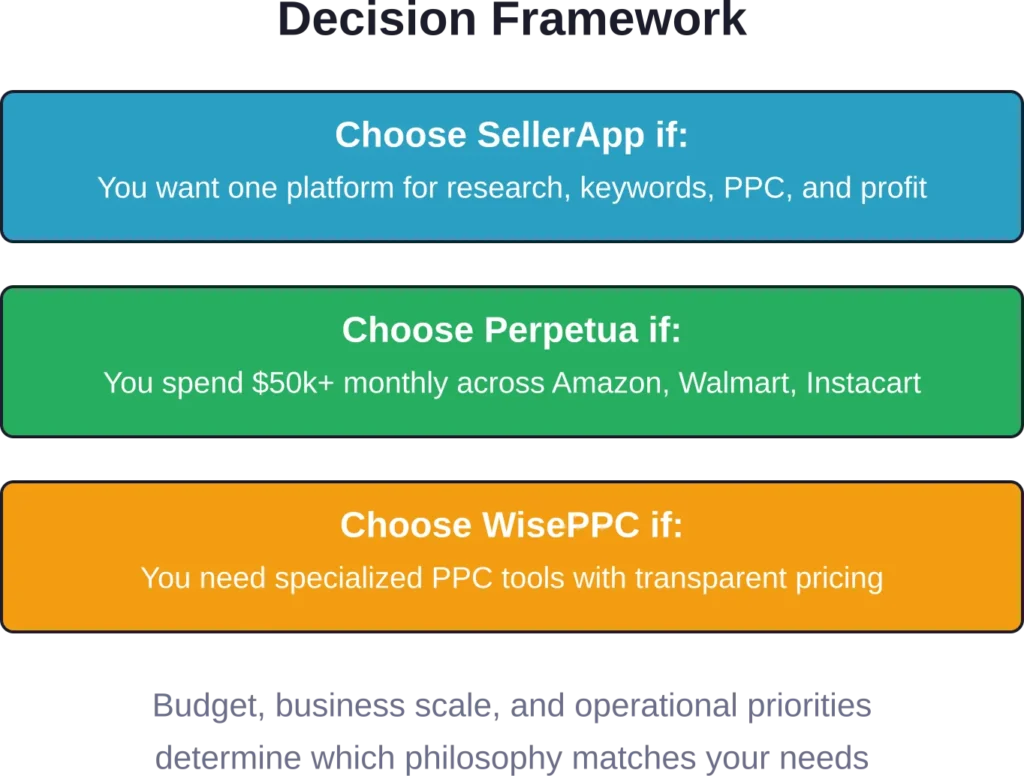
SellerApp fits sellers who value consolidation and want to minimize tool subscriptions. If managing product research in one platform, keywords in another, PPC in a third, and profit analytics in a fourth creates workflow friction, the all-in-one approach solves real problems.
The pricing makes sense for sellers with diversified needs. Plans range from $24.99/month (STARTER) to $66.99/month (PRO), with 50% annual savings available, providing access to 10+ features at a cost that often undercuts subscribing to specialized tools individually.
New sellers benefit from the comprehensive education resources and managed service options. Learning to sell on Amazon while simultaneously learning multiple disconnected tools compounds complexity. A unified platform with support reduces the learning burden.
Established sellers managing large catalogs appreciate the workflow integration. Research keywords, optimize listings, launch PPC campaigns, and track profitability without exporting data between systems.
When Perpetua (Former Sellics) Fits
Brands spending $50,000+ monthly on advertising across Amazon, Walmart, Instacart, and other retail media channels find value in Perpetua’s multi-platform capabilities and machine learning optimization.
The enterprise pricing becomes proportionally reasonable when managing seven-figure annual ad budgets. A 1-2% efficiency gain from better bid optimization returns more profit than the platform costs.
Companies with dedicated e-commerce teams who can invest in mastering sophisticated tools extract maximum value. The advanced features require analytical skill to leverage fully.
Sellers wanting basic keyword research without paid subscriptions can still use the free Sonar tool effectively. But accessing the full platform requires enterprise-scale budgets.
When WisePPC Delivers Value
Sellers laser-focused on advertising efficiency without needing product research, listing optimization, or comprehensive profit tracking find WisePPC’s specialized approach refreshing.
The transparent 1% ad spend pricing scales proportionally. Small sellers testing products with $2,000 monthly ad budgets pay $20. Growing brands spending $50,000 pay $500. The cost tracks directly to business scale.
Experienced PPC managers who understand campaign structure, keyword targeting, and bid strategy appreciate the tools that accelerate execution without black-box automation making decisions they can’t audit.
Sellers using other tools for non-PPC functions avoid paying for duplicate features. Combine WisePPC for advertising with Helium 10 for product research, Listing Dojo for SEO, and InventoryLab for accounting. Each tool does one job exceptionally well.
Common Pitfalls and Misconceptions
Choosing tools based on incomplete information creates expensive mistakes.
The All-in-One Assumption
Just because a platform bundles multiple features doesn’t mean each feature matches specialized alternatives. SellerApp’s product research won’t necessarily outperform dedicated tools like Jungle Scout. The keyword data might not match Helium 10’s depth.
The value lies in integration and convenience, not necessarily best-in-class performance across every function. Sellers expecting every bundled feature to compete with category leaders often feel disappointed.
The Free Tool Trap
Free tiers and freemium plans provide genuine value for specific tasks. Sonar’s keyword research helps thousands of sellers optimize listings without cost.
But building an entire business on free tools creates operational friction. Limited features, restricted data access, and missing automation mean manual workarounds consume time that could drive revenue.
Free tools work for validation and testing. Scaling profitable operations typically requires investing in paid platforms that remove bottlenecks.
Automation Overreliance
Aggressive bid automation promises hands-off campaign management. Reality proves messier.
Algorithms optimize based on historical data. When market conditions shift—new competitors launch, seasonal demand changes, Amazon adjusts algorithm weighting—automation can lag behind or overcorrect inappropriately.
Successful sellers combine automation for efficiency with regular manual audits to catch edge cases algorithms miss. Full black-box automation works until it doesn’t, often burning significant budget before problems surface.
Alternative Considerations
SellerApp, Sellics/Perpetua, and WisePPC represent three distinct philosophies. But the Amazon tool ecosystem includes other strong options worth evaluating.
Helium 10 and the Feature Kitchen Sink
Helium 10 competes directly with SellerApp in the all-in-one category. According to authoritative industry sources, Helium 10 (Adtomic) plans start around $229 per month plus ad spend percentages.
The platform includes extensive product research, keyword tools, listing optimization, PPC automation (Adtomic), inventory management, and refund recovery. The feature breadth exceeds even SellerApp in some areas.
The complexity matches the scope. New users face a significant learning curve navigating 20+ tools within the suite. Power users who invest time mastering the platform extract substantial value.
Specialized PPC Tools: BidX, Scale Insights, AdLabs
Several platforms compete with WisePPC in the PPC-specialist category, each with nuanced differences.
BidX offers algorithmic bid optimization starting around $199 per month plus ad spend percentages according to industry data. The automation runs more aggressively than WisePPC’s recommendation model.
Scale Insights charges 1% of ad spend similar to WisePPC but emphasizes machine learning bid adjustments across multiple marketplaces including Amazon and Walmart.
AdLabs positions as the tool for advertisers wanting surgical control, offering ultra-fast interfaces, bulk bid editing, and custom dashboards with hybrid automation features. The platform charges 1% of ad spend with a 30-day free trial.
Each specializes in advertising but implements automation and control differently. Testing trial periods reveals which philosophy matches specific workflow preferences.
Enterprise Platforms: Teikametrics, Pacvue, Quartile
Beyond Perpetua, several enterprise-grade platforms serve large brands and agencies managing substantial ad budgets.
Teikametrics applies algorithmic bidding with retail media optimization across Amazon, Walmart, and Target. Pricing operates on custom enterprise quotes.
Pacvue provides commerce acceleration and advertising automation for brands spending six figures monthly. The platform integrates deeply with retail media networks beyond just Amazon.
Quartile uses machine learning for bid optimization and campaign management, with pricing starting around $500-$1,000+ monthly plus ad spend percentages according to authoritative sources.
These platforms target the same enterprise segment as Perpetua, competing on algorithmic sophistication and multi-channel integration rather than affordability for small sellers.
Making the Final Decision
Tool selection ultimately hinges on matching platform strengths to business priorities.
Sellers operating on tight budgets who need multiple functions without subscribing to five tools should evaluate SellerApp seriously. The consolidated approach reduces subscription sprawl and simplifies workflows, though individual features might not match specialized alternatives.
Large brands spending aggressively across multiple retail channels require enterprise sophistication. Perpetua, Teikametrics, or Pacvue provide the machine learning optimization and multi-platform coordination that justifies premium pricing at scale.
PPC specialists who already use dedicated tools for product research and profit tracking benefit from WisePPC’s focused approach. The transparent pricing, granular controls, and lean interface eliminate bloat while delivering advertising intelligence that drives performance.
The wrong choice costs money and time. The right choice amplifies productivity and profitability.
Test trial periods when available. SellerApp offers limited freemium access. WisePPC and several competitors provide trial windows. Hands-on experience reveals whether interface design, feature depth, and workflow integration match expectations.
Monitor performance metrics after implementation. Track whether the platform actually improves ACoS, increases profitable sales, and saves operational time. Marketing promises matter less than measurable results.
And remember—no tool fixes fundamental business problems. Weak products, poor pricing strategy, or ineffective listings won’t succeed regardless of which software manages campaigns. Tools amplify good strategies; they don’t create them.
Frequently Asked Questions
New sellers typically benefit most from platforms offering comprehensive features at moderate price points. SellerApp’s all-in-one approach at $24.99/month (STARTER plan) with core features provides product research, keyword tools, PPC automation, and profit tracking in one subscription. This consolidation simplifies the learning process versus juggling multiple specialized tools. The free 7-day trial allows testing core functionality before committing to paid plans. However, sellers focusing exclusively on advertising might find WisePPC’s 1% ad spend model more economical during early stages with smaller budgets.
No. WisePPC specializes exclusively in PPC campaign optimization and provides no product research, keyword discovery beyond campaign analysis, listing optimization, or comprehensive profit tracking. Sellers using WisePPC typically pair it with complementary tools: Helium 10 or Jungle Scout for product research, dedicated listing optimization services, and profit analytics platforms. WisePPC excels at its narrow focus but requires a multi-tool stack for full business operations. SellerApp offers broader functionality in one platform but with less specialized depth in individual categories.
Sellics merged with Perpetua, transitioning from seller-focused affordable subscriptions to enterprise pricing targeting large brands and agencies. The free Sonar keyword research tool remains available without subscription requirements, but accessing the full advertising automation, analytics, and optimization suite now requires Perpetua’s custom enterprise contracts. Many small-to-medium sellers who relied on affordable Sellics plans migrated to alternative platforms when pricing shifted beyond their budgets. The enterprise Perpetua product serves brands spending $50,000+ monthly across multiple retail channels rather than individual sellers.
Percentage-based models like WisePPC’s 1% ad spend fee scale directly with business size, making them economical for small sellers testing products with modest ad budgets. A seller spending $5,000 monthly on ads pays $50 to WisePPC. However, costs increase proportionally—spending $100,000 means $1,000 in platform fees. Flat subscriptions like SellerApp’s base pricing remain constant regardless of ad spend, becoming more economical at higher budget levels. The crossover point where percentage fees exceed flat rates typically occurs around $20,000 in monthly ad spend, though this varies by specific pricing structures.
SellerApp supports multiple Amazon marketplaces globally including North America (US, Canada, Mexico), Europe (UK, Germany, France, Italy, Spain), and other regions. WisePPC focuses exclusively on Amazon marketplaces without extending to Walmart, Instacart, or other retail channels. Perpetua provides the broadest multi-platform coverage, managing campaigns across Amazon, Walmart, Instacart, Target, and other retail media networks—valuable for brands selling across multiple channels but unnecessary for Amazon-only sellers. Platform marketplace support should align with where products actually sell to avoid paying for unused capabilities.
Yes, and many sellers do. Common combinations include using SellerApp or Helium 10 for product research and listing optimization while running WisePPC exclusively for PPC management. This best-of-breed approach selects specialized tools for specific functions rather than relying on one platform’s implementation across all categories. The tradeoff involves managing multiple subscriptions and potentially transferring data between systems versus the convenience of a single integrated platform. Sellers should evaluate whether specialized performance gains justify additional complexity and subscription costs versus all-in-one consolidation benefits.
Realistic timelines depend on implementation quality and business fundamentals. PPC optimization through any platform typically shows initial performance changes within 2-4 weeks as bid adjustments and campaign restructuring take effect. Meaningful profitability improvements generally require 60-90 days of consistent optimization to accumulate sufficient data and refine strategies. Product research and keyword optimization impact timelines vary based on listing changes, competitive dynamics, and seasonal factors. Tools accelerate improvement but can’t overcome poor product-market fit, uncompetitive pricing, or weak listings. Expect gradual optimization gains rather than overnight transformations regardless of which platform you choose.
Conclusion
SellerApp, Sellics/Perpetua, and WisePPC represent fundamentally different philosophies in Amazon seller tools.
SellerApp consolidates product research, keyword intelligence, PPC automation, and profit analytics into one subscription starting at $24.99/month (STARTER plan). The all-in-one approach reduces tool sprawl for sellers wanting integrated workflows, though individual features might not match specialized alternatives depth-for-depth.
Sellics built its reputation on free keyword research through Sonar, which remains available. But the full platform transitioned to Perpetua’s enterprise ecosystem targeting large brands spending $50,000+ monthly across multiple retail channels with machine learning optimization and premium pricing.
WisePPC specializes exclusively in PPC campaign management with transparent 1% ad spend pricing and manual-hybrid automation. The focused approach delivers granular advertising controls without bloat but requires complementary tools for non-PPC functions.
The right choice depends on business model, budget, and operational priorities. Test available trials, monitor actual performance improvements, and select based on measurable results rather than marketing promises.
And remember—tools amplify strategy, they don’t create it. Strong products, competitive pricing, and effective listings remain foundational regardless of which software manages campaigns.
Ready to optimize your Amazon advertising? Evaluate which platform philosophy matches your business priorities and test trial periods to validate real-world fit before committing to annual subscriptions.