

Quick Summary: WisePPC, Helium 10, and Inventory Lab serve different core functions for Amazon sellers. Helium 10 ($99–$279/month) excels at product and keyword research with numerous tools. Inventory Lab (now Seller 365 at $69/month) focuses on FBA prep, shipment workflows, and profit tracking. WisePPC specializes in Amazon PPC automation and analytics. Most serious sellers need at least two of these platforms to cover research, operations, and advertising.
Choosing the right Amazon seller tools can feel overwhelming when every platform claims to be “essential.” The reality is simpler: WisePPC, Helium 10, and Inventory Lab aren’t really competitors. They solve fundamentally different problems.
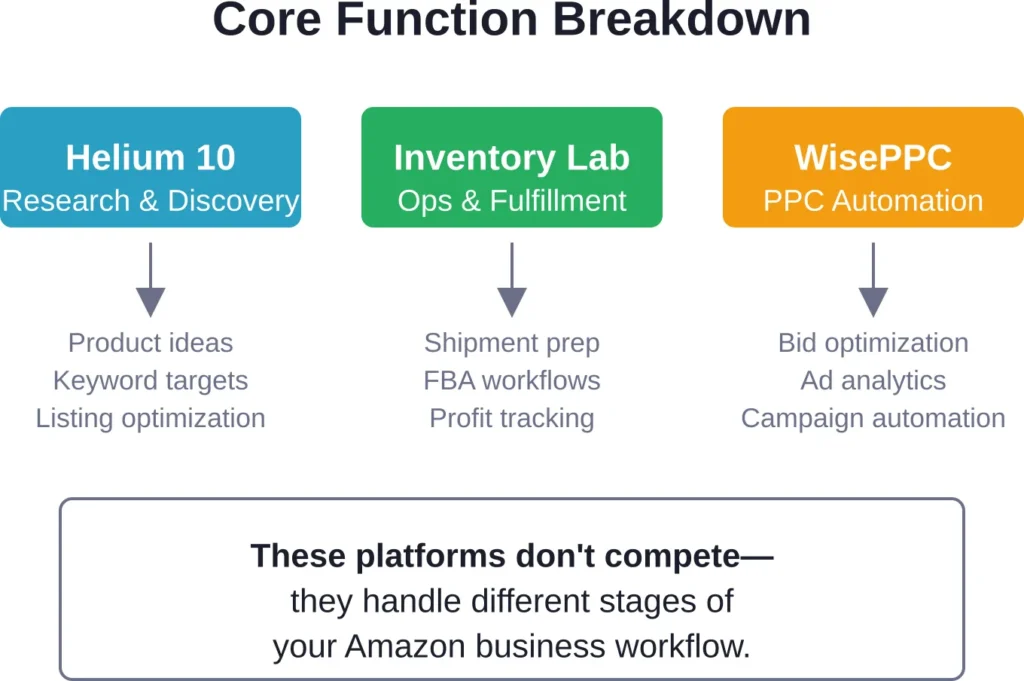
Helium 10 helps find products and keywords. Inventory Lab handles the physical work of prepping and shipping inventory. WisePPC automates your advertising so campaigns don’t bleed money overnight.
So the question isn’t which one is “better.” It’s which combination makes sense for your business model, stage, and budget. This guide breaks down what each platform actually does, what it costs, and when it pays for itself.
What Each Platform Actually Does (and Doesn’t Do)
Before comparing pricing or features, it’s worth understanding what problem each tool was built to solve. Mixing them up is one of the fastest ways to waste money on the wrong stack.
Helium 10: Research and Discovery Engine

Helium 10 is a research platform. It helps sellers identify profitable products, discover high-converting keywords, and optimize listings for search visibility. The platform bundles numerous tools into tiered plans ranging from free to enterprise-level.
Helium 10 currently offers three main paid tiers. The Platinum Plan is priced at $99 per month, or $79 per month if billed annually, which unlocks core product research tools like Black Box, keyword research via Cerebro and Magnet, and listing optimization with tools like Scribbles and Listing Builder.
The Diamond Plan is priced at $279 per month, or $229 monthly on the annual plan, and adds advanced features including Market Tracker 360 for competitive intelligence, higher usage limits across all tools, and the Adtomic PPC suite with the first $5K in ad spend per month managed free (then a 2% fee applies).
Key capabilities include:
- Product database filtering by revenue, competition, and seasonality
- Reverse ASIN lookup to uncover competitor keywords
- Listing quality scoring and optimization suggestions
- Inventory management and alerts for up to 200 ASINs
- Profitability calculator with fee breakdowns
What Helium 10 doesn’t do: it won’t prep your shipments, print labels, or manage your FBA workflow. And while it includes Adtomic for PPC, the advertising features are add-ons that come with usage fees beyond the base subscription.
Inventory Lab: Operations and Fulfillment Workflow

Inventory Lab is now part of Seller 365, a broader suite of 10 Amazon seller tools under one subscription that handles the physical side of Amazon FBA including receiving inventory, prepping items, creating shipments, and printing labels.
According to the official Inventory Lab website, Seller 365 costs $69 per month or $828 yearly / billed once for the standard plan (1 user). The Teams plan runs $75/month or $948/year and supports multiple users, allowing prep teams, VAs, and bookkeepers to access the platform.
Core Inventory Lab features inside Seller 365 include:
- Bulk product listing with automated price suggestions
- Smart boxing tools that auto-assign items to FBA shipment boxes
- 10-second product setup with barcode scanning
- Real-time cost and fee tracking at every stage
- Profit analytics broken down by SKU, shipment, and date range
What Inventory Lab doesn’t do: it won’t help with product research or keyword discovery. And while it tracks profit after the fact, it doesn’t automate or optimize your advertising campaigns.
WisePPC: Amazon Advertising Automation and Analytics

WisePPC is an Amazon PPC management platform designed to automate campaign optimization and surface actionable advertising insights that Amazon’s native interface buries or doesn’t provide at all.
Based on the available data, WisePPC focuses on solving Amazon Ads’ biggest pain points: slow manual bid adjustments, poor reporting granularity, and the inability to track product-level ad performance effectively. The platform includes rule-based automation, dayparting (time-of-day bid adjustments), AI keyword suggestions, and advanced analytics dashboards.
Based on WisePPC’s official documentation, the platform provides real-time analytics that combine advertising spend with sales data, helping sellers calculate true ACoS (Advertising Cost of Sale) and TACoS (Total Advertising Cost of Sale) across campaigns, ad groups, and individual ASINs.
Key capabilities include:
- Automated bid rules triggered by ACoS, conversion rate, or impression share
- Dayparting to increase bids during high-conversion hours
- Product-level ad attribution (which products are actually driving ad revenue)
- Negative keyword mining and bulk application
- Cross-campaign duplicate keyword detection
What WisePPC doesn’t do: it’s not a product research tool, and it won’t handle your inventory prep or shipment creation. It’s laser-focused on making your ad spend more efficient.
Integrate Financial Clarity and Strategic Advertising
In 2026, the combination of Helium 10, Inventory Lab, and WisePPC represents a complete operational stack for the professional seller. While Helium 10 dominates market research and Inventory Lab focuses on accounting and shipment processing, WisePPC acts as the high-performance advertising engine. It provides the technical depth needed to turn inventory and research data into scalable, profit-driven advertising campaigns.
- Multi-Year Data Sovereignty: WisePPC stores historical advertising and sales data for years, far exceeding the standard 60–90 day limits found in most research or accounting tools.
- Granular Placement Control: Sellers can analyze performance at the keyword and placement levels to ensure ad spend is focused on the most profitable areas of the Amazon marketplace.
- Unified Profit Dashboards: By syncing with advertising and organic sales data, the platform provides a clear view of total net profit and TACOS in a single interface.
- High-Speed Bulk Optimizations: The system allows for thousands of simultaneous updates across campaigns and targets, removing the manual friction often found in inventory-focused software.
- Verified Ads Partnership: As an Amazon Ads Verified Partner, the solution bridges technical skill gaps with tools built for professional-grade optimization and long-term business scalability.
To gain full visibility into your advertising metrics and access exclusive beta features, register at WisePPC.
Pricing Breakdown: What You Actually Pay
Tool costs add up fast. Here’s the real pricing for each platform as of 2026, pulled directly from official sources.
Helium 10 Pricing (May 2026)
Helium 10 operates on a tiered subscription model with the following plans:
| Plan | Monthly Price | Annual Price | Best For |
|---|---|---|---|
| Free | $0 | $0 | Testing tools, very light usage |
| Platinum | $99 | $79/month ($948/year) | Solo sellers, 1-10 products |
| Diamond | $279 | $229/month ($2,748/year) | Scaling brands, teams, agencies |
The Platinum Plan includes 5,000 Xray requests (the Chrome extension for product research). According to official sources, Cerebro and Magnet usage is included but daily limits vary by plan. Listing Builder integrates keyword research directly into the listing creation workflow.
Diamond adds higher limits across the board, including Black Box uses for product discovery and Advanced Brand Analytics searches, and Market Tracker 360 for monitoring competitor performance. The Adtomic PPC suite is included, with the first $5K in ad spend per month managed free and a 2% fee on spend above that threshold.
Add-ons available separately include Elite: The Inner Circle (coaching and training community at $99/month), Market Tracker 360: The Intelligence Nexus (typically priced around $500/month), and Adtomic standalone (typically priced around $199/month if available standalone).
Inventory Lab (Seller 365) Pricing
As listed on the official Inventory Lab website, the tool is now bundled into Seller 365, which includes 10 Amazon seller apps under one subscription.
| Plan | Monthly Price | Annual Price | User Limit |
|---|---|---|---|
| Seller 365 | $69 | $828 ($69/month) | 1 user |
| Seller 365 Teams | $75 | $948 ($79/month) | 10 users |
Both plans include the full Inventory Lab feature set plus nine additional tools. Standard support response times vary by plan level.
There’s a 14-day free trial: 7 days instantly plus 7 more when an Amazon Seller Pro or Walmart Seller account is connected.
WisePPC Pricing
WisePPC pricing details are not prominently displayed on the official website. The platform appears to specialize in PPC automation rather than offering tiered research tool bundles like Helium 10. For WisePPC pricing details, contact the platform directly or check their official website.
Feature Comparison: Tool by Tool
Breaking down features by category makes it easier to see where these platforms overlap (rarely) and where they’re complementary (often).
Product Research
Helium 10 dominates here. Black Box filters the entire Amazon catalog by criteria like revenue, review count, price range, and competition level. The Chrome extension Xray analyzes any search results page or product listing to show estimated sales, revenue, review velocity, and seasonality trends.
According to the official Helium 10 pricing documentation, Platinum users get 5,000 Xray requests, which enables evaluation of multiple products. Diamond users add higher limits on Black Box database searches and other tools.
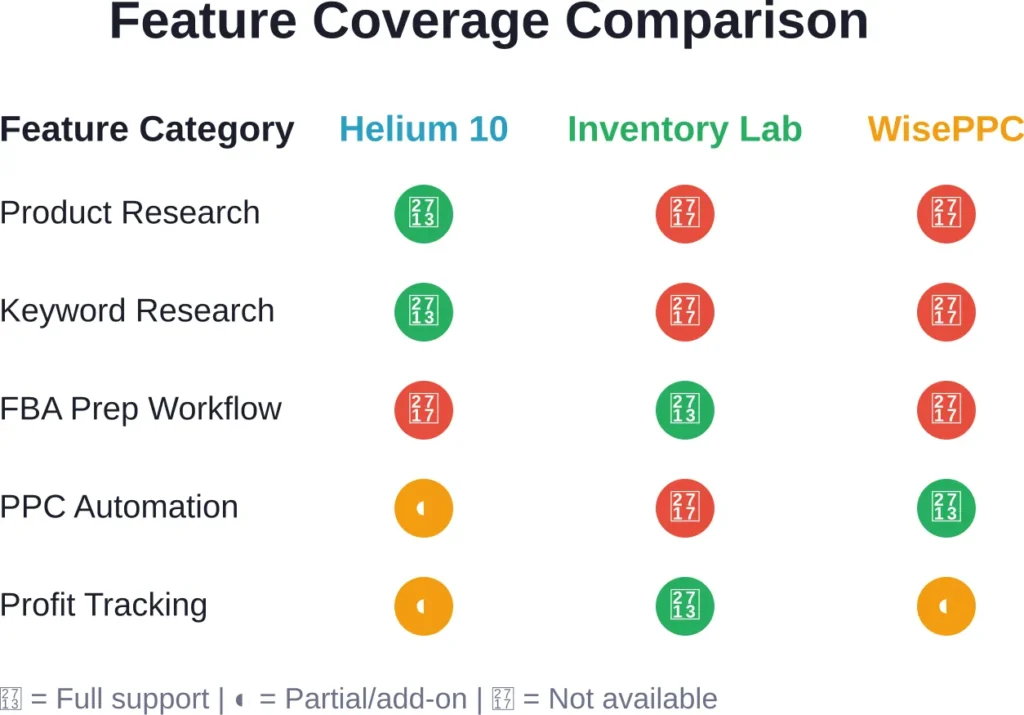
Inventory Lab and WisePPC don’t offer product research tools. If finding new products to sell is part of the workflow, Helium 10 (or a competitor like Jungle Scout) becomes necessary.
Keyword Research and Listing Optimization
Again, Helium 10 is the core tool here. Cerebro reverse-engineers competitor listings to uncover which keywords they rank for, while Magnet generates keyword ideas based on seed terms. Frankenstein processes keyword lists to remove duplicates and organize terms by search volume.
Listing Builder integrates keyword research directly into the listing creation workflow, tracking which keywords have been used in titles, bullets, and descriptions to maximize indexing without keyword stuffing.
Neither Inventory Lab nor WisePPC provide keyword research. However, WisePPC does offer keyword-level PPC analytics, which can inform which search terms are converting well in ads (and therefore might be worth adding to organic listings).
Inventory Management and FBA Prep
Inventory Lab is the only platform of the three built for this. The tool streamlines receiving inventory, assigning barcodes, building FBA shipments, and printing box labels. Smart boxing auto-assigns SKUs to shipment boxes based on size, weight, and destination fulfillment center.
The 10-second product setup feature uses barcode scanning to pull product data automatically, reducing manual entry. Real-time cost tracking shows landed costs, FBA fees, and estimated profit margins before items even ship.
Helium 10 includes basic inventory tracking (up to 200 ASINs with alerts for hijackers or listing changes), but it’s not designed for shipment creation or workflow automation. WisePPC has no inventory features at all.
PPC and Advertising Optimization
This is where WisePPC and Helium 10’s Adtomic suite compete directly, though they approach the problem differently.
WisePPC focuses on rule-based automation and advanced analytics. Sellers can set bid rules triggered by performance thresholds (e.g., increase bids by 15% when ACoS drops below 20%, pause keywords with zero sales after 50 clicks). Dayparting adjusts bids by hour of day or day of week based on conversion data.
The platform’s analytics separate organic sales from ad-attributed sales at the product level, solving a major Amazon Ads reporting gap. Sellers can see which ASINs are profitable from ads versus which are cannibalizing organic rank.
Helium 10’s Adtomic offers similar automation but is bundled into the Diamond Plan rather than sold standalone (though a standalone option exists at roughly $199/month). According to the official feature list, Adtomic includes the first $5K in ad spend per month managed free, with a 2% fee on spend above that threshold.
Adtomic provides AI-driven keyword suggestions, automated bid adjustments, and campaign performance dashboards. The integration with Helium 10’s other tools means keyword research from Cerebro can flow directly into campaign creation.
Inventory Lab doesn’t handle PPC at all. Sellers running ads need either WisePPC, Helium 10 Adtomic, or another dedicated PPC platform alongside Inventory Lab.
Profit Analytics and Reporting
All three platforms offer some form of profit tracking, but the depth varies.
Inventory Lab (via Seller 365) tracks profit at the SKU, shipment, and date-range level. The system accounts for product costs, FBA fees, shipping to Amazon, and Amazon referral fees. Sellers can see which shipments or product batches were profitable and which lost money.
Helium 10’s Profits tool pulls data from Seller Central to calculate net profit after fees, refunds, and PPC costs. It’s decent for high-level overview but lacks the shipment-by-shipment granularity Inventory Lab provides.
WisePPC reports advertising profitability (ACoS, TACoS, ROAS) but doesn’t calculate overall business profit. It’s laser-focused on making ad spend efficient rather than tracking all costs.
Which Tool Stack Makes Sense for Different Seller Types
The “right” combination depends on business model, stage, and where time gets wasted.
New Sellers (First 6 Months)
For sellers still validating their first few products, keeping costs low matters more than automation.
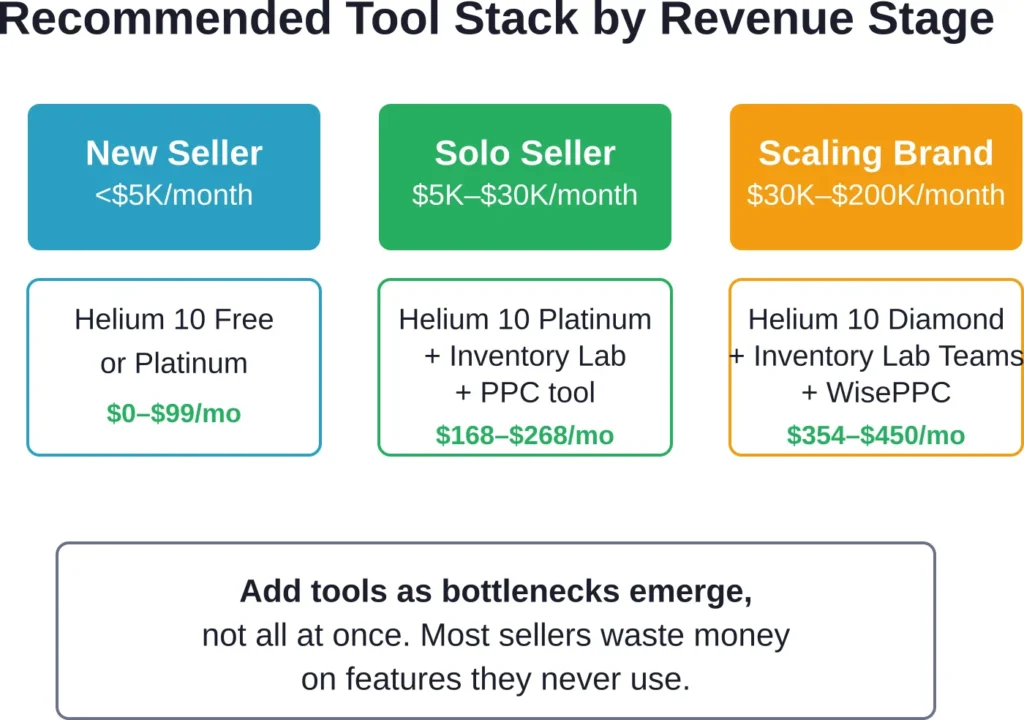
Start with Helium 10’s free plan to test product ideas and keyword research. Once a product is selected, upgrade to Platinum ($79 per month if billed annually) for full access to research and listing optimization tools.
Add Inventory Lab (Seller 365 at $69/month) once inventory volume makes manual shipment creation painful. If prepping fewer than 20 units per week, the native Seller Central workflow might be tolerable a bit longer.
Skip dedicated PPC tools initially. Helium 10 Platinum doesn’t include Adtomic, but new sellers can manage basic campaigns manually or use Amazon’s native interface until ad spend exceeds $2,000–$3,000/month.
Estimated cost: $99–$168/month (Helium 10 Platinum $79-99/month + optional Inventory Lab $69/month)
Solo Sellers (10–50 SKUs, $5K–$30K/Month Revenue)
At this stage, time becomes the constraint. Manual tasks that took 30 minutes now take three hours.
Helium 10 Platinum remains sufficient for research and listing work unless launching multiple products per month (in which case Diamond’s higher limits justify the upgrade).
Inventory Lab is nearly essential here. Prepping 50+ units weekly without workflow automation burns hours that could go toward sourcing or marketing.
PPC automation starts paying for itself once monthly ad spend crosses $3,000. At that threshold, even a 5% reduction in wasted spend ($150/month saved) offsets part of a tool’s cost. WisePPC or Helium 10 Adtomic (available standalone or as part of Diamond) both make sense.
Estimated cost: $168–$268/month (Helium 10 Platinum $99 + Inventory Lab $69 + PPC tool $100–$200)
Scaling Brands (50+ SKUs, $30K–$200K/Month Revenue)
Brands at this level typically run all three platforms or their equivalents.
Helium 10 Diamond ($229/month when billed annually) makes sense for higher usage limits and Market Tracker 360’s competitive intelligence. The included Adtomic suite handles PPC, though some sellers prefer WisePPC’s interface and rule customization.
Inventory Lab (Seller 365 Teams) supports multiple users, allowing prep teams, VAs, and bookkeepers to access the platform.
At this revenue level, the combined cost represents a small percentage of monthly revenue, making ROI straightforward to justify.
Estimated cost: Helium 10 Diamond (starting $229/month annual) + Inventory Lab (starting $69/month)
Agencies and Multi-Account Operators
Agencies managing multiple client accounts need enterprise-level access and white-label capabilities.
Helium 10 offers custom enterprise pricing for agencies. The platform supports multiple connected accounts and provides agency-specific features like client reporting dashboards.
Inventory Lab works per account, so agencies either subscribe to multiple instances or guide clients to maintain their own subscriptions.
WisePPC’s rule-based automation becomes especially valuable when managing dozens of campaigns across clients. Templates can be cloned and customized per account, reducing setup time.
Estimated cost: Custom/negotiated (enterprise plans typically start around $500–$1,000/month depending on account volume)
Common Mistakes When Choosing Tools
Seeing the same missteps repeated across seller communities highlights a few patterns worth avoiding.
Paying for Overlapping Features
It’s easy to subscribe to three tools that all claim to “track profit” without realizing they calculate it differently and none replace actual bookkeeping.
Before adding a new tool, map out which specific workflow pain point it solves. If the answer is vague (“better data”), that’s usually a sign of overlap with existing subscriptions.
Choosing Based on Free Trials Alone
A tool that feels intuitive during a 7-day trial might lack required features as the business scales. Conversely, a complex platform that feels overwhelming initially might be exactly what’s needed once workflows mature.
Check usage limits carefully. The free plan includes limited Xray requests, which may constrain research volume for sellers evaluating many products. Trials showcase interface and basic functionality but rarely stress-test limits.
Ignoring Integration Quality
Tools that don’t sync properly with Seller Central create more work than they save. Data discrepancies between Amazon’s reports and third-party dashboards force manual reconciliation, which defeats the purpose of automation.
Look for tools that integrate with Amazon’s official data sources, update frequently, and handle accounting edge cases accurately.
Underestimating Learning Curve Costs
Helium 10 bundles numerous features across research, optimization, and operations. Learning them all takes weeks, and most sellers use a subset of available features regularly.
The “time to value” matters more than feature count. A simpler tool that solves one problem well often delivers ROI faster than a Swiss Army knife that requires a training course.
When Tools Actually Pay for Themselves
ROI calculation for software is straightforward in theory: if the tool saves more money (or generates more profit) than it costs, it’s worth keeping.
In practice, measuring that is harder than it sounds.
Research Tools (Helium 10)
A product research tool can pay for itself if it helps identify high-potential products or avoid poor selection decisions.
If Helium 10’s data prevents one failed launch (or identifies one winner that wouldn’t have been found otherwise), the $948 annual Platinum cost is recovered.
Operations Tools (Inventory Lab)
Time savings are the primary ROI metric here. Time savings vary based on shipment volume and existing workflow efficiency.
PPC Tools (WisePPC, Helium 10 Adtomic)
Ad optimization tools typically pay for themselves when they reduce wasted spend by more than their subscription cost.
PPC optimization tools can reduce wasted advertising spend when they improve campaign efficiency.
PPC automation tools become cost-effective at moderate to higher monthly ad spend levels. Below that threshold, manual campaign management is feasible. Above it, the opportunity cost of manual work exceeds the tool cost.
Data Accuracy and Reporting Differences
One frustration sellers encounter is data discrepancies between Amazon Seller Central, Helium 10, Inventory Lab, and WisePPC.
These differences aren’t usually bugs—they reflect different calculation methodologies and data update frequencies.
Amazon API Sync Delays
Third-party tools pull data from Amazon’s Seller Partner API, which updates on various schedules depending on the data type. Order data refreshes quickly (often within minutes), while financial reports and advertising data can lag 24–48 hours.
Data from Amazon’s API updates on various schedules depending on the data type, which can create timing differences between Seller Central and third-party dashboards.
Profit Calculation Methods
Inventory Lab tracks profit at the shipment level while other tools may use different cost calculation methodologies. Different cost calculation methods can produce different profit figures for the same SKU.
Neither is “wrong”—they’re answering slightly different questions. Inventory Lab shows profitability of specific inventory batches; Helium 10 shows average profitability of a SKU over time.
PPC Attribution Windows
Amazon Ads uses a standard attribution window for ad-driven sales; purchases outside this window are not attributed to the ad.
WisePPC and Helium 10 Adtomic use the same attribution window Amazon provides via the API, but organic sales vs. ad-driven sales can blur when customers click ads, don’t buy immediately, then search organically and purchase later.
Product-level ad attribution helps distinguish ad-driven sales from organic sales.
Integration Ecosystem: What Works Together
Tools that integrate with each other reduce manual data entry and keep information synchronized.
Helium 10 Integrations
Helium 10 integrates with accounting and e-commerce platforms to support multi-channel operations. Adtomic (Helium 10’s PPC tool) pulls keyword research directly from Cerebro and Magnet, creating a closed-loop workflow from keyword discovery to campaign creation to performance tracking.
Inventory Lab Integrations
Inventory Lab integrates with Amazon Seller Central and accounting platforms. The platform exports financial data in formats compatible with most accounting software.
Inventory Lab is part of the Seller 365 bundle that includes tools for feedback management and profit analytics.
WisePPC Integrations
WisePPC connects with Amazon Advertising API and Amazon Seller Central to pull both ad performance and sales data. This dual connection enables the product-level attribution and TACoS (Total Advertising Cost of Sale) calculations that single-source tools can’t provide.
Future-Proofing: AI and Automation Trends in 2026
Amazon seller tools are rapidly adopting AI-driven features beyond basic automation.
AI Keyword Suggestions
Modern PPC tools including those with Helium 10 integration and WisePPC include AI-assisted keyword suggestions. This shift from “here’s what people searched last month” to “here’s what’s gaining momentum this week” gives early movers an edge in competitive niches.
Predictive Inventory Recommendations
Seller 365 is developing predictive features for inventory management. Advanced inventory systems aim to optimize reorder timing based on multiple factors.
Dynamic Bid Optimization
Modern PPC tools are evolving from simple rule-based automation to machine learning-driven optimization. WisePPC and Helium 10 Adtomic both offer versions of this, though these tools improve with access to historical campaign data.
| AI Feature | Helium 10 | Inventory Lab | WisePPC |
|---|---|---|---|
| Keyword Suggestions | Yes (Adtomic) | No | Yes |
| Predictive Inventory | No | Roadmap (2026) | No |
| Dynamic Bid Optimization | Yes (Adtomic) | No | Yes |
| Listing Quality Scoring | Yes | No | No |
Support Quality and Learning Resources
Tools are only as good as the support available when something breaks or a workflow doesn’t make sense.
Helium 10 Support
Helium 10 provides support based on plan level, with varying response times for different tiers. Higher-tier plans include priority support.
The Elite add-on ($99/month) includes community access, training webinars, and workshops. For sellers who learn better from cohort-based education than documentation, Elite can accelerate onboarding significantly.
Helium 10 provides educational resources including training materials for new sellers.
Inventory Lab Support
Seller 365 provides standard support. The platform includes educational resources covering common workflows.
Because Inventory Lab is now part of the Seller 365 bundle, support covers all 10 apps in the suite, which can occasionally create confusion if the support team needs to route questions to different product specialists.
WisePPC Support
WisePPC provides customer support. WisePPC provides setup assistance for new users.
Setup and configuration are important for PPC automation tools to function effectively.
Switching Costs: What Happens If You Change Tools
Migrating from one platform to another isn’t as simple as canceling one subscription and starting another.
Historical Data
Data portability varies between platforms when switching tools. When switching from Helium 10, historical research data may not be easily portable to other platforms.
For profit tracking tools like Inventory Lab, historical shipment records and cost basis data are critical for taxes and accounting. Make sure to export all reports and financial data before canceling.
Workflow Retraining
Every tool has a unique interface and workflow logic. Switching from Inventory Lab to a different inventory management system means retraining the team on a new shipment creation process, label printing workflow, and reporting dashboard.
Switching tools requires time investment for team retraining.
Integration Disruption
Changing integrations mid-cycle can create data gaps requiring reconciliation.
Plan tool switches during slower business periods rather than peak seasons.
Final Recommendation: Build Strategically, Not Reactively
Avoid subscribing to multiple tools with overlapping functionality or poor integration.
Start with a clear understanding of the current bottleneck. Is it finding profitable products? Spending hours on FBA prep? Watching PPC campaigns waste money overnight?
Match the tool to the bottleneck:
- Research bottleneck: Helium 10 Platinum or Jungle Scout
- Prep/shipping bottleneck: Inventory Lab (Seller 365)
- PPC efficiency bottleneck: WisePPC or Helium 10 Adtomic
As the business scales, add tools incrementally. Most serious sellers use multiple specialized platforms to cover different business functions.
Tools should integrate well and each address a specific need better than alternatives. Choose tools strategically based on identified needs rather than free trials alone.
Frequently Asked Questions
Absolutely. They serve completely different functions. Helium 10 handles product research, keyword research, and listing optimization. Inventory Lab manages FBA prep workflows, shipment creation, and profit tracking. Most serious sellers use both alongside a dedicated PPC tool like WisePPC.
It depends on the use case. WisePPC is a standalone PPC platform with deep customization for bid rules, dayparting, and product-level attribution. Helium 10’s Adtomic integrates tightly with its keyword research tools and is included in the Diamond Plan. If already paying for Helium 10 Diamond, Adtomic makes sense. If not, WisePPC offers more focused PPC features without bundling research tools into the cost.
Inventory Lab is built specifically for Amazon FBA workflows—shipment creation, box labeling, and tracking inventory sent to fulfillment centers. Sellers using Fulfillment by Merchant (FBM) or Seller Fulfilled Prime won’t benefit from most of Inventory Lab’s core features, though the profit tracking module still works for any fulfillment method.
Generally speaking, PPC tools become cost-effective around $3,000–$5,000 in monthly ad spend. Below that threshold, manual campaign management is tedious but manageable. Above it, the time cost of daily bid adjustments and the opportunity cost of suboptimal campaigns exceed the tool subscription cost. Even a 3–5% efficiency gain at $5,000/month ad spend ($150–$250 saved) offsets a typical PPC tool subscription.
Historical research data (saved product searches, keyword lists, tracking records) typically stays locked in Helium 10’s platform. Before canceling, export any critical data like keyword lists, product tracking reports, and profit summaries. Some data formats are portable (CSV exports), but workflow history and tool-specific features don’t migrate to competitors.
Seller 365 bundles Inventory Lab with nine other Amazon seller apps under one subscription. According to the official website, this includes tools for feedback management, profit analytics, listing optimization, and more. The standard plan runs $69/month for 1 user, and the Teams plan is $75/month for up to 10 users. Both include standard support.
Probably not. Helium 10 Platinum ($99/month) provides enough research capacity for sellers managing 10–20 SKUs. Diamond makes sense when hitting usage limits on Platinum (running out of Cerebro searches, Black Box uses, or Listing Builder slots) or when the included Adtomic PPC suite and Market Tracker 360 justify the higher cost. For most sellers under 50 SKUs, Platinum is sufficient.
Conclusion: Match Tools to Real Bottlenecks
WisePPC, Helium 10, and Inventory Lab aren’t competitors—they’re complementary tools solving different problems. Helium 10 finds products and keywords. Inventory Lab handles the logistics of getting inventory to Amazon. WisePPC optimizes advertising spend.
The best tool stack depends on where time and money are currently being wasted. New sellers typically start with Helium 10 for research, add Inventory Lab once prep becomes painful, and layer in PPC automation when ad spend crosses $3,000–$5,000/month.
Pick one bottleneck, solve it with the best tool available, then move to the next constraint. That approach builds a lean, effective stack instead of a bloated mess of overlapping subscriptions.
Ready to optimize your Amazon tool stack? Start by identifying your biggest current bottleneck—research, operations, or advertising—and choose the single tool that addresses it best. Add others only when the ROI is clear.