

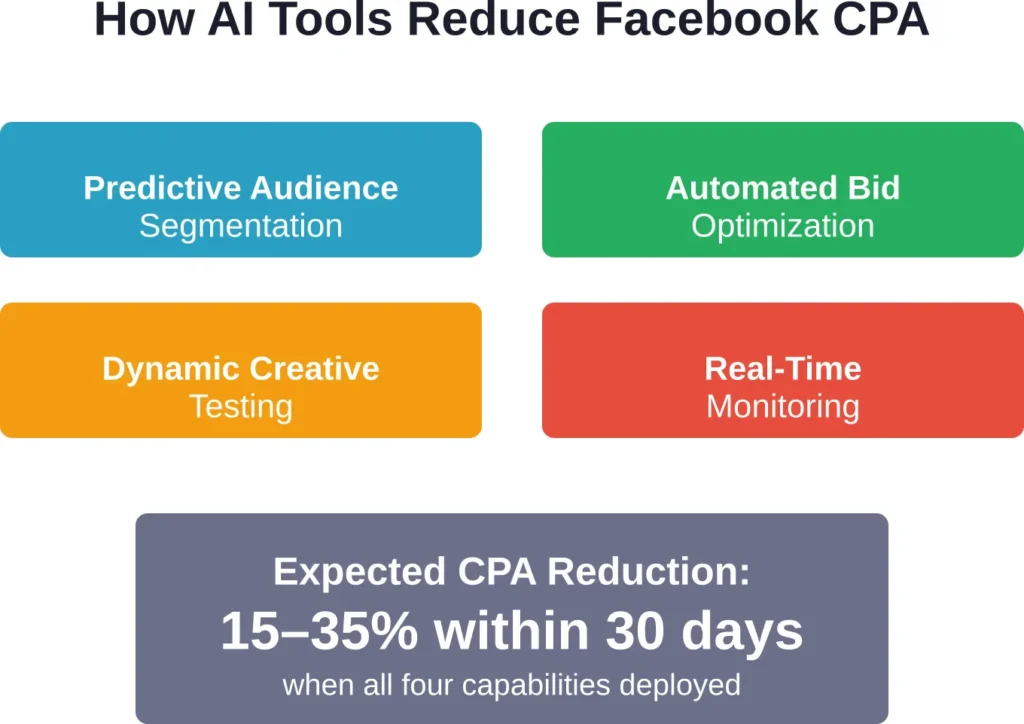
Quick Summary: AI-powered tools for Facebook advertising can reduce cost per acquisition (CPA) by 15–35% through advanced audience segmentation, automated bid optimization, dynamic creative testing, and real-time performance monitoring. The most effective platforms combine predictive analytics with continuous learning algorithms that adjust campaign parameters faster and more accurately than manual management, and according to third-party testing and documented case studies, AI-based campaign management can cut CPA by up to 28%.
Facebook advertising costs climbed steadily through 2025, and manual campaign management can’t keep pace with the auction complexity Meta’s algorithm creates. The platform processes billions of signals per second to determine ad delivery, and human intervention—tweaking bids at 9 AM, pausing ads at lunch, checking dashboards before dinner—introduces lag that costs money.
AI tools eliminate that lag. They monitor performance continuously, adjust bids in milliseconds, and identify audience segments that convert at lower costs. According to third-party testing and documented case studies, AI-based campaign management can reduce cost per action by up to 28%, and third-party tools tested in 2025 show CPA reductions ranging from 15% to 35% within the first month of deployment.
But here’s the thing—not all AI tools deliver the same impact. Some focus narrowly on creative generation, others on audience segmentation, and a few integrate across the entire campaign stack. The tools that produce measurable CPA reductions share four core capabilities: predictive audience modeling, automated bid optimization, dynamic creative testing, and real-time anomaly detection.
This guide examines the AI platforms demonstrating consistent CPA improvements in 2026, the specific mechanisms that drive those reductions, and how to select the right tool based on campaign structure and business model.
Why AI Outperforms Manual Facebook Ad Management
Manual campaign optimization relies on periodic check-ins—reviewing dashboards, interpreting charts, making adjustments. Even experienced advertisers check performance every few hours at best. AI systems monitor campaigns continuously, processing thousands of data points per second and executing optimizations the moment performance deviates from target thresholds.
The speed advantage matters because Facebook’s auction resets constantly. Ad delivery depends on real-time competition, audience behavior, and platform inventory. An ad set that performed well at 10 AM might hit delivery constraints by noon. Manual management catches that shift hours later; AI catches it in seconds.
Where Algorithms Outperform Human Instinct
Humans excel at strategy and creative direction. Algorithms excel at pattern recognition across massive datasets. The most effective Facebook ad accounts in 2026 combine both: human teams set objectives and creative guardrails, AI handles execution and micro-optimization.
According to research from UC Berkeley’s Haas School of Business, generative AI is reshaping marketing infrastructure, with the greatest gains coming from embedding AI into everyday marketing systems rather than one-off campaigns. That productivity gain translates directly into CPA reduction when AI reallocates budget from underperforming segments to high-conversion audiences faster than manual workflows allow.
AI tools parse historical ad performance, segment-level behavior, and market-wide signals to dynamically recalibrate campaign parameters. That’s not theoretical—the data confirms it works.
The Four AI Capabilities That Reduce CPA
Not every AI feature impacts cost per acquisition. Some tools generate headlines or resize images—useful for workflow, but not directly tied to auction efficiency. The AI capabilities that demonstrably reduce CPA fall into four categories.
1. Predictive Audience Segmentation
Standard Lookalike audiences let advertisers select a seed audience (all purchasers, page visitors, etc.) and a percentage range. AI-enhanced audience tools go deeper, analyzing customer lifetime value, purchase frequency, and behavioral signals to identify which subset of purchasers drives the highest return.
Instead of building a Lookalike from all purchasers, advanced AI tools segment the seed audience by LTV, recency, and product affinity, then create layered Lookalikes from the top-performing cohorts. Testing shows AI-optimized Lookalikes deliver 20–35% lower CPA than standard configurations.
Dynamic audience expansion adjusts targeting in real time based on conversion data. If mobile users aged 25–34 in the Northeast convert at twice the rate of the broader audience, AI tools automatically shift budget toward that segment without manual intervention.
2. Automated Bid Optimization
Meta’s native bid strategies (lowest cost, cost cap, bid cap) provide a baseline, but they react slowly to performance shifts. AI bid optimization tools monitor cost-per-result in real time and adjust bids before campaigns exceed target CPA.
When an AI system detects CPM rising or conversion rate declining, it reduces bids preemptively to maintain target efficiency. When it identifies underpriced inventory—high-converting placements with low competition—it increases bids to capture more volume. This continuous calibration keeps campaigns closer to target CPA than periodic manual adjustments.
3. Creative Testing and Rotation
Ad fatigue increases CPA as audiences see the same creative repeatedly. Manual rotation requires creating new ads, launching tests, waiting for statistical significance, then pausing losers. That cycle takes days. AI creative tools compress it into hours.
Generative AI platforms produce dozens of ad variations—headlines, primary text, descriptions—then test them simultaneously. Machine learning algorithms identify winning combinations faster by directing more impressions toward top performers while tests run. Campaigns using AI-driven creative testing typically see 30–50% longer creative lifespan and 20–30% lower cost per creative asset.
The testing volume advantage compounds over time. Manual workflows might test five ad variations per week. AI tools test fifty. That additional testing volume alone improves click-through rate by 10–20% because winning messages surface faster.
4. Real-Time Performance Monitoring and Alerts
CPA creeps upward when campaigns drift off target and no one notices. An audience segment that converted efficiently last week might exhaust its addressable pool this week, driving up costs. A creative that performed well in January might fatigue in February.
AI monitoring tools track performance against baseline metrics and trigger alerts when anomalies occur. For example, research from UC Berkeley illustrates how modern AI analytics deploy multiple specialized agents that collaborate continuously. One agent might monitor campaign metrics and notice performance deviations from baseline. It then autonomously triggers a second agent to analyze traffic sources, discovering a 10% overall conversion rate decline driven by a 15% drop in Europe—specifically a 25% decline in Europe organic search conversions.
That level of diagnostic precision allows teams to respond in hours instead of days. The faster the response, the less money gets wasted on underperforming delivery.
Top AI Tools for Reducing Facebook Ad CPA
The platforms below demonstrate measurable CPA reduction in documented case studies and testing environments. Each tool emphasizes different capabilities, so the best choice depends on account structure, team size, and optimization priorities.
Extuitive
Extuitive is a predictive AI platform that forecasts ad creative performance before you launch on Facebook/Meta Ads. It uses a network of over 150,000 AI consumer agents — modeled on real buyer behavior — to simulate audience reactions and score creatives for predicted CTR, ROAS, and purchase intent.
Real talk: Extuitive shines for Shopify DTC brands that burn through test budgets on weak creatives. Instead of the usual “launch and learn” cycle, you generate or upload variations, get instant performance predictions based on your own historical data, and launch only the winners. This upstream filtering dramatically cuts wasted spend in the critical early testing phase.
According to their case studies, brands using Extuitive have cut CPA in half while quadrupling creative throughput. One accessories brand (Groove Life) identified high- and low-performing creatives pre-launch, leading to significantly faster scaling and lower acquisition costs. Results vary based on creative volume and account maturity, but the platform consistently reduces waste on losers.
The core differentiator: true pre-launch prediction powered by massive AI consumer simulation, not just generation. It integrates directly with Shopify for automatic product pulls and works best as an upstream companion to tools like Madgicx, AdStellar, or Meta Advantage+.
Contact Information:
- Website: extuitive.com
- Email: [email protected]
- LinkedIn: www.linkedin.com/company/extuitive
- Twitter: x.com/Extuitive_Inc
- Instagram: www.instagram.com/extuitiveinc
Meta Advantage+ Shopping Campaigns
Meta’s native AI solution consolidates targeting, creative, and placement decisions into a single automated campaign type. Advantage+ Shopping Campaigns use machine learning to optimize across all available signals without requiring advertisers to define audiences, placements, or creative combinations manually.
According to Meta, businesses using Advantage+ Shopping Campaigns have seen up to a 32% boost in return on ad spend. One documented e-commerce case reduced CPA by 25% while gaining 15% more conversions compared to standard manual campaigns.
The primary advantage: zero integration friction. Advantage+ runs natively inside Ads Manager with no external platforms or API connections. The limitation: less granular control over audience exclusions and creative testing parameters compared to third-party tools.
Madgicx

Madgicx focuses on autonomous audience segmentation and budget allocation. The platform analyzes historical account data to identify high-performing audience clusters, then creates custom audience strategies that layer interests, behaviors, and demographics.
Real talk: Madgicx excels in accounts with complex audience structures—brands targeting multiple customer segments or running campaigns across different product lines. The AI Marketer feature automates budget shifts between ad sets based on real-time performance, reallocating spend from underperformers to winners without manual rules.
According to competitor content, Madgicx case studies show CPA reductions up to 34% in accounts using the platform’s full suite, though results vary based on baseline campaign structure and optimization maturity.
AdStellar AI

AdStellar emphasizes speed and scale—launching hundreds of ad variations in minutes. The platform connects directly to Meta’s API and uses machine learning to analyze existing account data, then generates campaign structures optimized for the specific account’s performance history.
The core differentiator: massive creative testing volume. AdStellar can launch 50+ ad variations simultaneously, then uses AI to identify winners within 24–48 hours. Testing volume drives CPA down by surfacing high-performing messages faster than manual workflows.
AdStellar offers a founding member discount of 20% off annual plans, making it accessible for teams ready to commit long-term. The platform focuses exclusively on Meta, so teams running multi-channel campaigns need additional tools for Google, TikTok, or other networks.
AdsGo Target Audience AI

AdsGo specializes in audience intelligence, analyzing customer databases to identify highest-value segments and building Lookalike audiences from those specific cohorts. Instead of using all purchasers as a seed, AdsGo isolates customers with the highest lifetime value, fastest purchase frequency, or strongest engagement—then builds Lookalikes from those subsets.
According to third-party testing cited in marketing materials, AI-optimized Lookalikes delivered 20–35% lower CPA than standard Lookalike configurations. The platform also enables dynamic audience layering, combining behavioral signals, purchase intent, and engagement data into multi-dimensional targeting.
AdsGo integrates audience segmentation with creative generation and bid optimization, positioning it as an end-to-end solution for teams that want unified campaign management rather than point solutions for individual optimization tasks.
Optmyzr

Optmyzr originated in Google Ads automation but expanded into Facebook campaign management with AI-driven budget allocation and bid optimization. The platform excels in accounts managing large ecommerce catalogs or SKU-level ROAS optimization.
Pricing often scales as a percentage of ad spend, typically ranging from 1–5% depending on enterprise agreements. Optmyzr suits larger advertisers with substantial monthly budgets who need algorithmic budget distribution across hundreds of products or campaigns.
AdAmigo.ai

AdAmigo.ai positions itself as an AI-first platform for performance marketers, automating audience targeting, bid adjustments, and creative rotation. The platform monitors cost-per-acquisition continuously and adjusts campaign parameters to maintain target efficiency.
Documented improvements from AdAmigo.ai testing include a 30% decrease in CPA, 26.7% increase in click-through rate, and 40% increase in conversion rate. AdAmigo.ai also provides predictive analytics that forecast performance shifts before they occur, allowing preemptive adjustments.
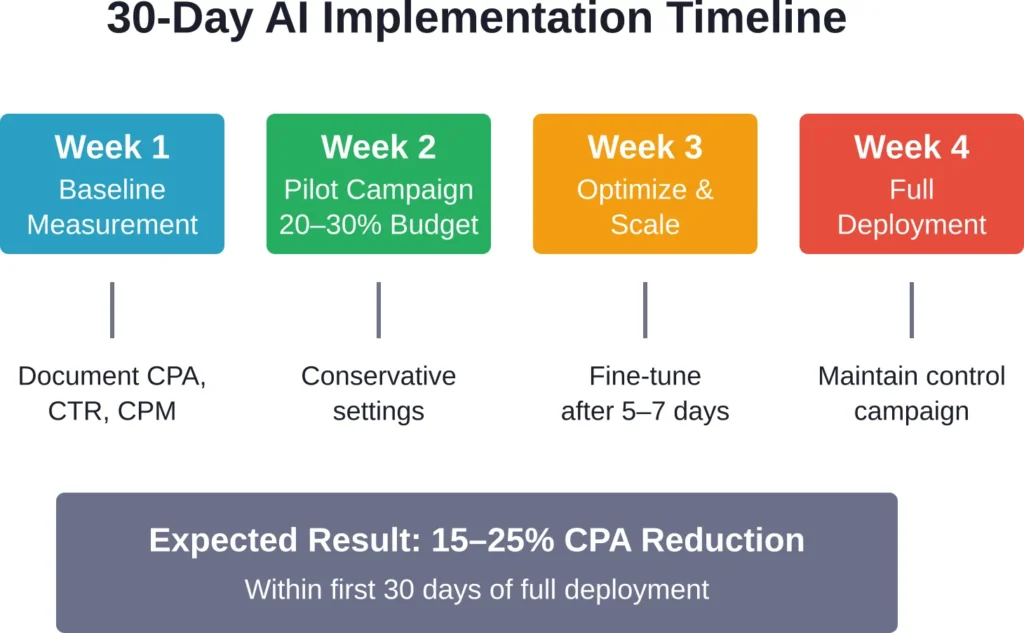
Implementation Strategy: 30-Day AI Deployment Roadmap
Switching from manual management to AI-driven optimization doesn’t happen overnight. The most successful implementations follow a phased approach that preserves baseline performance while introducing automation incrementally.
Week 1: Baseline Measurement and Tool Selection
Before deploying any AI tool, document current performance across key metrics: CPA, conversion rate, click-through rate, frequency, and cost per thousand impressions (CPM). These baseline measurements provide the comparison framework for evaluating AI impact.
Select one AI tool aligned with the campaign’s primary optimization need. If audience targeting presents the biggest challenge, prioritize audience segmentation platforms. If creative fatigue drives CPA increases, prioritize creative testing tools. Trying to deploy multiple tools simultaneously introduces too many variables and makes it difficult to isolate which changes drive results.
Week 2: Pilot Campaign Launch
Launch a pilot campaign using the selected AI tool while keeping existing campaigns running. Allocate 20–30% of total budget to the pilot to generate statistically significant data without risking overall account performance.
Configure the AI tool conservatively—use moderate bid caps, reasonable audience expansion limits, and creative guardrails that align with brand standards. The goal in week two is learning how the tool operates, not maximizing performance.
Week 3: Optimization and Scaling
Review pilot performance against baseline metrics. If CPA trends downward and conversion volume remains stable or increases, gradually shift more budget toward AI-managed campaigns. If performance lags baseline, adjust targeting parameters, bid strategies, or creative inputs before scaling.
Most AI tools require 5–7 days of learning before performance stabilizes. Don’t judge results after 48 hours. Week three focuses on fine-tuning configuration based on initial data.
Week 4: Full Deployment and Monitoring
If pilot results meet or exceed baseline performance, transition the majority of budget to AI-managed campaigns. Maintain one control campaign using manual management to provide ongoing performance comparison.
Establish monitoring protocols: daily checks on CPA, conversion volume, and creative fatigue indicators (frequency above 2.5, CTR declining 15%+ from baseline, CPM spikes). AI tools automate optimization, but they still require oversight to catch anomalies or platform bugs.
Five Mistakes That Undermine AI Performance Gains
AI tools work, but they’re not foolproof. These common implementation errors cancel out potential CPA reductions.
1. Insufficient Learning Period
Facebook’s algorithm needs data to optimize delivery. Pausing campaigns after two days because CPA looks high doesn’t give AI systems enough signal to calibrate. Most tools require 5–7 days minimum to complete the learning phase. Premature intervention resets learning and extends the time to stable performance.
2. Over-Constraining Targeting
AI audience expansion works by identifying high-converting users outside initial targeting parameters. Locking down audiences with tight demographic restrictions or small interest stacks limits the algorithm’s ability to find efficient delivery opportunities. Broader targeting generally outperforms narrow segmentation when paired with AI optimization.
3. Ignoring Creative Fatigue
AI can optimize bids and audiences, but it can’t force burned-out creative to perform. If ads run for weeks without refreshing, even perfect targeting won’t prevent CPA increases. Rotate creative every 10–14 days, or sooner if frequency exceeds 2.5 and CTR declines.
4. Setting Unrealistic CPA Targets
If baseline CPA sits at fifty dollars and the AI tool gets configured with a twenty-dollar target, the algorithm will struggle to find sufficient delivery volume. CPA targets should reflect market reality—set them 10–20% below baseline initially, then tighten once the tool demonstrates consistent performance.
5. Neglecting Data Quality
AI tools trained on poor data produce poor results. If conversion tracking fires incorrectly, pixel events duplicate, or offline conversions don’t sync properly, AI optimization drifts off target. Audit tracking implementation before deploying AI—accurate data is the foundation everything else builds on.
Measuring AI Impact: Beyond CPA
Cost per acquisition provides the clearest efficiency metric, but it doesn’t tell the complete story. AI tools affect multiple performance dimensions, and evaluating only CPA can miss important trade-offs or secondary benefits.
Key Metrics to Monitor
Track these metrics weekly during AI implementation and monthly once performance stabilizes:
- CPA trend: Should decline or remain stable as conversion volume increases.
- Conversion volume: Lower CPA doesn’t help if total conversions drop. Monitor absolute conversion count alongside efficiency.
- Return on ad spend (ROAS): Revenue per dollar spent should increase or hold steady as CPA declines.
- Click-through rate (CTR): Better audience targeting typically lifts CTR as ads reach more relevant users.
- Frequency: Should remain below 2.5 to avoid fatigue. AI audience expansion helps manage frequency by finding new users.
- Cost per mille (CPM): AI bid optimization can reduce CPM by avoiding overpriced inventory.
If CPA drops but conversion volume also declines significantly, the AI tool might be finding efficient delivery by excluding large audience segments. That’s a Pyrrhic victory—efficiency without scale doesn’t grow the business.
Attribution Considerations
AI tools optimize toward the conversion events the pixel tracks. If attribution windows change (e.g., shifting from 7-day click to 1-day click), reported CPA will shift even if actual performance stays constant. Maintain consistent attribution settings throughout testing periods to ensure valid comparisons.
Industry-Specific AI Tool Selection
Different business models benefit from different AI capabilities. E-commerce brands with large product catalogs face different optimization challenges than lead-generation businesses or subscription services.
E-Commerce and Retail
Product catalog campaigns benefit most from SKU-level optimization and dynamic creative that showcases individual products. Tools like Optmyzr excel here, allocating budget across hundreds of products based on real-time ROAS performance. Creative testing tools that auto-generate product-focused ads also deliver strong results.
Lead Generation
Lead-gen campaigns prioritize audience quality over volume. AI tools that analyze lead-to-customer conversion rates and build Lookalikes from closed deals (not just form submissions) reduce cost per qualified lead. Platforms like AdsGo that integrate CRM data for audience segmentation fit this model well.
SaaS and Subscriptions
Subscription businesses optimize for lifetime value, not just first conversion. AI tools that incorporate retention data and churn rates into audience models identify high-LTV prospects more accurately. Longer attribution windows and multi-touch analysis matter more than single-session conversions.
What to Expect in the First 90 Days
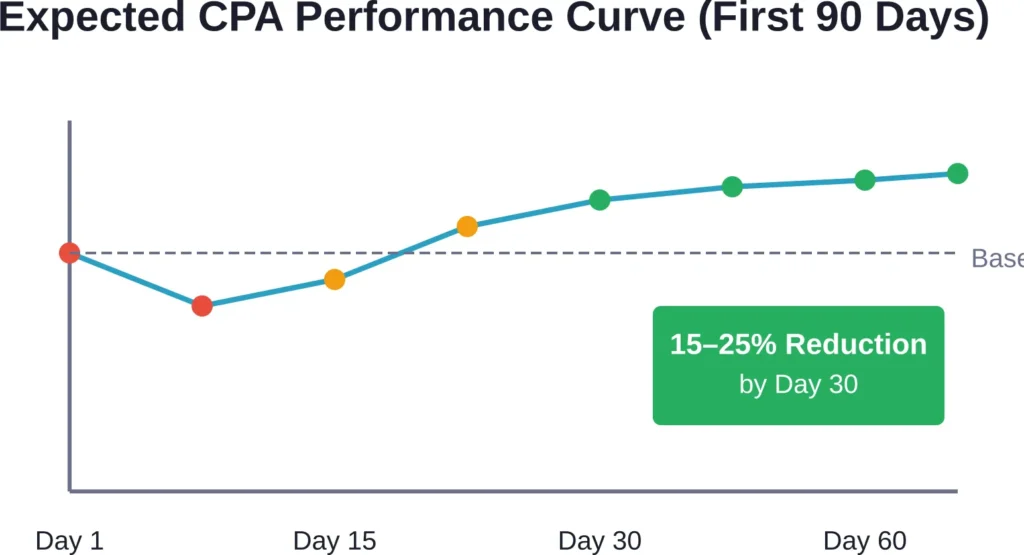
Performance improvement follows a predictable curve when AI tools deploy correctly. Understanding that curve prevents premature conclusions and helps teams stay committed through the learning phase.
Days 1–7: Learning Phase Volatility
CPA often spikes during the first few days as the algorithm explores delivery options. Conversion volume might dip temporarily. This is normal. Facebook’s machine learning requires data to calibrate, and initial delivery isn’t optimized yet. Don’t panic and don’t pause campaigns unless CPA exceeds 200% of baseline.
Days 8–30: Stabilization and Improvement
Around day 7–10, performance typically stabilizes and begins improving. CPA should trend toward or below baseline, and conversion volume should recover to previous levels or higher. AI-powered audience targeting typically reduces CPA by 15–25% within the first 30 days when configured properly.
Days 31–90: Compounding Gains
The real advantage emerges in months two and three. AI systems accumulate more performance data, refine audience models, and identify optimization opportunities manual management misses. CPA reductions compound as the algorithm learns which micro-segments convert most efficiently and reallocates budget accordingly.
Creative fatigue still occurs, so continue rotating ads every 10–14 days. But audience targeting and bid optimization should require less manual intervention as AI systems mature.
When AI Tools Don’t Work
AI isn’t a universal solution. Some campaign structures and business models don’t benefit from algorithmic optimization, and pushing AI into those situations wastes time and money.
Low-Volume Campaigns
Machine learning requires data. Campaigns generating fewer than 50 conversions per week don’t provide enough signal for AI algorithms to optimize effectively. In low-volume scenarios, manual management often outperforms AI because human judgment can incorporate qualitative factors algorithms can’t process.
Highly Seasonal or Event-Driven Campaigns
AI tools optimize based on historical patterns. If business is highly seasonal or dependent on one-time events (product launches, holiday promotions), algorithms trained on past performance might misread current conditions. Manual management with clear calendar awareness often works better.
Niche Audiences with Strict Targeting Requirements
Some businesses target very specific professional roles, certifications, or interest combinations. AI audience expansion can dilute targeting precision in these cases, delivering impressions to unqualified users. Narrow, manually defined audiences sometimes outperform AI-optimized broad targeting when addressable market size is inherently small.
The Future of AI in Facebook Advertising
AI capabilities in Facebook advertising continue advancing rapidly. What required third-party tools in 2024 often became native Meta features by 2026. That trend will accelerate.
Meta’s long-term strategy centers on making AI optimization the default, with manual controls available but secondary. Advantage+ campaigns represent that direction—advertisers provide creative assets and business objectives, the algorithm handles everything else.
Third-party AI tools will continue adding value by integrating cross-platform data (combining Facebook performance with Google Analytics, CRM systems, and offline conversion data) in ways Meta’s native tools don’t. The tools that survive long-term will be those that provide intelligence and insights beyond what Meta offers natively.
Research from MIT Sloan examining AI productivity gains in professional work shows that professionals using AI accounting software saw an increase in weekly client support and a reallocation of approximately 8.5% of accountant time from routine data entry toward high-value tasks. However, research also poses questions about how organizations should prepare for AI adoption in professional roles.
That pattern—significant productivity and quality improvements coupled with ongoing trust concerns—mirrors what’s happening in advertising. AI tools demonstrably improve efficiency, but they require oversight and validation. The advertisers seeing the best results combine AI automation with human strategic direction, not one or the other in isolation.
FAQ
Most AI optimization tools require 5–7 days to complete Meta’s learning phase. Measurable CPA reductions typically appear between days 10–15, with AI-powered audience targeting reducing CPA by 15–25% within the first 30 days when configured properly. Performance continues improving through day 90 as algorithms accumulate more conversion data and refine targeting models.
AI optimization requires sufficient conversion volume to train machine learning models. Campaigns generating fewer than 50 conversions per week don’t provide enough signal for AI algorithms to optimize effectively. For small budgets or low-volume campaigns, manual management often outperforms AI because human judgment can incorporate qualitative factors algorithms can’t process. Once weekly conversion volume exceeds 50–75 events, AI tools begin demonstrating consistent performance advantages.
No. AI tools automate execution and micro-optimization but don’t replace strategic thinking, creative direction, or business judgment. The most effective campaigns combine AI automation for bidding, targeting, and budget allocation with human oversight for creative strategy, audience definition, and business objectives. Research shows that professionals using AI reallocate time from routine tasks toward higher-value strategic work rather than being replaced entirely.
E-commerce campaigns with large product catalogs benefit most from SKU-level optimization platforms like Optmyzr or comprehensive solutions like AdsGo that combine audience intelligence with creative testing. Meta’s native Advantage+ Shopping Campaigns also deliver strong results—documented cases show up to 32% ROAS improvements and 25% CPA reductions. The best choice depends on catalog size, existing campaign structure, and whether teams need cross-platform capabilities beyond Facebook.
Pricing varies widely by platform and account size. Meta’s Advantage+ campaigns cost nothing beyond ad spend. Third-party subscription tools typically range from a few hundred to several thousand dollars monthly depending on features and account scale. Percentage-of-spend models (common with platforms like Optmyzr) typically charge 1–5% of monthly ad spend. For current pricing on specific tools, check official websites directly—pricing structures and tier availability change frequently.
Key warning signals include: CPA remaining elevated beyond day 10–14 of the learning phase, total conversion volume declining more than 15–20% compared to baseline, frequency climbing above 2.5 consistently, or CTR dropping 15%+ from baseline without recovery. If these patterns persist after 14 days, review targeting constraints, bid cap settings, and creative quality before concluding the tool doesn’t fit the campaign structure.
Yes, but the AI system needs access to lead quality data. Tools that integrate with CRM platforms can optimize toward closed deals or qualified leads rather than just form submissions. Platforms like AdsGo analyze customer databases to identify highest-value segments and build Lookalike audiences from customers who actually converted to sales, not just submitted initial forms. This requires proper conversion tracking and data integration between Facebook and business systems.
Conclusion
AI tools reduce Facebook ad CPA by processing data faster, identifying patterns humans miss, and executing optimizations continuously. The platforms demonstrating consistent results share four capabilities: predictive audience segmentation, automated bid optimization, dynamic creative testing, and real-time performance monitoring.
According to third-party testing and documented case studies, AI-based campaign management can reduce cost per action by up to 28%, and third-party tools tested in real-world campaigns show CPA reductions of 15–35% within the first 30 days when implemented correctly.
But AI isn’t automatic success. Tools require adequate conversion volume to learn effectively, campaigns need 5–7 days minimum to complete the learning phase, and creative still needs regular refreshing to avoid fatigue. The advertisers seeing the strongest results combine AI automation with human strategic oversight—algorithms handle execution speed and pattern recognition, humans provide creative direction and business judgment.
Start with one tool aligned to the campaign’s primary optimization challenge. Measure baseline performance before deployment, launch a pilot with 20–30% of budget, and allow sufficient learning time before scaling. Monitor CPA, conversion volume, and ROAS weekly. Adjust targeting and creative inputs based on data, not assumptions.
The tools exist. The data proves they work. The question isn’t whether AI can reduce Facebook ad costs—it’s which platform fits the specific campaign structure and how quickly teams can deploy it effectively.