

Quick Summary: AI tools for Facebook ads optimization automate targeting, bidding, creative testing, and performance analysis to improve ROAS and reduce manual work. Leading solutions include Meta’s native Advantage+ suite, third-party platforms like Extuitive, Madgicx and AdStellar AI, and general AI assistants like Claude for strategic analysis. The best tool depends on campaign volume, budget, and whether teams prioritize creative automation, bid management, or strategic insights.
Managing Facebook ad campaigns manually has become nearly impossible for teams trying to scale profitably. The platform processes millions of auction signals in real time, adjusts bids in real time, and requires constant creative refreshes to combat ad fatigue.
That’s where AI-powered optimization tools come in.
These platforms handle the repetitive, data-heavy tasks that drain marketing hours—audience segmentation, bid adjustments, A/B test analysis, creative variations—while letting strategists focus on the decisions that actually move revenue. The technology has matured significantly since 2024, with tools now offering sophisticated value-based bidding, automated scaling rules, and predictive performance modeling.
But here’s the thing: not all AI tools solve the same problems. Some excel at creative generation, others at bid optimization or budget allocation. Picking the wrong one means paying for features that don’t match how campaigns actually run.
This guide breaks down the best AI tools for Facebook ads optimization in 2026, what each one does well, and how to choose based on real campaign needs rather than marketing hype.
Why AI Optimization Matters for Facebook Ads in 2026
Meta’s advertising platform has grown exponentially more complex. According to research on mathematical optimization for analyzing performance metrics of Facebook posts, modern campaigns require analyzing multiple performance indicators simultaneously—engagement rates, click-through patterns, conversion timing, creative lifespan, and audience overlap—to make informed decisions.
Manual optimization can’t keep pace with that volume of data. Campaign managers who rely solely on native Facebook Ads Manager tools typically check performance a few times daily, adjusting budgets or pausing underperformers. AI systems monitor performance continuously, making micro-adjustments every few minutes based on real-time auction dynamics.
The result? Better cost-per-acquisition, higher return on ad spend, and fewer wasted impressions on fatigued creative or saturated audiences.
Academic analysis using Support Vector Regression on 500 Facebook posts revealed clear patterns in how input variables—post timing, content type, targeting parameters—affect outcomes. AI tools leverage these kinds of relationships at scale, learning which combinations drive conversions for specific business models.
Third-Party AI Platforms for Advanced Optimization
While Meta’s native tools handle basic automation well, third-party platforms add layers of strategic intelligence, cross-account management, and deeper analytics. These tools typically sit on top of Facebook Ads Manager, using the API to implement optimizations while providing interfaces designed for professional marketers.
Extuitive: Pre-Launch Predictive Validation
Extuitive positions itself as an AI-powered prediction engine focused on ad creative validation before launch. The platform combines generative AI agents with consumer behavior models based on vast real consumer profiles to simulate real-world reactions and performance.
Key capabilities include AI-driven ad generation that creates copy, images, videos and full concepts directly from your store data, predictive performance scoring that forecasts CTR, ROAS and purchase intent, and simulated consumer testing via thousands of AI personas acting as an always-on focus group.
The platform works particularly well for e-commerce brands and Shopify merchants that want to eliminate wasteful A/B testing and launch only high-confidence creatives. It connects directly to your store, learns from historical performance, and enables rapid iteration on messaging, visuals, and audience angles.
Extuitive offers plans starting at $1,000/month (Starter) with Enterprise custom pricing. Book a demo on extuitive.com.
Contact Information:
- Website: extuitive.com
- Email: [email protected]
- LinkedIn: www.linkedin.com/company/extuitive
- Twitter: x.com/Extuitive_Inc
- Instagram: www.instagram.com/extuitiveinc
Madgicx: End-to-End Campaign Management

Madgicx positions itself as an AI-driven command center for Facebook and Instagram advertising. The platform combines creative intelligence, audience insights, and automated rules into a unified dashboard.
Key capabilities include AI-powered audience segmentation that identifies high-value customer clusters, creative analysis that scores ad assets based on predicted performance, and autonomous budget allocation that shifts spend toward winning ad sets in real time.
The platform works particularly well for e-commerce brands running multiple product campaigns simultaneously. The AI learns which creative styles, messaging angles, and audience segments drive conversions for different product categories.
AdStellar AI: Goal-Driven Recommendations

AdStellar focuses on streamlining campaign setup and scaling decisions. The platform analyzes account performance and provides specific, actionable recommendations aligned with advertiser goals—whether that’s lowering cost-per-acquisition, increasing ROAS, or expanding reach.
One standout feature is bulk ad launch capability, letting teams deploy dozens of creative variations across multiple campaigns in minutes rather than hours. The AI automatically structures campaigns based on best practices, reducing setup errors that plague manual builds.
According to available data, AdStellar AI offers a 7-day free trial with full feature access. While full pricing isn’t publicly listed, they provide a founding offer of 20% off the annual plan for new users.
Revealbot: Automation Rules at Scale

Revealbot takes a different approach, focusing on sophisticated automation rules that execute actions based on performance thresholds. Teams can create conditional logic—if cost-per-acquisition exceeds target by 30% for 6 hours, reduce budget by 25%—and apply those rules across entire accounts.
The platform excels at preventing runaway spend on underperforming campaigns and capitalizing on winners before they saturate. It’s particularly valuable for agencies managing multiple client accounts with different optimization priorities.
Smartly.io: Enterprise-Grade Creative Automation

Smartly.io serves larger organizations with complex creative needs. The platform automates production of localized ad variations, dynamic product feeds, and seasonal campaign refreshes at scale.
The AI optimizes creative rotation based on performance data, automatically pausing fatigued assets and promoting fresh variations. For brands running campaigns across dozens of markets or managing thousands of SKUs, this level of automation is essential.
Meta’s Native AI: Advantage+ Campaign Suite
Meta has embedded AI optimization directly into its advertising platform through the Advantage+ suite. These aren’t third-party tools—they’re built into Ads Manager and available to all advertisers.
Advantage+ Shopping Campaigns
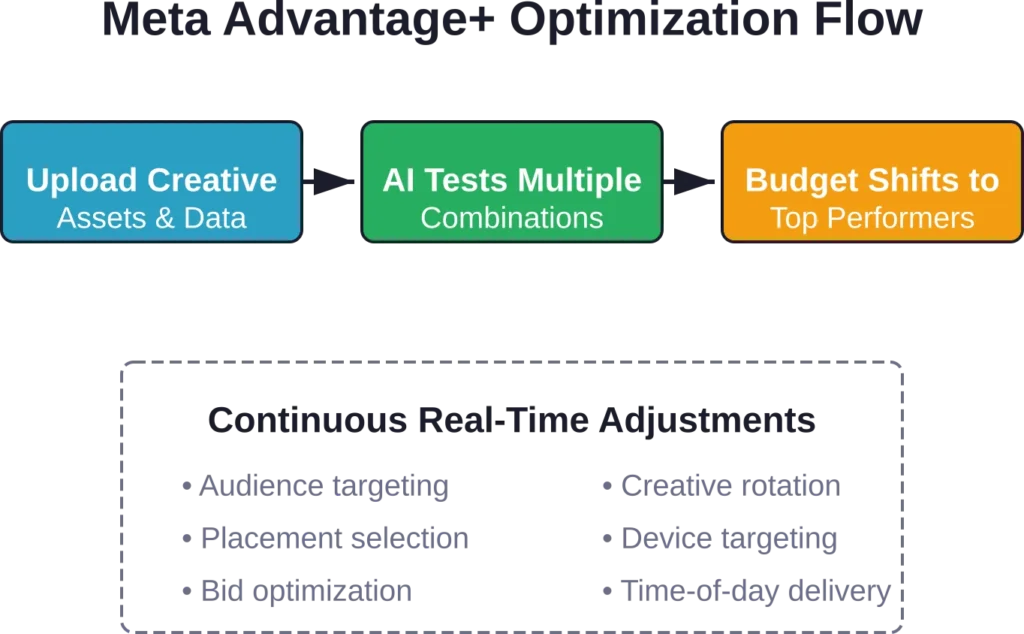
Designed specifically for e-commerce, these campaigns automate audience targeting, creative delivery, and placement selection. Instead of manually building audience segments and testing placements, advertisers provide creative assets and conversion data. Meta’s AI handles the rest.
The system tests creative combinations automatically, distributing budget toward top performers. It adjusts bids based on predicted conversion likelihood rather than static cost caps.
Advantage+ Creative
This feature optimizes individual creative elements—headlines, descriptions, media—by testing variations and personalizing delivery. The AI might show different headlines to different audience segments based on what’s most likely to drive action.
When Native Tools Work Best
Meta’s native AI optimization works well for straightforward campaigns with clear conversion events and sufficient data volume. Campaigns spending at least a few hundred dollars daily with consistent conversion tracking tend to see the strongest results.
The limitations? Less transparency into why decisions are made, limited control over optimization priorities, and no cross-platform insights if running ads beyond Meta properties.
AI Tools for Creative Optimization
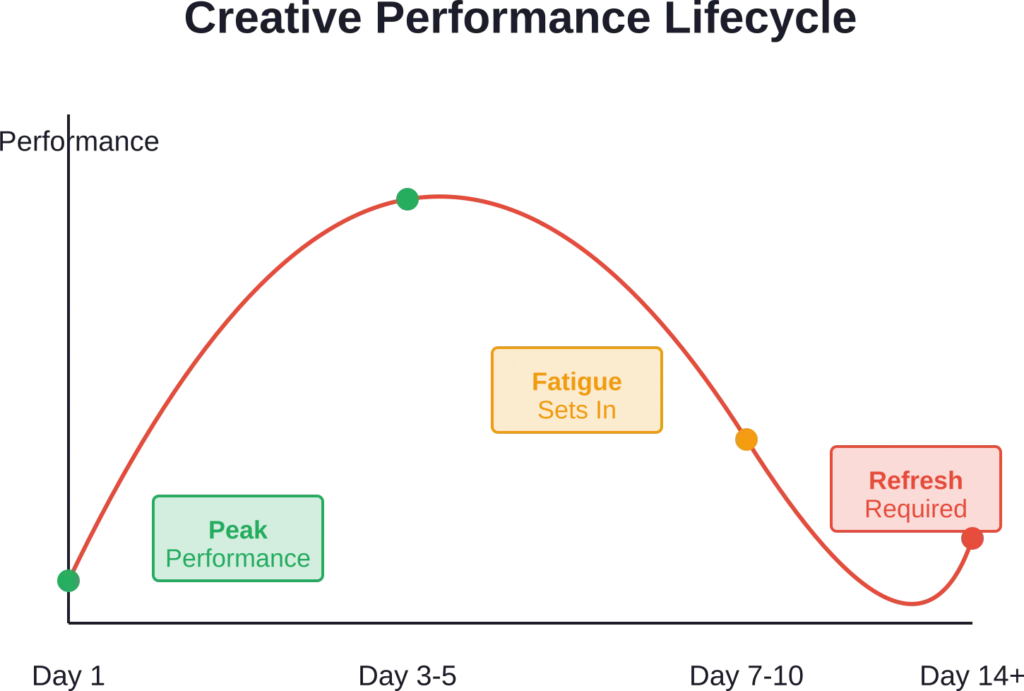
Campaign performance increasingly depends on creative quality and variety. Ad fatigue sets in faster than ever—winning creative can see declining performance within days. AI creative tools address this by generating variations, predicting performance, and identifying winning patterns.
AdCreative.ai: AI-Generated Ad Assets

AdCreative.ai uses machine learning models trained on millions of high-performing ads to generate new creative assets. Users input product information, brand guidelines, and campaign goals. The AI outputs multiple ad variations with different layouts, headlines, and visual styles.
The platform predicts performance scores for each generated asset before launch, letting teams prioritize the most promising concepts. This shortens creative iteration cycles from weeks to hours.
Foreplay.co: Creative Intelligence and Swipe Files

Foreplay takes a research-first approach, building a searchable database of competitors’ top-performing ads. The AI identifies patterns in successful creative—color schemes, offer structures, ad formats—and suggests concepts likely to resonate with target audiences.
This works especially well during campaign planning stages, informing creative briefs with data-backed insights rather than guesswork.
Arcads.ai: Video Creative Generation
Video consistently outperforms static creative in Facebook feeds, but production costs limit how many variations teams can test. Arcads.ai generates video ads using AI avatars and text-to-speech, dramatically reducing production time and cost.
While the output won’t replace professional video production for brand campaigns, it’s effective for direct-response testing where speed and volume matter more than production polish.
General AI Assistants for Strategic Analysis
Not all optimization happens within specialized advertising platforms. General-purpose AI assistants have become essential tools for campaign strategy, performance analysis, and decision support.
Claude: Analysis and Strategic Decisions

Claude has emerged as one of the most valuable tools for paid advertisers working across platforms. According to tested tools data, Claude is used literally by any advertiser who needs help with creative briefs, performance analysis, or strategic decisions.
Pricing starts with a free tier, with paid plans from $20/month. The value comes from its ability to analyze campaign data exports, identify non-obvious patterns, critique creative concepts, and generate strategic recommendations grounded in advertising principles rather than generic advice.
Many performance marketers report interacting with Claude 20+ times daily for tasks ranging from analyzing A/B test results to drafting audience targeting hypotheses.
ChatGPT and Other Language Models

ChatGPT and similar models serve similar purposes—ad copy generation, campaign structure recommendations, audience persona development. The key is providing detailed context about business goals, historical performance, and competitive positioning.
These tools work best as strategic partners for human decision-makers, not autonomous optimization systems.
Selecting the Right AI Tool for Specific Needs
The best AI optimization tool depends entirely on what bottleneck is limiting campaign performance.
Teams struggling with creative production should prioritize tools like AdCreative.ai or Arcads.ai that automate asset generation. Those losing money to poor bid management need platforms with sophisticated automation rules like Revealbot or Meta’s native Advantage+ bidding.
Agencies juggling multiple client accounts benefit most from unified dashboards like Madgicx that provide cross-account visibility and centralized optimization. Enterprise brands with complex creative needs require production-scale platforms like Smartly.io.
Budget matters too. Smaller accounts spending under a few thousand monthly on Facebook ads often see better ROI from free or low-cost tools—Claude for strategic analysis, Meta’s native Advantage+ for optimization—rather than expensive third-party platforms with features that require higher spend to be effective.
| Campaign Challenge | Recommended Tool Type | Example Platforms |
|---|---|---|
| Limited creative production capacity | AI creative generators | AdCreative.ai, Arcads.ai |
| Poor bid management and budget waste | Automation and bidding optimization | Revealbot, Meta Advantage+ |
| Lack of strategic direction | AI analysis assistants | Claude, ChatGPT |
| Multi-account complexity | Unified management platforms | Madgicx, AdStellar AI |
| Enterprise-scale creative needs | Production automation | Smartly.io |
Implementation Best Practices and Common Pitfalls
AI tools amplify existing campaign fundamentals—they don’t fix broken strategies. Poor tracking implementation, weak offer positioning, or misaligned audience targeting will produce bad results faster with automation, not better outcomes.
Data Quality Comes First
Value-based bidding tells Meta which conversions matter most. If a five-hundred-dollar purchase and a twenty-dollar purchase both count as one conversion, the AI optimizes for volume rather than value. Maintaining performance over weeks and months requires ongoing attention to data quality, creative freshness, and strategic oversight.
Train AI systems with quality conversion data that accurately reflects business economics. Implement proper tracking for all conversion touchpoints, not just final purchases.
Don’t Abandon Manual Oversight
AI handles tactical optimization well, but strategic decisions still require human judgment. When should campaigns expand into new markets? Which product lines deserve increased investment? How should messaging shift for seasonal promotions?
The most effective implementations pair AI automation for repetitive optimization tasks with regular human review of strategic direction and goal alignment.
Test Incrementally
Don’t migrate entire ad accounts to new AI platforms overnight. Start with a subset of campaigns, establish performance baselines, and validate that automation improves results before expanding.
This also builds institutional knowledge about how the tools work and what optimizations they prioritize.
The Role of AI in Meta’s Andromeda Update
Meta continues advancing its native advertising AI through platform updates. The Andromeda Update, introduced in late 2025, represents a significant evolution in how Meta’s systems optimize campaign delivery.
According to research on Meta’s Andromeda Update, this update fundamentally reshaped the advertising ecosystem by improving how Meta’s AI processes advertiser signals, interprets conversion data, and predicts user actions.
The practical implications? Campaigns with strong conversion tracking and clear value signals see improved performance. Those relying on outdated optimization strategies or weak data inputs face increasing costs and declining reach.
Third-party AI tools help bridge this gap by improving data quality, providing clearer signals to Meta’s systems, and optimizing the inputs that Meta’s AI uses for delivery decisions.
Measuring ROI on AI Optimization Tools
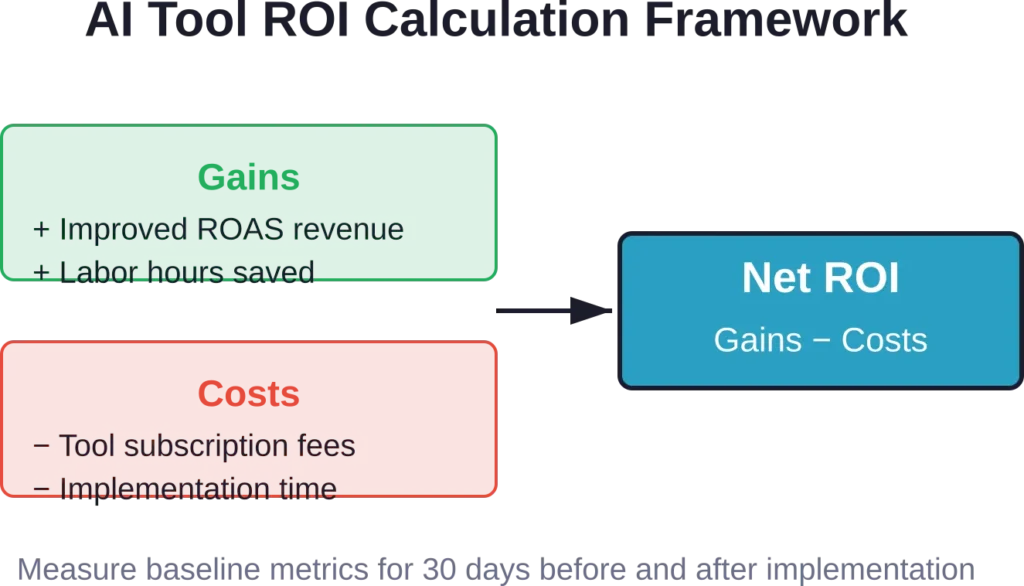
Paid tools need to generate measurable return on investment. The cost of a platform subscription should be offset by improved campaign efficiency—lower acquisition costs, higher conversion rates, or reduced labor hours.
Calculate a baseline before implementation: current cost-per-acquisition, average ROAS, and hours spent on campaign management weekly. After implementing AI tools, track the same metrics for at least 30 days.
The ROI equation is straightforward: (increased revenue from improved ROAS + labor cost savings) minus (tool subscription cost + implementation time) equals net value. Tools that don’t clear a positive ROI after 60-90 days probably aren’t the right fit.
Frequently Asked Questions
Start with Meta’s native Advantage+ features, which are free and built directly into Ads Manager. Pair that with Claude’s free tier for strategic analysis and campaign planning. This combination costs nothing beyond ad spend and provides solid optimization without complex platform learning curves. As campaigns scale past a few thousand monthly spend, evaluate specialized tools based on specific bottlenecks.
Pricing varies dramatically by platform and feature set. General AI assistants like Claude offer free tiers with paid plans from $20/month. Specialized advertising platforms range from free basic tiers to enterprise pricing in the thousands monthly. Mid-market tools often start around a few hundred per month. Check official websites for current pricing, as plans and tiers change frequently.
Not entirely. AI excels at tactical optimization—bid adjustments, budget allocation, creative rotation, audience refinement—but strategic decisions still require human judgment. Deciding which markets to enter, how messaging should evolve for new products, or when to pivot campaign focus entirely involves business context that AI can’t fully grasp. The most effective approach combines AI automation for repetitive optimization with human oversight for strategic direction.
Most tools show initial performance changes within 7-14 days as AI systems gather data and begin optimizing. Meaningful ROI assessment requires 60-90 days to account for learning periods, seasonal variations, and campaign cycles. Some changes—like automated bid adjustments—can impact performance within days, while others—like creative recommendations or audience insights—take longer to validate through testing.
AI optimization works for both, but the approach differs. E-commerce campaigns with direct purchases and clear conversion values provide clean data for value-based optimization. B2B campaigns with longer sales cycles, lead forms, and offline conversions require more sophisticated tracking implementation. Tools like Madgicx and AdStellar AI handle both models, but B2B advertisers need proper CRM integration and offline conversion tracking to feed quality data into AI systems.
It depends on needs and budget. Many successful implementations combine a general AI assistant like Claude for strategic analysis with one specialized platform for campaign automation. Using multiple overlapping tools—say, three different bid optimization platforms—typically creates conflicts and confused signals. The best approach: one primary optimization platform plus complementary tools that handle distinct functions like creative generation or competitive research.
Establish clear baseline metrics before implementing any tool—average cost-per-acquisition, ROAS, conversion rate, and creative lifespan. Run controlled tests where possible: optimize half the account with the new tool while managing the other half manually. Compare performance over 30-60 days. Watch for attribution manipulation where tools claim credit for conversions that would have happened anyway. Legitimate tools show measurable improvement in efficiency metrics, not just vanity numbers.
Conclusion
AI tools for Facebook ads optimization have matured from experimental curiosities into essential infrastructure for competitive campaign management. The technology handles data-heavy optimization tasks faster and more accurately than manual approaches, freeing strategic capacity for decisions that actually require human judgment.
But the tools themselves matter less than matching capabilities to actual campaign needs. Creative-constrained teams need generation tools. Bid-management bottlenecks require automation platforms. Strategic uncertainty benefits from AI analysis assistants.
Start with Meta’s native Advantage+ features and free AI assistants to validate that automation improves results for specific campaigns. As performance scales and complexity increases, layer in specialized platforms that address demonstrated bottlenecks rather than buying features that sound impressive but don’t match workflow reality.
The competitive advantage in 2026 isn’t simply using AI—it’s using the right AI tools aligned with campaign economics, integrated properly with tracking infrastructure, and paired with strategic oversight that keeps optimization efforts focused on business outcomes rather than vanity metrics.
Test incrementally, measure rigorously, and expect AI to amplify existing fundamentals rather than fix broken strategies. When implemented thoughtfully, these tools can dramatically improve campaign efficiency and free marketing capacity for growth initiatives that actually move business metrics.