

Quick Summary: Generative AI tools are transforming marketing workflows in 2026, with 62% of marketers using ChatGPT and 52% using embedded AI platforms like Canva. The best tools combine content automation, brand intelligence, and multi-channel capabilities to handle writing, design, video creation, and campaign optimization—helping teams reclaim the 63% of time currently spent on routine tasks.
Marketing teams face a sobering reality: most creative work fails. Research shows that only around 20% of ad creatives deliver strong campaign performance. The rest? Wasted budget, wasted effort.
But here’s the thing—generative AI isn’t just another productivity hack. It’s fundamentally changing how marketing content gets created, optimized, and distributed.
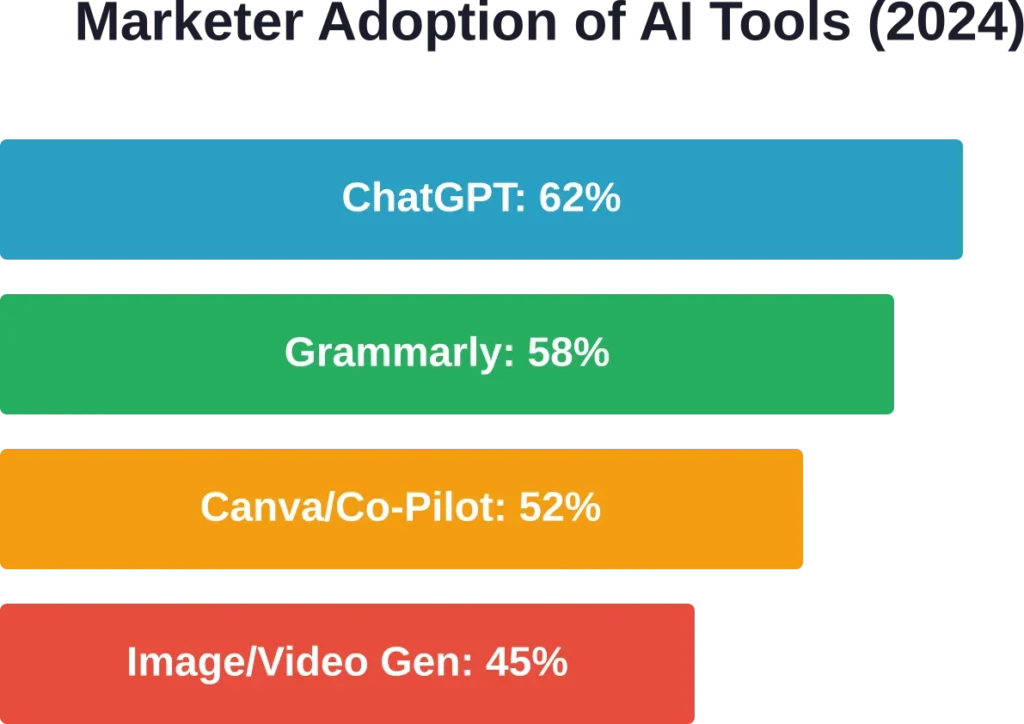
The numbers tell the story. According to data from the American Marketing Association, nearly 90% of marketers have used generative AI tools, with 62% relying on ChatGPT for content generation at work. Another 58% use AI-powered writing tools like Grammarly, while 52% work with embedded AI features in platforms like Canva or Microsoft Co-Pilot.
Traffic to generative AI products has surged 200% over the last 12 months, particularly for code generation and creative tools, dominating significant market share among AI platforms.
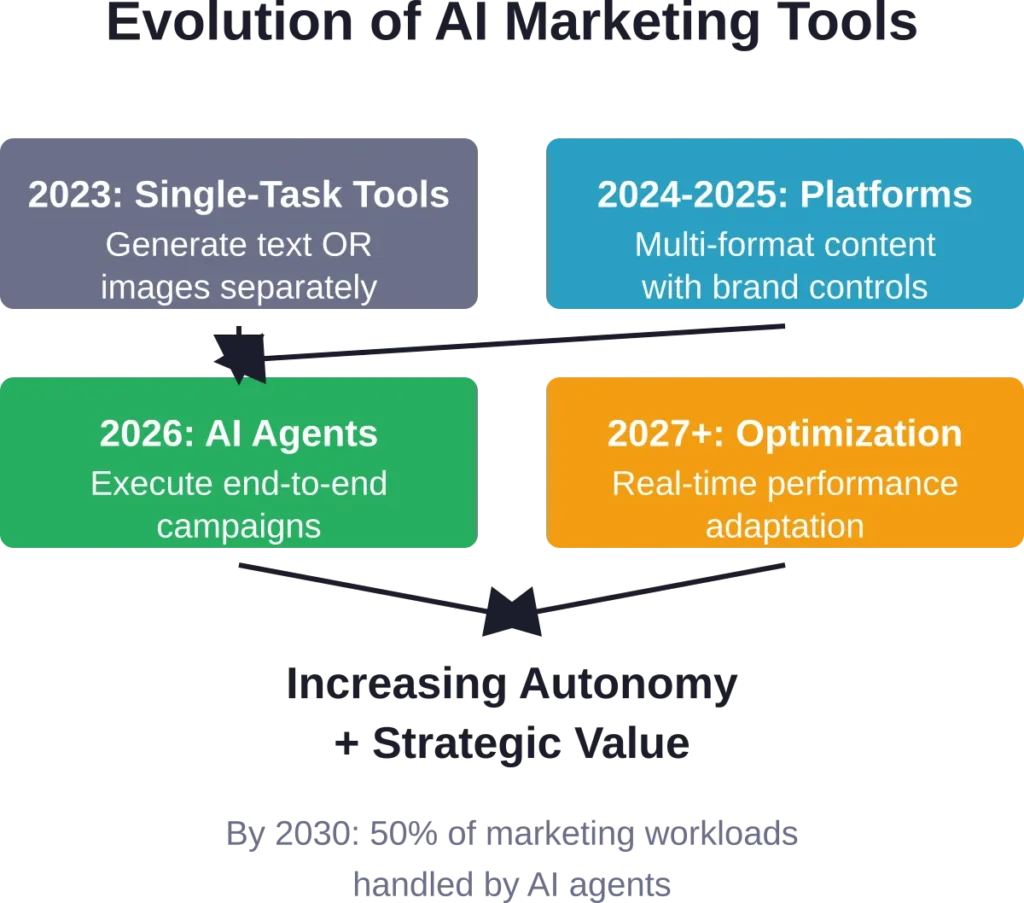
And the shift is just beginning. Industry analyses suggest that by 2030, 50% of marketing workloads will be handled by AI agents—purpose-built systems that execute end-to-end campaigns with minimal human intervention.
So what separates tools that deliver measurable results from those that just add more noise to the workflow?
This guide breaks down the generative AI platforms actually moving the needle for marketing teams in 2026—based on available usage data, published pricing, and documented performance metrics.
What Are Generative AI Tools for Marketing?
Generative AI tools use machine learning models—typically large language models (LLMs) or diffusion models—to create new content from text prompts. Unlike traditional marketing software that helps organize or distribute content, these platforms generate the content itself.
The scope covers everything from blog posts and ad copy to social graphics, product videos, and even full campaign strategies.
Here’s what sets them apart from earlier AI marketing tech:
- They create original content rather than just analyzing or optimizing existing material
- They work across multiple formats—text, images, video, audio
- They adapt to brand voice and style guidelines through training or prompting
- They integrate directly into creative workflows rather than operating as standalone analysis tools
The practical applications split into several categories. Image generation tools handle visual content. Writing platforms tackle everything from email subject lines to long-form articles. Video generators automate product demos and social clips. And increasingly, multi-modal platforms combine all three.
But capability alone doesn’t determine value. The best tools for marketing share three characteristics: they maintain brand consistency at scale, they reduce iteration time on creative assets, and they integrate with existing marketing tech stacks.
Top Generative AI Tools for Marketing in 2026
The market has exploded with options. After filtering for platforms with verified user bases, documented pricing, and measurable marketing applications, several tools stand out.
Extuitive: Predictive Ad Performance for Shopify Brands
Extuitive emerges as a specialized generative AI platform focused on pre-launch ad validation, helping Shopify merchants forecast real-world performance of creatives before spending on traffic. It combines generative capabilities with agentic AI simulations based on 150,000+ real consumer behavioral models.
The platform handles end-to-end creative workflows: analyzing connected Shopify stores for products, audience insights, and historical data; generating ad copy, images, videos, and campaign angles; then validating them through AI consumer simulations to predict CTR, ROAS, and engagement. Marketing teams use it to rapidly test dozens or hundreds of variations, filter winners, and launch with higher confidence.
Strengths include deep Shopify integration for automated context, predictive validation that reduces wasted ad spend, and agentic workflows that simulate consumer responses with accuracy tied to live campaign benchmarks. Weaknesses center on its primary focus on performance advertising (less emphasis on long-form content or broad brand storytelling), current Shopify-centric design that may limit non-ecommerce users, and reliance on historical data quality for best predictions.
Extuitive evolved from Flagship Pioneering’s innovation model into a full agentic AI marketing system. Its “Polyintelligence” engine powers autonomous agents acting as marketers, researchers, and consumer testers — generating concepts, running virtual focus groups, and delivering performance forecasts. This directly addresses the core 2026 challenge: skyrocketing creative volume from generative tools combined with expensive live testing and declining traditional ad efficiency.
For Shopify brands and small-to-medium ecommerce teams running frequent paid campaigns, Extuitive delivers measurable ROI through faster iteration and reduced risk. Larger enterprises or teams focused purely on organic/content marketing may find broader platforms like Jasper more suitable, while solo operators benefit from its low-friction “connect store → generate → validate” flow.
Contact Information:
- Website: extuitive.com
- Email: [email protected]
- LinkedIn: www.linkedin.com/company/extuitive
- Twitter: x.com/Extuitive_Inc
- Instagram: www.instagram.com/extuitiveinc
ChatGPT: The Universal Starting Point

ChatGPT remains the most widely adopted generative AI tool among marketers, with 62% using it for content generation according to American Marketing Association data.
The platform handles brainstorming, copywriting, research summarization, and basic content structuring. Marketing teams use it for email drafts, social media posts, blog outlines, ad copy variations, and customer response templates.
Strengths include natural language understanding, broad general knowledge, and zero learning curve. Weaknesses center on lack of brand memory across sessions, no direct marketing tool integrations, and outputs that require heavy editing for brand voice consistency.
For marketing applications, ChatGPT works best as a drafting assistant and ideation tool rather than a complete content solution. Teams still need human oversight for brand alignment, factual accuracy, and strategic relevance.
Jasper: Enterprise Content Automation

Jasper positions itself as an AI marketing platform rather than just a writing tool. The key differentiator is Brand IQ—a system that embeds brand voice, messaging guidelines, audience context, and performance signals directly into content generation.
This matters for teams managing multiple brands or requiring strict voice consistency across hundreds of assets. Instead of re-prompting for brand voice every time, the system maintains those parameters automatically.
The platform has evolved beyond text generation into AI agents—purpose-built systems that execute specific marketing workflows end-to-end. These include content optimization agents, performance analysis agents, and research agents that handle tasks like competitor monitoring and trend analysis.
Jasper also addresses a critical emerging challenge: generative engine optimization (GEO). As AI-powered search interfaces like ChatGPT, Perplexity, and Google AI Overviews change how content gets discovered, traditional SEO strategies become less effective. According to Jasper’s analysis, data shows that AI overviews reduced click-through rates for top-ranking Google content by 58%—a jump from 34.5% the previous year.
Jasper’s approach focuses on optimizing content for citation in AI-generated answers rather than just traditional search rankings. This includes structured formatting, authoritative sourcing, and clear answer patterns that language models prefer.
For enterprise marketing teams dealing with high content volume and strict brand requirements, Jasper delivers measurable efficiency gains. For smaller teams or single-person operations, the learning curve and pricing may outweigh the benefits.
Canva: Visual Content for Non-Designers
Canva dominates the accessible design space, with 52% of marketers using embedded AI tools like Canva or Microsoft Co-Pilot according to survey data.
The platform’s AI features handle image generation, background removal, brand kit application, template customization, and video editing—all through an interface designed for marketers without formal design training.
Pricing starts at $15.00 per month for the team plan, which includes AI-powered features alongside the core design capabilities. This positions it well below specialized design tools while offering enough functionality for most marketing content needs.
The real value comes from the combination of AI generation and collaborative features. Teams can create social graphics, presentation slides, video clips, and print materials in one platform, maintain brand consistency through shared templates and brand kits, and collaborate in real-time without version control headaches.
For marketing departments that previously relied on outsourced design or overtaxed internal designers, Canva’s AI features democratize visual content creation. The trade-off is less control over fine details compared to professional tools like Adobe Creative Suite.
Grammarly: AI-Powered Writing Quality

Grammarly shows up in 58% of marketer workflows according to American Marketing Association research. While not strictly a generative tool, its AI-powered writing assistance has become infrastructure for content creation.
The platform analyzes tone, clarity, engagement, and delivery to help writers match their content to audience expectations. For marketing teams, this means catching voice inconsistencies, simplifying complex language, and adjusting formality levels before content goes live.
The business tier adds brand voice customization, allowing teams to define their specific style guidelines and get real-time feedback when drafts deviate. This bridges the gap between AI-generated first drafts and polished, brand-aligned final versions.
Grammarly works as middleware in the content workflow—catching issues that humans miss and enforcing standards that would otherwise require manual style guide checking.
Adobe Firefly: Professional-Grade Image Generation

Adobe Firefly targets the professional creative market with image generation capabilities integrated directly into Adobe’s creative ecosystem.
Pricing starts at approximately $10 per month (varies by region) for standalone access, with additional integrations available through Creative Cloud subscriptions. This positions it as a premium option compared to consumer-focused image generators.
The platform emphasizes commercial safety—all training data comes from Adobe Stock, openly licensed content, and public domain materials. This matters for marketing teams concerned about copyright issues or brand safety violations from AI-generated assets.
Image quality tends toward photorealism and professional finish rather than artistic experimentation. Marketing applications include product visualization, hero images for campaigns, social media graphics, and custom illustrations that match specific brand aesthetics.
For teams already invested in Adobe’s ecosystem, Firefly provides seamless workflow integration. For those outside that environment, the learning curve and pricing may not justify the switch from more accessible alternatives.
Specialized Video Generation Tools
Video content demands have exploded, but traditional video production remains expensive and time-consuming. Several AI platforms address this gap with automated video generation.
Creatify AI focuses on effortless video content creation with pricing starting at approximately $19 per month. The platform handles script generation, voiceover, visual selection, and editing—turning product descriptions or blog posts into finished video clips.
AKOOL specializes in realistic AI avatar videos and creative storytelling, with tiered pricing options. Marketing teams use it for product explainers, testimonial-style content, and personalized video messages at scale.
The current limitations center on customization and brand control. Automated video tools work well for straightforward product demos and social content, but struggle with complex narratives or specific creative visions that require precise control over every frame.
Perplexity: AI-Powered Research Assistant

Perplexity combines search and language models to deliver cited, source-backed answers rather than generic AI responses. For marketers, this transforms research workflows.
The free plan provides unlimited quick searches and 5 Pro searches per day. The Pro tier at $20 per month adds 300+ Pro searches monthly and access to multiple AI models including GPT-4o, Claude-3, Sonar Large (Llama 3.1), and others.
Marketing research applications include competitive analysis, trend monitoring, content gap identification, and audience insight gathering. Unlike traditional search that returns lists of links, Perplexity synthesizes information across sources and provides direct answers with citations.
This matters for content strategy and campaign planning where marketers need quick, reliable information without manually reviewing dozens of sources. The citation feature also helps with fact-checking AI-generated content before publication.
Comparing Generative AI Tools: Key Capabilities
Different tools excel at different tasks. Understanding these specializations helps match platforms to specific marketing needs.
| Tool | Primary Strength | Content Types | Starting Price |
|---|---|---|---|
| ChatGPT | Versatile text generation | Copy, emails, brainstorming | Free (paid tiers available) |
| Jasper | Brand consistency at scale | Long-form content, campaigns | Contact for pricing |
| Canva | Visual content for non-designers | Graphics, presentations, video | $15/month |
| Grammarly | Writing quality and consistency | All text content | Free (business tier available) |
| Adobe Firefly | Commercial-safe images | Photos, illustrations, graphics | ~$10/month |
| Creatify AI | Automated video creation | Product videos, social clips | ~$19/month |
| Perplexity | Research with citations | Market research, content strategy | Free (Pro $20/month) |
The pricing differences reflect target markets and feature depth. Free and low-cost tools work well for individual marketers or small teams with straightforward needs. Enterprise platforms like Jasper justify higher costs through brand management features, team collaboration, and integration capabilities that matter for larger organizations.
Real-World Marketing Applications
How do these tools actually get used in day-to-day marketing operations?
Content Marketing and SEO
Content teams use AI tools to accelerate blog production, generate topic ideas, optimize for search engines, and create supporting assets.
A typical workflow combines multiple tools: ChatGPT or Jasper for first drafts, Grammarly for quality control, Canva for featured images and graphics, and platform-specific optimization for SEO requirements.
The efficiency gains are substantial. Teams that previously published one or two blog posts weekly can scale to five or more without increasing headcount. The trade-off is maintaining quality and originality when AI handles the heavy lifting.
This is where generative engine optimization (GEO) becomes critical. Traditional SEO optimized for Google’s algorithm. GEO optimizes for how AI systems like ChatGPT, Perplexity, and Google AI Overviews cite and reference content.
The difference matters because user behavior is shifting. Data shows that AI overviews reduced click-through rates for top-ranking Google content by 58%, a jump from 34.5% the previous year. Content that gets cited in those AI-generated answers captures visibility even without traditional rankings.
Social Media Management
Social teams use AI for post generation, image creation, caption writing, and content calendaring across multiple platforms.
Tools like Canva handle visual content while ChatGPT generates caption variations. The combination allows one person to manage content across Instagram, LinkedIn, Twitter, and Facebook—work that previously required dedicated staff for each platform.
But authenticity remains a challenge. AI-generated social content tends toward bland, safe language that lacks the personality and edge that drives engagement. Smart teams use AI for volume and consistency while reserving human creativity for high-stakes posts and community interaction.
Email Marketing Campaigns
Email marketers leverage AI for subject line testing, body copy variations, and personalization at scale.
Instead of manually writing subject line alternatives for A/B tests, tools like ChatGPT or Jasper generate dozens of options instantly. Instead of creating separate email versions for different audience segments, AI adapts core messages to different personas or industries.
The challenge is maintaining the human touch that drives email performance. Subscribers increasingly recognize AI-generated content, and generic messaging gets ignored. The winning approach combines AI efficiency with strategic human input on positioning, offers, and relationship-building.
Advertising Creative Development
Ad teams use AI tools to generate creative variants, test messaging angles, and optimize visual elements.
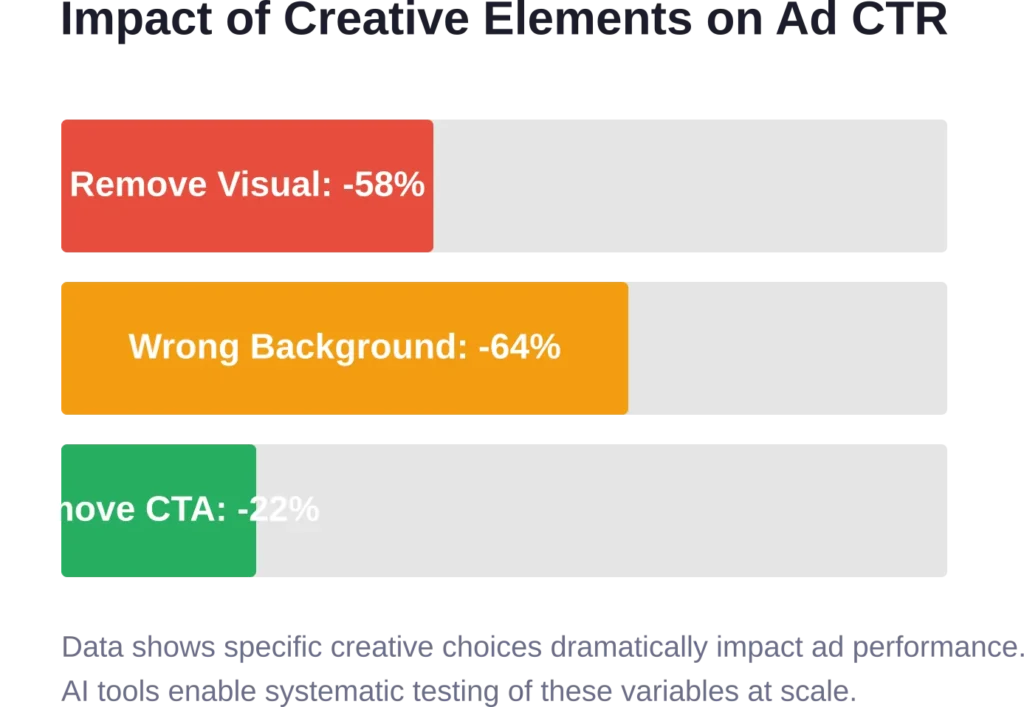
Research shows that only around 20% of ad creatives deliver strong campaign performance. The other 80% waste budget. AI addresses this by enabling massive variation testing—hundreds of headlines, images, and layouts tested systematically to identify the winning combinations.
Platforms like Canva generate visual variants while copy tools handle messaging alternatives. Performance data feeds back into the creation process, allowing teams to double down on what works and kill what doesn’t before burning through ad budgets.
Product Marketing and Launches
Product marketers use AI to accelerate launch asset creation—feature descriptions, comparison charts, demo videos, landing page copy, sales enablement materials.
The speed advantage matters during compressed launch timelines. Instead of waiting weeks for creative teams to produce all necessary assets, marketing can generate drafts immediately and refine based on early feedback.
Video tools like Creatify or AKOOL automate product demo creation, turning feature lists and screenshots into polished explainer videos. Writing tools handle messaging variants for different audiences—technical buyers, economic buyers, end users.
Strategic Considerations for AI Tool Adoption
Buying tools is easy. Using them effectively requires strategy.
Start with Outcomes, Not Features
The biggest mistake marketing teams make is choosing AI tools based on capabilities rather than business outcomes.
Ask what problems need solving. Is the bottleneck content volume? Visual asset creation? Campaign personalization? Research and analysis? Match tools to those specific constraints rather than adopting platforms because they’re popular or feature-rich.
A small team drowning in blog production needs different tools than an enterprise brand managing hundreds of campaigns across markets. The former might succeed with ChatGPT and Canva. The latter requires platforms like Jasper with brand management and governance features.
Plan for Human-AI Collaboration
AI tools don’t replace marketing teams—they change what those teams focus on.
The workflow shifts from creation to curation. Marketers spend less time writing first drafts or designing initial concepts, and more time defining strategy, reviewing outputs, and refining the assets that show promise.
This requires new skills. Teams need to learn effective prompting, quality evaluation, and strategic direction. Junior marketers who previously spent time on production tasks need training in these higher-level capabilities.
Organizations that treat AI as a replacement for human judgment get generic, ineffective content. Those that treat it as leverage for human creativity get efficiency without sacrificing quality.
Address Quality Control Early
AI-generated content requires systematic quality control processes.
Common issues include factual errors, brand voice inconsistencies, generic phrasing, and outputs that technically answer the brief but miss the strategic intent.
Smart teams implement review workflows before AI content reaches audiences. This includes fact-checking, brand voice verification, legal review for sensitive topics, and performance monitoring after publication.
Tools like Grammarly help catch consistency issues automatically. Brand management features in platforms like Jasper reduce voice drift. But human oversight remains essential, particularly for content representing the brand in high-stakes contexts.
Integrate with Existing Marketing Tech
Standalone AI tools create workflow friction. The best implementations integrate AI capabilities directly into existing marketing technology stacks.
This might mean choosing platforms with native integrations to content management systems, marketing automation tools, social media schedulers, or analytics platforms. Or it might mean using API access to build custom workflows that connect AI generation to distribution channels.
Teams using multiple disconnected tools spend excessive time on copy-paste between systems. Those with integrated workflows maintain speed and reduce errors.
Monitor Costs as Usage Scales
AI tool costs can escalate quickly as teams increase usage.
Free tiers and low entry prices attract initial adoption, but per-seat costs, usage limits, and premium features add up across departments. A tool that costs $20 per month for an individual becomes $2,000 monthly for a hundred-person marketing organization.
Enterprise platforms often use custom pricing models based on usage volume, making cost projection difficult. Teams should establish usage monitoring and budget caps before costs spiral beyond planned allocations.
Emerging Trends in Marketing AI
The generative AI landscape continues evolving rapidly. Several trends will shape marketing applications through 2026 and beyond.
AI Agents for End-to-End Campaign Execution
Current tools generate content. Emerging AI agents execute complete workflows.
Instead of using ChatGPT to write email subject lines, an AI agent handles the entire email campaign—researching topics, writing copy, generating images, setting up automation sequences, monitoring performance, and optimizing based on results.
Industry projections suggest 50% of marketing workloads will be handled by agents by 2030. Early implementations focus on repetitive, rules-based workflows like social media posting, email sequences, and ad variant testing.
The shift from tools to agents represents a fundamental change in how marketing teams operate. Tools augment human work. Agents complete tasks autonomously with human oversight.
Generative Engine Optimization
Search is fragmenting across ChatGPT, Perplexity, Google AI Overviews, and other AI-powered interfaces.
Traditional SEO optimized for Google’s algorithm and ranking factors. GEO optimizes for how language models cite and reference content in generated answers.
Data shows AI overviews reduced click-through rates for top-ranking content by 58%—up from 34.5% previously. This isn’t a temporary shift. As users get answers directly from AI interfaces, fewer click through to underlying sources.
Marketing teams need strategies for visibility in this new environment. That includes structured content formats, authoritative sourcing, clear answer patterns, and optimization for citation rather than just ranking.
Multimodal Content Generation
Early AI tools handled single content types—text, images, or video separately.
Newer platforms generate across modalities from unified prompts. Describe a marketing campaign concept, and the system produces blog posts, social graphics, video clips, and email copy—all maintaining consistent messaging and brand voice.
This matters for campaign consistency and production speed. Instead of coordinating separate tools for each asset type, teams work with integrated systems that understand how pieces fit together.
Real-Time Performance Optimization
Current workflows separate creation from optimization. Teams generate content, publish it, collect performance data, and eventually refine based on results.
Emerging systems close that loop. AI monitors content performance in real-time and automatically generates optimized variants based on what’s working. An ad that underperforms triggers automatic creation of alternative headlines, images, or layouts for testing.
This represents the convergence of generative AI and marketing analytics—using performance signals to drive continuous content evolution without manual intervention.
Common Challenges and Solutions
Adopting generative AI for marketing isn’t frictionless. Teams encounter predictable obstacles.
Generic Output Quality
Problem: AI-generated content sounds bland, safe, and indistinguishable from competitor content.
Solution: Invest time in prompt engineering and brand training. The more context provided—brand voice examples, audience personas, specific use cases—the better outputs become. Platforms with brand management features like Jasper deliver more consistent results than generic chatbots.
Factual Accuracy Issues
Problem: Language models confidently generate plausible-sounding but incorrect information.
Solution: Implement mandatory fact-checking workflows before publication. Use tools like Perplexity that provide source citations. Never publish AI-generated content on topics requiring accuracy—product specs, financial information, legal claims—without human verification.
Brand Voice Consistency
Problem: Different team members using AI tools produce content that sounds inconsistent.
Solution: Establish brand guidelines specifically for AI tool usage. Create prompt templates that include voice and tone parameters. Use platforms with built-in brand controls rather than expecting consistency from manual prompting.
Integration Complexity
Problem: AI tools don’t connect to existing marketing systems, creating manual workflow steps.
Solution: Prioritize tools with native integrations or API access to key platforms in the marketing stack. Budget for technical resources to build custom integrations where necessary. In some cases, workflow inefficiency costs more than the tool savings justify.
Team Skill Gaps
Problem: Marketing teams lack experience prompting AI effectively or evaluating outputs.
Solution: Invest in training before expecting productivity gains. Create internal resources—prompt libraries, quality checklists, best practice documentation. Designate AI champions within teams who develop expertise and help others learn.
Measuring AI Tool ROI
How do marketing teams know whether AI tools deliver value?
Track these metrics:
- Time savings per asset type: How long does blog post creation take with AI versus manual? Same for social posts, ad copy, emails, graphics.
- Content volume changes: Can the team produce more content with the same headcount? Quantify the increase.
- Quality metrics: Do AI-generated assets perform as well as human-created ones? Track engagement rates, conversion rates, and other performance indicators.
- Cost per asset: Calculate total cost including tool subscriptions, human review time, and revisions. Compare to previous production costs.
- Time to market: Does AI reduce launch timelines or enable faster campaign iteration?
Teams that measure rigorously can justify continued investment and identify which tools deliver the best returns. Those that adopt based on hype without tracking results often abandon tools before realizing their potential value.
Choosing the Right Tools for Different Team Sizes
Optimal tool selection varies based on team structure and scale.
Solo Marketers and Small Teams (1-5 people)
Priority: maximize output without complexity.
Recommended stack: ChatGPT for writing, Canva for design, Grammarly for quality control. Total monthly cost under $50 delivers significant capability.
Avoid enterprise platforms with features that small teams won’t use. Focus on tools with minimal learning curves and broad applicability.
Mid-Size Marketing Teams (5-20 people)
Priority: consistency across team members plus integration with marketing tech.
Recommended additions: Jasper or similar platform for brand management, specialized tools for high-volume needs (email, social, ads), integration capabilities to CMS and automation platforms.
Budget $500-2000 monthly depending on content volume. Invest in training to ensure team uses tools effectively.
Enterprise Marketing Organizations (20+ people)
Priority: governance, compliance, workflow integration, and performance measurement.
Recommended approach: Enterprise AI platforms with brand controls, legal review workflows, usage analytics, and API access for custom integrations. Dedicated training programs and internal AI expertise.
Budget varies significantly based on scale but expect $5,000+ monthly across tools and infrastructure. ROI comes from efficiency at scale and risk mitigation.
Frequently Asked Questions
The best tool depends on specific needs. ChatGPT offers the most versatility for general content tasks and has the highest adoption rate at 62% of marketers. Jasper delivers better brand consistency for teams producing high volumes of content. Canva excels for visual content creation without design expertise. Most effective marketing teams use combinations of tools rather than relying on a single platform.
Pricing ranges from free (ChatGPT, Grammarly basic) to enterprise-level custom pricing. Mid-tier options include Canva at $15 per month, Adobe Firefly at approximately $10 per month, Creatify AI at approximately $19 per month, and Perplexity Pro at $20 per month. Total costs depend on team size, content volume, and feature requirements. Small teams can operate effectively on $50-200 monthly budgets, while enterprise organizations often spend $5,000+ across platforms.
AI tools augment rather than replace marketing teams. Research shows that only around 20% of ad creatives deliver strong campaign performance, and AI helps test variants to identify winners. But strategic thinking, brand intuition, creative judgment, and relationship-building remain human responsibilities. The shift moves marketer time from production tasks to strategy and curation. By 2030, industry analyses suggest 50% of marketing workloads will be handled by AI agents, but this represents task automation rather than role elimination.
Key risks include factual inaccuracies, brand voice inconsistencies, generic content that fails to differentiate, copyright concerns from training data, and outputs that miss strategic intent despite technically meeting requirements. Mitigation strategies include mandatory human review, fact-checking workflows, tools with commercial-safe training data, brand management features, and clear quality standards. Teams should never publish AI content without verification, especially for technical, legal, or financial topics.
Traditional SEO optimizes content for search engine rankings and click-through from results pages. Generative engine optimization (GEO) optimizes for citation in AI-generated answers from ChatGPT, Perplexity, Google AI Overviews, and similar interfaces. The distinction matters because AI overviews have reduced click-through rates for top-ranking content by 58%, according to industry data. GEO focuses on structured formatting, authoritative sourcing, and clear answer patterns that language models prefer when synthesizing responses.
Effective AI usage requires prompt engineering (crafting clear, context-rich instructions), quality evaluation (distinguishing useful outputs from generic ones), brand voice definition (articulating style guidelines AI can follow), strategic thinking (knowing which tasks benefit from automation), and fact-checking (verifying accuracy before publication). Teams also need technical skills for tool integration and workflow design. Organizations should invest in training rather than expecting immediate productivity from tool adoption alone.
Track time savings per content type, changes in content volume, performance metrics for AI-generated versus human-created assets, total cost per asset including tools and review time, and impact on campaign timelines. Compare these metrics before and after AI adoption. Teams that measure rigorously can identify which tools deliver value and optimize usage patterns. Those that adopt without measurement often abandon tools before realizing potential returns or continue paying for platforms that don’t justify costs.
Conclusion: Strategic AI Adoption for Marketing Success
Generative AI has moved from experimental technology to marketing infrastructure. With 62% of marketers using ChatGPT and 52% working with embedded AI features in platforms like Canva, the question isn’t whether to adopt these tools but how to use them effectively.
The best implementations share common patterns. They start with business outcomes rather than tool features. They plan for human-AI collaboration instead of expecting automation to replace judgment. They implement quality controls before content reaches audiences. And they measure results systematically to optimize investments.
The competitive advantage doesn’t come from the tools themselves—most platforms are accessible to any team. It comes from strategic deployment, skill development, and workflow design that leverages AI for efficiency while preserving the creative and strategic thinking that differentiates brands.
As AI agents evolve to handle more complete workflows and real-time optimization becomes standard, the gap between teams that adopt thoughtfully and those that treat AI as magic will widen. Research suggests that by 2030, 50% of marketing workloads will be handled by autonomous agents. Teams building expertise now position themselves to lead in that environment.
The tools covered in this guide—ChatGPT, Jasper, Canva, Grammarly, Adobe Firefly, Creatify, AKOOL, and Perplexity—represent current best-in-class options based on adoption data, verified capabilities, and documented pricing. But the landscape evolves rapidly.
Smart teams stay informed about emerging platforms, test new capabilities against current workflows, and remain flexible as the technology advances. The goal isn’t finding perfect tools but building adaptable systems that deliver consistent results as AI capabilities expand.
Start with one or two tools addressing the biggest bottlenecks in current workflows. Measure results. Refine processes. Expand gradually as the team develops expertise. That disciplined approach outperforms rushing to adopt every new platform that promises transformation.
The marketing teams that thrive in 2026 and beyond will be those that master the collaboration between human creativity and AI capability—using automation to eliminate low-value work while doubling down on the strategic thinking and brand building that technology can’t replicate.