

Quick Summary: Finding the right custom web development partner can make or break your digital strategy. This guide profiles 15 leading agencies—from boutique studios to enterprise-scale firms—with verified pricing, specializations, and client ratings. Whether you need a product-first redesign or a complex web application, these companies represent the best in custom development for 2026.
The web development landscape has never been more competitive. Hundreds of agencies claim to deliver custom solutions, but not all possess the technical chops, design sensibility, or strategic vision to actually move the needle for your business.
Here’s the thing though—choosing a development partner isn’t just about finding someone who can write code. It’s about finding a team that understands your market, your users, and your growth trajectory. A team that can translate business objectives into elegant, scalable digital products.
This guide cuts through the noise. We’ve analyzed agencies across the USA and beyond, examining their portfolios, pricing structures, technical capabilities, and client feedback. The result? A curated list of 10 agencies that consistently deliver exceptional custom web development work.
No fluff. No invented rankings. Just verified data and real insights to help you make an informed decision.
What Makes a Custom Web Development Company Stand Out
Before diving into the list, it’s worth understanding what separates exceptional agencies from the rest.
Technical excellence matters, obviously. But the best custom web development companies combine several critical capabilities that generic development shops simply can’t match.
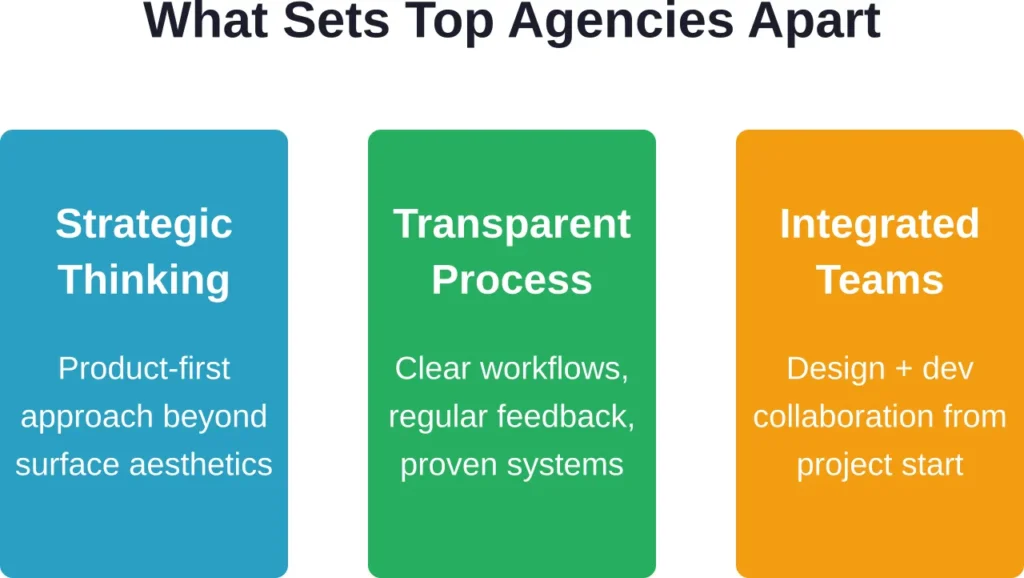
Strategic Thinking Beyond Code
Great agencies don’t just build what you ask for—they challenge assumptions and propose better solutions. They approach projects through a product lens, considering user journeys, conversion pathways, and long-term scalability from day one.
The agency approaches web design through a product-first lens, focusing on clarity, structure, and conversion rather than surface-level aesthetics. This mindset shift transforms development from a tactical service into a strategic partnership.
Proven Process and Communication
Custom development projects involve countless decisions, trade-offs, and course corrections. The best agencies maintain transparent communication throughout, with established workflows that keep projects on track.
Look for companies that prioritize regular check-ins, clear documentation, and iterative feedback loops. Their commitment to quality, transparency, and client satisfaction sets them apart in a highly competitive marketplace.
Design and Development Integration
The gap between design and development kills more projects than technical challenges. Top agencies eliminate this gap entirely by integrating UX research, web design, branding, and development into a seamless process.
When designers and developers collaborate from the start, you get websites that actually work—not just beautiful mockups that fall apart during implementation.
Top 15 Custom Web Development Companies
Now for what you came here for. These 15 agencies represent the cream of the crop across different specializations, price points, and geographic markets.
Each profile includes verified pricing data, client ratings, and core strengths to help you identify the best fit for your specific needs.
1. Lengreo
Lengreo acts as a complete marketing and tech partner for B2B companies, focusing on measurable growth through targeted strategies rather than generic campaigns.
They deliver results-driven services including SEO, paid ads, lead generation, demand generation, and website development, helping clients scale client acquisition, reduce costs per lead, and boost conversions. Their portfolio features strong case studies in SaaS, biotech, cybersecurity, and architecture sectors.
Specialization: B2B digital marketing, SEO, lead generation, web development
Best for ambitious B2B companies (especially SaaS, tech, and professional services) that need a proactive partner focused on qualified leads, ROI, and seamless integration into their existing processes.
Contact Information:
- Website: Lengreo.com
- Phone: +31 686 147 566
- Email: [email protected]
- Address: Vrijstraat 9 C/D, 5611 AT Eindhoven, Netherlands
- LinkedIn: Lengreo
- Twitter: @Lengreo
- Instagram: @lengreo
2. Gilzor
Gilzor takes a product-oriented approach to custom software development, helping startups launch MVPs and established businesses scale digital products efficiently.
By combining UI/UX design, full-cycle development (web & mobile), QA, business analysis, and go-to-market support, they create high-quality, scalable solutions that drive user adoption and revenue growth. Their work emphasizes speed to market, idea validation, and long-term partnerships.
Specialization: Custom software development, mobile & web apps, startup MVP, IT outsourcing
Best for startups and SMBs looking for a reliable development partner that delivers fast, cost-effective results without compromising quality — ideal when you need both technical execution and strategic product thinking.
Contact Information:
- Website: www.gilzor.com
- Email: [email protected]
- Address: Poland, Warsaw, Office 58, street Adama Mickiewicza 37, 01-625
- LinkedIn: www.linkedin.com/company/gilzor-softwaredevelopment
3. Oski Solutions
Oski Solutions delivers expert web development and full-cycle software solutions for enterprises and ambitious startups that value engineering excellence and innovation.
They specialize in cloud solutions, frontend development, AI integrations, CMS platforms, and industry-specific systems (travel, logistics, e-commerce, fintech, education), combining 25+ years of experience with AI-accelerated processes for faster delivery.
Specialization: Web development, cloud solutions, AI integrations, CMS (Umbraco/WordPress), industry-specific platforms
Best for tech-forward companies and enterprises seeking a dependable outsourcing/outstaffing partner focused on quality, scalability, and long-term support rather than just quick builds.
Contact Information:
- Website: oski.site
- Phone: +48571282759
- Email: [email protected]
- Address: Kaupmehe tn 7, 10114 Tallinn, Estonia
- LinkedIn: www.linkedin.com/company/oski-solutions
4. A-Listware
A-Listware operates as a full-service software development and IT consulting company, providing dedicated teams and comprehensive solutions that act as a seamless extension of your in-house capabilities.
They cover everything from custom software and application services to UX/UI design, QA/testing, data analytics, cybersecurity, and managed IT infrastructure, with strong emphasis on cost efficiency and 24/7 expert access.
Specialization: Dedicated development teams, custom software, IT consulting, QA & testing, cloud & infrastructure
Best for companies needing reliable, budget-conscious outsourcing or team augmentation with end-to-end IT support — perfect when you want high-quality delivery without the overhead of building everything internally.
Contact Information:
- Website: a-listware.com
- Phone: +1 (888) 337 93 73
- Email: [email protected]
- Address: North Bergen, NJ 07047, USA
- LinkedIn: www.linkedin.com/company/a-listware
- Facebook: www.facebook.com/alistware
5. Mobian Studio
Mobian Studio builds dedicated engineering teams for companies that demand fast, reliable delivery of mobile and AI-powered solutions.
They offer outsourcing and outstaffing models focused on clean architecture, senior-level talent, and full-cycle product development (mobile, backend, AI agents, legacy integration), serving industries like healthcare, fintech, logistics, and IT.
Specialization: Mobile app development, AI & automation systems, dedicated teams, outstaffing/outsourcing
Best for product companies and enterprises in regulated or fast-moving sectors that need senior engineers, scalable architecture, and a true long-term technology partner without hiring risks.
Contact Information:
- Website: mobian.studio
- Phone: [email protected]
- Address: Harju maakond, Tallinn, Kesklinnalinnaosa, Masina tn 22, 10113
- LinkedIn: www.linkedin.com/company/mobian-studio
6. Excited Agency
Excited takes a product-first approach that resonates with growth-stage companies. Rather than chasing visual trends, they focus on clarity, structure, and conversion optimization.
By combining UX research, web design, branding, and motion design, Excited creates websites that scale with the product and support long-term growth. Their portfolio showcases clean, functional designs that prioritize user experience without sacrificing aesthetic appeal.
Specialization: Product design, SaaS platforms, growth-focused websites
Best for companies that need a strategic partner focused on measurable outcomes rather than just pretty designs. Their product-first methodology aligns development work directly with business goals.
7. Code and Theory
Code and Theory operates at the intersection of creativity and technology, serving enterprise clients and global brands that demand both innovation and execution excellence.
This agency tackles complex digital transformation projects, bringing together strategists, designers, and developers to solve challenging business problems. Their work spans web platforms, mobile applications, and integrated digital experiences.
Specialization: Enterprise platforms, digital transformation, brand experience
The premium positioning reflects their strategic value and track record with Fortune 500 clients. When stakes are high and budgets allow for best-in-class execution, Code and Theory delivers.
8. Duck Design
Duck Design brings competitive pricing without compromising on quality—a rare combination in the custom development space.
With a 4.9 average rating on Clutch and a lean, efficient team structure, Duck Design serves businesses that need professional custom development at accessible price points. They excel at translating business requirements into clean, functional websites.
Specialization: Custom websites, e-commerce, brand identity
Their cost-per-hour positioning makes them accessible to startups and small businesses without sacrificing quality standards. Projects are delivered on time, within budget, and to high standards of quality.
9. Clay
Clay focuses on UI design, branding, and product experience, bringing a distinctive visual sensibility to custom web development projects.
Their portfolio demonstrates a consistent eye for detail and a willingness to push creative boundaries while maintaining usability. Clay works with both startups and established brands looking to differentiate through exceptional design.
Companies that compete on design and user experience find a natural partner in Clay. Their work elevates digital products through thoughtful interaction design and visual craft.
10. Instrument

Instrument combines strategic consulting with hands-on development and design execution. This integrated approach helps clients navigate complex digital challenges from concept through launch.
They work with ambitious brands and companies tackling difficult technical problems. Instrument’s team includes strategists, designers, and developers who collaborate throughout the entire project lifecycle.
Specialization: Digital strategy, custom platforms, brand experience
The integrated model eliminates the handoff problems that plague agencies with siloed departments. When strategy informs design and design guides development, projects stay coherent and purposeful.
11. Basic Agency (DEPT)
Basic Agency operates as part of DEPT, a global digital agency network, combining boutique sensibility with enterprise resources.
They specialize in creating digital experiences that connect brands with audiences through thoughtful design and solid technical execution. Their portfolio includes work for consumer brands, technology companies, and cultural institutions.
Specialization: Brand experience, content-driven websites, digital campaigns
The DEPT connection provides access to specialized talent and resources while maintaining the focused service model of a smaller studio. Companies get the best of both worlds—personalized attention backed by deep capabilities.
12. Fantasy
Fantasy pushes the boundaries of what’s possible on the web, creating highly interactive, visually striking digital experiences.
Their work often incorporates advanced animation, 3D graphics, and experimental interaction patterns. Fantasy serves brands that want to make a bold statement and stand out in crowded markets.
Not every project needs Fantasy’s level of creative ambition—but when differentiation matters and budgets support it, they deliver memorable digital experiences that command attention.
13. Ueno
Ueno built its reputation on distinctive design work and a collaborative studio culture. They work with startups and established companies alike, bringing fresh thinking to every project.
The agency emphasizes close collaboration with clients, treating projects as partnerships rather than vendor relationships. This approach yields digital products that feel authentic to each brand’s identity and goals.
Specialization: Product design, brand identity, web and mobile apps
Companies that value design excellence and collaborative process find Ueno a natural fit. Their team brings both creative firepower and technical expertise to complex development challenges.
14. Build in Amsterdam
Despite the name, Build in Amsterdam serves clients globally, bringing a distinct European design sensibility to digital projects.
They excel at creating cohesive digital ecosystems—websites, applications, and platforms that work together seamlessly. Build in Amsterdam approaches projects holistically, considering how each piece fits into the broader digital landscape.
Specialization: Digital ecosystems, platform design, integrated experiences
Companies with complex digital needs—multiple touchpoints, integrated systems, evolving platforms—benefit from Build in Amsterdam’s systems thinking and holistic approach.
15. Area 17

Area 17 specializes in content-rich websites and digital publishing platforms, serving cultural institutions, media companies, and organizations with complex content needs.
Their technical expertise in content management systems and information architecture makes them the go-to choice for projects where content strategy and structure matter as much as visual design.
Specialization: Content platforms, digital publishing, museums and culture
Organizations that need to manage, organize, and present large volumes of content find Area 17’s specialized expertise invaluable. They understand the unique challenges of content-first digital experiences.
Understanding Agency Pricing Models
Pricing for custom web development varies dramatically—and understanding why helps you evaluate proposals intelligently.
Hourly rates tell part of the story, but not all of it. A $50/hour agency that takes 400 hours costs the same as a $200/hour agency that delivers in 100 hours. Efficiency, experience, and strategic value matter more than raw hourly numbers.
Hourly Rate Ranges Explained
Based on verified data from multiple industry sources, hourly rates for custom web development typically fall into these brackets:
| Rate Range | Agency Type | Typical Services | Best For |
|---|---|---|---|
| $25–$49/hr | Emerging studios, regional shops | Standard websites, basic customization | Startups, small businesses |
| $50–$99/hr | Established agencies, specialized boutiques | Custom web apps, design systems | Growing companies, mid-market |
| $100–$199/hr | Premium agencies, niche specialists | Complex platforms, enterprise solutions | Established brands, scale-ups |
| $200–$300+/hr | Elite studios, global leaders | Strategic transformation, innovation | Fortune 500, high-growth tech |
Real talk: higher rates often correlate with faster delivery, fewer revisions, and better strategic outcomes. The cheapest option rarely proves economical once you factor in project delays, communication overhead, and potential rework.
Minimum Project Costs
Most quality agencies set minimum project thresholds. Industry data shows common minimums at $10,000, $50,000, and $250,000+ depending on the agency tier and service offering.
These minimums aren’t arbitrary—they reflect the fixed costs of project setup, discovery, architecture, and quality assurance that apply regardless of project scope.
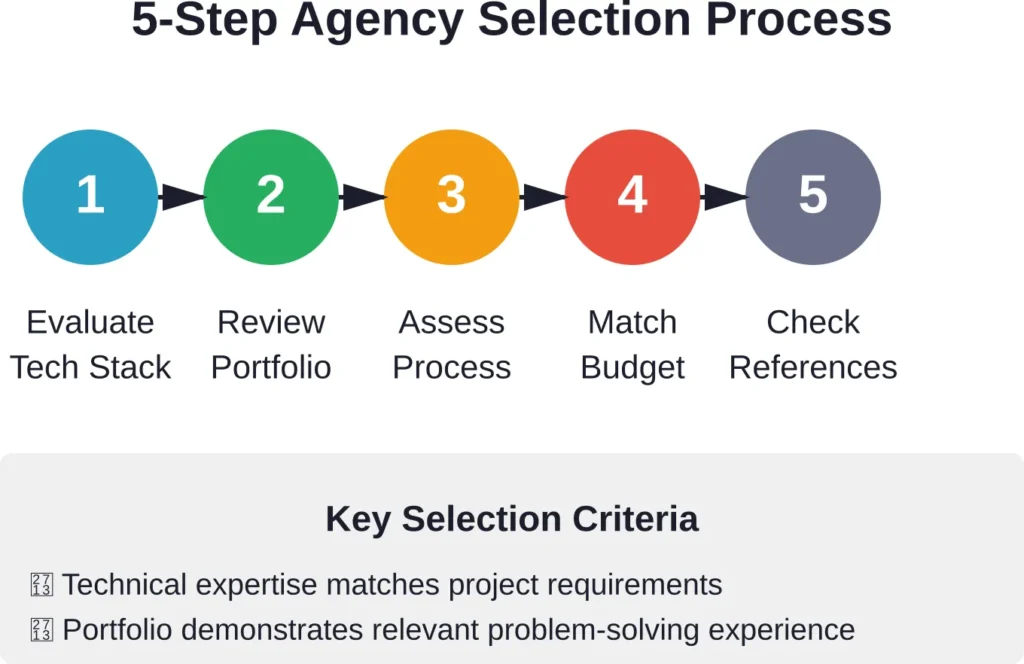
How to Choose the Right Custom Web Development Partner
Selecting an agency from this list—or any list—requires more than comparing hourly rates and portfolio screenshots.
The decision hinges on alignment: technical capabilities, cultural fit, communication style, and strategic vision all matter as much as design chops and coding skills.
Evaluate Technical Capabilities
Start by understanding what technologies and platforms your project requires. Different agencies specialize in different tech stacks.
Some excel with modern JavaScript frameworks like React, Vue, or Svelte. Others focus on robust content management systems like WordPress, Drupal, or headless CMS architectures. Still others specialize in custom web applications built on Ruby on Rails, Django, or Node.js.
Ask candidates about their technical approach. How do they handle scalability? What’s their deployment process? How do they ensure security and performance? The answers reveal depth of expertise beyond surface-level claims.
Assess Portfolio Quality and Relevance
Every agency showcases their best work. Look deeper than aesthetics—examine whether their previous projects solve problems similar to yours.
A stunning portfolio of marketing websites may not translate to complex web application development. An agency known for e-commerce might struggle with content-heavy publishing platforms.
Look for case studies that demonstrate problem-solving, not just final designs. How did they approach challenges? What metrics improved? How did users respond?
Consider Communication and Process
Development projects involve constant decision-making. Agencies with poor communication create frustration, delays, and misaligned expectations.
During initial conversations, notice how agencies explain their process. Do they ask insightful questions about your business? Do they push back on assumptions? Do they outline clear milestones and deliverables?
The best agencies establish clear workflows that keep projects on track while remaining flexible enough to accommodate discoveries and changes that emerge during development.
Match Budget to Value
Budget constraints are real, but false economy costs more in the long run. A $15,000 project that fails to achieve business goals wastes more money than a $50,000 project that drives measurable results.
Consider the potential return on investment. A well-executed custom web platform can drive customer acquisition, improve conversion rates, reduce support costs, or enable new business models. The right agency delivers value far exceeding their fees.
That said, match scope to budget realistically. Don’t expect enterprise-level results at startup-level pricing. Agencies priced at $25/hour can’t deliver the same strategic value as those at $200/hour—and that’s fine if your needs fit their capabilities.
Verify References and Reviews
Client reviews on platforms like Clutch provide valuable third-party validation, but don’t stop there. Ask agencies for direct references from recent projects similar to yours.
When speaking with references, ask specific questions: Did the project stay on budget? How did the agency handle challenges? Would they hire this agency again? What could have gone better?
Consistently positive feedback across multiple sources indicates reliable delivery. Mixed reviews or vague testimonials raise red flags worth investigating further.
Custom Web Development vs. Template Solutions
Before committing to custom development, it’s worth understanding when template-based solutions make more sense.
Custom development delivers maximum flexibility, performance optimization, and strategic alignment—but at significantly higher cost and longer timelines than template-based approaches.
When Custom Development Makes Sense
Choose custom development when your requirements include:
- Complex functionality that templates can’t accommodate
- Unique user experiences that differentiate your brand
- Integration with proprietary systems or databases
- Performance requirements beyond what templates deliver
- Scalability needs for high-traffic or high-transaction volumes
- Competitive advantage dependent on digital experience
Companies in these situations benefit from the flexibility and control that custom development provides. The investment pays dividends through better user experiences, operational efficiency, and competitive positioning.
When Templates Work Fine
Consider template-based solutions when:
- Budget constraints make custom development impractical
- Timeline requirements demand faster launch
- Functional needs align well with existing templates
- The website serves primarily informational purposes
- Brand differentiation happens offline or through other channels
Many businesses succeed perfectly well with thoughtfully customized templates. WordPress themes, Shopify templates, and other platform-based solutions have matured dramatically. Paired with good design sense and strategic thinking, templates can deliver excellent results at a fraction of custom development costs.
The Custom Web Development Process
Understanding what happens during a custom development project helps set realistic expectations and prepare for your role in the process.
While specific methodologies vary by agency, most custom web development follows a similar arc from discovery through launch and beyond.
Discovery and Strategy Phase
Projects begin with research and planning. The agency interviews stakeholders, analyzes competitors, reviews existing analytics, and documents technical requirements.
This phase typically includes:
- Stakeholder interviews and workshops
- User research and persona development
- Technical architecture planning
- Feature prioritization and roadmapping
- Content audit and strategy
Discovery work prevents costly mistakes later. Time invested upfront clarifying goals, understanding users, and aligning on priorities pays back through smoother development and better outcomes.
Design and Prototyping
With strategy established, designers create wireframes, mockups, and interactive prototypes that visualize the final product.
Modern agencies typically design in stages—starting with rough wireframes to establish structure and flow, then progressing to higher-fidelity mockups that define visual style, and finally creating interactive prototypes that demonstrate user interactions.
This iterative approach allows for course corrections before development begins. Changes cost less in design than in code.
Development and Testing
Developers translate approved designs into functional code, building out both front-end interfaces and back-end systems.
Quality agencies build and test simultaneously, catching bugs early rather than discovering them after full development. Regular demonstrations keep clients informed and allow for feedback throughout the process.
Testing includes functional testing (does everything work?), browser testing (does it work everywhere?), performance testing (is it fast?), and security testing (is it safe?).
Launch and Beyond
Launch day isn’t the finish line—it’s the starting line. Post-launch support, monitoring, optimization, and iteration determine long-term success.
Most agencies offer ongoing support packages that handle maintenance, updates, performance monitoring, and incremental improvements based on real user data.
The best digital products evolve continuously based on user feedback and changing business needs. Plan for iteration from the start rather than treating launch as the end of the relationship.
Key Technologies in Custom Web Development
Custom web development leverages dozens of frameworks, platforms, and technologies. Understanding the landscape helps evaluate agency capabilities and proposals.
Front-End Frameworks
The front-end—what users see and interact with—is typically built using modern JavaScript frameworks that enable dynamic, responsive interfaces.
React dominates the enterprise space, offering robust ecosystem support and widespread developer expertise. Vue provides a gentler learning curve and excellent documentation. Svelte delivers impressive performance through compile-time optimization.
Each framework has strengths and trade-offs. React’s popularity means abundant third-party libraries and easy hiring. Vue’s simplicity accelerates development for smaller teams. Svelte’s performance benefits complex, interactive applications.
Back-End Technologies
Server-side development handles business logic, database operations, authentication, and API services. Common choices include Node.js, Ruby on Rails, Python with Django or Flask, PHP with Laravel, and Java or C# for enterprise applications.
Technology selection depends on project requirements, team expertise, and integration needs. Node.js enables JavaScript across the entire stack. Rails accelerates development with convention over configuration. Django provides robust security and admin tools out of the box.
Content Management Systems
Many custom websites incorporate CMS platforms to enable non-technical content updates. WordPress powers millions of sites and offers extensive customization. Drupal handles complex content models and high-traffic scenarios. Headless CMS options like Contentful, Sanity, or Strapi separate content management from presentation.
| Platform | Best For | Key Strength | Consideration |
|---|---|---|---|
| WordPress | Content sites, blogs, marketing | Extensive plugin ecosystem | Security requires maintenance |
| Drupal | Enterprise, complex content | Robust permissions and workflows | Steeper learning curve |
| Headless CMS | Multi-channel publishing | Flexibility and performance | More technical setup |
| Custom CMS | Unique workflow requirements | Perfect fit for specific needs | Higher development cost |
Common Mistakes When Hiring Web Development Agencies
Even experienced teams make missteps when selecting and working with development partners. Avoiding these common pitfalls improves project outcomes.
Choosing Based Solely on Price
The cheapest proposal often proves most expensive once you factor in delays, quality issues, poor communication, and eventual rework.
Development expertise commands fair compensation. Agencies that underbid either lack experience, cut corners on quality, or will surprise clients with scope creep and change orders.
Evaluate total value, not just initial cost. Consider expertise, portfolio quality, communication effectiveness, and strategic value alongside pricing.
Inadequate Requirements Documentation
Vague requirements lead to misaligned expectations and disappointment. “We need a website” doesn’t provide enough direction for accurate proposals or successful development.
Document functional requirements, target users, success metrics, technical constraints, and timeline expectations before approaching agencies. Clear requirements enable accurate proposals and productive discovery conversations.
Skipping the Discovery Phase
Some clients push to skip discovery work and “just start building” to save time and money. This inevitably backfires.
Discovery prevents expensive mistakes, aligns stakeholders, validates assumptions, and establishes the strategic foundation for everything that follows. Skipping it saves a few thousand dollars upfront while risking tens of thousands in eventual rework.
Insufficient Client Involvement
Successful projects require active client participation. Development isn’t something agencies do to clients—it’s something agencies and clients do together.
Plan for regular meetings, timely feedback, and decision-making throughout the project. Delays on the client side derail timelines as surely as delays on the agency side.
Treating Launch as Completion
Many clients view launch as project completion. In reality, launch marks the beginning of the real work—optimization, iteration, and continuous improvement based on user data.
Budget and plan for post-launch support from the start. The best digital products evolve based on real-world usage, not assumptions made during development.
Measuring Custom Web Development Success
How do you know whether a custom development project succeeded? Success metrics should be established during discovery and tracked throughout the project lifecycle.
Technical Metrics
Performance benchmarks provide objective measures of technical quality:
- Page load time under 3 seconds on mobile
- Core Web Vitals passing Google’s thresholds
- Uptime above 99.9%
- Zero critical security vulnerabilities
- Accessibility compliance with WCAG 2.1 Level AA
These technical foundations enable business results but aren’t ends in themselves. Fast, secure, accessible websites serve users better—that improved experience drives business outcomes.
Business Metrics
Ultimately, custom development succeeds when it improves business performance:
- Increased conversion rates
- Higher customer lifetime value
- Reduced customer acquisition costs
- Improved customer satisfaction scores
- Decreased support costs
- Revenue growth attributable to digital channels
Define success metrics during the strategy phase and implement tracking from launch. Analytics without goals provide data but not insights. Goals without measurement provide aspirations but not accountability.
User Experience Metrics
User behavior data reveals whether the website actually serves its audience effectively:
- Task completion rates
- Time to complete key workflows
- Bounce rates and engagement metrics
- Search effectiveness
- Mobile vs. desktop behavior differences
User testing and feedback collection complement quantitative analytics. Numbers show what users do; qualitative research reveals why they do it.
Industry Standards in Custom Web Development
While custom development offers maximum flexibility, it still operates within established standards and best practices that ensure quality and compatibility.
Technical Standards
Organizations like the W3C and WHATWG develop and maintain technical standards that ensure websites work across browsers, devices, and assistive technologies. Custom development that ignores standards sacrifices compatibility and accessibility.
Security and Privacy Standards
Data protection regulations like GDPR, CCPA, and emerging privacy laws worldwide establish baseline requirements for handling user data. Custom development must incorporate privacy by design, secure data handling, and appropriate consent mechanisms.
Security standards address authentication, data encryption, vulnerability management, and incident response. Professional agencies implement security best practices throughout development rather than bolting them on afterward.
Accessibility Standards
Web Content Accessibility Guidelines establish criteria for making digital content accessible to people with disabilities. WCAG 2.1 Level AA compliance represents the baseline for professional custom development.
Accessibility benefits everyone, not just people with disabilities. Clear navigation, readable text, keyboard operability, and logical structure improve usability across the board.
Future Trends in Custom Web Development
The web development landscape continues evolving. Understanding emerging trends helps future-proof investment decisions.
AI and Machine Learning Integration
Artificial intelligence capabilities are increasingly woven into custom web applications. Practical AI applications in custom web development include personalization engines, predictive search, content recommendations, chatbots, and automated testing. These capabilities differentiate digital experiences and improve outcomes when implemented thoughtfully.
Jamstack Architecture
The Jamstack approach—JavaScript, APIs, and Markup—decouples front-end presentation from back-end services. This architecture delivers performance, security, and scalability advantages over traditional monolithic approaches.
Static site generators combined with headless CMS platforms and serverless functions enable fast, secure websites that scale effortlessly. Agencies increasingly adopt Jamstack principles for projects where they fit.
Progressive Web Apps
Progressive Web Apps blur lines between websites and native applications, offering offline functionality, push notifications, and app-like experiences through web technologies.
PWAs eliminate app store friction while delivering native-like experiences. For many use cases, they provide better reach and lower development costs than separate native applications.
Voice and Conversational Interfaces
Voice interaction and conversational UI present new design and development challenges. Custom applications increasingly incorporate voice search, voice commands, and chatbot interfaces.
These interfaces require rethinking information architecture and interaction patterns beyond traditional visual interfaces. Agencies with expertise in conversational design help clients navigate this emerging landscape.
Frequently Asked Questions
Custom web development costs vary dramatically based on scope and complexity. Simple custom websites typically start around $10,000–$25,000. Mid-complexity web applications range from $50,000–$150,000. Enterprise platforms often exceed $250,000. Hourly rates across the industry range from $25–$300 depending on agency expertise and location. Rather than focusing solely on cost, evaluate the potential return on investment and match budget to project ambition realistically.
Timeline depends on project complexity and scope. Simple custom websites typically take 6–12 weeks from kickoff to launch. Medium-complexity projects span 3–6 months. Large enterprise platforms often require 6–12 months or longer. Discovery and strategy phases typically consume 2–4 weeks. Design work takes 3–6 weeks for most projects. Development timelines vary based on features and integration complexity. Plan for adequate time—rushed projects compromise quality.
Location matters less than it once did. Remote collaboration tools enable effective partnerships regardless of geography. That said, local agencies offer easier in-person meetings and shared time zones. Remote agencies often provide access to specialized expertise unavailable locally. Evaluate agencies based on portfolio quality, communication effectiveness, and cultural fit rather than location alone. The best agency for your project might be across town or across the country.
WordPress is a content management platform that can power custom websites, but “custom development” typically refers to building from scratch without platform constraints. Custom development offers maximum flexibility, optimized performance, and unique functionality. WordPress provides faster development, lower costs, and easier content management for appropriate use cases. Many successful custom projects use WordPress as the CMS while building custom themes and functionality. The choice depends on requirements, budget, timeline, and long-term maintenance considerations.
Start with clear contractual agreements that specify intellectual property ownership. Most agencies transfer full IP rights to clients upon final payment, but verify this explicitly in contracts. Non-disclosure agreements protect confidential information shared during discovery. For particularly sensitive projects, consider source code escrow arrangements. Work only with reputable agencies that have established legal frameworks and professional insurance. Intellectual property disputes are rare with professional agencies but prevention through clear contracts beats resolution after problems arise.
Essential questions include: Can you share case studies from similar projects? What’s your development process and timeline? Who will be on our project team? How do you handle scope changes? What’s included in your pricing? What happens after launch? Can you provide references from recent clients? What technologies do you recommend for our project and why? How do you approach accessibility and performance? What’s your communication cadence during projects? The quality of answers reveals as much as the content—good agencies provide thoughtful, detailed responses.
Yes. All websites require ongoing maintenance including security updates, performance monitoring, bug fixes, content updates, and feature enhancements. The complexity of maintenance correlates with website complexity. Simple sites might need only monthly updates. Complex applications require continuous monitoring and support. Most agencies offer maintenance packages at hourly rates or monthly retainers. Budget 10-20% of initial development costs annually for maintenance and improvements. Neglected websites accumulate technical debt, security vulnerabilities, and performance problems over time.
Making Your Decision
Choosing a custom web development partner ranks among the most impactful decisions for your digital strategy. The right agency becomes a true partner—understanding your business, challenging assumptions, and delivering solutions that drive measurable results.
The agencies profiled here represent diverse specializations, pricing tiers, and approaches. From product-focused boutiques like Excited to enterprise powerhouses like Code and Theory, from accessible options like Duck Design to premium studios like Ueno, each brings distinct strengths to the table.
But here’s what really matters: the best agency for your neighbor might be wrong for you. Success depends on alignment—matching your requirements, budget, timeline, and culture with an agency’s capabilities, process, and style.
Start by clarifying your own needs. What problems are you solving? What outcomes define success? What constraints shape your project? Document requirements, success metrics, and decision criteria before approaching agencies.
Then evaluate candidates systematically. Review portfolios for relevant experience. Assess technical capabilities against your requirements. Verify references and client satisfaction. Compare pricing in context of value delivered, not isolation.
Most importantly, trust your instincts about communication and cultural fit. Development projects involve intense collaboration over months. Work with people who listen well, communicate clearly, and share your commitment to excellence.
The digital landscape will continue evolving. Technologies change, standards emerge, user expectations rise. But the fundamentals endure—clear strategy, thoughtful design, solid technical execution, and continuous improvement based on real user needs.
Partner with an agency that understands this. One that views launch as a beginning, not an ending. One that measures success by your business results, not their portfolio additions.
Your website isn’t just code and pixels—it’s a strategic asset that can drive growth, improve experiences, and differentiate your brand. Choose your development partner accordingly.
Ready to start your custom web development project? Review the agencies profiled here, explore their portfolios, and begin conversations with those that align with your needs. The right partner is out there. Find them, trust them, and build something remarkable together.