

Quick Summary: Choosing the right Magento development partner is critical for ecommerce success. This guide profiles 15 leading Magento agencies across different regions and expertise levels, covering their specializations, pricing models, and ideal use cases. Understanding hourly rates ($25-$199), minimum project budgets, and partnership credentials helps businesses match their needs with the right technical expertise.
The Magento development landscape has shifted dramatically. Adobe Commerce continues to dominate enterprise ecommerce, but finding the right development partner has become more complex than ever.
Here’s the thing though—not all Magento agencies are created equal. Some excel at migrations. Others specialize in performance optimization. A few have mastered the emerging composable commerce architecture.
This guide cuts through the noise. The agencies listed here represent verified expertise, demonstrated through Adobe partnership status, client portfolios, and technical capabilities confirmed across multiple industry sources.
Understanding Magento Development Agency Pricing Models
Before diving into specific companies, understanding how Magento agencies structure their pricing helps set realistic expectations.
Most Magento development companies work on hourly billing. Rates vary significantly by region and the developer’s experience level. Industry reports suggest a senior developer in North America might charge between $100 and $200+ per hour. Developers in Eastern Europe typically fall in the $60 to $100 range, with rates varying by location and experience.
For fixed-scope projects, many agencies offer a set price. A basic store build might cost between $20,000 and $40,000, while more complex implementations easily exceed $50,000.
| Pricing Model | Typical Range | Best For |
|---|---|---|
| Hourly Rate (North America) | $100 – $200+ | Ongoing support, evolving scopes |
| Hourly Rate (Eastern Europe) | $60 – $100 | Cost-conscious projects |
| Hourly Rate (Asia) | $25 – $50 | Large development teams |
| Fixed Project (Basic) | $20,000 – $40,000 | Simple store builds |
| Fixed Project (Enterprise) | $50,000+ | Complex implementations |
The minimum project budget varies widely. Some agencies start at $5,000 for smaller tasks, while enterprise-focused firms require $50,000 minimum commitments.
Top 15 Magento Development Companies in 2026
These agencies represent diverse capabilities across different specializations, geographic locations, and pricing tiers.
1. Oski Solutions

Oski Solutions delivers strong technical implementations for Magento projects, with a focus on progressive web apps and modern e-commerce architectures. They maintain a solid reputation with consistent 4.7 out of 5 ratings across platforms.
Headquartered in Tallinn, Estonia, the agency serves clients across Europe and beyond. Their team excels in full-cycle development, including custom modules, API integrations, and performance optimizations for scalable online stores.
Best for: Businesses seeking reliable Magento PWA development and clean, maintainable e-commerce solutions.
Contact Information:
- Website: oski.site
- Phone: +48571282759
- Email: [email protected]
- Address: Kaupmehe tn 7, 10114 Tallinn, Estonia
- LinkedIn: www.linkedin.com/company/oski-solutions
2. Gilzor

Gilzor brings expertise in custom e-commerce builds and platform migrations, helping businesses create tailored shopping experiences. They earn high marks with a 4.8 out of 5 average rating.
With a global team presence across Europe and North America, Gilzor specializes in end-to-end web development tied to real business needs. Their work covers Magento implementations, marketplace features, and ongoing support for growing retail operations.
Best for: Startups and SMBs needing custom Magento solutions aligned with specific operational goals.
Contact Information:
- Website: www.gilzor.com
- Email: [email protected]
- Address: Poland, Warsaw, Office 58, street Adama Mickiewicza 37, 01-625
- LinkedIn: www.linkedin.com/company/gilzor-softwaredevelopment
3. A-Listware

A-Listware stands out for Magento integrations with enterprise systems like ERP and CRM. They hold a steady 4.6 out of 5 rating reflecting quality delivery.
Based in the United States with strong development capabilities, the agency handles complex e-commerce ecosystems. Their services include custom development, platform enhancements, and seamless connections between Magento and other business tools.
Best for: Companies requiring deep Magento integrations and enterprise-level system connectivity.
Contact Information:
- Website: a-listware.com
- Phone: +1 (888) 337 93 73
- Email: [email protected]
- Address: North Bergen, NJ 07047, USA
- LinkedIn: www.linkedin.com/company/a-listware
- Facebook: www.facebook.com/alistware
4. Mobian Studio

Mobian Studio focuses on high-performance Magento solutions combined with mobile and AI capabilities. They maintain an impressive 4.7 out of 5 rating.
Operating from Europe, the agency supports clients in IT, healthcare, fintech, and logistics. They deliver scalable architectures, custom extensions, and integrated digital experiences built on Magento.
Best for: Businesses in regulated or tech-driven industries looking for modern Magento development with mobile and AI extensions.
Contact Information:
- Website: mobian.studio
- Phone: [email protected]
- Address: Harju maakond, Tallinn, Kesklinnalinnaosa, Masina tn 22, 10113
- LinkedIn: www.linkedin.com/company/mobian-studio
5. Lengreo

Lengreo combines Magento development with full-cycle e-commerce and digital marketing expertise. Their projects consistently receive around 4.6 out of 5 ratings.
Headquartered in Kyiv, Ukraine, with European reach, the agency creates robust online stores and supports them with SEO and conversion strategies. They handle everything from initial setup to advanced customizations and performance tuning.
Best for: Growing e-commerce brands that want integrated development and marketing support on Magento.
Contact Information:
- Website: Lengreo.com
- Phone: +31 686 147 566
- Email: [email protected]
- Address: Vrijstraat 9 C/D, 5611 AT Eindhoven, Netherlands
- LinkedIn: Lengreo
- Twitter: @Lengreo
- Instagram: @lengreo
6. Scandiweb

Scandiweb stands out as one of the most technically accomplished Magento agencies globally.
Headquartered in Stockholm, Sweden, Scandiweb maintains a strong presence across Europe and North America. The agency has earned Adobe Silver Partnership status and holds Hyvä Platinum Partner credentials—one of only a handful globally.
Their expertise spans enterprise-level implementations, progressive web app development, and headless commerce architectures. Scandiweb has worked with major retail brands requiring sophisticated catalog management and multi-region deployments.
Best for: Large enterprises needing advanced technical capabilities and modern frontend implementations.
7. Discretelogix

Operating at a more accessible price point, Discretelogix charges between $25 and $50 per hour with a $10,000 minimum project budget. Despite the lower rates, they maintain an impressive 4.8 out of 5 rating.
This agency focuses on mid-market businesses looking for solid Magento 2 implementations without enterprise-level budgets. Their team handles everything from initial store setup to custom module development and third-party integrations.
Discretelogix operates with development teams in Asia, allowing them to offer competitive pricing while maintaining quality standards. They’ve built a reputation for responsive communication and meeting deadlines.
Best for: Growing businesses with $10,000 to $50,000 budgets needing reliable Magento 2 development.
8. Ziffity Solutions

Ziffity occupies the mid-range pricing tier at $100 to $149 per hour, requiring a $25,000 minimum project size. Their 4.7 out of 5 rating reflects consistent delivery across diverse project types.
This agency brings deep technical expertise in Magento migration projects. Businesses running on outdated Magento 1 instances or looking to transition from other platforms often turn to Ziffity for structured migration methodologies.
Beyond migrations, Ziffity handles custom extension development, performance optimization, and ongoing managed services. Their team includes multiple Adobe Certified Experts.
Best for: Businesses planning platform migrations or requiring certified Magento expertise.
9. Webjump

Brazilian-based Webjump charges $100 to $149 hourly with a $30,000 minimum engagement. They hold a 4.6 out of 5 rating and serve primarily Latin American and North American markets.
Webjump differentiates itself through strong capabilities in payment gateway integrations—particularly important for Latin American merchants dealing with regional payment methods. They understand the complexities of multi-currency operations and local tax requirements.
The agency also provides comprehensive training programs, helping internal teams manage their Magento stores post-launch. This reduces long-term dependency on external developers.
Best for: Latin American businesses or companies expanding into Latin American markets.
10. Brainvire Infotech
Brainvire Infotech operates in the $25 to $49 hourly range with a $25,000 minimum project size. They maintain offices across the United States, United Kingdom, and India.
This multi-location setup gives Brainvire flexibility in resource allocation. Complex requirements get handled by senior architects in Western offices, while development execution happens through their larger Indian team.
Brainvire has particular strength in B2B ecommerce implementations. They understand the nuances of quote management, customer-specific pricing, purchase order workflows, and approval hierarchies that B2B merchants require.
Best for: B2B merchants needing sophisticated customer account management and pricing structures.
11. EbizON Digital

With the lowest entry point on this list, EbizON Digital starts projects at $5,000 while charging $25 to $49 per hour. Their 4.7 out of 5 rating shows they deliver quality despite smaller project sizes.
EbizON focuses on quick-turn projects—extension customizations, theme modifications, performance audits, and targeted feature additions. They’re not building enterprise platforms from scratch but excel at tactical improvements.
Small businesses that need specific problems solved without committing to massive retainers find EbizON particularly valuable. Their project managers scope work tightly to stay within budget constraints.
Best for: Small businesses needing specific enhancements or fixes with limited budgets.
12. Rave Digital

Rave Digital commands $100 to $149 per hour with a $50,000 minimum project budget. As an Adobe Silver Partner, they bring official partnership benefits to client engagements.
Their locations span the USA, UK, Belarus, and India, giving them global delivery capabilities with follow-the-sun development models. This geographic distribution accelerates project timelines.
Rave Digital emphasizes conversion rate optimization alongside technical development. They approach Magento projects with a marketing mindset, considering how technical decisions impact customer acquisition and retention metrics.
Best for: Marketing-savvy merchants who want development aligned with conversion optimization.
13. Elogic Commerce
Elogic Commerce is listed among top Magento development companies and has built a reputation for Magento-specific expertise. They focus exclusively on Adobe Commerce, avoiding the dilution that comes from supporting multiple platforms.
The agency operates from Eastern Europe, delivering Western-standard quality at more accessible rates. Their portfolio includes fashion retailers, consumer electronics stores, and specialty product merchants.
Elogic invests heavily in Magento community contributions. Several team members have authored popular open-source extensions and actively participate in Magento forums and events.
Best for: Merchants wanting pure-play Magento specialists without enterprise pricing.
14. Magneto IT Solutions
Magneto IT Solutions appears in the Adobe Solution Partner Directory, confirming their official partnership status. The agency handles everything from initial consulting through long-term support.
They’ve developed particular expertise in inventory management integrations, connecting Magento stores with warehouse management systems, POS platforms, and ERP solutions. This makes them valuable for omnichannel retailers.
Magneto IT Solutions also offers managed hosting services, taking responsibility for server performance, security patches, and infrastructure scaling alongside application development.
Best for: Omnichannel retailers needing deep integration capabilities.
15. IWD Agency

IWD Agency combines development services with their own suite of popular Magento extensions. This dual focus gives them intimate knowledge of the platform’s extension ecosystem.
As an Adobe Solution Partner, IWD brings official support channels and early access to Adobe roadmaps. Their extension products—particularly their checkout optimization suite—power thousands of Magento stores globally.
Working with IWD means access to both custom development and proven pre-built solutions. They can quickly assess whether a custom build or an existing extension better serves specific requirements.
Best for: Merchants looking for a mix of custom development and proven extension solutions.
What to Look for When Choosing a Magento Development Company
Selecting the right Magento partner involves more than comparing hourly rates. Several factors determine long-term success.
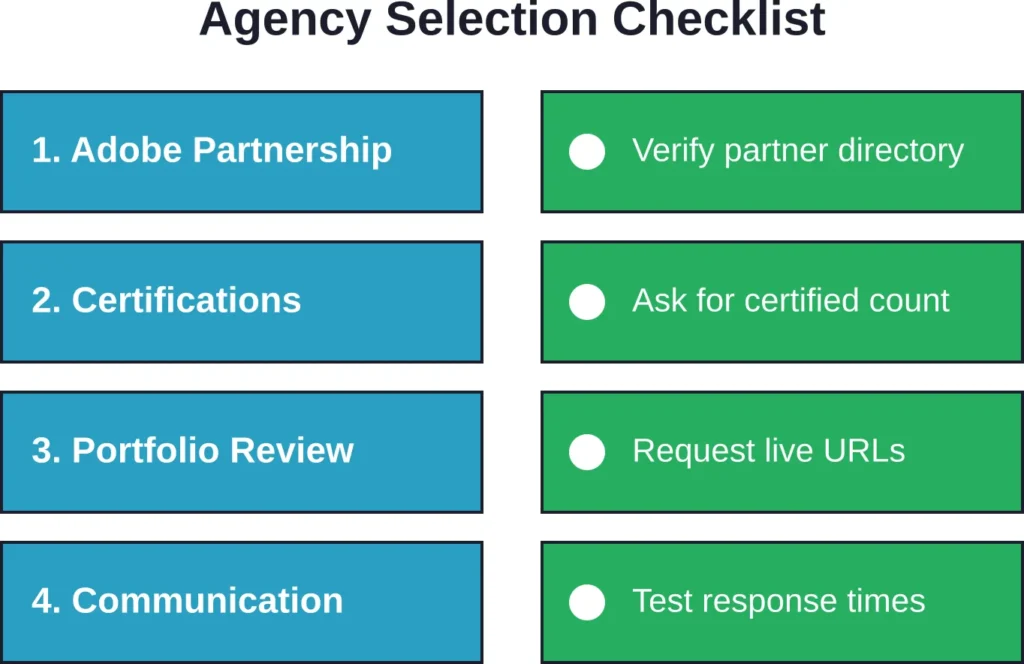
Adobe Partnership Status
Adobe maintains an official partner program with different tiers. Partners listed in the Adobe Solution Partner Directory have met specific technical and business requirements.
Silver and Gold partners receive training, early access to platform updates, and direct support channels with Adobe. This translates to faster issue resolution and better alignment with platform roadmaps.
That said, partnership status alone doesn’t guarantee quality. Some excellent agencies choose not to pursue formal partnership due to the associated costs and requirements.
Technical Certifications
Adobe offers individual developer certifications across different specializations—frontend development, backend development, solution architecture, and business practitioner roles.
Agencies with multiple certified developers demonstrate investment in technical education. These certifications require passing rigorous exams covering platform architecture, best practices, and advanced capabilities.
During vetting conversations, ask how many certified developers will work on the project. Some agencies tout certifications held by founders who no longer code.
Specialization Match
General Magento competence differs from specialized expertise in specific areas. Consider what the project truly needs.
Migration projects require different skills than greenfield builds. B2B implementations involve complexity that B2C developers might not understand. Multi-region deployments demand localization and compliance knowledge.
Review agency portfolios for projects similar in scope and industry. A fashion retailer shouldn’t necessarily hire an agency whose portfolio consists entirely of industrial equipment suppliers.
Portfolio Quality Over Quantity
Some agencies list hundreds of completed projects. Others showcase a dozen carefully selected works.
Quality matters more than volume. Look for detailed case studies explaining the business problem, technical approach, and measurable outcomes. Screenshots and URLs allow independent evaluation of the work.
Real talk: if an agency can’t share live URLs or detailed case studies citing confidentiality for every project, that’s a red flag.
Communication and Timezone Overlap
Technical capability means nothing if communication breaks down. Agencies operating in dramatically different timezones can slow decision-making and troubleshooting.
Some businesses don’t mind asynchronous communication. Others need real-time collaboration. Be honest about communication preferences during initial discussions.
Many global agencies structure teams to maintain overlap with client timezones. Ask specifically how they handle urgent issues and what response time guarantees they offer.
Key Trends Shaping Magento Development in 2026
The Magento ecosystem continues evolving. Agencies that stay current with these trends deliver more future-proof solutions.
Composable Commerce Architecture
Traditional monolithic ecommerce platforms are giving way to composable architectures. Instead of one platform handling everything, businesses assemble best-of-breed services.
Magento increasingly serves as the commerce engine while headless frontends, separate search services, and dedicated CMS platforms handle specific functions. Leading agencies now architect solutions around API-first principles.
This shift requires different expertise. Look for agencies discussing GraphQL, microservices, and API gateway patterns—not just traditional PHP development.
Performance Optimization Focus
Page speed directly impacts conversion rates. Google’s Core Web Vitals have made performance a ranking factor.
Modern Magento development emphasizes performance from day one. This includes database query optimization, proper caching strategies, image optimization, and critical rendering path improvements.
Agencies should discuss performance budgets, monitoring strategies, and specific optimization techniques during initial conversations. Vague promises about “fast sites” aren’t enough.
Hyvä Themes Adoption
Hyvä represents the most significant frontend innovation in Magento’s recent history. This modern theme architecture eliminates much of the JavaScript bloat that plagued traditional Magento frontends.
Stores built on Hyvä load dramatically faster with cleaner code and better maintainability. But not all agencies have Hyvä expertise yet.
If frontend performance matters—and it should—prioritize agencies with Hyvä partnership status or demonstrated Hyvä projects in their portfolio.
Enhanced B2B Capabilities
Adobe has invested heavily in B2B features. The platform now handles sophisticated customer hierarchies, negotiated pricing, quote workflows, and purchase order systems.
B2B ecommerce represents massive growth opportunity. Agencies specializing in B2B implementations understand the unique requirements around customer account management, approval workflows, and integration with ERP systems.
Red Flags to Watch During Agency Vetting
Certain warning signs indicate potential problems down the road.
Unwillingness to provide references. Every legitimate agency has satisfied clients willing to speak about their experience. Refusal to provide references or evasive responses about past clients suggest problems.
Over-promising on timelines. Experienced developers provide realistic estimates with built-in contingency. Agencies promising aggressive timelines they can’t possibly meet either don’t understand the work or plan to cut corners.
Lack of discovery process. Quality agencies invest time understanding business requirements before proposing solutions. Fixed quotes provided after a 30-minute call likely miss critical requirements.
No discussion of post-launch support. Launching a Magento store is just the beginning. Ongoing maintenance, security patches, and feature enhancements require continuing relationship. Agencies focused only on initial build often disappear after launch.
Pressure tactics. Artificial urgency and high-pressure sales approaches suggest agencies struggling to fill pipelines. Quality agencies stay busy through referrals and have structured sales processes without manipulation.
Questions to Ask During Initial Consultations
These questions help evaluate agency fit beyond surface-level marketing.
“How many active Magento projects do you currently support?” This reveals capacity. Agencies stretched too thin struggle to provide adequate attention.
“What’s your typical team structure for a project like mine?” Understanding who will actually work on the project matters more than the agency’s total headcount.
“Can you walk me through your development process from kickoff to launch?” Quality agencies have documented methodologies covering requirements gathering, design, development, testing, and deployment.
“How do you handle scope changes and additional requests?” Every project encounters changes. Clear change management processes prevent budget overruns and finger-pointing.
“What happens if key team members leave mid-project?” People change jobs. Agencies should have succession plans and knowledge transfer processes preventing disruption.
“Do you provide training for our internal team?” Post-launch independence requires knowledge transfer. Quality agencies build training into project plans.
Regional Considerations for Magento Development
Geography impacts more than just pricing. Different regions offer distinct advantages.
North American Agencies
North American agencies command premium rates but offer timezone alignment, cultural familiarity, and easier legal recourse if disputes arise.
For businesses operating primarily in North American markets, local agencies understand regional payment preferences, shipping logistics, and compliance requirements intuitively.
European Agencies
European agencies, particularly those in Eastern Europe, balance quality and cost effectively. Countries like Latvia, Poland, and Romania have strong technical education systems producing excellent developers.
European agencies also bring deep GDPR expertise—critical for any business serving European customers.
Asian Agencies
Asian development teams offer the most competitive pricing. India, in particular, has massive Magento expertise with thousands of certified developers.
Timezone differences require adjustment but can accelerate development through follow-the-sun models. Work continues around the clock with proper coordination.
| Region | Typical Hourly Rate | Key Advantages | Considerations |
|---|---|---|---|
| North America | $100 – $200+ | Timezone alignment, cultural fit | Premium pricing |
| Western Europe | $100 – $150 | GDPR expertise, quality standards | Language barriers in some countries |
| Eastern Europe | $60 – $100 | Strong technical skills, good value | Some timezone offset |
| Asia | $25 – $60 | Cost-effective, large talent pools | Significant timezone differences |
Making the Final Decision
After researching agencies, requesting proposals, and conducting interviews, the decision often comes down to intangibles.
Trust matters. Technical capability is table stakes among qualified agencies. The differentiator often becomes communication quality, cultural fit, and confidence in the team.
Pay attention to how agencies respond to questions. Do they listen carefully or push predetermined solutions? Do they acknowledge uncertainty or pretend to know everything?
The best agency relationships feel like partnerships. Both parties invest in success, communicate openly about challenges, and work collaboratively toward solutions.
Price shouldn’t be the only factor. The cheapest option rarely delivers the best value. But the most expensive doesn’t automatically mean the best either.
Consider the total cost of ownership—not just initial development but ongoing support, maintenance, and future enhancements. An agency charging higher rates but delivering maintainable, well-documented code often costs less long-term than cheap, messy implementations requiring constant fixes.
Frequently Asked Questions
Agencies provide teams with diverse specializations—backend developers, frontend specialists, project managers, and QA testers. Freelancers offer individual expertise, usually at lower rates but with limited capacity. Agencies handle larger, more complex projects with redundancy if team members become unavailable. Freelancers work well for smaller, tactical projects or ongoing maintenance tasks. The choice depends on project scope, timeline, and required skill diversity.
Timeline varies dramatically based on complexity. A simple store with minimal customization might launch in 8 to 12 weeks. Mid-complexity stores with custom integrations typically require 3 to 6 months. Enterprise implementations with complex workflows, multiple integrations, and custom modules often take 6 to 12 months or longer. Agencies should provide detailed project timelines during the proposal phase, broken into specific milestones.
Magento Open Source provides core ecommerce functionality at no licensing cost, making it suitable for small to mid-sized businesses. Adobe Commerce adds enterprise features like advanced marketing tools, B2B capabilities, enhanced security, and official support from Adobe. It requires annual licensing fees but includes features that would otherwise require third-party extensions. Businesses with annual revenue under $5 million typically start with Open Source. Larger operations benefit from Adobe Commerce’s additional capabilities.
Platform migration represents a core service for most Magento agencies. Agencies handle data migration from Shopify, WooCommerce, BigCommerce, and legacy custom platforms. Quality migration includes transferring products, customers, order history, and SEO elements while minimizing downtime. Experienced agencies follow structured migration methodologies with extensive testing before cutover. Expect migration projects to cost more than greenfield builds due to data mapping complexity and legacy system integration.
Ongoing costs include hosting infrastructure, security patches, extension updates, and functional enhancements. Hosting for Magento typically ranges from $200 to $2,000 monthly depending on traffic and performance requirements. Agencies often offer managed support retainers covering security updates, minor bug fixes, and technical questions, typically starting around $1,000 monthly. Budget separately for major feature additions, design refreshes, and integration work. Total ongoing costs usually run 15 to 25 percent of the initial development budget annually.
Adobe maintains a public Solution Partner Directory listing all official partners. Visit the Adobe Partner website and search by company name. Legitimate partners appear with their tier status, specializations, and location details. Be cautious of agencies claiming partnership without directory verification. Some agencies list former partnership status after their certification lapsed. Always verify current status directly through Adobe’s official directory rather than relying solely on agency website claims.
Successful offshore relationships establish clear communication protocols. Schedule regular video calls during overlapping business hours, even if that means early mornings or late evenings for one party. Use project management tools providing visibility into progress without requiring synchronous communication. Many offshore agencies assign project managers in client timezones for real-time communication while development teams work offshore. Define response time expectations for different priority levels. Critical issues might require 2-hour response commitments while routine questions can wait 24 hours.
Moving Forward with Confidence
The Magento development landscape offers exceptional talent across diverse specializations and pricing tiers. No single agency fits every business.
Small businesses launching their first ecommerce store have different needs than enterprise retailers managing millions in annual revenue. B2B wholesalers require different expertise than consumer fashion brands.
The agencies profiled here represent proven capabilities across different niches. Start by clarifying project requirements, budget constraints, and timeline expectations. Then match those needs to agencies with demonstrated expertise in similar projects.
Request detailed proposals from three to five agencies. Compare not just pricing but also proposed approaches, team composition, and communication style.
Check references thoroughly. Speak with past clients about their experience—not just the successful projects agencies volunteer but also how they handled challenges and changes.
Remember that the cheapest option rarely delivers the best value. Magento represents a significant business investment. Cutting corners on development creates technical debt requiring expensive fixes later.
Choose partners who ask difficult questions, challenge assumptions, and push back on unrealistic expectations. Those uncomfortable conversations during sales processes indicate agencies focused on long-term success rather than just closing deals.
The right Magento agency becomes a strategic partner driving revenue growth, not just a vendor executing tickets. Invest the time to find that partnership, and the returns will justify the effort.