

Quick Summary: This guide profiles 14 leading Node.js web development agencies in 2026, covering their expertise, team structure, service offerings, and ideal project types. Each company has been evaluated for technical depth, scalability support, and industry experience to help businesses find the right development partner for their Node.js projects.
Node.js has become the backbone of modern web infrastructure. With over 350 million monthly downloads across all versions, Node.js v22+ growing rapidly with 120 million downloads, the platform continues to dominate backend development in 2026.
But here’s the thing: finding the right Node.js development partner isn’t just about technical competence. It’s about alignment—does the agency understand your industry, your scale, and your timeline?
This guide cuts through the noise. We’ve evaluated agencies based on real project delivery, technical depth, and client outcomes. No fluff, no invented rankings—just practical insights to help you make an informed choice.
Why Node.js Remains the Top Choice for Web Development
The numbers speak clearly. Global Node.js job postings showed 28% year-over-year increase in 2024. According to industry analyses, 49.1% of professional developers worldwide use Node.js, making it the most popular web framework.
What’s driving this adoption? Three core advantages:
- Event-driven architecture enables non-blocking I/O, delivering superior concurrency performance in typical I/O-heavy scenarios compared to traditional multi-threaded servers
- JavaScript everywhere means one language across frontend and backend, reducing context switching and team fragmentation
- Real-time capabilities built into the core platform, making it ideal for chat systems, collaboration tools, and live dashboards
Netflix and PayPal achieved significant improvements through Node.js deployment, including startup time reduction and response time improvement. These aren’t edge cases—they represent what happens when the architecture matches the workload.
The Node.js ecosystem has also matured significantly. With solutions like airis-mcp-gateway, a Docker-based MCP multiplexer that aggregates 60+ tools behind 7 meta-tools, reducing context token usage by 97%, the platform continues to evolve for modern development workflows.
How We Selected These Companies
Every agency on this list met three baseline criteria:
Technical depth. Proven experience with Node.js core capabilities—API development, microservices architecture, real-time systems, and database integration. We looked for teams that understand event loops, async patterns, and performance optimization.
Delivery track record. Actual shipped projects, not just promises. We reviewed case studies, client testimonials, and public references to verify execution capability.
Specialization clarity. Each agency brings distinct strengths. Some excel at enterprise systems, others at rapid prototyping for startups. We prioritized firms that clearly define their sweet spot rather than claiming to do everything.
We excluded agencies that couldn’t demonstrate current Node.js projects or those with outdated portfolios. The web moves fast—your development partner should too.
The 15 Best Node.js Web Development Companies
1. Gilzor — Full-Cycle Web and Backend Development
Gilzor delivers end-to-end web solutions with a strong emphasis on custom Node.js backends. The team excels at turning ideas into scalable digital products, combining robust server-side architecture with clean frontend integration for startups and growing businesses.
Core capabilities:
- Node.js backend architecture and REST/GraphQL API development
- Full-stack web application development
- Real-time features and WebSocket implementations
- Database design and optimization (MongoDB, PostgreSQL, Redis)
- Cloud deployment and DevOps practices
- Integration with third-party services and payment systems
Ideal for: Startups validating and launching new web products, small and medium businesses expanding their digital presence, and product teams needing reliable backend infrastructure.
Their engagement model focuses on close collaboration from discovery through post-launch support, with transparent processes and dedicated technical leadership.
Contact Information:
- Website: www.gilzor.com
- Email: [email protected]
- Address: Poland, Warsaw, Office 58, street Adama Mickiewicza 37, 01-625
- LinkedIn: www.linkedin.com/company/gilzor-softwaredevelopment
2. Oski — Smart Web Solutions and Cloud Development
Oski builds well-engineered web platforms and enterprise-grade solutions using modern Node.js practices. They specialize in creating scalable, maintainable systems that combine strong backend performance with intuitive user experiences.
Core capabilities:
- Node.js microservices and API development
- Cloud-native web applications
- Real-time data processing and synchronization
- Frontend-backend integration with modern JavaScript frameworks
- CMS and custom web platform development
- Performance optimization and scalability engineering
Ideal for: Tech-forward enterprises, ambitious startups, and companies in logistics, e-commerce, fintech, and education looking for reliable web development partners.
They emphasize seamless project management and quick team ramp-up, working as an extension of client teams with clear communication and AI-accelerated delivery practices.
Contact Information:
- Website: oski.site
- Phone: +48571282759
- Email: [email protected]
- Address: Kaupmehe tn 7, 10114 Tallinn, Estonia
- LinkedIn: www.linkedin.com/company/oski-solutions
3. A-Listware — Node.js Development and Dedicated Teams

A-Listware provides expert Node.js development services and dedicated engineering teams for web applications. They focus on delivering high-quality, secure, and responsive digital solutions tailored to client-specific requirements.
Core capabilities:
- Custom Node.js web application development
- Backend API design and implementation
- Cloud application development with Node.js
- Integration and enterprise system connectivity
- Scalable architecture for web platforms
- Full-stack development with modern JavaScript ecosystem
Ideal for: Companies seeking dedicated Node.js expertise, businesses building enterprise web solutions, and organizations needing flexible development team augmentation.
Their approach ensures seamless integration with client workflows, round-the-clock availability when required, and consistent delivery through structured collaboration.
Contact Information:
- Website: a-listware.com
- Phone: +1 (888) 337 93 73
- Email: [email protected]
- Address: North Bergen, NJ 07047, USA
- LinkedIn: www.linkedin.com/company/a-listware
- Facebook: www.facebook.com/alistware
4. Mobian — AI-Powered Node.js and Full-Stack Development
Mobian creates production-ready web and backend solutions with Node.js at the core, specializing in scalable architectures and intelligent systems. They deliver dedicated teams that build clean, maintainable code for complex digital products.
Core capabilities:
- Node.js backend and API development
- Full-stack web and mobile-connected solutions
- AI and automation integrations with Node.js
- Scalable cloud architecture and microservices
- Legacy system integration and modernization
- Real-time features and high-performance web applications
Ideal for: Companies in healthcare, fintech, logistics, and IT needing robust web platforms, businesses scaling digital products, and teams requiring senior Node.js engineering support.
They offer both full outsourcing and team augmentation models, with strong focus on clean architecture, comprehensive documentation, and ongoing partnership beyond initial delivery.
Contact Information:
- Website: mobian.studio
- Phone: [email protected]
- Address: Harju maakond, Tallinn, Kesklinnalinnaosa, Masina tn 22, 10113
- LinkedIn: www.linkedin.com/company/mobian-studio
5. Lengreo — Web Development and Digital Solutions
Lengreo builds custom websites and web applications powered by solid Node.js backends. They combine technical development with business-oriented solutions to create platforms that drive growth and user engagement.
Core capabilities:
- Node.js web application and API development
- Custom website and e-commerce platform building
- Backend integration with marketing and analytics tools
- Real-time features and interactive web solutions
- Database architecture and optimization
- Full development cycle from discovery to deployment
Ideal for: Businesses modernizing their web presence, companies launching e-commerce or SaaS platforms, and organizations needing integrated web solutions with strong backend foundations.
They maintain transparent communication and work closely with clients throughout the project, delivering tailored web development that aligns with specific business goals and growth strategies.
Contact Information:
- Website: Lengreo.com
- Phone: +31 686 147 566
- Email: [email protected]
- Address: Vrijstraat 9 C/D, 5611 AT Eindhoven, Netherlands
- LinkedIn: Lengreo
- Twitter: @Lengreo
- Instagram: @lengreo
6. Peerbits — API-First Development and Mobile Backends

Peerbits built its reputation on API-first architecture. Their Node.js practice focuses on RESTful and GraphQL APIs that power mobile applications, with particular strength in real-time data synchronization.
The team has delivered over 300 projects spanning fintech, healthcare, and e-commerce. Their development approach emphasizes test-driven development with minimum 80% coverage—a standard aligning with backend development best practices.
Core capabilities:
- API gateway design and implementation
- Microservices architecture for scalable backends
- Third-party integration (payment processors, CRMs, analytics platforms)
- Database optimization (MongoDB, PostgreSQL, Redis)
- Real-time features using Socket.io and WebSockets
Ideal for: Mobile-first companies needing robust backend infrastructure, SaaS platforms requiring API ecosystems, and businesses modernizing legacy systems.
Peerbits maintains transparent communication structures with dedicated project managers and weekly sprint reviews. Their distributed team model allows for round-the-clock development cycles.
7. Vention — Enterprise-Scale Systems and Cloud Architecture

Vention operates at enterprise scale. Their Node.js practice serves Fortune 500 clients and high-growth companies requiring industrial-strength architecture.
What sets them apart is systems thinking. They don’t just build applications—they architect solutions that integrate with existing enterprise infrastructure, handle regulatory compliance, and scale to millions of users.
Technical strengths:
- Cloud-native development (AWS, Azure, Google Cloud)
- Kubernetes orchestration for Node.js microservices
- Event-driven architectures using message queues (RabbitMQ, Kafka)
- Performance engineering and load testing
- Security hardening and compliance (SOC 2, HIPAA, GDPR)
Vention’s engineering team includes Node.js contributors and conference speakers. They maintain internal frameworks and accelerators that reduce time-to-market for common enterprise patterns.
Best for: Enterprise transformations, regulated industries (healthcare, finance), and platforms expecting rapid user growth.
Their engagement model typically involves embedding engineers directly into client teams, operating as an extension of in-house development rather than an external vendor.
8. Simform — Cloud-Native and Serverless Specialists
Simform has bet heavily on cloud-native and serverless architectures. Their Node.js work centers on AWS Lambda, Google Cloud Functions, and Azure Functions—building applications that scale automatically and minimize operational overhead.
They’ve pioneered approaches that combine Node.js microservices with serverless functions, using each where it makes sense architecturally. This hybrid model often delivers better cost efficiency than pure serverless or pure container deployments.
Service offerings:
- Serverless application development
- API management using AWS API Gateway and similar tools
- Container orchestration (Docker, Kubernetes)
- CI/CD pipeline implementation
- Infrastructure as Code (Terraform, CloudFormation)
Simform publishes extensive technical content on cloud architecture patterns. Their engineering blog demonstrates depth in distributed systems, caching strategies, and database sharding.
Ideal client: Startups building cloud-first products, companies modernizing monolithic applications, and businesses with variable traffic patterns that benefit from auto-scaling.
They offer fixed-price and time-and-material engagement models, with most projects starting with a two-week discovery phase to validate technical approach.
9. Your Team in India — Cost-Effective Scalable Teams

Your Team in India positions itself as an offshore extension model rather than a traditional agency. Clients hire dedicated Node.js developers who integrate directly into existing workflows.
This model works particularly well for companies with internal product leadership but needing additional development capacity. The teams use client tools, attend client standups, and operate within client sprint cycles.
Key advantages:
- Rapid team scaling (from 1 to 20+ developers)
- Long-term engagement focus (average client relationship 18+ months)
- Flexible skill composition (frontend, backend, DevOps, QA)
- Time zone coverage with overlap for U.S. and European clients
Their Node.js developers work across Express.js, NestJS, Fastify, and other frameworks. The team maintains internal training programs to keep skills current with the latest Node.js releases—important given that end-of-life versions (v18 and below) represent 120+ million monthly downloads.
Best suited for: Startups extending runway through cost-effective development, established companies handling seasonal capacity needs, and product teams requiring specific skill augmentation.
The engagement process typically starts with a trial period where 1-2 developers join the project. After validating fit, teams expand based on project needs.
10. Brainhub — Product Engineering for Startups

Brainhub specializes in startup velocity—getting MVPs to market quickly without accumulating technical debt that becomes expensive later.
Their process combines product thinking with engineering execution. Projects begin with user story mapping and technical architecture planning before any code is written. This upfront investment prevents the rework that plagues many rapid-development projects.
Technical approach:
- Rapid prototyping with validated architecture
- Monorepo structures for managing related services
- Automated testing from day one
- Documentation as code practices
- Performance budgets and monitoring
Brainhub developers work in cross-functional squads (typically 3-5 people) that include frontend, backend, and QA expertise. This structure enables faster iteration than traditional siloed teams.
They’ve built products in e-commerce, proptech, and SaaS verticals. Case studies show particular strength in building admin dashboards and data visualization layers on top of Node.js APIs.
Ideal for: Pre-seed through Series A startups, corporate innovation labs, and established companies launching new product lines.
Engagement typically starts with a 2-3 month MVP phase, with options to continue with ongoing product development or transition code to an internal team.
11. Limeup — Fintech and Regulatory Compliance Focus

Limeup carved out expertise in regulated industries where compliance isn’t optional. Their Node.js work emphasizes security, audit trails, and regulatory reporting from the architecture phase.
The team includes former fintech engineers who understand PCI DSS, PSD2, and other regulatory frameworks. This institutional knowledge prevents costly redesigns when compliance audits reveal gaps.
Specialized capabilities:
- Payment processing integration (Stripe, PayPal, banking APIs)
- KYC/AML workflow implementation
- Encryption and data protection (at rest and in transit)
- Audit logging and compliance reporting
- Multi-tenancy with data isolation
Beyond fintech, Limeup serves healthcare and real estate clients where data privacy regulations similarly shape technical decisions.
Their development process includes security reviews at every sprint and penetration testing before production deployment. Node.js applications are hardened against common vulnerabilities—particularly relevant given recent supply chain attacks in the npm ecosystem.
Best for: Financial services companies, healthcare platforms handling PHI, and any business where regulatory compliance drives architecture.
Limeup offers both project-based and retainer models, with ongoing maintenance covering security patches and compliance updates.
12. Designli — Founder-Led Product Development
Designli targets non-technical founders building their first product. Their process assumes no existing technical team and guides founders through technology decisions, architecture choices, and MVP scoping.
What makes them distinct is product education. They don’t just build what founders request—they challenge assumptions, suggest simpler alternatives, and help prioritize features based on validation goals.
Service model:
- Product strategy workshops
- User experience design before development
- Full-stack development (React/Next.js frontend + Node.js backend)
- Launch support and infrastructure setup
- Post-launch iteration cycles
Designli’s Node.js implementations favor battle-tested patterns over cutting-edge frameworks. They prioritize maintainability and handoff-readiness since many clients eventually hire internal teams.
Their portfolio includes mobile apps, web platforms, and marketplace products. Projects typically start at MVP scope with defined feature sets, not open-ended ongoing development.
Ideal for: First-time founders, bootstrapped startups, and small businesses entering the software space for the first time.
The engagement usually begins with a fixed-price discovery phase (2-4 weeks) that produces detailed specifications and time/cost estimates for development.
13. Trio — Vetted Developer Marketplace
Trio operates differently than traditional agencies. They maintain a vetted network of senior Node.js developers who work directly with clients, with Trio handling vetting, contracts, and administrative overhead.
Their screening process filters for both technical skill and communication ability. Developers complete coding challenges, architecture reviews, and client communication simulations before joining the network.
Engagement benefits:
- Fast matching (typically 48 hours to developer introduction)
- Senior-level expertise (5+ years average experience)
- Direct developer relationship without agency overhead
- Flexible engagement length (short-term projects to ongoing roles)
- Replacement guarantee if fit isn’t right
This model suits companies that have technical leadership to guide and review work but need additional hands on keyboards. It’s less appropriate for businesses needing full project management.
Trio developers work across the Node.js ecosystem—Express, Koa, NestJS, Fastify, and newer frameworks. Many have contributed to open source projects or maintain popular npm packages.
Best for: Companies with existing engineering teams needing temporary capacity, technical founders building alongside a developer, and businesses testing offshore development before committing to a full team.
The process starts with a client interview to understand technical needs and working style, followed by developer matching and a trial period.
14. Goji Labs — Design-Engineering Integration

Goji Labs is a premium digital product agency combining user experience design with engineering excellence. Their Node.js backend work is always paired with frontend development and UX design, creating cohesive products rather than disconnected technical components.
This integrated approach prevents common friction points—designers creating interfaces that backend APIs can’t support efficiently, or engineers building powerful APIs that don’t map to actual user workflows.
Delivery model:
- User research informing API design
- Design systems that extend to backend response structures
- Component-driven development (frontend and backend aligned)
- Usability testing throughout development, not just at the end
Goji’s portfolio includes B2B SaaS platforms, consumer apps, and internal enterprise tools. Their work demonstrates particular strength in complex dashboards and data-heavy interfaces.
The team uses Node.js for both traditional REST APIs and GraphQL implementations. They’ve written internally about choosing between approaches based on client query patterns and team size.
Ideal for: Products where user experience is a competitive differentiator, companies building design-forward software, and projects requiring both technical and creative excellence.
According to their profile, they’ve successfully launched 400+ products and helped partners raise over $1 billion in funding.
Key Technical Capabilities to Evaluate
When assessing Node.js agencies, look beyond the claim “we do Node.js development.” Dig into specific technical capabilities that match your project requirements.
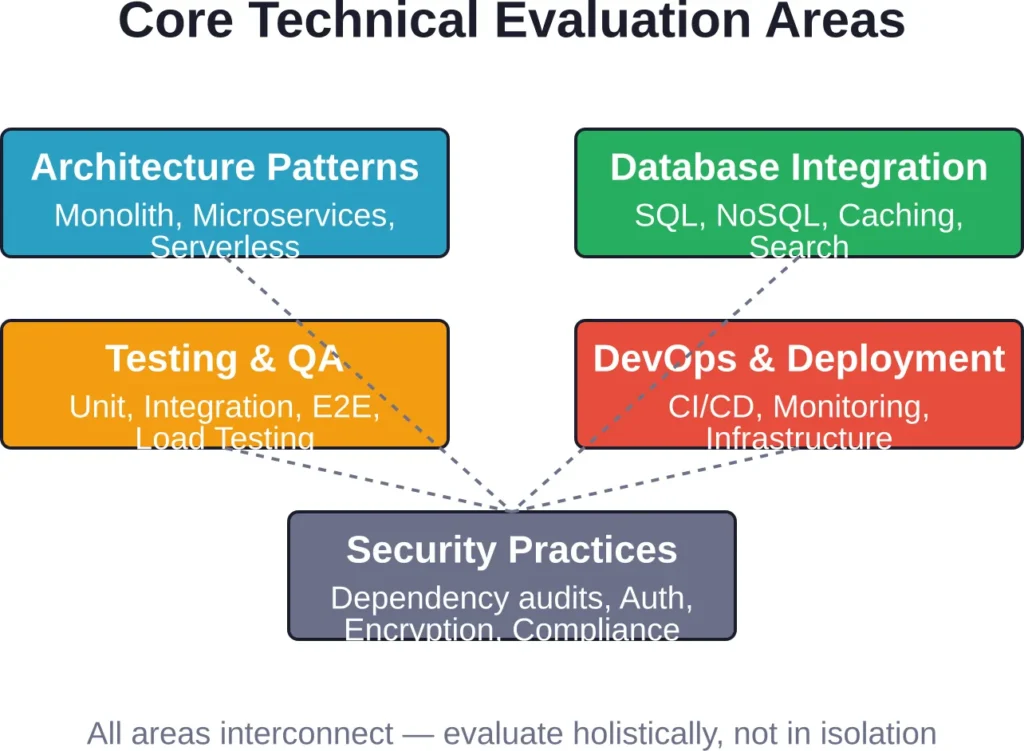
Architecture Patterns
Does the agency demonstrate experience with the architectural pattern your project needs? Common patterns include:
Monolithic applications: Single codebase, simpler deployment, appropriate for smaller applications or early-stage products. Requires discipline to prevent code coupling.
Microservices: Independent services communicating via APIs, enabling independent scaling and deployment. Adds complexity in orchestration, monitoring, and data consistency.
Serverless functions: Event-driven code executing in managed environments, optimal for variable workloads and rapid scaling. Best when combined with traditional services for steady-state operations.
The right pattern depends on team size, deployment frequency, scaling requirements, and operational maturity. Agencies should recommend based on context, not ideology.
Database Expertise
Node.js works with any database, but integration quality varies. Evaluate experience with:
- SQL databases (PostgreSQL, MySQL) via ORMs like Sequelize, TypeORM, or Prisma
- NoSQL databases (MongoDB, DynamoDB) and when document models make sense
- Caching layers (Redis, Memcached) for performance optimization
- Search engines (Elasticsearch, Algolia) for full-text and faceted search
Ask about migration strategies, backup procedures, and how they handle schema changes in production. These operational details reveal maturity.
Testing and Quality Assurance
Professional Node.js development includes testing at multiple levels:
Unit tests validate individual functions and modules. Integration tests verify component interactions. End-to-end tests confirm complete workflows. Load tests measure performance under stress.
Agencies should articulate their testing approach and show coverage metrics from recent projects. A minimum 80% coverage is a reasonable baseline for production applications.
DevOps and Deployment
Node.js applications need proper CI/CD pipelines, monitoring, and operational support. Technical capabilities should include:
- Containerization (Docker) and orchestration (Kubernetes, ECS)
- Automated deployment pipelines
- Application monitoring (error tracking, performance metrics, logging)
- Infrastructure as Code for reproducible environments
- Security scanning and dependency updates
Recent npm supply chain attacks underscore the importance of dependency auditing. Agencies should demonstrate awareness of Node.js security practices and supply chain risks.
Questions to Ask During Agency Selection
Initial conversations with agencies reveal whether they’re a genuine fit or just trying to close a deal. These questions cut through sales polish:
“Show me three Node.js projects you’ve delivered in the past 12 months.” Recent work demonstrates current capability. If all their examples are 2-3 years old, their team may have moved on to other technologies.
“What Node.js version do you currently recommend and why?” This reveals whether they stay current with the ecosystem. As of 2026, Node.js v22 is growing rapidly with 120 million monthly downloads, while end-of-life versions (v18 and below) represent 120+ million monthly downloads. Agencies should recommend modern versions unless specific constraints exist.
“How do you handle framework selection?” Express.js remains ubiquitous, but Fastify, NestJS, and other frameworks offer advantages in specific contexts. The agency should explain their decision criteria rather than defaulting to one option.
“Walk me through your typical development process from kickoff to production.” Listen for structured phases, quality gates, and client involvement points. Ad-hoc processes cause delays and budget overruns.
“How do you handle changes in project scope?” Every project encounters unexpected requirements. The process for managing scope changes—documentation, impact assessment, approval—matters more than preventing changes entirely.
“What happens after launch?” Production support, bug fixes, and ongoing maintenance should be addressed upfront. Some agencies disappear after deployment, leaving clients with no support path.
“Can I speak with a recent client reference?” Direct client conversations reveal working relationship quality, communication patterns, and how the agency handles challenges.
Red Flags to Watch For
Certain warning signs indicate an agency may not deliver successfully:
Vague or generic case studies. If portfolio examples lack specific technical details, team composition, or measurable outcomes, they may not be real projects.
Pressure to commit quickly. Professional agencies understand evaluation takes time. High-pressure sales tactics suggest they need your deposit more than they deserve your project.
No questions about your business. Agencies should ask about your users, business model, and success metrics. If they jump straight to “we can build that,” they’re not thinking strategically.
Unrealistic timelines. Building quality software takes time. If one agency quotes 4 weeks and others quote 12 for the same scope, the outlier probably misunderstands requirements or will cut corners.
Reluctance to share team information. You should know who will work on your project—their experience level, location, and availability. Opaque staffing models hide junior developers billing at senior rates.
No testing or QA mentioned. If the proposal covers only development without addressing quality assurance, expect bugs and production issues.
Making the Final Decision
After evaluating agencies, the choice often comes down to 2-3 finalists. Here’s how to make the final call:
Alignment matters more than capabilities. All finalists are probably technically capable. Choose based on understanding of your business, communication style, and shared values.
Start with a pilot project. If budget allows, begin with a defined small project before committing to a multi-month engagement. This validates working relationship and delivery quality.
Check cultural fit. Remote development means daily video calls and written communication. Timezone overlap, language proficiency, and communication preferences matter.
Verify technical leadership. Ask to meet the technical lead who will oversee your project. Their experience and communication ability directly impact project success.
Read contracts carefully. Understand payment terms, IP ownership, change order processes, and termination clauses. Legal clarity prevents disputes later.
The right agency becomes a long-term partner, not just a vendor. Many companies continue working with the same development partner across multiple projects and years.
Regional Considerations and Budget Planning
Geographic location affects both cost and working dynamics. Understanding regional differences helps set realistic budgets.
North American agencies (U.S., Canada) typically command premium rates but offer timezone alignment for domestic clients and minimal language barriers.
Western European firms (UK, Germany, Netherlands) provide high technical quality with moderate rates and good English proficiency. Timezone differences with U.S. clients remain manageable.
Eastern European agencies (Poland, Ukraine, Romania) offer strong technical skills at competitive rates. The region has produced many successful development firms serving international clients.
Indian companies provide cost-effective development with large talent pools. Time zone differences require asynchronous communication workflows but enable round-the-clock development.
The rate differential exists, but remember: total project cost depends on velocity and rework, not just hourly rates. A more expensive agency that delivers faster and with fewer bugs may cost less overall.
Budget for these project phases:
- Discovery: 10-15% of total budget for requirements gathering and technical planning
- Development: 60-70% for actual coding, testing, and iteration
- Launch: 10-15% for deployment, infrastructure setup, and initial stabilization
- Post-launch: 10-15% for bug fixes, performance optimization, and early feedback implementation
Agencies quoting only development time without discovery or post-launch support are underestimating project reality.
The Future of Node.js Development
Node.js continues evolving rapidly. Understanding trajectory helps choose agencies positioned for long-term success.
The ecosystem is consolidating around modern versions. With Node.js v22+ growing rapidly with 120 million downloads and v18 reaching end-of-life, the community is moving toward current releases. Agencies should demonstrate awareness of this shift and recommend migration paths for legacy applications.
TypeScript adoption has become standard for serious Node.js development. Type safety prevents entire classes of bugs and improves maintainability. Look for agencies that default to TypeScript unless specific constraints exist.
Performance optimization remains crucial. Companies deploying Node.js achieved dramatic improvements through proper architecture and optimization. These results come from proper architecture and optimization, not just choosing Node.js.
Security awareness has intensified following supply chain attacks in the npm ecosystem. The recent axios incident demonstrated how widely-used packages (100M+ weekly downloads) can be compromised. Professional agencies implement dependency scanning and security auditing as standard practice.
AI-assisted development is changing workflows. Tools that aggregate 60+ development tools behind simplified interfaces are making developers more productive. Forward-thinking agencies incorporate these productivity gains while maintaining code quality.
Frequently Asked Questions
Node.js delivers three core advantages: event-driven architecture enabling high concurrency with efficient resource usage, JavaScript across both frontend and backend reducing context switching, and real-time capabilities built into the platform for chat, collaboration, and live updates. Performance benefits show superior concurrency in typical I/O-heavy scenarios compared to traditional multi-threaded servers.
Timeline depends entirely on scope and complexity. A simple API with 5-10 endpoints might take 4-6 weeks. A complete SaaS platform with user management, payments, and admin dashboards typically requires 3-6 months. Enterprise systems with complex integrations can extend to 9-12 months. Discovery phases help establish realistic timelines based on specific requirements.
Agencies make sense when you need immediate capacity, lack technical leadership to build a team, or have a defined project with clear endpoints. In-house teams work better for ongoing product development, when core technology is a competitive advantage, or when you’ve reached sufficient scale to justify recruitment overhead. Many companies start with agencies and transition to internal teams as products mature.
Request to interview the technical lead assigned to your project. Ask about their approach to async error handling, experience with different frameworks, and how they debug performance issues. Review code samples from previous projects for readability, testing practices, and documentation quality. Check GitHub profiles for open source contributions and maintained projects. Professional developers can clearly explain technical decisions and tradeoffs.
Express.js is the minimalist standard—simple, flexible, and widely understood. It’s appropriate for most projects but provides little structure. NestJS adds TypeScript-first architecture with dependency injection and decorators, suited for large teams needing consistent patterns. Fastify optimizes for performance with schema-based validation, ideal when speed and throughput matter most. The choice depends on team preferences, project size, and performance requirements.
Ongoing maintenance includes security patches (Node.js releases security updates regularly), dependency updates (npm packages evolve quickly), performance monitoring and optimization, and bug fixes from production use. Budget approximately 15-20% of initial development cost annually for maintenance. Critical applications in regulated industries may require more. Agencies should offer maintenance retainers or support contracts rather than disappearing after deployment.
Absolutely. Netflix, PayPal, LinkedIn, and Uber all run critical systems on Node.js at massive scale. The platform handles millions of concurrent connections when architected properly. Success requires understanding horizontal scaling, proper load balancing, caching strategies, and database optimization. Enterprise adoption continues growing—global Node.js job postings increased 28% in 2024. The agencies listed here have delivered enterprise-scale systems across industries.
Conclusion: Choosing Your Node.js Development Partner
The right Node.js agency aligns with your project needs, budget, and timeline. No single “best” agency exists—only the best fit for your specific context.
Startups building MVPs need different partners than enterprises migrating legacy systems. Real-time applications demand different expertise than traditional CRUD APIs. Regulated industries require compliance awareness that general development shops don’t provide.
Use this guide as a starting point, not a definitive ranking. Research the agencies that match your project profile. Schedule conversations with 3-5 firms. Ask the hard questions about process, team structure, and post-launch support.
Look for partners who ask thoughtful questions about your business before proposing solutions. Value clear communication and transparent processes over rock-bottom pricing. Prioritize agencies demonstrating current Node.js expertise with recent projects and modern versions.
The Node.js ecosystem continues thriving with 350 million monthly downloads and growing adoption across industries. Finding the right development partner helps you capture these benefits—speed, scalability, and real-time capabilities—in your own products.
Start with a pilot project when possible. Build the relationship gradually. The best agency partnerships extend across multiple projects and years, becoming true collaborative relationships rather than transactional vendor arrangements.
Ready to move forward? Contact 2-3 agencies from this list that match your needs. Compare their approaches, validate their expertise, and choose the partner that demonstrates both technical capability and genuine understanding of your business goals.