

Quick Summary: This comprehensive guide showcases the top 15 Python web development companies in 2026, featuring detailed descriptions of each agency’s expertise, team capabilities, and specializations. The list covers a diverse range of firms from enterprise-focused development houses to specialized AI and data science teams, helping businesses find the perfect Python development partner for their specific project needs.
Finding the right Python web development company feels like searching for a needle in a haystack. Except the haystack is on fire, and the needle keeps sending automated “let’s connect” messages on LinkedIn.
Python has evolved from a simple scripting tool into the backbone of modern software architecture. Organizations across industries rely on Python for everything from machine learning pipelines to enterprise resource planning systems. The language’s versatility and extensive library ecosystem make it indispensable for teams building scalable digital products.
But here’s the thing—not all Python development companies are created equal. Some excel at AI-driven applications while others specialize in web frameworks like Django and Flask. Some bring years of enterprise experience while others thrive on rapid prototyping for startups.
This guide breaks down the top 15 Python web development companies operating in 2026. Each profile highlights what makes these agencies stand out, their core competencies, and the types of projects where they shine brightest. No fluff, no fabricated case studies—just straightforward information to help you make an informed decision.
Why Python Dominates Web Development in 2026
Python’s popularity isn’t accidental. The language consistently ranks among the top choices for developers and recruiters, driven by its clean syntax and powerful capabilities. According to industry analyses, employment of data analysts in the U.S.—many of whom work extensively with Python—is projected to grow by 23% through 2032, reflecting the broader demand for Python expertise across technology roles.
Web development teams choose Python for several practical reasons. The language supports rapid development cycles without sacrificing code readability. Frameworks like Django provide built-in security features and administrative interfaces that dramatically reduce time-to-market for web applications.
Python’s ecosystem spans far beyond basic web development. The same language powers data science workflows, machine learning models, automation scripts, and API integrations. This versatility means development teams can maintain consistency across different parts of a technology stack rather than context-switching between multiple languages.
Real talk: Python isn’t perfect for every scenario. Performance-critical applications sometimes require compiled languages. But for the vast majority of web development projects—especially those requiring integration with data processing, third-party APIs, or machine learning components—Python offers an unmatched combination of developer productivity and technical capability.
What Separates Great Python Development Companies from Average Ones
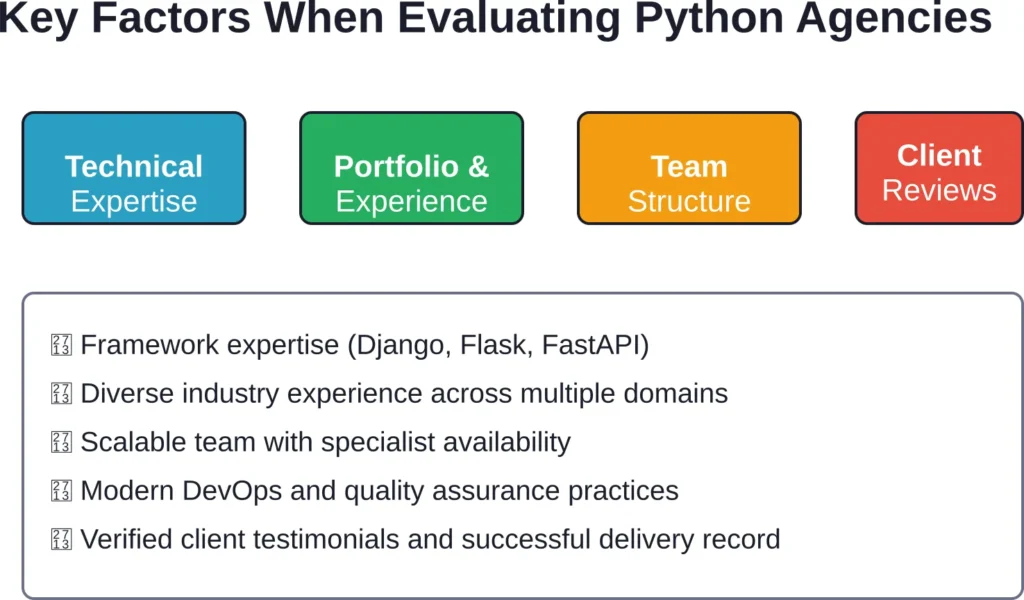
Technical competence with Python syntax represents table stakes. The companies that deliver exceptional results distinguish themselves through deeper factors that don’t always appear in marketing materials.
Portfolio Diversity and Domain Experience
Strong Python development firms demonstrate experience across multiple industries and project types. Look for companies that have built both customer-facing applications and internal business systems. This range indicates adaptability and the ability to translate varied business requirements into technical solutions.
Domain expertise matters enormously. A company that has built fintech applications understands regulatory compliance and security requirements in ways a generic web development shop won’t. Similarly, firms with healthcare experience bring knowledge of HIPAA compliance and patient data handling that saves months of learning curve.
Modern Development Practices
The best Python companies embrace contemporary software engineering practices. This includes comprehensive testing strategies, continuous integration pipelines, containerization with Docker, and infrastructure-as-code approaches.
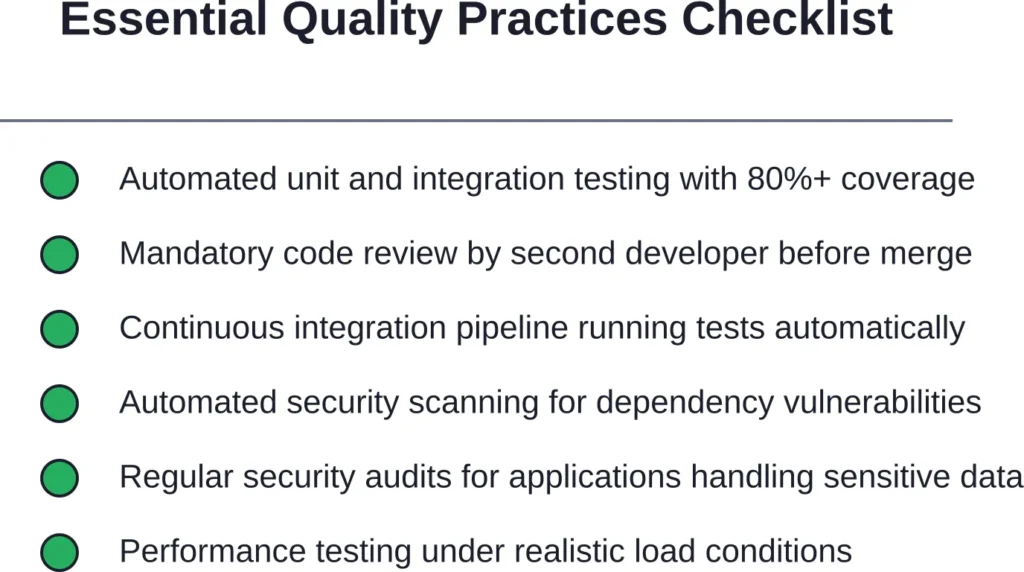
Code review processes separate professional teams from amateur operations. Companies that maintain high coding standards produce more maintainable systems and fewer production incidents. Ask potential partners about their quality assurance workflows and testing coverage expectations.
Communication and Collaboration Style
Pretty portfolios look good, but what clients say about communication, deadlines, and flexibility often reveals more than case studies. Development projects inevitably encounter unexpected challenges—scope changes, integration complications, shifting business priorities.
How a company handles these situations determines project success more than technical skill alone. Agencies that establish clear communication channels, provide regular progress updates, and adapt constructively to changing requirements deliver better outcomes than those with rigid processes.
Team Structure and Scalability
Understanding how a company structures its development teams provides insight into how they’ll approach projects. Some agencies assign dedicated teams to each client while others use resource pooling. Neither approach is inherently superior, but alignment with project needs matters.
Scalability becomes critical for projects with uncertain scope or growth trajectories. Can the company quickly add developers if the project accelerates? Do they have specialists available for specific technologies like Celery for task queues or Pandas for data processing?
Top 15 Python Web Development Companies in 2026
The companies listed here represent diverse approaches to Python development. Some focus on enterprise clients with complex requirements while others excel at rapid development for growth-stage companies. Geographic location, team size, and technical specializations vary significantly.
Requirements vary dramatically between projects. Do not rely solely on this ranking order—evaluate shortlisted options by engaging directly with them and assessing fit for specific needs.
1. Lengreo

Lengreo delivers focused Python web development services as part of full-stack custom solutions. The company builds scalable web applications and backend systems using Python alongside modern frontend technologies to create performant digital platforms.
What sets Lengreo apart is their practical, business-oriented approach that combines development with strategic outcomes. They create tailored web applications for B2B companies, e-commerce platforms, and custom business tools that emphasize functionality, performance, and long-term scalability.
Lengreo’s strength lies in lean processes that start with strategy workshops and move quickly into prototyping and development. Their teams focus on delivering measurable results through clean architecture and ongoing support rather than over-engineered solutions.
The company excels particularly in building API-based web applications, integrating backend Python logic with frontend interfaces, and creating systems that support marketing and growth objectives simultaneously.
Contact Information:
- Website: Lengreo.com
- Phone: +31 686 147 566
- Email: [email protected]
- Address: Vrijstraat 9 C/D, 5611 AT Eindhoven, Netherlands
- LinkedIn: Lengreo
- Twitter: @Lengreo
- Instagram: @lengreo
2. Gilzor

Gilzor brings strong expertise to Python web development with a full-cycle approach. The company builds robust web applications and backend services using Python frameworks such as Django and FastAPI for scalable server-side logic.
What sets Gilzor apart is their versatility across project types, from custom web platforms to process automation solutions. They work with startups and established businesses on web applications, microservices, and systems that incorporate real-time features and reliable infrastructure.
Gilzor’s strength lies in combining technical development with practical business analysis. Projects typically include detailed planning, iterative development, and focus on maintainable code that supports future growth.
The company excels particularly in projects requiring strong backend architecture — building RESTful APIs, integrating message queues, creating microservices, and ensuring high performance through efficient Python solutions.
Contact Information:
- Website: www.gilzor.com
- Email: [email protected]
- Address: Poland, Warsaw, Office 58, street Adama Mickiewicza 37, 01-625
- LinkedIn: www.linkedin.com/company/gilzor-softwaredevelopment
3. OSKI
OSKI positions itself as a reliable partner for Python web development and backend solutions. The company creates custom web applications, data-driven systems, and scalable backend services using Python’s flexibility for complex business requirements.
What sets OSKI apart is their emphasis on seamless integration and robust performance. They develop web platforms that connect smoothly with third-party services, handle complex workflows, and deliver consistent user experiences across devices.
OSKI’s strength lies in full-stack delivery that balances frontend design with powerful Python backend logic. Their approach prioritizes security, scalability, and practical solutions tailored to each client’s specific operational needs.
The company excels particularly in API development and integration projects — building flexible Python backends that power dynamic web applications, automate processes, and support progressive web experiences.
Contact Information:
- Website: oski.site
- Phone: +48571282759
- Email: [email protected]
- Address: Kaupmehe tn 7, 10114 Tallinn, Estonia
- LinkedIn: www.linkedin.com/company/oski-solutions
4. A-Listware
A-Listware offers comprehensive Python web development capabilities within their broader software engineering practice. The company builds secure, responsive web solutions and backend systems using Python alongside other modern technologies.
What sets A-Listware apart is their focus on high-quality, scalable digital solutions for businesses seeking reliable web platforms. They deliver custom web applications, APIs, and integrated systems that emphasize security and performance.
A-Listware’s strength lies in experienced development teams that combine deep technical skills with structured project delivery. They create maintainable codebases suitable for long-term business use.
The company excels particularly in complex web projects involving Python backend services — developing robust APIs, integrating multiple systems, and building web architectures that support data-intensive operations and business growth.
Contact Information:
- Website: a-listware.com
- Phone: +1 (888) 337 93 73
- Email: [email protected]
- Address: North Bergen, NJ 07047, USA
- LinkedIn: www.linkedin.com/company/a-listware
- Facebook: www.facebook.com/alistware
5. Mobian Studio
Mobian Studio specializes in Python-powered web development as part of their custom software solutions. The company creates modern web applications and backend systems using Python for scalable and efficient digital products.
What sets Mobian Studio apart is their focus on tailored web and cross-platform solutions for industries like healthcare, fintech, and logistics. They build web applications that combine strong Python backends with intuitive interfaces and performance optimization.
Mobian Studio’s strength lies in collaborative development that aligns technical implementation with clear business objectives. Their process emphasizes clean architecture and solutions designed for real-world usability.
The company excels particularly in projects that require reliable Python web backends — developing scalable server-side logic, integrating with mobile applications, and creating web platforms that deliver consistent performance across different environments.
Contact Information:
- Website: mobian.studio
- Phone: [email protected]
- Address: Harju maakond, Tallinn, Kesklinnalinnaosa, Masina tn 22, 10113
- LinkedIn: www.linkedin.com/company/mobian-studio
6. Iflexion
Iflexion brings over two decades of custom software development experience. The company serves mid-market and enterprise clients across manufacturing, retail, healthcare, and financial services sectors. Their Python development capabilities span web applications, business intelligence systems, and process automation tools.
The company emphasizes long-term partnerships rather than one-off projects. Many clients engage Iflexion for initial development then continue relationships for ongoing enhancements, maintenance, and gradual feature expansion. This model suits organizations that need reliable technical partners for evolving systems over years.
Iflexion’s development methodology includes comprehensive documentation practices. They produce technical specifications, architecture diagrams, and operational runbooks that enable knowledge transfer and long-term maintainability. This discipline proves valuable when internal teams eventually assume system ownership.
Their project management approach balances structure with flexibility. Teams follow defined processes for requirements gathering, sprint planning, and quality assurance while remaining responsive to changing priorities and emerging requirements that inevitably arise during development.
7. Velvetech
Velvetech positions itself as a software development company focused on data-intensive applications. Their Python expertise centers on projects involving complex data processing, analytics systems, and applications that integrate machine learning models into production environments.
The company has built recommendation engines for e-commerce platforms, predictive maintenance systems for industrial clients, and fraud detection applications for financial services. These projects require not just web development skills but also understanding of data science workflows and model deployment considerations.
Velvetech’s team structure typically includes both software engineers and data scientists who collaborate closely. This integration helps bridge the gap between experimental data science work and production-ready applications—a common challenge when organizations try to operationalize machine learning capabilities.
Their technical approach emphasizes data pipeline reliability and monitoring. They build systems with comprehensive logging, performance tracking, and automated alerts that surface issues before they impact end users. This operational discipline distinguishes production-grade systems from prototype applications.
8. Apriorit
Apriorit specializes in cybersecurity, driver development, and reverse engineering alongside custom software development. Their Python work often involves security-critical applications, security testing tools, and systems requiring deep technical expertise beyond typical web development.
The company serves clients in cybersecurity, data security, and enterprise software sectors. Projects often involve building security assessment tools, creating secure communication platforms, or developing applications with stringent security requirements driven by regulatory compliance or threat models.
Apriorit’s development teams include specialists with backgrounds in information security and system-level programming. This expertise enables them to conduct threat modeling exercises, implement defense-in-depth security architectures, and build applications resilient against sophisticated attack vectors.
Their approach suits organizations where security represents a primary concern rather than a checkbox compliance exercise. Financial institutions handling sensitive transactions, healthcare organizations managing patient data, and enterprise software companies building security products particularly benefit from Apriorit’s specialized capabilities.
9. Boldare
Boldare operates as a digital product development company emphasizing design thinking and user experience alongside technical development. Their Python development work integrates closely with product design, user research, and iterative validation processes.
The company’s methodology centers on discovering and validating user needs before committing to full development. Projects typically include design sprints, prototype testing with target users, and phased releases that gather feedback at each stage. This approach reduces the risk of building technically sound products that fail to meet actual user needs.
Boldare’s team composition reflects this integrated approach—designers, researchers, and developers work together from project initiation rather than following sequential handoffs. This collaboration results in products where design and technical implementation complement each other rather than compromising for independent optimization.
Their services prove particularly valuable for companies building customer-facing products where user experience significantly impacts success. Consumer applications, SaaS products, and digital services with non-technical end users benefit most from Boldare’s design-forward development approach.
10. Codilime

Codilime focuses on network, cloud, and software-defined infrastructure. Their Python development expertise emphasizes backend systems, network automation, DevOps tooling, and infrastructure management platforms.
The company serves telecommunications companies, cloud service providers, and enterprises with complex networking requirements. Projects often involve building network monitoring systems, automation tools for infrastructure provisioning, or control planes for software-defined networking solutions.
Codilime’s technical depth in networking and infrastructure distinguishes them from general web development agencies. Their developers understand protocols, network architectures, and distributed systems challenges that don’t arise in typical application development but become critical for infrastructure-oriented projects.
Their work suits organizations building technical platforms rather than end-user applications. Companies developing networking products, cloud management tools, or infrastructure automation capabilities benefit most from Codilime’s specialized expertise and deep technical knowledge.
11. ScienceSoft
ScienceSoft brings substantial experience to enterprise Python development. The company has demonstrated extensive experience, building a team of more than 700 technology professionals. Their expertise centers on custom enterprise software, particularly CRM and ERP solutions that integrate artificial intelligence and machine learning capabilities.
What sets ScienceSoft apart is their focus on complex business systems that require deep domain knowledge. They’ve built solutions for healthcare organizations managing patient data workflows, financial institutions requiring sophisticated risk analysis systems, and manufacturing companies optimizing supply chain operations.
The company’s strength lies in projects that demand both technical excellence and understanding of intricate business processes. Their team includes business analysts who translate operational requirements into technical specifications, ensuring development efforts align with actual business needs rather than theoretical feature lists.
ScienceSoft excels particularly when projects involve integrating Python applications with existing enterprise systems—connecting new web interfaces to legacy databases, building API layers for older business systems, or creating data pipelines that span multiple organizational platforms.
12. Intellectsoft

Intellectsoft positions itself as a full-cycle software development company with particular strength in emerging technologies. Their Python development work emphasizes projects incorporating blockchain, Internet of Things integrations, and augmented reality components alongside traditional web application development.
The company serves clients ranging from startups to Fortune 500 enterprises, demonstrating versatility across project scales. Their portfolio includes mobile applications, enterprise platforms, and progressive web applications—all built with Python backends providing scalable server-side logic.
Intellectsoft’s approach combines strategic consulting with hands-on development. Projects typically begin with discovery phases where their team evaluates technical feasibility, identifies potential architecture pitfalls, and proposes implementation roadmaps. This upfront investment in planning helps avoid costly mid-project course corrections.
Their development methodology emphasizes agile principles with two-week sprint cycles, regular stakeholder demos, and iterative refinement based on user feedback. Teams include dedicated project managers who handle coordination, allowing developers to focus on code quality rather than administrative overhead.
13. Konstant Infosolutions
Konstant Infosolutions operates as a mid-sized development firm with approximately 250 team members. The company has accumulated 14 years of experience delivering web and mobile applications across diverse industry verticals.
Their Python development services span web application frameworks, API development, and data engineering projects. Konstant frequently works with Django for content-heavy websites and Flask for lightweight microservices architectures. They’ve built e-commerce platforms handling thousands of daily transactions, content management systems for media companies, and booking platforms for hospitality businesses.
Konstant’s strength lies in delivering functional products within compressed timeframes. Their process prioritizes rapid prototyping—creating working versions of core functionality early in the development cycle. This approach allows clients to validate concepts with actual users before investing in complete feature sets.
The company maintains a practical approach to technology selection. Rather than defaulting to the newest frameworks, they recommend proven tools appropriate for project requirements and long-term maintenance considerations. This pragmatism results in stable, maintainable codebases rather than bleeding-edge experiments.
14. Oxagile

Oxagile specializes in video streaming technology, digital video processing, and media-rich web applications. Their Python development expertise centers on projects requiring sophisticated media handling, real-time processing, or complex data visualization.
The company has built video platforms for broadcasters, streaming services for entertainment companies, and video conferencing solutions for corporate clients. Their technical team combines Python backend development with expertise in video codecs, content delivery networks, and adaptive bitrate streaming.
Oxagile’s differentiation comes from their deep vertical specialization. Rather than being generalist developers, their team understands the specific challenges of media applications—latency requirements, bandwidth optimization, content protection, and cross-device compatibility.
Projects with Oxagile typically involve custom development rather than configuration of existing platforms. They build tailored solutions when off-the-shelf products can’t meet specific performance requirements or feature needs. This approach suits organizations with unique workflows or competitive differentiation based on technical capabilities.
15. Simform
Simform operates as a product engineering company focused on building digital products for software companies and technology-enabled businesses. Their Python development work emphasizes cloud-native applications designed for scalability and reliability.
The company’s technical approach centers on modern cloud architectures—microservices, containerization with Docker and Kubernetes, serverless functions, and managed cloud services. Their Python developers build applications designed specifically for AWS, Google Cloud, or Azure environments rather than treating cloud platforms as simple hosting providers.
Simform assigns dedicated product teams to each client rather than using resource pooling. This structure creates continuity and reduces communication overhead. Team members develop deep familiarity with specific products rather than context-switching between multiple projects.
Their expertise proves particularly valuable for companies building software products rather than internal tools. They understand product development concerns like multi-tenancy, usage-based billing integration, and feature flagging for gradual rollouts—considerations that differ significantly from traditional enterprise application development.
How to Evaluate Python Development Companies for Specific Needs
Generic evaluation checklists overlook the reality that different projects require different capabilities. A framework suitable for vetting enterprise development partners falls short when evaluating agencies for rapid prototyping projects.
For Enterprise Applications
Enterprise projects demand experience with organizational complexity, regulatory compliance, and integration with existing systems. When evaluating companies for enterprise Python development, prioritize these factors:
Look for demonstrated experience with similar compliance frameworks—HIPAA for healthcare, SOC 2 for SaaS products, PCI DSS for payment processing. Compliance isn’t just about checking security boxes; it requires understanding audit processes, documentation requirements, and ongoing monitoring obligations.
Integration capabilities matter enormously. Enterprise projects rarely involve greenfield development. Systems must connect to existing databases, authenticate against corporate directories, integrate with ERP platforms, and exchange data with third-party services. Companies with strong integration experience save months of troubleshooting connectivity issues.
Request references from clients with similar organizational size and complexity. A company that has built successful systems for organizations with 50 employees may struggle with the change management, stakeholder coordination, and organizational politics of 5,000-person enterprises.
For Startups and MVPs
Early-stage products require different considerations than enterprise systems. Speed to market, iteration capability, and development cost efficiency take priority over comprehensive feature sets.
Evaluate companies based on their ability to identify minimum viable scope. The best partners push back on feature bloat and help define the smallest product version that delivers value. Agencies that simply accept every feature request often deliver late and over-budget.
Look for experience with modern deployment practices that enable rapid updates. Continuous deployment pipelines, feature flags, and staged rollouts allow product teams to release frequently and gather user feedback quickly. Companies comfortable with these practices accelerate learning cycles.
Technical debt management becomes critical for startups planning to scale. Some agencies prioritize speed at all costs, creating codebases that become unmaintainable as teams grow. Better partners make pragmatic trade-offs—accepting shortcuts where appropriate while maintaining architectural foundations that support future growth.
For Data Science and Machine Learning Projects
Projects involving machine learning or sophisticated data processing require specialized evaluation approaches. Generic web development expertise doesn’t translate automatically to data-intensive applications.
Assess whether companies have genuine data science capabilities or just web developers who’ve completed online courses. Real expertise shows in portfolio projects involving model training, feature engineering, and production deployment of machine learning systems—not just integrating third-party AI APIs.
Production ML systems face challenges that don’t exist in typical web applications. Model monitoring, retraining pipelines, A/B testing of model versions, and handling data drift require specific engineering practices. Companies without this experience deliver prototypes that work in demos but fail in production.
Look for teams that include both software engineers and data scientists. The skills required for exploratory data analysis differ significantly from those needed for building reliable production systems. Companies that bridge both disciplines successfully deliver applications that actually work at scale.
Python Framework Selection and Company Expertise
Python web development relies heavily on frameworks that provide structure and common functionality. Understanding which frameworks different companies specialize in helps match technical approaches to project needs.
Django for Full-Featured Applications
Django remains the most comprehensive Python web framework, providing built-in functionality for authentication, admin interfaces, database migrations, and security features. The framework follows a batteries-included philosophy—most common web development needs are handled out-of-the-box.
Companies specializing in Django excel at content-heavy websites, SaaS applications, and systems requiring rapid development of administrative interfaces. Django’s admin panel alone saves weeks of development time for applications requiring internal management tools.
The framework’s opinionated structure suits teams that value consistency and established patterns over flexibility. Django projects share similar architecture, making it easier for new developers to orient themselves in existing codebases.
Flask for Lightweight Services
Flask takes a minimalist approach, providing core web functionality while leaving architecture decisions to developers. This flexibility suits microservices, APIs, and applications with unique structural requirements that don’t fit Django’s opinionated patterns.
Companies with strong Flask expertise typically build distributed systems, API-first applications, or services requiring tight control over every architectural decision. Flask’s simplicity enables rapid prototyping while remaining suitable for production systems.
The framework requires more decision-making than Django—developers must choose and integrate components for functionality that Django provides by default. This flexibility benefits when default choices don’t fit, but adds complexity when standard patterns suffice.
FastAPI for Modern API Development
FastAPI has gained significant adoption for building high-performance APIs. The framework provides automatic API documentation, built-in data validation using Python type hints, and async capabilities for handling concurrent requests efficiently.
Companies specializing in FastAPI often build backend services for mobile applications, microservices architectures, or API gateways serving multiple client types. The framework’s automatic documentation generation proves particularly valuable for teams building APIs consumed by external developers.
FastAPI’s async support enables handling more concurrent requests with fewer server resources compared to synchronous frameworks. This efficiency matters for applications with many simultaneous users or services that spend significant time waiting for external API responses.
| Framework | Best For | Learning Curve | Community Size |
|---|---|---|---|
| Django | Full-featured web apps, CMS, admin-heavy systems | Moderate | Very Large |
| Flask | Microservices, APIs, custom architectures | Low to Moderate | Large |
| FastAPI | High-performance APIs, async services | Low | Growing Rapidly |
| Pyramid | Flexible applications, evolving requirements | Moderate to High | Medium |
Geographic Considerations and Remote Development
Location matters less than ever for software development, but timezone alignment, cultural factors, and communication practices still impact project success.
Nearshore Development Partners
Nearshore companies—those in similar or overlapping timezones—enable synchronous collaboration. Real-time communication simplifies requirement discussions, pair programming sessions, and rapid troubleshooting.
Timezone alignment proves particularly valuable during project initiation when frequent discussions clarify requirements and establish direction. As projects mature and requirements stabilize, timezone overlap becomes less critical.
Cultural proximity affects communication effectiveness. Teams from similar business cultures often share assumptions about work practices, decision-making processes, and professional norms that reduce friction and miscommunication.
Offshore Development Arrangements
Offshore development offers cost advantages but requires process adjustments to accommodate timezone differences. Successful offshore partnerships emphasize asynchronous communication, comprehensive documentation, and clear specifications that reduce need for real-time discussion.
Projects with stable requirements suit offshore development better than those requiring frequent iteration and course correction. When specifications are clear and changes infrequent, timezone differences matter less.
Offshore arrangements work best with mature development processes. Companies with established practices for requirements documentation, code review, and quality assurance can operate effectively across timezones. Organizations still developing these practices often struggle with coordination challenges.
Fully Remote and Distributed Teams
Many development companies now operate as fully distributed organizations with team members across multiple locations. These companies design processes specifically for remote collaboration rather than adapting office-based practices.
Distributed-first companies often excel at asynchronous communication, comprehensive documentation, and remote collaboration tools. Their processes account for timezone challenges and lack of in-person interaction from the beginning.
Evaluate how companies handle communication and knowledge sharing. Strong remote teams maintain detailed documentation, record important decisions, and use project management tools that provide visibility without requiring synchronous meetings.
Project Management and Development Methodologies
How development companies structure work and manage projects impacts delivery timelines, budget predictability, and stakeholder satisfaction as much as technical capabilities.
Agile and Scrum Approaches
Most Python development companies operate using agile methodologies with regular sprints, iterative delivery, and continuous stakeholder feedback. Sprint lengths typically range from one to three weeks, with planning sessions at the beginning and reviews at the end of each cycle.
Agile approaches suit projects with evolving requirements or products requiring market validation before full development. Iterative delivery enables course correction based on user feedback and changing business priorities.
The methodology requires active client involvement. Product owners must prioritize features, review sprint deliverables, and make timely decisions about direction. Organizations unable to provide this engagement often frustrate agile teams and delay progress.
Fixed-Scope Waterfall Projects
Some projects—particularly those with comprehensive upfront specifications and stable requirements—follow more traditional waterfall approaches with sequential phases for design, development, testing, and deployment.
This methodology suits projects with regulatory requirements demanding extensive documentation, systems replacing well-defined existing functionality, or contracts requiring fixed-price commitments based on complete specifications.
Waterfall approaches demand thorough requirements gathering before development begins. Changes mid-project create cascading impacts and often require formal change control processes that add time and cost.
Hybrid Approaches
Many companies blend methodologies, using detailed upfront planning to establish architecture and core functionality while embracing iterative development for features and user-facing components.
Hybrid approaches balance structure with flexibility. Teams establish stable foundations through careful planning while maintaining ability to iterate on features based on feedback and changing requirements.
The specific methodology matters less than consistency and clear expectations. Problems arise when clients expect waterfall predictability while agencies operate in agile mode, or when fixed-price contracts constrain necessary iteration.
Quality Assurance and Testing Practices
Testing discipline separates professional development organizations from amateur operations. Companies with strong quality assurance practices deliver fewer bugs, require less rework, and produce more maintainable systems.
Automated Testing Coverage
Modern Python development emphasizes automated testing—unit tests for individual functions, integration tests for component interactions, and end-to-end tests verifying complete workflows. Automated test suites catch regressions when code changes and document expected behavior.
Companies should articulate their testing expectations and coverage targets. Organizations that test comprehensively typically aim for 80% or higher code coverage, though coverage percentages alone don’t guarantee quality.
Test-driven development (TDD) takes this further, writing tests before implementation code. This practice forces developers to think through requirements and edge cases before coding, often resulting in cleaner designs and fewer defects.
Code Review Processes
Systematic code review—requiring at least one other developer to examine changes before merging—catches bugs, improves code quality, and spreads knowledge across teams. Review processes prevent single points of failure where only one person understands critical code.
Companies with strong engineering cultures treat code review as knowledge sharing and mentoring opportunities, not just defect detection. Junior developers learn from feedback while senior developers gain fresh perspectives on their assumptions.
Review requirements should balance thoroughness with development velocity. Overly rigid approval processes create bottlenecks while rubber-stamp approvals provide no value. The best teams establish clear review guidelines that maintain quality without unnecessary ceremony.
Security Testing and Vulnerability Assessment
Security testing should be integrated throughout development rather than bolted on before launch. Modern development practices include automated security scanning for known vulnerabilities in dependencies, static code analysis for common security mistakes, and periodic penetration testing for critical systems.
Companies building applications handling sensitive data should demonstrate security competence beyond basic practices. Ask about their experience with security frameworks relevant to your domain, their process for addressing discovered vulnerabilities, and how they stay current with emerging threats.
Security represents an ongoing concern rather than a one-time audit. Systems require regular updates for security patches, monitoring for suspicious activity, and adaptation as new vulnerability classes emerge.
Communication and Project Transparency
Technical capability means little if communication breaks down. The best development partnerships establish clear communication rhythms and transparency practices that keep stakeholders informed without creating meeting overhead.
Regular Status Updates and Sprint Reviews
Development teams should provide predictable status visibility. This typically includes weekly written updates summarizing progress, challenges, and upcoming work, plus demonstrations of completed functionality at the end of each sprint.
Sprint demos serve multiple purposes beyond just showing progress. They create opportunities for stakeholders to provide feedback while functionality remains easy to adjust. They also surface misunderstandings about requirements before significant additional development occurs.
Written updates complement demos by providing context and flagging risks that might not be visible in demonstrations. They create historical records useful for understanding how decisions evolved and why certain approaches were chosen.
Issue Tracking and Transparency
Professional development teams maintain visible tracking of all work items—features, bugs, technical debt, and maintenance tasks. Stakeholders should have read access to project management tools showing current status and progress.
Transparency builds trust and reduces status meetings. When stakeholders can check progress independently, they require fewer formal updates and feel more confident about project trajectory.
Issue tracking also documents decisions and discussions. When questions arise later about why certain features work particular ways, the tracked conversation provides context that prevents repeated discussions.
Handling Scope Changes and Challenge
How companies handle unexpected challenges reveals their true character. Every project encounters surprises—technical limitations, requirement ambiguities, integration complications, shifting priorities.
Strong partners surface issues early and propose solutions rather than letting problems fester. They distinguish between changes that fit within existing scope and those requiring additional time or budget, managing expectations before commitments become untenable.
Formal change control processes help manage scope evolution without endless scope creep. When stakeholders want additional functionality, documented change requests clarify impact on timeline and budget before teams commit.
Long-Term Partnership and Maintenance Considerations
Initial development represents just the beginning of a software system’s lifecycle. Ongoing maintenance, feature enhancement, and technical updates continue indefinitely for successful products.
Post-Launch Support Options
Development companies typically offer several post-launch engagement models. Dedicated support contracts provide guaranteed response times and ongoing availability. Retainer arrangements allocate specific monthly hours for maintenance and small enhancements. Time-and-materials agreements provide flexibility for variable needs.
Understand support terms before launch. What response times can organizations expect for production issues? How are emergency situations handled outside business hours? What counts as maintenance versus new development requiring separate estimates?
Some companies specialize in initial development but struggle with long-term support. Others excel at maintenance but lack innovation for major enhancements. Ideal partners handle both initial development and ongoing evolution.
Knowledge Transfer and Documentation
Organizations eventually need to understand their own systems, whether for internal maintenance, coordinating with future partners, or strategic planning. Comprehensive documentation and knowledge transfer separate professional engagements from quick projects.
Documentation should include system architecture overviews, deployment procedures, common maintenance tasks, and explanations of key design decisions. This material enables new developers—internal or external—to orient themselves without requiring original developers.
Structured knowledge transfer sessions help internal teams understand systems at appropriate depth levels. Technical staff need architecture understanding and code orientation. Operations teams need deployment and monitoring procedures. Product teams need feature documentation.
Technology Updates and Technical Debt
Software systems require ongoing updates beyond feature development. Python versions advance, frameworks release major updates, dependencies need security patches, and hosting platforms evolve their capabilities.
Long-term partners help organizations navigate these changes, recommending when updates provide significant value and when stability takes priority. They maintain awareness of deprecation timelines and plan migrations before forced deadlines create crisis situations.
Technical debt accumulates in all systems—shortcuts taken for speed, architectural patterns that don’t quite fit evolving requirements, dependencies on older library versions. Responsible partners acknowledge this reality and schedule periodic refactoring to keep systems maintainable.
Making the Final Selection Decision
After researching companies, reviewing portfolios, and conducting initial discussions, the selection decision requires balancing multiple factors without analysis paralysis.
Reference Checks and Client Interviews
Speaking directly with previous clients provides insights that marketing materials never reveal. Ask about communication quality, how the company handled challenges, whether projects finished on schedule and budget, and whether clients would engage the company again.
Questions about problems and recovery often prove more valuable than questions about successes. Every project encounters difficulties—how companies respond to challenges determines whether partnerships survive rough patches.
Recent references matter most. Companies evolve, teams change, and processes improve or degrade over time. A stellar project from five years ago may not reflect current capabilities.
Trial Projects and Phased Engagement
Organizations uncertain about partners might start with limited engagements—proof-of-concept projects, design sprints, or initial phases with options to continue. These trial periods provide direct experience before major commitments.
Phased approaches reduce risk but require discipline. Organizations must genuinely evaluate performance rather than continuing from inertia. Partners must treat trial phases seriously despite uncertain futures.
Trial periods work best with clear evaluation criteria established upfront. What does success look like? What capabilities must the partner demonstrate? What would cause the organization to seek alternatives?
Trust Your Assessment
Data-driven evaluation matters, but intuition about partnership fit carries weight. If communication feels difficult during sales conversations, it rarely improves during projects. If a company’s working style clashes with organizational culture during initial discussions, expect greater friction under pressure.
The best partnerships combine technical competence with compatible communication styles, aligned working practices, and mutual respect. Sometimes less technically impressive companies deliver better results through superior collaboration and stakeholder understanding.
Perfect partners don’t exist. Every company has strengths and limitations. The goal is finding organizations whose capabilities align with project needs and whose limitations matter least for specific requirements.
Frequently Asked Questions
Focus on verified client reviews from platforms like Clutch and GoodFirms rather than portfolio presentations alone. Examine the company’s experience with projects similar in scope, industry, and technical complexity. Assess their development practices including testing coverage, code review processes, and deployment automation. Verify they have specialists for the specific Python frameworks and technologies relevant to the project—Django for full-featured web applications, FastAPI for modern APIs, or data science capabilities if the project involves machine learning. Communication practices and project management methodology should align with organizational preferences and stakeholder availability.
Development costs reflect multiple factors beyond simple hourly rates. Geographic location significantly impacts pricing—companies in North America and Western Europe typically charge more than those in Eastern Europe, Latin America, or Asia. Team seniority and specialization also affect costs; senior developers with niche expertise command premium rates. Project complexity influences total investment more than hourly rates; a well-architected system from an experienced team often costs less overall than cheap hourly rates producing poorly designed systems requiring extensive rework. For accurate budget planning, request detailed project estimates rather than relying solely on hourly rate comparisons.
This depends entirely on project requirements. Specialist Python companies bring deep expertise with the language ecosystem, modern frameworks, and best practices. They stay current with Python-specific tools and patterns. However, projects requiring mobile applications, specific front-end frameworks, or integration with non-Python systems may benefit from broader technology expertise. Generalist firms offer more comprehensive capabilities but may lack deep Python specialization. For Python-centric projects—particularly those involving data science, machine learning, or complex backend systems—specialist firms typically deliver superior results.
Project timelines vary dramatically based on scope and complexity. Simple web applications with standard features might launch in 8-12 weeks. Medium complexity projects with custom functionality, third-party integrations, and moderate user bases typically require 3-6 months. Large enterprise systems with extensive features, complex business logic, and sophisticated integrations often span 6-12 months or longer. These timelines assume proper project scoping, stakeholder availability for decisions, and stable requirements. Significant scope changes or delayed decision-making can extend any timeline substantially. Realistic timeline estimates require detailed requirement discussions rather than general estimates.
Leading Python development companies typically demonstrate expertise across multiple frameworks rather than specializing in just one. Django remains popular for content-heavy websites, content management systems, and applications requiring robust admin interfaces. Flask suits microservices, API development, and projects requiring architectural flexibility. FastAPI has gained significant traction for high-performance API development with automatic documentation generation. Strong companies match framework selection to project requirements rather than defaulting to their preferred technology. They can explain trade-offs between frameworks and justify recommendations based on specific project needs, scalability requirements, and long-term maintenance considerations.
Look beyond visual design to understand technical complexity and business outcomes. Examine whether portfolio projects solve problems similar to yours—same industry, comparable scale, or equivalent technical challenges. Ask about the company’s specific role in showcased projects; some portfolios include work where the company contributed small parts rather than leading development. Request to speak with clients from relevant projects to understand actual experience. Assess technical architecture discussions; strong companies can explain their design decisions, technology choices, and how they addressed specific challenges. Portfolio diversity indicates adaptability while concentrated industry experience suggests deep domain knowledge.
Professional Python development companies offer structured post-launch support covering bug fixes, security patches, performance monitoring, and minor enhancements. Support arrangements typically include defined response time commitments—often 4-8 hours for critical production issues and 24-48 hours for non-urgent matters. Expect regular maintenance for dependency updates, security patches, and framework version upgrades. Many companies provide tiered support levels with guaranteed availability hours and escalation procedures. Clarify support boundaries during initial discussions—what constitutes included maintenance versus billable enhancements? What monitoring and alerting will be provided? How are emergency situations handled outside business hours? Understanding these terms prevents frustration when issues arise.
Conclusion
Selecting the right Python web development company requires balancing technical capabilities, domain expertise, communication practices, and organizational fit. The companies profiled here represent diverse approaches—from enterprise-focused firms like ScienceSoft to specialized agencies like Oxagile for media applications.
But here’s what actually matters: no single company serves every need perfectly. The goal isn’t finding the objectively best Python development company. It’s identifying the organization whose strengths align with specific project requirements and whose limitations matter least for particular circumstances.
Research thoroughly, but don’t let analysis paralysis delay decision-making. Review portfolios critically. Speak with references. Conduct technical discussions to assess depth of knowledge. Trust both data and intuition about partnership compatibility.
The development partner becomes an extension of the team. Technical skill represents baseline requirements—communication quality, reliability under pressure, and collaborative approach ultimately determine success. Choose partners who demonstrate not just coding capability but genuine commitment to project outcomes.
Ready to start a Python development project? Begin with detailed requirement documentation, even if preliminary. Engage potential partners in technical discussions about architecture and approach. Their questions and recommendations during sales conversations reveal as much as their answers. The right partner will challenge assumptions, propose alternatives, and demonstrate deep understanding of both technical implementation and business context.
Take the next step by reaching out to two or three companies from this list whose specializations match project needs. Request detailed proposals that outline approach, timeline, team structure, and engagement terms. Compare not just what they promise to deliver, but how they propose working together to achieve it.