

Quick Summary: The best front-end web development companies specialize in React, Vue, Angular, and modern JavaScript frameworks to build fast, responsive user interfaces. These agencies combine technical expertise with design excellence to deliver scalable web applications. Top firms include Lengreo, Gilzor, OSKI Solutions, A-listware, Mobian Studio, The Frontend Company, Lounge Lizard, Clay, and HUEMOR, each offering distinct strengths in performance optimization, UI/UX design, and enterprise-grade development.
Finding the right frontend development company can feel exhausting. The market is saturated with agencies promising clean code, beautiful design, and teams that supposedly “get it.”
But here’s the thing: not all frontend shops are created equal. Some excel at React performance optimization. Others nail the design handoff process. A few specialize in converting legacy codebases to modern frameworks.
This guide cuts through the noise. We’ve analyzed agencies based on technical capabilities, client outcomes, framework expertise, and real-world execution—not just marketing claims.
Let’s explore the top frontend development companies shaping web experiences in 2026.
What Makes a Great Front-End Development Company
Before diving into the list, it helps to understand what separates excellent frontend agencies from mediocre ones.
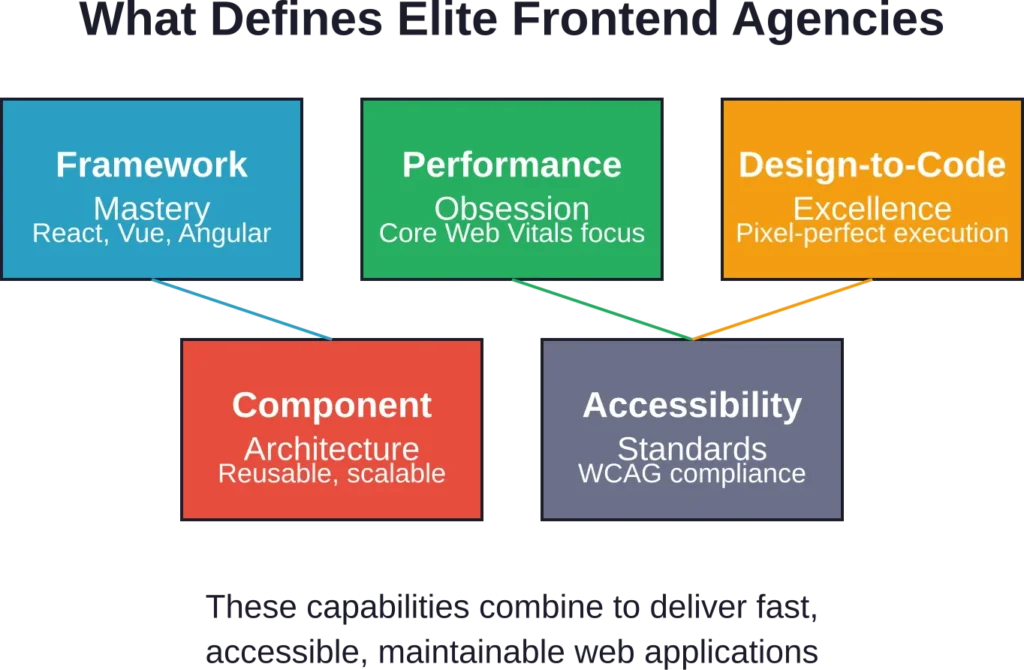
Strong frontend companies don’t just write JavaScript. They architect scalable component systems, obsess over performance metrics, and understand how browsers render pixels.
Technical Depth Across Modern Frameworks
The best firms maintain deep expertise in React, Vue, Angular, and Next.js. They don’t just follow tutorials—they understand reconciliation algorithms, hydration strategies, and bundle optimization.
Framework knowledge matters because choosing the wrong stack for your use case creates technical debt that compounds over months. A solid agency matches technology to business requirements rather than forcing every project into their preferred framework.
Performance-First Mentality
Speed isn’t optional anymore. Users abandon slow sites, and search engines penalize poor Core Web Vitals.
Top frontend teams measure everything: Time to Interactive, First Contentful Paint, Cumulative Layout Shift. They implement lazy loading, code splitting, and asset optimization as standard practice.
Look for agencies that talk about performance budgets and actually measure against them throughout development.
Design-to-Code Excellence
The handoff between design and development breaks more projects than any other phase. Great frontend companies bridge this gap seamlessly.
They work from design systems rather than one-off mockups. They understand spacing, typography, and animation timing. Most importantly, they push back when designs aren’t feasible or accessible.
This collaboration produces interfaces that look pixel-perfect while performing flawlessly across devices.
Top 15 Front-End Web Development Companies in 2026
These agencies represent the strongest frontend capabilities across different specializations and project types. Each brings unique strengths to the table.
1. Oski

Oski delivers high-performance frontend solutions that combine innovative design with seamless technical execution for tech-forward enterprises and ambitious startups.
The team excels in modern JavaScript frameworks, creating intuitive and visually compelling user interfaces that drive engagement and conversion. Their frontend work emphasizes clean architecture, responsive design, and optimal performance across devices.
What sets them apart is the integration of frontend development with AI-enhanced workflows and robust CMS implementations, ensuring interfaces remain maintainable and scalable. They specialize in React, Vue, Angular, Next.js, and Nuxt, delivering pixel-perfect experiences backed by strong usability principles.
Recent projects include building interactive web portals, modernizing legacy interfaces, and creating dynamic e-commerce and SaaS frontends for industries like fintech, travel, logistics, and education. Their solutions consistently focus on fast load times, smooth interactions, and accessibility.
Best for: Tech companies and enterprises needing polished, high-performance frontend implementations that integrate well with complex backend systems and modern technologies.
Contact Information:
- Website: oski.site
- Phone: +48571282759
- Email: [email protected]
- Address: Kaupmehe tn 7, 10114 Tallinn, Estonia
- LinkedIn: www.linkedin.com/company/oski-solutions
2. Lengreo

Lengreo brings a results-driven approach to frontend web development as part of their complete marketing and tech solutions. They build websites, landing pages, and digital experiences optimized for lead generation and business growth.
Their frontend work focuses on conversion-oriented design, fast-loading pages, and intuitive user flows that turn visitors into qualified leads. The team handles full-cycle website development with strong emphasis on UI implementation and performance.
What distinguishes them is the tight connection between frontend execution and marketing strategy — every interface element serves measurable business outcomes like reduced bounce rates and higher conversions. They deliver e-commerce sites, business portals, and optimized landing pages with clean, modern code.
Recent work includes building high-converting websites for IT companies, architecture firms, and tech providers, with documented improvements in user engagement and lead quality.
Best for: B2B companies that need frontend development tightly aligned with marketing goals and measurable growth outcomes.
Contact Information:
- Website: Lengreo.com
- Phone: +31 686 147 566
- Email: [email protected]
- Address: Vrijstraat 9 C/D, 5611 AT Eindhoven, Netherlands
- LinkedIn: Lengreo
- Twitter: @Lengreo
- Instagram: @lengreo
3. Gilzor

Gilzor specializes in custom frontend development as part of full-cycle digital product creation. They transform ideas into attractive, user-centric web interfaces that drive adoption and business results.
The agency combines deep UI/UX expertise with robust web development, creating responsive and performant frontends for web applications. Their approach prioritizes user experience, conversion optimization, and visual appeal without sacrificing technical quality.
What sets them apart is the user-centric methodology — they build interfaces that not only look great but also solve real user problems and support business scaling. Strong focus on modern web technologies ensures clean, maintainable code from the start.
Recent projects feature web applications for airlines, e-commerce grocery platforms, and cognitive training tools, all with highly polished and functional frontends that contributed to rapid user growth and positive feedback.
Best for: Startups and SMBs looking for custom web frontends that combine beautiful design with practical functionality and growth potential.
Contact Information:
- Website: www.gilzor.com
- Email: [email protected]
- Address: Poland, Warsaw, Office 58, street Adama Mickiewicza 37, 01-625
- LinkedIn: www.linkedin.com/company/gilzor-softwaredevelopment
4. A-listware

A-listware offers specialized frontend and UI/UX development within their broader software engineering capabilities. They create responsive, engaging web interfaces that enhance user satisfaction and brand perception.
The team works with leading frontend technologies including React, Angular, Vue, and modern CSS frameworks to deliver pixel-perfect, accessible designs. Their frontend projects emphasize responsive web design, intuitive navigation, and seamless interactions.
What makes them unique is the integration of UI/UX design with full software development expertise, ensuring frontends are not only visually strong but also technically solid and future-proof. They excel at building enterprise-grade interfaces and modernizing existing ones.
Recent work includes vibrant SaaS interfaces, responsive web portals, and user-focused applications for enterprise clients across multiple industries.
Best for: Businesses needing professional frontend development backed by strong design and enterprise-level technical standards.
Contact Information:
- Website: a-listware.com
- Phone: +1 (888) 337 93 73
- Email: [email protected]
- Address: North Bergen, NJ 07047, USA
- LinkedIn: www.linkedin.com/company/a-listware
- Facebook: www.facebook.com/alistware
5. Mobian Studio
Mobian Studio builds high-quality frontend solutions as part of dedicated engineering teams for mobile-first and web products. They focus on clean, scalable interfaces that perform exceptionally in production environments.
Their frontend expertise supports complex digital products with attention to architecture, performance, and user experience. The team delivers production-ready frontends with documented code and maintainable structures.
What sets them apart is the dedicated team model — senior engineers focused exclusively on your project deliver consistent quality in UI implementation, interactions, and integration with backend systems or AI components. Strong emphasis on scalable architecture from the frontend layer.
Recent projects include sophisticated web and mobile interfaces for healthcare, fintech, logistics, and IT companies, with focus on smooth user flows and reliable performance at scale.
Best for: Companies that require reliable, senior-level frontend development through dedicated teams for ambitious digital products.
Contact Information:
- Website: mobian.studio
- Phone: [email protected]
- Address: Harju maakond, Tallinn, Kesklinnalinnaosa, Masina tn 22, 10113
- LinkedIn: www.linkedin.com/company/mobian-studio
6. Storm Brain

Storm Brain brings technical rigor to frontend development with particular strength in complex data visualization and real-time application interfaces.
The agency specializes in React and Vue implementations for applications handling large datasets, live updates, and sophisticated filtering and search capabilities. Their work often involves integrating frontend interfaces with GraphQL APIs and WebSocket connections.
Storm Brain’s frontend developers demonstrate strong computer science fundamentals, implementing efficient algorithms for client-side data processing and optimizing render cycles for applications managing thousands of DOM elements.
Project work includes building administrative dashboards, analytics platforms, and enterprise tools where performance under load matters critically. They’ve documented expertise in virtual scrolling, memoization strategies, and state management patterns that keep complex interfaces responsive.
The agency serves primarily B2B clients with internal tools and customer-facing platforms requiring technical sophistication beyond typical marketing sites.
Best for: Data-intensive applications requiring advanced frontend engineering.
7. Instrument

Instrument combines strategic thinking, design excellence, and technical implementation for large-scale digital experiences. Their frontend work supports complex, content-rich sites for major brands.
The agency excels at building component systems that support diverse content types while maintaining consistent user experience. Frontend implementations handle high traffic volumes and integrate with enterprise content management systems.
Instrument’s technical team works across React, Vue, and modern JavaScript, choosing frameworks based on project requirements rather than predetermined preferences. They’ve built custom solutions when off-the-shelf frameworks don’t fit specific needs.
Their client roster includes Fortune 500 companies and globally recognized brands requiring enterprise-grade reliability, accessibility compliance, and internationalization support built into frontend architecture from the start.
Projects typically involve cross-functional teams including strategists, designers, and developers working in integrated sprints rather than sequential handoffs. This collaboration produces frontend code that reflects strategic intent and design vision accurately.
Best for: Enterprise brands requiring sophisticated, high-traffic digital experiences.
8. Code and Theory

Code and Theory operates as a creative agency with strong technical capabilities, including substantial frontend development expertise. The agency tackles digital transformation projects for large organizations.
Their frontend work spans web applications, e-commerce platforms, and digital marketing experiences. The team builds in React and Angular primarily, with expertise in headless architecture connecting frontend applications to enterprise backend systems.
Code and Theory brings particular strength to projects requiring integration between multiple systems—connecting e-commerce platforms, CRM databases, marketing automation tools, and analytics platforms through unified frontend interfaces.
The agency serves primarily enterprise clients with complex organizational requirements, compliance needs, and existing technology ecosystems that new frontend development must accommodate.
Their process emphasizes discovery and technical planning before development, mapping system dependencies and technical constraints to avoid surprises mid-project. Frontend architecture decisions account for security requirements, scalability needs, and maintenance realities.
Best for: Large organizations undertaking digital transformation with complex technical requirements.
9. TinyFrog Technologies

TinyFrog Technologies focuses on small to mid-sized business clients, delivering professional frontend development without enterprise agency overhead and complexity.
The agency builds primarily in WordPress and modern JavaScript frameworks, creating custom themes and plugins that extend platform capabilities while maintaining update compatibility and security.
TinyFrog’s frontend work emphasizes practical business outcomes—lead generation, clear calls-to-action, mobile responsiveness, and page speed optimization. Technical decisions prioritize maintainability and client team usability over architectural sophistication.
Their project approach includes training and documentation, ensuring client teams can manage content and make minor updates without ongoing developer dependency. Frontend implementations balance customization with sustainability.
The agency serves local and regional businesses, professional services firms, and B2B companies needing strong web presence without Fortune 500 budgets. Work demonstrates consistent quality across diverse industries.
Best for: Small to mid-market businesses needing reliable frontend development and ongoing support.
10. Duck Design
Duck Design specializes in Shopify frontend development, building custom themes and experiences optimized for e-commerce conversion and performance.
The agency’s frontend team masters Shopify’s Liquid templating language while implementing modern JavaScript for enhanced interactivity. They balance platform constraints with custom functionality, knowing exactly where Shopify’s native capabilities end and custom development should begin.
Duck Design’s work focuses on conversion optimization through frontend execution—product image galleries, variant selection interfaces, cart experiences, and checkout flow optimization within Shopify’s framework.
Their technical approach emphasizes mobile-first development and performance optimization, recognizing that e-commerce traffic increasingly comes from mobile devices with variable network conditions. Frontend code loads efficiently and performs smoothly across device and connection types.
The agency serves e-commerce brands at various scales, from emerging direct-to-consumer brands to established retailers expanding online presence. Work demonstrates understanding of retail business models and customer shopping behavior.
Best for: E-commerce businesses building or optimizing Shopify storefronts with custom frontend requirements.
11. The Frontend Company

The Frontend Company does exactly what the name suggests—frontend development, nothing else. This laser focus shows in their technical execution.
Founded in 2016, they’ve built their reputation entirely on React, Angular, Vue, and Next.js implementations. The team maintains a 5.0-star rating on Clutch across 29 reviews, reflecting consistent delivery quality.
What sets them apart is specialization depth. While full-service agencies spread resources across backend, DevOps, and design, The Frontend Company invests everything into JavaScript framework expertise and UI performance optimization.
Their minimum project engagement starts at $10,000, making them accessible for mid-market companies while still serving enterprise clients. The team size sits around 10-49 employees—small enough for partner attention, large enough for complex projects.
Recent work includes building component libraries, migrating legacy jQuery applications to React, and optimizing render performance for data-heavy dashboards. They’ve documented achieving measurable performance improvements through strategic code splitting and server-side rendering implementation.
Best for: Companies needing specialized frontend expertise without full-service overhead.
12. Lounge Lizard

Lounge Lizard brings a design-forward approach to frontend development. The agency balances aesthetic excellence with technical implementation, making them ideal for brands where visual impact matters as much as functionality.
Their frontend work connects tightly with their design team, creating seamless handoffs that preserve creative intent through to production code. This integration shows in portfolio work that looks polished while maintaining clean architecture underneath.
The agency has operated since 1998, giving them perspective on how frontend development has evolved from table layouts through jQuery to modern component frameworks. That experience translates into architectural decisions that anticipate future needs.
Lounge Lizard handles projects across React and Vue, with particular strength in animation implementation and micro-interactions that enhance user engagement without sacrificing performance.
Their client roster spans startups to established brands, with work that demonstrates range across e-commerce, SaaS platforms, and content-rich publishing sites.
Best for: Projects where design quality and frontend execution need equal weight.
13. Clay

Clay operates at the intersection of branding, UI design, and frontend development. The agency tackles complex digital products that require sophisticated interface design backed by robust technical implementation.
Their frontend team works primarily in React and Next.js, with emphasis on creating design systems that scale across large product surfaces. Projects often involve building component libraries that support dozens of unique page templates while maintaining consistency.
Clay’s strength lies in solving hard UX problems through frontend innovation. They’ve built custom animation frameworks, developed accessible data visualization components, and created interaction patterns that became industry standards.
The agency serves primarily venture-backed startups and enterprise clients with complex product requirements. Project scopes tend toward the ambitious end—complete platform builds rather than incremental improvements.
Their process emphasizes prototyping and iteration, building working frontend code early in the design phase rather than treating development as a final step. This approach catches technical constraints before they become expensive problems.
Best for: Complex digital products requiring custom frontend solutions and sophisticated interaction design.
14. HUEMOR

HUEMOR positions itself as a growth-focused web agency, and their frontend work reflects that priority. Every technical decision connects to business metrics—conversion rates, engagement time, bounce reduction.
The team specializes in React and Vue implementations optimized for conversion. They obsess over details that impact user action: button states, form validation patterns, loading indicators, error messaging.
HUEMOR’s frontend developers work closely with their analytics team, implementing event tracking and A/B testing infrastructure as core features rather than afterthoughts. This data-informed approach produces interfaces that perform measurably better than industry averages.
Their client work includes e-commerce platforms, lead generation sites, and SaaS applications where conversion optimization directly impacts revenue. Case studies document specific metric improvements—traffic increases, session duration extensions, conversion rate lifts.
The agency brings particular strength to WordPress and Shopify frontend development, building custom themes that balance visual flexibility with performance constraints inherent to these platforms.
Best for: Businesses prioritizing measurable conversion improvements through frontend optimization.
15. Excited Agency

Excited Agency takes a product-first approach to web design and frontend development. They focus on structure, clarity, and conversion rather than surface-level aesthetics.
The agency combines UX research, web design, branding, and motion design to create websites that scale with product growth. Their frontend implementations support long-term business evolution rather than static marketing sites.
Excited works primarily with B2B SaaS companies and tech startups where the website serves as a critical product marketing tool. Their frontend code emphasizes modularity—building systems that marketing teams can extend without developer involvement for every change.
The team builds primarily in modern JavaScript frameworks with headless CMS integration, giving content teams editorial control while maintaining developer control over frontend architecture and performance.
Their process includes extensive wireframing and prototyping before visual design, ensuring information architecture and user flows work correctly before committing to final styling. Frontend development begins from these validated structures.
Best for: Product-focused companies needing websites that support rapid iteration and growth.
How to Choose the Right Frontend Development Company
Selecting a frontend development partner requires matching agency capabilities to project needs. The “best” company varies dramatically based on context.
Match Technical Requirements to Agency Expertise
Start with framework requirements. If the project demands React, prioritize agencies with demonstrated React expertise. Don’t assume all JavaScript shops are interchangeable—React patterns differ substantially from Vue or Angular approaches.
Review agency portfolios for projects similar in technical complexity to yours. An agency that builds marketing sites beautifully might struggle with real-time data applications. Conversely, firms specializing in complex dashboards might over-engineer a simple content site.
Ask specific technical questions during vetting: How do they handle state management? What’s their testing approach? How do they optimize bundle sizes? Strong agencies answer these questions with specific methodologies, not generic best practices.
Evaluate Process Compatibility
Agency process matters as much as technical skill. Some firms work in strict sprints with formal handoffs. Others prefer continuous collaboration with daily check-ins.
Consider how the agency integrates with your team. Will they work with your designers, or do they require complete design control? Do they accept technical direction, or do they insist on architectural autonomy?
Process mismatches create friction even when technical capabilities align perfectly. A startup needing rapid iteration will struggle with agencies requiring extensive upfront planning. Enterprise clients with compliance requirements need structured processes that agile-focused shops might find constraining.
Assess Communication and Collaboration Style
Frontend development requires constant communication between designers, backend developers, product managers, and business stakeholders. Agency communication patterns predict project smoothness.
During initial conversations, notice response patterns. Do they ask clarifying questions or make assumptions? Do they explain technical tradeoffs in accessible language or hide behind jargon?
Strong frontend agencies translate between technical and business contexts fluently. They explain why certain designs create performance problems and propose alternatives that satisfy both aesthetic and technical requirements.
Review Real Client Outcomes
Marketing claims sound similar across agencies. Everyone promises clean code, beautiful design, and on-time delivery. Client outcomes reveal reality.
Look for case studies with specific metrics: performance improvements, conversion increases, development time reductions. Vague statements about “exceeded expectations” mean less than documented 50% faster page loads or 161% longer session durations.
Talk to references, but ask specific questions. Don’t settle for “were they good to work with?” Ask about how they handled unexpected challenges, how they managed scope changes, and whether the code proved maintainable after launch.
| Selection Criteria | Questions to Ask | Warning Signs |
|---|---|---|
| Technical Expertise | What frameworks do you specialize in? How do you handle performance optimization? | Generic answers, no specific methodologies, inability to discuss technical tradeoffs |
| Process Fit | How do you structure projects? What does collaboration look like day-to-day? | Rigid processes with no flexibility, unclear project phases, poor timeline estimates |
| Portfolio Relevance | Show me projects similar to mine in complexity and scale. | Only showing design, no live sites, no technical depth in case studies |
| Communication | How do you explain technical constraints to non-technical stakeholders? | Excessive jargon, dismissive of questions, slow response times during sales |
| Client Outcomes | What measurable results have you achieved? Can I speak with references? | Only testimonials, no metrics, reluctance to provide references |
The Frontend Development Landscape in 2026
Understanding current industry trends helps evaluate agencies and make informed decisions about technical direction.
Framework Consolidation and Specialization
The JavaScript framework explosion has settled into a more stable ecosystem. React maintains dominant market share, with Next.js becoming the default choice for new React projects requiring server-side rendering.
Vue continues strong adoption in enterprise contexts, particularly in Asia and Europe. Angular remains entrenched in large organizations with existing investments and developers who prefer its opinionated structure.
This consolidation benefits clients. Agencies can develop deeper expertise in fewer frameworks rather than superficially supporting every new library. Code patterns stabilize, making maintenance and team transitions smoother.
According to academic research on web development career paths, software developers focusing on modern frameworks like React can expect strong job growth—projected at 17.9% according to recent employment data. This growth ensures agencies can hire skilled developers and clients can find maintainers for their codebases.
Performance as Competitive Advantage
Page speed evolved from nice-to-have to business requirement. Google’s Core Web Vitals impact search rankings directly. Users abandon slow sites ruthlessly.
Top frontend agencies now treat performance as a feature, not an optimization phase. They establish performance budgets during architecture planning and measure against them throughout development.
This shift benefits everyone. Faster sites convert better, rank higher, and cost less to operate. Frontend developers who optimize images, implement lazy loading, and minimize JavaScript bundles create measurable business value.
AI’s Impact on Frontend Development
AI tools are changing frontend development workflows, though not replacing developers. GitHub Copilot and similar tools help generate boilerplate code and suggest implementations.
But AI struggles with architectural decisions, performance optimization, and accessibility implementation—precisely where experienced agencies add value. According to a Brookings Institution analysis, while AI companies increasingly compete with their customers in application development, the reality is that AI models remain commodities that require skilled implementation.
Smart agencies incorporate AI tools to accelerate routine tasks while focusing human expertise on complex problem-solving, user experience design, and strategic technical decisions that AI can’t replicate.
Component-Driven Development Maturity
Component-driven development moved from trend to standard practice. Agencies now build design systems first, then compose pages from reusable components.
This approach creates consistency across large sites, speeds development after initial component creation, and simplifies maintenance. Changes to a button component automatically update every instance across the application.
Tools like Storybook became standard for component development and documentation. Frontend teams develop components in isolation, test edge cases thoroughly, then integrate into full pages with confidence.
Common Frontend Development Challenges and Solutions
Every frontend project encounters predictable challenges. Understanding common problems and solutions helps set realistic expectations and evaluate agency responses.
Design-to-Code Translation Issues
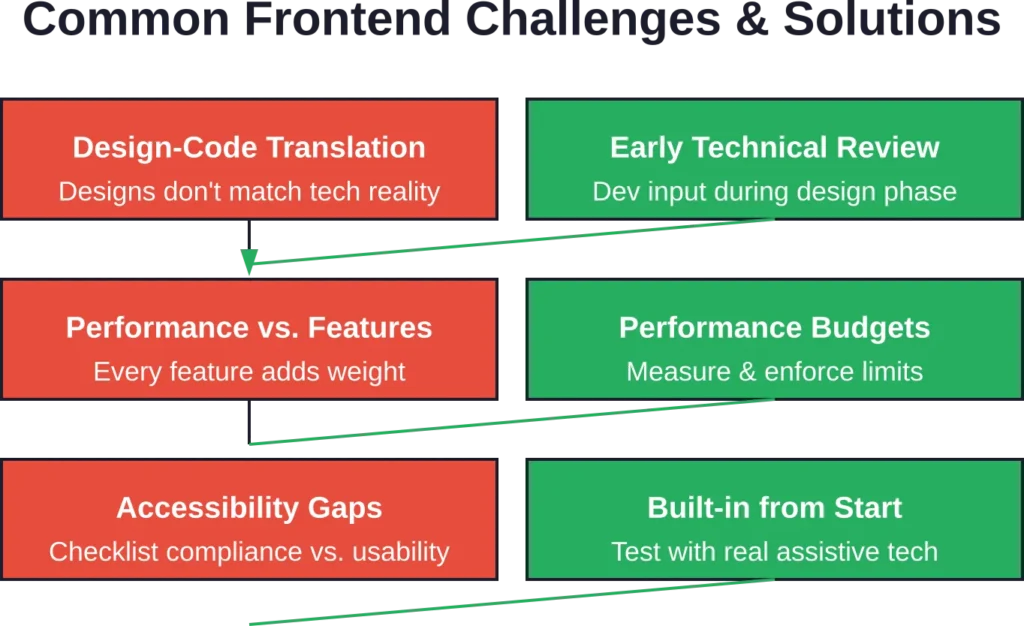
Designs often specify interactions that prove difficult or impossible to implement efficiently. Animations might require constant JavaScript execution. Layouts might break responsive design principles. Custom fonts might slow page loads unacceptably.
Strong agencies identify these problems early through technical review of designs before coding begins. They propose alternatives that preserve design intent while respecting technical constraints.
The solution involves close designer-developer collaboration throughout the process, not sequential handoffs where developers receive completed designs with no room for technical input.
Performance vs. Features Tradeoffs
Every feature adds weight. More JavaScript means slower initial loads. More images impact mobile users on slow connections. More animations consume device resources.
Experienced agencies help prioritize features based on user value versus performance cost. They implement progressive enhancement—delivering core functionality quickly, then enhancing the experience for capable devices and connections.
Performance budgets establish acceptable limits. When a new feature would exceed the budget, teams must optimize existing code or cut a lower-value feature rather than simply accepting degraded performance.
Browser Compatibility Complexity
Despite standardization improvements, browsers still render certain features inconsistently. Agencies must test across browser versions, devices, and operating systems.
Modern build tools help by transpiling new JavaScript features to older syntax and adding vendor prefixes to CSS. But manual testing across real devices remains necessary for complex interactions.
Clear browser support requirements set during project planning prevent surprises. Supporting Internet Explorer 11 requires dramatically different technical approaches than targeting only modern browsers.
Accessibility Implementation Gaps
Accessibility often gets treated as a checklist item rather than fundamental requirement. This produces interfaces that technically pass automated tests but frustrate actual users with disabilities.
Strong agencies build accessibility into component architecture from the start. They use semantic HTML, implement keyboard navigation, provide screen reader text, and test with actual assistive technologies.
Accessibility benefits everyone, not just users with disabilities. Keyboard navigation helps power users. Clear focus states improve usability. Good color contrast works better in bright sunlight.
Questions to Ask Potential Frontend Development Partners
Initial conversations with agencies reveal capabilities and compatibility. These questions cut through marketing language to substance.
Technical Capability Questions
What frameworks do you specialize in, and why? Strong agencies explain framework choices based on project requirements rather than developer preference.
How do you handle performance optimization? Look for specific techniques: code splitting, lazy loading, image optimization, caching strategies. Vague “we follow best practices” answers suggest shallow expertise.
What’s your testing approach? Quality agencies implement unit tests for components, integration tests for features, and end-to-end tests for critical user flows.
How do you ensure accessibility? Beyond automated testing, do they manually test with screen readers? Do they involve users with disabilities in testing?
Process and Collaboration Questions
How do you structure frontend projects? Understand their phases: planning, design review, component development, integration, testing, deployment.
What does day-to-day collaboration look like? Daily standups? Weekly check-ins? Slack communication? Shared project management tools?
How do you handle design changes mid-project? Flexible agencies accommodate reasonable changes through clear change request processes. Rigid shops either refuse changes or allow scope creep.
What happens after launch? Maintenance, bug fixes, performance monitoring, and ongoing optimization matter as much as initial development.
Experience and Outcomes Questions
Can you show me projects similar to mine? Review live sites, not just screenshots. Test performance, interactions, and responsive behavior.
What measurable results have you achieved? Specific metrics—conversion improvements, performance gains, traffic increases—indicate results-focused work.
Can I speak with references from similar projects? Ask references about problem-solving, communication, deadline management, and code quality.
How do you stay current with frontend evolution? Continuous learning matters in rapidly changing frontend landscape. Agencies should invest in team training and experimentation.
The Business Value of Quality Frontend Development
Frontend development costs money. Understanding the return on that investment helps justify appropriate budget allocation.
Performance Impact on Revenue
Page speed directly affects conversion rates. Research has documented correlations between page load speed and conversion rates, with studies indicating that latency significantly impacts sales. For e-commerce businesses, frontend optimization translates directly to revenue.
Mobile users on slow connections abandon sites that don’t load quickly. Research indicates that mobile users often abandon sites with slow load times. Fast frontend implementation captures revenue that slow sites lose.
User Experience Impact on Retention
Smooth, intuitive interfaces keep users engaged. Confusing navigation, broken interactions, and slow responses drive users away permanently.
Quality frontend development creates experiences that feel effortless. Users accomplish tasks without friction, building positive associations with the brand. Poor implementations frustrate users, damaging brand perception beyond the immediate interaction.
Maintainability Impact on Total Cost
Cheap frontend development often creates expensive maintenance problems. Poorly structured code requires extensive refactoring for even minor changes. Lack of documentation makes updates risky.
Quality agencies build maintainable codebases with clear architecture, comprehensive documentation, and automated testing. This upfront investment reduces long-term cost dramatically as the product evolves.
Accessibility Impact on Market Reach
Accessible frontend development expands potential market by making products usable for people with disabilities. This represents a significant addressable market, particularly in developed economies.
Beyond market reach, accessibility reduces legal risk. Web accessibility lawsuits increased substantially in recent years. Proactive accessibility implementation costs far less than retrofitting or litigation.
Frequently Asked Questions
Front-end development companies specialize exclusively in user interface implementation—the code that runs in browsers and creates what users see and interact with. They focus deeply on JavaScript frameworks like React, Vue, and Angular, along with HTML, CSS, and browser performance optimization.
Full-stack development companies handle both frontend and backend work, building complete applications including server logic, databases, APIs, and infrastructure alongside user interfaces. They offer broader capabilities but typically less specialized frontend expertise than dedicated frontend shops.
For projects where interface excellence matters critically—complex user interactions, demanding performance requirements, sophisticated design implementation—specialized frontend companies often deliver superior results. Full-stack firms make sense when backend complexity equals or exceeds frontend requirements.
Project timelines vary enormously based on scope and complexity. A simple marketing website might take 4-8 weeks from kickoff to launch. A component library for a design system might require 8-12 weeks. A complex web application with sophisticated interactions could span 3-6 months or longer.
Timeline factors include design complexity, required integrations, custom functionality, content volume, review cycles, and client responsiveness. Projects with clear requirements and available stakeholders progress faster than those with ambiguous scope or delayed feedback.
Reputable agencies provide timeline estimates after understanding project requirements. Be wary of firms promising unrealistic timelines—quality frontend work requires adequate time for development, testing, and refinement.
Framework selection depends on project requirements, team capabilities, and long-term maintenance considerations rather than following trends or developer preferences.
React offers the largest developer community, extensive third-party libraries, and strong job market for hiring developers. It works well for projects of any size and complexity. Next.js builds on React adding server-side rendering and simplified routing for better performance and SEO.
Vue provides gentler learning curves and excellent documentation, making it accessible for smaller teams. It scales well to complex applications while remaining approachable for simpler projects.
Angular suits large enterprise applications with multiple teams working on the same codebase. Its opinionated structure enforces consistency but requires more upfront learning investment.
A qualified frontend development company should recommend frameworks based on your specific needs rather than pushing a single preferred technology.
While specific pricing varies widely and falls outside this article’s scope, understanding general investment levels helps set realistic expectations.
Simple marketing websites with standard functionality represent the lower end of professional frontend development investment. Complex web applications with custom interactions, sophisticated state management, and extensive testing require substantially higher budgets.
Project costs scale with scope, complexity, timeline, and agency expertise. Specialized agencies with strong portfolios and proven results command premium rates but often deliver superior outcomes that justify higher investment through better performance, maintainability, and user experience.
Consider total cost of ownership beyond initial development. Well-built frontend code costs less to maintain and extend over time, while cheap implementations often require expensive rebuilds within 1-2 years.
The answer depends on project complexity and quality requirements. General web agencies handle straightforward projects adequately—standard marketing sites, simple e-commerce stores, basic web applications using established platforms.
Specialized frontend companies make sense when projects demand technical sophistication: complex user interactions, performance-critical applications, sophisticated animations, real-time data visualization, progressive web app functionality, or integration with complex backend systems.
Specialized firms also excel at scale—building design systems supporting multiple products, creating component libraries for large organizations, or establishing frontend architecture for growing platforms.
For business-critical applications where user experience directly impacts revenue or retention, specialized expertise typically proves worth the investment through superior execution and fewer costly revisions.
Mobile-first development means designing and building for mobile devices as the primary experience, then progressively enhancing for larger screens. This approach matters because mobile traffic dominates web usage across most markets and industries.
Mobile-first implementation forces prioritization. Smaller screens can’t accommodate everything desktop layouts display, requiring teams to identify truly essential content and functionality. This constraint typically produces cleaner, more focused experiences across all devices.
Performance considerations matter more on mobile due to slower processors, limited memory, and variable network conditions. Building mobile-first encourages performance optimization that benefits all users while ensuring solid experiences for the most constrained contexts.
Google’s mobile-first indexing means the mobile version of sites determines search rankings. Mobile-first frontend development aligns technical implementation with both user behavior and search engine requirements.
Non-technical stakeholders can assess frontend quality through observable outcomes rather than code review. Page load speed provides an objective metric—use Google PageSpeed Insights to test performance scores.
Cross-browser and device testing reveals implementation quality. Does everything work correctly in Safari, Chrome, Firefox, and Edge? Do interactions function smoothly on phones, tablets, and desktops? Quality code produces consistent experiences across contexts.
Accessibility testing shows attention to standards and inclusive design. Use free tools like WAVE or axe DevTools to check for obvious accessibility issues. Quality agencies build accessible interfaces from the start.
Ask the agency about their testing process, documentation practices, and code review standards. Strong shops implement automated testing, maintain documentation, and conduct peer code reviews. These practices correlate strongly with code quality.
Finally, check maintenance requirements post-launch. Quality code needs minor updates and occasional bug fixes. Poorly built sites require constant emergency fixes and expensive refactoring.
Making the Final Decision
Choosing a frontend development partner represents a significant business decision with long-term implications. The right agency becomes a trusted collaborator. The wrong choice creates technical debt and frustration.
Start by clearly defining project requirements. What problems need solving? What outcomes matter most? What constraints exist around budget, timeline, and technical infrastructure?
Evaluate agencies against those specific requirements rather than general reputation. An agency perfect for one project might be completely wrong for another. Match capabilities to needs.
Trust your assessment of cultural fit and communication style. Technical skills matter enormously, but projects succeed or fail based on collaboration quality. Choose partners who communicate clearly, ask good questions, and demonstrate genuine interest in understanding business context beyond technical specifications.
Request detailed proposals that demonstrate understanding of the project and outline specific approaches. Vague proposals suggest superficial engagement. Detailed technical approaches, realistic timelines, and clear deliverables indicate serious preparation.
The frontend development landscape offers strong options across specializations and scales. Companies needing specialized framework expertise find agencies like The Frontend Company. Brands prioritizing design execution work with firms like Lounge Lizard or Clay. Enterprise organizations tackle complex requirements with shops like Instrument or Code and Theory.
Investment in quality frontend development pays returns through better user experiences, stronger conversion rates, improved performance, and reduced long-term maintenance costs. The global IT skills shortage represents a significant economic challenge—makes quality development resources increasingly valuable.
Take time to evaluate options thoroughly. Review portfolios critically. Talk to references. Ask probing questions. The best frontend development companies welcome scrutiny because they’re confident in their capabilities and outcomes.
Your frontend represents the primary touchpoint between business and customers. Investing appropriately in that critical interface makes sound business sense regardless of industry or company size.