

Quick Summary: Selecting the right Drupal development company is critical for building secure, scalable, and content-rich websites. This guide profiles 15 top Drupal agencies in 2026 — ranging from enterprise-focused firms to specialized consultancies — based on their technical expertise, project portfolios, and client feedback. Each company brings unique strengths in custom module development, migration services, and ongoing support.
Drupal remains one of the most powerful content management systems available. It powers everything from government portals to Fortune 500 corporate sites, demanding a level of security and flexibility that few platforms can match.
But here’s the thing: Drupal isn’t a plug-and-play solution. It requires skilled developers who understand its architecture, API ecosystem, and best practices. That’s where specialized Drupal development companies come in.
This guide profiles ten agencies that consistently deliver exceptional Drupal projects in 2026. We’ve examined their technical capabilities, client portfolios, and community contributions to identify firms that truly understand the platform.
What Makes a Great Drupal Development Company?
Not every web development agency can handle Drupal effectively. The platform’s learning curve is steep, and quality implementations require specific expertise.
Strong Drupal agencies share several characteristics. They maintain active Drupal.org profiles with contributed modules or patches. Their teams include Acquia-certified developers. They’ve successfully migrated legacy systems to Drupal 10 and understand decoupled architecture patterns.
Experience with enterprise deployments matters too. The best firms have worked on high-traffic sites requiring custom workflows, multilingual content, and complex integrations. They understand accessibility standards, security hardening, and performance optimization at scale.
Real talk: check whether an agency contributes to the Drupal community. Companies that give back through module development, DrupalCon participation, or documentation tend to maintain deeper platform knowledge.
Core Competencies to Look For
Technical depth separates truly excellent Drupal shops from generalist agencies that dabble in the platform.
Custom module development is essential. Pre-built modules solve common problems, but complex projects always require custom code. Look for agencies that can architect scalable solutions using Drupal’s APIs and coding standards.
Migration expertise has become critical as Drupal 7 reached end-of-life. Firms should demonstrate experience upgrading legacy Drupal sites to current versions and migrating content from other CMS platforms.
Theming and front-end integration capabilities matter for user experience. Modern Drupal projects often use decoupled front ends with React or Vue. The best agencies bridge back-end power with contemporary design.
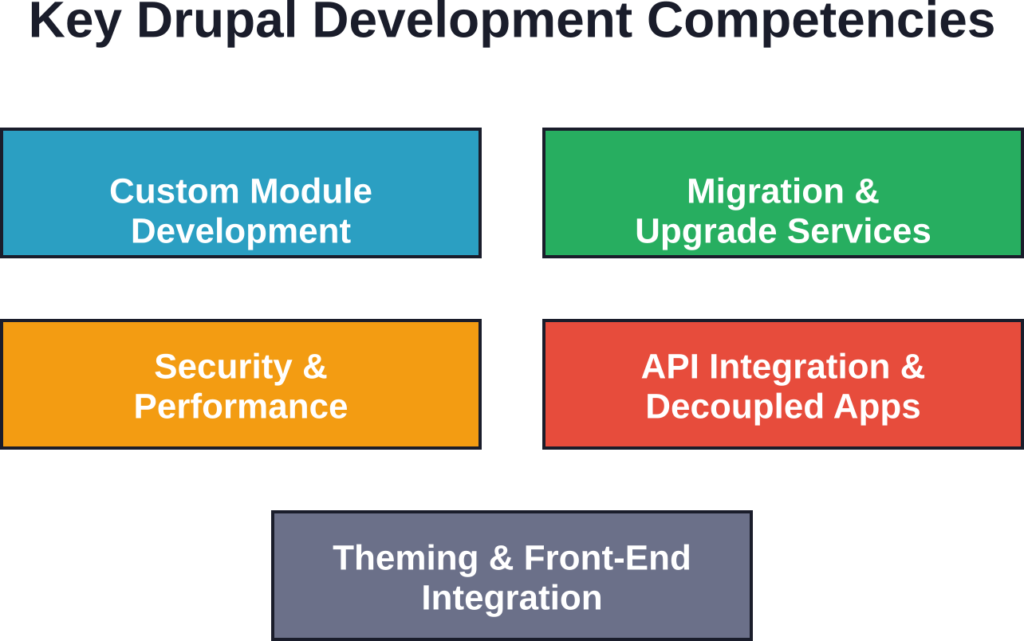
Five essential technical capabilities that distinguish leading Drupal development agencies from general web firms.
Top 15 Drupal Development Companies in 2026
The following agencies represent the best Drupal talent available today. Each brings distinct strengths and specializations.
1. Gilzor

Gilzor brings a product-first mindset to Drupal projects. Rather than simply coding to specifications, they collaborate closely with clients to validate ideas, shape requirements, and deliver solutions that drive real business outcomes.
The agency excels at creating custom Drupal-based web applications and platforms. They build enterprise content management systems, membership portals, and complex web solutions that leverage Drupal’s modular architecture for scalability and flexibility.
Gilzor’s team integrates Drupal developers with UI/UX specialists and technical architects. This cross-functional collaboration ensures that every implementation balances technical excellence with intuitive user experiences and strategic business alignment.
Their development process follows structured yet flexible methodologies with clear milestones, regular progress updates, and thorough quality assurance. Clients receive iterative deliverables that allow for continuous feedback and refinement throughout the project lifecycle.
Contact Information:
- Website: www.gilzor.com
- Email: [email protected]
- Address: Poland, Warsaw, Office 58, street Adama Mickiewicza 37, 01-625
- LinkedIn: www.linkedin.com/company/gilzor-softwaredevelopment
2. Mobian Studio
Mobian Studio approaches Drupal development with a strong emphasis on scalable architecture and future-proof solutions. They partner with clients to transform complex requirements into elegant, maintainable digital experiences built on Drupal.
The studio specializes in building robust Drupal platforms for industries requiring high performance and integration capabilities. Their work includes custom enterprise websites, data-driven applications, and systems that seamlessly connect with third-party services and APIs.
Their multidisciplinary team combines senior Drupal expertise with AI-enhanced development practices and domain specialists. This ensures solutions are not only technically sound but also aligned with industry-specific needs and long-term growth objectives.
Mobian Studio emphasizes clean code, comprehensive documentation, and dedicated team models. Projects benefit from rigorous testing, performance optimization, and ongoing partnership support after launch.
Contact Information:
- Website: mobian.studio
- Phone: [email protected]
- Address: Harju maakond, Tallinn, Kesklinnalinnaosa, Masina tn 22, 10113
- LinkedIn: www.linkedin.com/company/mobian-studio
3. Lengreo
Lengreo brings strategic insight and technical precision to Drupal projects. They work as true partners, helping clients refine their vision, optimize content strategies, and build platforms that support both marketing goals and operational efficiency.
The agency delivers custom Drupal solutions including advanced content management systems, SEO-optimized websites, and integrated web applications. They leverage Drupal’s powerful taxonomy, workflow, and multilingual capabilities to create flexible digital foundations.
Lengreo’s team unites Drupal developers with digital marketing and UX professionals. This holistic expertise ensures that technical implementations enhance visibility, user engagement, and business performance from day one.
Their process combines discovery, iterative development, and performance-focused delivery. Clients benefit from structured feedback loops, quality testing, and solutions designed for long-term maintainability and growth.
Contact Information:
- Website: Lengreo.com
- Phone: +31 686 147 566
- Email: [email protected]
- Address: Vrijstraat 9 C/D, 5611 AT Eindhoven, Netherlands
- LinkedIn: Lengreo
- Twitter: @Lengreo
- Instagram: @lengreo
4. A-Listware
A-Listware delivers enterprise-grade Drupal development with a focus on reliability and seamless integration. They partner with clients to design and implement solutions that scale effectively while meeting complex business and technical requirements.
The company builds sophisticated Drupal-based systems, including custom portals, e-commerce platforms, and enterprise content solutions. They utilize Drupal’s extensible framework to create secure, high-performance applications tailored to specific industry needs.
Their team consists of experienced Drupal specialists working alongside QA engineers, UX designers, and IT consultants. This comprehensive approach guarantees that every project aligns technical execution with user needs and organizational objectives.
A-Listware follows disciplined development practices with strong emphasis on testing, security, and documentation. Clients receive fully validated solutions supported by clear communication and structured project governance.
Contact Information:
- Website: a-listware.com
- Phone: +1 (888) 337 93 73
- Email: [email protected]
- Address: North Bergen, NJ 07047, USA
- LinkedIn: www.linkedin.com/company/a-listware
- Facebook: www.facebook.com/alistware
5. Oski
Oski focuses on delivering well-engineered Drupal solutions that prioritize stability, usability, and performance. They collaborate with clients to create digital platforms that solve real business challenges through Drupal’s robust capabilities.
The agency develops custom Drupal websites, enterprise CMS implementations, and integrated web applications. They excel at building scalable solutions for sectors requiring strong content management, user workflows, and third-party integrations.
Oski’s team blends Drupal development expertise with frontend specialists and solution architects. This ensures technically excellent implementations that deliver exceptional user experiences and operational efficiency.
Their methodology emphasizes quality at every stage, including thorough testing, performance optimization, and clear documentation. Clients receive reliable, maintainable solutions backed by ongoing support and partnership.
Contact Information:
- Website: oski.site
- Phone: +48571282759
- Email: [email protected]
- Address: Kaupmehe tn 7, 10114 Tallinn, Estonia
- LinkedIn: www.linkedin.com/company/oski-solutions
6. Light-it
Light-it brings a product development mindset to Drupal projects. Rather than simply executing specifications, they partner with clients to refine concepts, validate assumptions, and iterate toward optimal solutions.
The agency excels at building custom web applications on Drupal where the platform serves as a foundation for complex functionality. They’ve developed learning management systems, resource booking platforms, and data visualization dashboards using Drupal’s extensible architecture.
Light-it’s team combines Drupal developers with UX designers and business analysts. This multidisciplinary approach ensures technical implementations align with user needs and business objectives from the start.
Their agile development methodology emphasizes regular demos and feedback loops. Clients receive working software at the end of each sprint, allowing them to validate direction before teams invest in additional features.
7. Seasia Infotech

Established in 2011, Seasia Infotech has grown into a substantial digital solutions provider with strong Drupal capabilities. Their company size exceeds 1,000 employees, enabling them to handle enterprise-scale projects requiring large development teams.
Seasia’s Drupal practice serves clients across healthcare, education, finance, and retail verticals. They’ve developed deep domain expertise that informs their technical approaches and allows them to anticipate industry-specific requirements.
The company offers comprehensive quality assurance services alongside development. Their testing teams perform functional testing, security scanning, performance benchmarking, and cross-browser validation before any production deployment.
Seasia maintains ISO certifications and follows CMMI processes, providing the governance and documentation that enterprise clients require. Their project management methodologies emphasize risk mitigation and stakeholder communication throughout delivery cycles.
8. Existek
Existek operates as a full-cycle development company with dedicated Drupal expertise. They handle everything from initial concept validation through design, development, launch, and ongoing optimization.
Their Drupal team has particular strength in e-commerce implementations using Drupal Commerce. They’ve built sophisticated online stores with custom product configurators, dynamic pricing engines, and multi-warehouse inventory management.
Existek emphasizes performance optimization for Drupal sites. They implement advanced caching strategies, optimize database queries, and leverage content delivery networks to ensure fast page loads even for content-heavy sites.
The agency’s clients value their transparent communication and fixed-price project options. Existek provides detailed estimates during discovery phases and works within agreed budgets, reducing financial uncertainty for clients.
9. Umbrella IT
Umbrella IT focuses on mid-market clients who need professional Drupal development without enterprise agency overhead. They’ve built a reputation for delivering quality work on reasonable timelines and budgets.
The agency specializes in Drupal migrations from legacy platforms including WordPress, Joomla, and older Drupal versions. Their migration methodology preserves SEO value while modernizing information architecture and design.
Umbrella IT offers flexible engagement models including dedicated team arrangements where clients get consistent developers allocated to their projects. This model works well for organizations with ongoing development needs rather than one-time projects.
Their support and maintenance services help clients keep Drupal sites secure and current. Regular updates, security patches, and performance monitoring prevent the technical debt that accumulates when sites go unmaintained.
10. Achievion Solutions

Achievion Solutions brings enterprise consulting experience to Drupal implementations. Their team includes business strategists who help clients define requirements and success metrics before development begins.
The company excels at complex integration projects where Drupal serves as a content hub connected to multiple enterprise systems. They’ve integrated Drupal sites with ERP platforms, marketing automation tools, and customer data platforms.
Achievion’s approach emphasizes long-term value over quick launches. They architect Drupal solutions with extensibility and maintainability in mind, using design patterns and documentation that make future enhancements easier.
Their client relationships often extend beyond initial launches into ongoing optimization and enhancement engagements. This continuity allows their teams to refine implementations based on actual usage data and evolving business needs.
11. Specbee

Specbee has built a strong reputation as a Drupal-focused consultancy with particular strength in enterprise implementations. Founded by developers who cut their teeth on complex Drupal projects, the company maintains an exclusive focus on the platform rather than spreading across multiple technologies.
Their team includes multiple Acquia Grand Master certified developers — the highest level of Drupal certification available. This expertise shows in their work on high-profile projects for universities, healthcare organizations, and media companies.
What sets Specbee apart is their emphasis on performance optimization and scalability. They’ve developed proprietary approaches to caching, database query optimization, and CDN integration that keep large Drupal sites responsive under heavy traffic.
The agency also contributes actively to the Drupal community, maintaining several popular contributed modules and presenting regularly at DrupalCon events. This community involvement keeps their team current on platform developments and best practices.
12. Five Jars

Five Jars operates as a boutique Drupal agency that combines technical depth with strong design sensibilities. Based in New York with development teams distributed globally, they’ve carved out a niche working with design-forward brands that need Drupal’s power without sacrificing aesthetics.
Their portfolio spans e-commerce implementations, membership platforms, and content-heavy editorial sites. Five Jars excels at headless Drupal implementations where the CMS serves content via APIs to React or Vue front ends.
The agency’s approach emphasizes close collaboration during discovery and planning phases. They invest time understanding business requirements before proposing technical architectures, which reduces costly pivots during development.
Five Jars maintains a perfect client satisfaction rating across multiple review platforms, with particular praise for their communication and project management. Their teams include dedicated project managers who keep stakeholders informed throughout development cycles.
13. Cyber Infrastructure (CIS)
Founded in 2003, Cyber Infrastructure (CIS) has grown into a large IT services company with substantial Drupal capabilities. Their team size exceeds 1,000 employees, allowing them to staff multiple large-scale projects simultaneously.
CIS serves enterprise clients requiring comprehensive digital solutions beyond just Drupal development. They offer strategy consulting, UX design, quality assurance, and ongoing managed services. This full-service approach appeals to organizations seeking a single vendor for complex digital transformations.
The company’s Drupal practice has delivered projects for Fortune 500 companies, government agencies, and international NGOs. Their experience with multilingual sites and complex workflow automation makes them particularly strong for global organizations.
Based in San Jose with delivery centers in India, CIS leverages a follow-the-sun development model to maintain productivity across time zones. This operational structure helps them meet aggressive timelines for enterprise deployments.
14. WPWeb Infotech
Despite the WordPress reference in their name, WPWeb Infotech maintains significant Drupal expertise alongside their multi-CMS capabilities. The agency has earned Elite Author status on CodeCanyon and developed 20+ WordPress plugins, demonstrating technical versatility across platforms.
Their Drupal practice focuses on custom module development and complex integrations. WPWeb Infotech has particular expertise connecting Drupal sites to enterprise systems like Salesforce, SAP, and custom APIs. This integration focus serves clients with existing technology stacks.
The company offers both project-based and staff augmentation models. Organizations with internal development teams often engage WPWeb Infotech to supplement their Drupal expertise for specific initiatives or to handle overflow work.
Their technical team stays current with Drupal’s evolution, having successfully migrated dozens of sites from Drupal 7 to Drupal 10. They’ve developed standardized migration frameworks that reduce risk and accelerate timelines for upgrade projects.
15. CimpleO
CimpleO positions itself as a Drupal specialist with particular strength in government and nonprofit sectors. They understand the compliance requirements, accessibility standards, and budget constraints common in public-sector work.
The agency has deep experience with Drupal’s accessibility features, ensuring sites meet WCAG 2.1 AA standards and Section 508 requirements. Their testing processes include automated scanning plus manual testing with screen readers and keyboard navigation.
CimpleO’s government clients appreciate their security-focused development practices. They follow OWASP guidelines, implement comprehensive audit logging, and configure Drupal following security hardening checklists from agencies like CISA.
Beyond development, CimpleO offers training programs for content editors and site administrators. Their documentation and knowledge transfer ensure clients can manage their Drupal sites effectively after launch.
How to Evaluate Drupal Development Companies
Choosing the right agency requires looking beyond marketing materials to assess actual capabilities and fit.
Technical Assessment
Start by examining each agency’s Drupal.org profile. Companies with strong platform expertise maintain active profiles showing contributed modules, core patches, and participation in issue queues.
Ask about certifications. Acquia offers multiple certification levels from Developer to Grand Master. While certifications don’t guarantee quality, they demonstrate commitment to platform mastery.
Request code samples or GitHub repositories. Quality Drupal agencies follow coding standards, write comprehensive documentation, and implement automated testing. Their code should be readable and well-structured.
Inquire about their approach to security. Strong agencies follow security best practices including regular updates, security review processes, and adherence to OWASP guidelines for custom code.
Portfolio and Case Studies
Review completed projects similar to what’s needed. An agency with beautiful portfolio pieces in unrelated industries might not understand specific vertical requirements.
Look for quantifiable results in case studies. Vague claims about “improving user experience” matter less than specific metrics on traffic increases, conversion improvements, or page load reductions.
Check whether portfolio sites still function well. Some agencies showcase launches but don’t maintain sites afterward. Visiting portfolio sites reveals whether they’ve remained secure, fast, and functional.
Ask about project challenges and how they were resolved. Good agencies openly discuss obstacles encountered and solutions implemented rather than presenting every project as flawless.
Process and Communication
Understand their development methodology. Most quality shops use agile approaches with regular sprints, demos, and retrospectives. Waterfall processes often lead to misalignment between deliverables and expectations.
Clarify communication practices. How often will teams meet? Who serves as the primary point of contact? What project management tools will they use? Clear communication prevents most project problems.
Discuss their approach to requirements gathering and discovery. Agencies that jump straight to estimates without deep discovery often miss critical requirements that surface mid-project.
Ask about post-launch support options. Websites need ongoing maintenance, security updates, and optimization. Understand what support models the agency offers beyond initial delivery.
| Evaluation Criteria | What to Look For | Red Flags |
|---|---|---|
| Technical Expertise | Active Drupal.org profile, certifications, code samples | No contributed modules, outdated portfolio sites |
| Relevant Experience | Case studies in similar industry or project type | Generic portfolio with no vertical focus |
| Development Process | Agile methodology, regular demos, documented workflow | Vague process descriptions, waterfall approach |
| Communication | Dedicated PM, clear meeting cadence, transparent tools | Unclear points of contact, poor responsiveness |
| Post-Launch Support | Defined maintenance options, security update process | No support offerings, handoff-only approach |
| Community Involvement | DrupalCon presentations, module contributions | No community participation or giving back |
Common Drupal Development Services
Understanding what services agencies offer helps clarify what’s needed for specific projects.
Custom Drupal Development
Most projects require some custom code beyond contributed modules. Custom development includes building bespoke modules for unique functionality, creating custom content types and workflows, and developing specialized integrations.
Quality custom development follows Drupal coding standards and leverages core APIs rather than working around them. This approach ensures code remains compatible with future Drupal updates and doesn’t create technical debt.
Agencies should provide thorough documentation for custom code, including inline comments, architectural decisions, and usage instructions. This documentation proves essential when different developers maintain code over time.
Drupal Migration and Upgrade Services
Migrating to Drupal or upgrading between major versions represents significant undertaking. The process involves content migration, preserving URL structures for SEO, theme conversion, and functionality recreation.
Experienced migration specialists use Drupal’s Migrate API rather than manual content copying. Automated migrations reduce errors and enable testing before final cutover.
Critical considerations include redirects from old URLs, preserving metadata and taxonomies, migrating media libraries, and ensuring no content loss. Thorough testing in staging environments prevents surprises during production launches.
Drupal Theming and Design
Drupal’s separation between content management and presentation enables flexible design implementations. Agencies offer custom theme development, responsive design ensuring mobile compatibility, and accessibility-focused styling.
Modern Drupal theming often involves component-based approaches using pattern libraries. This methodology creates reusable design elements that maintain consistency across sites while simplifying maintenance.
Some agencies specialize in decoupled or headless implementations where Drupal serves content via APIs to separate front-end applications built with React, Vue, or other JavaScript frameworks.
Ongoing Support and Maintenance
Drupal sites require continuous attention to remain secure and performant. Support services typically include security updates, core and module updates, performance monitoring, backup management, and technical troubleshooting.
Agencies offer various support tiers from basic security patching to comprehensive managed services including content updates, feature enhancements, and strategic consulting.
Service level agreements define response times, availability guarantees, and scope of included work. Clear SLAs prevent misunderstandings about what support covers.
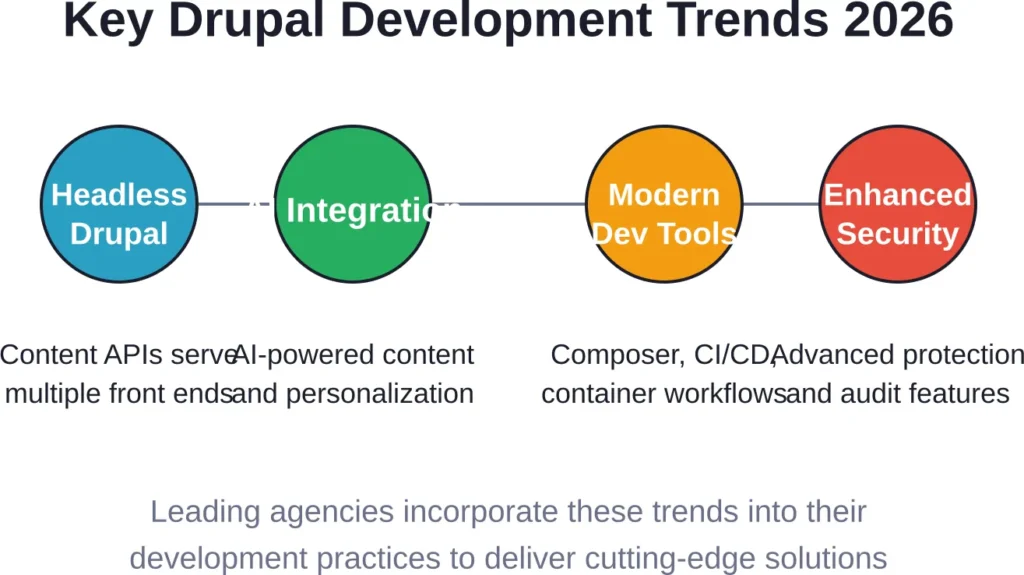
Drupal Development Trends in 2026
The Drupal ecosystem continues evolving. Several trends shape how leading agencies approach projects.
Drupal as a Content API
Headless or decoupled Drupal implementations have gained significant traction. Organizations use Drupal’s robust content management while delivering content through modern JavaScript frameworks for superior user experiences.
This architectural pattern suits organizations needing to publish content across multiple channels — websites, mobile apps, digital signage, and emerging platforms. Drupal serves as the central content repository with APIs feeding all channels.
JSON:API and GraphQL modules enable efficient content delivery to decoupled front ends. Agencies increasingly combine Drupal back ends with Next.js, Gatsby, or Nuxt.js front ends.
AI Integration in Drupal
Artificial intelligence capabilities are emerging in the Drupal ecosystem. The Drupal AI Initiative has attracted support from major organizations working to integrate AI features into core and contributed modules.
Early implementations include AI-assisted content creation, automated tagging and categorization, intelligent search with natural language processing, and personalization based on user behavior analysis.
Forward-thinking agencies experiment with these capabilities to deliver smarter content experiences. Expect AI integration to accelerate as tools mature and best practices emerge.
Improved Developer Experience
Drupal continues improving its developer experience with modern tooling and workflows. Composer-based dependency management has become standard. Automated testing frameworks enable continuous integration.
Development tools like Lando and DDEV simplify local environment setup. Teams can spin up consistent development environments quickly regardless of their operating systems.
These improvements reduce friction for developers and make Drupal more accessible to teams familiar with modern development practices from other platforms.
Enhanced Security Features
Security remains a top Drupal priority. The platform’s security team actively monitors for vulnerabilities and releases timely patches. Contributed modules undergo security reviews before receiving full project status.
Recent security enhancements include improved password policies, better protection against common attacks, enhanced permission granularity, and audit logging capabilities.
Leading agencies implement security best practices including regular updates, web application firewalls, intrusion detection, and comprehensive backup strategies.
Questions to Ask Potential Drupal Partners
The right questions during agency evaluation reveal capabilities and working style.
About Their Drupal Expertise
How many Drupal projects has the team completed in the past two years? Recent experience matters more than projects completed five years ago, especially given Drupal’s evolution.
What certifications do team members hold? Which contributed modules has the agency created? Community contributions indicate depth of platform knowledge.
What’s their experience with projects similar to what’s needed? Specific experience in relevant industries or project types reduces risk and accelerates delivery.
How do they stay current with Drupal developments? Quality agencies invest in ongoing training, conference attendance, and community participation.
About Project Approach
What does their discovery and planning process involve? Comprehensive discovery identifies requirements and prevents costly mid-project changes.
How do they handle scope changes during projects? Change management processes should be clear and fair to both parties.
What project management methodology do they follow? Agile approaches with regular feedback loops typically deliver better outcomes than rigid waterfall processes.
How will communication happen throughout the project? Establish expectations for meeting frequency, status reporting, and primary contacts upfront.
About Ongoing Support
What happens after the site launches? Understand their transition process, documentation handoff, and training offerings.
What support and maintenance options do they offer? Compare different tiers to understand what level of ongoing engagement makes sense.
How do they handle urgent issues outside business hours? Critical sites need clear escalation paths for emergency situations.
What’s their approach to proactive optimization? The best partnerships involve ongoing improvement rather than just reactive maintenance.
Red Flags When Choosing a Drupal Agency
Certain warning signs suggest an agency might not deliver quality results.
Be wary of agencies claiming expertise across dozens of platforms. Drupal requires focused specialization. Firms spreading across too many technologies often lack depth in any single one.
Suspiciously low estimates often indicate misunderstanding of requirements or planned shortcuts that create technical debt. Quality Drupal development requires investment.
Reluctance to show code samples or provide references suggests potential quality issues. Confident agencies eagerly share their work and connect prospects with satisfied clients.
Vague answers about their development process indicate lack of mature practices. Professional shops clearly articulate their methodologies.
Promises of ownership of code or restrictive licensing arrangements create vendor lock-in. Clients should own their custom code and have freedom to work with other developers.
Resistance to using contributed modules in favor of custom development for everything suggests either lack of Drupal knowledge or desire to inflate billing. Skilled developers leverage community modules appropriately.
Making Your Final Decision
After evaluating multiple agencies, synthesize findings to make an informed choice.
Consider technical expertise, relevant experience, cultural fit, and value rather than just cost. The cheapest option rarely delivers the best outcomes for complex Drupal projects.
Request detailed proposals from top candidates including project approach, timeline, team composition, and investment required. Compare proposals on methodology and understanding rather than just price.
Speak with references from similar projects. Ask about communication quality, how challenges were handled, and whether the agency delivered on commitments.
Trust intuition about working relationship potential. Technical skills matter, but so does collaborative fit. Projects succeed when teams work well together.
Start with a defined project rather than a vague ongoing relationship. Successful initial engagements often expand into long-term partnerships, but starting small reduces risk.
Frequently Asked Questions
Drupal development costs vary widely based on project complexity, required features, and agency expertise. Simple Drupal sites might start around $10,000, while complex enterprise implementations often exceed $100,000. Development rates range from under $25 per hour for offshore teams to over $150 per hour for specialized agencies in major markets. Most quality agencies fall in the $50-100 per hour range. Rather than focusing solely on rates, evaluate total project value including quality, timeline, and ongoing support.
Timeline depends on project scope and complexity. Basic Drupal sites with standard functionality might launch in 6-8 weeks. Medium complexity projects with custom features typically require 3-6 months. Enterprise implementations with extensive custom development, integrations, and content migration often take 6-12 months or longer. Proper discovery and planning phases add time upfront but prevent delays later. Rushed timelines often compromise quality, so realistic scheduling matters.
Drupal 10 represents the current stable release and is the right choice for new projects in 2026. Drupal’s release cycle now emphasizes continuous improvement rather than disruptive major versions. Upgrades between recent versions have become significantly easier than the Drupal 7 to Drupal 8 transition. Waiting for future versions delays projects unnecessarily since upgrade paths are well-supported. Choose Drupal 10 with confidence for new implementations.
Most websites can migrate to Drupal successfully. The platform includes robust migration tools supporting WordPress, Joomla, older Drupal versions, and custom platforms. Migration complexity depends on content volume, URL structure, custom functionality, and media libraries. Experienced agencies assess feasibility during discovery and develop migration strategies preserving SEO value and content. Plan for thorough testing before cutover to ensure all content and functionality transitions correctly.
Drupal’s complexity and architecture require specialized expertise. While competent developers can learn Drupal, experienced specialists deliver better results faster. Drupal-specific agencies understand best practices, common pitfalls, and efficient approaches that generalists miss. They contribute to the community and stay current with platform evolution. For anything beyond simple sites, Drupal specialists provide substantially better value despite potentially higher rates.
Drupal sites need regular maintenance including security updates for core and contributed modules, compatibility testing after updates, performance monitoring and optimization, backup verification, and content review. Security updates are critical — the Drupal security team releases patches for vulnerabilities that must be applied promptly. Most organizations either maintain internal Drupal expertise or contract ongoing support from their development agency. Neglected Drupal sites accumulate security risks and technical debt.
Drupal excels for content-heavy sites, complex workflows, enterprise requirements, multilingual content, and sophisticated user permissions. It’s particularly strong when security, scalability, and flexibility matter more than quick setup. Consider Drupal when content modeling is complex, multiple content types are needed, editorial workflows involve multiple roles, or significant customization is required. Simpler sites might be better served by WordPress or other platforms. Discuss requirements with experienced agencies to determine appropriate platforms.
Conclusion
Choosing the right Drupal development company shapes project outcomes significantly. The ten agencies profiled here represent some of the strongest Drupal expertise available in 2026.
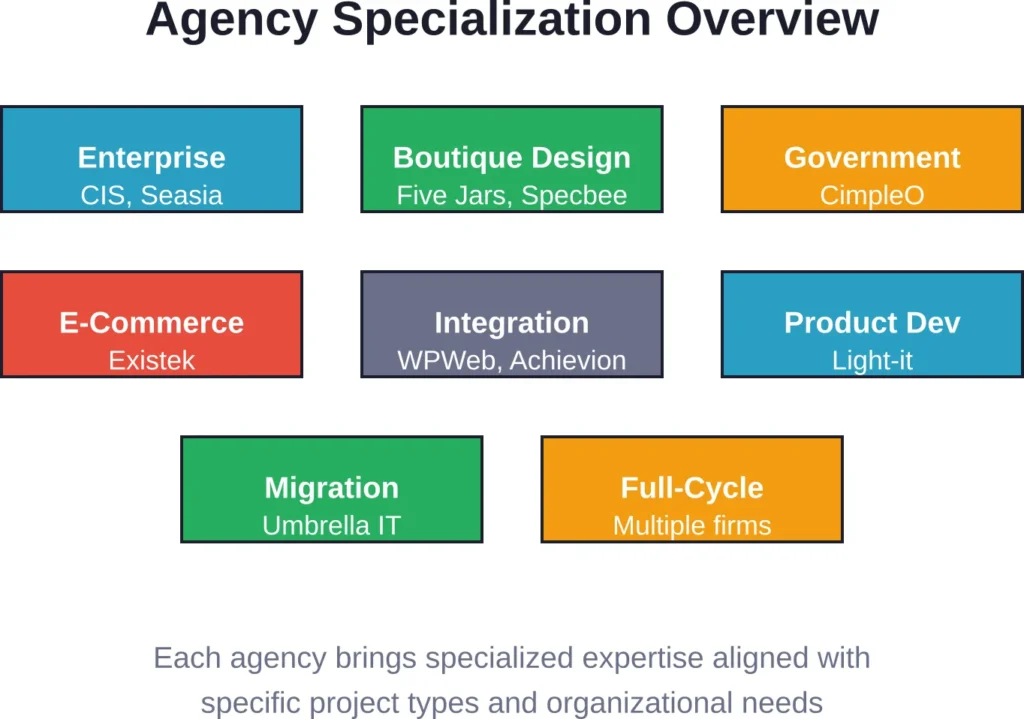
Each brings distinct specializations and strengths. Enterprise organizations might lean toward larger firms like Cyber Infrastructure or Seasia Infotech with substantial teams and processes. Mid-market clients often find better fit with boutique agencies like Five Jars or Specbee that combine technical depth with personalized service.
But here’s what matters most: alignment between agency capabilities and specific project needs. The “best” agency is the one that understands requirements, brings relevant experience, and demonstrates cultural fit.
Take time during evaluation to assess technical expertise, review portfolios, understand processes, and validate through references. Ask tough questions about approach, challenges, and ongoing support.
Drupal remains a powerful platform for organizations needing security, flexibility, and scalability. Partnering with skilled specialists ensures projects leverage the platform’s strengths while avoiding common pitfalls.
Ready to start your Drupal project? Reach out to agencies from this list that match your needs, request detailed proposals, and begin conversations about bringing your vision to life.