

Quick Summary: The best Java web development companies in 2026 combine deep technical expertise, proven enterprise experience, and strong delivery frameworks. This list features ten leading agencies recognized for their Java development capabilities, from Fortune 500 partners to innovative mid-market specialists, helping businesses find the right technical partner for scalable, secure web applications.
Java remains the foundation of enterprise software development more than three decades after its creation. According to Statista, 29.4 percent of developers used Java in 2025, and 90 percent of Fortune 500 companies rely on Java for their core systems.
The numbers tell the story. LinkedIn data shows almost 20,000 Java-related vacancies in the United States alone, creating a competitive landscape where businesses increasingly look to specialized development partners rather than building in-house teams.
But here’s the challenge: not all Java development companies are created equal. Some excel at legacy system modernization, others specialize in cloud-native microservices, and a few manage both with equal competence.
This guide examines ten leading Java web development companies, comparing their technical capabilities, delivery models, and ideal use cases. No generic rankings—just practical insights to help match your project requirements with the right technical partner.
Why Java Still Dominates Enterprise Web Development
Java’s “Write Once, Run Anywhere” philosophy has evolved into something more relevant: “Run Anywhere, Scale Everywhere.” That’s not marketing speak—it’s the reality of modern distributed systems.
The language powers mission-critical applications across banking, healthcare, e-commerce, and telecommunications. Spring Framework 6.0 brought modern reactive programming models, while Java 20 introduced performance improvements that keep the language competitive with newer alternatives.
Enterprise teams choose Java for several practical reasons. The ecosystem offers mature frameworks, extensive libraries, and decades of production-tested patterns. Security vulnerabilities get patched quickly. Talent pools run deep, even if competitive.
And unlike languages that surge in popularity then fade, Java maintains consistent backward compatibility. Applications written fifteen years ago still run on modern JVMs with minimal modification—a critical consideration for organizations with significant code investments.
What Separates Leading Java Development Companies
Technical competence with Java syntax represents table stakes. The companies that truly excel demonstrate capabilities across several dimensions.
Framework Mastery and Modern Architecture
Spring Framework remains the backbone of enterprise Java development, but leading companies understand the full ecosystem. Spring Boot for rapid application setup, Spring Cloud for microservices orchestration, Spring Security for authentication patterns.
They architect systems that balance complexity and maintainability. Microservices where modularity matters, monoliths where simplicity wins, and careful hybrid approaches when the situation demands both.
Modern Java shops understand containerization with Docker, orchestration with Kubernetes, and deployment pipelines that push code from commit to production in minutes rather than weeks.
Enterprise Integration Experience
Real-world enterprise applications don’t exist in isolation. They connect to legacy systems running on mainframes, integrate with third-party APIs, synchronize data across multiple databases, and expose their own services to downstream consumers.
The best Java development companies bring battle-tested integration patterns. They’ve wrestled with enterprise service buses, implemented message queues for asynchronous processing, and debugged distributed transactions across multiple services.
This experience shows up in architecture documents that anticipate integration challenges before code gets written.
Quality Assurance and Testing Rigor
Enterprise applications demand reliability. Leading companies implement comprehensive testing strategies—unit tests with JUnit, integration tests that verify component interaction, performance tests that simulate production load, and security testing that identifies vulnerabilities before deployment.
They automate testing within CI/CD pipelines, catching regressions immediately rather than discovering them in production. Test coverage metrics aren’t vanity numbers—they’re enforced standards that prevent undertested code from shipping.
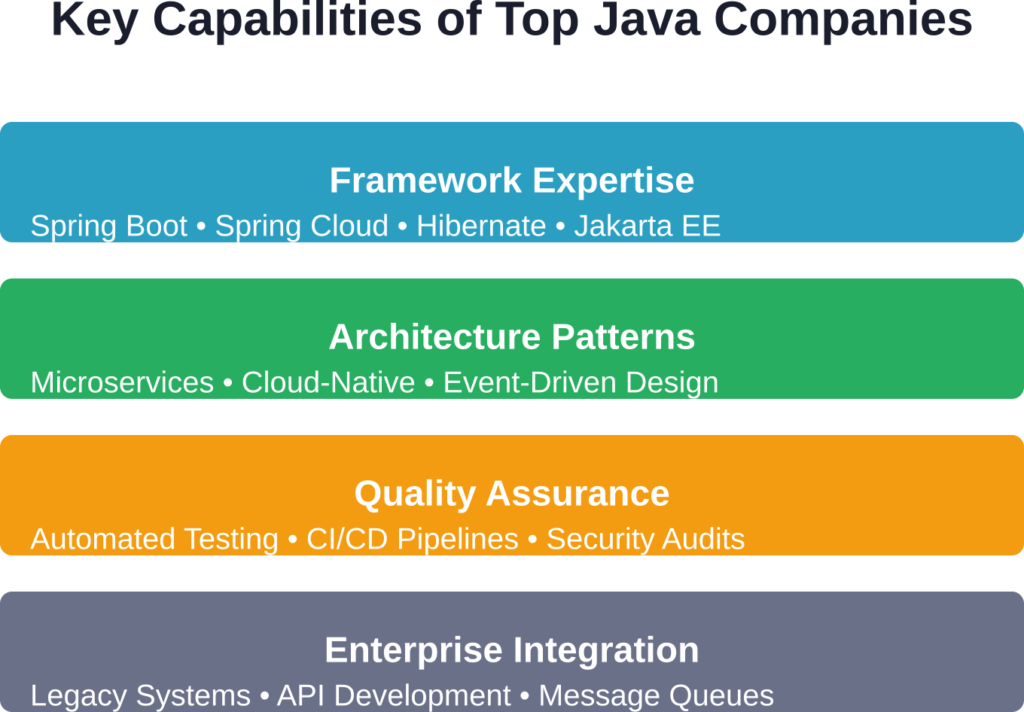
Four fundamental capability areas that distinguish enterprise-grade Java development partners from generic coding shops.
10 Leading Java Web Development Companies
The following companies represent a range of approaches, regional strengths, and technical specializations. Each brings distinct advantages depending on project requirements.
1. Lengreo

Lengreo serves as a complete marketing and tech partner for software development companies, delivering both digital growth strategies and custom web application development. They help IT firms and tech providers scale lead generation while building robust digital solutions that drive measurable business results. The company specializes in full-cycle website and web application development, combining technical implementation with B2B marketing expertise. Their Java practice supports backend services for scalable web platforms, API integrations, and enterprise-grade solutions that align technical delivery with market expansion goals. Lengreo’s strength lies in their integrated approach that merges development capabilities with proven demand generation tactics. This enables clients to not only build high-quality Java web applications but also rapidly acquire new customers and optimize conversion rates.
Contact Information:
- Website: Lengreo.com
- Phone: +31 686 147 566
- Email: [email protected]
- Address: Vrijstraat 9 C/D, 5611 AT Eindhoven, Netherlands
- LinkedIn: Lengreo
- Twitter: @Lengreo
- Instagram: @lengreo
2. Gilzor

Gilzor is a global custom software development company focused on building production-ready web and mobile solutions for startups, SMBs, and product studios. With a track record of successful launches across multiple industries, they deliver reliable digital products from idea validation to post-launch support. Their Java expertise powers secure, scalable backend services for web applications, microservices architectures, and integrations with modern frontend frameworks. The team emphasizes full-cycle development, including architecture design, quality assurance, and ongoing maintenance for long-term stability. Gilzor’s strength is their structured process that minimizes risks and accelerates time-to-market. They create cohesive web solutions where clean architecture and user-centric design work together to deliver both functional excellence and strong business outcomes.
Contact Information:
- Website: www.gilzor.com
- Email: [email protected]
- Address: Poland, Warsaw, Office 58, street Adama Mickiewicza 37, 01-625
- LinkedIn: www.linkedin.com/company/gilzor-softwaredevelopment
3. OSKI Solutions
OSKI Solutions designs, develops, and maintains well-engineered software solutions for tech-forward enterprises and ambitious startups. With deep experience in custom web development and cloud integration, they help businesses reimagine operations through reliable digital platforms. The company specializes in building scalable web applications using modern Java-compatible architectures alongside strong frontend frameworks and cloud services. Their practice covers full-stack development, API integrations, and enterprise solutions tailored to industries such as logistics, fintech, e-commerce, and education. OSKI’s strength lies in delivering 3× faster development through AI-accelerated engineering while maintaining high standards of quality and documentation. They create solutions that combine technical robustness with seamless user experiences and long-term maintainability.
Contact Information:
- Website: oski.site
- Phone: +48571282759
- Email: [email protected]
- Address: Kaupmehe tn 7, 10114 Tallinn, Estonia
- LinkedIn: www.linkedin.com/company/oski-solutions
4. A-Listware

A-Listware is a software development and consulting company with extensive experience in delivering high-quality digital solutions through dedicated teams and outsourcing models. They empower businesses with secure, responsive web applications and enterprise systems that scale effectively. Their Java practice includes custom software development, legacy modernization, cloud applications, and enterprise-grade web solutions. The company offers comprehensive services spanning software consulting, team augmentation, and full-cycle development using proven methodologies and modern technology stacks. A-Listware’s strength is seamless integration with client organizations, providing round-the-clock expert access and acting as a natural extension of internal teams. This approach ensures consistent quality delivery while maintaining flexibility across project types and business scales.
Contact Information:
- Website: a-listware.com
- Phone: +1 (888) 337 93 73
- Email: [email protected]
- Address: North Bergen, NJ 07047, USA
- LinkedIn: www.linkedin.com/company/a-listware
- Facebook: www.facebook.com/alistware
5. Mobian Studio

Mobian Studio is a European software development partner specializing in dedicated engineering teams for mobile and web solutions across IT, healthcare, fintech, and logistics. They focus on delivering production-ready software on time and within budget through outsourcing and outstaffing models. The company excels in end-to-end web and backend development with strong Java capabilities for scalable architectures, API services, and enterprise integrations. Their expertise covers full-stack delivery, legacy system connections, and AI-enhanced workflows built for real-world performance and compliance requirements. Mobian’s strength lies in building focused, high-performing dedicated teams that maintain clean architecture and excellent documentation. They provide post-launch partnership with bug warranties and scaling support, ensuring clients can move fast while keeping technical excellence and business alignment.
Contact Information:
- Website: mobian.studio
- Phone: [email protected]
- Address: Harju maakond, Tallinn, Kesklinnalinnaosa, Masina tn 22, 10113
- LinkedIn: www.linkedin.com/company/mobian-studio
6. Iflexion

Iflexion focuses on custom enterprise application development with particular strength in business process automation. Their Java solutions often integrate workflow engines, document management systems, and approval routing logic.
They bring experience across multiple industries, adapting proven patterns to specific business contexts. Healthcare systems need HIPAA compliance, financial applications require audit trails, and manufacturing systems demand real-time data processing—Iflexion’s teams understand these nuances.
Their development approach emphasizes prototyping and iterative refinement. Early demonstrations of working software help validate requirements before significant development investment.
7. Oxagile

Oxagile specializes in video streaming platforms and media applications built on Java infrastructure. They’ve developed solutions that handle millions of concurrent users, implementing content delivery networks, adaptive bitrate streaming, and live broadcasting capabilities.
This specialization brings deep expertise in performance optimization. Video applications expose bottlenecks quickly—network latency, database queries, cache invalidation, memory management. Oxagile’s teams architect systems that maintain responsiveness under load.
Their work extends beyond pure Java development into DevOps, implementing monitoring systems that detect performance degradation before users notice problems.
8. Belatrix Software
Belatrix Software maintains nearshore development centers across Latin America, offering time zone alignment for North American clients. Their Java practice emphasizes agile methodologies with bi-weekly sprints and continuous deployment.
They specialize in cloud-native Java applications, particularly on AWS and Azure platforms. Their architects design systems that leverage managed services—RDS for databases, ElastiCache for caching, Lambda for serverless functions—reducing operational overhead.
Belatrix brings strong DevOps culture, treating infrastructure as code and automating deployment pipelines. This approach accelerates delivery while maintaining consistency across environments.
9. Coherent Solutions
Coherent Solutions builds long-term relationships with clients, often embedding teams that function as extended engineering departments. Their Java developers integrate directly into client workflows, participating in planning sessions and architectural decisions.
The company maintains expertise across enterprise integration patterns, connecting Java applications with SAP systems, Salesforce platforms, and legacy mainframe infrastructure. They understand middleware technologies and message brokers that enable system interoperability.
Their quality assurance teams work in parallel with development, identifying issues early rather than discovering them during final testing phases.
10. Softeq
Softeq specializes in IoT platforms and embedded systems that communicate with Java backend services. Their full-stack approach spans hardware firmware, edge computing logic, cloud infrastructure, and web dashboards.
They bring experience building scalable data ingestion pipelines that process sensor data, implementing time-series databases, real-time analytics, and predictive maintenance algorithms.
This cross-disciplinary expertise proves valuable for industrial clients, smart city projects, and connected device manufacturers who need partners that understand both software and hardware integration challenges.
Comparing Engagement Models
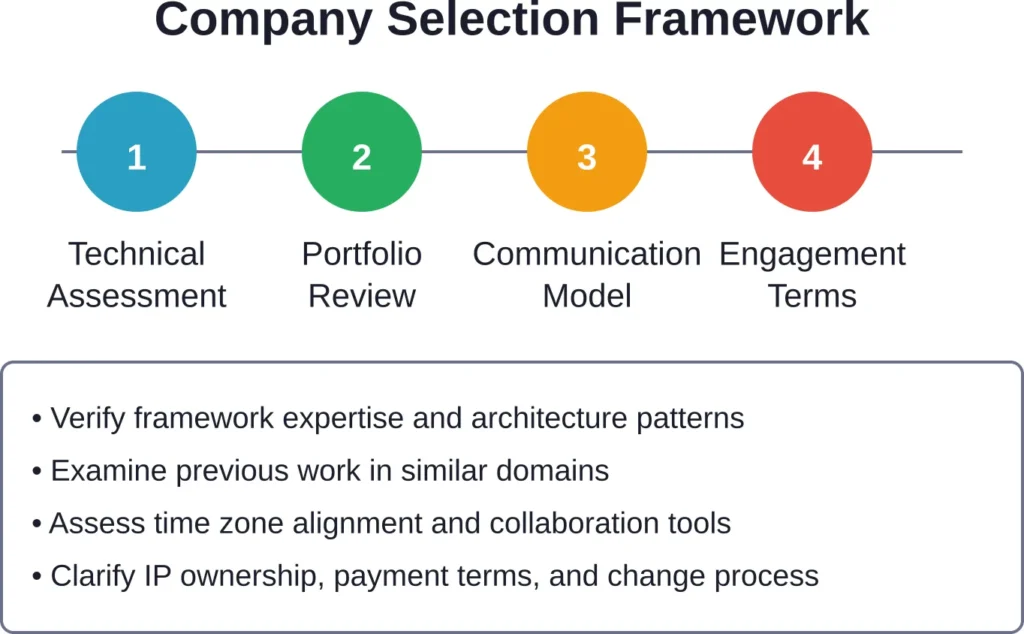
Java development companies offer several collaboration frameworks, each suited to different organizational needs and project characteristics.
Dedicated Teams
A dedicated team functions as an extension of the client organization. Developers, architects, and QA engineers work exclusively on client projects, participating in planning sessions and reporting through established management structures.
This model works well for long-term product development where requirements evolve gradually. Teams build domain knowledge over time, becoming more efficient as they understand business context.
The tradeoff involves commitment. Dedicated teams require minimum engagement periods, typically three to six months. Organizations pay for team capacity whether tasks fill available hours or not.
Staff Augmentation
Staff augmentation fills specific skill gaps within existing teams. A client might need senior Java architects for system design, performance optimization specialists for troubleshooting, or additional developers to accelerate delivery.
Augmented staff integrate into client workflows, using existing tools and following established processes. The client retains project management responsibility while the development company provides technical resources.
This approach offers flexibility—scale resources up during intensive development phases, scale down during planning or testing periods. But it assumes the client organization has project management capacity and technical leadership.
Fixed-Price Projects
Fixed-price contracts specify deliverables, timelines, and total cost upfront. The development company assumes risk for scope creep, technical challenges, and resource allocation.
This model demands detailed requirements definition before work begins. Ambiguous specifications lead to disputes when delivered functionality doesn’t match expectations.
Fixed-price works well for clearly defined projects—migrating a specific application to the cloud, building an integration between known systems, or implementing well-understood features. It struggles with exploratory projects where requirements emerge through iterative development.
Time and Materials
Time and materials contracts bill based on actual hours worked. The client pays for developer time at agreed rates, plus expenses for tools, infrastructure, and third-party services.
This model embraces flexibility. Requirements can evolve as business needs change or technical constraints emerge. Teams adjust priorities sprint by sprint based on current understanding.
The tradeoff involves budget predictability. Costs vary based on actual effort required, making financial planning more complex. Successful time-and-materials engagements require trust between client and development partner.
Critical Evaluation Criteria
Beyond technical capabilities, several factors determine whether a development partnership will succeed or struggle.
Communication and Time Zone Considerations
Real-time collaboration accelerates problem-solving. When developers work in vastly different time zones, simple questions that could be resolved in five-minute conversations instead require overnight email exchanges.
Some companies structure teams for asynchronous work, creating detailed documentation and using project management tools effectively. Others maintain overlapping working hours, with developers adjusting schedules to enable daily video conferences.
Neither approach is inherently superior—the question is which pattern aligns with organizational culture and project requirements.
Security and Compliance Standards
Enterprise applications often handle sensitive data governed by regulatory frameworks. Healthcare applications must comply with HIPAA, financial systems face SOC 2 requirements, and European deployments require GDPR adherence.
Leading Java development companies understand these standards, implementing appropriate security controls during development rather than retrofitting compliance after code is written.
Security encompasses code practices (input validation, authentication, encryption), infrastructure configuration (network segmentation, access controls), and operational procedures (incident response, audit logging).
Intellectual Property and Code Ownership
Contracts should clearly specify who owns developed code, whether the client can access source repositories during development, and what happens to intellectual property if the partnership ends.
Some companies retain ownership of reusable frameworks and libraries they’ve developed, licensing them to clients. Others transfer complete ownership, including all source code, documentation, and build configurations.
These terms significantly impact long-term flexibility. Organizations that don’t own their code may struggle to switch development partners or bring development in-house.
Regional Considerations and Talent Distribution
Java development expertise concentrates in specific geographic regions, each offering distinct advantages.
Eastern Europe
Countries like Poland, Ukraine, and Romania have invested heavily in technical education, producing large numbers of qualified Java developers. Labor costs run lower than Western Europe or North America while maintaining strong technical quality.
Time zone differences of 6-8 hours from US East Coast enable some overlap during business hours. Cultural alignment tends to be strong, with English proficiency sufficient for technical collaboration.
South America
Brazil, Argentina, and Colombia offer nearshore advantages for North American companies. Time zones align closely, enabling real-time collaboration throughout the workday.
The region has developed robust tech ecosystems with universities producing computer science graduates and established companies providing training grounds for developers.
Asia
India remains the largest offshore development market, with massive talent pools and mature service delivery infrastructure. Companies range from small specialized shops to massive service providers employing thousands.
Time zone differences challenge real-time collaboration—India is 10.5 hours ahead of US East Coast. Many companies adapt through split shifts, with some developers working evening hours to overlap with client business days.
North America and Western Europe
Local development commands premium rates but eliminates time zone challenges and simplifies legal considerations. Teams work in the same business hours, travel for face-to-face meetings is practical, and cultural assumptions align.
For projects requiring deep business context, frequent stakeholder interaction, or handling of extremely sensitive data, local development often proves more efficient despite higher per-hour costs.
| Region | Primary Advantage | Time Zone Consideration | Typical Team Size |
|---|---|---|---|
| Eastern Europe | Balance of quality and cost | 6-8 hour difference from US | 5-15 developers |
| South America | Nearshore time zone alignment | 0-3 hour difference from US | 5-20 developers |
| Asia (India) | Large talent pool, established processes | 10+ hour difference from US | 10-50+ developers |
| North America | Cultural alignment, same time zone | No difference | 3-10 developers |
| Western Europe | Regulatory expertise (GDPR), quality | 6-9 hour difference from US | 5-15 developers |
Red Flags When Evaluating Java Development Companies
Certain warning signs suggest a partnership might encounter problems. Watch for these indicators during evaluation.
Overpromising on Timelines
Software estimation is notoriously difficult. Companies that promise aggressive timelines without understanding requirements are either inexperienced or willing to sacrifice quality to meet deadlines.
Reliable partners ask probing questions before providing estimates. They acknowledge uncertainty and build buffer into schedules rather than presenting best-case scenarios as commitments.
Lack of Process Documentation
Mature development organizations document their processes—how they handle requirements gathering, code review, testing, deployment, and support. Companies that can’t articulate their development lifecycle may lack consistent practices.
This doesn’t mean rigid waterfall processes. Agile methodologies emphasize working software over comprehensive documentation, but teams still need shared understanding of workflow.
Reluctance to Provide References
Established companies should readily provide references from previous clients. Reluctance to connect prospects with past customers suggests problematic relationships or unsuccessful projects.
When speaking with references, ask about communication patterns, how the company handled unexpected challenges, and whether delivered software met quality expectations.
Exclusively Junior Staff Presentations
During evaluation, companies naturally present their strongest technical talent. If only junior developers appear in technical discussions, question whether senior architects will actually participate in project work.
Some companies employ a handful of senior architects who design systems but delegate implementation entirely to junior developers. This model works when juniors are competent and well-supervised. It fails when inexperienced developers make architectural decisions without guidance.
Making the Final Decision
After evaluating technical capabilities, reviewing portfolios, and checking references, decision-makers face the challenge of choosing among qualified candidates.
Price shouldn’t be the sole determining factor. The cheapest bid often becomes expensive when projects require extensive rework, exceed timelines, or deliver unstable software. Total cost of ownership includes maintenance, bug fixes, and future enhancements—systems built poorly require expensive remediation.
Cultural fit matters more than many realize. Development partnerships last months or years, requiring ongoing collaboration under deadline pressure. Teams that communicate well, share problem-solving approaches, and align on quality standards navigate challenges more successfully.
Start with a pilot project when possible. A small initial engagement—lasting 4-8 weeks—reveals how a company operates before committing to larger contracts. Pilot projects demonstrate technical quality, communication effectiveness, and ability to meet commitments with manageable risk.
Trust instincts along with analytical evaluation. If something feels off during discussions—vague answers to direct questions, reluctance to discuss past challenges, or mismatch between marketing materials and actual team capabilities—investigate further before signing contracts.
Frequently Asked Questions
Request code samples from previous projects (with proprietary information removed). Review their GitHub repositories if they contribute to open source. During technical discussions, ask detailed questions about specific frameworks and architectural patterns—experienced developers provide nuanced answers while less qualified candidates resort to marketing language. Consider administering technical assessments or requesting a short paid proof-of-concept to evaluate coding standards and problem-solving approaches.
Simple business applications with straightforward requirements might be delivered in 3-4 months. Mid-complexity projects involving integration with several external systems typically require 6-9 months. Large-scale enterprise platforms with extensive customization, complex workflows, and regulatory requirements often span 12-18 months or longer. These timelines include requirements gathering, design, development, testing, and initial deployment—but not ongoing maintenance and enhancement.
Large firms bring process maturity, extensive resources, and ability to scale teams quickly. They handle multiple simultaneous projects and maintain deep benches across various specializations. Smaller agencies often provide more direct access to senior developers, greater flexibility in engagement terms, and personalized attention. The right choice depends on project scope, budget, and organizational preferences. Large regulated enterprises often prefer established large firms for compliance reasons, while startups and mid-market companies frequently find better value with specialized boutique agencies.
Domain knowledge significantly accelerates projects in regulated industries like healthcare, finance, or government where compliance requirements are complex. In these contexts, developers who understand regulatory frameworks make better architectural decisions and avoid costly mistakes. For less regulated domains, general software development competence often suffices—solid Java developers can learn business logic through collaboration with subject matter experts. Prioritize domain expertise when regulations heavily constrain technical decisions, prioritize general technical excellence when business logic is unique to your organization.
Comprehensive support includes bug fixes during a warranty period (typically 30-90 days), performance monitoring and optimization, security patch application, and assistance with production issues. Many companies offer tiered support packages with defined response times for different severity levels. Clarify whether support covers only defects in delivered functionality or extends to questions about usage and configuration. Understand whether support transitions to a separate team or continues with developers who built the system—continuity often results in faster problem resolution.
Comprehensive legal contracts should specify IP ownership, confidentiality requirements, and restrictions on code reuse. Many companies sign NDAs before detailed discussions begin. Consider jurisdictional issues—contracts governed by foreign legal systems may be difficult to enforce. Some organizations require developers to sign individual IP assignment agreements, not just company-level contracts. For extremely sensitive projects, explore whether the development company can work within your network infrastructure rather than accessing systems remotely. Background checks on individual developers provide additional assurance for projects involving sensitive data.
Java encompasses many application types—desktop applications, mobile backends, embedded systems, batch processing, and web applications. Java web specialists focus specifically on building browser-accessible applications using frameworks like Spring MVC, JavaServer Faces, or modern REST API backends that serve JavaScript frontends. They understand HTTP protocols, session management, security concerns specific to web contexts (XSS, CSRF, authentication), and browser compatibility. When hiring for web projects, verify that candidates have specific experience with web technologies rather than general Java programming—the skillsets overlap but aren’t identical.
Conclusion
Selecting a Java web development partner represents a significant strategic decision with long-term implications. The right partner accelerates delivery, improves software quality, and adapts as business requirements evolve. The wrong partner creates technical debt, misses deadlines, and delivers unstable systems that require expensive remediation.
The ten companies highlighted here bring proven capabilities, but the best choice depends on specific project requirements, organizational culture, and business constraints. Technical excellence matters, but so do communication patterns, engagement flexibility, and alignment on quality standards.
Take time during evaluation. Speak with multiple candidates, check references thoroughly, review actual code samples, and start with smaller engagements when possible. The investment in careful selection pays dividends throughout project execution and long after initial delivery.
Java’s longevity demonstrates its staying power—three decades of continuous evolution and adaptation. The companies that master Java development don’t just write code; they architect systems that scale, integrate seamlessly, and adapt to changing business needs. Find a partner that brings that perspective, and technical challenges become manageable rather than insurmountable.