

Quick Summary: The best outsource web development companies in 2026 combine technical expertise, proven track records, and AI-driven workflows. This guide profiles 15 leading agencies across different specializations—from enterprise-grade custom solutions to startup MVPs—helping businesses match their project requirements with the right development partner without getting lost in pricing debates.
Choosing the right web development company isn’t just about finding someone who can code. It’s about finding a partner who understands your business goals, communicates clearly, and delivers on time.
The outsourcing landscape has shifted dramatically. With 78% of global organizations actively integrating AI into their operational workflows, development agencies aren’t just building websites—they’re architecting intelligent digital experiences that adapt, learn, and optimize themselves.
This guide cuts through the noise. No fluff about “digital transformation journeys” or “synergistic partnerships.” Just 15 proven companies that consistently deliver quality work across different niches, team sizes, and technical challenges.
What Makes a Web Development Company Worth Outsourcing To?
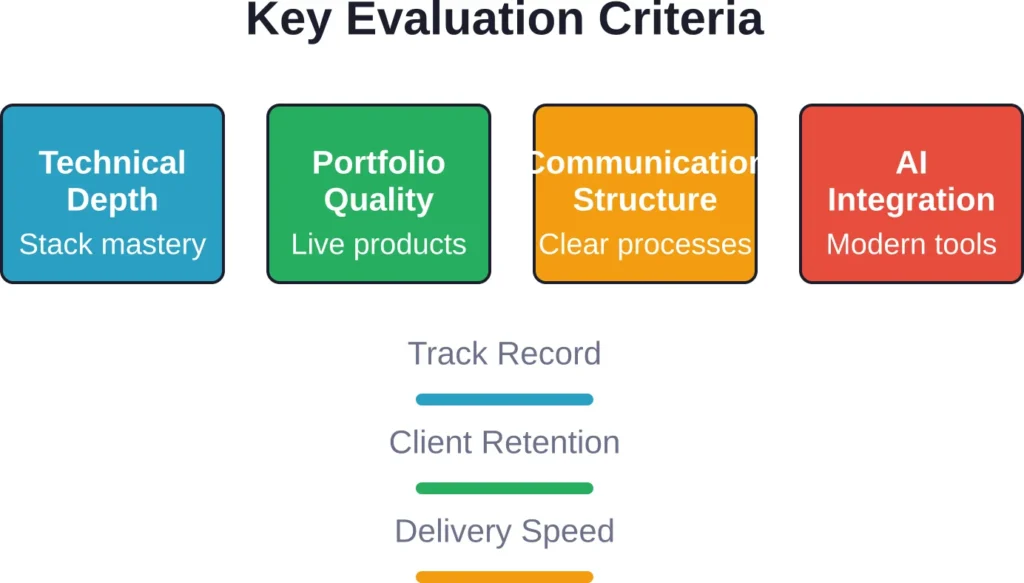
Not all development shops are created equal. The best ones share specific characteristics that separate them from the hundreds of generic agencies flooding the market.
Technical depth matters more than breadth. A company claiming to master fifteen frameworks probably excels at none. Specialists in React, Node.js, or Rails typically deliver cleaner code and faster timelines than generalists.
Portfolio quality tells the real story. Look beyond polished case studies—examine actual live products. Can the agency show production systems handling real traffic? Do their past clients still use the solutions they built, or did everything get rebuilt after six months?
Communication structure makes or breaks remote collaboration. Time zone overlap, English proficiency, and project management methodology aren’t sexy topics, but they’re the difference between smooth sprints and chaotic firefighting.
AI integration capability has become non-negotiable. According to industry sources, developers increasingly rely on AI for deployment and monitoring processes. Agencies that haven’t adapted to agentic workflows and AI-assisted development are already falling behind.
The Top 15 Outsource Web Development Companies in 2026
1. Gilzor

Gilzor specializes in custom software development for startups, scale-ups, and product studios. Operating as a global team with strong roots in Eastern Europe, they focus on turning ideas into market-ready digital products with full-cycle delivery.
Their technical stack emphasizes modern web and mobile technologies, including React, Node.js, Flutter, and cross-platform solutions, paired with robust backend architectures. The company primarily serves early-stage startups validating ideas and established SMBs looking to add digital channels or automate operations.
What sets Gilzor apart is their heavy emphasis on upfront validation and product-market fit. They combine idea testing, user-centric UI/UX design, and go-to-market strategy support before deep development begins, significantly reducing the risk of building the wrong product.
The team follows a structured full-cycle approach that includes business analysis, R&D for PoCs, quality assurance with strict internal metrics, and ongoing support & maintenance, making them a reliable long-term partner for clients who need both speed and quality.
Contact Information:
- Website: www.gilzor.com
- Email: [email protected]
- Address: Poland, Warsaw, Office 58, street Adama Mickiewicza 37, 01-625
- LinkedIn: www.linkedin.com/company/gilzor-softwaredevelopment
2. Lengreo
Lengreo acts as a complete marketing and tech partner, combining website development with performance-driven digital marketing for B2B companies. Based in Eastern Europe, they help clients generate qualified leads and scale online presence through integrated solutions.
Their capabilities center on custom website and landing page development (e-commerce, business, and portfolio sites) alongside SEO, paid ads, and lead generation campaigns. They work primarily with IT service providers, SaaS companies, and service businesses in architecture, fintech, and tech sectors that need websites to directly support revenue growth.
What distinguishes Lengreo is their results-oriented, full-funnel approach. Rather than delivering isolated websites, they integrate discovery, business analysis, and conversion-focused development with ongoing marketing optimization to drive measurable client acquisition and ROI.
Clients benefit from personalized outreach strategies, transparent communication, and teams that integrate deeply into the client’s processes, often taking leadership of digital marketing efforts while maintaining flexible collaboration models.
Contact Information:
- Website: Lengreo.com
- Phone: +31 686 147 566
- Email: [email protected]
- Address: Vrijstraat 9 C/D, 5611 AT Eindhoven, Netherlands
- LinkedIn: Lengreo
- Twitter: @Lengreo
- Instagram: @lengreo
3. Mobian Studio
Mobian Studio is a European outsourcing and outstaffing partner specializing in mobile and AI-powered solutions for regulated and high-growth industries. They build dedicated engineering teams that deliver production-ready software for companies where technology execution is critical.
Their expertise covers full-stack mobile (iOS, Android, Flutter), AI/automation systems, scalable backends, and legacy integration. They primarily serve clients in healthcare, fintech, logistics, and IT who require senior-level delivery without the overhead of building in-house teams.
What sets Mobian apart is their dedicated team model with zero context switching. Projects receive exclusive engineering squads that maintain deep product knowledge from day one, combined with clean architecture, thorough documentation, and post-launch partnership.
They offer both end-to-end outsourcing (full delivery ownership) and outstaffing (embedding seniors into client teams), always with a strong focus on regulatory compliance, scalable systems, and long-term maintainability.
Contact Information:
- Website: mobian.studio
- Phone: [email protected]
- Address: Harju maakond, Tallinn, Kesklinnalinnaosa, Masina tn 22, 10113
- LinkedIn: www.linkedin.com/company/mobian-studio
4. Oski
Oski delivers smart, well-engineered software solutions for tech-forward enterprises and ambitious startups. With a strong emphasis on quality and innovation, they handle design, development, deployment, and long-term maintenance of complex digital products.
Their technical stack includes modern frontend frameworks (React, Vue, Angular), cloud solutions (AWS, Azure), AI/ML integrations, and CMS platforms like Umbraco and WordPress. They excel in industries such as travel, logistics, e-commerce, education, fintech, and insurance.
What distinguishes Oski is their AI-accelerated engineering combined with deep domain focus. They prioritize performance, scalability, and user experience from the earliest stages, enabling faster development cycles while maintaining enterprise-grade reliability.
The company builds solutions that adapt to business growth, offering comprehensive services from cloud architecture and frontend experiences to full AI implementations, making them ideal for organizations seeking a strategic long-term development partner.
Contact Information:
- Website: oski.site
- Phone: +48571282759
- Email: [email protected]
- Address: Kaupmehe tn 7, 10114 Tallinn, Estonia
- LinkedIn: www.linkedin.com/company/oski-solutions
5. A-Listware

A-Listware is a software development and consulting company focused on outsourcing, dedicated teams, and IT augmentation. They connect clients with experienced developers and provide end-to-end management for high-quality, secure digital solutions.
Their broad tech expertise spans cloud solutions, data analytics, UI/UX, machine learning, enterprise applications (ERP, CRM), and full software engineering services. They work with enterprises, SMBs, and startups needing reliable development capacity or specialized team extensions.
What sets A-Listware apart is their seamless team integration model. Dedicated developers and squads act as true extensions of the client’s organization, with 24/7 access, strong project management, and full transparency throughout the engagement.
They offer a wide spectrum of services including custom development, legacy modernization, QA/testing, cybersecurity, and infrastructure management, providing a one-stop solution for companies that want cost-effective yet high-quality outsourced or augmented engineering capabilities.
Contact Information:
- Website: a-listware.com
- Phone: +1 (888) 337 93 73
- Email: [email protected]
- Address: North Bergen, NJ 07047, USA
- LinkedIn: www.linkedin.com/company/a-listware
- Facebook: www.facebook.com/alistware
6. Valor Software
Valor Software specializes in Angular development and maintains several popular open-source Angular libraries. This deep framework expertise makes them the go-to choice for enterprise organizations already committed to the Angular ecosystem.
The company contributes actively to Angular core development and employs several developers who work directly with Google on framework improvements. This level of involvement means they often know about breaking changes and new features before they’re publicly announced.
Beyond Angular, Valor has strong capabilities in NestJS for backend development and TypeScript across the full stack. Their code reviews are notoriously thorough—sometimes frustratingly so—but the result is exceptionally maintainable codebases.
Valor works best with technical teams who can engage in detailed architectural discussions. Non-technical stakeholders sometimes find their communication style too engineering-focused.
7. Ramotion

Ramotion operates at the premium end of the market, focusing on branding and web design for tech startups raising Series A funding and beyond. Their portfolio includes several recognizable logos and websites in the SaaS and fintech spaces.
The agency’s strength lies in creating cohesive visual systems that work across web, mobile, and marketing materials. They think in design systems rather than individual pages, which pays dividends as companies scale.
Development capabilities center on modern React and animation libraries, with particular expertise in micro-interactions and motion design. Their websites feel polished and intentional rather than template-driven.
Ramotion’s positioning makes them expensive relative to pure development shops. Companies paying for their services are buying brand elevation alongside technical implementation.
8. DesignRush Agency Network
DesignRush operates as a curated marketplace connecting businesses with vetted agencies across development, design, and marketing disciplines. It’s not a single company but a network of hundreds of specialized firms.
The platform solves the discovery problem: instead of evaluating agencies cold, businesses can filter by industry expertise, technology stack, company size, and verified client reviews. Each listed agency undergoes a vetting process before acceptance.
This model works well when project requirements are clear but the right partner type isn’t obvious. Need WordPress specialists with healthcare compliance experience? The filtering system surfaces relevant matches quickly.
The trade-off is variability. Since DesignRush doesn’t directly employ developers or control delivery, quality depends entirely on which specific agency gets selected from their network.
9. Major Tom
Major Tom combines web development with performance marketing, positioning themselves for clients who measure success in conversions and revenue rather than just launch dates.
Based in North America with teams across multiple cities, they emphasize close collaboration and frequent communication. Time zone alignment with US and Canadian clients is a deliberate competitive advantage.
Their technical approach prioritizes headless CMS architectures and JAMstack deployments, particularly for content-heavy sites that need both editorial flexibility and performance. They’ve built extensively with Contentful, Sanity, and Strapi.
Major Tom works across industries but has particular depth in retail and consumer brands. Their case studies show measurable improvements in conversion rates and average order values post-launch.
10. Mighty Roar

Mighty Roar specializes in WordPress development at the enterprise level—not small business sites but large-scale publishing platforms and multi-site installations for universities and media companies.
They’ve built custom blocks for Gutenberg, headless WordPress APIs, and complex user permission systems. The team understands WordPress performance optimization at scale, managing sites that handle millions of monthly visitors.
Security and compliance are core competencies. Mighty Roar has experience implementing WCAG 2.1 accessibility standards, GDPR compliance tools, and enterprise security hardening for WordPress installations.
The company works best with organizations already committed to WordPress who need serious engineering rather than theme customization. Their developers can explain the WordPress core codebase and contribute patches when needed.
11. SumatoSoft
SumatoSoft specializes in enterprise web applications and B2B SaaS platforms. Based in Eastern Europe with a team of around 100 developers, they’ve built a reputation for handling complex backend architectures and data-intensive applications. Their technical stack centers on .NET, React, and Angular, with strong capabilities in cloud infrastructure across AWS and Azure. The company works primarily with mid-sized B2B companies and established enterprises rather than early-stage startups. What sets SumatoSoft apart is their approach to requirements analysis. They invest heavily in the discovery phase, often spending 2-3 weeks mapping business processes before writing a single line of code. This front-loaded effort reduces scope creep and change requests later. The company maintains dedicated teams for clients, meaning developers aren’t shuffled between projects mid-sprint. For organizations that value continuity and deep product knowledge, this model delivers measurable benefits.
12. Toptal
Toptal operates differently than traditional agencies. Instead of maintaining in-house teams, they run a vetted network of freelance developers who pass through a rigorous screening process. The platform claims to accept only the top 3% of applicants, though that number is self-reported and hard to verify independently. What’s certain is that their developers tend to be senior-level professionals with specialized skills rather than junior generalists. Toptal works well for companies that need specific expertise quickly. Need a senior Rails developer with e-commerce experience for a three-month engagement? Toptal can typically match within 48 hours. The trade-off comes in team cohesion. Since developers work independently rather than as integrated units, projects requiring tight collaboration across multiple specialists can become coordination-heavy.
13. S-Pro

S-Pro focuses on startups and scale-ups building their first or second product versions. With offices in Ukraine and development centers across Eastern Europe, they specialize in MVP development and rapid iteration cycles. Their sweet spot is the three-to-six-month project: complex enough to require professional engineering but scoped tightly enough to reach market quickly. The company has delivered over 200 products across fintech, healthcare, and logistics verticals. S-Pro’s tech stack emphasizes modern JavaScript frameworks—React, Vue, and Node.js dominate their GitHub repositories. They’ve also invested heavily in DevOps automation, with CI/CD pipelines that support daily deployments for clients who need them. The team structure favors cross-functional squads. Each project gets a designer, frontend developer, backend developer, and QA engineer working together from day one, which accelerates feedback loops and reduces handoff delays.
14. Excited Agency

Excited Agency positions itself at the intersection of design and development, with particularly strong capabilities in product-focused web applications for SaaS companies. Their process starts with UX research and user testing before committing to visual design or development. This research-first approach resonates with product teams who’ve been burned by beautiful interfaces that users can’t actually navigate. The agency specializes in web applications that need to scale as the product grows. They build with component libraries and design systems from the start, making it easier to maintain consistency as features multiply. Excited works primarily with B2B SaaS companies in growth stage, typically Series A through C. Their client list includes several well-known platforms in project management and analytics spaces.
15. WebFX
WebFX brings a marketing-centric perspective to web development, making them particularly valuable for companies where the website directly drives revenue through lead generation or e-commerce. The company employs over 500 people across development, SEO, PPC, and content marketing. This full-service model means they can optimize not just the technical build but also the traffic acquisition and conversion funnel. Their development work emphasizes performance optimization and Core Web Vitals, recognizing that site speed directly impacts search rankings and conversion rates. Every project includes performance budgets and monitoring from the start. WebFX works well for businesses that need both the website and the strategy to fill it with qualified traffic. For companies with in-house marketing teams who just need clean development work, their value proposition weakens.
Understanding Web Development Cost Structures
Talking about quality without acknowledging cost is unrealistic. While this guide doesn’t list specific rates—they vary too much by project scope and change too frequently—understanding cost structures helps set expectations.
According to data aggregated across multiple industry sources, web development typically costs between $5,000 and $10,000 for a basic corporate site. Complex B2B SaaS platforms can require six-figure budgets.
Geography drives significant rate variations. Development teams in Eastern Europe and Asia typically charge less than North American or Western European agencies, though the gap has narrowed as demand for quality remote talent has increased.
But here’s what matters more than hourly rates: total project cost depends more on scope clarity and change management than on the rate card. A $75/hour team that nails requirements and minimizes revisions will often cost less than a $40/hour team dealing with constant scope changes.
Meaningful custom web projects start in the tens of thousands of dollars. Sub-$10,000 proposals usually mean template work or offshore teams with junior developers, not custom engineering. That’s fine for some projects—just know what’s being purchased.
Project Timelines and Delivery Expectations
Realistic timeline expectations prevent frustration on both sides. Web development isn’t like ordering from Amazon—complex applications take months, not weeks.
A typical corporate website with custom design takes 8-12 weeks from kickoff to launch. That includes discovery, design iterations, development, content migration, and testing. Rush it, and something breaks—usually quality or scope.
MVP development for a SaaS product typically requires 3-6 months depending on feature complexity and integration requirements. Teams promising MVPs in 4-6 weeks are either building extremely limited functionality or cutting corners on architecture.
Enterprise applications can stretch 6-12 months or longer. Large organizations have compliance requirements, security reviews, and stakeholder approval processes that add weeks regardless of development speed.
The best agencies build buffer time into estimates. A team quoting exactly what seems theoretically possible has no room for the inevitable complications that arise in real projects.
Technical Stacks and Specializations
Different companies specialize in different technologies. Matching tech stack to project requirements matters more than most buyers realize.
JavaScript frameworks dominate modern web development. React remains the most popular choice for complex user interfaces, with a massive ecosystem of libraries and developers. Vue offers a gentler learning curve and works well for teams that need something less opinionated than React. Angular suits enterprise environments with strict architectural standards.
Backend choices often depend on existing infrastructure. Node.js makes sense for teams that want to use JavaScript across the full stack. Python with Django or Flask works well for data-heavy applications. Ruby on Rails still excels for rapid MVP development despite being declared “dead” every year since 2013.
.NET remains dominant in enterprise environments, particularly organizations already invested in the Microsoft ecosystem. PHP powers a huge percentage of the web through WordPress, though modern PHP frameworks like Laravel bear little resemblance to the language’s reputation.
Cloud platform expertise increasingly matters as much as framework knowledge. Teams familiar with AWS, Azure, or Google Cloud can architect scalable infrastructure from the start rather than hitting walls as traffic grows.
| Technology Stack | Best Use Cases | Typical Company Size | Learning Curve |
|---|---|---|---|
| React + Node.js | SaaS products, complex UIs, real-time features | Startups to enterprise | Moderate to steep |
| WordPress | Content sites, blogs, marketing pages | Small business to enterprise | Low to moderate |
| Ruby on Rails | MVP development, CRUD applications | Startups to mid-size | Moderate |
| .NET Core | Enterprise applications, legacy integration | Mid-size to enterprise | Moderate to steep |
| JAMstack (Next.js/Gatsby) | Marketing sites, documentation, blogs | All sizes | Moderate |
| Django/Flask | Data-heavy apps, ML integration | Startups to enterprise | Moderate |
The Role of AI in Modern Web Development
AI has fundamentally changed how development agencies operate. This isn’t future speculation—it’s current practice affecting every project starting in 2026.
Private investment in AI within the United States alone reached $109.1 billion by late 2024, with generative AI attracting $33.9 billion globally—an 18.7 percent year-over-year increase. (Per AI Web Development 2026 Guide, sunlightmedia.org, April 2026) That capital has accelerated AI adoption across development workflows.
Code generation tools like GitHub Copilot and Cursor have become standard in most agencies’ toolchains. Developers use them to autocomplete boilerplate code, generate test cases, and explore API documentation. This doesn’t replace developers—it makes them more productive.
AI-powered deployment and monitoring processes now handle routine tasks that used to require manual intervention. Developers increasingly rely on AI for deployment and monitoring processes, freeing them to focus on architecture and business logic.
Agentic workflows—where AI systems handle multi-step processes with minimal human oversight—are reshaping QA and testing. Automated test generation, visual regression testing, and accessibility audits now run continuously rather than as manual pre-launch checklists.
The agencies on this list understand that AI is a capability multiplier, not a developer replacement. The best teams combine AI tools with human judgment, using automation to eliminate tedious work while preserving creative problem-solving for complex challenges.
Evaluating Agencies: Red Flags and Green Flags
Certain patterns predict success or failure before a contract is signed. Learning to spot them saves time and money.
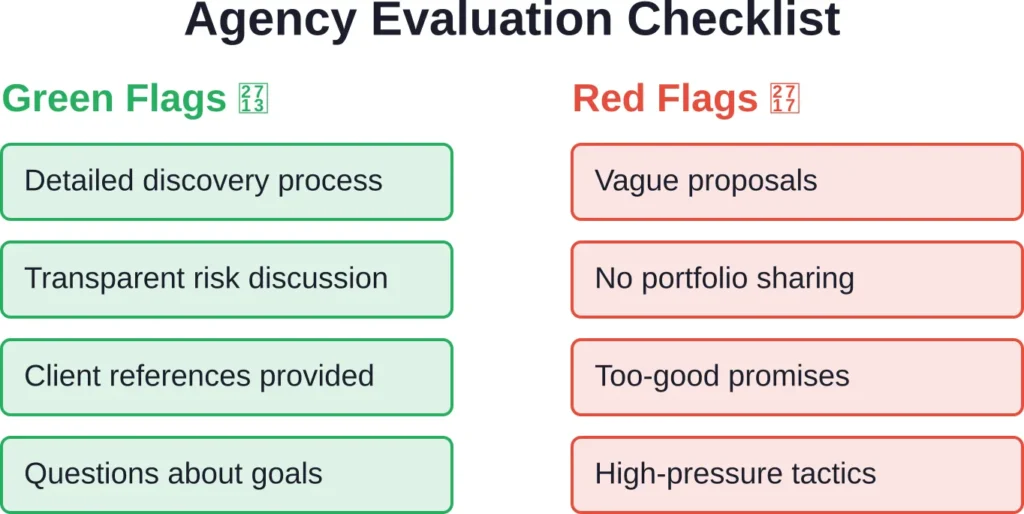
Red Flags That Signal Problems
Vague proposals without detailed timelines or deliverables indicate inexperience or lack of process. Professional agencies break projects into specific milestones with clear acceptance criteria.
Reluctance to share client references or portfolio work suggests the agency either has unhappy clients or hasn’t actually delivered projects of the claimed complexity.
Promises that sound too good to be true usually are. Building complex web applications fast, cheap, and high-quality is impossible—physics doesn’t allow all three simultaneously. Agencies claiming otherwise are either lying or don’t understand the scope.
High-pressure sales tactics and tight deadlines to “lock in rates” signal desperation rather than confidence. Quality agencies have healthy pipelines and don’t need to manufacture urgency.
Green Flags That Indicate Quality
Detailed discovery processes before quoting final prices show the agency understands that accurate estimates require understanding requirements. Fixed bids without thorough discovery are essentially guesses.
Questions about business goals and user needs—not just technical requirements—indicate strategic thinking beyond just coding to specification.
Transparent communication about risks, dependencies, and potential challenges demonstrates maturity. Every project has risks; agencies pretending otherwise are either naive or dishonest.
Case studies that discuss problems encountered and how they were solved are more valuable than portfolios showing only polished final products. Real projects hit obstacles—how teams handle them matters.
Communication and Project Management
Technical skills matter, but communication determines whether those skills actually deliver value. Brilliant developers who can’t explain decisions or respond to questions create more problems than they solve.
Time zone overlap affects project velocity more than most buyers expect. A four-hour overlap allows for daily standups, quick clarifications, and real-time collaboration. Zero overlap means 24-hour delays for every question.
Project management methodology should match organizational culture. Agile with two-week sprints works well for products with evolving requirements. Waterfall with detailed upfront specs suits projects with regulatory constraints and fixed scope.
Communication tools and cadence need explicit agreement. Daily Slack updates? Weekly video calls? Bi-weekly demos? Mismatched expectations here cause frustration even when development proceeds smoothly.
Language proficiency matters beyond basic comprehension. Can the team explain technical trade-offs in business terms that stakeholders understand? Technical accuracy without clarity doesn’t help decision-making.
Security, Compliance, and Accessibility
Non-functional requirements often get overlooked during vendor selection, then become expensive problems during or after development.
Security practices should be baked into development processes, not added as afterthoughts. Ask about code review procedures, dependency scanning, and how the team handles vulnerability disclosures.
Industry-specific compliance requirements—HIPAA for healthcare, SOC 2 for SaaS, PCI DSS for e-commerce—require specialized knowledge. Agencies claiming they can handle any compliance regime probably haven’t actually implemented the specific standard needed.
Web accessibility (WCAG 2.1 compliance) is increasingly a legal requirement, not just a nice-to-have. Agencies with accessibility expertise build it into component libraries from the start rather than retrofitting at the end.
Data privacy regulations like GDPR and CCPA affect how user data is collected, stored, and processed. Development teams need to understand these requirements and implement appropriate controls.
Scaling Considerations and Long-Term Partnerships
The launch isn’t the end—it’s the beginning. Choosing an agency means choosing a potential long-term partner for maintenance, updates, and future development.
Technical debt accumulates in every codebase. Agencies that prioritize clean architecture and documentation make it easier for future teams (or future versions of themselves) to extend functionality without rewriting everything.
Ownership and knowledge transfer matter if the relationship ends. Does the client get complete access to repositories, documentation, and deployment processes? Can another team pick up where this one leaves off?
Ongoing support models vary widely. Some agencies offer retainer-based maintenance. Others transition to time-and-materials support. A few walk away entirely after launch. Clarify expectations before the contract is signed.
Team continuity affects institutional knowledge. Agencies with high developer turnover lose context about why decisions were made, making future changes slower and riskier.
Industry-Specific Considerations
Different industries have different needs. Generic web development expertise doesn’t automatically translate to specialized domains.
E-commerce Development
E-commerce platforms require expertise in payment processing, inventory management, and conversion optimization. Agencies specializing in e-commerce understand checkout flow psychology and can implement features like abandoned cart recovery and dynamic pricing.
Platform choice matters enormously. Shopify works well for businesses prioritizing speed to market. Custom solutions built on frameworks like React or Vue offer more flexibility but require more development time.
Healthcare and Regulated Industries
Healthcare applications require HIPAA compliance, which affects everything from hosting infrastructure to user authentication. Agencies without healthcare experience underestimate the complexity and timeline impact.
Audit trails, consent management, and data encryption aren’t optional—they’re legal requirements. Development teams need to understand both the technical implementation and the regulatory reasoning.
Fintech and Financial Services
Financial applications demand robust security, precise calculations, and integration with banking APIs. Fintech agencies understand PSD2, open banking standards, and fraud prevention patterns.
Real-time transaction processing, reconciliation systems, and multi-currency support require specialized expertise beyond typical web development.
Media and Publishing
Publishing platforms prioritize content management workflows, multi-format delivery, and performance at scale. Agencies experienced in media understand editorial workflows and can build systems that non-technical content teams can actually use.
Advertising integration, subscription paywalls, and content recommendation engines are common requirements that generic development teams often underestimate.
| Industry | Critical Requirements | Common Platforms |
|---|---|---|
| E-commerce | Payment processing, inventory sync, checkout optimization | Shopify, WooCommerce, custom React |
| Healthcare | HIPAA compliance, EHR integration, consent management | Custom HIPAA-compliant stacks |
| Fintech | PCI DSS, banking APIs, transaction processing | Custom secure frameworks |
| Media/Publishing | CMS workflows, multi-format delivery, ad integration | WordPress, headless CMS |
| SaaS B2B | Multi-tenancy, API design, dashboard UIs | React, Vue, Angular |
Questions to Ask During Vendor Evaluation
The right questions reveal capability and culture faster than polished presentations.
“Can you share a project that didn’t go well and explain what happened?” Agencies that only discuss successes are hiding something. Everyone has projects that struggled—how they handled the struggle matters.
“What’s your process when requirements change mid-project?” They will change. The answer reveals whether the agency has structured change management or handles everything ad-hoc.
“How do you handle team member turnover during active projects?” Developer turnover happens. Agencies should have knowledge transfer processes and can reassign work without catastrophic delays.
“What metrics do you track to measure project health?” Agencies that track velocity, bug rates, and cycle time can spot problems early. Those that don’t track anything manage by intuition and hope.
“Can I speak with three clients whose projects launched in the past six months?” Recent references matter more than decade-old testimonials. Companies change—verify current capability.
“What happens if we’re unhappy with deliverables at milestone reviews?” The contract should specify revision processes and escalation procedures. Verbal assurances don’t help during disputes.
Frequently Asked Questions
Custom web applications typically require 3-6 months for an MVP with core functionality, depending on complexity and feature scope. Simple corporate websites take 8-12 weeks. Enterprise applications with complex integrations can extend 6-12 months or longer. Timeline depends heavily on requirements clarity, stakeholder availability for feedback, and whether scope remains stable during development.
Agencies provide complete teams including designers, developers, QA testers, and project managers working together with established processes. Freelancers offer specialized individual expertise and often cost less but require the client to coordinate multiple contractors. Agencies suit projects needing full-service delivery and consistent availability. Freelancers work well for specific technical challenges or when in-house teams need targeted expertise.
Time zone overlap of at least 3-4 hours enables daily standups and real-time collaboration, significantly improving communication velocity. Zero overlap means 24-hour response cycles for questions, slowing progress. However, agencies in different time zones can work effectively with asynchronous communication tools, detailed documentation, and structured handoffs. Prioritize communication processes over geographic proximity—a responsive team eight time zones away beats a local team that doesn’t respond promptly.
Request GitHub profiles or code samples in the specific technology stack. Review their portfolio for production applications built with those technologies—not just proof-of-concept demos. Ask technical questions during initial calls; experienced developers can discuss framework-specific trade-offs and architecture patterns. Request references from clients whose projects used the same tech stack and ask about the team’s actual capabilities versus what was promised.
Standard contracts should transfer full intellectual property rights to the client upon final payment, including source code, documentation, and design assets. Verify the contract explicitly states IP transfer and that developers sign agreements allowing the agency to transfer rights. Some agencies retain rights to proprietary frameworks or tools—clarify what’s custom versus pre-existing. Ensure the client receives access to all repositories, deployment credentials, and technical documentation needed to maintain or migrate the application.
Maintenance typically costs 15-20% of initial development annually, covering security updates, dependency upgrades, bug fixes, and minor enhancements. More complex applications with frequent updates or high uptime requirements may require 25-30%. Some agencies offer retainer packages with allocated monthly hours. Others work on time-and-materials for maintenance requests. Budget for both planned maintenance (security patches, framework upgrades) and reactive support (bug fixes, emergency issues).
Rock-bottom pricing usually signals junior developers, offshore teams with communication barriers, template-based work instead of custom development, or unrealistic bids that lead to scope disputes and overruns. Cheap agencies often cut corners on testing, documentation, and code quality, creating technical debt that costs more to fix than proper development would have cost initially. However, expensive doesn’t guarantee quality either—evaluate based on portfolio, process, and references rather than just price.
Making Your Final Decision
Vendor selection ultimately comes down to fit—not just technical capability but cultural compatibility and aligned expectations.
Create a scorecard with weighted criteria that matter to the specific project. Technical expertise might weigh 30%, communication and process 25%, industry experience 20%, cost 15%, and cultural fit 10%. Adjust weights based on project priorities.
Interview at least three agencies before deciding. Patterns emerge across conversations that aren’t visible evaluating a single vendor. The comparison clarifies what differentiation actually matters versus generic marketing claims.
Request detailed proposals with milestone breakdowns, acceptance criteria, and risk assessments. Generic proposals with vague timelines indicate the agency hasn’t invested time understanding the project.
Trust instincts about communication and responsiveness during the sales process. Agencies that respond slowly or vaguely before signing contracts rarely improve after.
Start with a smaller project or trial phase when possible. Building a simple feature or conducting a discovery sprint tests the working relationship before committing to a major engagement.
Conclusion
The 15 companies profiled here represent different approaches to web development outsourcing, from enterprise-focused agencies to startup specialists, from design-led shops to technical framework experts.
No single “best” agency exists—only the best fit for specific requirements. SumatoSoft excels at enterprise B2B applications. S-Pro specializes in startup MVPs. Valor Software owns the Angular ecosystem. Matching project needs to agency strengths matters more than rankings.
The outsourcing landscape continues evolving rapidly. AI integration, remote collaboration tools, and distributed team models have fundamentally changed how quality development work happens. Geographic boundaries matter less than they did five years ago.
Take time during vendor selection. Rushing into contracts with the first responsive agency often leads to mismatched expectations and project struggles. The upfront investment in thorough evaluation pays dividends throughout development and beyond.
Ready to find the right development partner? Start by documenting project requirements, technical constraints, and success criteria. Clear requirements enable agencies to provide accurate estimates and demonstrate relevant experience. The clearer the brief, the better the proposals.