

Quick Summary: The best startup web development companies in 2026 combine technical expertise with an understanding of early-stage business needs. This curated list features 15 agencies that specialize in building scalable, conversion-focused websites for startups across SaaS, eCommerce, and tech sectors, evaluated on portfolio strength, client feedback, and startup-specific service offerings.
Choosing the right web development partner can make or break a startup’s digital presence. Unlike established enterprises with dedicated tech teams and generous budgets, startups need agencies that move fast, understand product-market fit constraints, and build for growth rather than just aesthetics.
The landscape has shifted dramatically. According to G2’s 2026 Best Software Awards, the Top 100 companies saw a 34% shakeup this year, with 34 newcomers entering the rankings (representing 34% of the shakeup). That kind of volatility reflects how quickly the web development agency space evolves.
But here’s the thing: not every agency that claims to serve startups actually understands the unique pressures of building a business from scratch. Many treat startup projects like scaled-down enterprise work, missing the mark entirely on what early-stage companies actually need.
This guide cuts through the noise. The following 15 agencies have proven track records working with startups, demonstrated expertise in modern web technologies, and client portfolios that show real business results rather than just pretty designs.
What Makes a Web Development Company Right for Startups?
Before diving into specific agencies, it’s worth understanding what distinguishes a truly startup-friendly web development company from the hundreds of firms offering generic services.
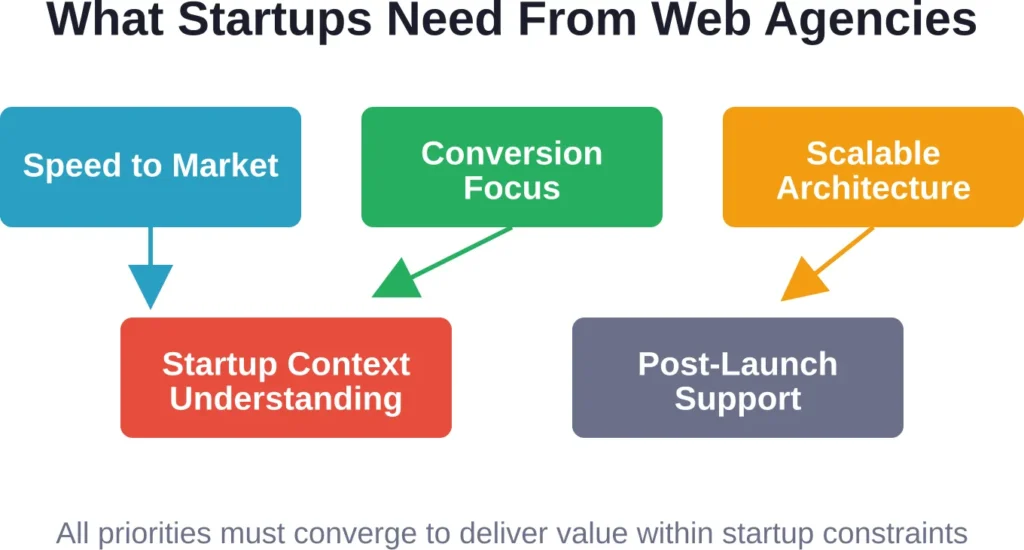
Speed matters more than perfection. Startups operate on compressed timelines where getting to market quickly often trumps having every pixel perfect. The best agencies understand this trade-off and structure their processes accordingly.
They think in terms of conversion and validation, not just design. A beautiful site that doesn’t convert visitors into users or customers is worthless for an early-stage company burning through runway. Agencies that understand startups focus obsessively on metrics that matter: signup rates, demo requests, activation flows.
Technical debt awareness is critical. Startups need sites that can scale from 100 to 100,000 users without complete rebuilds. That requires architectural thinking from day one, choosing the right tech stack, and building with growth in mind rather than just current needs.
Real talk: the best startup agencies often have founders on their teams who’ve built companies themselves. They’ve felt the pressure of a dwindling bank account and an investor meeting next month. That lived experience shapes how they prioritize work.
Key Services Startup Web Development Companies Should Offer
Look for agencies that bundle these capabilities rather than forcing multiple vendor relationships:
- Full-stack development covering front-end interfaces and back-end infrastructure
- UI/UX design that prioritizes user flows over pure aesthetics
- CMS implementation that lets non-technical teams update content independently
- Basic technical SEO setup including site structure, meta tags, and performance optimization
- Responsive design that works seamlessly across devices without separate mobile builds
- Post-launch support for inevitable bugs, tweaks, and quick iterations
Many agencies also offer product design services that extend beyond the website into the core product interface, which can be particularly valuable for SaaS startups that need consistent design language across marketing site and application.
The 15 Best Startup Web Development Companies in 2026
Each agency below has been evaluated on portfolio quality, client reviews from platforms like Clutch, service offerings specifically relevant to startups, and demonstrated results with early-stage companies. The list spans different specializations and team sizes to match various startup needs.
1. A-listware
A-listware specializes in software development outsourcing and dedicated team augmentation for startups and growing businesses. They focus on building high-quality, secure, and scalable digital solutions while integrating seamlessly as an extension of the client’s team.
Their strength lies in rapid team setup and end-to-end delivery across custom software development, cloud solutions, AI integration, and full lifecycle services. This allows companies to scale development capacity without the overhead of building in-house teams.
Clients value the transparent collaboration, consistent quality, and ability to handle everything from legacy modernization to new product development.
Best for: Startups and SMBs that need flexible, reliable software development teams and outsourcing partnership
Key strength: Seamless team augmentation and end-to-end software development with strong technical delivery
Notable clients: Enterprise companies, small and medium businesses, and startups across various technology sectors
Contact Information:
- Website: a-listware.com
- Phone: +1 (888) 337 93 73
- Email: [email protected]
- Address: North Bergen, NJ 07047, USA
- LinkedIn: www.linkedin.com/company/a-listware
- Facebook: www.facebook.com/alistware
2. Gilzor
Gilzor focuses on turning startup ideas into production-ready digital products that investors and users love. They provide full-cycle development from idea validation and UI/UX design to web and mobile applications with strong emphasis on performance and user experience.
The team excels at building scalable solutions while maintaining clean architecture and fast delivery. Their user-centric design process consistently improves conversion rates, and they support clients from early validation through go-to-market and ongoing growth.
Clients value their ability to reduce risk through proper research, QA, and strategic product thinking that aligns technology with business objectives.
Best for: Early-stage startups and product studios that need end-to-end web and mobile development with strong design focus
Key strength: Idea validation, user-centric design, and full-cycle custom software development
Notable clients: Startups in e-commerce, airlines, health & wellness, and various product companies
Contact Information:
- Website: www.gilzor.com
- Email: [email protected]
- Address: Poland, Warsaw, Office 58, street Adama Mickiewicza 37, 01-625
- LinkedIn: www.linkedin.com/company/gilzor-softwaredevelopment
3. Mobian Studio
Mobian Studio builds dedicated engineering teams that deliver production-ready mobile and AI solutions for companies that need speed and reliability. They offer both full outsourcing and outstaffing models with senior-level execution.
Their approach emphasizes clean architecture, scalable systems, and domain expertise in regulated industries. From mobile apps to AI agents and legacy integration, they ensure projects ship on time without quality trade-offs.
Clients appreciate the clear communication, post-launch support, and ability to scale products from dozens to hundreds of thousands of users seamlessly.
Best for: IT, healthcare, fintech, and logistics companies that need fast, high-quality mobile and AI development
Key strength: Dedicated teams delivering scalable architecture and full-stack production software
Notable clients: Companies in healthcare, fintech, logistics, and enterprise IT
Contact Information:
- Website: mobian.studio
- Phone: [email protected]
- Address: Harju maakond, Tallinn, Kesklinnalinnaosa, Masina tn 22, 10113
- LinkedIn: www.linkedin.com/company/mobian-studio
4. Lengreo
Lengreo has established itself as a complete marketing and tech partner for B2B companies looking to scale lead generation and digital presence. They combine strategy with hands-on execution across SEO, paid ads, website development, and outbound campaigns.
Their strength lies in delivering measurable growth through hyper-personalized outreach and conversion-focused websites. Instead of generic packages, they tailor tactics to each client’s industry and goals, resulting in strong ROI on lead quality and cost efficiency.
Client testimonials highlight the team’s initiative, seamless communication, and consistent delivery of high-quality results that directly impact business development.
Best for: B2B startups and scale-ups that need integrated marketing and website solutions to drive qualified leads
Key strength: Results-driven digital marketing combined with conversion-focused website development
Notable clients: Software development companies, IT services providers, architecture & design firms, event technology, and sports tech companies
Contact Information:
- Website: Lengreo.com
- Phone: +31 686 147 566
- Email: [email protected]
- Address: Vrijstraat 9 C/D, 5611 AT Eindhoven, Netherlands
- LinkedIn: Lengreo
- Twitter: @Lengreo
- Instagram: @lengreo
5. Oski
Oski delivers well-engineered software solutions for tech-forward enterprises and ambitious startups. They combine cloud infrastructure, modern frontend frameworks, and artificial intelligence to create powerful, scalable digital products.
The team stands out for AI-accelerated development and thoughtful system design that supports long-term growth. Their solutions span cloud architecture, intuitive user interfaces, and intelligent features that drive real business impact.
Clients benefit from fast team ramp-up and solutions built with flexibility and performance in mind across multiple industries.
Best for: Ambitious startups and enterprises that need modern web, cloud, and AI-powered solutions
Key strength: AI-accelerated engineering combined with strong cloud and frontend capabilities
Notable clients: Companies in travel, logistics, e-commerce, education, fintech, and insurance
Contact Information:
- Website: oski.site
- Phone: +48571282759
- Email: [email protected]
- Address: Kaupmehe tn 7, 10114 Tallinn, Estonia
- LinkedIn: www.linkedin.com/company/oski-solutions
6. Bop Design
Bop Design focuses specifically on B2B companies, making them particularly relevant for SaaS and enterprise software startups. They understand the longer sales cycles and multiple stakeholder dynamics that B2B sites must navigate.
The agency’s approach centers on lead generation rather than just traffic. Every design decision gets evaluated against its impact on converting visitors into qualified leads. For B2B startups where each customer represents significant revenue, that focus matters enormously.
They’re particularly strong at creating content architectures that serve different buyer personas and stages. A technical evaluator visiting the site sees different content than a C-level budget holder, with smart navigation guiding each appropriately.
Based in San Diego, they’ve built a client roster heavy on technology and professional services startups. Reviews consistently mention their understanding of complex B2B buying processes.
Best for: B2B SaaS startups that need lead generation focus over consumer-style marketing
Key strength: Deep B2B expertise with content strategy that serves complex buying committees
Notable clients: B2B software, professional services, and enterprise technology startups
7. Dotlogics Inc.
Dotlogics operates as a full-service agency with strong technical capabilities across web development, mobile apps, and digital marketing. For startups that need multiple capabilities coordinated, that breadth reduces vendor management overhead.
They’ve built particular expertise in eCommerce platforms, making them relevant for direct-to-consumer startups and marketplace businesses. The team understands payment processing, inventory integration, and conversion optimization specific to online retail.
Client reviews emphasize their technical problem-solving abilities. When complex integration challenges arise, Dotlogics has the development depth to work through them rather than escalating to third parties.
The agency maintains a balance between custom development and leveraging proven platforms like Shopify and WordPress where appropriate. That pragmatism serves startup budgets well.
Best for: eCommerce startups and companies needing coordinated web, mobile, and marketing services
Key strength: Strong technical capabilities with eCommerce specialization and payment integration expertise
Notable clients: Direct-to-consumer brands, marketplace platforms, and retail technology startups
8. Huemor
Huemor has built a reputation for creative, unconventional web experiences that stand out in sea-of-sameness industries. They’re the agency startups hire when they want to differentiate through bold design rather than incremental improvement.
The team excels at storytelling through web experiences. They think cinematically, crafting narrative flows that guide visitors through key messages rather than just presenting information architecturally.
That creative strength comes with strong technical execution. Sites load fast, work across devices, and integrate with marketing automation and CRM systems that startups rely on.
Reviews frequently mention how Huemor challenges conventional thinking and pushes clients toward bolder creative directions. For startups in conservative industries looking to disrupt, that perspective is valuable.
Best for: Startups that want bold, differentiated web experiences rather than safe conventional design
Key strength: Creative storytelling approach with technical chops to execute ambitious designs
Notable clients: Startups and growth companies across healthcare, finance, and technology sectors
9. eDesign Interactive

eDesign Interactive specializes in website design and development with a particular focus on conversion optimization. They approach every project through the lens of business results rather than creative expression.
The agency has developed a structured methodology for optimizing conversion paths based on testing thousands of variations across client sites. For startups where small conversion rate improvements dramatically impact customer acquisition costs, that expertise matters.
They work extensively with B2B companies, understanding the lead nurturing workflows and marketing automation integration that complex sales processes require. Sites they build integrate cleanly with HubSpot, Salesforce, and similar platforms.
Client reviews emphasize their analytical approach and focus on measurable outcomes. Startups report receiving detailed reports on site performance and data-driven recommendations for ongoing improvements.
Best for: Data-driven startups that prioritize measurable conversion improvements
Key strength: Conversion optimization expertise backed by extensive A/B testing experience
Notable clients: B2B technology companies, professional services firms, and SaaS startups
10. The Creative Momentum

The Creative Momentum (now part of CloudMellow) operates as a growth-focused agency helping startups build and optimize their digital presence. They combine web development with ongoing marketing services.
Their model works particularly well for startups that need a long-term partner rather than a one-time project vendor. Many clients start with a website build and continue with retainer arrangements for ongoing optimization and marketing support.
The agency has experience across various industries but maintains strong expertise in technology and professional services. They understand the unique challenges of marketing intangible software products.
Reviews highlight their collaborative approach and willingness to adapt processes to match how startups actually work. They don’t force rigid methodologies that clash with startup pace and flexibility.
Best for: Startups seeking a long-term partner for web development and ongoing growth marketing
Key strength: Combined capabilities in website development and growth marketing with flexible engagement models
Notable clients: Technology startups, SaaS platforms, and service-based businesses
11. ParallelHQ

ParallelHQ has carved out a distinct position serving AI and SaaS startups specifically. They’re not trying to be everything to everyone, which is exactly what makes them effective for their niche.
Their core strength lies in combining product design with web development under one roof. For SaaS startups, that means the marketing site and product interface share design language and don’t feel like they came from different companies.
The team operates as a distributed group of specialists who’ve worked at startups themselves. That context shows up in how they structure projects: fast iteration cycles, heavy emphasis on conversion metrics, and technical architecture that anticipates rapid scaling.
Client reviews consistently mention the speed of delivery without sacrificing quality. One founder noted on Clutch that ParallelHQ delivered a complete marketing site and product redesign in six weeks, a timeline that would take most agencies three months.
Best for: AI and SaaS startups that need cohesive design across marketing and product
Key strength: Product design expertise combined with web development, startup-native team
Notable clients: Early-stage B2B SaaS companies across fintech, developer tools, and AI sectors
12. Clay Agency
Clay has built a reputation for brand-forward work with tech companies that want to stand out visually. They’re the agency startups hire when they’ve raised a Series A and need to look like a grown-up company.
The design quality is exceptional. Every project in their portfolio looks like it could win awards, because many of them have. But here’s what matters more for startups: the sites actually work from a conversion standpoint.
Clay excels at creating memorable brand identities that extend seamlessly into web experiences. Their process starts with brand strategy before touching any code, ensuring the site reflects a coherent market position rather than just looking pretty.
They work primarily with venture-backed startups that have secured funding and need to professionalize their digital presence quickly. The team size allows them to take on complex projects while maintaining hands-on creative direction.
Best for: Funded tech startups that need premium brand identity and web presence
Key strength: Award-winning design that balances aesthetics with conversion performance
Notable clients: Venture-backed tech companies in fintech, crypto, and B2B software
13. Lollypop Design Studio

Lollypop operates as a full-service digital product studio with particularly strong mobile and web capabilities. They’ve worked with over 200 startups across various stages, from pre-seed to Series C.
The agency’s strength lies in research-driven design. They don’t just execute what founders ask for; they validate assumptions through user research first. For startups, that means fewer expensive pivots after launch.
Their web development work integrates tightly with broader product design engagements. Many clients hire them initially for a website and expand into product design work as the relationship proves valuable.
Team size has grown to over 100 designers and developers distributed globally, allowing them to handle multiple startup projects simultaneously without resource bottlenecks that plague smaller agencies.
Best for: Startups that want research-backed design decisions rather than gut-feel execution
Key strength: User research integration and full product design capabilities beyond just websites
Notable clients: Consumer tech startups, mobile-first products, and B2B SaaS platforms
14. Digital Silk

Digital Silk positions itself as a premium digital agency working with ambitious brands, including many well-funded startups. They’ve built a particular expertise in creating websites that reflect sophisticated brand positioning.
The agency handles everything from strategy through execution, which can be valuable for startups that don’t have internal marketing leadership yet. That full-service approach means projects stay cohesive rather than requiring coordination across multiple vendors.
Their process emphasizes custom development over template-based solutions. For startups planning to scale significantly, that foundation prevents the need for complete rebuilds later.
Client feedback often highlights the strategic thinking that precedes design and development work. Digital Silk doesn’t just build what clients request; they challenge assumptions and recommend approaches based on industry benchmarks.
Best for: Well-funded startups that need strategic guidance alongside execution
Key strength: Full-service approach from strategy through development and ongoing optimization
Notable clients: Scale-ups and later-stage startups across technology, healthcare, and finance
15. Lounge Lizard

Lounge Lizard has been building websites since 1998, giving them deep experience across technology platforms and industry cycles. That longevity matters because they’ve seen patterns repeat and know what actually works.
The agency operates with a “brandtenders” philosophy, mixing creativity with strategic thinking. For startups, that translates to websites that differentiate in crowded markets rather than following generic best practices.
They maintain offices in New York, Los Angeles, and other major markets, allowing face-to-face collaboration for startups that value in-person working relationships. But they also work effectively with remote clients.
Reviews on Clutch give them high marks for communication and project management, two areas where agencies often stumble. Startups report clear timelines, regular updates, and responsiveness when issues arise.
Best for: Startups that want proven experience and prefer agencies with physical office presence
Key strength: Two decades of web development experience with strong project management processes
Notable clients: Mix of startups and established brands across diverse industries
How to Choose the Right Agency for Your Startup
With 15 strong options, the selection process comes down to matching agency strengths with specific startup needs. The wrong match wastes time and money; the right one accelerates growth.
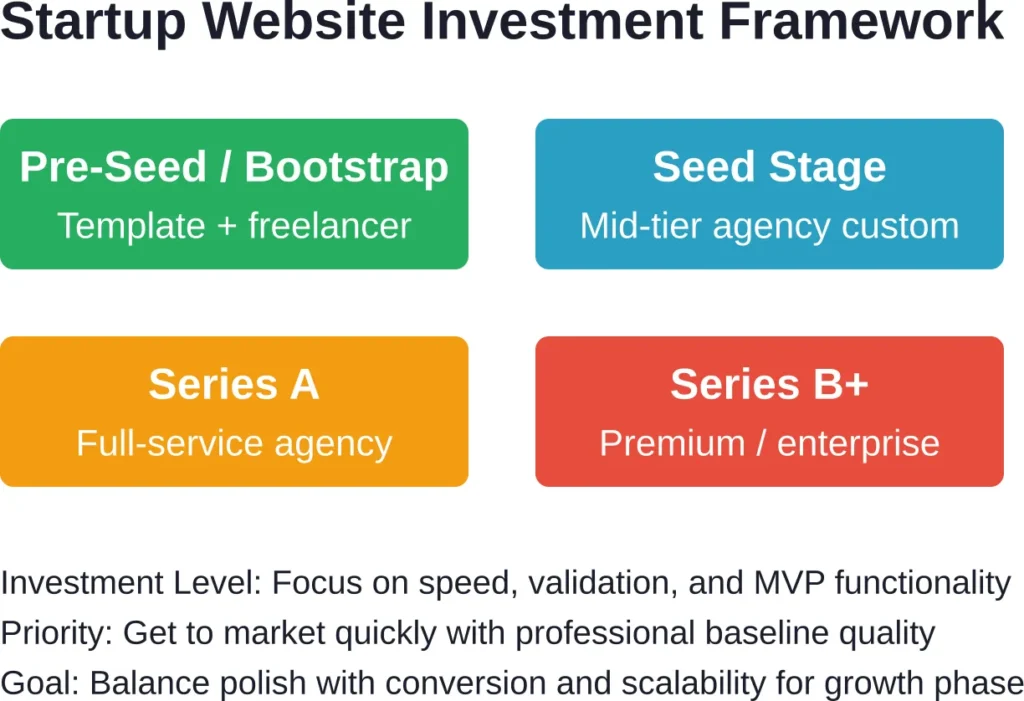
Start by clarifying what problem needs solving. A pre-launch startup validating product-market fit has radically different needs than a Series A company scaling sales operations. The former needs speed and flexibility; the latter needs polish and conversion optimization.
Match Stage to Agency Capabilities
Pre-seed and seed-stage companies should prioritize agencies comfortable with ambiguity and rapid iteration. Look for teams that have worked with very early-stage companies and won’t balk when requirements shift mid-project.
Series A and beyond startups need agencies that can deliver professional, scalable results. At this stage, the website represents the company to investors, enterprise buyers, and potential hires. It needs to inspire confidence, not just function adequately.
Evaluate Portfolio Relevance
Don’t just look for pretty designs. Study each agency’s portfolio specifically for projects similar to what’s needed. If they’ve never built a B2B SaaS site, they’ll learn on the startup’s dime.
Pay attention to the companies they’ve worked with. Agencies that list mostly Fortune 500 clients probably aren’t set up for startup pace and budget realities, regardless of what their sales team promises.
Check Recent Client Reviews
Platforms like Clutch aggregate verified reviews from actual clients. Read reviews from the past 12 months specifically, since agencies change personnel and processes.
Look for patterns in feedback. If multiple reviews mention communication issues or timeline slips, that’s a red flag. If they consistently praise responsiveness and flexibility, that signals a team that works well with startups.
Web Development Agency vs. Freelancer: What Works for Startups?
Many startups debate whether to hire an agency or work with individual freelancers. Both approaches have merit depending on circumstances.
Freelancers offer flexibility and often lower costs. A talented freelance developer can build a solid site for a fraction of agency costs. That math makes sense for very early-stage startups with tight budgets.
But freelancers come with risks. They get sick, take other projects, or disappear mid-engagement. There’s no team backing them up. For startups facing a launch deadline or investor meeting, that risk can be catastrophic.
Agencies provide reliability and breadth. If the lead designer gets hit by a bus, someone else picks up the work. Complex projects requiring multiple specialties (design, front-end, back-end, SEO) get coordinated under one roof.
The cost difference is real but often overstated. Industry analyses suggest typical project ranges fall between different tiers depending on scope and provider type. A specialized marketing site through an agency might run higher than freelance alternatives, but the time-to-value and reduced management overhead often justify the delta.
Here’s a practical framework: for straightforward website builds without complex integrations, experienced freelancers can deliver excellent results. For projects requiring coordination across design, development, content, and technical SEO, agencies prevent the coordination nightmare of managing multiple independent contractors.
The Hybrid Approach
Some startups find success using agencies for core website work while hiring freelancers for specific tasks like content writing or ongoing maintenance. This captures agency reliability for the critical path while containing costs.
Retainer arrangements become relevant once the initial site launches. Typical retainer ranges vary widely based on scope. These cover ongoing optimization, content updates, and technical maintenance without the overhead of project-based contracting for every small change.
Red Flags to Watch During Agency Selection
Certain warning signs should prompt immediate concern when evaluating web development companies.
Guaranteeing specific rankings or traffic numbers. No agency controls Google’s algorithms. Anyone promising first-page rankings or specific traffic volumes is either dishonest or dangerously naive.
Pushing proprietary platforms or CMSs. Agencies that insist on their custom content management system create vendor lock-in. If the relationship sours, moving the site elsewhere becomes nearly impossible.
Refusing to share previous client contacts. Legitimate agencies gladly connect prospects with past clients. Reluctance suggests either minimal experience or unhappy customers.
Requiring full payment upfront. Standard practice involves payment milestones tied to deliverables. Full prepayment removes all leverage if the agency underdelivers.
Unable to explain their process. Professional agencies have defined methodologies for discovery, design, development, and launch. Vague hand-waving about “collaborative approaches” often masks inexperience.
Overpromising timeline or scope. A complex SaaS website can’t be properly built in two weeks. Agencies that agree to impossible timelines will either miss deadlines or deliver substandard work.
Essential Questions to Ask Potential Agencies
Come prepared to initial agency conversations with specific questions that reveal how they actually work.
Who will actually work on the project? Many agencies lead with senior talent in sales meetings but assign junior teams to execution. Insist on meeting the actual designer and lead developer before signing.
What happens after launch? Sites need ongoing maintenance, security updates, and optimization. Clarify what post-launch support is included versus billed separately.
How do you handle scope changes? Startup requirements shift as market feedback rolls in. Understand the agency’s change management process and associated costs before committing.
What metrics do you optimize for? The answer reveals their priorities. Agencies focused on “engagement” or “visual impact” think differently than those obsessing over conversion rates and business metrics.
Can you integrate with our existing tools? Most startups already use marketing automation, CRM, and analytics platforms. The new site needs to integrate cleanly with those systems.
What’s your typical revision process? Unlimited revisions sound great until discovering they only apply to minor tweaks. Understand specifically what’s included in the base agreement.
Technical Considerations for Startup Websites
Beyond design and agency selection, certain technical decisions significantly impact long-term success.
Platform Selection
WordPress remains the most common CMS choice, powering a significant portion of websites globally. Its massive plugin ecosystem and developer community provide solutions for nearly any requirement.
Webflow has gained substantial traction with startups preferring visual design tools and modern architecture. It offers more design flexibility than WordPress without requiring custom code for many features.
Headless CMS approaches (Contentful, Sanity, etc.) combined with frameworks like Next.js provide maximum performance and flexibility. But they require more technical expertise to maintain, making them better suited for startups with technical co-founders or engineering teams.
The best agencies help navigate these options based on specific needs rather than pushing whatever they’re most comfortable building.
Performance and Core Web Vitals
Site speed directly impacts both conversion rates and search rankings. Google’s Core Web Vitals measure loading performance, interactivity, and visual stability.
Startups often sacrifice performance for design complexity, adding heavy animations and high-resolution images that tank load times. The best agencies balance visual appeal with technical performance.
Ask potential agencies specifically about their performance optimization process. Do they routinely achieve good Core Web Vitals scores? Can they show examples of fast-loading sites they’ve built?
Mobile-First Development
More than half of web traffic comes from mobile devices for most B2B and B2C startups. Yet many sites still treat mobile as an afterthought, simply shrinking the desktop version.
Proper mobile-first development starts by designing the mobile experience, then expanding to desktop. This approach ensures the most common use case gets priority attention.
Budget Realities and Investment Levels
Understanding realistic budget requirements prevents both underspending (which leads to poor results) and overspending (which burns unnecessary runway).
Project costs vary dramatically based on complexity, customization, and agency positioning. Simple template-based implementations start at the lower end. Mid-market agencies delivering full custom sites with CMS integration and basic SEO typically fall in a moderate range. Top-tier agencies building complex SaaS websites with custom functionality command higher investments.
For most early-stage SaaS or AI startups, analyses indicate the moderate range delivers professional results without enterprise-level budgets. That typically includes custom design, CMS implementation, mobile optimization, and basic technical SEO.
Avoid penny-wise-pound-foolish thinking. A site that converts 2% costs the same to drive traffic to as one converting 4%, but the latter generates twice the revenue. Investing adequately in conversion optimization often delivers better ROI than skimping on development to spend more on ads.
Ongoing Optimization After Launch
The website launch marks the beginning, not the end, of effective web presence. Startups that treat their site as a finished product leave significant value on the table.
Continuous optimization based on real user data separates high-performing sites from mediocre ones. Every startup should implement analytics tracking, heatmaps, and session recording from day one.
Conversion Rate Optimization
Small improvements compound dramatically over time. Raising conversion from 2% to 3% might sound trivial, but it represents a 50% increase in leads or signups from the same traffic.
Run structured A/B tests on critical pages: homepage, pricing, signup flow. Test headlines, calls-to-action, form lengths, and page layouts systematically rather than changing multiple things at once.
The best agencies offer ongoing optimization services through retainer arrangements. This makes sense once the site launches and real usage data becomes available. Having the team that built the site continue optimizing it preserves context and accelerates improvement cycles.
Content Updates and SEO
Search rankings take months to develop. Launch-day SEO is just the foundation; ongoing content development and technical refinement drive long-term organic traffic growth.
Plan for regular content additions: blog posts, case studies, resource pages, documentation. These serve both users and search engines while establishing topical authority.
Technical SEO requires periodic attention as Google’s algorithms evolve and Core Web Vitals benchmarks tighten. Partner with agencies or specialists who stay current with search engine requirements.
Common Mistakes Startups Make with Web Development
Having worked with hundreds of startups, certain patterns of mistakes appear repeatedly.
Designing for themselves, not customers. Founders often want websites that impress other founders rather than convert their actual target buyers. This leads to over-designed, confusing experiences.
Skipping user research. Assumptions about what visitors need rarely match reality. The best results come from actually watching target users interact with prototypes before full development.
Underestimating content requirements. Great design can’t fix terrible copy. Budget adequate time and resources for professional content creation, not just design and development.
Launching without analytics. Incredibly, some startups launch without proper analytics tracking. They have no idea what’s working, what’s failing, or how to improve.
Ignoring page speed. Heavy images, excessive scripts, and bloated code create slow sites that lose visitors and tank search rankings. Performance must be a requirement, not an afterthought.
Setting unrealistic timelines. Quality web development takes time. Rushing the process leads to technical debt, poor user experience, and expensive fixes later.
The Role of AI in Modern Web Development
Artificial intelligence tools have transformed how agencies build websites, but the technology remains a means to an end rather than a replacement for human expertise.
AI-powered design tools help agencies iterate faster, generating multiple layout options and design variations quickly. This accelerates the creative process without replacing the strategic thinking that determines which directions to explore.
Code generation tools like GitHub Copilot make developers more productive, reducing time spent on boilerplate code. But they require experienced developers to implement effectively and debug when they inevitably generate problematic suggestions.
Content generation through AI assists with first drafts and ideation, but quality websites still require human editing and strategic oversight. AI can draft product descriptions; it can’t articulate unique value propositions that resonate with specific buyer personas.
Thrive Agency reported substantial growth in referral traffic from AI platforms, with total traffic from all AI platforms growing from January to October 2025. This reflects how AI-powered search and recommendations are reshaping traffic sources.
Forward-thinking agencies incorporate AI tools to deliver better results faster while maintaining the creative and strategic judgment that separates exceptional work from mediocre.
Frequently Asked Questions
Timeline varies based on project complexity and agency processes. A straightforward marketing site with 5-10 pages typically takes 6-10 weeks from kickoff to launch. This includes discovery, design, development, content creation, and testing phases. More complex sites requiring custom functionality, extensive content, or multiple stakeholder approvals can extend to 12-16 weeks. Agencies that promise delivery in 2-3 weeks are either using templates with minimal customization or will likely miss deadlines.
The answer depends on technical resources and specific requirements. WordPress works well for content-heavy sites and offers the most extensive plugin ecosystem. Webflow provides excellent design flexibility with better performance than WordPress for most use cases. Custom development using frameworks like Next.js delivers maximum performance and flexibility but requires ongoing technical expertise to maintain. For most early-stage startups without technical co-founders, Webflow or WordPress managed by the agency provides the best balance of capability and maintainability.
Standard post-launch support usually covers bug fixes for 30-60 days after launch, basic CMS training, and minor content updates. Beyond that window, agencies typically offer monthly retainer arrangements covering ongoing maintenance, security updates, performance monitoring, content changes, and iterative improvements. The scope varies significantly between agencies, so clarify these terms before signing. Some include hosting and technical maintenance in retainers; others bill those separately.
Budget requirements align with startup stage and complexity needs. Very early-stage companies can start with template-based solutions at lower costs. Most seed-stage startups benefit from professional custom design in moderate ranges that deliver professional results without enterprise budgets. Well-funded Series A companies should expect to invest more for sites that represent the company to enterprise buyers and investors. Remember that a higher-converting site often delivers better ROI than a cheaper one that underperforms.
In-house development makes sense when the founding team includes experienced designers and developers with available capacity. The challenge is that building a great marketing site requires different skills than product development. Technical founders can often build functional sites but may lack the UX design and conversion optimization expertise that agencies provide. Additionally, in-house development diverts founding team attention from core product and business development. For most startups, agencies deliver faster results and better outcomes unless web design is a core competency.
Focus on these critical areas: Who specifically will work on the project (not just the sales contact)? What does post-launch support include? How do they handle scope changes and revisions? What metrics do they optimize for? Can they provide references from similar startups? What’s their typical timeline and how do they prevent delays? How do they approach mobile optimization and site performance? What CMS do they recommend and why? These questions reveal whether the agency understands startup needs and has robust processes.
Industry specialization offers advantages but isn’t mandatory. Agencies with deep expertise in SaaS, eCommerce, or other specific sectors understand common patterns, buyer behaviors, and competitive landscape nuances. They bring proven best practices rather than learning from scratch. However, excellent generalist agencies often deliver outstanding results by asking great questions and applying strong fundamentals. The agency’s overall quality, process, and cultural fit matter more than narrow industry specialization. A mediocre SaaS-focused agency will underperform an excellent generalist every time.
Making the Final Decision
Selecting the right web development agency ranks among the most consequential decisions early-stage companies make. The website serves as the face of the business to customers, investors, partners, and potential hires.
Start by clarifying specific needs: What problem is the website solving? Who are the primary audiences? What actions should visitors take? How does this fit into broader go-to-market strategy?
Narrow the list to three agencies that align with those needs based on portfolio, specialization, and budget fit. Schedule detailed discovery calls with each, bringing specific questions and evaluating not just what they say but how they approach the conversation.
Request detailed proposals outlining scope, timeline, deliverables, and investment required. Compare these carefully, recognizing that the lowest bid often signals corners that will be cut.
Check recent client references, specifically asking about responsiveness, ability to meet deadlines, quality of deliverables, and post-launch support. Past client experiences predict future ones more reliably than marketing materials.
Trust instincts about cultural fit. The relationship will involve dozens of hours of collaboration over several months. If early interactions feel difficult or misaligned, that won’t improve under project pressure.
Once selected, invest time in a thorough discovery and planning phase before any design work begins. The clearer the brief and shared understanding upfront, the smoother execution becomes. Many project failures trace back to rushed or inadequate discovery that leaves critical questions unresolved.
Conclusion
The right web development agency accelerates startup growth by creating digital experiences that convert visitors into customers. The 15 agencies profiled here represent different specializations and strengths, allowing startups to find partners aligned with specific needs.
ParallelHQ excels with AI and SaaS startups needing cohesive product and web design. Clay delivers premium brand-forward work for funded tech companies. Lollypop brings research-driven processes that validate assumptions before expensive development. Digital Silk provides full-service strategy through execution. Lounge Lizard offers decades of proven experience with strong project management.
Bop Design specializes in B2B lead generation for complex sales processes. Dotlogics brings deep eCommerce and technical integration capabilities. Huemor creates bold, differentiated experiences that stand out in crowded markets. eDesign Interactive focuses obsessively on conversion optimization backed by extensive testing. The Creative Momentum combines web development with ongoing growth marketing partnerships.
The selection process should prioritize portfolio relevance, client feedback from similar startups, technical capabilities matching specific requirements, and cultural alignment for productive collaboration.
Budget appropriately for the startup’s stage and goals. Underspending leads to poor results that cost more to fix than building properly initially. The site represents the company to every visitor; it deserves adequate investment.
Remember that launch marks the beginning of optimization, not the end of web development. The best results come from continuous improvement based on real user data, making ongoing partnerships often more valuable than one-off projects.
Now it’s time to make a decision. Review the agencies that align best with specific needs, schedule discovery calls with the top candidates, and move forward with building a web presence that drives real business results.