

Quick Summary: Finding the right medical web development company in 2026 requires evaluating HIPAA compliance, patient-focused design, accessibility standards, and healthcare industry experience. The best agencies specialize in secure platforms, mobile-first architecture, and integration with EHR systems while meeting WCAG 2.2 and FDA cybersecurity requirements. This guide profiles 15 leading medical web development companies and explains how to choose the right partner for your healthcare organization.
Medical web development isn’t the same as building a website for a coffee shop or an e-commerce store. Healthcare organizations face a unique set of requirements: patient data protection, regulatory compliance, accessibility mandates, and the need to build trust in an industry where reputation is everything.
Around 78% of patients researching healthcare providers do so on a phone. And here’s the thing—if that mobile experience is clunky, slow, or confusing, they’ll move on to the next practice.
Choosing a medical web development company means finding a partner who understands not just code and design, but the healthcare ecosystem. That means HIPAA compliance isn’t an afterthought. It means WCAG 2.2 accessibility isn’t optional. And it means security protocols meet FDA cybersecurity standards established in March 2023 under section 524B of the Federal Food, Drug, and Cosmetic Act.
This guide breaks down 15 medical web development companies that have proven track records in the healthcare space. No fluff, no invented stats—just what these agencies actually deliver.
Why Healthcare Websites Need Specialized Development Expertise
Building medical websites demands a different skill set than general web development. Healthcare providers operate under regulatory frameworks that most industries never encounter.
HIPAA compliance is non-negotiable. Any website collecting patient information—appointment requests, contact forms tied to medical inquiries, patient portals—must protect that data with proper encryption, secure hosting, and documented safeguards. A single breach can result in penalties reaching thousands per violation.
But compliance goes beyond HIPAA. WCAG 2.2 compliance is now something healthcare providers are being audited on, and agencies that don’t build for it are creating liability for their clients. Accessibility isn’t just ethical—it’s increasingly a legal requirement.
Then there’s the trust factor. Over 70% of healthcare searches now happen on smartphones and tablets. Patients are vetting providers before they ever pick up the phone. A website needs to instantly reassure visitors they’re in capable hands. That means clear messaging, intuitive navigation, visible credentials, patient testimonials, and transparent information about services and insurance.
Add to that the technical requirements: integration with electronic health records systems, appointment scheduling software, telemedicine platforms, and patient portals. HL7 FHIR standards, established by Health Level Seven International, are now central to healthcare interoperability. FHIR is already required under several CMS interoperability rules, and its adoption is growing across both public programs and commercial health plans.
The right medical web development company understands all of this. They’re not learning healthcare compliance on your dime—they’ve built dozens of medical sites before yours.
Top 15 Medical Web Development Companies in 2026
These agencies have demonstrated healthcare specialization, compliance expertise, and measurable results.
1. Mobian Studio
Mobian Studio is a European partner specializing in medical web and mobile development, with strong expertise in Healthcare, telehealth platforms, and AI-powered solutions. They build dedicated teams for full-cycle development, including HL7/FHIR integrations, regulatory compliance, patient apps, and scalable architectures for clinics and health tech. Their approach combines end-to-end product delivery with legacy integration and post-launch support, ensuring clean, documented code tailored to healthcare constraints.
Best for: Healthcare organizations, fintech-health intersections, and logistics-health providers needing reliable, compliant web and mobile medical solutions.
Contact Information:
- Website: mobian.studio
- Phone: [email protected]
- Address: Harju maakond, Tallinn, Kesklinnalinnaosa, Masina tn 22, 10113
- LinkedIn: www.linkedin.com/company/mobian-studio
2. Lengreo

Lengreo (always with small “g”) serves as a complete marketing & tech partner with dedicated healthcare web development services. They create functional, user-friendly websites, landing pages, and digital platforms for medical practices, clinics, and healthcare organizations, focusing on patient engagement, appointment conversion, and compliance. Their strengths include website development, SEO, lead generation, and ongoing support that drive patient acquisition and trust-building online.
Best for: Clinics, private practices, and healthcare providers seeking conversion-focused medical websites combined with digital marketing.
Contact Information:
- Website: Lengreo.com
- Phone: +31 686 147 566
- Email: [email protected]
- Address: Vrijstraat 9 C/D, 5611 AT Eindhoven, Netherlands
- LinkedIn: Lengreo
- Twitter: @Lengreo
- Instagram: @lengreo
3. Gilzor

Gilzor specializes in custom web and mobile development for healthcare, including patient-facing apps, UI/UX design that improves conversion, and full-cycle solutions from idea validation to go-to-market. They have experience building health-related products like cognitive function apps and solutions that enhance user experience in medical contexts. Their user-centric approach emphasizes QA, security, scalability, and automation to support clinics and health startups.
Best for: Healthcare startups, product studios, and SMBs looking for custom medical web/mobile apps and digital health solutions.
Contact Information:
- Website: www.gilzor.com
- Email: [email protected]
- Address: Poland, Warsaw, Office 58, street Adama Mickiewicza 37, 01-625
- LinkedIn: www.linkedin.com/company/gilzor-softwaredevelopment
4. Oski.site

Oski Solutions delivers expert web development and smart software solutions for healthcare, including patient administration platforms, EHR integrations, telemedicine, and appointment systems. They focus on secure, scalable web solutions with AI, cloud, and frontend technologies that improve care delivery and operational efficiency. Their turnkey services cover design, development, deployment, and maintenance for medical organizations.
Best for: Enterprises, clinics, and health tech companies needing reliable, innovative medical web platforms and custom healthcare software.
Contact Information:
- Website: oski.site
- Phone: +48571282759
- Email: [email protected]
- Address: Kaupmehe tn 7, 10114 Tallinn, Estonia
- LinkedIn: www.linkedin.com/company/oski-solutions
5. A-listware

A-listware provides software development, UX/UI design, and IT solutions tailored for healthcare, including medical web applications, patient management systems, data analytics for labs/providers, and infrastructure support. They help build compliant, responsive digital solutions that empower healthcare businesses. Their expertise covers custom development, dedicated teams, and end-to-end services for clinical and operational needs.
Best for: Healthcare providers, labs, and medical organizations requiring scalable web development, team augmentation, and specialized healthcare IT solutions.
Contact Information:
- Website: a-listware.com
- Phone: +1 (888) 337 93 73
- Email: [email protected]
- Address: North Bergen, NJ 07047, USA
- LinkedIn: www.linkedin.com/company/a-listware
- Facebook: www.facebook.com/alistware
6. Azuro Digital

Azuro Digital operates out of California and specializes in healthcare, SaaS, and digital health platforms. They’ve built patient portals, telemedicine interfaces, and compliance-focused websites for medical startups.
Their technical depth includes custom integrations with practice management systems and EHR platforms. They’re comfortable working with complex healthcare software ecosystems.
Best for: Digital health startups, telehealth platforms, and organizations needing deep technical integrations.
7. Viedoc
Viedoc delivered a 100% increase in conversion rates for a healthcare technology client through strategic website design and creative solutions tailored to the clinical research sector.
They specialize in healthcare technology platforms that serve pharmaceutical companies, research organizations, and medical device manufacturers.
Best for: Clinical research organizations, pharmaceutical companies, and medical technology firms.
8. KNB Communications

KNB Communications specializes in medical website design for healthcare providers, biotech, medtech, dental tech, and medical practice websites. They focus on building trust through clear messaging, strong visuals, and streamlined user flows.
Their work emphasizes regulatory compliance and patient-focused content strategy.
Best for: Biotech companies, medical device manufacturers, and specialty healthcare providers needing strategic messaging.
9. Forefrontweb

Forefrontweb builds responsive, mobile-first interfaces for healthcare organizations. They implement CMS platforms that empower practices to manage content without developer dependency.
Their front-end development expertise ensures websites work flawlessly across all devices—critical since over 70% of healthcare searches happen on smartphones.
Best for: Practices needing clean, fast, mobile-optimized websites with easy content management.
10. Marketing LTB

Marketing LTB provides healthcare web design with integrated digital marketing services. They focus on helping healthcare providers build online presence through SEO-optimized websites, content marketing, and PPC.
Their approach combines web design with patient acquisition strategy, making them a fit for practices looking to grow patient volume.
Best for: Small to mid-sized practices seeking web design and patient acquisition marketing in one package.
11. Orbix Studio

Orbix Studio specializes in patient experience design and telehealth platforms. Based in New York, they focus on clinics, SaaS healthcare platforms, and MVP development for healthcare startups.
Their core strength is patient UX combined with technical web design that converts visitors into appointments. They’ve worked across healthcare and SaaS industries, with a 5.0 rating on Clutch.
Best for: Clinics, telehealth startups, and healthcare SaaS platforms needing modern, conversion-focused design.
12. Cardinal Digital Marketing

With 14 years in healthcare digital marketing, Cardinal Digital specializes in multi-location healthcare groups. They’ve delivered patient lead increases of 38% and specialist lead growth of 285% for clients.
Their expertise spans healthcare web design, SEO, PPC, and modular website systems that scale across multiple practice locations. They’re built for organizations managing complex patient acquisition funnels.
Best for: Multi-location practices, hospital systems, and specialty medical groups focused on measurable lead growth.
13. WebFX

WebFX brings enterprise-scale capabilities to healthcare web design. They offer SEO, PPC, and their proprietary MarketingCloudFX platform for patient lead generation.
They’ve worked with healthcare organizations looking for comprehensive digital marketing tied to web development. Their client base includes hospitals, medical device companies, and large practice groups.
Best for: Large healthcare organizations needing integrated web development and full-service digital marketing.
14. Thrive Agency
Thrive Agency focuses on medical web design, SEO, and patient acquisition strategies. They emphasize conversion optimization and trust-building design elements that reassure patients.
Their healthcare portfolio includes private practices, dental groups, and outpatient facilities. They combine design with ongoing marketing support.
Best for: Private practices and specialty clinics seeking design and marketing as a unified service.
15. ThrillX

ThrillX specializes in healthcare technology platforms and medical practice redesigns. Clients report up to 40% growth after redesigns, driven by comprehensive audits that identify conversion bottlenecks.
They focus on data-driven design decisions, A/B testing, and performance optimization. Their approach is analytical, not just aesthetic.
Best for: Healthcare tech companies and established practices ready to optimize existing sites for performance.
What to Look for in a Medical Web Development Company
Not every agency claiming healthcare expertise actually has it. Here’s what separates specialists from generalists who dabble in medical sites.
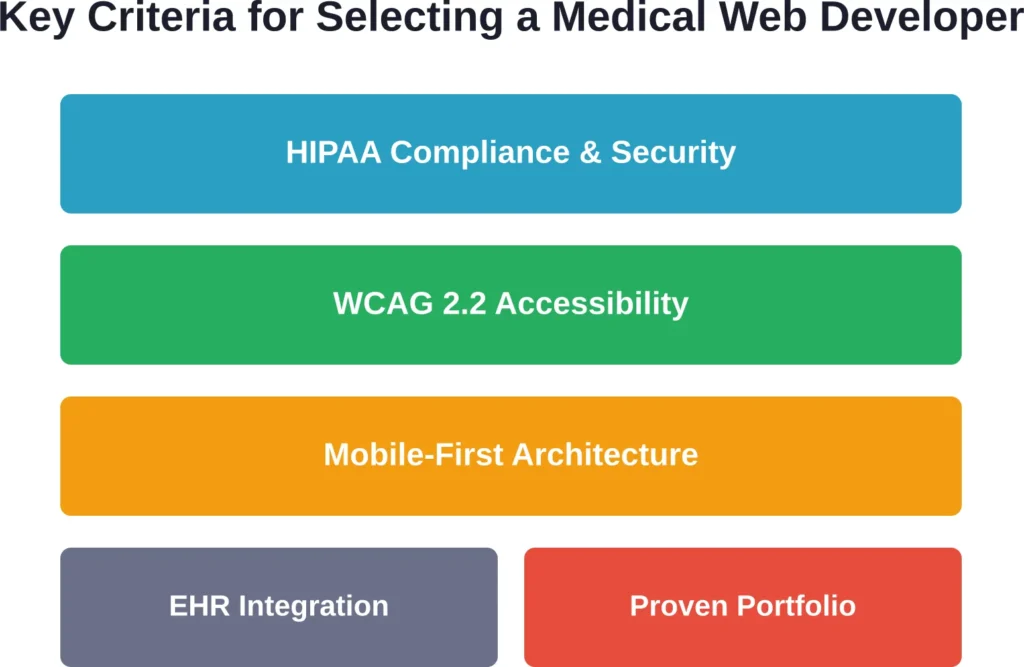
HIPAA Compliance and Security Infrastructure
Any medical web development company should provide Business Associate Agreements and demonstrate documented security practices. That includes SSL certificates, encrypted data transmission, secure hosting environments, and regular security audits.
Look for agencies familiar with FDA cybersecurity requirements. On December 29, 2022, the Consolidated Appropriations Act, 2023 (‘Omnibus’) was signed into law. Section 3305 of the Omnibus — ‘Ensuring Cybersecurity of Medical Devices’ — amended the Federal Food, Drug, and Cosmetic Act (FD&C Act) by adding section 524B. The amendments took effect 90 days after enactment, on March 29, 2023. Agencies working with healthcare technology platforms should understand these standards.
Accessibility Standards
WCAG 2.2 compliance isn’t optional anymore. Healthcare websites must be usable by patients with visual, auditory, motor, and cognitive disabilities. That means proper heading structure, alt text for images, keyboard navigation, sufficient color contrast, and screen reader compatibility.
Agencies should conduct accessibility audits and remediation as standard practice, not as an upsell.
Mobile-First Architecture
Mobile traffic dominates healthcare searches. A mobile-first approach means designing for small screens first, then scaling up—not the reverse. Touch-friendly buttons, fast load times, simplified forms, and click-to-call functionality are baseline expectations.
Patient-Centered UX Design
Healthcare websites serve anxious, stressed users looking for answers. Navigation should be obvious. Information should be easy to find. Appointment booking should take seconds, not minutes.
Agencies with healthcare specialization conduct user research specific to patient journeys. They understand what someone with a medical concern needs to see within the first 10 seconds of landing on a page.
Integration Capabilities
Medical practices rely on practice management systems, EHR platforms, billing software, and scheduling tools. A quality medical web development company integrates websites with these systems so appointment requests flow directly into calendars, forms populate patient records, and workflows stay efficient.
HL7 FHIR integration is becoming standard for organizations coordinating care across multiple systems. As of February 2026, HL7’s FAST Accelerator and the Da Vinci Project are unifying scalable FHIR infrastructure to build secure, trusted nationwide interoperability.
Proven Healthcare Portfolio
Review case studies and client lists. Have they worked with hospitals, private practices, telehealth platforms, or medical device companies? Do they show measurable results—patient lead growth, conversion rate improvements, traffic increases?
Agencies without healthcare portfolios are experimenting. Specialists have refined processes across dozens of projects.
How Medical Web Development Impacts Patient Acquisition
A well-designed medical website isn’t just a digital brochure. It’s a patient acquisition engine.
Medical website costs vary significantly based on complexity and features, from budget-friendly template options to custom enterprise solutions. But the investment often pays for itself quickly through improved conversion rates and reduced patient acquisition costs.
Medical practices often report improvements in patient inquiries and conversion rates following professional redesigns, though specific metrics vary by organization and implementation.
Why such dramatic shifts? Because most medical websites fail at basic conversion principles. They bury contact information. They use confusing navigation. They load slowly on mobile. They don’t answer the questions patients actually have.
A specialized medical web development company fixes these issues systematically. They optimize forms to reduce friction. They place clear calls-to-action. They structure content around patient concerns, not provider egos.
Real talk: if a patient can’t figure out how to book an appointment within 30 seconds, they’re calling your competitor instead.
Compliance Requirements Every Medical Website Must Meet
Regulatory compliance isn’t optional. Here’s what every medical website needs to address in 2026.
HIPAA Compliance
If your site collects any protected health information—even basic appointment request forms that include health concerns—you need HIPAA-compliant infrastructure. That means:
- Business Associate Agreements with hosting providers and third-party services
- Encrypted data transmission via SSL certificates
- Secure form handling that prevents data exposure
- Access controls and audit logging for backend systems
- Documented security policies and staff training
A quality medical web development company handles this as standard practice. They don’t just build a pretty website—they ensure it won’t land you in legal trouble.
WCAG 2.2 Accessibility
Web Content Accessibility Guidelines 2.2 set the standard for making websites usable by people with disabilities. Healthcare providers are increasingly being held to these standards through lawsuits and regulatory enforcement.
Compliance requires semantic HTML structure, keyboard navigation support, sufficient color contrast ratios, alt text for all meaningful images, captions for video content, and screen reader compatibility.
Agencies that skip accessibility audits are setting clients up for legal liability and excluding patients who need accommodations.
FDA Cybersecurity Standards
For organizations involved with medical devices, connected healthcare systems, or healthcare software platforms, FDA cybersecurity requirements are critical. Section 524B of the FD&C Act, enacted March 29, 2023, mandates cybersecurity measures for medical devices.
While this primarily affects device manufacturers, healthcare organizations using connected systems need partners who understand these standards. Healthcare organizations using connected medical device systems need partners familiar with cybersecurity requirements. For example, security vulnerabilities in certain medical device systems have required manufacturers to issue updates and provide guidance to users. Security updates may require upgrading to specific software versions such as Axeda agent 6.9.1 or above.
Medical web development companies working with healthcare technology platforms should be familiar with these cybersecurity requirements.
HL7 FHIR Standards
As healthcare moves toward interoperability, HL7 FHIR standards enable seamless data exchange between systems. CMS interoperability rules now require FHIR for certain data exchanges.
The Da Vinci Project Community Roundtable, scheduled for January 28, 2026, will provide insights on FHIR implementation guides aligned with CMS-0057-F compliance requirements. Organizations building patient portals, care coordination platforms, or systems that exchange clinical data need development partners who understand FHIR architecture.
HL7 International launched an AI Office in July 2025, appointing Daniel Vreeman, DPT, as Chief AI Officer to establish standards for safe, trustworthy AI in healthcare. This signals the growing intersection of AI, interoperability, and healthcare technology—areas where forward-thinking medical web development companies are building expertise.
| Compliance Area | Why It Matters | Key Requirements |
|---|---|---|
| HIPAA | Protects patient data and avoids penalties | BAAs, encryption, secure hosting, access controls |
| WCAG 2.2 | Ensures accessibility and reduces legal risk | Semantic HTML, keyboard nav, color contrast, alt text |
| FDA Cybersecurity | Secures connected medical devices and systems | Section 524B compliance, vulnerability management |
| HL7 FHIR | Enables interoperability and CMS compliance | FHIR APIs, data exchange standards, integration |
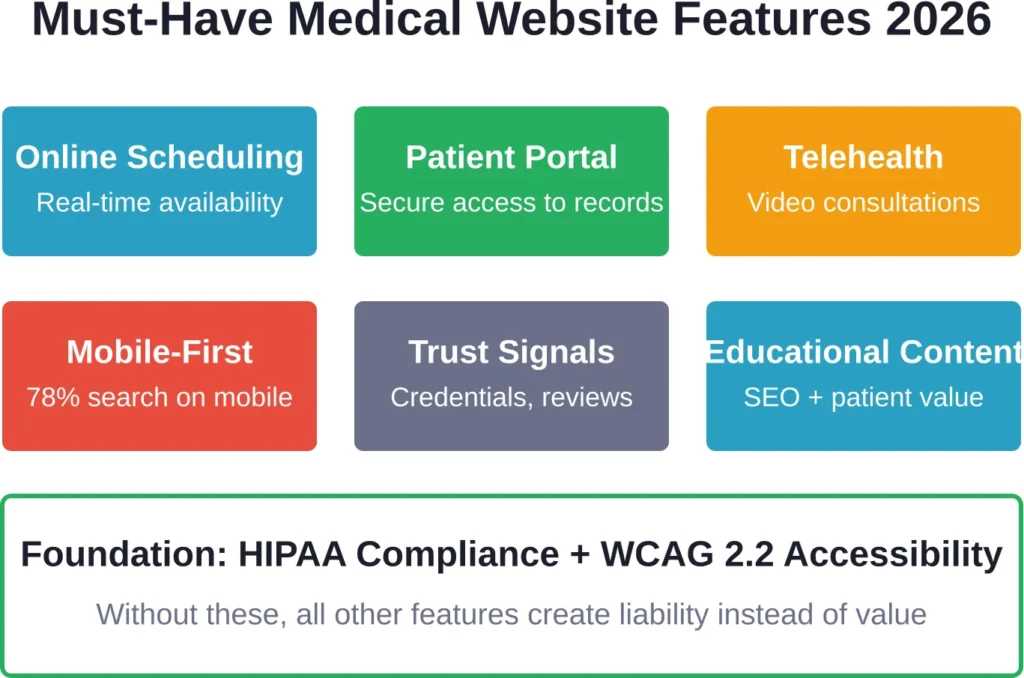
Essential Features for Medical Websites in 2026
Beyond compliance, modern medical websites need functionality that meets patient expectations and practice efficiency goals.
Online Appointment Scheduling
Patients expect to book appointments online, not wait on hold. Integration with practice management systems ensures appointments sync directly to provider calendars.
Effective scheduling tools offer real-time availability, appointment type selection, provider choice, automated confirmation emails, and SMS reminders.
Patient Portals
Secure patient portals let patients access test results, request prescription refills, view appointment history, message providers, and manage billing—all without phone calls.
Building HIPAA-compliant portals requires secure authentication, encrypted data storage, and audit trails.
Telehealth Integration
Telehealth became standard during the pandemic and remains essential in 2026. Medical websites should integrate video consultation platforms seamlessly.
Patients need one-click access to virtual visits, with no confusing logins or technical hurdles.
Insurance and Billing Information
Transparency around insurance acceptance and costs builds trust. Clear information about accepted plans, payment options, and billing processes reduces patient anxiety and administrative calls.
Educational Content
Patients research conditions, treatments, and symptoms online. Providing accurate, accessible health information positions your practice as a trusted resource.
Blog posts, condition guides, treatment explainers, and FAQs improve SEO while serving patient needs.
Trust Signals
Healthcare decisions are high-stakes. Websites must establish credibility immediately through provider credentials and certifications, patient testimonials and reviews, hospital affiliations, industry awards and recognition, and professional photography.
Mobile-Optimized Experience
With 78% of healthcare searches happening on mobile devices, mobile optimization isn’t optional. That means fast load times under 3 seconds, thumb-friendly buttons and form fields, simplified navigation for small screens, and click-to-call functionality.
Questions to Ask Before Hiring a Medical Web Development Company
Not all agencies deliver what they promise. Ask these questions before signing a contract.
Can you provide healthcare client references?
Request specific case studies with measurable results. Talk to current clients about their experience.
How do you ensure HIPAA compliance?
They should explain technical measures, hosting arrangements, BAAs, and ongoing security practices—not just claim compliance vaguely.
What’s your approach to accessibility?
WCAG 2.2 compliance should be standard, not an add-on. Ask about testing methods and remediation processes.
Do you integrate with our existing systems?
Confirm they’ve worked with your EHR, practice management software, and scheduling tools before. Integration is complex—experience matters.
What happens after launch?
Websites need ongoing maintenance, security updates, and optimization. Clarify post-launch support, hosting management, and update processes.
Who owns the website and content?
Ensure you retain ownership of your site, content, and data. Some agencies lock clients into proprietary platforms.
What’s your timeline and process?
Understand milestones, approval stages, and realistic launch dates. Be wary of agencies promising unrealistic timelines.
Red Flags When Evaluating Medical Web Development Companies
Watch for warning signs that indicate an agency isn’t the right fit.
Generic portfolios without healthcare examples suggest they’re experimenting, not specializing. Vague compliance claims without technical details indicate surface-level understanding. No accessibility discussion means they’re ignoring legal requirements.
Ownership restrictions that lock you into proprietary platforms create long-term dependency. Unrealistic timelines—promising a complex medical site in 2-3 weeks—suggest they’re cutting corners. And lack of ongoing support leaves you stranded when issues arise.
Template-only approaches work for some practices, but custom healthcare websites typically deliver better results for organizations with complex needs.
The ROI of Professional Medical Web Development
Investing in specialized medical web development delivers measurable returns beyond aesthetics.
Improved patient acquisition means more appointment requests from qualified leads. Better conversion rates turn more visitors into patients. Reduced acquisition costs lower your cost per patient.
Operational efficiency improves through online scheduling, patient portal adoption, and reduced administrative calls. Staff spend less time on phone scheduling and insurance questions when websites provide clear information and self-service tools.
Compliance protection prevents costly penalties and lawsuits. A single HIPAA violation can cost thousands. Accessibility lawsuits are expensive and damage reputation.
Competitive positioning matters too. Patients compare providers online. A modern, professional website signals quality care. A dated, confusing site suggests outdated practices.
Organizations that invest in professional medical web development typically see ROI within 6-12 months through increased patient volume and operational savings.
Emerging Trends in Medical Web Development for 2026
The healthcare digital landscape continues evolving. Here’s what’s shaping medical web development now.
AI-Powered Patient Interactions
HL7 International’s AI Office, launched in July 2025 with Daniel Vreeman, DPT, as Chief AI Officer, is establishing standards for safe, trustworthy AI in healthcare. Expect more medical websites to incorporate AI-powered chatbots, symptom checkers, and personalized content recommendations—built on standardized, compliant frameworks.
Advanced Interoperability
HL7’s FAST Accelerator and the Da Vinci Project are building unified FHIR infrastructure for nationwide interoperability. Medical websites increasingly serve as patient-facing interfaces for complex data exchanges between providers, payers, and health systems.
Personalized Patient Experiences
Websites that adapt content based on patient demographics, location, insurance type, and previous interactions create more relevant experiences. This requires sophisticated CMS platforms and integration with CRM systems.
Enhanced Security Measures
With cybersecurity threats increasing, medical websites need robust security beyond basic SSL certificates. Multi-factor authentication, advanced threat detection, and regular penetration testing are becoming standard.
Voice Search Optimization
As voice assistants become ubiquitous, medical websites need optimization for conversational queries like “find a cardiologist near me” or “what are symptoms of strep throat.”
Integrated Telehealth Experiences
Telehealth is no longer a separate platform—it’s embedded seamlessly into website patient journeys, from scheduling to video consultations to follow-up care.
Frequently Asked Questions
Medical website costs vary significantly based on complexity and features. Budget-friendly template options are available for practices with basic needs, while custom designs with advanced features like patient portals, EHR integration, and appointment booking typically range from $8,000 to $30,000. Enterprise solutions for hospital systems and multi-location practices often exceed $30,000. Contact agencies directly for current project quotes, as pricing depends heavily on specific requirements and scope.
Timeline depends on project complexity. Simple template-based sites can launch in 4-6 weeks. Custom designs with standard features typically take 8-12 weeks. Complex sites with custom integrations, patient portals, and extensive content can require 16-24 weeks or more. Factor in time for compliance reviews, content creation, stakeholder approvals, and testing.
Not necessarily. Many medical web development companies provide HIPAA-compliant hosting as part of their service. This is often preferable because they handle security configurations, Business Associate Agreements, and compliance requirements. If you choose separate hosting, ensure the provider offers HIPAA-compliant infrastructure and will sign a BAA.
Most modern medical websites use content management systems that allow non-technical staff to update content, add blog posts, and modify information. However, structural changes, feature additions, and compliance updates typically require developer expertise. Clarify with your agency what you can manage internally versus what requires their support.
HIPAA compliance for websites involves multiple layers: encrypted data transmission via SSL certificates, secure form handling that protects patient information, HIPAA-compliant hosting infrastructure with proper safeguards, Business Associate Agreements with all service providers handling PHI, access controls and audit logging, and documented security policies and staff training. Any website collecting protected health information requires these measures.
Extremely important—around 78% of patients researching healthcare providers do so on mobile devices. Mobile optimization impacts first impressions, appointment booking conversion rates, local search rankings, and patient satisfaction. A website that doesn’t work well on smartphones actively drives patients to competitors. Mobile-first design should be non-negotiable in 2026.
It depends on your needs and budget. Templates work well for small practices with straightforward requirements and limited budgets. They’re faster to launch and cost less upfront. Custom design is better for organizations with specific branding, complex functionality, multiple service lines, competitive markets requiring differentiation, or unique patient journeys. Custom sites typically deliver better conversion rates and user experience but require larger investment.
Choosing Your Medical Web Development Partner
The right medical web development company becomes a long-term partner, not just a vendor. They understand your patient population, competitive landscape, and growth goals.
Start by clarifying your priorities. Do you need lead generation, operational efficiency, compliance updates, or complete rebuilds? Different agencies excel in different areas.
Review portfolios carefully. Look for work with organizations similar to yours. Ask about measurable results, not just pretty designs.
Evaluate communication and process. You’ll work closely with this team for weeks or months. Responsive communication and clear processes matter.
Consider long-term support needs. Websites require ongoing updates, security patches, and optimization. Agencies offering comprehensive support often deliver better long-term value than one-off project shops.
And remember—the cheapest option rarely delivers the best results. Healthcare websites represent your practice to thousands of potential patients. Investing in quality development pays dividends through patient trust, operational efficiency, and competitive positioning.
The 15 agencies profiled here represent different specializations and approaches. Match their strengths to your organizational needs and growth objectives.
Ready to transform your medical practice’s digital presence? Start by reaching out to 2-3 agencies from this list. Share your goals, review their proposals, and ask the questions outlined in this guide. The right partner will demonstrate healthcare expertise, compliance knowledge, and genuine interest in your success.
Your patients are searching for healthcare providers right now. Make sure they find a website that builds trust, answers questions, and makes booking appointments effortless.