

Quick Summary: The top Vue.js development companies in 2026 include specialized agencies like Lengreo, Gilzor, OSKI Solutions, A-listware, Mobian Studio, eSparkBiz, Sombra, KitelyTech, Netguru, and Simform, each bringing strong frontend engineering capabilities and component-driven architecture expertise. These agencies deliver scalable web applications backed by proven portfolios, certified development teams, and consistent project execution. Selecting the right partner depends on project complexity, technical requirements, and the agency’s track record in building reactive interfaces.
Vue.js has carved out a unique position in the frontend development landscape. It’s lightweight yet powerful. Progressive yet full-featured. And increasingly, it’s the framework companies turn to when they need reactive interfaces without the overhead of larger ecosystems.
But here’s the thing—building production-grade Vue.js applications requires more than just framework knowledge. It demands architectural insight, performance optimization expertise, and a deep understanding of component-driven design patterns.
That’s where specialized development partners come in.
This guide examines 15 agencies that have demonstrated consistent Vue.js delivery capabilities through verified client work, technical depth, and sustainable development practices. No fluff. No fabricated claims. Just agencies with proven track records in building Vue.js applications that actually ship.
Why Vue.js Continues to Gain Enterprise Adoption
Vue.js’s progressive nature allows incremental adoption. Teams can integrate Vue.js into existing projects without rewriting entire codebases. The learning curve stays manageable while the performance ceiling remains high.
According to competitor source material, Stack Overflow Developer Survey 2024 shows 15.9% developer usage—a solid presence that reflects Vue.js’s practical appeal. It’s not the most hyped framework. But it’s consistently chosen by teams that prioritize maintainability and developer experience.
Three factors drive this adoption pattern:
- Reactive data binding without excessive boilerplate
- Component composition that scales from small widgets to full applications
- Tooling ecosystem that supports both single-file components and traditional separation of concerns
The framework’s documentation remains exceptionally clear. New developers get productive quickly. Senior engineers appreciate the flexibility to optimize when needed without fighting the framework.
What Separates Strong Vue.js Development Agencies From Average Ones
Not every agency that lists Vue.js on their technology page actually specializes in it. Real expertise shows up in specific ways.
Look for agencies that demonstrate component architecture thinking. Their portfolios should show applications where state management, routing, and UI composition work together coherently. The code should be readable months after initial development.
Strong agencies handle these technical dimensions well:
- Performance optimization using Vue’s reactivity system efficiently
- State management patterns appropriate to application complexity
- Testing strategies that cover both unit and integration levels
- Build configurations tuned for production deployment
Data security and quality assurance practices have become baseline expectations among leading Vue.js development agencies. Established agencies often maintain ISO 27001 certification and strong client retention practices.
The best agencies don’t just write Vue.js code. They architect solutions that remain maintainable as requirements evolve.
Top 15 Vue.js Development Companies in 2026
These agencies represent consistent execution, verified client work, and technical depth in Vue.js development.
1. A-Listware

A-Listware delivers Vue.js development as part of their custom software development and dedicated team services. They build scalable enterprise web applications, complex business portals, CRM/ERP interfaces, and data-driven platforms where Vue.js powers reactive and maintainable frontend architecture.
Their Vue.js projects focus on clean component composition, efficient state management, and seamless integration with backend systems and cloud infrastructure. The company handles full-cycle development including architecture planning, implementation, legacy modernization, and ongoing support.
Strong emphasis is placed on performance optimization, security compliance, and delivering responsive user interfaces that scale with enterprise requirements.
Contact Information:
- Website: a-listware.com
- Phone: +1 (888) 337 93 73
- Email: [email protected]
- Address: North Bergen, NJ 07047, USA
- LinkedIn: www.linkedin.com/company/a-listware
- Facebook: www.facebook.com/alistware
2. Oski

Oski provides specialized Vue.js development within their frontend solutions for tech-forward enterprises and startups. They create high-performance, intuitive web applications using Vue.js to deliver exceptional user experiences across cloud-native and industry-specific platforms.
Vue.js serves as a core technology for building reactive interfaces in fintech, logistics, e-commerce, education, and travel solutions. Projects cover full development lifecycle — from UI/UX design and architecture through implementation to deployment and maintenance.
Their approach combines Vue.js with modern practices to ensure flexible, scalable, and visually compelling applications that integrate smoothly with backend services and AI capabilities.
Contact Information:
- Website: oski.site
- Phone: +48571282759
- Email: [email protected]
- Address: Kaupmehe tn 7, 10114 Tallinn, Estonia
- LinkedIn: www.linkedin.com/company/oski-solutions
3. Gilzor

Gilzor offers Vue.js development through full-cycle custom web application services for startups, SMBs, and product companies. They build modern, user-centric web solutions where Vue.js enables dynamic interfaces, efficient data handling, and smooth user interactions.
Their Vue.js expertise supports e-commerce platforms, internal tools, automation systems, and industry-specific products from initial idea validation and design through development, QA, and long-term maintenance.
The team focuses on clean architecture, performance optimization, and delivering scalable Vue.js applications that drive business growth and operational efficiency.
Contact Information:
- Website: www.gilzor.com
- Email: [email protected]
- Address: Poland, Warsaw, Office 58, street Adama Mickiewicza 37, 01-625
- LinkedIn: www.linkedin.com/company/gilzor-softwaredevelopment
4. Mobian

Mobian builds Vue.js development capabilities into their dedicated engineering teams for web and full-stack solutions. They deliver production-ready web applications and complex digital products in healthcare, fintech, logistics, and IT, using Vue.js for scalable and maintainable frontend layers.
Vue.js projects benefit from their end-to-end approach: clean architecture, legacy integration, AI-enhanced interfaces, and post-launch support. Whether through full outsourcing or team augmentation, they ensure high-quality Vue.js implementations that meet strict industry requirements.
Focus lies on fast delivery, documented code, and systems designed to scale from hundreds to hundreds of thousands of users.
Contact Information:
- Website: mobian.studio
- Phone: [email protected]
- Address: Harju maakond, Tallinn, Kesklinnalinnaosa, Masina tn 22, 10113
- LinkedIn: www.linkedin.com/company/mobian-studio
5. Lengreo

Lengreo integrates Vue.js development into their custom website and web application services as a complete marketing and tech partner. They build conversion-focused business platforms, eCommerce solutions, and dynamic web tools using Vue.js to create reactive, high-performance user interfaces.
Their development process combines business analysis, prototyping, and full implementation with Vue.js best practices for component-driven architecture and seamless API integration. Projects are tailored to support lead generation, client portals, and marketing-driven web solutions.
The team delivers practical Vue.js applications that align technical quality with clear business outcomes and measurable results.
Contact Information:
- Website: Lengreo.com
- Phone: +31 686 147 566
- Email: [email protected]
- Address: Vrijstraat 9 C/D, 5611 AT Eindhoven, Netherlands
- LinkedIn: Lengreo
- Twitter: @Lengreo
- Instagram: @lengreo
6. Merixstudio
Merixstudio brings product development perspective to Vue.js projects. The agency combines technical implementation with user experience design, resulting in interfaces that balance functionality with usability.
Their Vue.js work spans fintech, healthtech, and e-commerce sectors. Applications demonstrate attention to interaction design details—smooth transitions, intuitive navigation patterns, and responsive behavior across device categories.
The agency’s process includes discovery phases that inform technical decisions. Vue.js architecture choices reflect actual user workflows rather than purely technical preferences.
Merixstudio maintains strong frontend engineering practices including component documentation, style guide development, and accessibility compliance. Projects ship with maintainable codebases designed for long-term evolution.
7. Xfive

Xfive operates with 250+ team members and maintains a 5.0 Clutch rating alongside 19+ years of web development experience. The agency specializes in frontend engineering with Vue.js as a primary technology.
Their technical approach emphasizes clean code, performance optimization, and cross-browser compatibility. Vue.js implementations demonstrate careful attention to bundle size, lazy loading strategies, and runtime performance.
Portfolio includes migration projects where legacy applications transition to Vue.js architecture. The agency handles these transitions with strategies that minimize disruption while modernizing codebases.
Xfive’s Vue.js projects integrate with various CMS platforms and backend systems. They maintain expertise in headless architecture patterns where Vue.js serves as presentation layer for content from WordPress, Contentful, or custom APIs.
8. DEPT

DEPT brings 1000+ employees and 8+ years of digital experience to Vue.js development. The agency operates across multiple markets with capability in both development and digital marketing integration.
Their Vue.js work often connects to broader digital transformation initiatives. Applications receive development within context of customer journey optimization, conversion rate improvement, and user engagement strategies.
Technical implementations demonstrate solid Vue.js fundamentals with emphasis on performance metrics that impact business outcomes. The agency tracks Core Web Vitals and optimizes Vue.js applications for measurable user experience improvements.
DEPT maintains a 4.8 Clutch rating, reflecting consistent delivery across diverse client requirements and project scales.
9. Boldare

Boldare combines product design with Vue.js development capabilities. The agency’s process starts with validation workshops before technical implementation begins.
Their Vue.js projects reflect this product-first approach. Applications demonstrate clear user flows, intuitive interface patterns, and features aligned with validated user needs rather than technical possibilities.
Portfolio spans startup MVPs and enterprise digital products. Vue.js serves projects requiring rapid iteration, where the framework’s flexibility supports evolving requirements without architectural rewrites.
Boldare’s development teams work closely with design counterparts throughout implementation. Vue.js components emerge from design system thinking rather than isolated technical decisions.
10. Radixweb

Radixweb delivers Vue.js development alongside broader digital transformation services. The agency handles projects where frontend modernization connects to backend system updates and cloud migration initiatives.
Their Vue.js expertise covers both new application development and legacy system modernization. Projects demonstrate capability with complex data integration requirements and enterprise security standards.
Technical approach includes proper separation of concerns, with Vue.js handling presentation while business logic resides in appropriate backend services. Applications scale horizontally through stateless frontend architecture.
Radixweb maintains development practices including code review, automated testing, and continuous integration. Vue.js projects ship with documentation supporting ongoing maintenance by internal teams.
11. eSparkBiz

eSparkBiz operates with 400+ professionals and maintains a 4.9 Clutch rating. The agency brings 15+ years of software development experience, with Vue.js representing a core competency within their frontend practice.
Their approach emphasizes component-driven architecture and reusable UI patterns. Projects span enterprise dashboards, customer portals, and data visualization interfaces where Vue’s reactivity handles complex state requirements.
The team handles full project lifecycle work—from initial architecture decisions through deployment and maintenance. Their Vue.js implementations typically integrate with REST and GraphQL APIs, demonstrating solid backend integration capabilities.
Technical stack includes Vue 3 with Composition API, Pinia for state management, and Vite for build tooling. Testing practices incorporate Vitest and Cypress for comprehensive coverage.
12. Sombra

With 1000+ employees and a 4.9 Clutch rating, Sombra brings 11+ years of development experience to Vue.js projects. The agency maintains strong engineering practices across distributed teams.
Their Vue.js work focuses on scalable web applications requiring complex client-side logic. Portfolio includes fintech interfaces, healthcare portals, and logistics management systems where performance under load matters.
Sombra’s development process emphasizes code review, automated testing, and continuous integration. Vue.js projects follow established patterns for component composition, making codebases maintainable as teams scale.
The agency demonstrates capability with modern Vue.js ecosystem tools including Nuxt.js for server-side rendering scenarios. They handle both greenfield development and migration projects from legacy frameworks.
13. KitelyTech

KitelyTech operates with 250+ professionals and maintains both a 4.9 Clutch rating and 15+ years of development experience. The agency specializes in enterprise-grade web applications where Vue.js serves complex business requirements.
Their technical approach emphasizes architectural planning before implementation. Vue.js projects receive detailed component hierarchy planning, state management strategy, and performance optimization roadmaps.
Portfolio work includes enterprise resource planning interfaces, customer relationship management systems, and analytics dashboards. These applications demonstrate proper handling of large datasets through Vue’s virtual DOM optimization.
KitelyTech maintains expertise in Vue.js integration with enterprise backend systems including Java Spring, .NET Core, and Node.js APIs. Security practices meet enterprise compliance requirements.
14. Netguru

Netguru stands as one of the most recognized names in Vue.js development circles. The agency’s official partnership with Vue.js core team members provides direct access to framework expertise.
Their Vue.js practice spans product design, development, and growth phases. Projects receive both technical implementation and strategic product thinking—useful for startups and digital transformation initiatives.
The agency’s portfolio includes consumer-facing applications, B2B platforms, and SaaS products built on Vue.js foundations. Work demonstrates solid understanding of progressive web app capabilities and mobile-responsive design patterns.
Netguru’s development methodology combines agile practices with design thinking workshops. Vue.js implementations benefit from their broader product development experience across multiple frameworks and platforms.
15. Simform

Simform delivers Vue.js development through a team experienced in cloud-native application architecture. The agency emphasizes modern deployment patterns alongside frontend development capabilities.
Their Vue.js projects typically target AWS, Azure, or Google Cloud infrastructure. Applications receive architecture designed for scalability, with proper separation between presentation layer and backend services.
Portfolio demonstrates capability with real-time features using WebSocket integration, complex form handling with validation, and data-intensive interfaces requiring optimization. Vue.js serves as presentation layer within larger microservices architectures.
Simform’s technical stack reflects current best practices: Vue 3, TypeScript for type safety, Pinia for state management, and comprehensive testing with Jest and Testing Library.
How to Evaluate Vue.js Development Capabilities
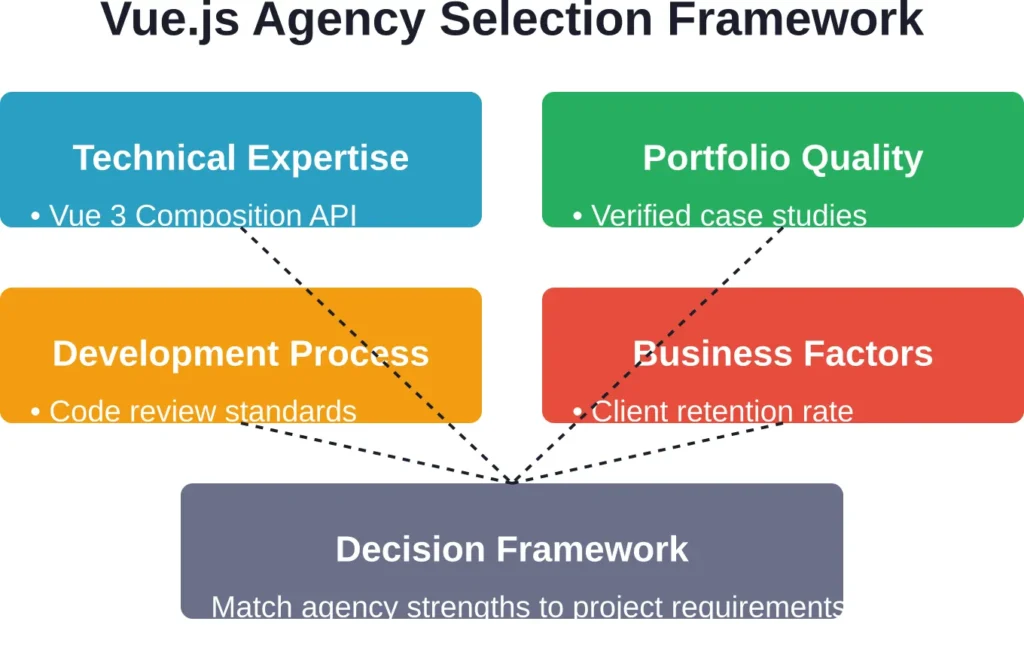
Agency websites all look polished. Case studies sound impressive. But actual capability reveals itself through specific technical indicators.
Start with portfolio examination. Look for applications demonstrating proper component architecture—not just simple landing pages converted to Vue.js. Strong portfolios show complex state management, real-time features, or data-intensive interfaces where Vue’s reactivity system solves actual problems.
Ask about testing practices. Agencies delivering maintainable Vue.js applications write tests. They should describe unit testing approaches for components, integration testing for user flows, and end-to-end testing for critical paths.
Technical Interview Questions That Reveal Real Expertise
When evaluating agencies, these questions surface actual Vue.js knowledge:
- How do you decide between Options API and Composition API for new projects?
- What state management approach do you recommend for applications with 50+ components?
- How do you handle performance optimization when lists contain thousands of items?
- What’s your approach to component testing versus integration testing?
Strong agencies answer with specific trade-offs rather than dogmatic preferences. They acknowledge context matters. They describe scenarios where different approaches make sense.
Watch for agencies that discuss build optimization, code splitting, and lazy loading without prompting. These topics indicate production deployment experience rather than just tutorial-level knowledge.
Portfolio Red Flags to Watch For
Some warning signs suggest limited Vue.js depth:
Portfolios showing only marketing sites or simple forms indicate the agency hasn’t tackled complex Vue.js challenges. Real applications involve state management complexity, performance optimization needs, and integration requirements.
Generic descriptions without technical detail suggest marketing copy rather than engineering perspective. Strong case studies discuss specific architectural decisions and trade-offs encountered during development.
Absence of post-launch involvement indicates transactional relationships. The best agencies maintain ongoing relationships with clients, handling updates and enhancements as applications evolve.
Vue.js Development Services to Expect From Top Agencies
Comprehensive Vue.js partners deliver more than just coding. Their services should span the full application lifecycle.
Architecture and Planning
Before writing code, strong agencies architect solutions. They map component hierarchies, plan state management approaches, and identify integration points with backend systems.
This planning phase prevents architectural debt. Applications scale more easily when foundational decisions receive thoughtful consideration upfront.
Custom Application Development
Core development services include building Vue.js applications from requirements through deployment. This encompasses component development, state management implementation, API integration, and user interface optimization.
Agencies should demonstrate capability with modern Vue.js patterns including Composition API, script setup syntax, and reactive refs. Projects should leverage Vite for build tooling rather than older webpack configurations.
Migration and Modernization
Many projects involve migrating from legacy frameworks to Vue.js. Strong agencies handle these transitions methodically, often implementing strangler fig patterns where Vue.js gradually replaces old code.
Migration expertise includes integrating Vue.js into existing applications without complete rewrites. This incremental approach reduces risk while modernizing codebases.
Performance Optimization
Applications slow down as they grow. Experienced agencies optimize Vue.js performance through lazy loading, computed property caching, virtual scrolling for large lists, and bundle size reduction.
They measure performance using Core Web Vitals and browser profiling tools. Optimization decisions come from data rather than assumptions.
Maintenance and Support
Post-launch support keeps applications current. This includes dependency updates, security patches, performance monitoring, and feature enhancements as requirements evolve.
Top agencies maintain strong client retention rates, suggesting ongoing relationships beyond initial development.
| Service Category | Key Deliverables | When It Matters Most |
|---|---|---|
| Architecture Planning | Component hierarchy, state strategy, integration design | Complex applications with multiple user roles |
| Custom Development | Full-stack Vue.js implementation with testing | New product development or feature builds |
| Migration Services | Incremental framework transition with risk mitigation | Legacy system modernization projects |
| Performance Work | Load time optimization, reactivity tuning, bundle reduction | Applications experiencing user experience issues |
| Ongoing Support | Updates, monitoring, enhancement implementation | Production applications requiring reliability |
Cost Considerations Without Specific Pricing
Agency costs vary significantly based on location, expertise level, and project complexity. Understanding the factors that influence cost helps set realistic budget expectations.
Geography affects rates substantially. Agencies in North America and Western Europe typically command higher rates than those in Eastern Europe or Asia. But rate differences don’t automatically indicate quality differences—many offshore agencies deliver exceptional work.
Project scope drives total cost more than hourly rates. A well-architected project with clear requirements costs less than a poorly defined one, regardless of agency rates.
What Drives Vue.js Development Costs
Several factors influence project budgets:
Application complexity matters most. A dashboard with data visualization costs more than a marketing site. Real-time features, complex state management, and backend integration all increase development time.
Design requirements impact costs. Custom UI components require more effort than template-based designs. Interaction design details like transitions and animations add development time.
Integration complexity affects budgets. Projects connecting to multiple APIs, handling authentication flows, or implementing payment processing require additional development effort.
Testing requirements influence costs. Comprehensive test coverage takes time to develop and maintain. Projects with strict quality requirements need larger testing budgets.
Engagement Models That Make Sense
Agencies typically offer several engagement structures:
Fixed-price projects work when requirements are stable and well-defined. The agency quotes a total cost for specified deliverables. This model reduces budget uncertainty but requires detailed upfront planning.
Time-and-materials arrangements bill actual hours worked. This flexibility suits projects where requirements evolve during development. Clients pay for actual effort rather than estimated scope.
Dedicated team models assign developers to your project full-time. This works for ongoing product development where consistent velocity matters more than project boundaries.
Retainer agreements provide ongoing access to development capacity. Monthly fees cover maintenance, updates, and small enhancements without per-project negotiations.
Questions to Ask Before Signing a Contract
Due diligence prevents misaligned expectations. These questions surface potential issues before projects begin.
About Their Vue.js Experience
How many Vue.js projects have you delivered in the past year? Look for consistent Vue.js work rather than occasional projects.
Can you share repositories or live applications demonstrating your Vue.js work? Code quality reveals itself through examination.
What’s your team’s experience with Vue 3 specifically? The framework evolved significantly between versions 2 and 3.
About Development Process
What does your typical Vue.js project workflow look like? Understanding their process helps set expectations.
How do you handle requirement changes during development? Flexibility matters when building applications.
What testing practices do you follow? Testing indicates commitment to code quality.
How do you approach code review and quality assurance? Multiple eyes on code catch issues before production.
About Communication and Collaboration
How will we communicate during the project? Clear communication patterns prevent misunderstandings.
What project management tools do you use? Transparency into progress matters.
How do you handle timezone differences for distributed teams? Overlap hours affect collaboration quality.
About Post-Launch Support
What happens after the application launches? Ongoing support keeps applications running smoothly.
Do you provide training for our internal team? Knowledge transfer enables long-term maintenance.
What are your response times for critical issues? Support responsiveness affects application uptime.
Vue.js Versus Other Frontend Frameworks: When It Makes Sense
Framework selection affects projects for years. Vue.js fits specific scenarios better than alternatives.
React dominates the enterprise market through ecosystem size and corporate backing. It offers more third-party libraries and larger talent pools. But it comes with more boilerplate and steeper learning curves.
Vue.js delivers similar capabilities with less complexity. The framework’s progressive nature allows incremental adoption. Teams can start small and scale up without architectural rewrites.
Angular provides comprehensive structure for large enterprise applications. It enforces conventions that prevent architectural inconsistency across large teams. But that structure comes with significant complexity and longer learning curves.
Vue.js offers middle ground—more structure than React, more flexibility than Angular. It suits teams wanting guidance without rigid enforcement.
When Vue.js Represents the Right Choice
Several scenarios favor Vue.js selection:
Projects requiring incremental adoption benefit from Vue’s progressive design. Teams can add Vue.js to existing applications without complete rewrites.
Teams prioritizing developer experience appreciate Vue’s clear documentation and intuitive API design. Onboarding new developers happens faster with Vue.js than with more complex frameworks.
Applications with complex UI state benefit from Vue’s reactivity system. The framework handles state updates efficiently without manual optimization.
Projects with limited frontend specialization work well with Vue.js. Full-stack developers find Vue’s learning curve manageable compared to alternatives.
Common Vue.js Implementation Challenges and Solutions
Even experienced teams encounter specific Vue.js challenges. Understanding these issues helps plan accordingly.
State Management Complexity
Applications outgrow simple component props quickly. State management becomes critical as component trees deepen.
Pinia has replaced Vuex as the recommended state management solution. It offers better TypeScript support, simpler API design, and improved developer experience.
But not every application needs formal state management. Small to medium applications often work fine with provide/inject or composables. Overengineering state management creates unnecessary complexity.
Performance at Scale
Large lists and frequent updates can cause performance issues. Vue’s reactivity system works efficiently but isn’t magic.
Virtual scrolling libraries like vue-virtual-scroller handle large datasets efficiently. They render only visible items, keeping DOM size manageable.
Computed properties and watch callbacks need careful design. Expensive computations should be memoized. Watch callbacks should avoid triggering additional state updates that cause render loops.
TypeScript Integration Challenges
TypeScript support has improved dramatically in Vue 3. But proper typing requires understanding Vue’s type system.
The script setup syntax provides better type inference than Options API. Using defineProps and defineEmits with TypeScript generics gives proper type safety.
Third-party component libraries don’t always include proper TypeScript definitions. This requires custom type declarations or limits library choices.
Testing Component Composition
Complex components with multiple composables become challenging to test. Dependencies between composables create coupling that complicates unit testing.
Vue Testing Library encourages testing components from user perspective rather than implementation details. This approach produces more resilient tests that survive refactoring.
Integration tests covering user workflows often provide better value than exhaustive unit tests. Testing critical paths through the application catches more real issues.
The Future of Vue.js Development
Framework landscapes shift constantly. Understanding Vue.js trajectory helps with long-term planning.
Vue 3 represents the current stable version with excellent performance and developer experience. The Composition API provides better code organization for complex components. Script setup syntax reduces boilerplate significantly.
Nuxt 3 brings server-side rendering and static site generation capabilities. It’s maturing into a full-featured framework for applications requiring SEO or initial load performance.
Vite has become the standard build tool for new Vue.js projects. It offers dramatically faster development server startup and hot module replacement compared to webpack-based tooling.
TypeScript adoption continues increasing in the Vue.js ecosystem. Most new libraries ship with proper TypeScript definitions. The framework’s type support improves with each release.
Ecosystem Maturity Indicators
Several factors suggest Vue.js long-term viability:
Corporate adoption has increased steadily. Companies like Alibaba, GitLab, and Nintendo use Vue.js in production applications. This enterprise adoption indicates framework stability.
The component library ecosystem continues growing. Libraries like Vuetify, Quasar, and PrimeVue provide production-ready components. Element Plus serves Chinese markets extensively.
Tooling quality has reached parity with React ecosystem. VS Code extensions like Volar provide excellent development experience. Browser devtools for Vue.js debugging work reliably.
Community governance remains stable under Evan You’s leadership. The core team maintains consistent release cadence and backward compatibility commitments.
Making Your Final Agency Selection
With research complete, decision time arrives. Several factors should weigh into final selection.
Technical capability matters most. The agency must demonstrate Vue.js expertise through portfolio work and technical discussions. Code quality should be evident.
Communication quality affects project success significantly. Agencies should respond promptly, explain technical concepts clearly, and show genuine interest in understanding your requirements.
Process transparency builds trust. Strong agencies explain their workflow, provide visibility into progress, and communicate proactively about issues.
Cultural alignment shouldn’t be overlooked. Working relationships span months or years. Teams should mesh well on communication style, work hours, and collaboration approaches.
Trial Projects Reduce Risk
Many agencies offer trial projects or paid discovery phases. These limited engagements let both parties evaluate fit before large commitments.
A two-week trial reveals more about working relationship than any number of sales calls. It surfaces communication patterns, technical approach, and work quality.
Discovery phases produce architectural plans, technology recommendations, and project roadmaps. Even if you don’t proceed with that agency, the deliverables provide value.
Reference Checks Matter
Speaking with past clients provides unfiltered perspectives. Agencies willingly provide references when they deliver quality work.
Ask references specific questions: How did the agency handle unexpected challenges? Did deliveries meet scheduled timelines? How responsive was communication? Would you hire them again?
Pay attention to what references don’t say. Hesitation or qualified answers often signal issues they’re too polite to state directly.
Frequently Asked Questions
Vue.js occupies middle ground between React’s flexibility and Angular’s structure. It offers progressive adoption—teams can use Vue.js for small widgets or full applications without architectural rewrites. The learning curve stays gentler than Angular while providing more guidance than React. Vue’s reactivity system works intuitively without JSX syntax. Documentation quality exceeds most frameworks. These factors make Vue.js particularly suitable for teams wanting powerful capabilities without excessive complexity.
Project timelines vary dramatically based on scope. Simple applications with standard CRUD operations might take 6-8 weeks. Medium complexity applications with custom workflows, multiple user roles, and backend integration typically span 3-6 months. Enterprise applications with complex business logic, extensive integration requirements, and strict compliance needs can require 6-12 months or longer. Timeline depends more on feature scope and complexity than framework choice.
Absolutely. Companies like Alibaba use Vue.js for applications serving hundreds of millions of users. The framework scales well through proper architecture—code splitting, lazy loading, state management patterns, and performance optimization. Enterprise success depends more on architectural decisions than framework limitations. Vue.js provides necessary capabilities for large applications when implemented thoughtfully. Proper component composition, state management, and build optimization matter more than raw framework choice.
Migration decisions require careful analysis. If your current application works well and meets business needs, migration might not justify the cost. Consider migration when facing specific problems—performance issues, difficulty adding features, or inability to hire developers familiar with legacy technology. Vue.js supports incremental migration through progressive integration. You can adopt Vue.js gradually without complete rewrites. But migration requires significant investment. It makes sense when technical debt actively impedes business objectives.
Several mechanisms enforce quality standards. Include code review in the contract—your team or an independent consultant reviews deliverables. Require comprehensive testing—unit tests, integration tests, and end-to-end tests should cover critical functionality. Demand adherence to linting and formatting standards using tools like ESLint and Prettier. Insist on documentation covering architecture decisions, component APIs, and deployment procedures. Schedule regular code reviews throughout development rather than only at project end. Quality emerges from process, not hope.
Vue.js applications require regular maintenance like any software. Dependency updates address security vulnerabilities and maintain compatibility. Vue.js itself receives periodic updates requiring migration. Third-party libraries need updates as they evolve. Performance monitoring identifies degradation requiring optimization. Feature additions and modifications reflect changing business requirements. Budget for ongoing maintenance—typically 15-20% of initial development cost annually. Applications without maintenance accumulate technical debt that eventually requires expensive remediation.
Vue.js developer availability has improved significantly. The framework’s 15.9% usage rate in Stack Overflow’s 2024 survey indicates solid adoption. More developers learn Vue.js as its popularity grows. However, React developers remain more numerous in most markets. Hiring difficulty varies by location—major tech hubs offer better Vue.js talent pools than smaller markets. Remote work has eased hiring constraints considerably. Many React or Angular developers transition to Vue.js quickly given its clear documentation. Developer availability shouldn’t prevent Vue.js adoption, but expect slightly more effort than hiring React developers.
Conclusion
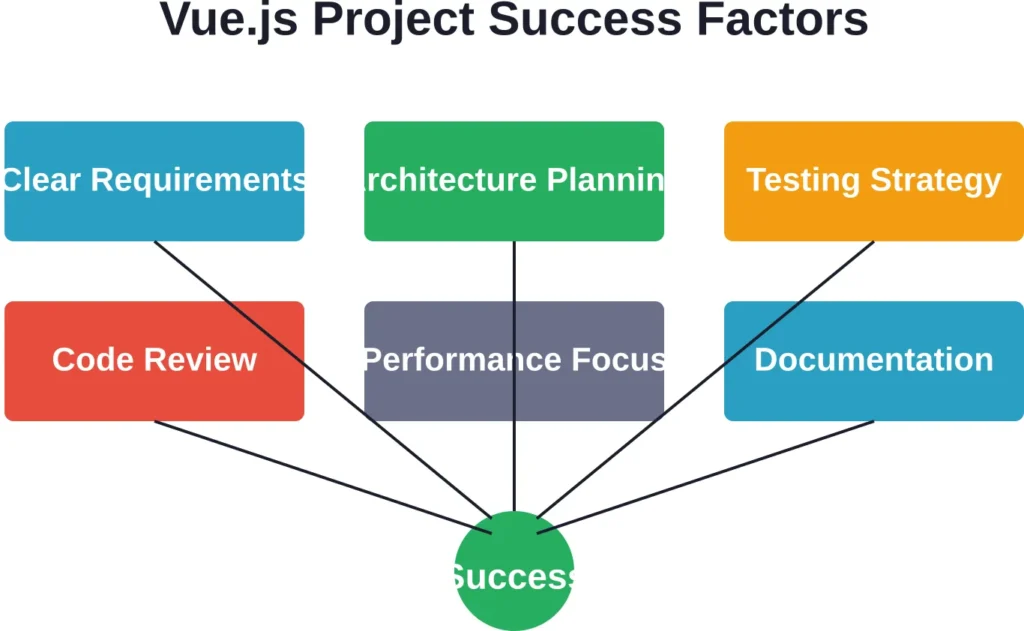
Selecting a Vue.js development partner requires methodical evaluation. Technical capability matters most, but process quality, communication patterns, and cultural alignment significantly impact project success.
The agencies profiled here demonstrate consistent Vue.js delivery through verified portfolios and client work. They represent solid starting points for exploration rather than exhaustive options.
Real evaluation happens through direct engagement. Schedule technical discussions. Review their code. Speak with references. Consider trial projects before large commitments.
Vue.js offers genuine advantages for specific scenarios—progressive adoption, developer experience, and maintainable reactivity. Paired with the right development partner, it delivers production applications that serve users reliably while remaining maintainable as requirements evolve.
Start with clear requirements. Evaluate agencies against those needs. Make decisions based on demonstrated capability rather than marketing polish. And build applications that actually ship.
Ready to find your Vue.js development partner? Reach out to the agencies profiled here. Ask tough questions. Verify their answers through portfolio review. And build something worthwhile.