

Quick Summary: Finding the right Shopify development company is critical for eCommerce success in 2026. This comprehensive guide profiles 15 top Shopify agencies—from full-service partners to Shopify Plus specialists—each vetted for technical expertise, project portfolio, and merchant results. Whether you need custom development, platform migration, or conversion optimization, these agencies deliver enterprise-grade Shopify solutions without hourly rate comparisons.
Shopify has evolved from a simple storefront builder into a full-scale commerce ecosystem. The platform powers fast-growing DTC brands, B2B operations, and global Shopify Plus merchants handling millions in transactions.
But here’s the thing—building a high-performing Shopify store isn’t just about installing a theme and uploading products. Real growth requires technical expertise, conversion optimization strategy, and deep platform knowledge.
That’s where specialized Shopify development companies come in. The best agencies don’t just build stores. They architect scalable solutions, migrate complex catalogs, integrate custom workflows, and optimize checkout experiences that actually convert.
This guide breaks down 15 top Shopify development agencies in 2026, comparing their core services, technical strengths, and ideal client profiles. No fluff. No pricing debates. Just the information needed to make an informed partner decision.
Why Partner With a Specialized Shopify Development Company?
Shopify’s low barrier to entry makes it tempting to DIY. Plenty of merchants launch with a stock theme and basic setup. That works—until growth demands more.
Custom integrations with ERPs, subscription platforms, or warehouse management systems require actual development. Headless commerce architectures demand specialized technical skills. Shopify Plus checkout customization isn’t something a freelancer typically handles.
Specialized Shopify development companies bring three critical advantages:
Technical depth. Official Shopify Partners maintain direct relationships with Shopify’s platform team. They stay current on API changes, beta features, and best practices. When Shopify releases new commerce components or updates Liquid templating, expert agencies adapt immediately.
Project efficiency. Agencies that focus exclusively on Shopify have built dozens—sometimes hundreds—of stores. They’ve solved the same technical challenges repeatedly. That experience translates to faster timelines, fewer bugs, and cleaner implementations.
Strategic guidance. The best development partners don’t just execute requirements. They challenge assumptions, recommend proven conversion patterns, and identify technical debt before it becomes expensive to fix.
According to the official Shopify Partners Directory, merchants can browse partners by service type, including store setup, development and troubleshooting, custom apps and integrations, and ongoing website management. Over 100K partners operate across 50 countries within the Shopify ecosystem globally.
Top 15 Shopify Development Companies for 2026
The following agencies represent the strongest Shopify development partners operating in 2026. Each has been evaluated based on technical capabilities, client portfolio, official Shopify partnership status, and verified merchant reviews.
1. Lengreo

Lengreo operates as a full-cycle B2B digital marketing and tech partner that includes website development services for eCommerce projects. The agency combines strategy, SEO, and technical builds to support online stores and lead generation.
Core Services:
- Website Development Services (eCommerce, business sites, landing pages)
- Discovery, Business Analysis, and Research
- Prototyping and Design Development
- Website Development and Implementation
- Quality Assurance and Support
- B2B Digital Marketing Strategy & Consulting
- SEO (including website audits & optimizations)
- Paid Ads and Lead Generation
Best For: B2B brands seeking integrated marketing and eCommerce website development under one roof. Their approach works well for companies that want technical builds paired with traffic and conversion strategies.
Notable Strengths: Results-driven case studies, strong emphasis on discovery and strategy before development, verified client testimonials.
Contact Information:
- Website: Lengreo.com
- Phone: +31 686 147 566
- Email: [email protected]
- Address: Vrijstraat 9 C/D, 5611 AT Eindhoven, Netherlands
- LinkedIn: Lengreo
- Twitter: @Lengreo
- Instagram: @lengreo
2. Gilzor

Gilzor specializes in custom software development and full-cycle web solutions, including eCommerce platforms for startups and SMBs. They focus on building scalable digital products from idea validation to launch and maintenance.
Core Services:
- Web development (full-cycle from design to post-launch maintenance)
- Custom eCommerce builds and platform switches
- UI/UX design with user-centric approach
- Mobile development (iOS & Android)
- Quality assurance and testing
- Idea validation, business analysis, and go-to-market strategy
- Support & maintenance
Best For: Startups and small/medium businesses needing custom web or eCommerce solutions alongside product strategy and scaling support. Their end-to-end process helps reduce risks in digital product development.
Notable Strengths: High recurring customer rate, focus on functional and attractive products, expertise across multiple industries including eCommerce.
Contact Information:
- Website: www.gilzor.com
- Email: [email protected]
- Address: Poland, Warsaw, Office 58, street Adama Mickiewicza 37, 01-625
- LinkedIn: www.linkedin.com/company/gilzor-softwaredevelopment
3. A-listware

A-listware is a software development and consulting company offering dedicated teams, custom development, and eCommerce solutions. They explicitly list Shopify among supported platforms and have experience with Shopify-related projects (e.g., integrations and custom builds).
Core Services:
- Software Development (including custom and enterprise)
- Dedicated Development Teams and team augmentation
- UX/UI Design
- Application Services and integrations
- eCommerce solutions (Shopify support noted)
- Testing & QA, IT Consulting
- Data Analytics and Infrastructure Services
Best For: Enterprises, SMBs, and startups looking for outsourced or augmented teams to build or enhance eCommerce platforms and custom software. Their outsourcing model provides flexibility and cost-effective scaling.
Notable Strengths: Broad tech expertise including Shopify, focus on seamless team integration, end-to-end IT ecosystem management.
Contact Information:
- Website: a-listware.com
- Phone: +1 (888) 337 93 73
- Email: [email protected]
- Address: North Bergen, NJ 07047, USA
- LinkedIn: www.linkedin.com/company/a-listware
- Facebook: www.facebook.com/alistware
4. Oski
Oski Solutions provides custom software development, web solutions, and eCommerce platforms. They have hands-on experience with Shopify stores (including migrations and optimizations) as part of broader digital solutions for various industries.
Core Services:
- Web development and custom eCommerce platforms
- Cloud solutions and DevOps
- Frontend development (React, etc.) and CMS
- Artificial Intelligence integrations
- UI/UX design
- Full-cycle development and maintenance
- Industry-specific solutions (including eCommerce)
Best For: Tech-forward enterprises and ambitious startups needing scalable eCommerce or custom web solutions with modern tech stacks. Their approach supports both building from scratch and optimizing existing platforms.
Notable Strengths: AI-accelerated development, eCommerce specialization (including Shopify cases), focus on performance and user experience.
Contact Information:
- Website: oski.site
- Phone: +48571282759
- Email: [email protected]
- Address: Kaupmehe tn 7, 10114 Tallinn, Estonia
- LinkedIn: www.linkedin.com/company/oski-solutions
5. Mobian Studio

Mobian Studio operates as a European software development partner specializing in building dedicated engineering teams for custom digital products, with strong expertise in mobile and AI solutions. The agency delivers production-ready software through outsourcing or outstaffing models for companies that require reliable, scalable technology execution.
Core Services:
- Dedicated development teams (full end-to-end delivery)
- Mobile app development (iOS, Android, Flutter)
- AI & automation systems (custom AI agents, LLM workflows, computer vision)
- Full-stack web and backend development
- Scalable architecture and cloud infrastructure
- Legacy system integration
- Post-launch support and maintenance
Best For: Companies in IT, Healthcare, Fintech, and Logistics that need fast, high-quality software delivery without the overhead of building in-house teams. Their dedicated team model works especially well for businesses requiring mobile apps, AI features, or complex platform integrations alongside eCommerce operations.
Notable Strengths: Senior-level execution with clean architecture, focus on on-time and on-budget delivery, strong domain expertise in regulated industries, flexible outsourcing and outstaffing options.
Contact Information:
- Website: mobian.studio
- Phone: [email protected]
- Address: Harju maakond, Tallinn, Kesklinnalinnaosa, Masina tn 22, 10113
- LinkedIn: www.linkedin.com/company/mobian-studio
6. Brainvire Infotech

Brainvire Infotech operates as a full-service digital agency with a dedicated Shopify development practice. The company has been building eCommerce solutions since 2000.
Beyond Shopify, Brainvire offers broader technology services including mobile app development, custom software, and enterprise system integration. Their Shopify practice benefits from cross-platform technical expertise.
Core Services:
- Shopify store development and customization
- Shopify Plus enterprise solutions
- Mobile app development (iOS, Android)
- Custom integration development
- Multi-platform eCommerce strategy
Best For: Merchants who need Shopify development alongside mobile app builds or custom software projects. Their broader technical capabilities support omnichannel strategies.
Notable Strengths: Long operational history, multi-platform expertise, large development team.
7. Swanky

Swanky specializes in Shopify development for fashion, beauty, and lifestyle brands. Their design-forward approach creates visually distinctive stores that reflect brand identity.
The agency combines technical Shopify development with brand strategy, art direction, and content production. Projects often include photography, video, and brand positioning work alongside technical builds.
Core Services:
- Custom Shopify theme development
- Brand strategy and visual identity
- Art direction and content production
- Shopify Plus implementations
- Conversion-focused UX design
Best For: Fashion, beauty, and lifestyle brands where visual presentation drives purchasing decisions. Their creative capabilities extend beyond standard development agencies.
Notable Strengths: Design specialization, fashion/beauty focus, integrated creative services.
8. ControlF5

ControlF5 operates as a technical Shopify development agency focused on custom builds, complex integrations, and performance optimization.
The agency’s engineering-first approach appeals to merchants with technical requirements beyond standard theme customization. They build custom apps, architect headless solutions, and handle complex API integrations.
Core Services:
- Custom Shopify development
- Shopify Plus technical implementations
- Custom app development
- API integration and middleware
- Performance optimization and technical audits
Best For: Merchants with complex technical requirements, custom business logic, or unusual integration needs. Their engineering focus handles edge cases that template solutions can’t support.
Notable Strengths: Technical depth, custom development expertise, engineering-focused approach.
9. Elsner Technologies
Elsner Technologies provides Shopify development services alongside broader eCommerce and web development offerings. The company has operated since 2006.
Their Shopify practice covers standard implementations through Shopify Plus enterprise builds. The team handles migrations, custom theme development, and third-party integrations.
Core Services:
- Shopify store development
- Shopify Plus implementations
- Platform migrations
- Theme customization
- Integration development
Best For: Merchants seeking established agencies with long operational histories and diverse technical capabilities across multiple platforms.
Notable Strengths: Long operational history, multi-platform experience, established processes.
10. IT Geeks

IT Geeks positions itself as a technical Shopify development partner focused on custom solutions and complex integrations.
The agency handles projects requiring custom app development, unusual business logic implementation, or integration with enterprise systems. Their technical team includes specialists in Shopify APIs, GraphQL, and custom backend development.
Core Services:
- Custom Shopify development
- Shopify Plus technical builds
- Custom app development
- Enterprise system integration
- Technical consulting and problem-solving
Best For: Merchants with unique technical challenges, custom workflows, or integration requirements that off-the-shelf solutions can’t handle.
Notable Strengths: Technical problem-solving, custom development focus, integration expertise.
11. Coalition Technologies

Coalition Technologies operates as one of the most established Shopify development companies in the United States, with over 16 years of experience building eCommerce solutions.
The agency positions itself as a results-driven partner combining Shopify development with integrated digital marketing services. Their technical team handles everything from basic theme customization to complex Shopify Plus implementations.
Core Services:
- Custom Shopify development and theme builds
- Shopify Plus enterprise solutions
- Platform migrations from legacy systems
- Conversion rate optimization
- SEO and paid advertising management
- Ongoing technical support and retainers
Best For: Merchants who want development and marketing under one roof. Coalition’s integrated approach works well for brands that need technical builds paired with traffic acquisition and conversion optimization.
Notable Strengths: Long operational history, comprehensive service range, strong review ratings across multiple platforms.
12. Expert Village Media

Expert Village Media specializes in full-service Shopify solutions for D2C, B2C, and B2B brands. The agency maintains a 4.9/5 rating based on 440 verified reviews.
Their approach emphasizes strategic planning before development begins. Discovery phases map business requirements to technical architecture, reducing scope creep and missed expectations.
Core Services:
- Full-service Shopify development
- Custom theme and app development
- Shopify Plus implementations
- B2B wholesale portal builds
- Third-party integrations (ERP, CRM, fulfillment)
- Technical audits and performance optimization
Best For: Growing brands needing strategic guidance alongside technical execution. Their discovery process helps merchants clarify requirements before code gets written.
Notable Strengths: Strong client retention, comprehensive project methodology, verified review volume.
13. Netalico

Netalico has operated as a specialized Shopify development agency since 2013, focusing heavily on Shopify Plus custom development and complex platform migrations.
The agency maintains a 5/5 rating on Shopify Partners and 4.9/5 based on 28 Clutch reviews. Their client roster includes recognizable brands like Oatly, Big Green Egg, Vybes, and Matte.
Core Services:
- Shopify Plus custom development
- Platform migrations from Magento, custom platforms
- UX design and conversion optimization
- Klaviyo email and SMS marketing integration
- Technical audits and performance reviews
Best For: Enterprise merchants migrating from complex legacy platforms or custom builds. Netalico’s migration experience reduces risk for high-stakes transitions.
Notable Strengths: Strong enterprise client portfolio, migration specialization, verified ratings across multiple review platforms.
14. Eastside Co

Eastside Co positions itself as a growth-focused Shopify Plus agency, blending technical development with conversion rate optimization and growth marketing.
The agency’s approach emphasizes data-driven experimentation. Post-launch, they run systematic A/B tests on checkout flows, product pages, and site navigation to improve conversion rates.
Core Services:
- Shopify Plus development and optimization
- Conversion rate optimization (CRO)
- Growth marketing and analytics
- Custom checkout experiences
- Ongoing optimization retainers
Best For: High-growth DTC brands that need technical development paired with systematic conversion optimization. Their retainer model supports continuous improvement beyond initial launch.
Notable Strengths: CRO specialization, growth-focused approach, data-driven methodology.
15. WeMakeWebsites

WeMakeWebsites operates as a global Shopify Plus agency with offices across multiple continents. The agency focuses exclusively on Shopify and Shopify Plus projects.
Their technical team includes specialists in headless commerce builds, custom app development, and complex third-party integrations. They’ve handled enterprise migrations for large-catalog merchants.
Core Services:
- Shopify Plus custom development
- Headless commerce architecture
- Custom app development
- Enterprise migrations
- Third-party system integration
- Technical consulting and audits
Best For: Enterprise brands requiring headless commerce solutions or complex technical architectures. Their global team supports projects across time zones.
Notable Strengths: Headless commerce expertise, global presence, enterprise focus.
What to Look for in a Shopify Development Agency
Not all Shopify agencies are built the same. Some excel at visual design but lack backend development capabilities. Others crush technical implementations but offer zero marketing support.
Here’s what actually matters when evaluating potential partners:
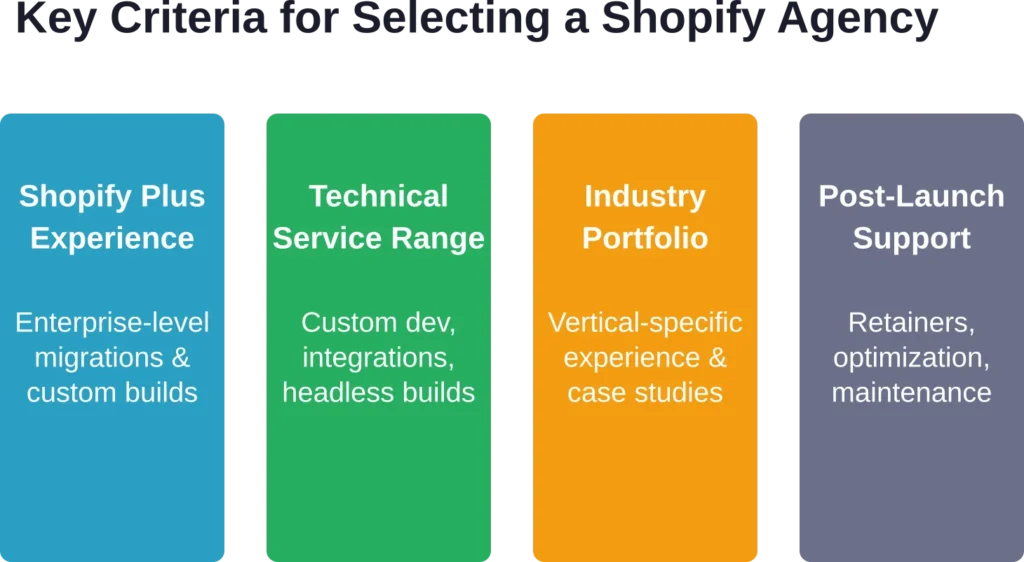
Shopify Plus Experience
Shopify Plus isn’t just “Shopify with more features.” The enterprise tier unlocks wholesale channels, advanced APIs, custom checkout functionality, and automation workflows that standard Shopify can’t support.
Agencies with verified Shopify Plus experience understand how to architect solutions at scale. They’ve handled platform migrations moving 50,000+ SKUs. They’ve built custom B2B portals with tiered pricing logic. They know how to optimize high-traffic stores during flash sales.
Look for case studies featuring recognizable brands. Check partner badges on the official Shopify Partners Directory.
Technical Service Range
Development encompasses many specialties. Some agencies focus narrowly on theme customization. Others offer full-stack capabilities including custom app development, API integrations, and headless commerce builds.
Common technical services include:
- Custom theme development from design mockups
- Platform migration from Magento, WooCommerce, BigCommerce, or legacy systems
- Third-party integration (ERP, PIM, CRM, fulfillment, subscription platforms)
- Custom Shopify app development for unique business logic
- Headless commerce architecture with modern frontend frameworks
- Performance optimization and technical audits
- Checkout customization and conversion rate optimization
Broader service offerings mean fewer vendor relationships to manage. But specialists often deliver deeper expertise in their niche.
Industry-Specific Portfolio
Some agencies work across all verticals. Others specialize in fashion, beauty, food and beverage, or B2B wholesale.
Industry specialization matters when technical requirements intersect with regulatory compliance, unusual fulfillment workflows, or niche customer behavior patterns. Fashion brands need sophisticated variant management. Food companies require subscription models and recurring billing. B2B merchants need tiered pricing and quote management.
Review agency portfolios for similar business models, not just visual aesthetics.
Post-Launch Support
Launch day is just the beginning. Stores need ongoing maintenance, security updates, feature additions, and performance monitoring.
Some development companies disappear after go-live. The best partners offer retainer relationships for continuous optimization, technical support, and growth experiments.
Shopify Development Service Types Explained
Agencies offer different service packages depending on technical complexity and business requirements. Understanding these categories helps match agency capabilities to project needs.
Theme Customization vs. Custom Development
Theme customization starts with an existing Shopify theme—either from the theme store or a commercial framework. Developers modify styling, layout, and components to match brand requirements.
Custom development builds themes from scratch, coding every template, component, and interaction specifically for the project. Custom builds offer complete design freedom and optimized performance, but require longer timelines.
Most projects fall somewhere in the middle: starting with a solid theme framework and customizing sections that need unique functionality.
Platform Migrations
Platform migrations move existing stores from other eCommerce platforms to Shopify. Common migration sources include Magento, WooCommerce, BigCommerce, and custom-built platforms.
Migrations involve:
- Product catalog transfer (products, variants, images, descriptions)
- Customer data migration (accounts, addresses, order history)
- URL mapping and redirect setup to preserve SEO
- Payment gateway and shipping configuration
- Third-party integration reconnection
Complex migrations require careful planning. Data mapping, SEO preservation, and integration testing prevent post-launch issues.
Custom App Development
Custom Shopify apps add functionality that themes and existing apps can’t provide. Apps can be private (used only by the merchant) or public (listed in the Shopify App Store).
Common custom app use cases include:
- Unique product configurators or builders
- Custom pricing logic and tiered wholesale pricing
- Specialized inventory management workflows
- Integration middleware connecting Shopify to internal systems
- Custom reporting and analytics dashboards
App development requires full-stack engineering: frontend interfaces, backend logic, database design, and API integration.
Headless Commerce Architecture
Headless commerce separates the frontend presentation layer from Shopify’s backend commerce engine. Developers build custom frontends using modern frameworks (React, Vue, Next.js) while leveraging Shopify’s Storefront API for commerce functionality.
Headless builds enable:
- Fully custom user experiences beyond Liquid templating constraints
- Multi-channel commerce (web, mobile apps, IoT devices) sharing one commerce backend
- Advanced performance optimization through static generation
- Greater flexibility for experimentation and personalization
Headless projects require specialized development expertise and typically involve higher complexity than traditional Shopify builds.
How to Choose the Right Shopify Development Partner
Selecting an agency partner involves matching technical capabilities to project requirements while evaluating cultural fit and communication style.
Define Project Scope First
Before contacting agencies, document what the project actually needs:
- Which Shopify tier (standard vs. Plus)?
- Custom design or theme customization?
- Required integrations (ERP, CRM, fulfillment, subscription)?
- Migration from another platform?
- Desired launch timeline?
- Post-launch support expectations?
Clear scope documentation helps agencies provide accurate proposals and prevents miscommunication about capabilities.
Review Relevant Portfolio Work
Don’t just look at portfolio aesthetics. Evaluate technical complexity and business similarity.
Ask specific questions:
- Have they built stores with similar product catalog complexity?
- Do their case studies show relevant integrations?
- Have they migrated from the same platform?
- Do they have experience in the same industry vertical?
Agencies with relevant experience navigate challenges faster because they’ve solved similar problems before.
Verify Official Partnership Status
According to the official Shopify Partners Directory, verified partners maintain direct relationships with Shopify’s platform team. Official partners receive:
- Early access to new features and API updates
- Direct support channels for technical issues
- Partner education and certification programs
- Preview builds for testing before public releases
Check the official Shopify Partners Directory to verify agency partnership status and review client ratings.
Evaluate Communication and Process
Technical skills matter, but so does project communication. During initial conversations, evaluate:
- How clearly do they explain technical concepts?
- Do they ask detailed questions about business requirements?
- What does their project management process look like?
- How do they handle scope changes and unexpected issues?
- What does post-launch support include?
Mismatched communication styles cause friction throughout projects. Cultural fit matters as much as technical capability.
Request Detailed Proposals
Generic proposals indicate generic thinking. Strong proposals demonstrate understanding of specific project requirements.
Look for:
- Detailed scope breakdown with specific deliverables
- Realistic timeline with defined milestones
- Clear explanation of technical approach
- Identified risks and mitigation strategies
- Transparent breakdown of what’s included vs. out of scope
Detailed proposals prevent scope creep and set clear expectations from the start.
| Evaluation Criteria | Why It Matters | How to Verify |
|---|---|---|
| Shopify Plus Experience | Enterprise features require specialized knowledge | Review case studies, check official partner badges |
| Technical Service Range | Broader capabilities mean fewer vendor relationships | Examine portfolio diversity, ask about in-house vs. outsourced services |
| Industry Portfolio | Vertical experience accelerates problem-solving | Request case studies from similar business models |
| Communication Style | Prevents friction throughout project lifecycle | Evaluate initial conversations, ask about project management process |
| Post-Launch Support | Stores need ongoing optimization beyond launch | Ask specific questions about retainer options and support structure |
Common Shopify Development Project Challenges
Even with expert agency partners, certain challenges appear repeatedly across Shopify projects. Understanding these ahead of time helps set realistic expectations.
Scope Creep and Feature Expansion
Projects start with defined requirements. Then stakeholders discover new features they want. Design reveals opportunities for additional customization. Integrations turn out more complex than initially understood.
Scope creep is normal, but unmanaged expansion blows budgets and timelines. Strong agencies document scope clearly, price change requests transparently, and help prioritize features for phased releases.
Integration Complexity
Third-party integrations often prove more complex than anticipated. Legacy systems lack modern APIs. Middleware requires custom development. Data synchronization logic involves edge cases.
Experienced agencies scope integrations conservatively, building buffer for unexpected complexity. They identify integration risks during discovery rather than mid-build.
Migration Data Quality Issues
Migrating from legacy platforms reveals data inconsistencies: duplicate products, malformed addresses, incomplete customer records, broken category structures.
Smart migration processes include data audits before transfer, cleaning scripts to normalize records, and validation testing to catch issues before go-live.
Performance Optimization Trade-offs
Feature-rich stores can suffer performance problems. Heavy JavaScript frameworks slow page loads. Unoptimized images bloat file sizes. Too many apps create script conflicts.
Performance optimization often involves trade-offs between functionality and speed. Agencies experienced in performance work help balance capabilities with load times.
Shopify Plus: When Enterprise Features Matter
Shopify Plus unlocks capabilities that standard Shopify can’t support. For certain business models, these features justify the platform investment. According to available industry information, Shopify Plus requires custom pricing evaluation, with investment starting well above standard Shopify plans, excluding agency development work.
Key Shopify Plus Capabilities
Unlimited staff accounts. Standard Shopify caps staff logins based on plan tier. Plus removes limits, supporting large teams and multiple agency partners.
Wholesale channel. Built-in B2B functionality supports separate wholesale catalogs, tiered pricing, and custom payment terms—all managed within one Shopify instance.
Advanced automation. Shopify Flow automates workflows across the platform: tagging customers, triggering fulfillment, managing inventory, sending notifications.
Checkout customization. Plus merchants can modify checkout with custom fields, upsells, messaging, and branding—functionality standard Shopify strictly controls.
API rate limit increases. Higher API limits support complex integrations and high-volume operations without throttling.
Dedicated support. Priority technical support with assigned merchant success managers and faster response times.
When Plus Makes Sense
Shopify Plus becomes cost-effective when:
- Revenue exceeds certain thresholds where percentage-based fees matter
- Business requires B2B wholesale alongside DTC retail
- Operations need advanced automation to manage complexity
- Checkout customization drives conversion improvements
- High transaction volume demands API performance
For smaller merchants, standard Shopify provides sufficient capabilities. The Plus investment makes sense when specific enterprise features unlock meaningful business value.
The Role of Ongoing Optimization
Launch day marks the beginning, not the end. High-performing stores undergo continuous optimization based on analytics, user testing, and conversion data.
Conversion Rate Optimization
CRO systematically improves the percentage of visitors who complete purchases. Even small conversion improvements create significant revenue impact at scale.
Common CRO focus areas:
- Product page layout and content optimization
- Checkout flow reduction and form simplification
- Trust signal placement (reviews, security badges, guarantees)
- Mobile experience optimization
- Cart abandonment reduction tactics
Some development agencies offer integrated CRO services. Others focus purely on technical build, requiring separate optimization partners.
Performance Monitoring and Improvement
Site speed directly impacts conversion rates and SEO rankings. Ongoing performance monitoring identifies degradation before it impacts revenue.
Performance optimization tactics include:
- Image optimization and lazy loading
- JavaScript minimization and async loading
- Theme code cleanup and optimization
- App audit and removal of unused scripts
- CDN configuration and caching strategy
Technical debt accumulates over time. Regular performance audits keep stores fast as content and functionality expand.
Feature Iteration and A/B Testing
Best-performing stores treat optimization as ongoing experimentation. A/B testing compares variations to identify what actually improves conversion.
Testable elements include:
- Product page layouts and image presentations
- Add-to-cart button placement and styling
- Navigation structure and menu organization
- Homepage hero messaging and calls-to-action
- Checkout flow steps and form fields
Systematic testing replaces guesswork with data-driven decision making.
Future-Proofing Your Shopify Store
Platform capabilities evolve constantly. Building stores that adapt to change prevents expensive rebuilds down the road.
Modular Architecture
Modular builds separate components into independent sections. Theme sections, custom apps, and integration middleware maintain clear boundaries.
Modularity enables:
- Easier updates to individual components without affecting others
- Simpler testing and debugging
- Faster feature additions
- Reduced risk when making changes
Agencies experienced in scalable architecture design systems that grow with business requirements.
Documentation and Knowledge Transfer
Proper documentation prevents vendor lock-in. When agencies document code, architecture decisions, and integration logic, merchants maintain flexibility to change partners or bring development in-house.
Critical documentation includes:
- Technical architecture diagrams
- Custom code documentation and comments
- Integration specifications and API documentation
- Configuration settings and environment variables
- Deployment processes and environment setup
Documentation takes time, but protects against knowledge loss when team members change.
Staying Current With Platform Updates
Shopify releases new features, API versions, and platform improvements regularly. Stores built on outdated patterns accumulate technical debt.
According to the Shopify Developer Community (published 2026-03-03), app approval times have slowed in recent months due to huge increases in submissions, as Shopify remains committed to ensuring high quality, secure, and impactful tools reach merchants. Shopify remains committed to ensuring high quality, secure, and impactful tools reach merchants.
Strong agency partners monitor platform changes, recommend upgrades proactively, and keep stores current with best practices.
Frequently Asked Questions
Shopify developers are individual freelancers or contractors who handle specific technical tasks—theme customization, app development, or integration work. Shopify agencies are full-service teams offering comprehensive capabilities: strategy, design, development, project management, and often marketing services. Agencies provide broader expertise and handle larger, more complex projects, while developers work well for specific technical needs or smaller scopes.
Timeline varies dramatically based on scope. Basic theme customization might complete in 2-4 weeks. Custom theme builds typically require 8-12 weeks. Complex Shopify Plus implementations with custom integrations, migrations, and extensive customization often span 3-6 months. Agencies provide timeline estimates based on specific project requirements during the proposal phase.
Standard Shopify serves most small-to-medium merchants effectively. Shopify Plus becomes valuable when businesses need specific enterprise features: B2B wholesale channels, advanced automation through Shopify Flow, checkout customization, unlimited staff accounts, or higher API limits for complex integrations. Plus also makes financial sense at higher revenue levels where transaction fee structures shift. Agencies can help evaluate whether Plus capabilities justify the investment for specific business models.
Technically yes, but transitions involve friction. New agencies need time to understand existing architecture, code structure, and business requirements. Proper documentation and knowledge transfer from the original agency smooths transitions significantly. Some merchants switch agencies for post-launch optimization while others maintain long-term partnerships with their original development partner. Clear contracts and documentation protect flexibility regardless of which approach makes sense.
Review portfolio work for technical complexity similar to project needs. Ask specific questions about their experience with required integrations, platform migrations, or custom development. Request references from clients with similar technical requirements. Check official Shopify partner status and certifications. During initial conversations, evaluate how clearly they explain technical concepts and whether they ask detailed questions about business requirements. Strong agencies demonstrate expertise through specific examples rather than generic claims.
Ongoing support typically includes bug fixes, minor content updates, technical troubleshooting, security monitoring, and platform update management. More comprehensive retainers add performance optimization, conversion testing, feature additions, and strategic consultation. Clarify exactly what’s included before committing to retainer agreements—scope varies significantly between agencies. Some offer tiered support packages while others customize retainers to specific merchant needs.
Project investment varies widely based on scope and complexity. Industry reports suggest basic Shopify stores using theme customization typically sit at one end of the spectrum, while custom Shopify websites occupy the middle range. Advanced stores with custom UX and integrations reach higher investment levels, and Shopify Plus websites with enterprise features represent the top tier. These figures cover development work; additional costs include the Shopify subscription, apps, themes, and ongoing maintenance. Agencies provide detailed estimates based on specific project requirements.
Making the Right Agency Decision
Choosing a Shopify development partner represents a significant business decision. The right agency accelerates growth, while the wrong fit wastes time and budget.
Start by defining clear project requirements. Understand which technical capabilities actually matter for the business model. Evaluate agencies based on relevant experience, not just portfolio aesthetics.
Verify official Shopify partnership status through the Shopify Partners Directory. Review case studies from similar industries and technical complexity levels. Have detailed conversations about process, communication style, and post-launch support.
Request comprehensive proposals that demonstrate understanding of specific requirements. Compare not just total cost, but scope clarity, timeline realism, and what’s included versus additional.
The 15 agencies profiled here represent strong Shopify development partners with verified capabilities and client success. Each brings different specializations—from full-service solutions to technical custom development to enterprise migrations.
Look—no single agency fits every project perfectly. The right partner depends on specific technical requirements, business model, industry vertical, and working style preferences.
Take time to evaluate options thoroughly. The investment in finding the right agency partner pays dividends throughout the project and beyond.
Ready to start your Shopify project? Review the agencies listed here, evaluate portfolios against your specific requirements, and reach out to partners whose expertise aligns with your business goals. Building a high-performing Shopify store starts with choosing the right development partner.