

Quick Summary: Legacy system modernization companies specialize in transforming outdated infrastructure into cloud-native, AI-ready platforms. The top 15 agencies for 2026 include Lengreo, Gilzor, OSKI Solutions, A-listware, Mobian Studio, Keyhole Software, Hexaware, Techstack, Cygnet Infotech, Smartbridge, Softura, ThoughtWorks, N-iX, Code District, and Corsac. These firms excel in re-architecting monolithic applications, migrating mainframe workloads, and accelerating digital transformation through proven methodologies and emerging AI capabilities.
Legacy systems are quietly strangling enterprise innovation. Research consistently shows that legacy infrastructure absorbs 60–80% of enterprise IT spending, leaving minimal budget for new initiatives. Mainframe COBOL applications that powered banking for decades now block real-time analytics. Monolithic .NET systems strain under modern API demands. And talent pools for legacy languages are shrinking fast, with approximately 5,000 to 10,000 mainframe developers retiring annually.
But here’s the thing—modernization done wrong costs more than standing still. Multi-million dollar lift-and-shift migrations that fail to deliver business value. Re-platforming projects that balloon from 18 months to four years. Cloud bills that exceed on-premise costs because the architecture never changed.
The right modernization partner doesn’t just move code. They re-architect for AI, automate with proven frameworks, and deliver measurable outcomes. This analysis examines the top 15 legacy system modernization companies based on solution methodology, delivery evidence, and emerging AI capabilities as we head deeper into 2026.
Why Legacy System Modernization Matters in 2026
The enterprise architecture landscape has shifted dramatically. According to Forrester, the Enterprise Architecture Tools market has surpassed $1 billion (as of 2026) and its momentum is transforming how organizations govern complexity. Companies that modernize now ship AI-powered capabilities throughout 2026. Those that delay fall further behind every quarter.
Legacy systems aren’t just expensive to maintain. They actively block strategic initiatives:
- AI adoption stalls when data sits trapped in mainframe silos with no real-time access layer
- Compliance risk mounts as unsupported systems can’t meet evolving security standards—according to sources cited in legacy modernization research, it takes approximately 55 days to remediate 50% of critical vulnerabilities on legacy platforms
- Developer productivity collapses when teams spend 60–70% of their time maintaining aging codebases instead of building new features
- Customer experience suffers from slow release cycles and brittle integrations that can’t support modern omnichannel demands
The U.S. Government Accountability Office reports that 80% of federal IT spending goes toward operations and maintenance of existing IT infrastructure. Commercial enterprises face similar ratios. When IT budgets are consumed by keeping the lights on, digital transformation becomes impossible.
Real talk: the window for strategic modernization is closing. Talent constraints will only worsen. Cloud economics favor early movers who can optimize architecture from day one. And AI capabilities are advancing so quickly that delaying modernization means missing the entire wave.
Top 15 Legacy System Modernization Companies in 2026
1. Mobian Studio
Mobian Studio delivers dedicated engineering teams specialized in modernizing legacy systems through seamless integration and scalable architecture. They connect new mobile, AI, and cloud solutions to existing infrastructure without disruptive rip-and-replace approaches, ensuring production-ready delivery with clean, documented code.
Their models support both full outsourcing and outstaffing, emphasizing post-launch partnership, performance scaling, and domain-specific compliance in healthcare, fintech, and logistics environments.
Core Strengths: legacy system integration, dedicated engineering teams, AI-powered modernization, scalable architecture
Industries Served: Healthcare, fintech, logistics, IT
Best For: Companies needing reliable legacy integration and modern AI/mobile capabilities with ongoing support and minimal disruption
Contact Information:
- Website: mobian.studio
- Phone: [email protected]
- Address: Harju maakond, Tallinn, Kesklinnalinnaosa, Masina tn 22, 10113
- LinkedIn: www.linkedin.com/company/mobian-studio
2. A-listware
A-listware provides end-to-end software development and consulting focused on legacy modernization through dedicated teams, cloud migration, and application services. They handle legacy software modernization, infrastructure management, and seamless transitions to modern enterprise solutions including ERP, CRM, and cloud applications.
The firm excels at team augmentation and full-spectrum engineering that integrates with client environments while delivering high-quality, secure digital transformations.
Core Strengths: legacy software modernization, dedicated development teams, cloud application development, IT consulting
Industries Served: Enterprise, manufacturing, technology, financial services
Best For: Organizations requiring reliable outsourcing or team extension for complex legacy modernization and infrastructure transformation
Contact Information:
- Website: a-listware.com
- Phone: +1 (888) 337 93 73
- Email: [email protected]
- Address: North Bergen, NJ 07047, USA
- LinkedIn: www.linkedin.com/company/a-listware
- Facebook: www.facebook.com/alistware
3. Gilzor
Gilzor specializes in custom software development that supports modernization of existing products and systems through technology migration, architecture consulting, and full-cycle redevelopment. They focus on stabilizing delivery, implementing new technologies, and migrating legacy components to modern scalable web and mobile solutions.
Their approach includes business analysis, R&D for PoC, quality assurance, and ongoing support to help clients evolve legacy applications into high-performance digital products.
Core Strengths: technology migration, full-cycle web and mobile development, architecture consulting, product stabilization
Industries Served: Startups, SMBs, product studios, airlines, e-commerce
Best For: Businesses looking to modernize legacy applications or migrate to new technologies while maintaining performance and user experience
Contact Information:
- Website: www.gilzor.com
- Email: [email protected]
- Address: Poland, Warsaw, Office 58, street Adama Mickiewicza 37, 01-625
- LinkedIn: www.linkedin.com/company/gilzor-softwaredevelopment
4. Oski Solutions
Oski Solutions builds smart, well-engineered software solutions with strong capabilities in cloud migration, AI integration, and modernization of enterprise systems. They deliver cloud solutions, frontend modernization, and AI-powered enhancements that help organizations reimagine legacy operations into scalable, efficient platforms.
The team emphasizes AI-accelerated development, robust architecture, and industry-specific solutions for seamless digital transformation.
Core Strengths: cloud modernization, AI integrations, full-stack development, enterprise solution engineering
Industries Served: Fintech, insurance, logistics, travel, e-commerce
Best For: Tech-forward enterprises and startups seeking AI-enhanced legacy modernization and cloud-native transformations
Contact Information:
- Website: oski.site
- Phone: +48571282759
- Email: [email protected]
- Address: Kaupmehe tn 7, 10114 Tallinn, Estonia
- LinkedIn: www.linkedin.com/company/oski-solutions
5. Lengreo
Lengreo serves as a complete marketing and tech partner that accelerates legacy system modernization projects through targeted B2B lead generation, digital strategy, and website development. They help modernization-focused software and IT companies generate high-quality opportunities and scale client acquisition with data-driven campaigns.
Their services include SEO, demand generation, and personalized outreach specifically effective for technology service providers promoting modernization solutions.
Core Strengths: B2B lead generation for modernization services, digital marketing strategy, website development, conversion optimization
Industries Served: Software development, IT services, architecture & design tech, cybersecurity
Best For: Modernization service providers needing to attract enterprise clients and scale business development through specialized marketing
Contact Information:
- Website: Lengreo.com
- Phone: +31 686 147 566
- Email: [email protected]
- Address: Vrijstraat 9 C/D, 5611 AT Eindhoven, Netherlands
- LinkedIn: Lengreo
- Twitter: @Lengreo
- Instagram: @lengreo
6. Softura

Softura focuses on Microsoft stack modernization—particularly legacy .NET Framework applications moving to .NET Core/modern .NET and Azure cloud services. Their team has deep expertise in WCF-to-REST API conversion, SQL Server optimization, and Azure DevOps pipeline implementation.
The firm’s delivery model emphasizes parallel run periods where legacy and modern systems operate simultaneously, allowing thorough validation before cutover. Softura’s ongoing support includes performance tuning and cost optimization after initial deployment.
Core Strengths: Microsoft stack expertise, .NET Framework to modern .NET migration, Azure cloud services, parallel run methodology
Industries Served: Healthcare, financial services, logistics, government
Best For: Microsoft-centric organizations modernizing .NET applications to Azure cloud
7. ThoughtWorks
ThoughtWorks pioneered the Strangler Fig pattern and continues to lead in methodology-driven incremental modernization. Their consultants embed with client teams, transferring knowledge and building internal capability while delivering transformation outcomes.
The firm emphasizes evolutionary architecture and continuous delivery practices. ThoughtWorks projects typically involve significant organizational change management alongside technical delivery—transforming both systems and team practices.
Core Strengths: Strangler Fig methodology, evolutionary architecture, continuous delivery, embedded consulting model
Industries Served: Financial services, retail, media, technology
Best For: Organizations seeking methodology leadership and internal capability building alongside system modernization
8. N-iX

N-iX provides dedicated team augmentation for modernization projects, supplying senior engineers with specific legacy stack expertise. Their model works well for enterprises with internal architecture leadership who need execution capacity.
The firm has particular depth in Java modernization, Spring Framework upgrades, and microservices decomposition. N-iX teams integrate with client processes and tools, operating as extensions of internal development organizations.
Core Strengths: Dedicated team augmentation, Java modernization, Spring Framework expertise, microservices decomposition
Industries Served: Technology, financial services, telecommunications, logistics
Best For: Enterprises with internal architecture leadership needing senior engineering capacity
9. Code District
Code District specializes in rapid modernization for mid-size applications using modern frameworks like React, Node.js, and serverless architectures. Their approach favors rebuild over refactor when legacy code quality is poor or business logic has diverged from actual requirements.
The team emphasizes discovery phases that map actual system behavior through observation and user interviews, often uncovering that documented requirements don’t match current usage patterns. This prevents rebuilding legacy mistakes into modern systems.
Core Strengths: Rapid rebuild methodology, modern framework expertise (React, Node.js, serverless), behavior-driven discovery
Industries Served: SaaS, media, e-commerce, professional services
Best For: Mid-size companies with legacy applications where rebuild is more cost-effective than refactor
10. Corsac
Corsac focuses on transparent, milestone-based delivery with clear success metrics defined upfront. Their methodology emphasizes business outcome validation at each phase—ensuring technical progress translates to measurable improvements in system performance, user satisfaction, or operational cost.
The firm’s project governance includes executive steering committees and regular business stakeholder reviews, maintaining alignment between technical execution and business priorities throughout multi-month transformations.
Core Strengths: Outcome-focused delivery, milestone-based governance, business stakeholder alignment, transparent communication
Industries Served: Financial services, healthcare, logistics, manufacturing
Best For: Organizations requiring strong governance and business outcome validation throughout modernization
11. Keyhole Software
Keyhole Software stands out as a Claude Partner Network member, delivering AI-accelerated modernization with architect-governed workflows using Claude Code and Codex. Their approach combines test-gated delivery pipelines with senior-led architecture review at every phase.
The team specializes in Java, .NET, and JavaScript stack modernization with particular strength in financial services and healthcare systems where regulatory compliance demands rigorous testing. Keyhole’s methodology emphasizes incremental delivery—breaking large transformations into two-week sprints with working software deployed continuously.
Core Strengths: AI-accelerated code analysis, architect-governed delivery, test-driven modernization, Claude AI partnership
Industries Served: Financial services, healthcare, insurance, manufacturing
Best For: Mid-size to enterprise companies requiring regulated, high-assurance modernization with measurable velocity improvements
12. Hexaware Technologies
Hexaware brings enterprise-scale delivery capacity with a focus on multi-cloud re-architecture and mainframe offloading. Their Amaze modernization platform automates assessment, dependency mapping, and code translation for COBOL, C++, and Java legacy stacks.
The firm has documented success with Fortune 500 manufacturing and retail clients, delivering end-to-end transformations from legacy assessment through cloud-native deployment and ongoing managed services. Hexaware’s strength lies in handling complex, multi-year programs with distributed global delivery teams.
Core Strengths: Enterprise-scale delivery, Amaze automation platform, mainframe modernization, multi-cloud architecture
Industries Served: Manufacturing, retail, telecommunications, banking
Best For: Large enterprises with mainframe workloads and complex, multi-system transformation needs
13. Techstack
Techstack focuses on mid-market application modernization with an emphasis on transparent, phased delivery. Their approach starts with deep assessment and risk mapping, then proceeds through definition, implementation, stabilization, and cost tracking phases.
Client retention is notably high—Techstack reports 60% client retention beyond 5 years, indicating strong ongoing relationships. The team specializes in .NET, Node.js, and Python modernization with particular expertise in e-commerce and SaaS platforms.
Core Strengths: Transparent phased delivery, strong client retention, .NET and Node.js expertise, e-commerce specialization
Industries Served: E-commerce, SaaS, logistics, professional services
Best For: Mid-market companies seeking predictable, risk-managed modernization with ongoing partnership
14. Cygnet Infotech
Cygnet combines AI-driven code analysis with end-to-end delivery at enterprise scale. Their modernization practice emphasizes multi-cloud re-architecture and has particular depth in BFSI (Banking, Financial Services, Insurance) regulatory environments.
The firm’s assessment frameworks map technical debt, compliance gaps, and architectural constraints upfront, creating clear roadmaps before implementation begins. Cygnet’s delivery model includes ongoing optimization post-migration, ensuring cloud costs align with projected savings.
Core Strengths: AI-driven code analysis, multi-cloud re-architecture, BFSI regulatory expertise, end-to-end delivery
Industries Served: Banking, financial services, insurance, healthcare, manufacturing, retail, government
Best For: Enterprises in regulated industries requiring compliance-focused modernization
15. Smartbridge

Smartbridge specializes in application portfolio rationalization and selective modernization—helping clients decide what to migrate, what to retire, and what to replace. Their assessment methodology evaluates technical fit, business value, and strategic alignment before recommending specific modernization paths.
The team has strong capabilities in ASP.NET Web Forms modernization and monolithic application decomposition. Smartbridge’s approach emphasizes proof-of-concept phases to validate architecture decisions before full-scale implementation.
Core Strengths: Portfolio rationalization, ASP.NET modernization, monolithic decomposition, proof-of-concept validation
Industries Served: Manufacturing, healthcare, financial services, energy
Best For: Organizations with large application portfolios needing strategic rationalization before modernization
Key Modernization Strategies and Approaches
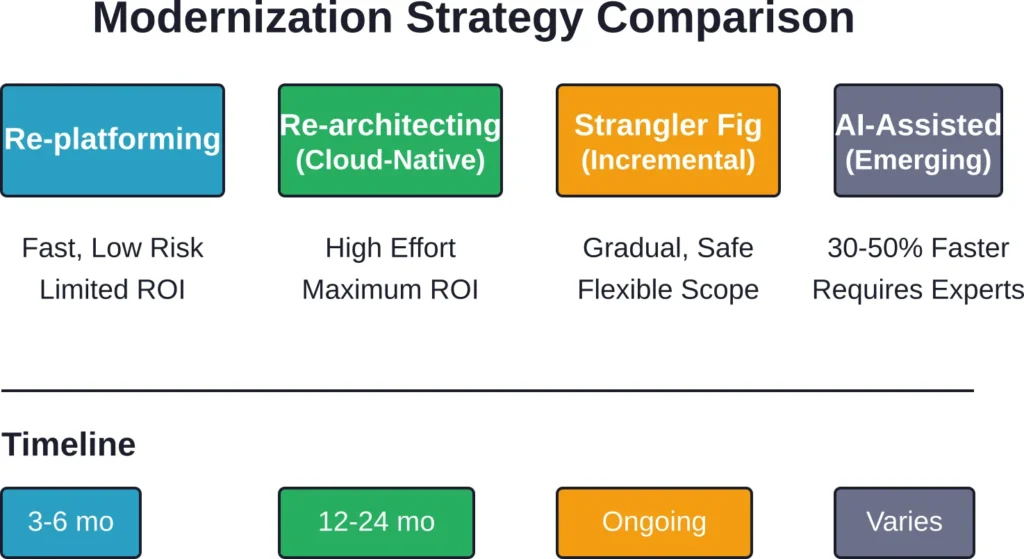
Not all modernization paths deliver equal value. The leading companies use one or more of these proven strategies:
Re-platforming and Cloud Migration
Moving applications to cloud infrastructure—AWS, Azure, Google Cloud—without fundamentally changing the code. This delivers infrastructure cost reduction of 30–50% via cloud elasticity and removes hardware management burden. But it doesn’t unlock modern architecture benefits unless paired with refactoring.
Re-architecting for Cloud-Native
Decomposing monolithic applications into microservices, implementing event-driven patterns, and adopting container orchestration. This approach unlocks faster time-to-market (2–4x improvement), improved developer productivity (20–40% more capacity for product work), and true scalability. It’s more expensive upfront but delivers compounding returns.
Strangler Fig Pattern
Incrementally replacing legacy system components by building new services around the edges and gradually routing traffic away from old code. This reduces risk by avoiding big-bang rewrites and allows teams to deliver value continuously. ThoughtWorks pioneered this methodology and it remains the gold standard for mission-critical system migrations.
AI-Accelerated Modernization
Using AI code analysis tools like Claude Code, GitHub Copilot, and specialized AST parsing engines to automate portions of code translation, test generation, and documentation. Leading firms report 30–50% acceleration in assessment and refactoring phases. But AI still requires architect-governed workflows—human expertise remains critical for architecture decisions and business logic validation.
Mainframe Offloading and COBOL Translation
Specialized approaches for moving workloads off expensive mainframe infrastructure. This can involve automated COBOL-to-Java translation, gradual data migration to cloud databases, and establishing integration layers that allow new systems to coexist with legacy cores during transition.
Emerging Trends in Legacy System Modernization
AI-Native Architecture
The shift isn’t just from monolith to microservices anymore. It’s from batch-oriented systems to real-time, AI-ready data platforms. According to Forrester, leading service providers like Accenture are now quantifying AI earnings, with $5.7 billion in genAI bookings in FY ’25 signaling strong client commitment to AI transformation.
Modern architecture must support vector databases, model inference pipelines, and real-time feature stores. Legacy modernization projects in 2026 increasingly include AI readiness assessments and architectural patterns that enable future ML/AI capabilities.
Agentic Automation in ERP Systems
Forrester’s Enterprise Resource Planning Solutions Landscape, Q1 2026 notes that ERP is pushing toward an intelligent orchestration engine, with AI-driven automation and early agentic capabilities built into core workflows. This means legacy ERP modernization must consider not just technical migration but AI-enhanced process automation.
Platform Engineering and Developer Experience
Modernization outcomes are increasingly measured by developer productivity improvements. The focus has shifted from “did we move to cloud?” to “can developers ship features 3x faster with better quality?” Platform engineering practices—internal developer platforms, golden paths, self-service infrastructure—are now core deliverables in modernization programs.
FinOps and Cloud Cost Optimization
Early cloud migrations often resulted in higher costs than on-premise infrastructure because lift-and-shift approaches didn’t optimize for cloud economics. Modern engagements include FinOps practices from day one: right-sizing instances, implementing auto-scaling, using reserved capacity strategically, and establishing cost accountability.
Composable Architecture and API-First Design
The trend toward composable business capabilities means legacy modernization projects focus heavily on API design and service boundaries. Rather than building new monoliths in modern languages, the goal is creating loosely coupled, independently deployable services that can be composed into new customer experiences quickly.
How to Choose the Right Legacy Modernization Partner
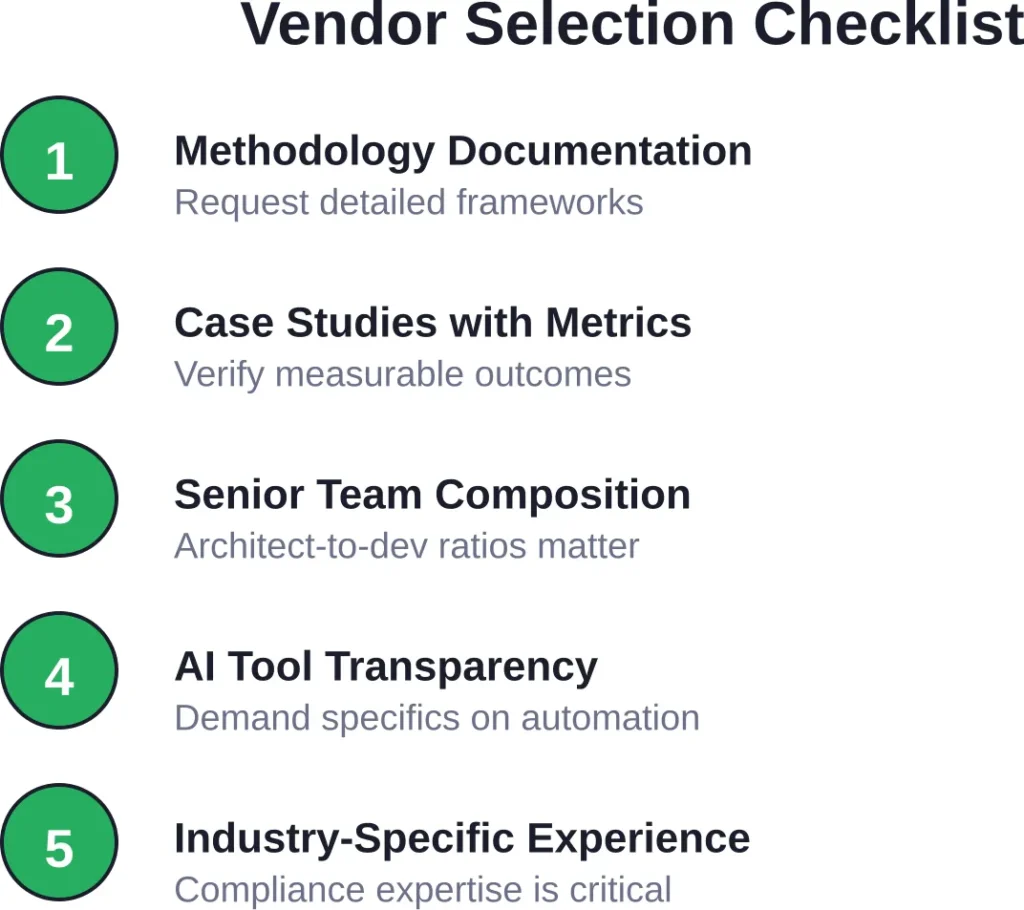
Selecting a modernization vendor requires evaluating capability beyond marketing claims. Here’s what actually matters:
Assess Methodology Depth
Ask for detailed methodology documentation. The best firms have documented frameworks covering assessment, architecture definition, migration execution, testing strategy, and post-migration optimization. Generic “agile” references aren’t sufficient—look for modernization-specific practices.
Demand Delivery Evidence
Request case studies with specific outcomes: application response time improvements, infrastructure cost reductions, developer productivity gains, time-to-market acceleration. Vague claims about “successful transformations” are meaningless. Real evidence includes metrics, timelines, and business impact.
Evaluate Team Seniority
Modernization requires architectural judgment that only comes with experience. Ask about the team’s average years of experience and the ratio of architects to developers. Junior developers can write code, but they can’t make the architectural trade-off decisions that determine project success or failure.
Understand AI Capabilities
If the firm claims AI-accelerated modernization, dig into specifics. What tools? What’s automated vs. manual? What quality gates ensure AI-generated code meets standards? AI acceleration is real, but it requires expert oversight. Automated code translation without architect review creates technical debt in modern languages.
Validate Industry Expertise
Regulatory requirements, compliance standards, and domain complexity vary dramatically by industry. A vendor with deep healthcare experience understands HIPAA compliance, HL7 integration, and EHR system constraints. Generic modernization expertise doesn’t translate directly across highly regulated sectors.
Review Ongoing Support Models
Modernization doesn’t end at deployment. Ask about post-migration support: performance tuning, cost optimization, feature enhancement, team training. The best partners offer flexible ongoing engagement models, not just project-based delivery.
Check Technology Partnerships
Partnerships with cloud providers (AWS, Azure, Google Cloud) and AI platforms (Anthropic, OpenAI) signal investment in cutting-edge capabilities. Partner status often includes early access to new features, specialized training, and architectural support that benefits clients.
Common Modernization Pitfalls to Avoid
Even with the right partner, modernization projects can derail. Watch for these warning signs:
Big Bang Rewrites
Attempting to replace entire systems in one massive project creates enormous risk. Business requirements change during multi-year rewrites. Technology choices become outdated. Team members leave. The strangler fig pattern—incrementally replacing components while maintaining continuous delivery—dramatically reduces risk.
Lift-and-Shift Without Re-architecture
Moving legacy applications to cloud VMs delivers minimal value. Without decomposing monoliths, implementing auto-scaling, and optimizing for cloud-native patterns, organizations pay cloud premiums for on-premise architecture. Infrastructure cost reduction of 30–50% only materializes when architecture changes to exploit cloud capabilities.
Ignoring Organizational Change
Technology transformation without process transformation fails. Legacy organizations have processes built around legacy system constraints—monthly release cycles, manual testing, change advisory boards for every deployment. Modern systems require modern processes: continuous integration, automated testing, DevOps practices, product-oriented teams.
Underestimating Data Migration Complexity
Data migration is typically the highest-risk phase. Legacy systems accumulate decades of data quality issues: duplicate records, orphaned references, inconsistent encoding, undocumented transformations. Successful projects invest heavily in data profiling, cleansing strategy, and parallel run validation before cutover.
No Post-Migration Optimization
Initial cloud deployments are rarely optimized. Teams focus on functional equivalence first, then optimize performance and cost. Organizations that treat deployment as project completion miss the compounding benefits of continuous optimization. The best vendors include post-migration tuning in their engagement models.
Real-World Modernization Outcomes
The measurable benefits of successful legacy modernization include:
| Outcome Category | Typical Impact Range | What Drives Results |
|---|---|---|
| IT Maintenance Cost Reduction | 40–60% decrease | Elimination of mainframe licenses, reduced support staff, automated operations |
| Developer Productivity | 20–40% capacity increase | Modern tooling, automated testing, reduced technical debt, better documentation |
| Time-to-Market | 2–4x faster | CI/CD pipelines, microservices architecture, cloud-native deployment automation |
| Infrastructure Cost | 30–50% reduction | Cloud auto-scaling, right-sized resources, serverless architectures, reserved capacity |
| System Availability | 99.9%+ uptime | Multi-region deployment, automated failover, health monitoring, chaos engineering |
| Security Posture | Compliance-ready | Modern authentication, encryption at rest/transit, automated patching, audit logging |
But here’s what matters more than percentages: strategic capability. Organizations running on legacy systems can’t adopt AI, can’t support real-time customer experiences, can’t scale to meet demand spikes, can’t attract top engineering talent who want to work with modern technology.
Modernization unlocks strategic options that weren’t previously available. That capability gap—between what legacy systems allow and what modern business demands require—is the real cost of delay.
Budget and Timeline Expectations
Modernization investments vary dramatically based on system complexity, data volume, regulatory requirements, and organizational readiness.
Individual Application Modernization
Single application modernization typically ranges from $200,000 to $1 million and takes 4–9 months. Scope includes assessment, architecture design, code migration or rebuild, testing, deployment, and stabilization. Simpler applications with clean architecture and minimal integration land at the lower end. Complex, poorly documented systems with extensive custom logic and brittle integrations land at the upper end.
Multi-System Modernization Programs
Transforming 3–8 interconnected applications runs $1 million to $5 million+ over 12–24 months. These programs include portfolio assessment, shared infrastructure design (API gateways, identity management, data platforms), phased application migration, integration testing, and organizational change management. The investment scales with application count, integration complexity, and regulatory requirements.
Enterprise-Wide Transformations
Comprehensive modernization of core business systems becomes a multi-year, multi-million-dollar strategic initiative. These programs touch dozens of applications, require extensive data migration, involve multiple vendor partners, and demand executive sponsorship. Timeline typically spans 2–4 years with phased value delivery throughout.
The most successful organizations don’t view modernization as a one-time project but as an ongoing capability. They establish internal platform engineering teams, adopt continuous modernization practices, and maintain partnerships with specialist vendors who provide expertise for complex initiatives.
The Strategic Imperative for 2026
The window for strategic modernization is narrowing. According to Forrester, the Enterprise Architecture Tools market has surpassed $1 billion (as of 2026) as organizations recognize that governing complexity has become a strategic necessity, not a back-office IT concern.
Companies that modernize in 2026 position themselves to exploit AI capabilities, deliver superior customer experiences, and attract engineering talent. Those that delay face mounting technical debt, escalating maintenance costs, and widening capability gaps versus competitors.
The question isn’t whether to modernize. It’s whether to lead the transformation or react to it. And it’s whether to choose partners who deliver real capability or settle for vendors who promise everything and deliver PowerPoints.
The agencies profiled here represent genuine capability—documented methodologies, measurable outcomes, and emerging AI competency. They’re not the only capable firms, but they’re among the most credible based on publicly available evidence of delivery excellence.
Frequently Asked Questions
Legacy system modernization is the process of transforming outdated software infrastructure—mainframes, monolithic applications, obsolete frameworks—into modern, cloud-native architectures. This typically involves re-platforming to cloud infrastructure, re-architecting monoliths into microservices, migrating to supported frameworks, and establishing DevOps practices. The goal is reducing maintenance costs, improving developer productivity, enabling AI capabilities, and supporting modern business requirements that legacy systems cannot meet.
Timeline varies dramatically by scope. Individual application modernization runs 4–9 months. Multi-system programs span 12–24 months. Enterprise-wide transformations take 2–4 years with phased delivery throughout. The strangler fig approach allows continuous value delivery rather than waiting for complete project completion. Organizations that treat modernization as an ongoing capability rather than a one-time project see better long-term outcomes.
Re-platforming moves applications to new infrastructure (typically cloud) without fundamentally changing the code—it’s a “lift and shift” approach that delivers infrastructure benefits like reduced hardware management but limited architectural improvements. Re-architecting fundamentally redesigns the application structure—decomposing monoliths into microservices, implementing event-driven patterns, adopting cloud-native services. Re-architecting costs more upfront but delivers compounding benefits in scalability, developer productivity, and business agility.
AI serves two roles in modernization. First, AI tools accelerate the modernization process itself through automated code analysis, dependency mapping, test generation, and code translation—leading firms report 30–50% acceleration in assessment and refactoring phases. Second, modern architecture must support AI capabilities: real-time data access, vector databases, model inference pipelines, feature stores. Legacy systems can’t support these patterns, making modernization a prerequisite for AI adoption.
The highest risks include: big bang rewrites that attempt complete replacement in one project (strangler fig incremental approach dramatically reduces this risk), data migration complexity and quality issues accumulated over decades, inadequate testing leading to production defects, cloud cost overruns from unoptimized architecture, and organizational resistance when processes don’t adapt to match modern technology. Successful projects address these through phased delivery, extensive data profiling, automated testing, FinOps practices, and change management.
Most organizations need both. External partners bring specialized expertise in modernization methodologies, architecture patterns, and technology platforms that internal teams lack. But successful modernization requires deep business and domain knowledge that only internal teams possess. The best approach combines external methodology leadership and technical acceleration with internal teams who provide business context, make trade-off decisions, and maintain systems long-term. Knowledge transfer should be a core deliverable in any external engagement.
Measurable outcomes include: reduced IT maintenance costs (40–60% is common), improved developer productivity (20–40% more capacity for new features), faster time-to-market (2–4x improvement), infrastructure cost reduction (30–50% via cloud optimization), improved system availability (99.9%+ uptime), and enhanced security posture meeting current compliance requirements. But strategic capability matters more than percentages—modernization enables AI adoption, real-time customer experiences, and competitive agility that legacy systems fundamentally cannot support.
Making the Decision
Legacy system modernization represents one of the most consequential technology decisions enterprises face in 2026. The investment is substantial. The organizational change is significant. And the execution risk is real.
But the cost of inaction compounds every quarter. Technical debt accumulates. Talent becomes harder to recruit and retain. Competitors shipping AI-powered features gain market share. And the capability gap between what legacy systems allow and what modern business requires widens into an unbridgeable chasm.
The agencies profiled here—Keyhole Software, Hexaware, Techstack, Cygnet, Smartbridge, Softura, ThoughtWorks, N-iX, Code District, and Corsac—represent diverse approaches to modernization. Some emphasize AI acceleration. Others lead with methodology rigor. Several specialize in specific technology stacks or industries.
The right choice depends on organizational context: system complexity, regulatory environment, internal capability, risk tolerance, and strategic timeline. But delaying the decision while waiting for perfect clarity guarantees falling further behind.
Organizations that move decisively in 2026—selecting capable partners, committing executive sponsorship, funding appropriately, and maintaining focus through inevitable challenges—position themselves for the AI-driven, customer-centric, digitally native business model that defines competitive advantage this decade.
Those that don’t will spend the next five years managing decline while competitors race ahead. The choice is stark. And the window is closing.