

Quick Summary: The best technical SEO optimization companies in 2026 specialize in site architecture, Core Web Vitals, structured data, and AI search visibility. This guide profiles 15 top agencies—from boutique specialists to enterprise-scale firms—that fix crawl errors, speed bottlenecks, and schema markup to drive measurable organic growth. Each agency is evaluated for proven results, technical depth, and adaptation to generative AI search engines like ChatGPT and Perplexity.
Technical SEO is the foundation every ranking strategy is built on. While content and links still matter, a site riddled with crawl errors, slow load times, and broken structured data won’t see first-page results no matter how brilliant the copy.
And 2026 has introduced a new layer of complexity. According to industry insights, approximately 60% of searches are now zero-click—answered directly by AI overviews, featured snippets, and answer engines. That means technical optimization now extends beyond Google’s traditional bot to systems like ChatGPT, Perplexity, and Gemini.
This guide evaluates 15 agencies that excel at the hard work: fixing site architecture, optimizing for Core Web Vitals, implementing schema markup, and ensuring AI search engines can parse and recommend your brand.
Why Technical SEO Matters More Than Ever in 2026
Search is no longer just about ranking on page one. Recent data shows that 84% of B2B/SaaS buyers now use AI tools for vendor discovery, compared to 24% in 2025. These AI systems don’t browse the way humans do—they rely on structured data, clean HTML, fast servers, and trustworthy signals to decide what information to surface.
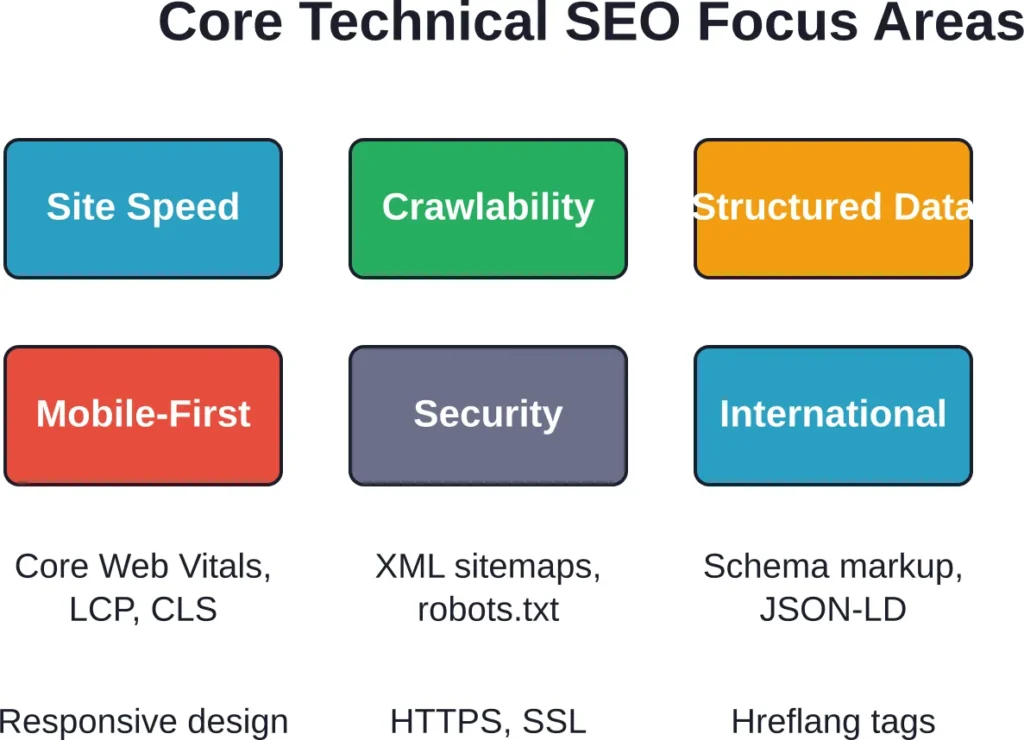
Technical SEO ensures search engines and answer engines can crawl, understand, and trust your site. It covers:
- Site speed and Core Web Vitals optimization
- Mobile responsiveness and rendering
- XML sitemaps and robots.txt configuration
- Structured data (Schema.org markup)
- Canonical tags and duplicate content management
- HTTPS security and hreflang for international sites
- JavaScript rendering and dynamic content indexing
- Server response codes and redirect chains
When these elements break, organic traffic collapses. One documented case showed a 2000% increase in search visibility across eight international markets simply by fixing hreflang tags. Another case study achieved a 493% increase in market penetration by focusing on lower-friction technical opportunities instead of chasing high-competition keywords.
But fixing technical issues isn’t a one-time project. Algorithm updates, site migrations, and new content can introduce fresh problems. That’s why many brands partner with specialized agencies that monitor, audit, and repair technical health continuously.
What Sets Technical SEO Agencies Apart
Not every SEO agency does technical work well. Many focus on content creation or link building and treat technical audits as a checkbox exercise. The best technical SEO agencies distinguish themselves through:
- Deep engineering expertise: They understand server configurations, JavaScript frameworks, CDN behavior, and browser rendering—not just SEO theory.
- Proprietary tooling: They build custom scripts and dashboards to monitor crawl health, log file analysis, and real-time Core Web Vitals.
- Cross-functional collaboration: They work directly with development teams, using Git, staging environments, and version control to implement fixes without breaking production.
- AI search adaptation: They track visibility in ChatGPT, Perplexity, and Google AI Overviews—not just traditional SERPs.
Here’s the thing though—technical SEO often delivers the highest ROI per hour invested. A single redirect loop fix or schema implementation can unlock thousands of pages for indexing overnight.
The 15 Best Technical SEO Optimization Companies
1. Gilzor
Gilzor positions itself as a technical partner for custom digital products that support strong SEO foundations and scalable online presence. They focus on building fast, secure, and user-centric websites and applications that perform well in search engines.
Their services cover full-cycle web and mobile development, UI/UX design optimized for conversion, quality assurance to prevent performance issues, and go-to-market strategies. Notable outcomes include X3 MRR growth for partner businesses, successful product launches with strong early user adoption, and architecture improvements that enhance speed and reliability.
Gilzor’s strength lies in creating technically sound platforms — from idea validation and PoC to post-launch maintenance — that naturally support technical SEO best practices such as clean code, fast load times, and scalable infrastructure for growing organic visibility.
Contact Information:
- Website: www.gilzor.com
- Email: [email protected]
- Address: Poland, Warsaw, Office 58, street Adama Mickiewicza 37, 01-625
- LinkedIn: www.linkedin.com/company/gilzor-softwaredevelopment
2. Mobian
Mobian builds dedicated engineering teams specialized in mobile and AI solutions that deliver production-ready digital products with technical excellence.
They focus on end-to-end product development, scalable architecture, AI & automation systems (including LLMs and computer vision), legacy integration, and domain expertise in healthcare, fintech, logistics, and IT. Both outsourcing and outstaffing models emphasize clean architecture, thorough documentation, and post-launch support.
Their approach ensures systems are built for performance and growth from day one — resulting in fast, reliable platforms that excel in technical SEO factors such as mobile optimization, speed, and future-proof infrastructure while enabling rapid iteration and scaling.
Contact Information:
- Website: mobian.studio
- Phone: [email protected]
- Address: Harju maakond, Tallinn, Kesklinnalinnaosa, Masina tn 22, 10113
- LinkedIn: www.linkedin.com/company/mobian-studio
3. A-listware
A-listware provides dedicated software development and technical consulting that strengthens the backend infrastructure and site performance essential for robust technical SEO.
They offer custom software development, team augmentation, UX/UI design, testing & QA, cloud solutions, data analytics, and legacy modernization. Their expertise spans enterprise applications, ERP/CRM systems, e-commerce platforms, and AI/ML integrations, serving enterprises, SMBs, and startups.
A-listware stands out for seamless integration as an extension of client teams, 24/7 expert access, and end-to-end technical management that ensures secure, scalable, high-performance digital assets — directly supporting crawl efficiency, site speed, structured data, and overall search optimization.
Contact Information:
- Website: a-listware.com
- Phone: +1 (888) 337 93 73
- Email: [email protected]
- Address: North Bergen, NJ 07047, USA
- LinkedIn: www.linkedin.com/company/a-listware
- Facebook: www.facebook.com/alistware
4. Lengreo
Lengreo specializes in technical SEO combined with full-funnel B2B digital marketing for software development, IT services, and tech-enabled businesses. They excel at website audits and optimizations that drive both search visibility and lead generation.
Their approach includes in-depth keyword research, competitor analysis, local SEO, link building, and content strategy paired with technical fixes such as site architecture improvements and conversion rate optimization. They’ve delivered standout results including 400% increase in annually acquired clients for a US software company, 6X reduction in cost per lead for a Dutch event tech company, and 53.6% boost in conversion rate for a Ukrainian IT company.
What stands out is their end-to-end execution: they combine technical SEO with hyper-personalized outreach, demand generation, and website development to turn search traffic into qualified opportunities and revenue. This makes them particularly effective for tech companies needing measurable ROI from organic channels.
Contact Information:
- Website: Lengreo.com
- Phone: +31 686 147 566
- Email: [email protected]
- Address: Vrijstraat 9 C/D, 5611 AT Eindhoven, Netherlands
- LinkedIn: Lengreo
- Twitter: @Lengreo
- Instagram: @lengreo
5. Oski
Oski delivers enterprise-grade technical solutions with a strong emphasis on web development, cloud architecture, and AI integrations that power high-performing digital experiences and SEO-friendly sites.
They specialize in frontend frameworks (React, Vue, Angular, Next.js), CMS platforms (Umbraco, WordPress), cloud and serverless solutions, and custom AI implementations. Their work helps clients in travel, logistics, e-commerce, fintech, and education build scalable, secure platforms with excellent user experiences and performance.
What distinguishes them is rapid team ramp-up and AI-accelerated engineering that delivers faster development while maintaining clean, maintainable code — critical for ongoing technical SEO success, Core Web Vitals, and long-term organic growth.
Contact Information:
- Website: oski.site
- Phone: +48571282759
- Email: [email protected]
- Address: Kaupmehe tn 7, 10114 Tallinn, Estonia
- LinkedIn: www.linkedin.com/company/oski-solutions
6. iPullRank
iPullRank is known for thought leadership in enterprise technical SEO. They pioneered what they call Relevance Engineering—optimizing how AI systems understand, trust, and recommend brands.
Their technical work goes beyond standard audits. They analyze log files to understand Googlebot behavior, optimize for crawl efficiency, implement advanced schema types (including custom vocabularies), and work on entity optimization for knowledge graphs.
iPullRank also focuses heavily on AI search. They track visibility in ChatGPT, Perplexity, and other large language models, ensuring clients appear in generative answers—not just blue links.
They’re a good fit for enterprise brands with complex technical challenges: large-scale migrations, international rollouts, and sites built on headless CMS or JavaScript frameworks.
7. Siege Media
Siege Media is primarily known for content marketing, but they’ve built a strong technical SEO practice to support their editorial work. They understand that great content doesn’t rank if the technical foundation is broken.
Their technical services include Core Web Vitals optimization, structured data implementation, mobile-first audits, and canonicalization fixes. They’ve published detailed case studies showing how technical improvements amplified content performance.
Siege Media’s integrated approach is their differentiator. They don’t hand off technical recommendations to a separate team—they own the full stack from content creation to technical implementation to performance tracking.
They’re a strong choice for brands that need both technical fixes and high-quality content to capitalize on those improvements.
8. Silverback Strategies
Silverback Strategies offers enterprise SEO with a heavy emphasis on technical audits and ongoing monitoring. They’ve worked with large brands across ecommerce, finance, and healthcare.
Their technical services include site speed optimization, crawl budget management, structured data audits, and hreflang implementation for international sites. They use a mix of industry tools and custom scripts to monitor site health continuously.
Silverback’s strength is cross-functional collaboration. They work closely with development teams, product managers, and IT departments to implement fixes that align with broader engineering roadmaps.
They’re a good fit for large organizations where SEO changes require approval from multiple stakeholders and integration with existing workflows.
9. SeoProfy
SeoProfy specializes in healthcare and local SEO, but their technical practice is robust across industries. They focus on Core Web Vitals, mobile responsiveness, structured data, and Google penalty recovery.
They’ve documented consistent results in improving site speed and fixing crawl errors for healthcare providers, local service businesses, and ecommerce brands. Their approach includes pre-audit diagnostics, detailed fix recommendations, and post-implementation validation.
SeoProfy also offers link building and international SEO services, which makes them a good choice for brands that need technical fixes alongside off-page work.
Their retention rate is high, suggesting they provide ongoing technical support rather than one-time audits.
10. The HOTH
The HOTH started as a link-building service but has expanded into full-service SEO with a strong technical offering. They provide site audits, schema implementation, Core Web Vitals optimization, and ongoing technical monitoring.
Their strength is accessibility. They offer flexible engagement models—one-time audits, monthly retainers, and project-based work—which makes them a fit for small and mid-sized businesses that can’t commit to long-term contracts.
The HOTH uses industry-standard tools and provides clear, actionable reports. They’re not the most advanced technical agency on this list, but they deliver solid results at a more accessible scale.
They’re a good choice for brands that need reliable technical support without the complexity and cost of enterprise-level agencies.
11. First Page Sage
First Page Sage specializes in data-driven technical SEO for enterprise and mid-market brands. They’re known for rigorous site audits that uncover crawl inefficiencies, duplicate content issues, and Core Web Vitals bottlenecks.
Their approach combines manual analysis with proprietary tooling to monitor log files, track indexation changes, and validate schema markup. They’ve documented consistent results in improving organic visibility through technical fixes—particularly for SaaS and financial services clients.
What stands out is their focus on AI search visibility. They track brand mentions in ChatGPT, Perplexity, and Google AI Overviews, ensuring clients appear in generative answer engines—not just traditional search results.
First Page Sage emphasizes strategic battle selection: prioritizing high-impact, lower-friction technical opportunities over chasing saturated keywords. This philosophy has delivered documented increases in market penetration without requiring massive content investments.
12. Embarque

Embarque positions itself as an ROI-first technical SEO agency. Founded in 2020, they’ve built a reputation for combining technical fixes with data-driven growth strategies.
They specialize in technical audits that identify rendering issues, canonicalization problems, and server response errors. One notable result: they helped Flick reach 9.6 million in yearly traffic by addressing crawl budget waste and optimizing site architecture.
Embarque’s strength lies in cross-functional execution. They work directly with engineering teams to implement fixes in staging environments, validate with testing tools, and monitor production rollouts to prevent regressions.
They also monitor algorithm changes closely and adjust technical strategies proactively. That kind of continuous attention prevents the traffic drops that often follow Google core updates.
13. WebFX
WebFX has operated since 1996 and offers full-service digital marketing with a strong technical SEO practice. They’re one of the larger agencies on this list, with a team that includes dedicated technical specialists.
Their technical services cover Core Web Vitals optimization, structured data implementation, mobile-first indexing audits, and JavaScript SEO for single-page applications. They’ve published case studies showing traffic increases after resolving indexation issues and redirect chains.
WebFX uses a mix of industry-standard tools and custom reporting dashboards. They provide ongoing monitoring for crawl errors, server issues, and schema validation, which helps catch problems before they impact rankings.
Their scale allows them to handle large enterprise sites with complex architectures—multiregional configurations, dynamic content, and massive product catalogs.
14. Victorious
Victorious focuses exclusively on SEO—no PPC, no social media, no content marketing outside of SEO. That narrow focus translates into deep technical expertise.
They’re particularly strong in site migrations, international SEO (hreflang implementation), and fixing crawl budget issues for large ecommerce sites. Their team includes former Google employees and engineers who understand crawling behavior at a code level.
Victorious has documented results in reducing crawl errors by over 80% for enterprise clients, leading to significant indexation improvements. They also work on Core Web Vitals optimization, especially Largest Contentful Paint (LCP) and Cumulative Layout Shift (CLS) improvements.
Their process includes pre-launch migration testing, post-launch monitoring, and rollback plans—critical for high-traffic sites where downtime costs thousands per hour.
15. Searchbloom
Searchbloom combines technical SEO with conversion rate optimization, which gives them a unique perspective. They don’t just fix crawl errors—they ensure the technical improvements drive measurable business outcomes.
They’ve published extensive documentation on their MERIT Framework, which integrates technical SEO with AI search optimization. Their case studies show an average ROI of 720% or higher across campaigns, with a client retention rate of 98%, one of the highest in the industry.
Searchbloom’s technical services include schema markup for rich results, site speed optimization, mobile responsiveness testing, and server-side rendering for JavaScript frameworks. They also track AI search visibility and optimize for answer engine citations.
Their strength is translating technical fixes into revenue impact, which makes them a strong fit for brands that need to justify SEO investments with hard numbers.
Key Technical SEO Services These Agencies Provide
While each agency has unique strengths, all 15 offer core technical SEO services that form the foundation of site health and search visibility.
Site Speed and Core Web Vitals Optimization
Google’s Core Web Vitals—Largest Contentful Paint (LCP), First Input Delay (FID), and Cumulative Layout Shift (CLS)—are confirmed ranking factors. Agencies optimize server response times, image compression, JavaScript execution, and layout stability to meet Google’s thresholds.
Real-world improvements often include implementing lazy loading, switching to next-gen image formats (WebP, AVIF), optimizing CSS delivery, and reducing third-party script impact.
Crawl Budget Optimization and Log File Analysis
Large sites waste crawl budget on low-value pages—pagination, filters, session IDs, and duplicate URLs. Agencies analyze server logs to understand Googlebot behavior and optimize robots.txt, internal linking, and URL parameters.
This work is critical for ecommerce sites with thousands of product pages or publishers with large archives.
Structured Data and Schema Markup
Schema.org markup helps search engines understand content types—articles, products, FAQs, events, local businesses. Agencies implement JSON-LD structured data, validate with Google’s Rich Results Test, and monitor for errors in Search Console.
Structured data is especially important for AI search. Answer engines rely on schema to extract and cite information accurately.
Mobile-First Indexing and Responsive Design
Google indexes the mobile version of sites by default. Agencies audit mobile usability, fix rendering issues, optimize touch targets, and ensure parity between desktop and mobile content.
International SEO and Hreflang Implementation
For brands operating in multiple countries or languages, hreflang tags tell Google which version to serve to which audience. Incorrect implementation causes duplicate content issues and wrong-language results.
Agencies audit hreflang tags, fix mismatches, and validate with tools like Screaming Frog and Google Search Console.
JavaScript SEO and Dynamic Rendering
Sites built on React, Angular, or Vue require special handling. Agencies test how Googlebot renders JavaScript, implement server-side rendering or static site generation, and ensure critical content is indexable.
HTTPS, Security, and Server Configuration
HTTPS is a ranking signal and a trust factor. Agencies audit SSL certificates, fix mixed content warnings, and implement security headers (HSTS, CSP).
What to Look for When Hiring a Technical SEO Agency
Not every agency is a fit for every business. Here’s what to evaluate during the vetting process.
Ask for Detailed Case Studies
Generic claims like “we increased traffic by 200%” don’t mean much without context. Ask for case studies that show:
- The specific technical problems identified
- The fixes implemented
- The measurable outcomes (crawl errors reduced, Core Web Vitals improved, indexation increased)
- The timeline and resources required
Strong agencies publish detailed case studies with before-and-after data, tool screenshots, and technical explanations.
Evaluate Their Tool Stack
Technical SEO requires more than Ahrefs and SEMrush. Ask what tools they use for:
- Log file analysis (Screaming Frog Log Analyzer, Botify, OnCrawl)
- Core Web Vitals monitoring (PageSpeed Insights, CrUX, WebPageTest)
- Schema validation (Google Rich Results Test, Schema.org validator)
- Crawl simulation (Screaming Frog, Sitebulb, Lumar)
- JavaScript rendering (Puppeteer, Headless Chrome, Google Search Console URL Inspection)
Agencies that build custom scripts or use BigQuery for log analysis often deliver deeper insights than those relying solely on off-the-shelf tools.
Assess Cross-Functional Collaboration Experience
Technical SEO changes often require engineering support. Ask how the agency works with development teams:
- Do they submit pull requests or just provide PDF recommendations?
- Can they test fixes in staging environments?
- Do they understand version control (Git) and deployment pipelines?
- Have they worked with your specific CMS, framework, or hosting environment?
Agencies that integrate with engineering workflows deliver faster, more reliable implementations.
Check AI Search Capabilities
Given that 60% of searches are now zero-click and 84% of B2B buyers use AI for vendor discovery, ask how the agency tracks and optimizes for AI search:
- Do they monitor visibility in ChatGPT, Perplexity, and Google AI Overviews?
- Can they implement entity optimization and knowledge graph signals?
- Do they understand prompt-level tracking and citation analysis?
Agencies focused exclusively on traditional SERP rankings may miss opportunities in AI search visibility.
Review Client Retention Rates
High retention rates signal consistent value delivery. If an agency’s clients stick around for years, it means they’re providing ongoing monitoring, proactive fixes, and measurable results.
Ask for average client tenure and references from long-term clients.
The Shift to AI Search and Generative Engine Optimization
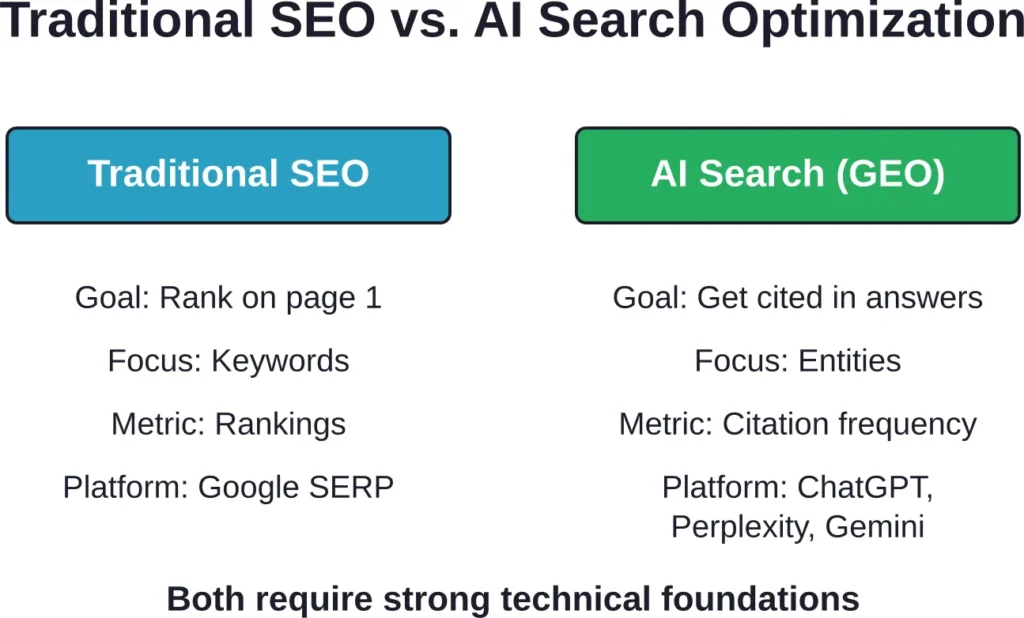
Traditional SEO optimizes for Google’s algorithm. But in 2026, that’s only part of the picture. Answer engines like ChatGPT, Perplexity, and Google’s AI Overviews are reshaping how people find information.
According to recent research, organic traffic can drop by 30-70% when AI-generated overviews appear in search results. That means brands must optimize not just for ranking, but for being cited by AI systems.
This new discipline—called Generative Engine Optimization (GEO) or Answer Engine Optimization (AEO)—requires technical SEO plus entity optimization. Agencies that excel here focus on:
- Structured data to help AI systems parse content
- Entity signals (brand mentions, Wikipedia presence, knowledge graph inclusion)
- Authoritative citations and backlinks from trusted sources
- Clear, factual, well-sourced content that AI systems can extract and cite confidently
Industry discussions suggest that SEO agencies incorporating GEO tactics are charging an additional $4,000 per month for these services. Early adopters report an 88% year-over-year increase in organic traffic in the first two quarters by optimizing for both traditional search and AI search simultaneously.
How Technical SEO Supports AI Search Visibility
Technical SEO and GEO are tightly linked. AI systems rely on clean, structured, fast-loading sites to extract accurate information. Specifically:
- Schema markup tells AI systems what entities exist on the page (people, products, organizations, events)
- Canonical tags prevent confusion when AI systems crawl duplicate content
- Fast load times ensure AI crawlers can access content efficiently
- Mobile-first design matters because AI systems often pull from mobile-indexed versions
- Clean HTML structure makes parsing easier for large language models
In practice, brands that fix technical issues see improved visibility in both traditional search and AI answer engines.
Common Technical SEO Challenges and How Agencies Solve Them
Every site faces unique technical issues, but certain problems appear repeatedly. Here’s how specialized agencies tackle the most common obstacles.
JavaScript Rendering and Indexation Issues
Single-page applications built on React, Angular, or Vue often fail to render content for Googlebot. The symptom: pages show up in Search Console but display zero content when inspected.
Agencies solve this by implementing server-side rendering (SSR), static site generation (SSG), or dynamic rendering. They test with Google’s Mobile-Friendly Test and URL Inspection Tool to verify Googlebot sees the full content.
Crawl Budget Waste on Faceted Navigation
Ecommerce sites generate thousands of filter combinations (color + size + price range). Googlebot wastes crawl budget on low-value URLs, leaving important product pages undiscovered.
Agencies fix this by blocking filter URLs in robots.txt, using canonical tags to consolidate variations, and implementing rel=nofollow on filter links. They also optimize internal linking to prioritize high-value product and category pages.
Duplicate Content from URL Parameters
Session IDs, tracking parameters, and sort filters create duplicate content. Google sees the same page at multiple URLs and may not index the correct version.
Agencies implement canonical tags, configure URL parameters in Search Console, and strip unnecessary parameters at the server level.
Core Web Vitals Failing Due to Third-Party Scripts
Ad networks, analytics tags, and chat widgets often block rendering and cause layout shifts. Sites fail Core Web Vitals despite fast hosting.
Agencies audit third-party scripts, implement lazy loading, use facade techniques (loading scripts only on user interaction), and optimize script execution order.
Hreflang Errors Causing Wrong-Language Results
International sites with hreflang tags often have implementation errors: missing return tags, incorrect language codes, or wrong URL references.
Agencies audit hreflang using Screaming Frog, validate with Search Console, and fix mismatches. One case study documented a 2000% increase in search visibility across eight markets simply by correcting hreflang errors.
Schema Markup Errors Preventing Rich Results
Incorrect schema syntax, missing required fields, or mismatched schema types prevent rich results from appearing. Sites lose star ratings, FAQ snippets, and product carousels.
Agencies validate schema with Google’s Rich Results Test, fix errors, and monitor Search Console for schema-related issues. They also implement new schema types as Google supports them (e.g., HowTo, SpecialAnnouncement, FAQ).
Measuring Technical SEO Success: Key Metrics
Technical SEO isn’t a one-time project—it requires continuous monitoring. Agencies track these metrics to measure success and catch regressions early.
Crawl Error Rate
Measured in Google Search Console under Coverage reports. A healthy site has fewer than 1% of URLs showing errors. Agencies monitor for sudden spikes, which indicate broken links, server issues, or incorrect redirects.
Core Web Vitals Scores
Tracked in Search Console and CrUX reports. Agencies aim for 75% of page loads to meet the “Good” thresholds:
- LCP under 2.5 seconds
- FID under 100 milliseconds
- CLS under 0.1
Indexation Rate
The percentage of important pages successfully indexed. Agencies compare submitted sitemaps against indexed URLs in Search Console. Large discrepancies signal crawl budget issues or noindex errors.
Organic Click-Through Rate (CTR)
Measured in Search Console. Technical improvements (faster load times, rich results from schema) often increase CTR by reducing bounce rates and improving snippet appearance.
Page Speed and Time to First Byte (TTFB)
Tracked with PageSpeed Insights, GTmetrix, and WebPageTest. Agencies aim for TTFB under 200ms and total load times under 3 seconds.
AI Search Visibility
Newer metric tracked by specialized tools (Visto, BrightEdge, custom scripts). Measures how often a brand appears in ChatGPT responses, Perplexity citations, or Google AI Overviews for target queries.
Recent data shows an 88% year-over-year increase in organic traffic for brands optimizing for both traditional and AI search, compared to 42% for those focusing on SERPs alone.
| Metric | Tool | Target / Threshold |
|---|---|---|
| Crawl Error Rate | Google Search Console | < 1% of total URLs |
| Core Web Vitals (LCP) | CrUX, PageSpeed Insights | < 2.5 seconds |
| Indexation Rate | Search Console Coverage | > 95% of submitted URLs |
| Schema Validation | Rich Results Test | Zero errors |
| Mobile Usability | Search Console | Zero mobile usability errors |
| TTFB | WebPageTest | < 200ms |
Frequently Asked Questions
Technical SEO covers all the behind-the-scenes optimizations that help search engines crawl, understand, and index a website. It includes site speed, mobile responsiveness, structured data, XML sitemaps, crawl budget management, and server configuration. Without solid technical SEO, even great content won’t rank because search engines can’t access or understand it properly.
Most agencies don’t publish pricing publicly, but typical ranges fall between one-time audits (starting around $1,000–$2,500) and ongoing monthly retainers. The exact cost depends on site size, complexity, and scope of work. For current pricing from any specific agency, check their official website or request a proposal directly.
Some fixes show impact within days—like correcting a noindex tag or fixing broken redirects. Larger improvements (Core Web Vitals optimization, crawl budget fixes) typically take 4–12 weeks to reflect in rankings as Google recrawls and reindexes the site. International SEO fixes (hreflang) can take even longer because Google must recrawl multiple country versions.
Technical SEO removes barriers that prevent ranking, but it doesn’t guarantee top positions by itself. It’s the foundation—sites with solid technical health see better results from content and link-building efforts. One documented case showed a 493% increase in market penetration through technical fixes and strategic keyword selection, proving that technical work can drive significant growth when combined with smart strategy.
On-page SEO focuses on content elements: keywords, meta tags, headers, internal links, and readability. Technical SEO focuses on infrastructure: site speed, crawlability, indexation, structured data, and server configuration. Both are essential, and they overlap—for example, implementing schema markup is both a technical and on-page task.
Many large brands use agencies to supplement in-house teams. Agencies bring specialized expertise (log file analysis, JavaScript SEO, Core Web Vitals optimization) that in-house generalists may lack. They also provide an external perspective and catch issues internal teams miss. For complex projects like site migrations or international rollouts, agency expertise often prevents costly mistakes.
Run a free audit using Google Search Console, PageSpeed Insights, and Mobile-Friendly Test. Look for crawl errors, Core Web Vitals failures, mobile usability issues, and schema validation errors. If you see a pattern of declining organic traffic, pages not indexing, or poor mobile performance, technical issues are likely contributing.
Generative Engine Optimization (GEO) or Answer Engine Optimization (AEO) focuses on visibility in AI-powered answer engines like ChatGPT, Perplexity, and Google AI Overviews. Given that 60% of searches are now zero-click and 84% of B2B buyers use AI for vendor discovery, optimizing for AI citations is becoming as important as ranking on page one. GEO requires technical SEO (structured data, clean HTML) plus entity optimization to help AI systems understand and trust your brand.
Conclusion: Choosing the Right Technical SEO Partner
Technical SEO is no longer optional. With algorithm updates, AI search, and increasing competition for organic visibility, brands need specialized expertise to maintain site health and ranking performance.
The 15 agencies profiled here represent the top tier of technical SEO specialists. They’ve documented measurable results, built proprietary tools, and adapted to the shift toward AI search.
When evaluating potential partners, prioritize agencies that:
- Publish detailed case studies with specific technical fixes and measurable outcomes
- Use advanced tools (log analyzers, custom scripts, BigQuery) beyond off-the-shelf platforms
- Collaborate directly with engineering teams rather than just delivering PDF recommendations
- Track AI search visibility alongside traditional rankings
- Maintain high client retention rates, signaling consistent value delivery
Real talk: technical SEO is complex, but the ROI can be massive. A single hreflang fix delivered a 2000% increase in international visibility. Strategic technical optimizations drove a 493% increase in market penetration. And early adopters of AI search optimization report an 88% year-over-year traffic increase.
The agencies on this list have the expertise to deliver those kinds of results. The right choice depends on your specific needs—enterprise scale, ecommerce complexity, international rollout, or AI search visibility.
Start by reaching out to 2–3 agencies, sharing your site challenges, and reviewing their proposed approach. The best technical SEO partnerships are built on transparency, collaboration, and a shared commitment to measurable outcomes.