

Quick Summary: Choosing the right web design and development agency can transform your online presence. This guide profiles 15 leading agencies specializing in everything from SaaS design to eCommerce and branding, helping you match your project needs with the right expertise. Each agency brings distinct strengths—whether it’s conversion-focused design, enterprise-scale projects, or startups seeking rapid growth.
Your website is often the first handshake between your business and potential customers. Users typically take just 50 milliseconds to assess the visual appeal of a website—and decide whether to stay or bounce.
That’s why partnering with the right web design and development company isn’t just a nice-to-have. It’s mission-critical.
But here’s the problem: the landscape is crowded. Hundreds of agencies claim to be the best, each promising stunning designs and flawless execution. How do you separate genuine expertise from marketing fluff?
This guide cuts through the noise. We’ve analyzed the top web design agencies operating in 2026, examining their specialties, client rosters, and what makes each one stand out. Whether you’re building a SaaS product, launching an eCommerce store, or refreshing your brand’s digital presence, you’ll find an agency match here.
No fabricated rankings. No invented data. Just real companies with proven track records.
Why Your Choice of Web Design Agency Matters
Before we dive into the agency profiles, let’s establish why this decision carries so much weight.
A slow-loading website kills conversions. Research shows that a one-second delay in page response can reduce conversions by 7%. A study by Google found that 53% of mobile users will abandon a site if it takes more than three seconds to load.
Poor user experience doesn’t just frustrate visitors—it costs revenue. , which increasingly include digital touchpoints.
On the flip side, . The right design choices compound into measurable business outcomes.
But technical performance is only half the equation. Your website needs to communicate your brand identity, guide users toward conversion actions, and scale as your business grows. That requires strategic thinking alongside design chops.
The agencies profiled below excel at balancing aesthetics with performance, strategy with execution.
The Top 15 Web Design and Development Companies
Here’s our curated list of agencies that consistently deliver exceptional results across different specializations and project types.
1. Gilzor
Gilzor specializes in custom software development with a strong emphasis on web and mobile applications that deliver exceptional user experiences and business value.
The agency follows a full-cycle approach that includes idea validation, business analysis, UI/UX design, development, quality assurance, and go-to-market support. This structured process helps clients reduce risk while building digital products that meet real user needs.
Their portfolio features web and mobile solutions across industries including airlines, eCommerce grocery platforms, and health & wellness apps. These projects focus on automation, user engagement, and scalable performance that drive measurable results like user growth and operational efficiency.
Gilzor’s team of creative and strategic thinkers prioritizes clean architecture, user-centric design, and reliable delivery, making them a trusted partner for both startups and established businesses.
For companies that need custom web and mobile solutions built from idea to launch and beyond, Gilzor delivers high-quality digital products tailored to specific business goals.
Best for: Startups, SMBs, product studios, custom web and mobile applications
Specialty strengths: Full-cycle web development, UI/UX design, idea validation, scalable architecture, go-to-market support
Contact Information:
- Website: www.gilzor.com
- Email: [email protected]
- Address: Poland, Warsaw, Office 58, street Adama Mickiewicza 37, 01-625
- LinkedIn: www.linkedin.com/company/gilzor-softwaredevelopment
2. Mobian
Mobian builds dedicated engineering teams that deliver production-ready mobile and web solutions with a focus on speed, quality, and scalability for companies in IT, healthcare, fintech, and logistics.
The agency works through outsourcing and outstaffing models, providing full-stack delivery from design and architecture to deployment and ongoing support. Their process prioritizes clean code, clear documentation, and seamless integration with client environments.
Mobian develops web and mobile applications, AI-powered systems, and complex digital products that solve real business challenges while maintaining high performance and regulatory compliance where required.
Their senior-level engineers emphasize scalable architecture, legacy integration, and post-launch partnership, ensuring solutions remain effective as businesses grow.
For companies that need fast, reliable delivery of web and mobile solutions without the overhead of building internal teams, Mobian provides expert execution and long-term technical partnership.
Best for: IT, healthcare, fintech and logistics companies, dedicated team projects, complex digital products
Specialty strengths: Full-stack web and mobile development, AI systems, scalable architecture, dedicated engineering teams, legacy integration
Contact Information:
- Website: mobian.studio
- Phone: [email protected]
- Address: Harju maakond, Tallinn, Kesklinnalinnaosa, Masina tn 22, 10113
- LinkedIn: www.linkedin.com/company/mobian-studio
3. Lengreo
Lengreo acts as a complete marketing and tech partner, delivering integrated digital solutions that combine strategic marketing with high-performing website development for B2B companies.
The agency focuses on results-driven digital experiences, building websites, landing pages, and eCommerce platforms that support lead generation, conversion optimization, and business growth. Their process starts with deep business analysis and strategy development before moving into design, development, and ongoing optimization.
Lengreo creates websites and digital systems that drive measurable outcomes such as increased client acquisition, reduced cost per lead, and higher conversion rates for companies in software development, architecture, event technology, sports tech, and IT services.
Their team blends marketing strategists, designers, developers, and customer success specialists who ensure seamless alignment between technical execution and business objectives. This integrated approach allows clients to treat them as a true extension of their growth team.
For B2B companies seeking websites that actively generate leads and revenue while supporting broader marketing efforts, Lengreo provides the full-stack capabilities to execute effectively.
Best for: B2B companies, lead generation websites, marketing-driven digital platforms, eCommerce and service websites
Specialty strengths: B2B digital strategy, website development, conversion optimization, lead generation systems, SEO-integrated web solutions
Contact Information:
- Website: Lengreo.com
- Phone: +31 686 147 566
- Email: [email protected]
- Address: Vrijstraat 9 C/D, 5611 AT Eindhoven, Netherlands
- LinkedIn: Lengreo
- Twitter: @Lengreo
- Instagram: @lengreo
4. A-listware
A-listware is a software development and consulting company that delivers custom web applications, enterprise solutions, and dedicated development teams tailored to client requirements.
The agency offers end-to-end services including software consulting, custom development, UX/UI design, team augmentation, and infrastructure management. Their collaborative approach ensures solutions integrate smoothly with existing systems and teams.
They create enterprise applications, ERP, CRM, and other web-based systems for companies ranging from startups to large organizations. Projects emphasize quality, security, responsiveness, and long-term maintainability.
A-listware’s flexible engagement models and broad technical expertise allow them to function as a seamless extension of client teams while delivering cost-effective, high-quality digital solutions.
For businesses needing reliable custom software development and web solutions with strong technical execution, A-listware serves as a dependable long-term technology partner.
Best for: Enterprises, SMBs, startups, custom software and web platforms
Specialty strengths: Custom software development, dedicated teams, UX/UI design, enterprise applications, cloud and infrastructure solutions
Contact Information:
- Website: a-listware.com
- Phone: +1 (888) 337 93 73
- Email: [email protected]
- Address: North Bergen, NJ 07047, USA
- LinkedIn: www.linkedin.com/company/a-listware
- Facebook: www.facebook.com/alistware
5. Oski
Oski builds smart, well-engineered software solutions including modern web platforms, frontend systems, and content management solutions for tech-forward enterprises and ambitious startups.
The agency combines innovative design with robust development practices across cloud, frontend technologies, AI integrations, and CMS platforms. Their process emphasizes quality, scalability, and seamless user experiences from concept through deployment and maintenance.
Oski delivers digital solutions for industries such as travel, logistics, eCommerce, education, fintech, and insurance. Their work focuses on creating intuitive interfaces, powerful backend systems, and AI-enhanced features that improve operations and customer engagement.
With expertise in React, Vue, Angular, cloud architectures, and AI tools, Oski’s team creates flexible, high-performance web solutions that adapt to evolving business needs.
For enterprises and startups that require reliable, scalable web solutions with advanced capabilities, Oski provides the technical depth and creative approach to bring ambitious digital visions to life.
Best for: Tech-forward enterprises, startups, industry-specific web platforms, cloud-based solutions
Specialty strengths: Frontend development, cloud architecture, AI integration, CMS solutions, scalable web applications
Contact Information:
- Website: oski.site
- Phone: +48571282759
- Email: [email protected]
- Address: Kaupmehe tn 7, 10114 Tallinn, Estonia
- LinkedIn: www.linkedin.com/company/oski-solutions
6. Digital Silk

Digital Silk specializes in enterprise-scale websites and digital experiences for established brands, bringing capabilities that match the complexity and scale requirements of larger organizations.
The agency handles projects that often involve multiple stakeholder groups, complex approval processes, and integration with existing enterprise systems. Their process accommodates these organizational realities while maintaining design quality and project momentum.
Digital Silk’s portfolio includes work for global brands across industries including healthcare, finance, and technology. These projects typically require rigorous security standards, accessibility compliance, and sophisticated content management systems.
Their team structure includes strategists, designers, developers, and project managers who can navigate enterprise buying cycles and coordinate with internal IT departments. This organizational maturity differentiates them from smaller agencies that struggle with enterprise-scale complexity.
For established companies undertaking significant digital initiatives—complete redesigns, digital transformation projects, or launching new digital business lines—Digital Silk brings the infrastructure and experience to execute at scale.
Best for: Enterprise companies, large-scale redesigns, complex organizational requirements
Specialty strengths: Enterprise process navigation, stakeholder management, system integration, compliance and security
7. Lounge Lizard
Lounge Lizard positions itself as a “brandtenders” agency, emphasizing the connection between web design and broader brand expression.
The agency’s approach treats websites as brand ambassadors, ensuring every design decision reinforces brand identity and positioning. This makes them particularly valuable for companies where brand differentiation matters—competitive markets where visual identity and brand perception influence buying decisions.
Lounge Lizard’s work spans websites, mobile apps, and digital marketing, allowing them to maintain brand consistency across touchpoints. Their process typically begins with brand strategy work before moving into design execution.
The agency has operated since 1998, giving them longevity that’s relatively rare in the agency world. This experience base means they’ve navigated multiple waves of web technology evolution and understand how to build sites that remain effective as technologies shift.
Their client roster includes both B2B and B2C companies across sectors, with particular strength in lifestyle brands, consumer products, and professional services where brand perception drives value.
Best for: Brand-focused companies, lifestyle products, competitive consumer markets
Specialty strengths: Brand strategy, visual identity, cross-channel consistency, long-term agency relationships
8. Ruckus

Ruckus specializes in marketing-focused websites with particular strength in eCommerce, content marketing, and lead generation architectures.
The agency’s philosophy centers on treating websites as revenue-generating tools rather than digital brochures. Their designs prioritize clear conversion paths, strategic calls-to-action, and user flows optimized for business outcomes.
Ruckus brings notable strength in Shopify development, making them a natural fit for eCommerce brands building or refreshing online stores. Their understanding of eCommerce best practices—from product page optimization to checkout flow refinement—comes from deep platform specialization.
Beyond eCommerce, Ruckus works with B2B companies needing lead generation machinery and content publishers requiring sophisticated content management and distribution capabilities.
Their development team handles custom functionality alongside design work, allowing them to build tailored solutions when off-the-shelf tools don’t meet requirements. This technical flexibility supports unique business models and workflows.
Best for: eCommerce brands, Shopify stores, marketing-focused websites, lead generation
Specialty strengths: Shopify expertise, conversion optimization, eCommerce best practices, marketing automation integration
9. Top Notch Dezigns

Top Notch Dezigns operates as a design and digital marketing agency serving small to mid-sized businesses across industries, with a focus on affordable, results-driven solutions.
The agency’s strength lies in making professional web design accessible to businesses that might not have enterprise budgets but still need quality digital presence. They’ve refined processes that deliver solid results without the overhead and complexity that can inflate costs at larger agencies.
Top Notch Dezigns offers bundled services including web design, SEO, social media management, and content creation. This one-stop-shop model appeals to smaller businesses that prefer consolidated vendor relationships rather than managing multiple agencies.
Their portfolio spans local service businesses, small eCommerce operations, and professional practices. These clients typically need straightforward websites that look professional, load quickly, and convert visitors—without unnecessary complexity.
The agency’s approach emphasizes practical solutions over cutting-edge experimentation, delivering proven designs that serve business objectives reliably.
Best for: Small businesses, local service providers, budget-conscious projects
Specialty strengths: Affordable solutions, bundled marketing services, practical design, small business focus
10. Fantasy
Fantasy operates at the premium end of the market, creating high-concept digital experiences for brands where design innovation and creative risk-taking align with brand positioning.
The agency’s portfolio features visually striking, interaction-rich websites that push technical and creative boundaries. Their work often incorporates advanced animations, custom illustrations, and experimental interaction patterns.
Fantasy’s client list includes fashion brands, entertainment companies, cultural institutions, and consumer products where design serves as a primary differentiator. These are contexts where conventional design patterns would feel limiting.
The agency’s creative-first approach means they’re less focused on conversion optimization formulas and more interested in creating memorable brand experiences. This makes them ideal for brands where emotional impact and brand perception matter more than immediate conversion metrics.
Fantasy projects typically involve longer timelines and larger budgets, reflecting the custom nature of their work and the level of creative exploration involved. They’re not optimizing templates—they’re crafting bespoke digital experiences.
Best for: Premium brands, fashion and lifestyle, entertainment, brands prioritizing creative impact
Specialty strengths: Creative innovation, advanced interactions, brand storytelling, custom development
11. Clay
Clay has built a reputation as a UI/UX powerhouse serving venture-backed startups and established tech companies. Their portfolio spans high-profile clients across SaaS, fintech, and consumer tech.
What sets Clay apart is their product-first approach. They don’t just design websites—they architect digital experiences that support business objectives and scale with product growth. Their process integrates UX research, interface design, and brand strategy into cohesive solutions.
Their client results speak volumes. Designs for Datawisp helped the company raise $3.6M in funding. Work for Floret contributed to a $2.3M raise. And their design work for Aampe supported an $18M funding round., and their designs often play a role in helping startups secure investment rounds.
Clay excels at taking complex technical products and making them feel intuitive and approachable. If you’re building a SaaS application or digital product where user experience directly impacts retention and growth, Clay brings the expertise and track record to deliver.
Best for: SaaS companies, tech startups, digital products requiring sophisticated UI/UX
Specialty strengths: Product design, user research, interface architecture, branding integration
12. Eleken
Eleken operates as a distributed team of over 100 designers and SaaS product experts, all laser-focused on one thing: making complex web applications simple, fast, and usable.
Founded in 2015, the agency has carved out a distinctive niche in SaaS product design. They’re not trying to be everything to everyone—they concentrate specifically on web applications where usability can make or break the product.
Their client results speak volumes. Designs for Datawisp helped the company raise $3.6M in funding. Work for Floret contributed to a $2.3M raise. And their design work for Aampe supported an $18M funding round.
These outcomes aren’t coincidental. Eleken treats design projects as startup accelerators, understanding that for early-stage companies, design quality directly influences investor confidence and user adoption.
The agency’s distributed structure allows them to scale teams flexibly while maintaining consistent quality across projects. For SaaS founders who need design expertise without the overhead of a full in-house team, Eleken offers a compelling model.
Best for: SaaS startups, web applications, product teams needing flexible design resources
Specialty strengths: Complex application UI, user flows, product thinking, startup acceleration
13. Huemor
Huemor positions itself at the intersection of design and business strategy, working primarily with established businesses undergoing digital transformation.
The agency’s strength lies in understanding that redesigns aren’t just about prettier interfaces—they’re about solving business problems. Whether that’s improving lead generation, increasing eCommerce conversions, or repositioning a brand for new markets.
Huemor’s process starts with strategic discovery, identifying the core business objectives before any design work begins. This approach ensures the final website directly supports measurable outcomes rather than just aesthetic preferences.
Their client roster includes B2B service companies, mid-market eCommerce brands, and professional services firms. These organizations typically need websites that generate leads and communicate authority—exactly where Huemor’s expertise shines.
The agency handles both design and development in-house, allowing tighter integration between creative vision and technical execution. This reduces the friction that often occurs when design and development are siloed.
Best for: Established businesses, B2B companies, lead generation-focused websites
Specialty strengths: Strategic discovery, conversion optimization, business-focused design, full-stack development
14. Bop Design
Bop Design specializes in websites for B2B firms and professional services, with particular strength in content strategy and messaging architecture.
Many agencies focus primarily on visual design, treating content as an afterthought. Bop flips that equation, recognizing that for B2B buyers, substance often matters more than style. Their process emphasizes clarifying value propositions, structuring information hierarchies, and crafting messaging that resonates with decision-makers.
The agency works extensively with consulting firms, software companies, and professional services organizations where the buying cycle is long and content plays a crucial role in nurturing prospects.
Bop’s strength in messaging makes them particularly valuable for companies struggling to articulate complex offerings clearly. They excel at translating technical features into customer benefits and structuring content to guide prospects through consideration stages.
Their design aesthetic tends toward clean, professional layouts that establish credibility without unnecessary flourish—appropriate for audiences that prioritize substance over flash.
Best for: B2B firms, professional services, consulting companies, complex offerings
Specialty strengths: Content strategy, messaging architecture, value proposition development, professional credibility
15. Thrive Internet Marketing Agency
Thrive operates as a full-service digital marketing agency where web design integrates with broader marketing initiatives including SEO, paid advertising, and content marketing.
This integrated approach offers distinct advantages. Thrive’s designers build websites with SEO architecture from the ground up rather than retrofitting optimization later. Their understanding of conversion optimization comes from running actual ad campaigns and analyzing performance data.
The agency has achieved notable growth in referral traffic from AI platforms, with total traffic from generative AI sources growing by 4,302% from January to October 2025. This demonstrates their ability to adapt to emerging search behaviors—a critical advantage as AI-powered search tools reshape how users discover websites.
Thrive’s strength lies in treating website design as one component within a comprehensive digital strategy. Thrive was able to achieve substantial growth in referral traffic from popular generative AI platforms using innovative AI SEO strategies. From January to October 2025, total traffic from all AI platforms grew by a staggering +4,302%.
Their client base spans industries, from local service businesses to national brands, with scalable service packages accommodating different budget levels and complexity needs.
Best for: Businesses needing integrated marketing, companies launching with paid acquisition, local service businesses
Specialty strengths: SEO integration, conversion optimization, paid traffic strategy, comprehensive digital marketing
What to Look for in a Web Design Company
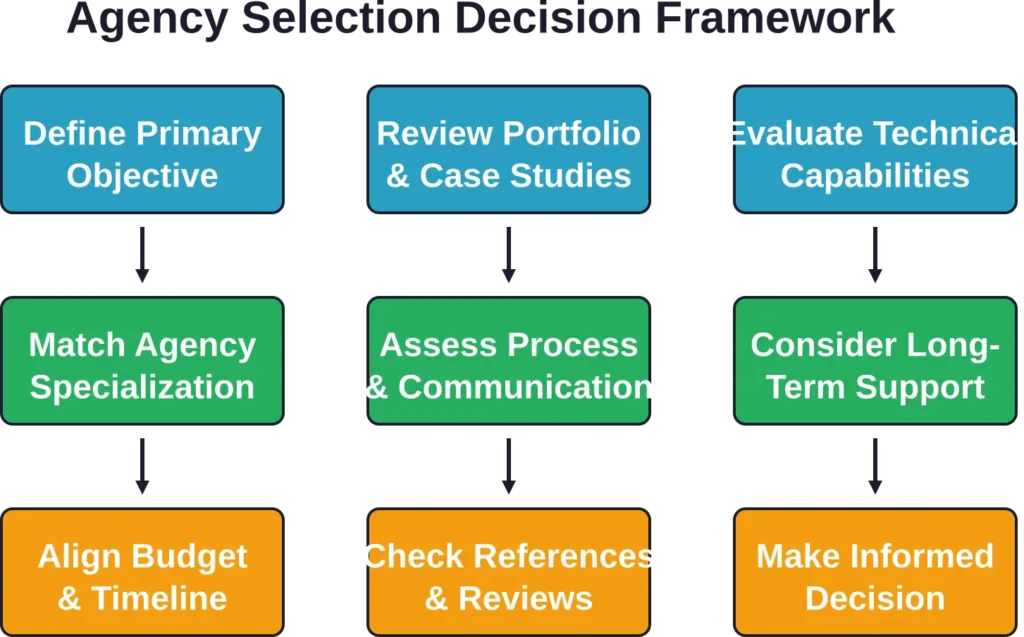
Not every agency is the right fit for every project. Here’s what matters when evaluating potential partners:
Specialization vs. Generalization
Some agencies specialize deeply in one niche—SaaS product design, Shopify eCommerce, nonprofit websites. Others offer broader services across multiple industries.
Neither approach is inherently better. Specialists bring domain expertise and tested frameworks for common challenges in their niche. Generalists offer flexibility and fresh perspectives from cross-industry experience.
Match the agency’s focus to your specific needs.
Portfolio Quality and Relevance
Review actual work, not just case study narratives. Look for projects similar in scope and complexity to yours.
Pay attention to visual consistency, attention to detail, and whether the designs feel current or dated. The best agencies evolve their aesthetic while maintaining recognizable quality standards.
Process and Communication
How does the agency approach projects? Do they conduct user research? Run usability tests? Iterate based on data?
Clear processes reduce miscommunication and scope creep. Ask about timelines, revision policies, and how they handle feedback.
Technical Capabilities
Does the agency build custom solutions or rely on templates? Can they handle complex integrations, custom CMS implementations, or advanced animations?
For straightforward projects, template-based approaches work fine. For unique requirements, you’ll need development depth.
Long-Term Partnership Potential
Websites aren’t one-and-done deliverables. They require ongoing optimization, content updates, and technical maintenance.
Consider whether the agency offers retainer arrangements or post-launch support. The best relationships extend beyond the initial launch.
Matching Your Project to the Right Agency
With these profiles in mind, how do you actually choose?
Start by defining your primary objective. Are you launching a new product? Generating B2B leads? Building an eCommerce store? Refreshing an outdated brand presence?
Your objective should narrow the field quickly. A SaaS startup seeking investor credibility needs different expertise than an eCommerce brand optimizing checkout flows.
Budget Realities
Agency capabilities generally correlate with budget requirements, though there’s significant variation.
Generally speaking, the cost of hiring a web designer typically ranges from $1,500 to $10,000+ for a complete website, depending on complexity and customization needs. , custom development, and the involvement of specialized teams including strategists, designers, developers, and project managers.
Premium agencies with household-name portfolios command higher fees reflecting their experience and demand. Smaller specialized agencies often deliver comparable quality at lower price points, trading brand recognition for value.
Be realistic about your budget constraints, but remember: a website is an investment, not an expense. The right agency delivering measurable business results justifies premium pricing.
Timeline Considerations
Complex custom projects require longer timelines. Template-based approaches deliver faster.
Factor in your internal review processes, content creation timelines, and coordination requirements. Delays often originate from client-side bottlenecks rather than agency execution.
Chemistry and Communication
Technical capabilities matter, but so does working relationship quality.
During initial conversations, assess communication style, responsiveness, and whether the agency asks good questions. Do they seek to understand your business, or push a predetermined solution?
Request references from past clients with similar project types. Ask about communication frequency, how the agency handled challenges, and whether projects stayed on timeline and budget.
Common Mistakes When Hiring a Web Design Agency
Even armed with good information, businesses frequently stumble in the agency selection process. Here are pitfalls to avoid:
Choosing Based on Price Alone
The cheapest option rarely delivers the best value. Extremely low prices usually signal inexperience, offshore teams with communication challenges, or template-based approaches with minimal customization.
While budget constraints are real, prioritizing cost over capabilities often results in websites that underperform—and require expensive rebuilds sooner than expected.
Ignoring Cultural Fit
An agency might have impressive credentials but communication styles that clash with your organization’s culture. Misalignment here creates friction throughout the project.
Pay attention to how agencies communicate during the sales process. That’s usually their best behavior—issues only amplify under project pressure.
Unclear Requirements and Scope
Vague project briefs lead to mismatched expectations and scope disputes. Before engaging agencies, document your requirements, objectives, and constraints clearly.
What’s the purpose of the site? Who are the target users? What actions should visitors take? What integrations are required? What content already exists?
Clear requirements enable accurate proposals and reduce mid-project surprises.
Skipping the Discovery Phase
Some clients want to jump straight into design execution, viewing discovery work as unnecessary overhead. This almost always backfires.
Discovery phases clarify objectives, identify constraints, align stakeholders, and establish strategic direction. Skipping this creates designs built on assumptions rather than insights.
The best agencies insist on discovery work. If an agency is willing to start designing without understanding your business, that’s a red flag.
Neglecting Post-Launch Planning
Websites require ongoing maintenance, content updates, performance monitoring, and optimization. Too many businesses focus exclusively on the launch without planning for what comes after.
Discuss post-launch support during agency selection. What’s included? What costs extra? Can you handle updates internally, or will you need ongoing agency involvement?
Trends Shaping Web Design in 2026
Understanding current trends helps evaluate whether agencies are staying current or relying on outdated approaches.
AI-Enhanced Personalization
Advanced websites now adapt content and layouts based on user behavior, location, and preferences. Studies show that brands sending tailored in-app messages retain between 61% to 74% of users in subsequent 28 days, compared to much lower retention for generic experiences.
Leading agencies are incorporating personalization engines and AI-driven content recommendations into their designs, creating dynamic experiences that respond to individual users.
Accessibility as Standard Practice
Accessibility is no longer an optional add-on—it’s a baseline requirement. Frameworks like the Six Essential Steps for Digital Accessibility developed by the University of Maryland’s Digital Accessibility Team (led by Dr. Ana Palla, Senior IT Accessibility and UX Specialist) provide practical approaches that improve usability for everyone while ensuring compliance.
Top agencies build accessibility into their design systems from the start, conducting audits and testing throughout development rather than retrofitting compliance later.
Static Site Architecture
There’s growing adoption of static site generators and headless CMS architectures that serve pre-built pages rather than dynamically generating content on each request. This approach dramatically improves load times and security.
Static sites eliminate the database queries and server processing that slow dynamic sites, delivering the speed that users expect and search engines reward.
Minimal Computing Approaches
Related to static site adoption, minimal computing philosophies emphasize lean, efficient architectures that reduce energy consumption, improve performance, and simplify maintenance.
This trend reflects growing awareness of the environmental impact of digital infrastructure and the practical benefits of simpler, faster systems.
Interaction Design Patterns
Rather than reinventing common interfaces, designers increasingly rely on established UI patterns that users recognize and understand. Pattern libraries provide tested solutions for common challenges—navigation, forms, data display, authentication flows.
This doesn’t mean websites look identical. The best designers apply patterns strategically while differentiating through brand expression, content, and unique features.
Questions to Ask Prospective Agencies
When you’re narrowing your shortlist, these questions help reveal capabilities and fit:
- What’s your typical project process from kickoff to launch?
- How do you handle scope changes and additional requests?
- What’s included in your standard deliverables?
- Who will I be working with day-to-day?
- How do you approach user research and testing?
- What platforms or technologies do you specialize in?
- Can you share examples of similar projects?
- What’s your revision and feedback process?
- How do you handle hosting, domains, and technical infrastructure?
- What post-launch support do you offer?
- What’s your typical timeline for a project like mine?
- How do you measure project success?
The quality of responses matters as much as the content. Good agencies answer thoughtfully, ask clarifying questions, and demonstrate they’ve understood your specific situation.
Beyond the Initial Launch: Long-Term Success
The best agency relationships extend beyond the initial website launch. Websites are never truly finished—they evolve with your business, user needs, and technological capabilities.
Optimization and Testing
Post-launch optimization drives significant value. A/B testing different headlines, layouts, or calls-to-action reveals what resonates with your audience. Analytics identify friction points and drop-off locations.
Some agencies offer optimization retainers where they continuously test and refine the site based on performance data. This approach treats your website as a living asset rather than a static deliverable.
Content Strategy and Production
Design provides the framework, but content drives results. Whether that’s blog articles, product descriptions, case studies, or landing page copy, you need ongoing content production.
Some agencies offer content services. Others partner with specialized content studios. Clarify content responsibilities early—unexpectedly discovering you need to produce all content yourself delays launches and undermines design effectiveness.
Technical Maintenance
Websites require regular updates: security patches, plugin updates, performance optimization, and compatibility testing as browsers evolve.
Decide whether you’ll handle maintenance internally or engage the agency on a retainer. For non-technical organizations, agency maintenance contracts provide peace of mind and ensure issues are addressed promptly.
Frequently Asked Questions
It’s depending on complexity, customization needs, and agency expertise. Small business sites with standard functionality fall toward the lower end. Large SaaS or enterprise-level projects can exceed $30,000–$100,000 due to advanced functionality, custom development, and specialized teams including strategists, designers, developers, and project managers. Pricing varies significantly based on agency reputation, location, and project scope.
Straightforward website projects typically require 6-12 weeks from kickoff to launch, including discovery, design, development, and testing phases. More complex projects with custom functionality, integrations, or extensive content requirements often take 3-6 months. Enterprise implementations with multiple stakeholder groups and sophisticated technical requirements can extend beyond six months. Timeline accuracy depends heavily on clear requirements, efficient client feedback cycles, and timely content delivery.
Specialized agencies bring deep expertise in specific niches—SaaS design, Shopify eCommerce, or B2B lead generation. This specialization means proven frameworks and industry-specific best practices. Full-service agencies offer broader capabilities across web design, branding, digital marketing, and development, providing integrated solutions and consolidated vendor relationships. Choose specialists when you have clearly defined needs in their domain. Choose generalists when you need flexibility, diverse capabilities, or integrated services across multiple disciplines.
Web design focuses on visual aesthetics, user experience, layout, typography, color schemes, and interaction design—the look and feel of the site. Web development involves the technical implementation: writing code, building functionality, database integration, and ensuring the site works properly across devices and browsers. Most professional projects require both disciplines. Some agencies handle both in-house; others partner with specialists. For simple projects, designers using website builders can deliver complete solutions. Complex custom projects need dedicated development expertise.
Mobile responsiveness is absolutely critical. Over half of web traffic comes from mobile devices, and 53% of mobile users will abandon a site if it takes more than three seconds to load. Google’s search algorithm prioritizes mobile-friendly sites. Beyond rankings, user experience suffers dramatically on poorly optimized mobile sites—leading to lost conversions and brand damage. Any agency you consider should build mobile-first or mobile-responsive designs as standard practice, not as an optional upgrade.
Examine the variety and quality of work, looking for projects similar to yours in scope and industry. Assess visual consistency—do designs feel cohesive or wildly inconsistent in quality? Check whether sites are still live and functioning well, or if they’ve been abandoned or redesigned by someone else. Look beyond static screenshots to actual user experiences: navigation clarity, load times, mobile performance. Read case studies to understand the agency’s problem-solving approach and measurable outcomes they achieved. Strong portfolios demonstrate both creative excellence and strategic thinking.
This depends on the technology platform and how the site is built. Content management systems like WordPress, Webflow, or Shopify allow non-technical users to update content, add pages, and modify text and images without coding knowledge. Custom-coded sites or complex functionality typically require developer involvement for updates. Discuss content management capabilities during agency selection. Request training on the CMS if you plan to handle updates internally. Many agencies offer hybrid models—you handle routine content updates while they manage technical changes and optimization.
Making Your Final Decision
You’ve researched agencies, reviewed portfolios, asked questions, and narrowed your options. How do you make the final call?
Trust your instincts about the relationship. Technical capabilities matter, but you’ll be collaborating closely for weeks or months. Choose partners you trust and communicate well with.
Evaluate the balance between expertise and cost. The most expensive agency isn’t always the best fit, nor is the cheapest. Look for the best value—appropriate expertise for your specific needs at a price that aligns with expected returns.
Consider the agency’s capacity and availability. Can they start when you need? Do they have bandwidth to prioritize your project, or will you be competing for attention with larger clients?
Request a detailed proposal outlining scope, deliverables, timeline, and costs. Compare proposals not just on price but on comprehensiveness and clarity. Vague proposals often lead to scope disputes later.
Check references thoroughly. Past client experiences reveal how agencies handle challenges, communicate under pressure, and deliver on promises.
Finally, recognize that some uncertainty is inevitable. You’re making a decision with incomplete information. But by doing thorough research, asking good questions, and evaluating agencies systematically, you dramatically improve your odds of a successful outcome.
Conclusion: Your Website Is Worth the Investment
Your website is often the first—and sometimes only—interaction potential customers have with your business. Within milliseconds, visitors form impressions that influence whether they engage or bounce.
That makes choosing the right web design and development partner one of the most important business decisions you’ll make. The agencies profiled here represent some of the best options available in 2026, each bringing distinct strengths and specializations.
Whether you’re a SaaS startup needing investor-ready product design, an eCommerce brand optimizing for conversions, or an established enterprise undergoing digital transformation, there’s an agency match for your needs.
Take time to clarify your objectives, evaluate options thoroughly, and choose a partner aligned with both your immediate project requirements and long-term business goals.
The right agency doesn’t just deliver a website—they become a strategic partner in your digital success. Make the investment. Choose wisely. Your online presence depends on it.
Ready to start your web design project? Review the agencies above, shortlist those matching your needs, and begin conversations. Your next-generation website awaits.