

Quick Summary: Finding the right web design partner can transform a pest control company’s digital presence. This guide profiles 15 specialized agencies that understand the pest control industry’s unique needs—from mobile-optimized booking flows to local SEO strategies that drive qualified leads. Each agency brings proven expertise in converting worried homeowners into booked appointments through smart design, trust signals, and conversion-focused user experiences.
A pest control website isn’t just a digital brochure. It’s the first interaction anxious homeowners have with a company when they discover ants in the kitchen or hear scratching in the attic at 2 AM.
The difference between a generic template and a purpose-built pest control website shows up in conversion rates. Homeowners need immediate reassurance—clear service areas, visible phone numbers, same-day availability, and trust signals that prove the company can solve their problem.
That’s where specialized web design agencies come in. These companies understand pest control business models, seasonal demand patterns, service territory mapping, and the psychology of emergency service buyers.
This guide examines 15 agencies that have built their reputations designing websites specifically for pest control companies. No generic web shops—these teams know the difference between residential pest control and commercial integrated pest management.
What Makes Pest Control Web Design Different
Pest control websites face unique challenges that don’t apply to most other industries. The buying cycle compresses into hours rather than days.
Someone who finds termite damage or sees a rodent doesn’t spend weeks researching options. They want a solution now, which means the website needs to answer three questions immediately: Can this company help me? Do they serve my area? How fast can they come out?
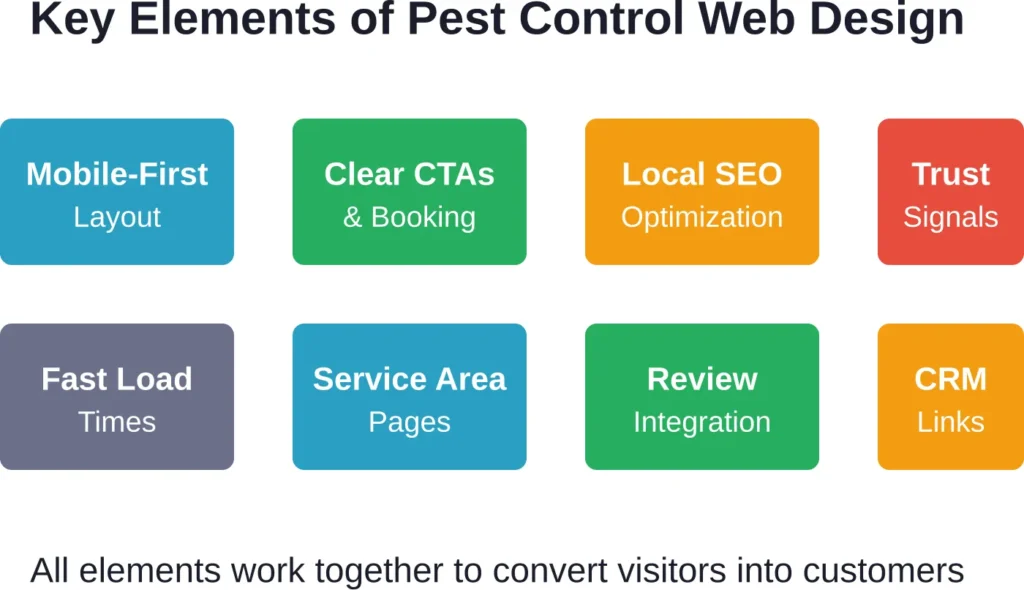
Mobile responsiveness matters more than average because homeowners often search from their phones while standing in front of the problem. Desktop traffic represents a minority of pest control website visits.
Trust signals carry extra weight. Reviews, guarantees, certifications, and local presence indicators all influence the split-second decision to call or click away to a competitor.
The best pest control websites balance urgency with authority. Too much alarm creates anxiety without action. Too corporate feels disconnected from the homeowner’s real problem.
Agency Selection Criteria
The agencies in this list meet specific standards that matter for pest control companies looking for web design partners.
Each has documented experience building websites for pest control businesses or adjacent home services industries. That experience shows up in design choices—prominent click-to-call buttons, service area pages optimized for local search, and booking flows designed for mobile users.
Portfolio quality matters more than portfolio size. A dozen well-executed pest control sites demonstrates more relevant expertise than hundreds of generic small business websites.
Technical competence separates good agencies from great ones. Modern pest control websites need fast load times, schema markup for local business data, integration with CRM systems, and tracking that connects website activity to booked jobs.
But specialization alone isn’t enough. The agencies here also maintain strong reputations for communication, meeting deadlines, and supporting clients after launch.
Top 15 Pest Control Web Design Companies
Here’s the breakdown of agencies that consistently deliver strong results for pest control businesses.
1. A-listware
A-listware provides software development and dedicated team solutions for businesses in the home services space, with proven capabilities in building custom websites for pest control companies. They focus on reliable, secure digital solutions.
Their approach includes custom software development, UX/UI design, and full infrastructure support. For pest control operators, this translates into websites with strong local SEO foundations, easy service navigation, and robust backend systems.
The team delivers end-to-end solutions — from application development to testing & QA — ensuring websites perform well across all devices and handle seasonal traffic spikes effectively.
A-listware stands out through seamless integration with client processes and their focus on delivering cost-effective, high-quality development that supports long-term business scalability in the pest control sector.
Contact Information:
- Website: a-listware.com
- Phone: +1 (888) 337 93 73
- Email: [email protected]
- Address: North Bergen, NJ 07047, USA
- LinkedIn: www.linkedin.com/company/a-listware
- Facebook: www.facebook.com/alistware
2. Mobian Studio
Mobian Studio creates dedicated engineering teams that build production-ready digital solutions for companies in service industries, including specialized web platforms for pest control businesses. They offer both project outsourcing and team augmentation models.
Their expertise covers end-to-end product development with strong focus on mobile and web solutions. Pest control clients receive fast, scalable websites with clean architecture, excellent documentation, and ongoing support.
Design and development prioritize user experience, conversion optimization, and technical reliability. Mobian delivers systems that help pest control companies manage leads efficiently while maintaining professional brand presence.
What sets Mobian apart is their senior-level execution and ability to deliver on time without compromising quality, making them a strong partner for pest control companies looking to modernize their online presence.
Contact Information:
- Website: mobian.studio
- Phone: [email protected]
- Address: Harju maakond, Tallinn, Kesklinnalinnaosa, Masina tn 22, 10113
- LinkedIn: www.linkedin.com/company/mobian-studio
3. Lengreo

Lengreo focuses on full-cycle digital marketing and website development for home services companies, with strong expertise in the pest control sector. Their approach combines strategic B2B marketing with custom website solutions that drive qualified leads.
The agency emphasizes hyper-personalized outreach and conversion optimization tailored to pest control buying journeys. They build websites that support both residential and commercial pest control providers through integrated lead generation systems.
Design work prioritizes clean, trustworthy aesthetics that communicate professionalism while encouraging quick contact from homeowners facing urgent pest issues. Lengreo handles everything from discovery and business analysis to website implementation and ongoing optimization.
What sets Lengreo apart is their ability to connect marketing strategy with technical execution — creating websites that not only look good but actively reduce cost per lead and increase conversion rates for pest control businesses.
Contact Information:
- Website: lengreo.com
- Phone: +31 686 147 566
- Email: [email protected]
- Address: Vrijstraat 9 C/D, 5611 AT Eindhoven, Netherlands
- LinkedIn: www.linkedin.com/company/lengreo
- Instagram: www.instagram.com/lengreo.agency
- Twitter: x.com/Lengreo
4. Oski

Oski builds smart, well-engineered software solutions for tech-forward service companies, with notable strength in developing high-performance websites for the pest control industry. Their focus lies in creating scalable digital platforms.
The company combines cloud technologies, modern frontend frameworks, and AI capabilities to build fast, secure websites optimized for local search and lead conversion. Pest control clients benefit from integrated features like real-time booking and automated service reminders.
Design work emphasizes intuitive user flows and professional aesthetics that build trust with residential customers. Oski delivers solutions across cloud infrastructure, frontend development, and content management systems.
What distinguishes Oski is their ability to deliver 3× faster development while maintaining excellent code quality and user experience tailored to the operational needs of pest control businesses.
Contact Information:
- Website: oski.site
- Phone: +48571282759
- Email: [email protected]
- Address: Kaupmehe tn 7, 10114 Tallinn, Estonia
- LinkedIn: www.linkedin.com/company/oski-solutions
5. Gilzor

Gilzor specializes in custom software development and digital product creation for service-based businesses, including specialized website solutions for pest control companies. They focus on building scalable web platforms that support business growth.
Their technical approach includes full-cycle development from idea validation and UI/UX design to quality assurance and go-to-market strategy. For pest control clients, this means creating intuitive booking systems, service area pages, and customer portals that improve user experience.
Design philosophy centers on user-centric interfaces that make it easy for homeowners to request inspections or treatments. Gilzor delivers mobile-responsive websites with strong performance and clean architecture.
The team excels at turning complex business needs into functional, attractive digital products that help pest control companies stand out in competitive local markets.
Contact Information:
- Website: www.gilzor.com
- Email: [email protected]
- Address: Poland, Warsaw, Office 58, street Adama Mickiewicza 37, 01-625
- LinkedIn: www.linkedin.com/company/gilzor-softwaredevelopment
6. DAGMAR Marketing
DAGMAR Marketing targets pest control brands looking for vertical-specific expertise. The entire agency focuses on pest control and related industries, which creates deep knowledge of market dynamics and customer behavior.
Their design approach balances aesthetics with functionality. Websites look professional and modern while prioritizing the practical elements that drive conversions—visible phone numbers, service area indicators, and clear next steps.
DAGMAR’s process includes competitive research within each client’s specific market. They analyze what competing pest control companies are doing online and identify opportunities for differentiation through design and positioning.
The agency handles both new website builds and redesigns of existing sites. For redesign projects, they conduct audits to identify what’s working and what needs improvement rather than starting from scratch unnecessarily.
Integration capabilities cover the major pest control software platforms. DAGMAR can connect websites to scheduling tools, customer portals, and field service management systems that pest control companies use to run operations.
7. WebFX

WebFX brings enterprise agency capabilities to pest control companies of various sizes. Their team includes over 500 digital marketing specialists, allowing them to staff projects with dedicated resources.
Design work follows a research-driven process. WebFX starts with audience analysis and competitor benchmarking before moving into design concepts. This foundation ensures websites address actual user needs rather than designer preferences.
The agency’s technology platform includes proprietary tools for reporting and analytics. Pest control clients get dashboards that connect website performance to business outcomes—tracking how many site visitors convert to leads and how many leads convert to customers.
Content development receives significant emphasis. WebFX’s writing team creates service pages, location pages, and educational content optimized for both search engines and human readers.
Their track record includes work with pest control companies seeking niche agency expertise in SEO, Google Ads, and social media alongside web design—making them a suitable choice for businesses wanting integrated digital marketing support.
8. Built-Right Digital

Built-Right Digital focuses on ROI-driven pest control marketing, with web design as a core service offering. The agency positions itself for exterminators wanting exclusive, high-intent leads rather than shared directory listings.
Design philosophy emphasizes conversion rate optimization from the ground up. Every page layout, headline, and call-to-action placement reflects testing and refinement aimed at maximizing the percentage of visitors who request service.
The agency’s approach integrates web design with paid advertising strategy. They build landing pages specifically for Google Ads and Meta Ads campaigns, optimizing message match between ad copy and landing page content.
Technical implementation includes conversion tracking that connects website interactions to actual booked jobs. This closed-loop attribution helps pest control companies understand true marketing ROI rather than vanity metrics like traffic or clicks.
Built-Right’s team includes former pest control business owners who bring operational perspective to marketing strategy. They understand the economics of service calls, seasonal demand fluctuations, and customer lifetime value calculations.
9. Profit Parrot
Profit Parrot targets pest control companies looking for done-for-you solutions that combine web design with ongoing lead generation. Their service model bundles website development with monthly marketing support.
Design work emphasizes speed to market. Profit Parrot uses proven templates customized for individual clients rather than building every site from scratch. This approach reduces development time while maintaining professional quality.
The agency’s platform includes features pest control companies specifically need—online scheduling integration, service area mapping, review aggregation, and mobile-optimized contact forms designed for high conversion rates.
Content creation follows established frameworks for pest control messaging. Service pages address common pest problems with solution-oriented copy that builds confidence and urgency without creating unnecessary alarm.
Profit Parrot’s business model works well for pest control operators who want turnkey solutions rather than managing multiple vendors. The bundled approach simplifies decision-making and provides single-point accountability.
10. Ironchess SEO + Marketing
Ironchess combines web design with aggressive SEO strategy for pest control companies aiming to dominate local search results. Their approach treats website design as the foundation for broader digital visibility.
Design decisions prioritize search engine optimization from the start. Information architecture, URL structure, internal linking, and content organization all support organic search goals alongside user experience.
The agency’s technical capabilities include advanced schema implementation, Core Web Vitals optimization, and mobile-first development that aligns with Google’s ranking factors.
Content strategy receives equal weight to visual design. Ironchess develops comprehensive content plans that cover service pages, location pages, pest-specific informational content, and ongoing blog publishing to build topical authority.
Their client base includes pest control companies in competitive markets where organic search visibility directly impacts lead volume. The agency’s value proposition centers on long-term sustainable growth rather than quick wins.
11. Coalmarch

Coalmarch focuses exclusively on home services companies, with significant pest control client representation. Their design philosophy centers on route density optimization—building websites that don’t just generate leads but generate leads in geographic clusters that improve technician efficiency.
The agency’s technical approach combines conversion-focused design with local SEO architecture. Service area pages receive individual optimization rather than generic templates, which helps pest control companies rank for city-specific searches like “termite inspection in [city name].”
Their portfolio includes both independent operators and multi-location pest control companies. Design work emphasizes clean, modern aesthetics that balance professionalism with approachability.
Project timelines typically run 8-12 weeks from kickoff to launch, with ongoing optimization available through retainer agreements. The team handles everything from wireframes to content creation to technical implementation.
What sets Coalmarch apart is their understanding of pest control business economics. They build websites that support business models—whether that’s recurring service subscriptions, one-time treatments, or commercial contracts.
12. Scorpion

Scorpion serves large pest control brands and multi-location operators that need enterprise-level solutions. Their platform approach provides consistency across multiple locations while allowing customization for regional differences.
The company’s technology stack includes proprietary tools for call tracking, lead attribution, and conversion analytics. Pest control companies get visibility into which website elements drive phone calls versus form submissions versus chat conversations.
Design work emphasizes brand consistency and scalability. A franchise with 50 locations gets a system that maintains corporate brand standards while optimizing for local search in each market.
Scorpion’s team size allows them to handle complex integrations—connecting websites to field service management software, scheduling systems, and CRM platforms that enterprise pest control companies already use.
Their approach works best for established companies with significant marketing budgets and complex operational needs. Smaller operators might find the platform’s capabilities exceed their current requirements.
13. Blue Corona
Blue Corona brings data-driven methodology to pest control web design. Every design decision ties back to conversion rate optimization principles tested across their home services client base.
The agency’s process starts with competitive analysis and user experience research specific to pest control buying behavior. That research informs information architecture, content hierarchy, and call-to-action placement.
Technical execution emphasizes page speed and mobile performance. Blue Corona’s development team optimizes images, minimizes code, and implements caching strategies that keep load times under three seconds even on slower mobile connections.
Their analytics implementation goes beyond basic Google Analytics. Custom dashboards track pest control-specific metrics—quote request rates, service area coverage, seasonal traffic patterns, and lead quality indicators.
Ongoing optimization is built into the engagement model. Blue Corona doesn’t consider a website finished at launch—they continuously test headlines, layouts, and conversion elements to improve performance over time.
14. Hook Agency

Hook Agency specializes in home services digital marketing with particular strength in pest control and lawn care. Their web design work integrates tightly with broader marketing strategies.
Design aesthetics lean modern and clean, with bold typography and high-quality photography that differentiates pest control brands from template-based competitors. The team provides art direction for photoshoots when clients don’t have existing brand imagery.
Hook’s technical approach prioritizes local search visibility. Websites launch with proper schema markup, Google Business Profile integration, and location-specific content that helps pest control companies rank in map pack results.
The agency’s process includes strategic messaging development—not just designing pages but crafting the copy that communicates unique value propositions and answers homeowner objections.
Project management receives strong client feedback. Hook maintains clear communication throughout design and development, with regular check-ins and structured approval processes that keep projects on schedule.
15. Thrive Internet Marketing Agency
Thrive operates as a full-service digital marketing agency with dedicated expertise in pest control web design. Their team includes designers, developers, content writers, and SEO specialists who collaborate on integrated projects.
Design work emphasizes conversion optimization and user experience. Thrive builds websites with clear service differentiation, prominent trust signals, and streamlined contact flows that reduce friction in the decision process.
The agency’s content team creates original copy tailored to pest control audiences—service pages that address specific pest problems, FAQ content that answers common homeowner questions, and blog content that supports organic search visibility.
Technical capabilities include custom WordPress development, third-party integrations, and responsive design that maintains functionality across all device types and screen sizes.
Key Website Features Pest Control Companies Need
Certain website elements consistently appear in high-performing pest control sites. These features aren’t optional extras—they’re fundamental components that influence whether visitors convert.
Mobile-Optimized Booking Flows
Desktop browsing represents a minority of pest control website traffic. Homeowners discover pest problems and immediately search for solutions from their phones.
Mobile optimization means more than responsive design. It requires rethinking information architecture for smaller screens—putting the most critical information and actions within thumb reach without scrolling.
Click-to-call buttons need prominent placement. Form fields should minimize typing through smart defaults and dropdown selections. Multi-step processes should show progress indicators so users know how close they are to completion.
The best pest control websites test booking flows on actual devices under real conditions—not just desktop browsers resized to mobile dimensions.
Service Area Visualization
Homeowners need immediate confirmation that a pest control company serves their location. Generic “serving the greater metro area” messaging creates uncertainty.
Interactive maps provide instant clarity. A homeowner enters their ZIP code and sees whether they’re in the service area before investing time in a phone call or form submission.
Service area pages for individual cities and neighborhoods serve double duty—providing location-specific information for visitors while creating landing pages optimized for local search terms.
The technical implementation matters. Maps need fast loading and smooth interaction on mobile devices. Service area pages require unique content rather than duplicated templates that create SEO problems.
Trust Signal Integration
Pest control purchases involve inviting strangers into homes and spending significant money on invisible problems. Trust signals reduce the psychological barrier to conversion.
Reviews from actual customers carry more weight than marketing copy. The best websites prominently display Google reviews, testimonials with names and locations, and aggregate ratings from multiple platforms.
Professional certifications and industry memberships add credibility. Licenses, insurance documentation, and association logos demonstrate legitimacy and expertise.
Guarantees address the biggest homeowner objection—what happens if the treatment doesn’t work? Clear guarantee language reduces perceived risk and increases conversion rates.
Speed and Performance
Page load time directly affects conversion rates. Even a one-second delay in load time reduces conversions measurably.
Performance optimization requires technical work—image compression, code minification, content delivery networks, and browser caching. These behind-the-scenes improvements might not be visible, but their impact shows up in analytics.
Core Web Vitals represent Google’s formalized performance standards. Websites that meet these thresholds receive ranking preference in search results while also delivering better user experiences.
Performance testing should happen on real mobile devices over cellular connections, not just desktop computers on high-speed office internet.
The Web Design Process
Understanding what happens during a web design project helps pest control companies set realistic expectations and participate effectively.
Discovery and Strategy
Good agencies start with questions, not design mockups. The discovery phase explores business goals, target audience, competitive positioning, and technical requirements.
This phase typically includes stakeholder interviews, competitive analysis, user research, and technical audits of existing websites. The deliverable is a strategic brief that guides design decisions.
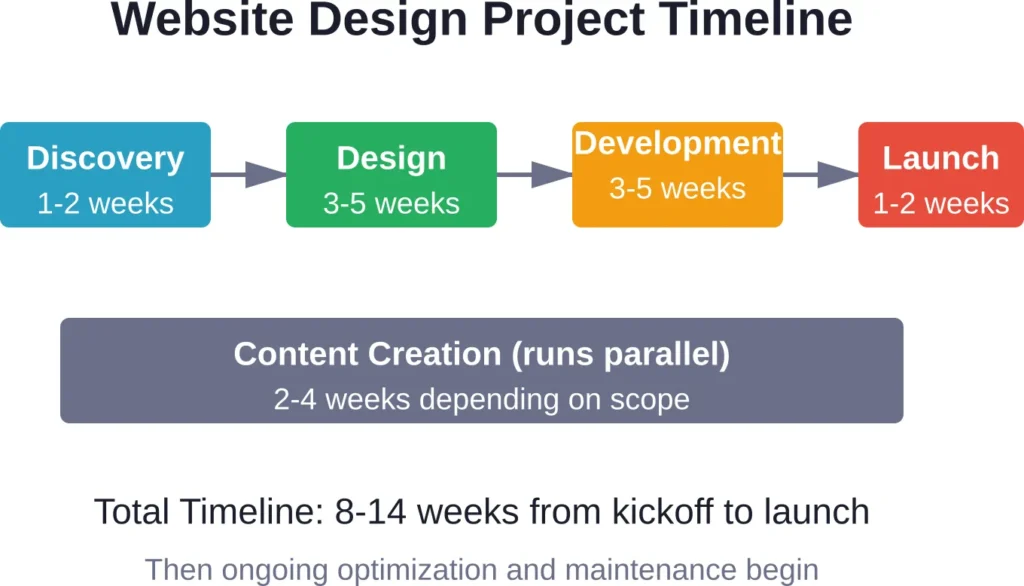
Timeline expectations: 1-2 weeks for discovery, depending on project complexity and client availability for interviews and information gathering.
Design and Development
Design work proceeds in stages—wireframes showing structure and layout, then visual designs adding brand elements and aesthetics, then interactive prototypes demonstrating functionality.
Most agencies present 2-3 design concepts for initial feedback, then refine the selected direction through multiple revision rounds. Development begins once designs receive final approval.
Timeline expectations: 4-8 weeks for design and development, depending on site complexity, custom functionality, and revision cycles.
Content Creation
Content development often runs parallel to design work. Professional agencies either create original content or provide detailed guidelines for client-supplied content.
Strong content strategy addresses both user needs and search engine optimization. Service pages answer homeowner questions while targeting relevant keywords. Location pages provide useful local information rather than thin templated content.
Timeline expectations: 2-4 weeks for content strategy, writing, and revision, depending on site size and whether content is agency-created or client-supplied.
Launch and Optimization
Pre-launch activities include testing, quality assurance, and migration planning. Agencies verify functionality across browsers and devices, check all links and forms, and prepare redirects from old URLs to new ones.
Post-launch support varies by agency. Some provide a transition period with included revisions. Others move immediately into ongoing optimization retainers.
Timeline expectations: 1-2 weeks for final testing and launch preparation, with ongoing optimization continuing indefinitely.
| Project Phase | Duration | Key Deliverables | Client Involvement |
|---|---|---|---|
| Discovery | 1-2 weeks | Strategy brief, competitive analysis, user research | High – interviews and information gathering |
| Design | 3-5 weeks | Wireframes, visual designs, interactive prototypes | Medium – feedback and approvals |
| Development | 3-5 weeks | Functional website, integrations, CMS setup | Low – periodic status updates |
| Content | 2-4 weeks | Written copy, optimized service and location pages | Variable – depends on content source |
| Testing & Launch | 1-2 weeks | QA reports, redirects, live website | Medium – final approvals and testing |
| Optimization | Ongoing | A/B tests, performance improvements, content updates | Low – quarterly strategy reviews |
Investment Considerations
Web design costs vary significantly based on project scope, agency positioning, and ongoing services.
Basic pest control websites built from templates might start around the lower end of typical agency minimums. Custom-designed sites with advanced functionality, extensive content, and integration requirements can reach higher investment levels.
The distinction between one-time design costs and ongoing support matters. Some agencies charge separately for design and development versus monthly maintenance and optimization. Others bundle everything into retainer agreements.
Return on investment calculations should factor in customer lifetime value. A pest control customer acquired through the website might generate thousands in recurring revenue over multiple years. That context changes how to evaluate design investment.
Industry reports suggest basic local SEO retainers typically start at lower thresholds, while comprehensive digital marketing programs for competitive markets can reach higher monthly budgets. These ranges help establish baseline expectations when evaluating proposals.
Common Mistakes to Avoid
Pest control companies make predictable mistakes when selecting web design partners and managing projects.
Choosing on Price Alone
The cheapest option rarely delivers the best value. Template-based websites from generic providers might cost less upfront but fail to convert visitors at competitive rates.
Design quality, technical implementation, and strategic thinking separate agencies. These factors influence revenue generation far more than the difference between a budget quote and a mid-range proposal.
That doesn’t mean the most expensive agency is automatically the best choice. But price should be one factor among many—portfolio quality, relevant experience, and strategic approach matter more.
Neglecting Mobile Experience
Some pest control companies still evaluate website designs primarily on desktop computers. That creates misalignment with how actual customers interact with the site.
Mobile experience should drive design decisions, not serve as an afterthought. Navigation patterns, content hierarchy, and interaction models all need mobile-first thinking.
Testing should happen on real phones with real thumbs. What works perfectly with a mouse cursor might frustrate mobile users trying to tap small buttons or fill multi-field forms.
Skipping Content Strategy
Beautiful design can’t compensate for weak content. Pest control websites need clear service descriptions, compelling calls to action, and SEO-optimized copy that drives organic visibility.
Some companies assume they’ll “add content later” and launch with placeholder text or minimal information. That approach wastes the design investment and delays business results.
Content development should run parallel to design work, with the same strategic thinking applied to messaging and information architecture as visual aesthetics.
Ignoring Analytics and Tracking
A website without proper analytics is operating blind. Pest control companies need visibility into traffic sources, user behavior, conversion rates, and lead quality.
Good agencies implement comprehensive tracking during development—Google Analytics, call tracking, form submission tracking, and conversion attribution that connects website activity to booked jobs.
But implementation alone isn’t enough. Someone needs to actually review the data and make decisions based on what it reveals. Regular reporting and analysis should be part of the ongoing relationship.
Questions to Ask Prospective Agencies
The right questions reveal whether an agency truly understands pest control web design or just claims vertical expertise.
Ask to see specific examples of pest control websites they’ve built. Review those sites on a mobile device, not just desktop screenshots. Look for design quality, functionality, and whether the sites still appear to be actively maintained.
Request case studies with concrete results. Traffic and rankings mean nothing without conversion data. Ask how many leads the website generates monthly and what percentage of visitors take desired actions.
Understand their technical approach. What platform do they recommend and why? How do they handle mobile optimization? What’s their strategy for page speed and performance?
Clarify the content strategy. Who writes the copy? How do they approach SEO? What’s their process for service pages, location pages, and ongoing blog content?
Discuss integration requirements early. If the pest control company uses specific software for scheduling, CRM, or field service management, confirm the agency can connect the website to those systems.
Ask about their typical project timeline and what causes delays. Understanding potential bottlenecks helps pest control companies plan accordingly and provide whatever the agency needs to maintain momentum.
When to Redesign an Existing Website
Not every pest control company needs a completely new website. Sometimes targeted improvements deliver better ROI than full redesigns.
Clear indicators suggest redesign timing. If the current site isn’t mobile-responsive, that’s a critical deficiency affecting most visitors. If load times exceed three seconds, performance problems are likely costing conversions.
Major brand changes justify redesigns. Companies rebranding after acquisitions, changing service focus, or expanding geographically need websites that reflect the new positioning.
Technology obsolescence forces updates. Websites built on outdated platforms become security risks and limit functionality. At some point, migration becomes necessary regardless of visual design quality.
But some problems don’t require full redesigns. Conversion rate issues might stem from messaging, calls to action, or trust signals—all fixable without rebuilding everything. Low search rankings might need SEO work rather than design changes.
A good agency can assess whether a pest control company needs a full redesign or targeted improvements. That honest assessment—even when it means less project revenue—builds trust and long-term relationships.
Platform Considerations
The technology platform matters more than many pest control companies realize. Platform choice affects flexibility, maintenance costs, integration capabilities, and long-term scalability.
WordPress
WordPress powers a significant portion of pest control websites. The platform’s flexibility, extensive plugin ecosystem, and familiar content management make it popular with agencies and clients.
Advantages include customization potential, SEO-friendly architecture, and a large developer community. Pest control companies can find support easily and aren’t locked into proprietary systems.
Disadvantages include maintenance requirements and potential security vulnerabilities if updates are neglected. WordPress sites need regular updates to core software, themes, and plugins.
Custom Proprietary Platforms
Some agencies build websites on proprietary platforms they’ve developed specifically for home services industries. These systems often include pest control-specific features out of the box.
Advantages include streamlined development, integrated marketing tools, and support from teams who understand the platform intimately.
Disadvantages center on vendor lock-in. Moving away from a proprietary platform often means completely rebuilding the website. Customization beyond what the platform offers might be limited or expensive.
Website Builders
Template-based website builders offer quick deployment and low initial costs. Some pest control companies start with these platforms when budget is the primary constraint.
Advantages include affordability and speed. A basic pest control website can launch in days rather than weeks.
Disadvantages include limited customization, generic design templates shared with competitors, and constraints on advanced functionality. These platforms work for very basic websites but limit growth potential.
SEO Integration
Web design and search engine optimization aren’t separate activities—they’re integrated disciplines that succeed or fail together.
Technical SEO starts during website architecture planning. URL structure, site hierarchy, internal linking patterns, and schema markup implementation all require coordination between designers, developers, and SEO specialists.
On-page optimization happens during content creation. Title tags, meta descriptions, header hierarchy, and keyword placement need strategic planning based on target search terms.
Local SEO receives particular emphasis for pest control companies. Google Business Profile integration, location page optimization, and local schema markup help websites rank in map pack results and location-specific searches.
The best agencies treat SEO as a foundational requirement rather than an add-on service. Every design decision considers search implications alongside user experience and visual aesthetics.
Ongoing Website Management
Website launch isn’t the finish line—it’s the starting point. Effective pest control websites require continuous management and improvement.
Security and Updates
Websites face constant security threats from automated bots and malicious actors. Regular software updates, security monitoring, and backup systems protect against vulnerabilities.
Maintenance includes updating core platform software, themes, plugins, and dependencies. These updates patch security holes and add functionality improvements.
But updates also create risk if not tested properly. A plugin update might conflict with custom code or break functionality. Professional maintenance includes staging environments where updates get tested before deployment to live sites.
Content Updates
Static websites become stale. Fresh content signals to search engines that the site remains active and relevant.
Blog content supports organic search visibility by targeting long-tail keywords and answering homeowner questions. Service pages might need seasonal updates. Review and testimonial sections should reflect recent customer experiences.
Some agencies include content updates in monthly retainers. Others charge separately for content work. Either way, budget for ongoing content development, not just initial site launch.
Conversion Rate Optimization
Analytics data reveals what’s working and what isn’t. Conversion rate optimization uses that data to systematically improve website performance.
A/B testing compares different approaches—two headline options, different call-to-action placements, various form designs. Statistical analysis determines which version performs better, then the winning variant becomes the new standard.
This continuous improvement process compounds over time. Small incremental gains in conversion rate add up to significant revenue differences across months and years.
Industry-Specific Features
Certain website features specifically benefit pest control companies beyond general small business needs.
Pest Identification Tools
Interactive tools that help homeowners identify pests add value while capturing lead information. Users answer questions about what they’re seeing, and the tool suggests likely pest types with information about treatments.
These tools serve double duty—providing useful information while qualifying leads. The system can route different pest types to appropriate service pages or prompt immediate contact for urgent situations.
Service Area Maps
Interactive maps showing service coverage help homeowners immediately determine whether the company serves their location. ZIP code lookup tools provide instant feedback.
Advanced implementations display different service types by area—some locations might have same-day availability while others require advance scheduling.
Online Scheduling
Integrated scheduling reduces friction in the conversion process. Instead of playing phone tag, homeowners can see available appointment slots and book directly.
Scheduling integration requires connecting the website to field service management or scheduling software. The technical implementation matters—changes made through the website need to sync reliably with what technicians see.
Customer Portals
Secure portals let existing customers access service history, view invoices, manage recurring treatment schedules, and request additional services.
Customer portals increase retention by making the relationship more convenient. They also reduce administrative overhead by letting customers self-serve for routine requests.
FAQs
Most pest control website projects run 8-14 weeks from initial kickoff through launch. This includes discovery and strategy (1-2 weeks), design development (3-5 weeks), technical development (3-5 weeks), content creation (2-4 weeks running parallel), and final testing before launch (1-2 weeks). Complex sites with extensive custom functionality or large content libraries might extend beyond this range. Simpler template-based sites can launch faster. Project timeline depends heavily on client responsiveness during review and approval stages—delays in providing feedback or content will extend the schedule accordingly.
Template-based websites can work for pest control companies with limited budgets and basic needs—establishing online presence, providing contact information, and describing services. However, custom design delivers significant advantages in competitive markets. Custom sites better communicate unique positioning, implement conversion optimization specific to the business, create mobile experiences optimized for pest control buying behavior, and avoid the generic appearance of templates used by multiple competitors. The investment difference shows up in conversion rates and competitive differentiation. For growing companies serious about digital lead generation, custom design typically provides better long-term ROI.
Mobile responsiveness ranks first—most pest control searches happen on phones, so the mobile experience drives conversions. Fast page load speeds (under three seconds) keep visitors from abandoning the site. Click-to-call functionality provides immediate contact options. Online scheduling integration lets homeowners book appointments without phone calls. Service area tools help visitors immediately determine coverage. Call tracking connects phone inquiries to marketing sources. Form optimization reduces friction in lead capture. Integration with CRM and field service management systems ensures leads flow into operational systems. Schema markup improves local search visibility. These technical elements work together to convert website visitors into booked appointments.
Website design investment varies based on scope, customization level, and included services. Entry-level template-based sites might start at lower thresholds but offer limited customization and functionality. Professional custom designs for independent pest control operators typically fall in the mid-range. Larger companies or multi-location operators requiring extensive functionality, integrations, and content can reach higher investment levels. These figures typically cover design and initial development. Ongoing costs include hosting, maintenance, security, and content updates—monthly retainers for basic maintenance and optimization often start around baseline levels, with comprehensive digital marketing programs reaching higher monthly budgets depending on market competitiveness and growth goals.
Web design agencies focus specifically on website strategy, design, and development. They create the website but might not provide ongoing marketing services like SEO, paid advertising, or content marketing. Full-service digital marketing agencies bundle web design with broader marketing services—search optimization, Google Ads management, social media, review management, and lead generation. For pest control companies wanting a single partner for all digital marketing, full-service agencies provide integrated strategy and execution. Companies comfortable managing marketing separately or already working with specialists might prefer design-focused agencies. Cost structures differ—design agencies typically charge project fees plus optional maintenance, while full-service agencies often work on monthly retainers covering both the website and ongoing marketing activities.
Pest control websites face unique requirements driven by purchase behavior and industry specifics. The buying cycle compresses dramatically—homeowners need immediate solutions, not weeks of research. Mobile usage dominates because people search from their phones when they discover problems. Service area clarity matters more than in many industries since pest control is inherently local. Emergency service positioning requires different messaging than scheduled maintenance services. Trust signals carry extra weight because customers invite technicians into their homes. Seasonal demand patterns affect content strategy and advertising integration. Review prominence influences conversion more significantly. These factors require design approaches, content strategies, and conversion optimization specifically tailored to pest control rather than generic small business templates.
The answer depends on internal capabilities and available time. Basic content updates—changing service descriptions, adding blog posts, updating contact information—can be handled in-house if someone has CMS training and dedicates time consistently. Technical updates, security patches, plugin maintenance, and troubleshooting typically require professional support unless staff includes web development expertise. Strategic improvements—conversion optimization, SEO refinements, new feature implementation—benefit from agency experience across multiple pest control sites. Most pest control companies find a hybrid approach works best: staff handle routine content updates while agencies manage technical maintenance, security, and strategic optimization. This division leverages internal knowledge about the business while accessing specialized technical and marketing expertise. Monthly retainers with agencies often include allocated hours for updates, providing flexibility without paying project rates for small changes.
Conclusion
The right web design partner transforms a pest control company’s digital presence from generic template to conversion-focused lead generation engine.
The 15 agencies profiled here bring specialized expertise in pest control web design—understanding the industry’s unique challenges, homeowner psychology, and technical requirements that drive results.
But agency selection matters less than strategic approach. The best website projects start with clear business goals, realistic timelines, and collaborative relationships between pest control operators and design teams.
Design quality, mobile optimization, conversion-focused architecture, and ongoing optimization separate websites that generate consistent leads from digital brochures that look nice but underperform.
For pest control companies ready to invest in professional web design, the next step involves evaluating agencies against specific business needs. Review portfolios. Ask detailed questions. Request case studies with quantifiable results. Understand pricing models and ongoing support options.
The website isn’t a one-time expense—it’s infrastructure that generates revenue continuously when built correctly and maintained strategically. That perspective shifts the investment conversation from cost to return.
Ready to build a pest control website that actually drives business growth? Review the agencies in this guide, evaluate their approaches against business needs, and start conversations with partners who demonstrate genuine pest control industry expertise.