

Quick Summary: 3D architectural modeling costs in 2026 range from $100 for simple renders to over $10,000 for complex commercial projects. BIM modeling for a typical 50,000 SF commercial building costs $7,500–$37,500, while basic residential models run $150–$500. Pricing depends on detail level, project scope, LOD requirements, and whether you need scanning, animations, or regulatory documentation.
Picture this: you’re planning a new building, and you want to see it in vivid 3D before a single shovel hits the dirt. Maybe you’re a homeowner dreaming up a renovation, or an architect pitching a commercial complex to skeptical stakeholders.
Either way, you’ll need 3D architectural modeling. But here’s the thing—pricing isn’t straightforward.
At its core, this process involves creating digital, three-dimensional versions of buildings using specialized software, packed with details like textures, lighting, and structural data. Costs in 2026 typically range from $100 for simple renders to $10,000 or more for intricate, high-stakes projects.
Real talk: the gap between those numbers isn’t random. It depends on what you’re building, how detailed it needs to be, and who’s doing the work.
The Core Price Ranges You’ll Encounter
Let’s cut through the noise. Here’s what different project types actually cost according to the project’s scope and goals.
A basic model for a homeowner’s reno might run $150 to $500, while a detailed commercial complex with animations could hit $5,000 to $15,000. Industry data backs this: residential models often fall between $250 and $1,000, while commercial ones climb significantly higher.
| Project Type | Typical Cost Range | What You Get |
|---|---|---|
| Basic Residential Model | $150 – $500 | Simple geometry, basic textures, single view |
| Mid-Range Commercial | $1,000 – $5,000 | Detailed interiors, multiple views, realistic lighting |
| Complex BIM Project | $5,000 – $15,000+ | Full data integration, multiple disciplines, animations |
| Large-Scale Development | $10,000 – $100,000+ | Site context, phasing, high-resolution renders |
For Building Information Modeling specifically, the numbers get more granular. A typical 50,000 SF commercial building costs $7,500–$37,500 for BIM modeling, plus $5,000–$15,000 for the 3D scanning that provides the source data. The minimum project cost for Scan-to-BIM is $2,500 regardless of building size.
Understanding BIM Cost Per Square Foot
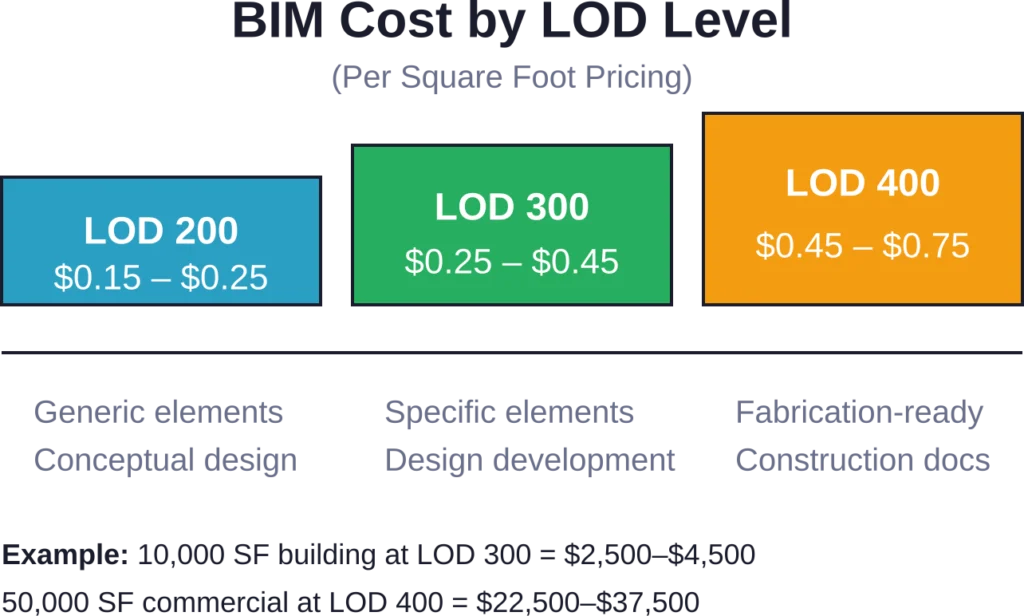
BIM pricing breaks down by Level of Development—basically, how much detail you’re packing into the model.
Here’s how LOD levels translate to actual dollars:
- LOD 200 (generic elements): $0.15–$0.25 per square foot
- LOD 300 (specific elements): $0.25–$0.45 per square foot
- LOD 400 (fabrication-ready): $0.45–$0.75 per square foot
For a 10,000 SF building, that means LOD 200 hits the $2,500 minimum cost, LOD 300 runs $2,500–$4,500, and LOD 400 climbs to $4,500–$7,500.
The adoption numbers tell you why this matters: around 74% of U.S. contractors, 67% of engineers, and 70% of architects now use BIM. It’s not a novelty—it’s standard practice.
What Actually Drives the Price Up
Complexity is the single biggest cost driver. But that’s vague—let’s break it down.
Model Detail and Polygon Count
Basic models run $40 to $200 for low-poly shapes like walls or simple structures. Medium complexity—think furniture or basic interiors—jumps to $200 to $1,000. High complexity items like intricate facades or detailed mechanical systems push $1,000 to $5,000+.
Photorealistic models require sizable work on surface details, proper UV mapping, and sophisticated shader networks. That means more hours, higher rates.
Rendering Type and Output Quality
Interior rendering depicts a room with furniture, textures, lighting, flooring, and ornaments. Depending on realism and detail, prices range from $150 to $1,500.
Exterior renderings cost more—typically $1,400 to $2,800 per image—because they include landscaping, environmental context, and often multiple lighting scenarios.
An animated architectural rendering is much more expensive, simply because the 3D animators have to build everything frame by frame. A resolution of 1920 x 1080p in 30fps is standard nowadays; the cost starts from $5,000 to $10,000 per minute. High-end 4K productions can exceed $15,000 per minute.
| Service Type | Cost Range | Typical Deliverable |
|---|---|---|
| 3D Floor Plans | $600 – $1,500 | Per image, top-down view with furniture |
| Interior Rendering | $900 – $1,800 | Single room, realistic materials and lighting |
| Exterior Rendering | $1,400 – $2,800 | Building facade with site context |
| Animation (per minute) | $6,000 – $12,000 | 1080p walkthrough or flyover |
Revisions and Client Feedback Loops
Here’s where things get messy. Most quotes include 2-3 revision rounds. After that, you’re paying hourly—often $50 to $150 per hour depending on the studio’s location and expertise.
Scope creep kills budgets. If you change the design halfway through, expect to pay for rework.
Project Use Cases and Their Price Tags
Why you need the model matters as much as what’s in it.
Residential Visualization
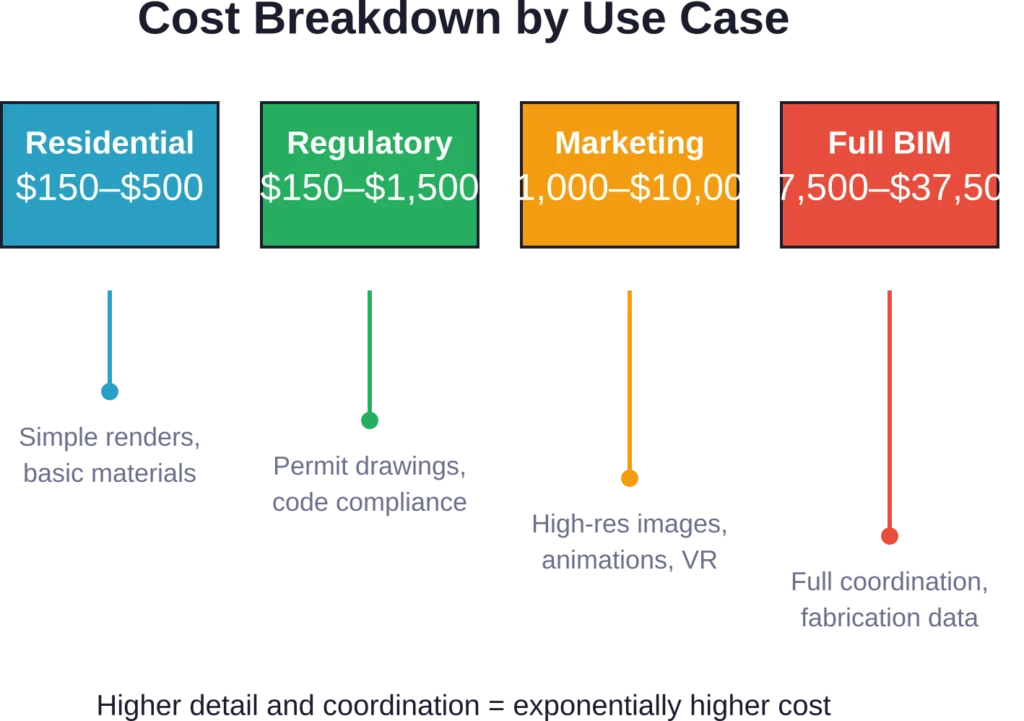
Homeowners visualizing small changes typically spend $150 to $250. These are straightforward: a kitchen remodel, a new deck, maybe a room addition.
For whole-house renovations or new construction, expect $500 to $2,000 for multiple views and exterior context.
Regulatory Approvals and Permitting
Regulatory approvals run $150 to $300 for basic models to show zoning boards or planning commissions. For detailed plans that navigate complex building codes or historical district requirements, you’re looking at $600 to $1,500.
Marketing and Sales Materials
Developers selling pre-construction units need high-quality renders. Budget $1,000 to $3,000 per image for marketing-grade work, plus $5,000 to $10,000 for 360-degree tours or videos.
These aren’t optional if you’re selling luxury condos or commercial space—they’re the difference between a signed contract and a lost lead.
Billing Methods That Impact Your Bottom Line
How you’re charged matters almost as much as the rate itself.
Hourly Rates
Freelancers typically charge $50 to $150 per hour. Studios and established firms push $100 to $250+ per hour, especially in major metros.
Hourly billing works for exploratory projects or when scope is unclear. But it can spiral if the project drags.
Flat Project Fees
Most architectural modeling quotes come as fixed-price packages. You get a defined deliverable—say, three exterior views and two interiors—for a set price.
This protects you from runaway costs, but only if the scope is nailed down upfront. Change the design mid-stream, and you’ll trigger change orders.
Per-Image or Per-Square-Foot Pricing
Rendering studios often quote per image: $900 for an interior, $1,800 for an exterior. BIM projects typically use per-square-foot rates as outlined earlier.
This makes apples-to-apples comparisons easier, but watch for hidden fees—revisions, file format conversions, rush delivery.
Get Architectural Modelling Support During Design Development
Powerkh provides architectural BIM modelling support for project teams working through developed and technical design stages. Its services include model development, drawing production, coordination support, and existing conditions modelling.
Need Architectural Modelling Support?
Talk with Powerkh to:
- prepare architectural models for coordination
- support drawing and documentation workflows
- update models based on design development
- improve collaboration across project teams
Review your architectural modelling workflow with Powerkh.
Hidden Costs Most People Miss
The quote you see isn’t always the final invoice.
File preparation and cleanup: If you’re providing existing CAD files or old drawings, expect cleanup fees—$200 to $1,000 depending on how messy the source data is.
Additional file formats: Need the model in three different software formats? Studios charge $100 to $300 per conversion.
Rush delivery: Tight deadline? Add 25-50% to the base price for expedited work.
Licensing for commercial use: Some freelancers retain rights to their work. If you plan to use renders in advertising or sales materials, clarify licensing upfront or pay extra for buyout rights.
How BIM Saves Money in the Long Run
BIM costs more upfront, but the return is measurable. Projects routinely run over budget and behind schedule. BIM directly addresses this inefficiency.
BIM adoption has been shown to reduce costs through fewer errors and clashes. Automated clash detection catches conflicts between structural, mechanical, and electrical systems before construction begins, eliminating costly rework on site. Some studies suggest BIM coordination prevents 5-15% in construction rework.
For a $1 million construction project, that’s significant savings—far more than the $10,000 to $30,000 you might spend on the BIM model itself.
Regional and Provider Variations
Geography drives pricing more than most clients realize.
U.S. studios in New York, San Francisco, or Los Angeles charge premium rates—$150 to $250+ per hour. Midwest and Southern markets run $75 to $150 per hour.
Offshore providers in Eastern Europe or Asia quote $25 to $75 per hour, but quality and communication vary. You’ll often spend extra time on revisions or fixing misaligned expectations.
For high-stakes projects—regulatory submittals, investor presentations, luxury developments—paying for domestic expertise usually pays off. For exploratory work or early concept studies, offshore can work if you manage it tightly.
In-House vs. Outsourcing
Should you hire a full-time modeler or contract project-by-project?
Full-time hires run $40,000 to $80,000 annually in salary, plus additional costs for benefits, software licenses, and hardware. That makes sense if you have steady workflow—architectural firms designing multiple projects per year, developers with ongoing needs.
For one-off projects or sporadic work, outsourcing is almost always cheaper. A $5,000 freelance project versus $100,000+ in annual overhead isn’t a hard decision.
Smart Ways to Control Costs Without Sacrificing Quality
You don’t need to blow your budget to get usable results.
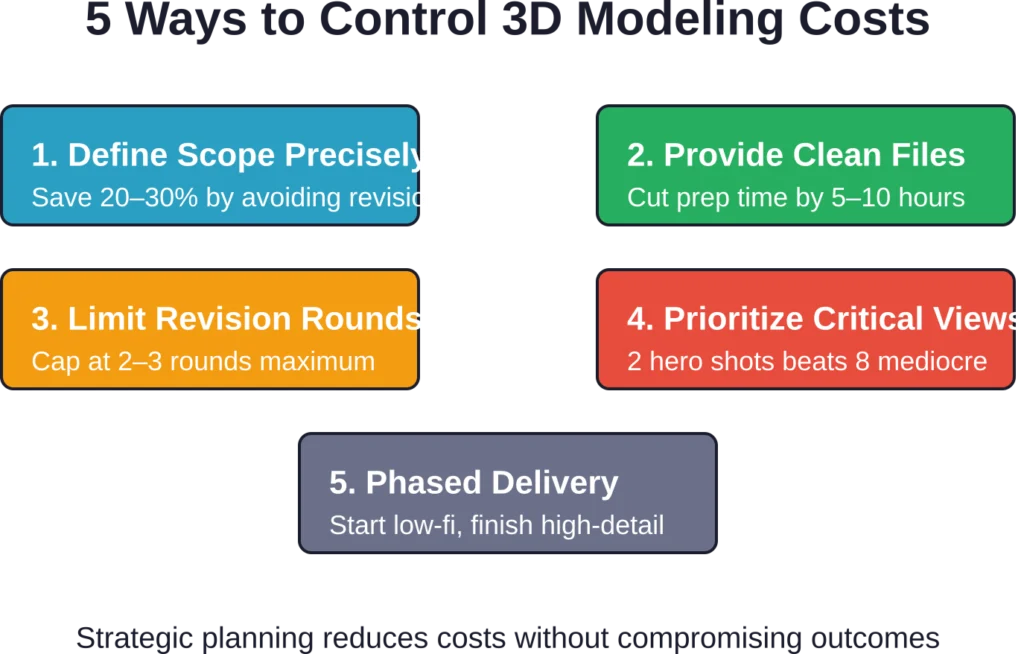
Define Scope Precisely
Vague briefs lead to expensive revisions. Specify exactly what views you need, what level of detail, what file formats, and how many revision rounds are included.
Provide Clean Source Files
The cleaner your CAD files or drawings, the less time the modeler spends interpreting and fixing errors. That translates directly to lower fees.
Limit Revisions
Each revision round costs time and money. Get stakeholder alignment before the modeler starts, not after the first draft.
Prioritize Critical Views
Do you really need eight exterior angles, or will two hero shots do the job? Fewer images at higher quality beats a dozen mediocre renders.
Consider Phased Delivery
Start with a low-fidelity model to confirm design direction, then invest in high-detail rendering once the concept is locked. This avoids expensive rework on fully finished assets.
2026 Trends Affecting Pricing
Technology is reshaping what’s possible—and what it costs.
AI-Assisted Modeling
Generative AI tools are accelerating certain tasks—initial concept sketches, material suggestions, even basic geometry. This hasn’t crashed prices yet, but it’s shaving 10-15% off timeline estimates for some studios.
Some industry observers anticipate this could eventually trickle into lower costs for early-stage concept work as adoption increases.
Real-Time Rendering Engines
Unreal Engine and similar platforms let studios produce near-final-quality renders in minutes instead of hours. This has the potential to cut iteration time, which could reduce per-image costs for clients willing to work with real-time workflows.
Cloud-Based Collaboration
Cloud platforms have enabled distributed teams to collaborate on models simultaneously, potentially reducing some geographic pricing advantages by improving turnaround time capabilities.
When to Invest More—and When to Save
Not all projects justify premium pricing.
Spend more when: You’re selling pre-construction units, seeking investor funding, navigating complex regulatory approvals, or competing for high-value contracts. The model is a revenue driver, not a cost center.
Save money when: You’re doing internal feasibility studies, early design exploration, or personal projects without commercial stakes. Good-enough beats perfect when the outcome doesn’t hinge on photorealism.
Questions to Ask Before You Sign
Protect yourself by clarifying these points upfront:
- How many revision rounds are included in the quoted price?
- What file formats will be delivered, and are conversions included?
- Who owns the rights to the final model and renders?
- What’s the timeline, and what happens if you need rush delivery?
- Are there additional fees for file cleanup, scanning, or licensing?
- What’s the payment schedule—deposit, milestones, or net-30?
Get answers in writing before work starts.
Real Project Examples with Actual Costs
Abstract ranges only tell part of the story. Here’s what real projects cost:
Single-family home renovation: A typical single-family home renovation requiring three interior views and one exterior for contractor bidding might range from $600 to $1,500 depending on detail level and complexity.
Mixed-use development: For a mixed-use development requiring full BIM coordination, LOD 300 models typically range from $18,750 to $33,750 (at $0.25-$0.45/sqft for 75,000 SF), plus $5,000-$15,000 for 3D laser scanning services.
Historic restoration: For a historic restoration requiring detailed facade modeling for landmark commission approval, high-detail models typically range from $1,000 to $5,000 depending on complexity, with revisions typically costing $200-$1,000 per round.
Commercial office build-out: For a commercial office build-out requiring photorealistic interior views with furniture layout and lighting design, costs typically range from $3,600 to $7,200 for four images (at $900-$1,800 per interior view).
Frequently Asked Questions
A simple residential model with basic geometry and textures typically costs $150 to $500. This covers single-room visualizations or straightforward exterior views without complex materials or lighting. For basic commercial projects, expect $500 to $1,500 depending on the scope.
3D modeling creates visual representations; BIM integrates data for construction coordination, scheduling, and cost estimation. BIM costs more—$0.15 to $0.75 per square foot versus $100 to $10,000 flat fees for standalone modeling—but delivers coordination data that prevents costly field errors and change orders.
Architectural animations in 1080p at 30fps start at $5,000 to $10,000 per minute. High-end 4K productions with complex camera moves, environmental effects, and photorealistic materials can exceed $15,000 per minute. Most marketing videos run 60-90 seconds, putting typical project costs at $7,500 to $22,500.
Offshore providers charge $25 to $75 per hour versus $100 to $250 domestically, offering 50-70% cost savings. However, communication barriers, time zone delays, and quality inconsistencies often require additional revision rounds that erode savings. Offshore works best for low-stakes exploratory work, not regulatory submittals or investor presentations.
Standard quotes include 2-3 revision rounds. Each additional round costs $200 to $1,000 depending on scope. To minimize revision costs, get stakeholder alignment on design intent before modeling begins, provide detailed reference materials, and consolidate feedback into single revision requests rather than piecemeal changes.
Photorealistic materials and lighting add 30-50% to base costs. Animations multiply costs by 5-10× versus static renders. High LOD levels in BIM projects double or triple per-square-foot rates. Complex geometry—curved facades, intricate ornament, irregular shapes—adds 20-40% in modeling time. Rush delivery typically adds 25-50% surcharges.
Full-time modelers cost $40,000 to $80,000 in salary plus $20,000 to $40,000 in benefits, software, and hardware—total $60,000 to $120,000 annually. Outsourcing makes sense unless you have steady workflow exceeding 20-30 billable hours per week year-round. For most small firms and one-off projects, per-project outsourcing costs 40-60% less than in-house staff.
Making the Right Budget Decision
So, how much does 3D architectural modeling actually cost? The honest answer: it depends on what you’re building, why you need it, and who’s doing the work.
But you’re not flying blind anymore. You know basic residential models run $150 to $500, complex BIM projects hit $7,500 to $37,500, and animations start at $5,000 per minute. You understand that LOD level, polygon count, rendering quality, and revision rounds all drive the final invoice.
More importantly, you know the right questions to ask before signing a contract—and when it makes sense to invest in premium quality versus settling for good-enough.
The smart move? Start by defining exactly what you need—not what sounds impressive, but what actually moves your project forward. Get three quotes, compare scope carefully (not just the bottom-line number), and clarify revision policies upfront.
Whether you’re a homeowner visualizing a renovation or a developer coordinating a multi-million-dollar build, the right 3D modeling investment pays for itself in better decisions, faster approvals, and fewer costly surprises during construction.
Ready to move forward? Define your scope, set a realistic budget based on the ranges above, and start vetting providers. The clearer your requirements, the more accurate your quotes—and the better your final results.