

Quick Summary: Architectural design costs typically range from $100 to $250 per hour, or 5% to 15% of total construction costs. Most residential projects fall between $5,000 and $30,000, depending on project complexity, scope, and location. Pricing models include hourly rates, flat fees, and percentage-based structures.
Planning a building project means wrestling with one unavoidable question: what will the architect actually cost?
The answer isn’t straightforward. Architect fees vary wildly based on project type, location, complexity, and how the professional structures their billing. Some charge by the hour, others take a percentage of construction costs, and many use flat fees for specific services.
Understanding these pricing models—and the factors that drive costs up or down—helps project owners budget realistically and avoid unpleasant surprises halfway through design.
Standard Architect Pricing Models
Architects use three primary fee structures, each suited to different project types and client needs.
Hourly Rates
The costs for hiring the services of an architect usually range between $100 to $250 per hour. Architectural designer rates may fall between $50 and $150, depending on experience level and project complexity.
Hourly billing works well for consultations, smaller projects, or when scope remains uncertain. Clients pay for actual time spent, which provides flexibility but makes final costs harder to predict.
Senior architects with specialized expertise command higher rates. Geographic location matters too—metropolitan areas typically see rates at the upper end of the spectrum.
Percentage of Construction Cost
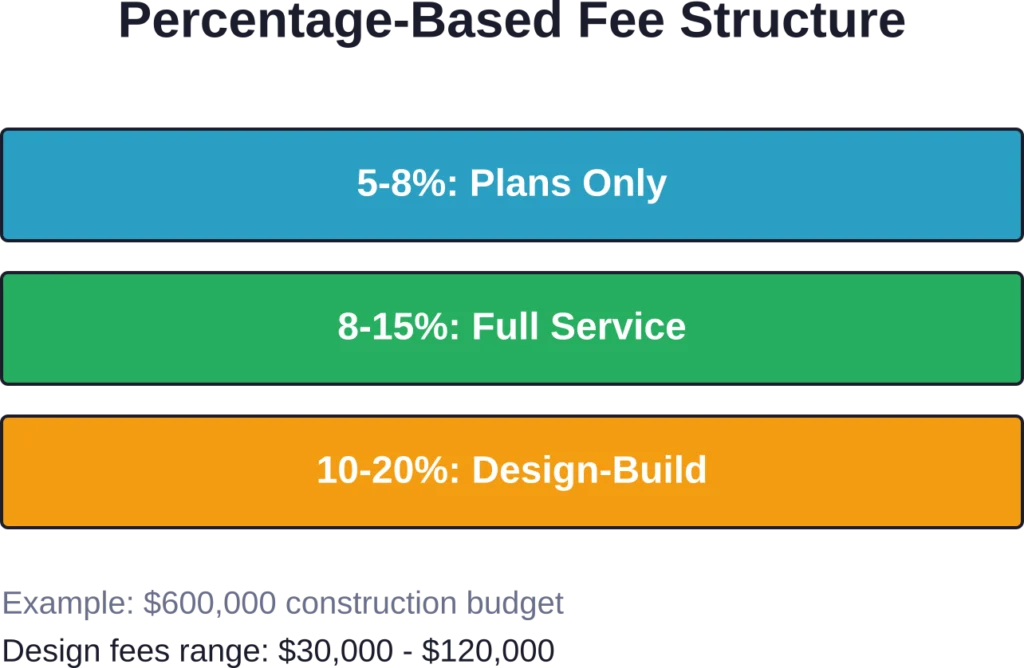
Most architects base their fees on what the project will cost to build. This percentage typically falls between 5% and 15% of total construction costs.
For design-build companies, billing is usually in the range of 10% to 20% of the construction costs. The percentage varies based on project complexity and the level of service provided.
Here’s how that breaks down practically: for a $600,000 build, an architect might charge between $30,000 and $90,000 depending on the complexity and level of service.
The percentage model aligns architect incentives with project success. When construction costs rise, so do design fees—which can motivate cost-conscious design or create conflicts depending on the relationship.
Flat Fee Arrangements
For well-defined projects with clear scope, many architects offer fixed pricing. The client knows the total cost upfront, which simplifies budgeting and eliminates hourly tracking.
Flat fees work best when project parameters are established and unlikely to change. Additions or modifications typically trigger change orders with additional fees.
Service overall expense will differ with a minimum cost of $5,000 up to a maximum of $30,000 or more, depending on project scope and complexity.
What Influences Architectural Design Costs
Several factors push fees higher or lower within the ranges above.
Project Complexity and Size
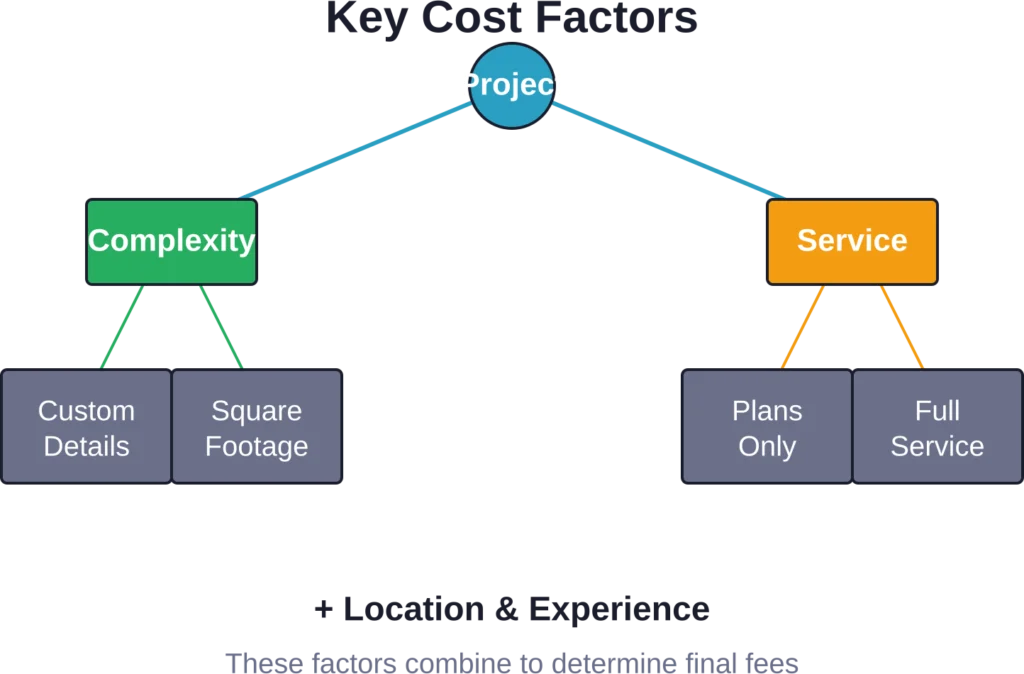
Simple rectangular additions cost less to design than multi-story homes with custom details. Complexity demands more design time, engineering coordination, and documentation.
Square footage matters, but not proportionally—a 3,000-square-foot home doesn’t cost twice as much to design as a 1,500-square-foot home. Fixed design tasks remain constant regardless of size.
Custom millwork, complex roof structures, extensive glazing, and specialty systems all increase design fees. Off-the-shelf solutions and standard construction methods keep costs down.
Service Level and Project Phases
Not all architect services are created equal. Full-service architectural work typically includes:
- Schematic design (conceptual drawings and space planning)
- Design development (detailed drawings and material selection)
- Construction documents (complete specs and drawings for permits and bidding)
- Bidding assistance (helping vet contractors and review bids)
- Construction administration (periodic site visits to verify work matches plans)
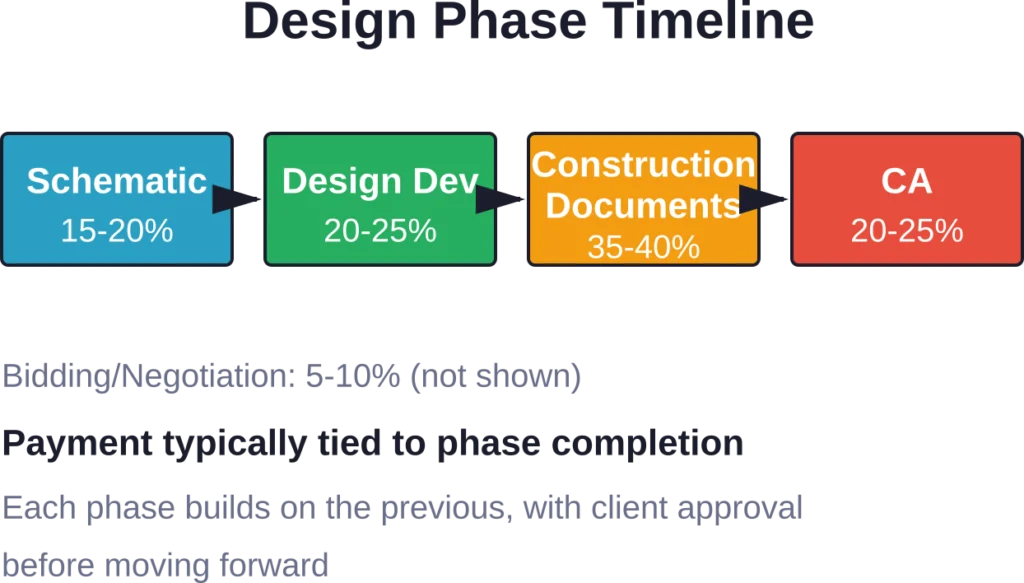
Construction administration alone typically represents 20-25% of total design fees. Clients who skip this phase save money but lose professional oversight during the build.
Plans-only services—delivering construction documents without follow-through—represent the lower end of percentage-based fees, typically between 5% and 8% of construction costs.
Location and Market Conditions
Geographic location significantly impacts rates. Metropolitan areas with high costs of living see higher professional fees. Regional building codes, permit requirements, and local construction costs also influence pricing.
According to NCARB’s 2025 data, in 2024, 89% of architects followed the NAAB-accredited path to licensure, while 11% earned licensure through additional experience. Licensing requirements vary by jurisdiction, affecting practice costs and, consequently, fees.
Professional Experience and Specialization
Seasoned architects with strong portfolios command premium rates. Specialists in particular building types—healthcare, hospitality, historic preservation—typically charge more than generalists.
These industry benchmarks influence how firms structure their billing to remain competitive while covering overhead and expertise.
Typical Cost Ranges for Common Projects
Real-world numbers help ground these abstract percentages.
Residential Projects
For Accessory Dwelling Units (ADUs), architects charge a certain percentage of the total construction costs and will work between 5% to 15%. If an ADU’s total construction costs amount to $200,000, design fees would range from $10,000 to $30,000.
New single-family homes typically see fees between 8% and 12% of construction costs for full architectural services. A $500,000 home build would carry $40,000 to $60,000 in design fees.
Renovations and additions often command higher percentages—10% to 15%—because they require working within existing constraints, matching materials, and coordinating around occupied spaces.
Small Commercial Projects
Small commercial work—retail fit-outs, small office renovations, restaurant spaces—typically falls in the 10% to 15% range for full services.
Institutional and Public Projects
Public sector work often follows different procurement rules, sometimes with capped fees or formula-based pricing tied to project budgets.
| Project Type | Typical Fee Range | Example Cost |
|---|---|---|
| ADU Design | 5-15% of construction | $10,000-$30,000 |
| New Home (Full Service) | 8-12% of construction | $40,000-$60,000 |
| Renovation/Addition | 10-15% of construction | $20,000-$45,000 |
| Small Commercial | 10-15% of construction | $25,000-$75,000 |
| Plans-Only Service | 5-8% of construction | $15,000-$40,000 |
Understanding Design Phases and Their Costs
Architectural fees aren’t paid in one lump sum. Most agreements break payments across project phases.
Schematic Design
This initial phase explores concepts, establishes overall layout, and defines the project vision. It typically represents 15% to 20% of total design fees.
Deliverables include rough floor plans, elevations, and preliminary site plans—enough to confirm the design direction matches the client’s goals.
Design Development
Once the concept is approved, design development adds detail. Material selections, structural systems, mechanical layouts, and refined dimensions come together here.
This phase usually accounts for 20% to 25% of total fees. The drawings become detailed enough for preliminary cost estimating.
Construction Documents
This is the heavy lifting—complete drawings and specifications that contractors use for bidding and building. Every wall, every fixture, every material gets specified.
Construction documents typically represent 35% to 40% of total design fees. These documents also serve as the basis for permit applications.
Bidding and Negotiation
Helping find and vet the right contractor falls into this phase, usually 5% to 10% of fees. The architect answers contractor questions, reviews bids, and helps the owner make informed decisions.
Construction Administration
Periodic site visits to verify work matches plans constitute construction administration, typically 20% to 25% of total fees.
The architect reviews submittals, answers field questions, observes progress, and helps resolve issues that arise during construction.
Additional Costs Beyond Base Fees
The architect’s fee rarely tells the complete story of design-phase expenses.
Consultant Fees
Most projects require specialized consultants—structural engineers, mechanical engineers, landscape architects, or lighting designers. These professionals bill separately, though sometimes the architect coordinates and includes their fees in a single contract.
Consultant costs typically add 20% to 40% to the base architectural fee, depending on project complexity.
Permit and Approval Costs
Permit fees vary by jurisdiction and project size. Some municipalities charge flat fees, others calculate costs as a percentage of construction value.
Budget for permit fees, plan check fees, and any required studies (environmental, geotechnical, traffic) separate from design fees.
Revisions and Changes
Most contracts include a defined number of revision rounds. Changes beyond that scope—or significant direction changes after phase approval—trigger additional fees.
Change orders during construction that require drawing updates also generate additional architectural fees.
Get BIM Support During Architectural Design
Powerkh works with architects and consultants during developed and technical design stages. Its services include BIM modelling, coordination support, constructability reviews, and technical documentation for project delivery.
Need Support During Architectural Design?
Talk with Powerkh to:
- develop coordination-ready BIM models
- support design reviews and technical delivery
- improve collaboration across disciplines
- prepare documentation for construction stages
Talk with Powerkh about BIM support for architectural design delivery.
How to Reduce Architectural Design Costs
Strategic decisions early in the process can keep fees manageable without sacrificing quality.
Define Scope Clearly
The more precisely the project is defined upfront, the more accurately fees can be estimated and contained. Vague or evolving requirements lead to extra work and additional charges.
Choose the Right Service Level
Not every project needs full-service architecture. If the owner has construction experience or a trusted contractor, plans-only services might suffice.
That said, skipping construction administration saves money upfront but can cost more if field issues arise without professional guidance.
Limit Customization
Stock doors, standard windows, and conventional framing cost less to specify than custom millwork and specialty systems. Straightforward designs reduce both design and construction costs.
Use Design-Build or Streamlined Delivery
Design-build firms integrate design and construction under one contract, sometimes reducing overall fees through efficiency. But watch for reduced design quality or limited design exploration compared to traditional architect-led projects.
Questions to Ask Before Hiring an Architect
Smart questions upfront prevent misunderstandings later.
What’s included in your fee? Clarify which services are covered and which cost extra. Does the fee include consultant coordination? How many revision rounds? What about permitting assistance?
How do you handle changes? Understand the process and cost structure for changes mid-project. Fixed fees sometimes include less flexibility than hourly arrangements.
What’s your payment schedule? Most architects request payments tied to phase completion—typically 10% at contract signing, then installments as each phase is delivered.
Can I see similar projects? Review past work to gauge style compatibility and understand the architect’s experience with projects like yours.
What’s your timeline? Design phases have typical durations, but architect workload and responsiveness affect the schedule. Clarify expectations upfront.
Professional Credentials and What They Mean
Not all design professionals carry the same qualifications or legal standing.
Licensed Architects
Licensure requires completing a professional degree (typically accredited by the National Architectural Accrediting Board), gaining practical experience through programs like the Architectural Experience Program (AXP), and passing the Architect Registration Examination.
The Two Times AXP path requires documenting double the AXP’s requirements (7,480 hours total). According to NCARB’s 2025 data, in 2024, 89% of architects followed the NAAB-accredited path to licensure, while 11% earned licensure through additional experience via alternative routes.
Only licensed architects can legally stamp construction drawings in most jurisdictions, which is required for building permits on significant projects.
Architectural Designers
These professionals have design training and experience but may not hold a license. They can work on smaller projects where state law doesn’t require an architect’s stamp, or as part of an architect-led team.
Rates for architectural designers tend to fall on the lower end of the spectrum—often $50 to $150 per hour—but they can’t provide the full range of services a licensed architect offers.
NCARB Certification
The NCARB Certificate demonstrates additional professional standing beyond basic licensure. Effective January 15, 2026, NCARB retired the time-bound three-year waiting period between becoming licensed and receiving eligibility to apply for NCARB certification through the Education Alternative, allowing architects to pursue certification immediately after receiving their initial license.
Certified architects can more easily obtain licenses in multiple states, which matters for firms working across jurisdictions.
Frequently Asked Questions
Architects hold professional licenses that allow them to practice architecture and stamp drawings for permit applications. Building designers may have similar training but typically aren’t licensed, limiting the scope and scale of projects they can lead independently. State laws vary on what unlicensed designers can legally do.
Possibly, but with tradeoffs. Experienced contractors can handle straightforward projects, but they may lack the design expertise and impartiality an architect brings. Without professional design oversight, construction errors and code issues can cost more than the design fees you saved. Complex projects almost always benefit from architectural involvement.
Practices vary. Many architects offer a free or low-cost initial meeting to discuss the project and determine fit. Extended consultations, site analysis, or preliminary sketches typically involve fees. Always clarify billing before scheduling meetings.
Remodeling often costs more as a percentage of construction cost—typically 10% to 15% compared to 8% to 12% for new builds. Working within existing structures requires more investigation, coordination, and problem-solving than designing from scratch.
The architect should work with the owner to redesign or value-engineer the project to meet budget constraints. Reputable professionals budget throughout the design process to catch cost issues early. Significant redesigns to reduce costs may trigger additional fees depending on the contract.
Sometimes. Architects with lighter workloads or strong interest in a particular project may negotiate, especially on fee structure rather than total amount. But experienced professionals with full schedules have less incentive to discount. Value and fit matter more than bottom-line fees—low fees from the wrong architect create expensive problems.
Design-build firms employ architects or architectural designers as part of their team. The design component is bundled with construction services, which can streamline delivery but may limit design exploration or independent oversight compared to hiring an architect separately.
Making the Investment Work
Architectural design costs represent a significant portion of project budgets—but they’re rarely the place to cut corners.
Good design prevents costly construction mistakes, maximizes functionality and aesthetics, and often adds more value than it costs. Poor design or incomplete documentation leads to change orders, delays, and compromises that diminish the final result.
The key is understanding what you’re paying for, choosing the right professional for the project, and structuring the agreement to align incentives and expectations.
When budget is tight, consider reducing scope rather than cutting design fees below what’s needed for quality work. A smaller, well-designed project delivers more satisfaction than a larger, poorly executed one.
Start by interviewing multiple architects, reviewing their work, and discussing fee structures openly. The right fit combines expertise, communication style, and pricing that respects both the professional’s value and the project’s budget constraints.
Ready to move forward? Clarify your project goals, establish a realistic budget including design fees, and begin conversations with licensed professionals who specialize in your project type.