

Quick Summary: Working out when sore is generally safe and can even be beneficial for muscle recovery, as long as the soreness is mild to moderate delayed onset muscle soreness (DOMS) and not acute pain from injury. Active recovery with light exercise often helps reduce muscle stiffness faster than complete rest. However, severe soreness, sharp pain, or symptoms of overtraining require rest and possibly medical attention.
That familiar muscle ache the day after a tough workout—it’s practically a badge of honor for fitness enthusiasts. But when you can barely walk down the stairs or lift your arms to brush your teeth, the question becomes urgent: should you push through and work out again, or give your body a break?
The answer isn’t as simple as yes or no. Muscle soreness exists on a spectrum, and what works for mild stiffness could seriously harm you if you’re dealing with severe pain.
Understanding Delayed Onset Muscle Soreness (DOMS)
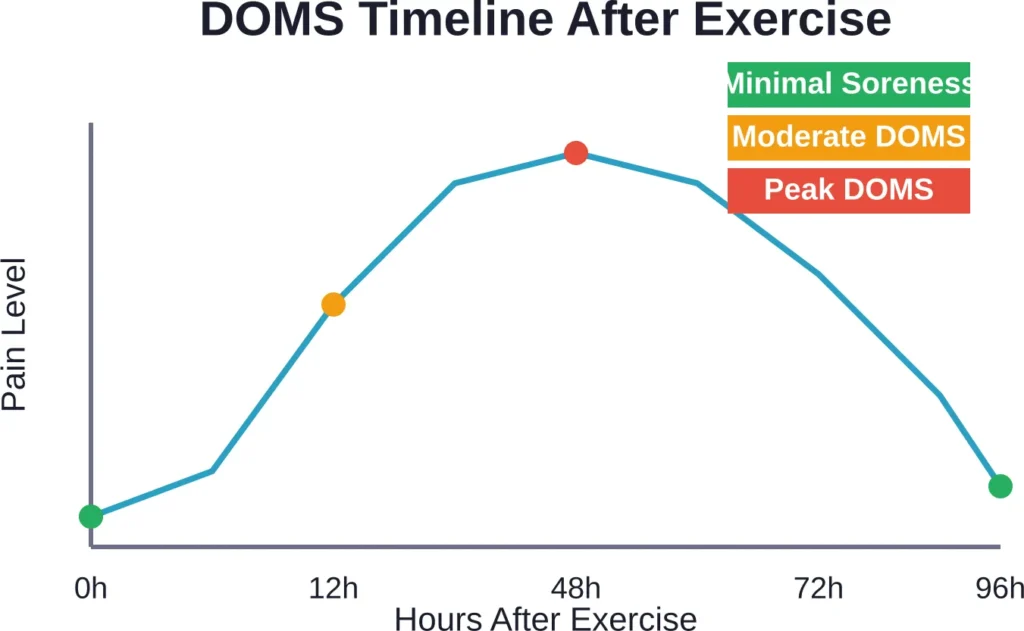
That achy feeling that peaks 24 to 72 hours after exercise has a name: delayed onset muscle soreness, or DOMS. According to research published by the National Institutes of Health, DOMS represents micro-trauma to muscle fibers, particularly following eccentric contractions—the lengthening phase of movements like lowering a weight or running downhill.
Here’s what actually happens: when you challenge your muscles beyond their usual capacity, you create microscopic tears in the muscle fibers. Research suggests that muscle injury during DOMS may occur at the musculotendinous junction or in the extramuscular fascia, with fascia playing a role in post-exercise discomfort.
Your body responds to this damage by initiating an inflammatory response. White blood cells flood the area, releasing growth factors and starting the repair process. This inflammation contributes to the swelling, stiffness, and tenderness you feel.
The delayed aspect is key. Unlike the immediate burning sensation during exercise (caused by metabolic byproducts like lactate), DOMS typically develops between 12-24 hours post-workout and peaks around 24-72 hours after exercise. The good news? It dissipates over the next few days as your muscles adapt and grow stronger.
When It’s Safe to Work Out with Sore Muscles
The short answer? Mild to moderate soreness shouldn’t stop you from exercising. In fact, light activity might actually help.
Community discussions among experienced athletes consistently report that gentle movement helps work through stiffness faster than remaining sedentary. This aligns with what exercise physiologists call “active recovery.”
Active recovery involves low-intensity movement that increases blood flow to sore muscles without adding additional damage. Think of activities like:
- Walking or light jogging at a conversational pace
- Swimming or water aerobics
- Cycling at low resistance
- Yoga or dynamic stretching
- Light resistance training targeting different muscle groups
Research published in the Journal of Athletic Training found that foam rolling after intense exercise can reduce DOMS severity and support recovery of dynamic performance measures.
The key principle: train different muscle groups. If your legs are screaming from yesterday’s squat session, an upper-body workout makes perfect sense. This approach allows sore muscles to recover while maintaining your training momentum.
The Soreness Scale: Your Decision Guide
Think of muscle soreness on a 0-10 scale, where 0 is no soreness and 10 is debilitating pain that prevents normal movement.
| Soreness Level | Description | Recommendation |
|---|---|---|
| 0-3 (Mild) | Slight tenderness when pressing on muscles or during deep movements; doesn’t affect daily activities | Proceed with normal training; consider light warm-up |
| 4-7 (Moderate) | Noticeable discomfort during movement; affects exercise form but not daily life | Modify workout intensity; focus on different muscle groups; try active recovery |
| 8-10 (Severe) | Significant pain during daily activities; difficulty with basic movements like sitting or reaching | Prioritize rest; avoid training sore areas; consider medical evaluation if persistent |
Warning Signs: When Soreness Means Stop
Not all muscle discomfort is created equal. Some sensations signal your body needs immediate rest—or medical attention.
DOMS vs. Injury: Critical Differences
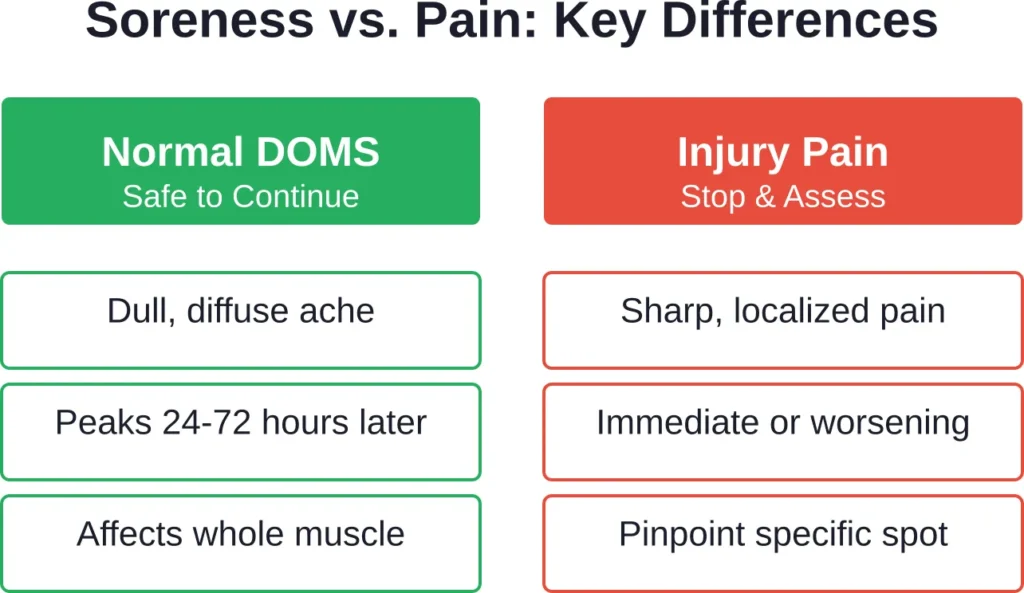
Delayed onset muscle soreness feels like a dull, generalized ache spread throughout the muscle. Injury pain tends to be sharp, localized, and sudden. If you can pinpoint the exact spot that hurts, that’s a red flag.
Other warning signs include:
- Sharp, stabbing pain during or immediately after exercise
- Pain that worsens rather than improves after 72 hours
- Significant swelling or bruising
- Joint pain (DOMS affects muscles, not joints)
- Numbness or tingling sensations
- Visible asymmetry or deformity
Rhabdomyolysis: A Serious Concern
In rare cases, extreme muscle breakdown can lead to rhabdomyolysis—a dangerous condition where damaged muscle tissue releases proteins and electrolytes into the bloodstream, potentially causing kidney damage.
Warning signs include:
- Extremely dark urine (tea or cola-colored)
- Severe muscle pain disproportionate to the workout
- Unusual weakness
- Nausea or vomiting
- Confusion or disorientation
Rhabdomyolysis requires immediate emergency medical care. While uncommon, it most often occurs when someone attempts extremely high-volume exercise without proper conditioning—like a novice performing hundreds of reps of an unfamiliar movement.
Evidence-Based Recovery Strategies
Research on post-exercise recovery techniques reveals which methods actually work for reducing DOMS and speeding recovery.
A systematic review with meta-analysis published in Frontiers in Physiology evaluated multiple recovery modalities. Massage was found to be effective for DOMS and fatigue recovery, with moderate decreases in creatine kinase and small decreases in inflammatory markers like interleukin-6 and C-reactive protein.
What Actually Helps
Progressive Movement: The CDC recommends that adults 65 and older engage in at least 150 minutes per week of moderate-intensity aerobic activity (or 75 minutes of vigorous-intensity activity). Staying active—even when sore—helps maintain this baseline while promoting recovery through increased circulation.
Proper Nutrition: According to the American College of Sports Medicine, recovery nutrition should focus on protein for muscle repair and carbohydrates to replenish glycogen stores. Adequate hydration matters too—according to ACSM guidance, drinking about 2 cups of water in the hour before exercise and approximately 1 cup every 15 minutes during activity is recommended, though these figures should be adjusted based on workout, sweat rate, and thirst.
Sleep Quality: Muscle repair happens primarily during sleep. Most recovery and adaptation processes accelerate during deep sleep stages, making quality rest non-negotiable for athletes and active individuals.
Foam Rolling: Studies show that foam rolling post-exercise can reduce DOMS severity without impairing performance. The mechanical pressure may help reduce swelling and improve tissue mobility.
What Doesn’t Work (Contrary to Popular Belief)
The old “lactic acid buildup” theory has been debunked. Lactate clears from muscles within an hour after exercise—long before DOMS begins. Research measuring lactate levels for 72 hours confirmed that lactate concentration returns to baseline quickly and doesn’t correlate with delayed soreness.
Static stretching before exercise hasn’t shown consistent benefits for preventing DOMS. Dynamic warm-ups that gradually increase heart rate and mimic workout movements prove more effective.
The Repeated Bout Effect: Why It Gets Easier
Here’s encouraging news: the more consistently you train, the less severe your DOMS becomes. Exercise scientists call this the “repeated bout effect.”
Research from Brigham Young University found that T-cells from the immune system are present in damaged muscles after repeated workouts, suggesting a role in muscle adaptation. The immune system essentially learns to respond more efficiently to exercise stress.
This adaptation means your initial workout might leave you hobbling for days, but the same workout two weeks later produces minimal soreness. Your muscles literally get better at handling that specific stress.
The American College of Sports Medicine’s updated 2026 resistance training guidelines emphasize this principle. Based on data from more than 30,000 participants across 137 systematic reviews, the guidelines confirm that consistency matters more than complicated programming. For strength, lifting heavier loads at 80% of one-repetition maximum for 2-3 sets per exercise is recommended. For muscle growth (hypertrophy), aim for approximately 10 sets per muscle group weekly.
Practical Guidelines for Training Through Soreness
So how do you actually apply this information? Here’s a practical framework:
Same-Day Decision Tree:
- Assess your soreness level (0-10 scale)
- If 0-3: Proceed with planned workout after thorough warm-up
- If 4-7: Modify intensity or switch to different muscle groups
- If 8-10: Rest, use active recovery only (walking, gentle stretching)
Workout Modifications for Moderate Soreness:
- Reduce training volume by 30-50% (fewer sets or reps)
- Decrease intensity (lighter weights, slower pace)
- Focus on technique and control rather than maximum effort
- Extend warm-up duration to increase blood flow gradually
- Choose exercises that feel manageable rather than pushing through pain
Weekly Planning: Structure your training to alternate muscle groups and intensity. A simple split might look like upper body Monday, lower body Wednesday, and full-body light activity Friday. This approach allows 48-72 hours between training the same muscles—the minimum recovery window recommended by most exercise physiologists.
When to Seek Medical Attention
Most muscle soreness resolves within 3-5 days without intervention. Persistent symptoms beyond a week warrant professional evaluation.
Seek immediate medical care if you experience:
- Dark brown or red urine
- Severe pain that prevents all movement
- Significant swelling that doesn’t improve with rest and ice
- Fever or chills accompanying muscle pain
- Numbness or complete loss of strength in a limb
A healthcare provider can rule out serious conditions like rhabdomyolysis, compartment syndrome, or structural injuries requiring specific treatment.
Conclusion: Listen to Your Body, Not Just Your Schedule
Working out when sore isn’t just okay—it’s often beneficial, provided you’re dealing with typical DOMS and not injury. The science supports light to moderate activity as an effective recovery strategy that can reduce stiffness and maintain training consistency.
But here’s the thing: fitness isn’t about perfect adherence to a rigid schedule. It’s about long-term sustainable progress. Pushing through severe pain or ignoring warning signs doesn’t demonstrate commitment—it demonstrates poor judgment that can sideline you for weeks or months.
The smartest athletes aren’t the ones who never miss a workout. They’re the ones who understand the difference between productive discomfort and counterproductive pain, who know when to push and when to back off, and who prioritize longevity over any single training session.
Pay attention to the signals your body sends. Assess your soreness honestly. Modify your approach when needed. And remember: rest days aren’t wasted days—they’re when adaptation actually happens.
Frequently Asked Questions
Wait at least 48-72 hours before intensely training the same muscle group again. This gives your muscles time to complete the repair process that makes them stronger. Light activity or active recovery targeting those muscles is fine during this window, but avoid high-intensity training until soreness substantially decreases.
Not necessarily. Soreness indicates you challenged your muscles in an unfamiliar way, but it’s not a reliable measure of workout quality or effectiveness. As you adapt to a training program, you’ll experience less soreness while still making progress. Lack of soreness doesn’t mean lack of results—it often means your body has adapted efficiently.
Complete prevention isn’t realistic when progressing your training, but you can minimize severity. Gradually increase workout intensity rather than making sudden jumps, maintain consistent training rather than sporadic hard sessions, perform thorough warm-ups, stay hydrated, and ensure adequate protein intake. The repeated bout effect means regular training naturally reduces DOMS over time.
For mild to moderate soreness, light exercise (active recovery) often reduces stiffness faster than complete rest. Activities like walking, swimming, or gentle yoga increase blood flow without adding damage. For severe soreness rated 8-10 on a pain scale, complete rest is more appropriate until intensity decreases to moderate levels.
Non-steroidal anti-inflammatory drugs (NSAIDs) can reduce pain but may interfere with the muscle adaptation process. Some research suggests regular NSAID use might blunt strength and muscle growth gains. Occasional use for severe discomfort is generally acceptable, but relying on pain relievers to push through every workout isn’t advisable. Natural recovery methods should be the first approach.
This is the hallmark of DOMS. The inflammatory response and muscle repair process peaks 24-72 hours after exercise, not immediately. The microscopic damage triggers a cascade of cellular events that takes time to develop fully. This delayed timeline explains why you might feel fine the evening after a workout but struggle to move two days later.
Evidence for stretching preventing or significantly reducing DOMS is limited. Static stretching before exercise doesn’t consistently prevent soreness, though dynamic warm-ups that gradually increase intensity appear helpful. Gentle stretching when already sore might provide temporary relief and improve range of motion, but it won’t accelerate the underlying repair process. Focus on gradual progression and active recovery instead.