
Quick Summary: Raw eggs can be eaten but carry a real risk of Salmonella food poisoning, particularly for children under 5, pregnant women, elderly people, and those with weakened immune systems. According to the CDC, recent Salmonella outbreaks linked to eggs have caused hundreds of illnesses and hospitalizations across multiple states. Cooking eggs to 160°F eliminates the bacteria, while pasteurized eggs offer a safer raw option.
Rocky Balboa drank them. Bodybuilders swear by them. Your grandmother’s cookie dough recipe called for them.
But are raw eggs actually safe to eat?
The short answer is complicated. Raw eggs offer legitimate nutritional benefits, but they also come with documented health risks that have landed hundreds of people in hospitals. The decision isn’t just about personal preference—it’s about understanding who’s most vulnerable and what precautions actually work.
The Salmonella Problem Is Real
Fresh eggs can harbor Salmonella bacteria even when the shell looks perfectly clean and uncracked. According to the FDA, this bacteria causes intestinal infections that lead to foodborne illness.
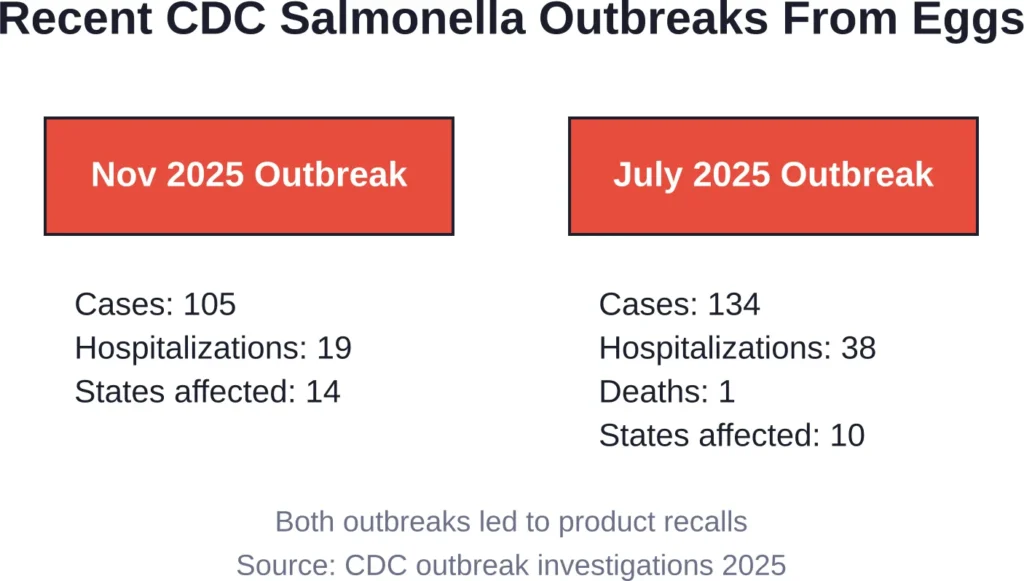
Recent CDC outbreak data paints a sobering picture. Between 2025 and early 2026, multiple Salmonella outbreaks linked to eggs affected hundreds of Americans:
- A November 2025 outbreak caused 105 cases and 19 hospitalizations across 14 states
- A July 2025 outbreak resulted in 134 cases, 38 hospitalizations, and 1 death across 10 states
- Both outbreaks triggered egg recalls and investigations
Research published in medical journals shows that eggs accounted for 53% of all Salmonella cases reported to the CDC between 1985 and 2002. More recent Korean research found that 5.3% of foodborne Salmonella outbreaks in 2020 were linked to eggs.
The bacteria can contaminate eggs in two ways: through the shell from external sources, or internally if the hen’s ovaries are infected. This means washing the shell doesn’t eliminate the risk.
Who Faces the Highest Risk
Not everyone faces equal danger from raw eggs. Certain groups are significantly more vulnerable to severe Salmonella infections.
According to the CDC and FDA, these high-risk groups should avoid raw or undercooked eggs entirely:
- Children under 5 years old — The World Health Organization reports that children under 5 experienced 29% of the health burden from unsafe food, with 143,000 deaths in 2021
- Pregnant women — Infections can affect both mother and fetus
- Elderly people — Weakened immune systems make recovery harder
- People with compromised immune systems — Including those with HIV/AIDS, cancer patients, or organ transplant recipients
For these groups, the FDA explicitly recommends avoiding foods containing raw or undercooked eggs, including homemade Caesar dressing, hollandaise sauce, mayonnaise, and raw cookie dough.
Healthy adults face lower risk but aren’t immune. Most recover from Salmonella infections within 4-7 days, but severe cases can lead to hospitalization and, as the 2025 outbreaks showed, occasionally death.
Nutrition Facts: What Raw Eggs Actually Offer
Raw eggs are undeniably nutritious. One large raw egg contains all 9 essential amino acids, making it a complete protein source.
A single raw egg provides approximately:
- 6 grams of protein
- 5 grams of fat
- Vitamin D: 41 IU (5% of Daily Value)
- Phosphorus: 99 mg (8% of DV)
- Magnesium: 6 mg (1% of DV)
- Calcium: 28 mg (2% of DV)
- Potassium: 69 mg (1% of DV)
The yolks contain most of these nutrients, plus additional vitamins A, E, and K.
Here’s the catch: eating eggs raw actually reduces how much nutrition the body can absorb.
Raw Eggs Reduce Protein Absorption
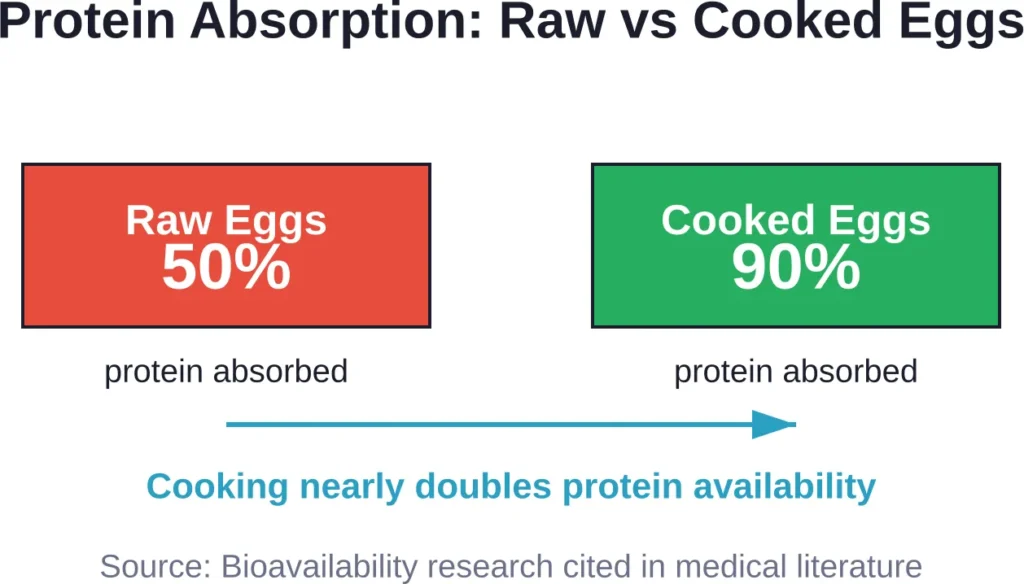
Research indicates that cooked eggs have significantly higher protein bioavailability than raw eggs.
This means eating raw eggs gives you access to considerably less usable protein content.
Raw Egg Whites Block Biotin
Raw egg whites contain avidin, a protein that binds to biotin (vitamin B7) and prevents its absorption. Biotin supports healthy skin, hair, nails, and metabolic function.
Cooking denatures avidin and eliminates this blocking effect. So ironically, cooked eggs deliver more bioavailable nutrients than raw ones.
Safe Cooking Temperatures That Kill Salmonella
Proper cooking eliminates Salmonella risk entirely. According to the USDA Food Safety and Inspection Service, eggs must reach specific internal temperatures:
| Egg Preparation | Safe Internal Temperature |
|---|---|
| Egg dishes (casseroles, quiche) | 160°F |
| Fried, poached, boiled eggs | Yolks and whites are firm |
| Scrambled eggs | No visible liquid egg remains |
| Meringue-topped pies | 350°F oven for 15 minutes |
The FDA provides additional guidance for food service operations: cook shell eggs broken for immediate service to 145°F for 15 seconds, or to 155°F for 17 seconds for foods prepared with raw shell eggs.
Korean research examining cooking methods found that the probability of Salmonella illness from cooked eggs dropped to 6.8×10⁻¹⁰ — essentially negligible when proper temperatures are reached.
The Pasteurized Egg Alternative
Pasteurized eggs offer a middle ground: raw texture with significantly reduced Salmonella risk.
According to USDA Agricultural Research Service data, less than 3% of the approximately 74 billion fresh eggs produced in the United States annually are pasteurized. Traditional hot water pasteurization involves immersing eggs in 130-140°F water for about 1 hour, which historically added approximately $1.50 to the retail price per dozen.
Newer radio frequency (RF) pasteurization methods can achieve 99.999% pathogen reduction in just 23 minutes without affecting egg quality.
Pasteurized eggs are often marketed to nursing homes, hospitals, and other institutional kitchens serving vulnerable populations. They’re also sold in retail stores for consumers who want to make homemade mayonnaise, Caesar dressing, or other recipes traditionally calling for raw eggs.
While pasteurization dramatically reduces risk, it doesn’t eliminate it entirely. Proper refrigeration and handling remain essential.
Safe Handling Practices If You Choose Raw
For those who decide to consume raw eggs despite the risks, proper handling is critical. The USDA and FDA recommend:
- Buy refrigerated eggs — Choose eggs stored in refrigerated cases, never at room temperature
- Check for cracks — Discard any eggs with cracked or dirty shells
- Refrigerate promptly — Store eggs at 40°F or below; use within 3 to 5 weeks
- Don’t leave eggs out — According to USDA guidelines, don’t keep eggs out of the refrigerator more than 2 hours
- Use quickly — Prepare dishes containing raw eggs immediately, or refrigerate and cook within 24 hours
- Separate raw egg whites — Store in refrigerator for 2 to 4 days, or freeze for up to 12 months
The CDC emphasizes washing hands, bowls, utensils, and countertops after handling raw eggs or dough containing eggs.
Research analyzing egg consumption found that 1.5% of eggs were consumed raw, 57.5% were dry-heated, and 41% were moist-heated.
When Raw Eggs Might Be More Acceptable
Egg safety standards vary significantly by country. Some nations have implemented comprehensive farm-to-retail safety programs that substantially reduce Salmonella prevalence.
Japanese surveillance data shows dramatic improvement: the prevalence of Salmonella Enteritidis in commercial eggs was estimated at approximately 0.003%, representing a tenfold decrease compared to similar surveillance in the mid 1990s. This reduction corresponded with a 90% decrease in Salmonella foodborne disease cases between 1998 and 2010.
Canada has implemented rigorous inspection and grading systems that keep Salmonella risk extremely low compared to some other countries. In nations with strong egg safety programs, the risk calculation changes somewhat for healthy adults.
That said, even in countries with excellent egg safety records, high-risk groups should still avoid raw eggs.
The Bottom Line on Raw Egg Safety
So is it okay to eat raw eggs?
For healthy adults in countries with strong egg safety programs, occasional raw egg consumption carries relatively low risk — but it’s never zero. Recent CDC outbreak data confirms that Salmonella from eggs remains a real and ongoing threat.
For children under 5, pregnant women, elderly individuals, and anyone with a compromised immune system, raw eggs should be avoided entirely. The potential consequences are too severe.
From a nutrition standpoint, cooking eggs actually delivers more bioavailable protein and nutrients than eating them raw.
If recipes require raw eggs, pasteurized eggs offer a safer alternative. And if taste or tradition matters more than marginal risk reduction, strict adherence to safe handling practices is non-negotiable.
The choice is ultimately personal — but it should be an informed one based on facts, not myths.
Frequently Asked Questions
Yes. Salmonella can contaminate egg shells from external sources like hen feces or contaminated environments. However, the bacteria can also be inside the egg if the hen’s ovaries were infected. This is why washing the shell doesn’t eliminate risk, and proper cooking is the only way to kill bacteria that may be present inside the egg.
According to the USDA, egg dishes must reach an internal temperature of 160°F to kill Salmonella bacteria. For individual fried, poached, or boiled eggs, cook until both the yolk and white are firm. The FDA specifies 145°F for 15 seconds for eggs broken and cooked immediately in food service settings.
Pasteurized eggs are significantly safer than regular eggs for raw consumption, with modern methods achieving 99.999% pathogen reduction. However, pasteurization doesn’t guarantee 100% elimination of all bacteria. Proper refrigeration and handling remain important, and high-risk individuals should still exercise caution even with pasteurized eggs.
No. Research shows that cooked eggs actually provide better protein absorption than raw eggs — 90% versus only 50%. Bodybuilders and athletes can get more usable protein from cooked eggs, scrambled eggs, or hard-boiled eggs than from raw eggs, without the Salmonella risk. The Rocky Balboa raw egg routine is outdated.
According to the USDA, raw eggs in their shells can be stored in the refrigerator for 3 to 5 weeks from the date of purchase. Raw egg whites can be refrigerated for 2 to 4 days or frozen for up to 12 months. Always store eggs at 40°F or below and never leave them at room temperature for more than 2 hours.
Japan has achieved remarkably low Salmonella prevalence in eggs (0.003% according to national surveillance), making raw egg dishes more culturally acceptable there. Canada also maintains rigorous inspection and grading systems. However, even in countries with excellent safety records, vulnerable populations should avoid raw eggs, and proper handling is always essential.
Yes. According to the FDA, fresh eggs with clean, uncracked shells may still contain Salmonella bacteria. The bacteria can be transmitted to the egg from an infected hen’s ovaries before the shell even forms. This internal contamination is why shell appearance isn’t a reliable safety indicator and why thorough cooking is necessary.