
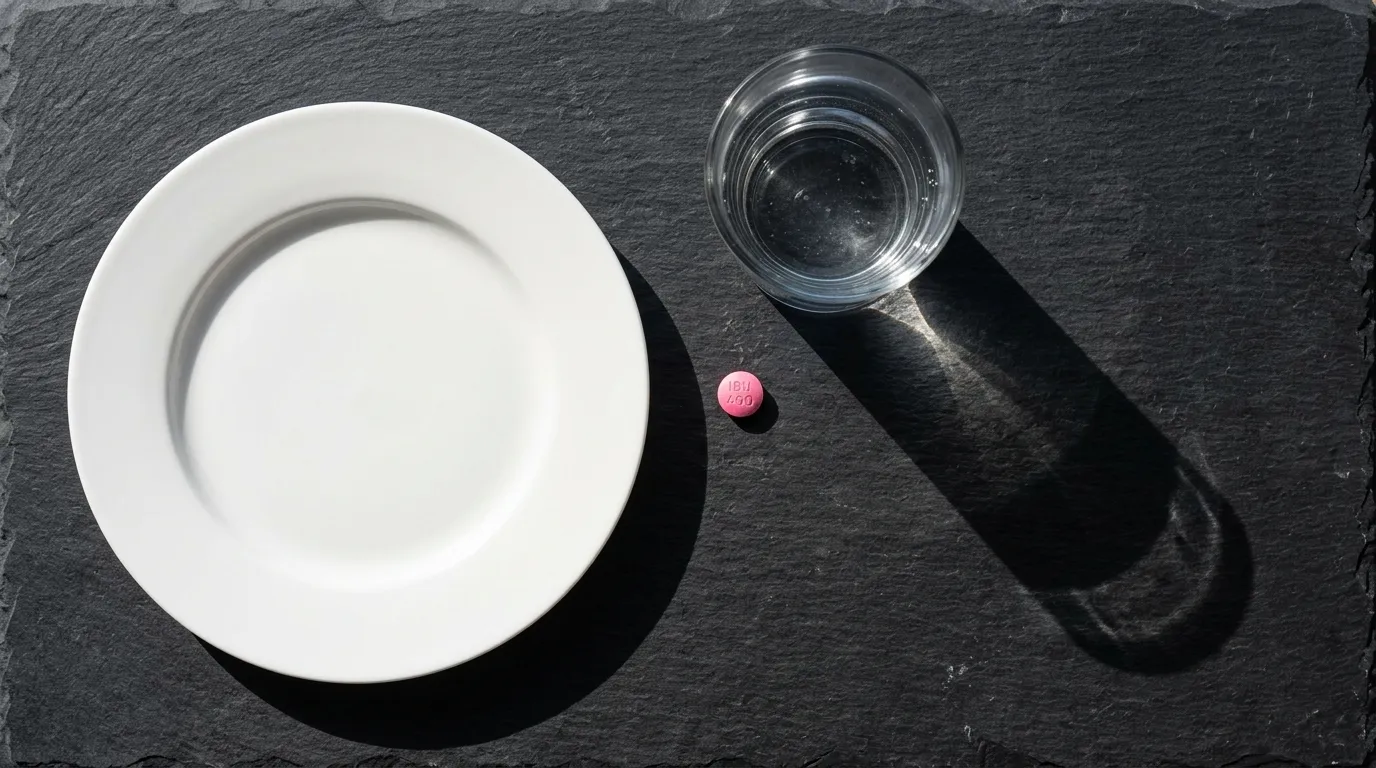
Quick Summary: Taking ibuprofen on an empty stomach is possible but increases the risk of gastrointestinal irritation and discomfort. While the medication absorbs faster without food, reaching peak blood levels within 15-30 minutes, it can irritate the stomach lining and potentially lead to more serious complications with prolonged use. For most people, taking ibuprofen with a small snack or meal reduces these risks without significantly affecting pain relief.
Ibuprofen ranks among the most widely used over-the-counter painkillers worldwide. It treats headaches, muscle pain, menstrual cramps, and inflammation with proven effectiveness.
But here’s the question that sends people down the internet rabbit hole: can you take it without eating first?
The answer isn’t a simple yes or no. The relationship between ibuprofen and your digestive system involves real trade-offs between convenience, absorption speed, and stomach protection.
What Happens When You Take Ibuprofen Without Food
Ibuprofen belongs to a class of medications called nonsteroidal anti-inflammatory drugs (NSAIDs). These drugs work by inhibiting prostaglandin synthesis—chemicals your body produces that cause pain and inflammation.
That’s great for pain relief. The downside? Prostaglandins also protect your stomach lining by regulating mucus production and acid levels.
When you swallow ibuprofen on an empty stomach, the medication comes into direct contact with your stomach lining without any food buffer. This creates two immediate effects:
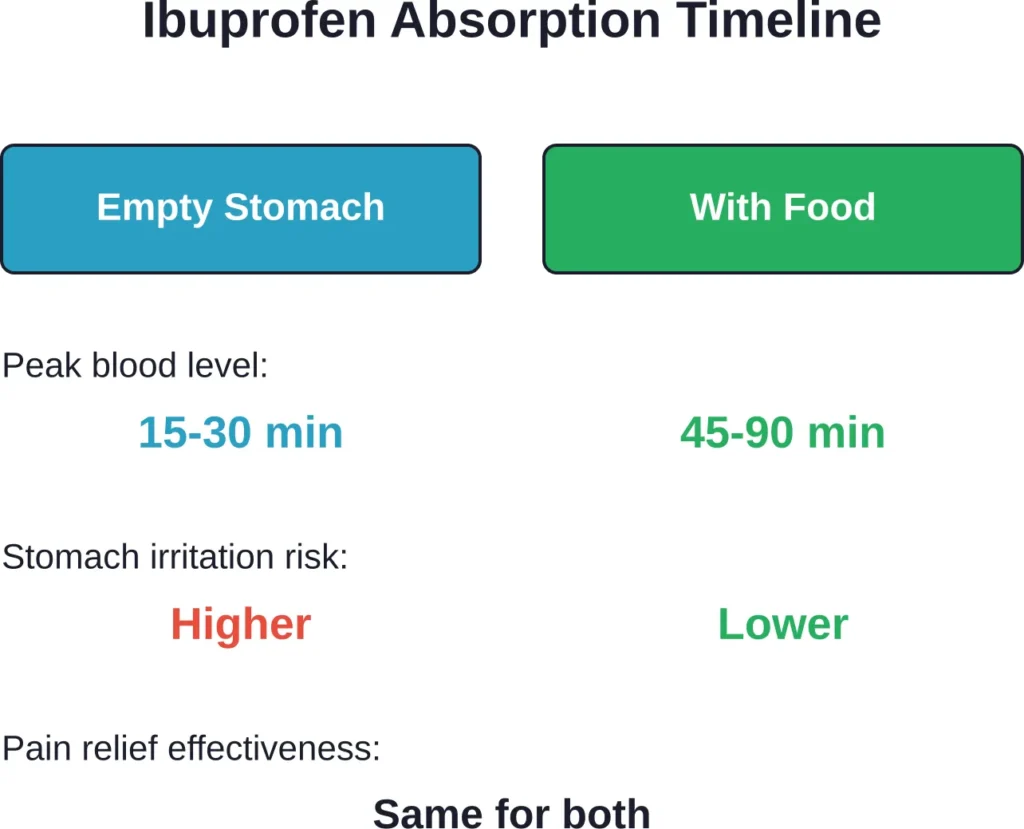
First, absorption happens faster. Ibuprofen taken without food reaches peak blood levels within 15-30 minutes, providing quicker pain relief. That’s why some people prefer this method when they need immediate results.
Second, the concentrated medication sits against your stomach wall. Without food to dilute it, ibuprofen can irritate the protective mucosal layer more intensely than it would with a meal present.
The stomach responds by producing less protective mucus while the medication suppresses prostaglandin production. This combination leaves your stomach lining more vulnerable to its own acid.
Understanding the Gastrointestinal Risks
The risks aren’t just theoretical. Research analyzing the FDA Adverse Event Reporting System database confirms that NSAID-induced gastrointestinal disorders represent a significant pattern of reported complications. Studies document GI bleeding incidence ranging from 0.4% to 1.7% for conventional NSAIDs.
These events include ulcers, bleeding, and in severe cases, perforation of the stomach or intestine.
Taking ibuprofen without food doesn’t guarantee you’ll experience these severe outcomes. But it does increase the baseline risk, especially with repeated use.
Who Faces Higher Risk
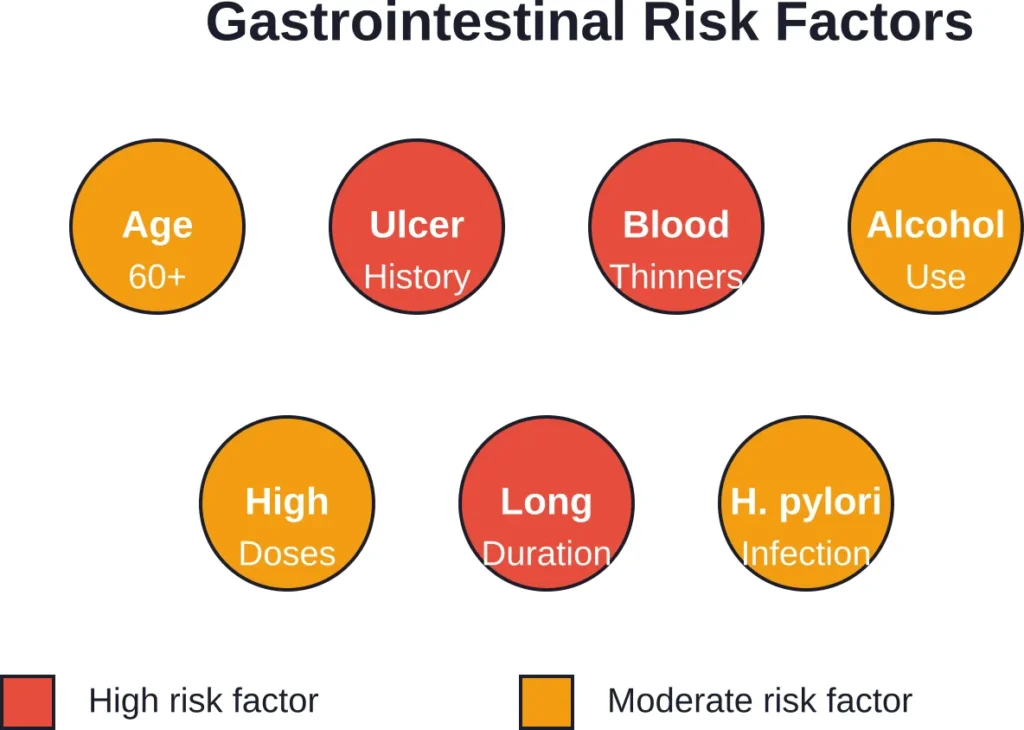
Certain factors amplify the danger of taking ibuprofen on an empty stomach:
- History of stomach ulcers or gastrointestinal bleeding
- Concurrent use of blood thinners or corticosteroids
- Age over 60
- Regular alcohol consumption
- Taking higher doses or using ibuprofen for extended periods
- Smoking tobacco
- Presence of H. pylori infection
For these individuals, the empty stomach question becomes more critical. The protective effect of food matters more when baseline risk already sits elevated.
How Much Ibuprofen Is Safe to Take
Dosing guidelines exist for good reason. According to Cleveland Clinic guidance, adults should take no more than 200 to 400 mg every four to six hours as needed.
The maximum over-the-counter dose is 1,200 mg in 24 hours. Prescription-strength ibuprofen can reach 3,200 mg per day, but only under medical supervision.
Duration matters as much as dose. For pain, don’t exceed 10 days of continuous use without consulting a healthcare provider. For fever, the limit drops to 3 days.
| Usage Type | Single Dose | Frequency | Daily Maximum | Duration Limit |
|---|---|---|---|---|
| OTC pain relief | 200-400 mg | Every 4-6 hours | 1,200 mg | 10 days |
| OTC fever reduction | 200-400 mg | Every 4-6 hours | 1,200 mg | 3 days |
| Prescription strength | Varies | Per provider | Up to 3,200 mg | Per provider |
These limits apply regardless of whether you take ibuprofen with food or not. But combining maximum doses with empty stomach use amplifies risk unnecessarily.
The Food Buffer Effect
Food doesn’t just slow absorption. It creates a physical and chemical barrier between the medication and your stomach lining.
When you eat before taking ibuprofen, the food dilutes the medication concentration in your stomach. The pill dissolves more gradually, spreading the active ingredient across a larger volume of stomach contents.
This reduces the intensity of contact between ibuprofen and the mucosal cells that line your stomach wall.
Food also stimulates protective mucus secretion. Your stomach naturally ramps up mucus production when digesting, creating additional protection against both stomach acid and medication irritation.
The trade-off? Absorption slows down. Peak blood levels might not appear for 45 to 90 minutes instead of 15 to 30 minutes. But here’s the thing—the ultimate pain relief effectiveness remains the same. You just wait a bit longer for it to kick in.
What Counts as Food
You don’t need a full meal. A small snack provides meaningful protection:
- A slice of toast
- Crackers with cheese
- Yogurt
- A banana
- A glass of milk
The goal is simply putting something substantial in your stomach, not achieving perfect nutrition.
Warning Signs Your Stomach Is Irritated
Pay attention to these symptoms when taking ibuprofen, especially without food:
Mild to moderate signs:
- Heartburn or indigestion
- Stomach pain or cramping
- Nausea
- Bloating or gas
- Loss of appetite
Serious warning signs requiring immediate medical attention:
- Black, tarry stools (indicates GI bleeding)
- Vomiting blood or material that looks like coffee grounds
- Severe stomach pain
- Unexplained weight loss
- Persistent nausea or vomiting
These severe symptoms suggest possible ulceration or bleeding. Don’t wait if you experience them.
Drug Interactions Worth Knowing
Ibuprofen doesn’t exist in isolation. It interacts with several common medications, and some of these interactions involve the empty stomach question indirectly.
Aspirin Interaction
If you take daily low-dose aspirin for heart protection, timing matters. Research documented in prescribing information shows that ibuprofen 400 mg taken 2 hours before immediate-release aspirin showed interaction affecting aspirin’s antiplatelet activity.
This matters because if you’re taking ibuprofen on an empty stomach for faster absorption, you might inadvertently time it wrong relative to your aspirin dose.
Other Notable Interactions
Ibuprofen can interact with:
- Blood pressure medications (may reduce effectiveness)
- Warfarin and other blood thinners (increases bleeding risk)
- Corticosteroids (amplifies GI risk)
- SSRIs and other antidepressants (increases bleeding risk)
- Diuretics (may impair kidney function)
These interactions exist regardless of food intake, but taking ibuprofen with food becomes even more important when combined medications already stress your gastrointestinal system.
Alternatives and Combination Products
Sometimes the empty stomach question arises because people want fast relief without the hassle of eating. Alternative approaches exist.
Ibuprofen Plus Famotidine
Combination products containing both ibuprofen and famotidine (an acid reducer) address stomach protection directly. Famotidine decreases stomach acid production, providing additional mucosal protection.
These combinations were specifically designed for people who need NSAID therapy but have elevated GI risk. The famotidine component doesn’t eliminate all risk, but it reduces it meaningfully.
COX-2 Selective NSAIDs
Medications like celecoxib selectively inhibit COX-2 enzymes while sparing COX-1. Since COX-1 produces the prostaglandins that protect your stomach, COX-2-selective drugs theoretically cause less GI damage.
Research confirms lower GI bleeding rates with COX-2-selective NSAIDs (0.3% to 0.8%) compared to conventional NSAIDs (0.4% to 1.7%).
Acetaminophen Alternative
For pure pain relief without inflammation reduction, acetaminophen (paracetamol) works through different mechanisms. It doesn’t inhibit prostaglandin synthesis in the stomach, so it carries substantially lower GI risk.
The empty stomach question becomes irrelevant with acetaminophen—it doesn’t irritate gastric mucosa the way NSAIDs do.
The downside? Acetaminophen doesn’t reduce inflammation, making it less effective for conditions like arthritis or muscle strains where inflammation drives symptoms.
Practical Guidelines for Safe Use
So what’s the practical takeaway? Here’s a decision framework:
Take ibuprofen with food if:
- You’re using it regularly (more than occasional single doses)
- You have any GI risk factors
- You’ve experienced stomach upset from NSAIDs before
- You’re taking other medications that increase GI risk
- Waiting 30-60 extra minutes for pain relief is acceptable
Empty stomach use might be reasonable if:
- You need very fast pain relief for an acute situation
- You have no GI risk factors
- You’re taking a single dose, not regular use
- You’ve successfully taken ibuprofen without food before
Always take with food if:
- You’re over 60
- You have a history of ulcers or GI bleeding
- You take blood thinners, corticosteroids, or SSRIs
- You drink alcohol regularly
- You’re using prescription-strength doses
When to See a Healthcare Provider
Most people can use over-the-counter ibuprofen safely with minimal guidance. But certain situations require professional consultation:
- Pain that requires ibuprofen for more than 10 days
- Fever lasting more than 3 days despite ibuprofen
- Any symptoms of GI bleeding (black stools, bloody vomit)
- New stomach pain that develops while taking ibuprofen
- Need for higher doses than OTC recommendations
- Uncertainty about drug interactions with current medications
- Kidney or liver disease
- Heart disease or high blood pressure
NSAIDs carry cardiovascular risks separate from GI concerns. They can increase blood pressure and potentially elevate risk for heart attack and stroke, particularly with long-term use.
These risks apply to all NSAIDs, not just ibuprofen, and occur regardless of stomach contents.
Frequently Asked Questions
Food provides maximum protection when taken immediately before or with ibuprofen. But residual food in your stomach continues offering some buffering effect for one to two hours after eating. If you ate a substantial meal recently, taking ibuprofen within that window still provides more protection than a completely empty stomach.
Water alone doesn’t provide the buffering and mucus-stimulating effects that food does. Drinking a full glass of water with ibuprofen is good practice—it helps the pill dissolve and prevents esophageal irritation—but it doesn’t replace the protective benefit of eating something before taking the medication.
Taking ibuprofen at bedtime on an empty stomach increases risk. When lying down, stomach acid and medication can more easily contact the esophageal sphincter, potentially causing reflux symptoms. If you need ibuprofen before bed, have a light snack first and wait 30 minutes before lying down.
Enteric-coated formulations delay dissolution until the medication reaches the small intestine, theoretically reducing direct stomach contact. However, the systemic effects of prostaglandin inhibition still affect the stomach lining even when the pill dissolves downstream. Coated versions may cause less immediate irritation but don’t eliminate GI risk, especially with regular use.
Acute irritation can develop within hours of a single dose, especially on an empty stomach. Mild inflammation might resolve when the medication clears your system. More serious damage like ulcers typically requires repeated exposure over days to weeks. Clinical data shows measurable increases in serious GI events after three to six months of regular NSAID use.
Ibuprofen sits in the middle range for GI toxicity among NSAIDs. Aspirin and indomethacin typically cause more gastric damage, while naproxen and celecoxib may cause slightly less. But individual variation matters—some people tolerate ibuprofen perfectly while others experience significant irritation. All NSAIDs carry the same class warnings about gastrointestinal risks.
No supplement reliably prevents NSAID-induced gastric damage. Some people take acid reducers like famotidine or proton pump inhibitors alongside NSAIDs for stomach protection, but this requires medical guidance. Probiotics haven’t demonstrated meaningful protective effects against NSAID-induced injury in clinical research. Food remains the simplest, most accessible protective measure.
The Bottom Line
Can you take ibuprofen on an empty stomach? Yes. Should you? Usually not.
The medication works just as effectively when taken with food, and the gastrointestinal risks drop meaningfully with that simple precaution. The faster absorption you gain from empty stomach use rarely matters enough to justify increased risk, especially for regular users.
For occasional single doses in people without risk factors, empty stomach use probably won’t cause problems. But making it a habit invites trouble.
The safest approach: take ibuprofen with at least a light snack, stay within recommended dosing limits, and don’t use it longer than suggested without medical guidance. Watch for warning signs of stomach irritation, and adjust your approach if symptoms develop.
Pain relief matters. So does protecting the organ delivering that medication to your bloodstream. A small snack provides that protection without meaningful downside.