

Quick Summary: Yes, it is perfectly acceptable to start a sentence with ‘and.’ The Chicago Manual of Style and other major style guides confirm there is no grammatical rule against beginning sentences with coordinating conjunctions. While some teachers discouraged this practice to help students avoid sentence fragments, professional writers and editors regularly start sentences with ‘and,’ ‘but,’ and other conjunctions in both formal and informal writing.
If someone ever told you that starting a sentence with “and” is grammatically incorrect, they were wrong. This supposed “rule” has persisted through generations of English classes, yet it has no foundation in actual grammar or professional writing standards.
The short answer? It’s perfectly acceptable to begin a sentence with and, but, or, nor, so, yet, or any other coordinating conjunction. And that’s not just an opinion—it’s confirmed by every major style guide.
The Myth Behind the Rule
Many people remember being corrected by teachers for starting sentences with conjunctions. But where did this “rule” come from?
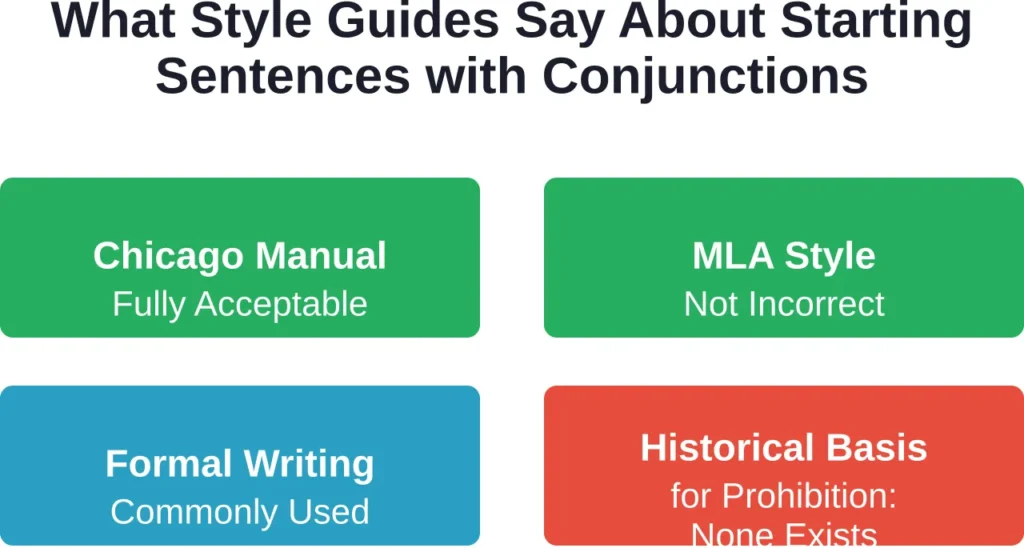
According to The Chicago Manual of Style, there is “no historical or grammatical foundation” for the prohibition against starting sentences with coordinating conjunctions. The myth likely originated as a teaching technique to prevent young students from writing sentence fragments.
Here’s the thing though—a fragment happens when you write an incomplete thought, not when you use a particular word. “And went to the store” is a fragment because it lacks a subject. “And then he went to the store” is a complete sentence with a subject and verb.
Teachers simplified the rule to help children avoid common mistakes. Unfortunately, that oversimplification stuck with many people long after they mastered sentence structure.
What Grammar Authorities Actually Say
Major style guides and academic institutions confirm that starting sentences with conjunctions is grammatically correct and stylistically acceptable.
The Chicago Manual of Style explicitly addresses this in their FAQ section, stating that using conjunctions at the beginning of sentences is proper form in both academic and professional writing. The guide notes that while some with journalism training may hesitate, there’s no legitimate grammatical objection.
The MLA Style Center acknowledges that some view this practice as informal, but confirms it’s not incorrect. Academic writing from respected institutions regularly features sentences beginning with coordinating conjunctions.
When Starting with ‘And’ Works Best
While it’s grammatically acceptable, starting with “and” serves specific purposes in effective writing.
Creating Emphasis
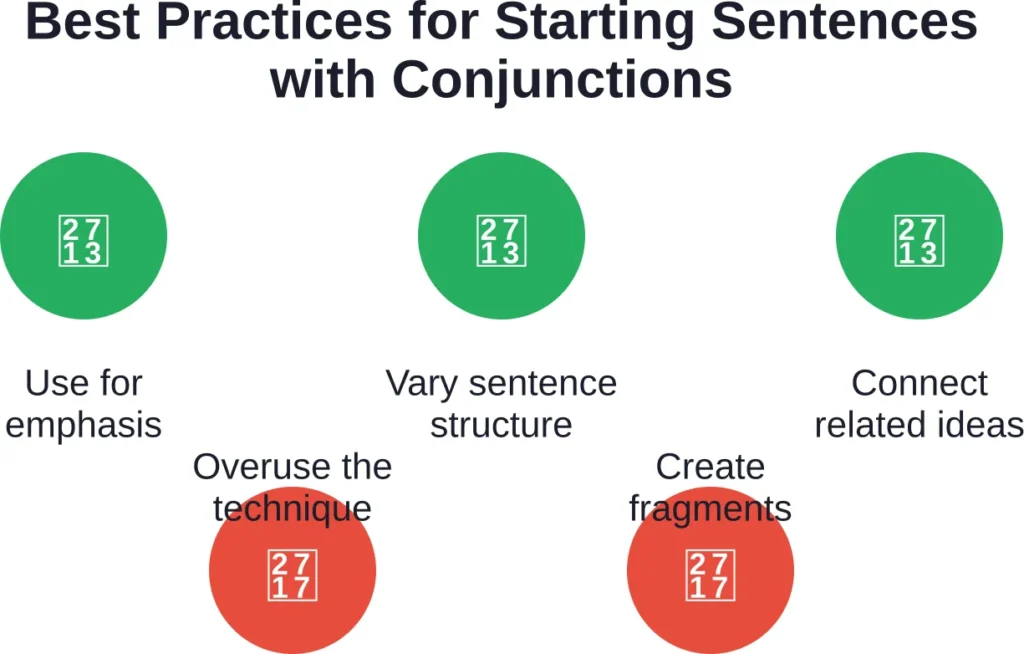
Beginning a sentence with “and” adds emphasis to what follows. It signals to readers that the upcoming information is significant or surprising.
Compare these examples:
“The company posted strong quarterly earnings, and the stock price doubled overnight.”
“The company posted strong quarterly earnings. And the stock price doubled overnight.”
The second version emphasizes the dramatic stock movement by placing it in its own sentence.
Establishing Rhythm and Flow
Starting sentences with conjunctions creates a conversational rhythm that keeps readers engaged. It mimics natural speech patterns, making formal writing more accessible.
Professional writers use this technique to vary sentence length and structure. Short sentences beginning with “and” or “but” provide pace changes that prevent monotonous rhythm.
Showing Connection Between Ideas
Conjunctions at the beginning of sentences explicitly link ideas across sentence boundaries. This helps readers follow complex arguments or narratives.
“The experiment failed three times. And each failure revealed a different flaw in the original hypothesis.”
The “and” clearly connects the repeated failures to the accumulated knowledge gained.
Common Conjunctions That Work at the Start
All coordinating conjunctions can effectively begin sentences when used appropriately.
| Conjunction | Primary Use | Example |
|---|---|---|
| And | Addition, continuation | And that changed everything. |
| But | Contrast, opposition | But the results surprised everyone. |
| Or | Alternative, choice | Or the entire system could fail. |
| Nor | Negative addition | Nor was this the last setback. |
| So | Consequence, result | So the team pivoted completely. |
| Yet | Contrast with surprise | Yet the data told a different story. |
Each conjunction creates a different relationship between sentences, giving writers precise control over how ideas connect.
What About Academic and Formal Writing?
Community discussions often question whether this technique belongs in academic papers or professional documents.
The answer is clear: formal writing regularly features sentences beginning with conjunctions. Academic journals, legal documents, business reports, and scholarly articles all use this construction.
The Chicago Manual of Style specifically addresses this concern, noting that academic law reviews and other formal publications accept this practice. The guide confirms it’s proper academic form, contrary to what some believe.
That said, moderation matters. Overusing any technique weakens its impact. Starting every third sentence with “and” becomes distracting and reduces clarity.
The Real Grammar Rule to Remember
The actual rule isn’t about conjunctions at all—it’s about complete sentences.
Every sentence needs a subject and a predicate. Whether it starts with “and,” “the,” “however,” or any other word doesn’t matter. What matters is that the sentence expresses a complete thought.
“And the data supported the conclusion” is complete. It has a subject (the data) and a verb (supported).
“And supporting the conclusion” is a fragment. It lacks a main verb and doesn’t express a complete thought.
Focus on writing complete sentences rather than worrying about which words can or can’t start them.
Frequently Asked Questions
Yes. The Chicago Manual of Style confirms this is proper academic form. Major academic journals and scholarly publications regularly feature sentences beginning with coordinating conjunctions. Focus on clarity and effective communication rather than avoiding specific words.
No. All coordinating conjunctions (and, but, or, nor, so, yet) follow the same grammatical rules. The Chicago Manual of Style notes that commas aren’t usually needed after these conjunctions when they start sentences, and all are equally acceptable in formal writing.
Teachers often simplified the rule to help students avoid sentence fragments. Young writers might write incomplete thoughts like “And went home” without a subject. The blanket prohibition was a teaching tool, not an actual grammar rule. Professional writing freely uses sentence-initial conjunctions.
Not necessarily. While the MLA Style Center notes some view it as informal, context and frequency matter more than the technique itself. Legal documents, business reports, and academic journals use this construction. Overusing it or using it inappropriately affects tone more than the practice itself.
Use this technique strategically for emphasis and rhythm. If sentences frequently begin with conjunctions, the technique may lose effectiveness and seem repetitive. Moderation prevents the style from becoming distracting and maintains clarity.
Some style guides for specific organizations or publications may restrict this practice. Check any guidelines provided by publishers, employers, or academic departments. Otherwise, use editorial judgment based on clarity and effectiveness rather than avoiding the technique entirely.
Grammar rules vary across languages. This guidance applies to English. Other languages have different conventions for conjunctions and sentence structure. Consult style guides specific to the language in which you’re writing.
Moving Forward with Confidence
The myth that sentences can’t start with “and” persists despite clear evidence to the contrary. Every major style guide confirms this practice is grammatically correct and stylistically appropriate.
Professional writers, editors, and academics use sentence-initial conjunctions regularly. They provide emphasis, create rhythm, and explicitly connect ideas across sentence boundaries.
The real rule is simple: write complete sentences that express clear thoughts. Whether those sentences start with “and,” “but,” or any other word matters far less than whether they communicate effectively.
And now that this myth is dispelled, writers can focus on what actually matters—clarity, precision, and engaging their readers with well-constructed prose that follows genuine grammatical principles rather than outdated schoolroom simplifications.