

Quick Summary: Auto 4WD mode is perfectly safe for highway driving and is designed for exactly that purpose. The system automatically distributes power to front and rear wheels as needed, providing improved traction without driver intervention. According to automotive manufacturers like Ford and Chevrolet, Auto 4WD operates seamlessly at highway speeds and can enhance handling in varied road conditions without damaging the vehicle or reducing fuel efficiency significantly.
There’s plenty of confusion about whether leaving a truck or SUV in Auto 4WD mode during highway trips will cause problems. Some drivers worry about damaging the drivetrain, hurting fuel economy, or creating unnecessary wear.
The short answer? Auto 4WD was built specifically for situations like highway driving where conditions can change unexpectedly. But understanding exactly how it works—and when other modes make more sense—helps drivers make smarter choices.
What Auto 4WD Actually Does
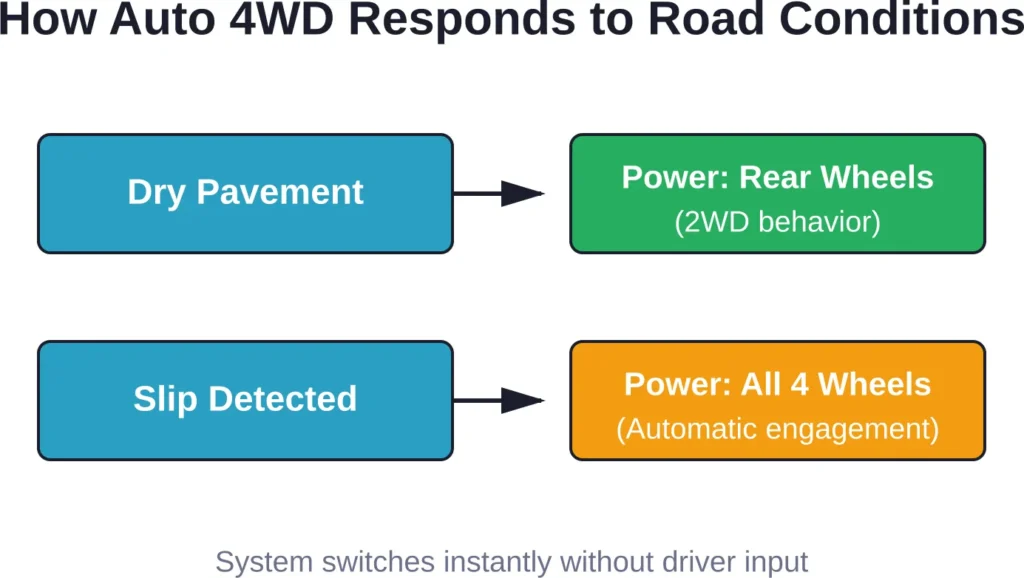
Auto 4WD (sometimes labeled as 4A or 4WD Auto) represents an electronically controlled four-wheel drive system that monitors traction in real time. Unlike full-time 4WD High, it doesn’t permanently engage all four wheels.
According to Ford, Auto 4WD “provides increased traction on varied road conditions” by electronically delivering power to front and rear wheels as needed. Chevrolet’s AutoTrac 2-speed transfer case works similarly—the system continuously adjusts power distribution based on wheel slip detection.
Here’s the thing though—the system operates seamlessly at any legal highway speed. There’s no mechanical reason to avoid using it on interstates, freeways, or any paved road.
Comparing Drive Modes for Highway Use
Most modern trucks and SUVs with four-wheel drive offer three or four distinct modes. Each serves a specific purpose.
| Drive Mode | Best Highway Use | Power Distribution | Speed Limit |
|---|---|---|---|
| 2WD High (2H) | Dry, clear conditions | Rear wheels only | No limit |
| Auto 4WD (4A) | Variable conditions, winter travel | Automatic (rear + front as needed) | No limit |
| 4WD High (4H) | Deep snow, ice, off-road | Locked front + rear | No limit (avoid dry pavement) |
| 4WD Low (4L) | Never for highway | Locked with torque multiplication | Max ~40 mph |
Ford’s documentation explicitly states that Four-wheel drive auto “provides increased traction on varied road conditions” and is suitable for normal driving. Chevrolet notes that its AutoTrac system allows drivers to “select the ideal 4WD mode” at any time, including while cruising at highway speeds.
The key distinction: Auto 4WD doesn’t lock the drivetrain like 4H does. That means it won’t cause binding or tire scrubbing on dry pavement—a common concern that leads drivers to avoid using it unnecessarily.
Does Auto 4WD Hurt Fuel Economy?
This question comes up constantly in community discussions. The reality is a bit nuanced.
On one recent 400-mile trip documented in community forums, a driver noticed better fuel economy in Auto mode compared to 2H. Sounds counterintuitive, right?
Here’s what’s happening: when roads are completely dry and traction is optimal, Auto 4WD essentially operates as 2WD. The system isn’t continuously powering the front axle—it’s monitoring and ready to engage, but not actively transferring torque.
That said, any time the system does engage four-wheel drive (even briefly), there’s a slight fuel penalty. The additional rotating mass, drivetrain friction, and power distribution create marginally higher fuel consumption.
Real talk: the difference is minimal. Most drivers report differences of 0.5 to 1.5 MPG between 2H and Auto modes during mixed highway driving. Weather conditions, tire pressure, and driving habits have larger impacts on fuel economy than the choice between these two modes.
When Auto 4WD Saves Fuel
In winter conditions with variable traction, Auto 4WD can actually improve efficiency. The system prevents wheel spin that wastes fuel and maintains momentum more effectively than a driver manually switching between modes.
Aggressive acceleration in 2WD on slippery roads burns more fuel through wheel spin than smooth acceleration in Auto 4WD with optimized traction.
Situations Where Auto 4WD Makes the Most Sense
Auto 4WD isn’t just acceptable for highway use—it’s ideal for specific scenarios.
Variable Weather During Long Trips
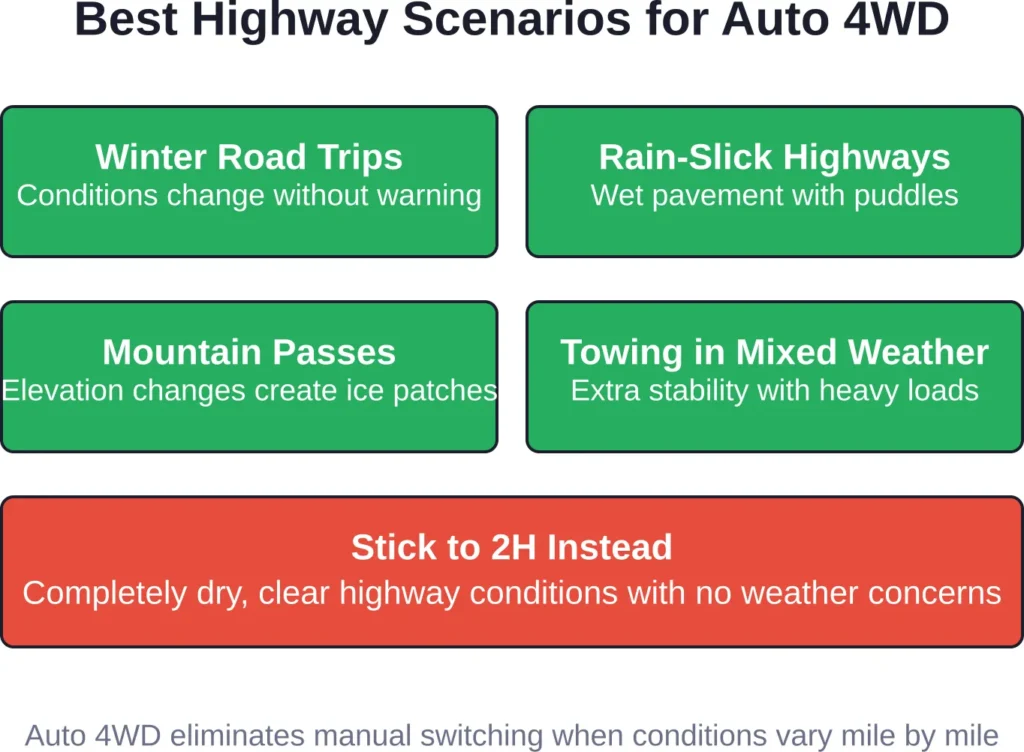
Long interstate drives often cross multiple weather systems. Starting in clear conditions doesn’t mean finishing that way. Auto 4WD adapts automatically without requiring pulls to the shoulder for mode changes.
Wet or Icy Patches
Even in relatively mild weather, bridges freeze first, shaded areas hold ice longer, and sudden rain creates slick spots. Auto 4WD engages precisely when needed and disengages just as quickly.
Towing Trailers
Extra weight reduces available traction and makes wheel slip more likely during acceleration or climbing grades. Auto 4WD provides an extra margin of safety without the fuel penalty of full-time 4H.
When to Choose 2H Instead
Despite Auto 4WD’s versatility, 2H remains the better choice for specific situations.
Completely dry, warm-weather highway driving doesn’t require the monitoring and engagement capability of Auto mode. Sticking with 2H delivers slightly better fuel economy and reduces wear on front drivetrain components that remain inactive.
If the forecast shows clear skies for the entire route and pavement is bone-dry, 2H handles the job perfectly. Save Auto 4WD for when conditions create uncertainty.
What About 4WD High on the Highway?
Now, this is where it gets interesting. Unlike Auto 4WD, traditional 4WD High (4H) locks the front and rear driveshafts together through the transfer case.
4H works brilliantly on low-traction surfaces—snow, ice, mud, gravel—but creates serious problems on dry pavement. The locked drivetrain can’t accommodate the different rotational speeds needed when turning. This causes binding, tire scrubbing, and stress on drivetrain components.
But wait. Does that mean 4H is never appropriate for highways?
Not exactly. If a highway is covered in snow or ice—think blizzard conditions or an unplowed interstate—4H is the right choice. The key is surface condition, not road type. A snow-covered highway functions like an off-road trail from a traction perspective.
Community discussions frequently mention dealers suggesting 2H for around-town driving and switching to Auto for slippery conditions, or to 4H when conditions deteriorate significantly. That’s solid advice.
Common Misconceptions About Auto 4WD
Several myths persist about Auto 4WD that lead drivers to avoid using it unnecessarily.
Myth: Auto 4WD Constantly Runs in Four-Wheel Drive
False. The system defaults to two-wheel drive and only engages the front axle when sensors detect wheel slip. On dry pavement at steady highway speeds, Auto 4WD operates identically to 2H.
Myth: Using Auto 4WD Causes Premature Wear
Minimal. Yes, components that engage occasionally will experience some wear, but that’s exactly what they’re designed for. The system uses clutch packs or electronic controls rated for thousands of engagement cycles. Normal use won’t cause premature failure.
Myth: Auto 4WD Reacts Too Slowly
Modern systems respond in milliseconds. By the time a driver consciously recognizes wheel slip and reaches for a mode selector, Auto 4WD has already engaged. The electronic response time far exceeds human reaction speed.
Vehicle-Specific Considerations
Different manufacturers implement Auto 4WD slightly differently. Understanding your specific vehicle matters.
Chevrolet’s AutoTrac 2-speed transfer case is available on trucks like the Colorado. Ford’s system similarly permits switching between 2H, 4A, and 4H without stopping.
Some older systems required the vehicle to be stationary or below certain speeds for mode changes. Consult the owner’s manual to understand your vehicle’s specific capabilities and limitations.
Indicator Lights and System Feedback
Most vehicles display the current drive mode on the instrument cluster. When Auto 4WD is selected but operating in 2WD mode, some vehicles show “4WD AUTO” while others display “2WD” until the system actually engages.
Learning how your specific vehicle communicates system status helps drivers understand what’s happening in real time.
Maintenance and Long-Term Reliability
Auto 4WD systems require minimal special maintenance beyond what’s already recommended for four-wheel drive vehicles.
Transfer case fluid should be changed according to the manufacturer’s schedule—typically every 30,000 to 50,000 miles, though severe-use conditions may require more frequent service. This applies whether using 2H, Auto, or 4H regularly.
Front differential fluid also needs periodic replacement, usually on a similar schedule. Again, this is standard maintenance for any 4WD vehicle, not a penalty specific to Auto mode.
Some drivers worry that more frequent engagement in Auto mode accelerates wear. In practice, the system is built to handle regular engagement cycles. Occasional use doesn’t create measurably more wear than letting components sit idle.
Safety Benefits of Auto 4WD on Highways
Beyond convenience, Auto 4WD offers genuine safety advantages in certain highway scenarios.
Maintaining vehicle control during unexpected traction loss is critical for preventing accidents. Auto 4WD engages before most drivers can consciously react, potentially preventing loss of control.
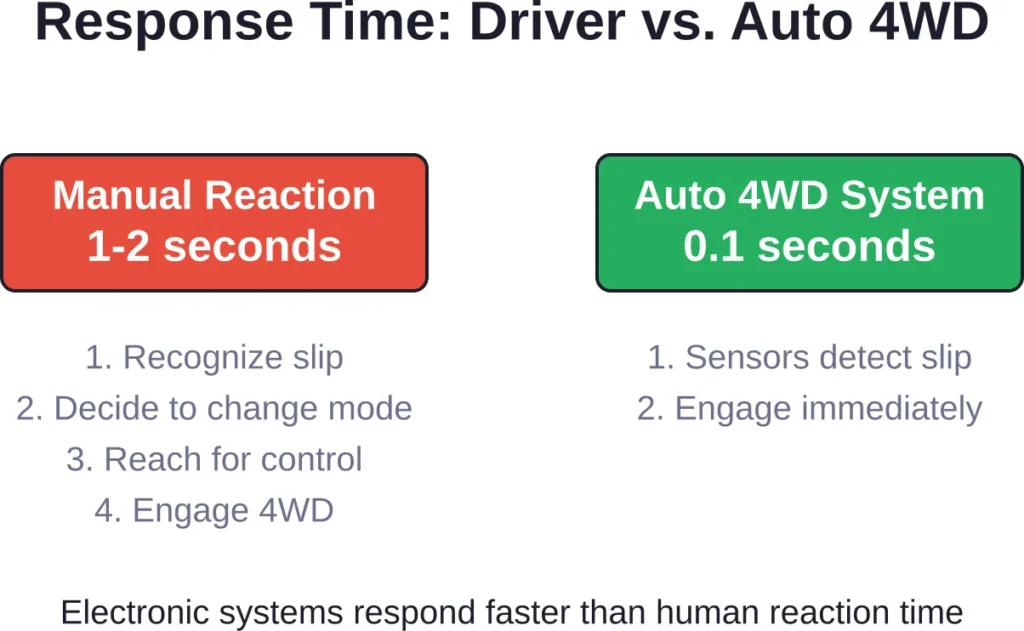
During sudden lane changes to avoid obstacles, uneven weight distribution can cause momentary loss of rear-wheel traction. Auto 4WD compensates instantly. During emergency braking on mixed-surface conditions, the system helps maintain directional stability.
These scenarios happen without warning on highways. Having Auto 4WD active means the safety net is already deployed rather than requiring perfect timing from the driver.
Cost Considerations: Fuel vs. Flexibility
The fuel economy trade-off matters to many drivers, especially with today’s fuel prices and long commutes.
For someone driving 20,000 highway miles annually in a truck averaging 20 MPG in 2H and 19.5 MPG in Auto 4WD (a realistic 0.5 MPG difference), the annual cost difference at $3.50 per gallon is roughly $90.
That’s about $7.50 per month for the convenience and safety benefits of Auto mode. For drivers in regions with unpredictable weather, that’s a reasonable trade-off. For those in consistently dry climates, sticking with 2H makes more financial sense.
Regional and Seasonal Strategies
Smart drive mode selection adapts to regional conditions and seasons.
In the upper Midwest, Mountain West, and other snow-belt regions, many drivers leave their vehicles in Auto 4WD from November through March. The minor fuel penalty is worth not having to remember to switch modes when the first snowfall hits.
In the South and Southwest where snow is rare, 2H handles the majority of driving. Auto 4WD gets reserved for known wet conditions or when storm systems are forecast.
Coastal regions with frequent rain but little snow fall somewhere in between—Auto 4WD during rainy season, 2H during dry months.
Real-World Driver Experiences
Community discussions have documented drivers using Auto mode continuously through winter months without mechanical issues. Some drivers reported improved highway MPG in Auto mode during trips with variable road conditions. Dealer recommendations commonly suggest using 2H around town and switching to Auto for winter highway travel.
What the Manufacturers Say
Official manufacturer guidance consistently supports Auto 4WD use for highway driving.
Chevrolet’s documentation for AutoTrac systems explicitly states drivers can “select the ideal 4WD mode” at any time and that the system is “designed to automatically engage” based on conditions. There’s no warning against highway use or suggestion that it’s inappropriate for any paved road.
Ford’s guidance notes that Four-wheel drive auto provides “increased traction on varied road conditions” and is suitable for normal driving—implicitly including highway travel. The only mode with speed restrictions is 4WD Low, which shouldn’t exceed approximately 40 mph.
Manufacturer silence on any restrictions for Auto 4WD highway use speaks volumes. If there were concerns about drivetrain damage, excessive wear, or safety issues, owner’s manuals would include explicit warnings.
Frequently Asked Questions
Yes, Auto 4WD can remain engaged continuously without causing mechanical problems. The system operates as 2WD when full traction is available and only engages four-wheel drive when needed. There’s no technical reason to turn it off, though 2WD delivers slightly better fuel economy when conditions don’t require the added capability.
Typically yes, but the difference is small—usually 0.5 to 1.5 MPG under most highway conditions. On completely dry pavement where the system never engages, fuel consumption is nearly identical to 2WD. When conditions cause frequent engagement, the gap widens slightly. The overall impact on fuel costs is minimal for most drivers.
Start with Auto 4WD. If roads are severely snow-covered with continuous low traction, switch to 4H for maximum grip. Auto 4WD works well for mixed conditions where some stretches are clear and others are snowy. Full-depth snow or ice covering the entire highway warrants 4H. The advantage of Auto mode is not having to switch back when conditions improve.
Absolutely. Auto 4WD systems engage and disengage at any speed, including highway speeds above 70 mph. The electronic controls respond in milliseconds regardless of vehicle velocity. There’s no speed threshold above which the system stops functioning.
No. Unlike 4WD High which locks the drivetrain, Auto 4WD uses clutch packs or electronic systems that allow differential rotation between axles. This prevents the binding and tire scrubbing that damages vehicles when running locked 4H on dry pavement. Auto mode is explicitly designed for dry pavement use.
For dry conditions, either works fine—2H offers marginally better fuel economy while Auto provides extra security if traction becomes marginal. For wet, snowy, or icy conditions while towing, Auto 4WD is the better choice. The added weight of a trailer reduces available traction, making wheel slip more likely during acceleration or on grades.
Most vehicles display drive mode status on the instrument cluster. Some show a specific indicator when the system actively transfers power to front wheels, while others simply display “4WD AUTO” regardless of momentary engagement status. Feeling a subtle change in drivetrain response or hearing slight mechanical engagement noise indicates the system activated, but operation is generally seamless.
Making the Right Choice for Your Driving
Auto 4WD exists specifically to handle the scenarios drivers face on highways—changing conditions, unexpected weather, and varied traction that doesn’t warrant full-time 4H but exceeds what 2WD safely manages.
The system won’t damage the vehicle. It doesn’t dramatically hurt fuel economy. And it operates flawlessly at highway speeds.
For drivers in snow-belt regions, Auto 4WD makes sense as a default setting during winter months. For those in milder climates, switching to Auto when weather turns questionable or before long trips through varied conditions is the smart play. For consistently dry, clear highway driving, 2WD delivers optimal efficiency.
The bottom line? Auto 4WD is not just acceptable for highway use—it’s exactly what the mode was designed for. Use it with confidence whenever conditions create uncertainty, and don’t hesitate to leave it engaged for entire trips when weather varies. Modern four-wheel drive systems are robust, intelligent, and built to handle exactly this kind of use for hundreds of thousands of miles.
Check your vehicle’s owner’s manual for specific guidance on your make and model, and choose the drive mode that matches conditions rather than worrying about restrictions that don’t actually exist.