
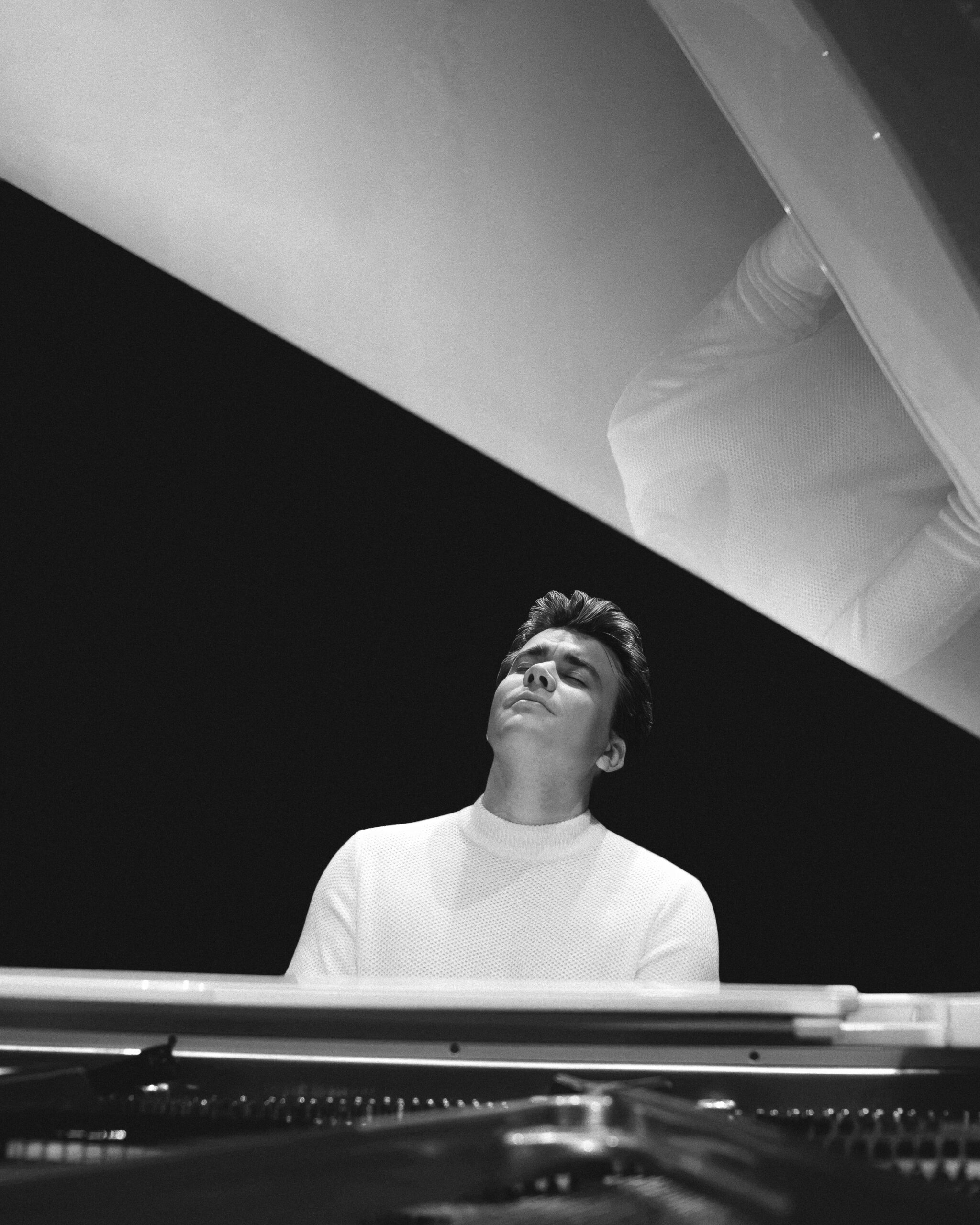
Beauty exists where the artist perceives connections between genres and diverse art forms. Composer Teodor Doré speaks of a path where creativity becomes religion, and attention to detail becomes a means of creating something genuine. When I was four years old, one morning on the edge of sleep and waking, I heard an orchestra.
The music sounded so loud that it filled the entire room, the house, and the space beyond. I thought a concert was playing on television and asked my father to turn it down. My father replied, bewildered, that there was no concert; he was watching a football match.
There was no orchestra. In that moment I understood that sounds came from within, and so began a lifelong journey: the search for music’s source, the recording without distortion of what I hear in my head. I was born into a creative family where art was the very air we breathed.
My mother, a pianist; my grandmother, a choir conductor who prepared many students for entry into the Moscow Conservatory. My grandfather, Vitaly Zaikov, was an outstanding Soviet sculptor, creator of the monument The Tale of the Urals, which appears on the five-thousand-rouble banknote in Russia. He had more than forty-five monuments across the former Soviet space.
As a child I helped him in his workshop: mixing clay, building scaffolding. This atmosphere, where each day was saturated with creativity, shaped my view of the world. I don’t want people to visit museums to touch art.
I want their entire lives to be art. In Barcelona, at the Liceu Conservatory, my professor was Benjamin Davis, son of the legendary conductor Meredith Davis. He said: write what you want, but do it professionally.
Your harmonies are your palette, your colours, your own choice. He said that what distinguishes a good composer from a poor one is a single thing: attention to detail. I define my style as a new wave of Renaissance in music.
This is Renaissance-21. A return to harmony, to beauty, to classical tradition, whilst also permitting synthesis with electronics and national instruments. On 29th January 2025, New York, minus seventeen, snow shrouding Manhattan, I was on stage at Carnegie Hall — the world’s most important venue for any pianist — presenting Rachmaninoff’s lost suite, which I spent two years reconstructing, with the blessing of his great-granddaughter.
After one concert, a woman approached and said that her father had died the day before. She had thought life meaningless, but the music had healed her soul. For such moments it is worth doing what we do.