
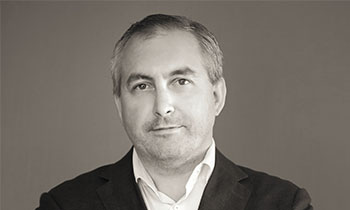
It’s the neurosis of our time — the desire to be good, effi- cient, useful, prosperous. And the list goes on. Because it doesn’t matter what a person wants to be if he does not want to be himself. Dmitry Solopov, legend of Russian media, argues in his column that there is no universal formula for success, and we have no reason to doubt his words. In early 2016, Solopov began his new project, the PRoGRess communication agency, which has quickly managed to become one of the capital’s most fashionable PR companies. His approach to success may not apply equally to everyone, but it is quite simple: do not be afraid to be yourself. Don’t be afraid to be paradoxical, skeptical, awkward, ambitious, adamant, and, at the same time, delicate, amorous, vulnerable, sincere, open. Unswayed by external judgment. Fearless. To be truly yourself, invest all of yourself, in every action and every decision.
In short, I’m known for media management, journal- ism, and advertising. I began to focus on PR, having just started the PRoGRess agency in January of 2016, alongside my partner, Anatoli Vereshagin. I had been surprised to discover the huge deficit in communication that people these days are suffering. It’s paradoxical, in that our available channels of communication have become so manifold that we no longer have a functional sense of which of them are actually effective. We don’t advertise for PRoGRess; there’s no one whose job it is to go out to parties and scout for clients, and yet our returns have increased twenty five times in a year. For this to happen, it was necessary to realise that the world has been changed by the Internet. Ten years ago, in order to say, “Abramovich is a bad guy,” you would have had to buy a newspaper, make a website, and expend a massive amount of resources. But today, I can do all this in five minutes, by making a landing page where everything about Abramovich appears. Everything. The barrier to entry for information offensives has dropped to zero, and the amount of information constantly coming at you has increased, not geometrically, but to an unlimited degree. In this new reality, it’s senseless to work in the old, slow, cumbersome ways. We go off of the goals of the clients, off of their demands. How we get the job done is unimportant, as long as the result satisfies the client. My position, which I am prepared to declare pub- licly, is as follows: every employee of our agency should be unconsciously greedy. They should be unprincipled for the sake of the agency’s success. Maximum profit through maximum customer satisfaction. The client should experience an infinite orgasm, and, out of this, we must extract endless profit.
If I were given the chance to live another life, but without any concerns about money, then I would become what I always wanted to be, a teacher of Russian language and literature
In the next few years, our agency will be one of the top five in Russia. Within the next fifteen, it will be among the top five largest agencies in the world.
Free time is something I don’t have. If self-education and reading count as free time, then I would say reading is my preferred pastime. I read a variety of different books. I’m currently reading The Three Musketeers, as well as The Philokalia, the great Orthodox work.
Robert de Niro can’t say, “I don’t want to play Hitler.” He would say, “I will play Hitler for a hundred million.”It is my opinion that any thinking person is a believer. And every person has a concept of good and evil. But my job is not to impose ideas of Christian truths. My job is to implement better means of communication. If my principles were to conflict with those of my client, I’d be better off engaging in some other business. There is no “I don’t want to” in business. You’ve declared who you are. If you’re saying “I don’t want to,” then leave, let others do it. Robert de Niro can’t say, “I don’t want to play Hitler.” He would say, “I will play Hitler for a hundred million.” I made this choice: I chose this business and thus took on all the costs associated with this choice. It’s just my profession, and I am a professional.
Life is not linear. I have a lovely wife and four children; you fall in love — what can you do? Looking from any vantage point — in theory, everyone knows the correct, righteous answer. In practice, everyone is looking for a compromise, or else they go straight ahead, and they find that there’s also a third, fourth, fifth path. Because life is multifaceted, constantly shifting in space and time. Except for our holy fathers, I don’t know anyone who manages successfully to cope with their feelings. Such feelings have been called temptation, demonic obsession, and this is right.
Similarly, there is no recipe for a happy life. It seems the only way to be happy is to live in response to your surrounding environment and in accordance with your circumstances.I am an ordinary person who, under certain circumstances, has made certain decisions possible for myself. It is easy to be a saint in imaginary situations. When there is a real choice, when real money and real circumstances are involved, everything changes. I therefore say that, if I were to be approached by some sort of Hitler in need of a communication company, I would make the necessary decision only then and there. I have read a great many books about successful people, about strategies for success, and I have come to understand very clearly that there is no universal recipe for it. Such a thing would be totally unrealistic. Similarly, there is no recipe for a happy life. It seems the only way to be happy is to live in response to your surrounding environment and in accordance with your circumstances. I recently rewatched Schindler’s List. I can really relate to the main character, because my friends are always asking, “How did you do it?” with regards to my business. And I don’t know what to say. They ask me: “Well, what do you do in your business?” And, like Schindler, I respond: “I represent.” I mean, how can business be explained? Schindler is a wonderful hero. He acts according to circumstance, but, at some point, realises that human life, regardless of nationality, is more important than business. For each of us, for every Christian, there exists this threshold, when reality transforms in such a way that it becomes impossible to live as before.
Real media should be sincere and uncompromising.I quit the media because, from my point of view, journalism died in 2012. At that time, Kommersant.fm was a very fashionable radio station and had a large audience. Everyone who came out to Bolotnaya Square listened to it. I left because I realised that journalism had become a pipeline through which you are told what you can and can’t do. I started working in journalism in 1993, but I faced this for the first time in 2012. I always created really gnarly content, causing scandals. Real media should be sincere and uncompromising. If it stops being so, it becomes uninteresting. In 2014, I fulfilled my dream, launching a radio station, News of Kiev, where the main presenter was Matvei Ganapolsky. And for half a year it was the most popular talk radio station in Ukraine. Due to it being completely in Russian, it was picked apart. Yet it was the quintessence of media and radio, and caused a huge reaction from a live audience, with tens of thousands of phone calls coming in per hour. It was wildly cool. If I were given the chance to live another life, but without any concerns about money, then I would become what I always wanted to be, a teacher of Russian language and literature. There is no greater buzz than reading books and teaching. Literature is the preserve of human feelings. What could be more interesting?