
The internet is losing its mind over OpenClaw. Again.
Meanwhile, Anthropic has implemented restrictions on Claude Code subscriptions after observing high token consumption patterns from certain autonomous agent implementations. And honestly? Such measures are understandable from a platform management perspective.
Here’s what nobody’s telling you: comparing OpenClaw to Claude Code is like comparing a motorcycle to a car with airbags. Sure, the motorcycle goes fast and feels exciting. But one wrong move and you’re eating pavement.
I’ve deployed both tools in real production environments. I’ve watched Claude Code handle enterprise codebases with surgical precision. And I’ve seen autonomous agent implementations struggle with reliability while consuming substantial API credits.
So let’s cut through the hype and talk about what these tools actually do, where they shine, and why the smartest developers I know aren’t choosing between them anymore.
What Actually Is Claude Code?
According to Anthropic’s official documentation, Claude Code is an agentic coding tool that reads your codebase, edits files, runs commands, and integrates with your development tools. It’s available in your terminal, IDE, desktop app, and browser.
But here’s the thing: Claude Code is really three different products pretending to be one.
You’ve got the API, which developers use to build custom integrations. You’ve got the desktop agent, which can actually interact with your local development environment. And you’ve got the web interface, which is basically ChatGPT with file access and better code understanding.
Claude Code has two kinds of memory that persist across sessions: Auto memory (useful context like project patterns and preferences) and CLAUDE.md files. While conversation history can be fresh, users can also use the –continue flag to pick up where they left off with full context.
Claude Code also includes what Anthropic calls “skills”—custom extensions that let you teach Claude new capabilities. You can create slash commands, build custom subagents, and even run agent teams for complex workflows.
What OpenClaw Actually Does (And Why Everyone’s Freaking Out)
OpenClaw isn’t a competitor to Claude Code. It’s a framework that uses Claude’s API and other model providers.
Read that again.
OpenClaw is built on top of APIs from Anthropic, OpenAI, and other providers. It’s not its own model. It’s not even its own inference engine. It’s a traditional software application that makes API calls to language models.
So why the hype?
Because OpenClaw does something Claude Code explicitly refuses to do: it runs autonomously without human oversight. It has persistent memory that carries context across sessions. And it can operate 24/7 on scheduled tasks, sending you notifications when something needs your attention.
According to community discussions on Reddit, users describe OpenClaw as having hierarchical memory approaches that persist across sessions. This is fundamentally different from Claude Code’s session-based approach.
One developer on Reddit captured the distinction: “You have to instruct Claude Code per each task—you give it a task, it performs it and comes back to you for further instructions. Whereas agents such OpenClaw have their own built-in driver.”
That autonomous capability is also the primary source of concern.
The Security Picture Nobody Wants To Talk About
Let’s address the elephant in the room: OpenClaw’s security model carries significant risks.
I don’t say that lightly. I’ve seen the GitHub discussions. I’ve read the Reddit threads where developers discuss the risks. I’ve watched security teams express caution about deployment.
Why? Because OpenClaw runs with elevated permissions on your local machine. It can execute arbitrary commands. It can access your filesystem. And it does all of this based on instructions from a language model that’s fundamentally probabilistic.
One Reddit user captured the core concern: “OpenClaw is basically Claude Code without the corporate safety guardrails. You know, the ones that protect you from bad actors.”
Claude Code, by contrast, operates within carefully designed boundaries. It asks for permission before executing commands. It sandboxes operations when possible. And it maintains strict separation between conversation context and system access.
Does this make Claude Code slower? Sometimes. Does it make it safer for enterprise environments? Absolutely.
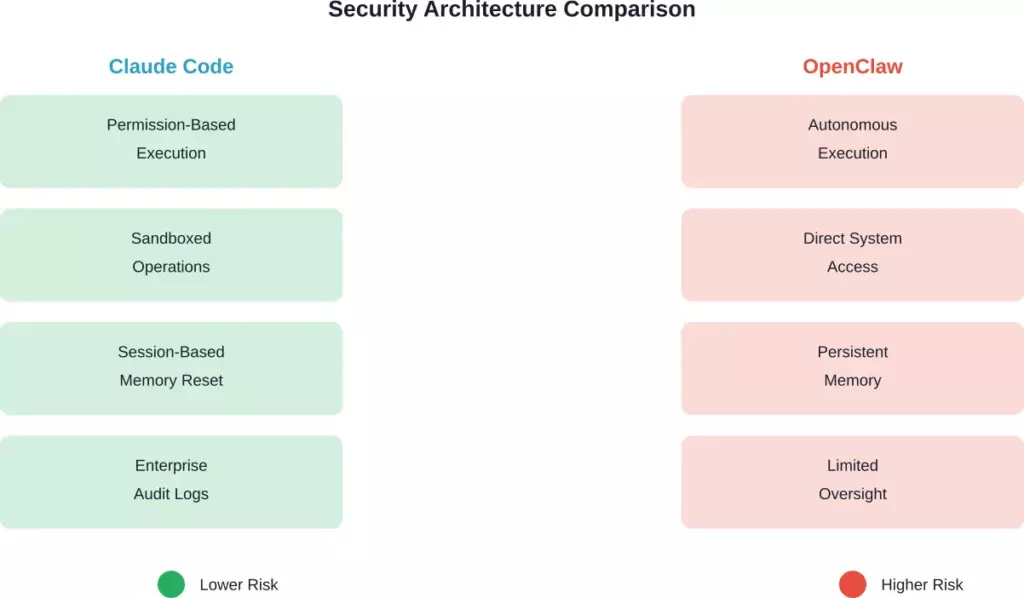
Security architecture differences between Claude Code and OpenClaw show distinct approaches to system access and oversight.
Where Claude Code Actually Wins
Let’s talk about what Claude Code does better than autonomous agent frameworks.
- First, integration depth. Claude Code ships with native IDE extensions, terminal commands, and desktop applications that feel like first-class development tools. You’re not hacking together API wrappers or dealing with flaky integrations.
- Second, context understanding. Claude’s training includes extensive code comprehension capabilities. When you point it at a complex codebase, it doesn’t just read files—it understands architecture, dependencies, and design patterns.
- Third, reliability. Claude Code operates with designed safeguards that help prevent unexpected behavior. The stability and predictability are significant advantages in professional settings.
Community discussions describe the benefits of Claude Code’s controlled approach, with users noting that the requirement for human approval on critical operations means mistakes are caught before they ship.
And here’s something most reviews miss: Claude Code’s limitations are actually features in production environments. The fact that it requires human approval for critical operations means you catch mistakes before they ship.
| Feature | Claude Code | OpenClaw |
|---|---|---|
| Memory Model | Session-based, resets between tasks | Persistent, hierarchical across sessions |
| Execution Mode | Human-in-the-loop, permission-based | Autonomous, scheduled operations |
| Integration | Native IDE, terminal, desktop apps | API-based, requires configuration |
| Security Model | Sandboxed with enterprise controls | Direct system access, minimal guardrails |
| Token Usage | Optimized per task | High consumption, continuous operation |
| Enterprise Ready | Yes, with audit logs and compliance | No, experimental use only |
| Learning Curve | Moderate, well-documented | Steep, community-driven docs |
Where OpenClaw Still Wins (And Probably Always Will)
But look, OpenClaw does things Claude Code can’t touch.
The 24/7 operation model is genuinely useful. You can set OpenClaw to monitor GitHub issues, respond to customer emails, or run scheduled data processing tasks while you sleep. Claude Code stops when you close your laptop.
The persistent memory architecture means OpenClaw can learn from past interactions and maintain context across days or weeks. That’s powerful for long-running projects where continuity matters.
And the customization potential? It’s unlimited. OpenClaw is open source. You can modify the agent loop, add custom tools, integrate with any API you want. Claude Code gives you skills and plugins, but you’re still operating within Anthropic’s framework.
One Reddit user captured this perfectly: “The ‘hype’ is mostly about the move from reactive LLMs (where you have to type every prompt) to proactive agents (that run on heartbeats/cron).”
That shift from reactive to proactive is the real innovation here. But it comes with trade-offs most people aren’t thinking through.
The Token Usage Problem That Affected OpenClaw’s Adoption
Here’s what happened: Observers noticed that OpenClaw implementations consumed more tokens than Claude Code for similar tasks.
Why? Because OpenClaw’s autonomous loop architecture makes continuous API calls to maintain context, check conditions, and evaluate next steps. Even when it’s not actively working on a task, it’s thinking.
According to Reddit discussions, Anthropic implemented restrictions on certain subscription types to manage usage patterns. Users relying on consumer account API access experienced limitations.
This pushed OpenClaw users toward proper API accounts with metered billing. Suddenly, the autonomous agent workflow required more transparent cost management. Monthly bills started increasing for users who left such systems running continuously.
Claude Code, by contrast, only consumes tokens when you’re actively working. Session-based architecture means you’re not paying for idle thinking time.
The Privacy Picture Is More Interesting Than You’d Think
Everyone assumes Claude Code phones home to Anthropic constantly while OpenClaw keeps everything local. That’s not quite right.
- Claude Code does send data to Anthropic’s servers—that’s how it works. But Anthropic’s privacy policy includes commitments around data retention and enterprise controls. Companies can negotiate custom terms for sensitive codebases.
- OpenClaw, meanwhile, uses whatever API provider you configure. That could be Anthropic, OpenAI, or a local model via Ollama. But here’s the catch: most OpenClaw users still end up using cloud APIs because local models typically offer reduced capability compared to advanced cloud-based models.
Several developers in community discussions reported challenges when attempting to run OpenClaw with local models, noting reliability differences compared to cloud-based approaches. The intelligence-capability relationship is a practical consideration.
So in practice, OpenClaw users are often sending just as much data to cloud providers as Claude Code users. The difference is that Claude Code’s data path is documented and auditable, while OpenClaw’s depends on how you’ve configured it.
Stop Comparing Them. Combine Them.
Here’s what the smartest developers I know are doing: they use both.
- Claude Code handles the core development work. Code reviews, refactoring, debugging, architecture decisions. Anything that touches production code goes through Claude Code’s safety-first workflow.
- OpenClaw handles the grunt work. Monitoring RSS feeds, aggregating research, processing data exports, managing routine admin tasks. Anything where “good enough” beats “perfect” and you can tolerate occasional mistakes.
Some developers have experimented with hybrid approaches, attempting to combine features from both toolsets with additional safety constraints. This reflects the desire for “the power and autonomy while maintaining safety considerations.”
This hybrid approach makes sense. You’re not betting your entire workflow on an experimental autonomous agent. But you’re also not manually handling tasks that could run on autopilot.
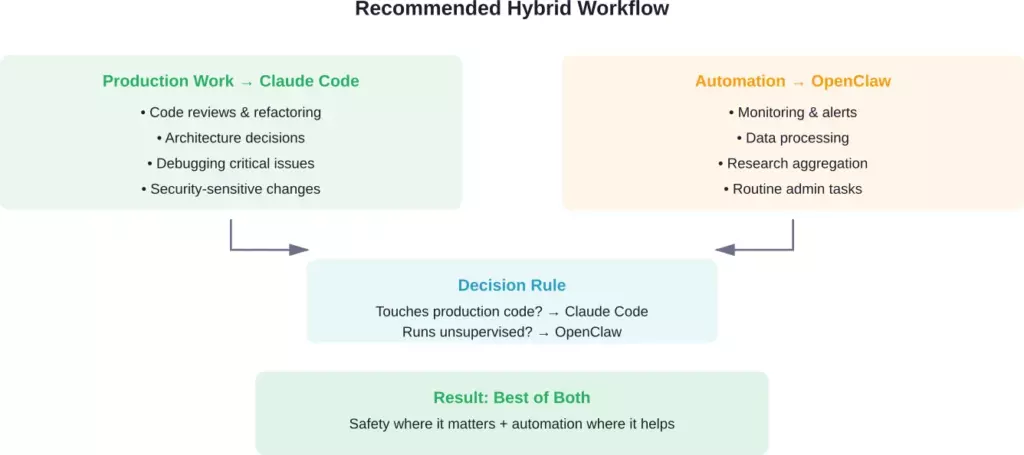
Hybrid workflow approach using Claude Code for production work and OpenClaw for experimental automation tasks.
What Enterprise Teams Need To Know
If you’re evaluating these tools for a team, here’s what matters.
- Claude Code has enterprise features that OpenClaw doesn’t: audit logs, role-based access controls, compliance documentation, and support contracts. These aren’t sexy, but they’re necessary when you’re dealing with regulated industries or customer data.
- OpenClaw is explicitly positioned as experimental in its documentation. The repository includes disclaimers about security considerations. Community discussions reflect ongoing caution about giving autonomous agents elevated system permissions.
That doesn’t mean OpenClaw has no enterprise use cases. But those use cases are limited to sandboxed environments, internal tools, and non-critical automation where you can tolerate failures.
For anything customer-facing or revenue-critical, Claude Code’s conservative approach wins. The structured execution model is worth the careful approach to operations.
Cost Considerations
- Claude Code pricing is straightforward: you pay for API usage or subscribe to Claude Pro for unlimited access (with rate limits). Enterprise teams can negotiate volume discounts.
- OpenClaw costs depend entirely on your API provider. If you’re using Claude’s API through OpenClaw, you’re paying Claude anyway. If you’re using local models, you’re paying for compute instead.
But the hidden cost is maintenance. OpenClaw requires ongoing tweaking, monitoring, and configuration. Claude Code has more streamlined operational requirements.
Compliance and Data Governance
- Claude Code supports SOC 2, GDPR compliance, and other enterprise certifications through Anthropic. The data retention policies are clear and auditable.
- OpenClaw’s compliance posture depends on how you deploy it. Using cloud APIs? You’re subject to those providers’ terms. Running locally? You need to handle security yourself.
For most enterprises, that calculus favors Claude Code’s documented compliance over custom deployment approaches.
The Intelligence Question: Does It Actually Matter?
Here’s a question nobody’s asking: does the underlying model matter more than the framework?
OpenClaw can use Claude’s models. Claude Code uses Claude’s models. If they’re both powered by the same AI, how different can they really be?
Turns out, very different. The framework matters as much as the model.
Claude Code’s framework includes carefully designed prompts, context management, and error recovery that’s been refined through production deployments. It’s not just Claude-the-model; it’s Claude-the-product.
OpenClaw’s framework prioritizes autonomy over structured oversight. It’s optimized for long-running tasks and persistent memory, which introduces complexity that can lead to different failure modes.
The model’s capabilities are best utilized through well-designed frameworks that complement its strengths.
Where This Is All Heading In 2026
The agent tools landscape is evolving.
Anthropic will continue expanding Claude Code’s capabilities while maintaining enterprise-grade safety features. The line between “assistant” and “autonomous agent” will continue to blur.
Open-source frameworks will improve in reliability and safety through community feedback. We’ll see more sandboxing options, better error handling, and community-driven best practices.
And most importantly, the hybrid approach will become standard. Developers won’t choose between human-supervised and autonomous operation. They’ll use both, intelligently segmented by risk and criticality.
The question isn’t “OpenClaw vs Claude Code.” It’s “OpenClaw and Claude Code for what?”
The Bottom Line: Pick Your Use Case, Not Your Side
The developers asking “OpenClaw or Claude Code?” are asking the wrong question.
Claude Code wins for production development, team collaboration, enterprise deployment, and anything where reliability matters more than autonomy. It’s the safe choice, the documented choice, and the choice that aligns with organizational best practices.
OpenClaw wins for experimental automation, long-running background tasks, and situations where you need persistent context across days or weeks. It’s the customizable choice, and the choice that requires careful deployment and monitoring.
Most developers will end up using both. Claude Code as their primary development partner. OpenClaw for specific automation use cases where its capabilities genuinely add value.
Stop treating these tools as competitors. Start treating them as complementary pieces of a larger agentic coding workflow.
And whatever you do, deploy OpenClaw thoughtfully with appropriate security considerations. The demos are compelling, but the risks are real.
Ready to implement agentic coding in your workflow? Start with Claude Code to understand the fundamentals, then experiment with OpenClaw in a sandboxed environment once you’ve built intuition for how these tools actually behave. The future of development is agentic—but thoughtful deployment is essential.
Frequently Asked Questions
Yes, OpenClaw supports Claude’s API as a model provider. However, Anthropic has implemented usage management policies. You’ll need a proper API account with metered billing to run OpenClaw with Claude models reliably.
OpenClaw requires elevated system permissions and executes commands autonomously, which creates significant security considerations. It’s best deployed in isolated environments like virtual machines or containers, not on your primary development machine with access to sensitive codebases or credentials.
No, Claude Code requires an internet connection to access Anthropic’s API. All processing happens on Anthropic’s servers. If you need offline capabilities, you’d need to use local models through frameworks like Ollama, though you’ll experience capability differences compared to cloud-based Claude models.
OpenClaw’s autonomous architecture makes continuous API calls to maintain context, evaluate conditions, and plan next steps. Even during idle periods, it’s consuming tokens. Claude Code only uses tokens during active sessions when you’re directly working on tasks, making it far more token-efficient.
OpenClaw lacks enterprise features like audit logs, compliance certifications, and security controls typically required for production environments. It’s better suited for experimental automation in sandboxed environments where failures are acceptable. For production workloads, Claude Code’s enterprise features are standard requirements.
Claude Code is beneficial for learning because it explains its reasoning and operates with your approval, reinforcing understanding. OpenClaw’s autonomous nature means you’re less involved in decision-making, which can reduce learning opportunities. For educational purposes, supervised tools generally provide better learning outcomes.
Anthropic hasn’t blocked OpenClaw outright, but they’ve implemented usage management on consumer accounts. This encourages proper API accounts with transparent pricing. Anthropic’s focus is managing usage patterns, not eliminating autonomous agent use cases.