

Between February 12 and 13, 2026, an automated trading bot using OpenClaw infrastructure (operating under account Bidou28old) generated $116,280.60 in profit on Polymarket. The bot completed 52 trades with an 83% success rate.
That’s not a typo. An AI-powered trading system made more in 24 hours than most people earn in months, all while its operator presumably slept.
But here’s the thing: this wasn’t luck or some get-rich-quick scheme. The OpenClaw Polymarket bot represents a sophisticated convergence of prediction market theory, quantitative finance, and automated execution infrastructure that’s reshaping how traders approach crypto-based prediction platforms.
What Is Polymarket and Why It Matters
Polymarket operates as the world’s largest prediction market, where users trade on real-world event outcomes using cryptocurrency. According to Polymarket Documentation, the platform runs on a CLOB (Central Limit Order Book) architecture, enabling traders to place limit orders, market orders, and implement complex trading strategies.
Markets resolve through the UMA Optimistic Oracle, a smart-contract based system that finalizes outcomes according to pre-defined rules. The resolution process typically takes approximately two hours when undisputed (Propose then Resolve flow), though contested outcomes can escalate to UMA’s Data Verification Mechanism for token holder votes.
After receiving CFTC regulatory approval in November 2025, Polymarket received authorization to operate an intermediated trading platform subject to full requirements applicable to federally regulated US exchanges. The platform’s trading volumes have surged, creating the liquidity conditions necessary for automated market-making strategies to thrive.
How the OpenClaw Bot Works
The OpenClaw architecture chains together multiple specialized skills that work in concert. Think of it as a digital market maker executing thousands of micro-trades per day, each one calculated to capture a statistical edge.
Here’s what happens under the hood:
The bot continuously scans Polymarket for mispriced contracts and liquidity gaps using real-time market analysis. It doesn’t rely on gut feelings or hunches. Instead, it calculates fair value using quantitative models, then compares that theoretical price against actual orderbook data from the CLOB API.
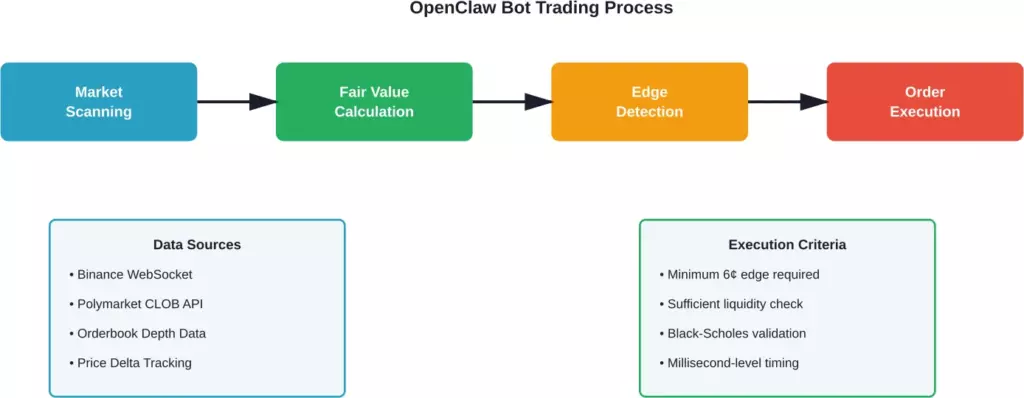
The four-stage process OpenClaw bots use to identify and execute profitable trades on Polymarket
The Black-Scholes Connection
One documented implementation tracks Bitcoin price deltas from Binance WebSocket feeds, then calculates Black-Scholes fair value for binary options. The bot executes trades only if fair value beats the ask price by at least a six-cent minimum edge requirement, and only if sufficient liquidity exists at reasonable prices.
That six-cent minimum edge requirement isn’t arbitrary. It’s the buffer that accounts for fees, slippage, and execution risk while still preserving profitability across hundreds of trades.
The Numbers That Turned Heads
The Bidou28old account’s performance between February 12-13, 2026, tells a compelling story. With 52 completed trades and an 83% success rate, the bot generated $116,280.60 in profit within 24 hours.
But look closer at the loss patterns. Only three trades closed at a loss, and two of them were the very first bets recorded. One lost $74.99 and another $50 when Solana and Ethereum unexpectedly moved up between 5:00 PM and 5:15 PM ET on February 12.
That’s not coincidence. That’s the learning algorithm adapting in real-time.
| Metric | Value | Context |
|---|---|---|
| Total Profit | $116,280.60 | Generated in 24 hours |
| Trade Count | 52 trades | Feb 12-13, 2026 |
| Success Rate | 83% | 49 wins, 3 losses |
| Losses | 3 total | First 2 trades lost, then adapted |
| Current Positions | $0 | All positions closed post-run |
Building Your Own: The Technical Reality
The GitHub repository imthatcarlos/openclaw-polymarket-bot provides a working implementation. But here’s what won’t be found in the README: the operational security measures that protect seven-figure profit runs.
Community discussions suggest successful implementations require proxies, TLS fingerprint spoofing, and compiled code to prevent reverse-engineering. The technical architecture is replicable, but the operational security creates the moat.
Core Components You’ll Need
- First, real-time market data from multiple sources is required. The bot architecture requires WebSocket connections to both crypto exchanges (like Binance) and Polymarket’s CLOB API simultaneously.
- Second, implement quantitative pricing models. Black-Scholes provides the theoretical framework, but parameters must be calibrated for the specific characteristics of binary prediction markets.
- Third, build execution infrastructure capable of millisecond-level order placement. Speed matters when competing against other automated systems for the same mispriced contracts.
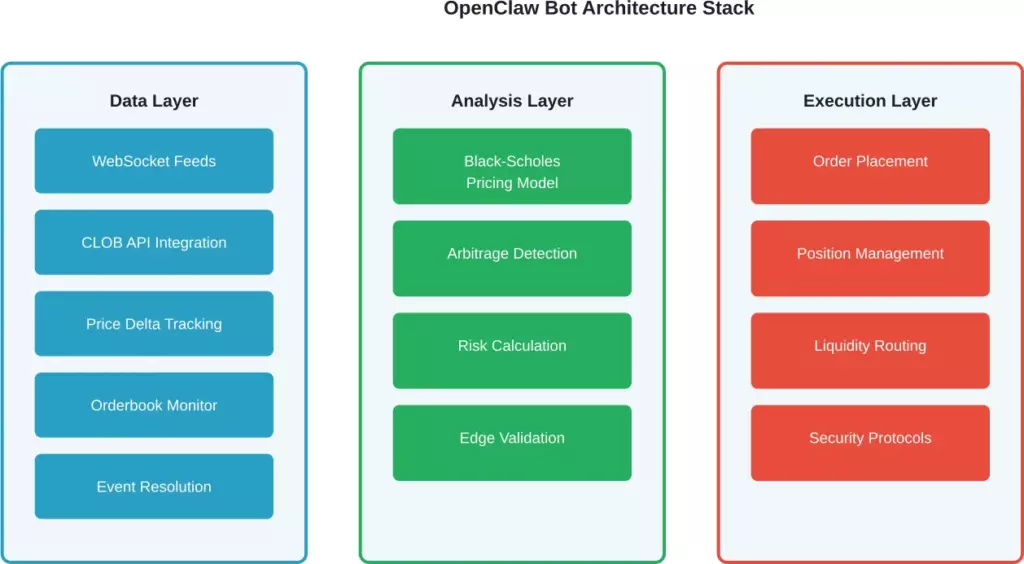
The three-layer architecture showing how OpenClaw bots process data, analyze opportunities, and execute trades
The Risk Nobody Talks About
Automated trading on prediction markets isn’t a guaranteed path to wealth. Those early losses the Bidou28old bot took? They’re warnings.
Market conditions change. Liquidity dries up. Other bots compete for the same edges. And prediction markets carry unique risks that traditional financial markets don’t: resolution disputes, oracle failures, and smart contract vulnerabilities.
According to Polymarket Documentation, disputed resolutions can escalate to UMA’s Data Verification Mechanism, potentially locking up capital for extended periods. The bot that made $116,280.60 in a day could theoretically lose it all in a single contested market resolution.
Regulatory Landscape in 2026
In September 2025, the CFTC issued a no-action letter to QCX LLC and QC Clearing LLC (entities acquired by Polymarket in July for $112 million), granting relief on event contract reporting rules.
CEO Shayne Coplan stated the CFTC’s no-action letter had given the company “the green light to go live in the USA,” noting “This process has been accomplished in record timing.”
However, the regulatory picture remains complex. On February 9, 2026, Polymarket filed a federal lawsuit against Massachusetts, challenging the state’s authority to regulate CFTC-approved prediction markets. This legal battle could determine whether states can independently ban or regulate federally-approved prediction platforms.
The Future of Automated Prediction Trading
The documented Polymarket bot results represent just the beginning. As prediction markets gain regulatory approval and liquidity deepens, expect more sophisticated automated strategies to emerge.
But here’s what won’t change: the fundamental requirement to identify genuine statistical edges and execute them faster than competition. The OpenClaw framework provides the infrastructure, but profitable implementation requires quantitative skill, operational discipline, and realistic risk management.
Those interested in exploring automated prediction market trading should begin by thoroughly understanding Polymarket’s API documentation, studying quantitative pricing models, and paper-trading strategies before risking real capital. The opportunity is real, but so are the risks.
Frequently Asked Questions
An OpenClaw Polymarket bot is an automated trading system that uses AI-powered market analysis and quantitative pricing models to identify and exploit arbitrage opportunities on Polymarket’s prediction markets. These bots execute trades at millisecond-level speed based on calculated statistical edges.
While one documented bot generated $116,280.60 in 24 hours during February 2026, these results aren’t typical. Profitability depends on market conditions, capital allocation, competition from other bots, and operational security. Many implementations lose money during testing phases.
Yes. Polymarket provides API access specifically for automated trading through their CLOB (Central Limit Order Book) infrastructure. The platform’s documentation includes technical guides for implementing trading bots and market-making strategies.
Programming experience (Python or JavaScript typically) is required, along with understanding of WebSocket connections and API integration, familiarity with quantitative finance concepts like Black-Scholes pricing, and knowledge of operational security practices including proxy configuration and TLS fingerprinting.
Most implementations use variations of Black-Scholes pricing models adapted for binary options. The bot tracks price deltas from crypto exchanges via WebSocket feeds, calculates theoretical fair value, then compares that against actual orderbook prices from Polymarket’s CLOB API to identify mispricing.
Key risks include market resolution disputes that can lock capital, oracle failures, smart contract vulnerabilities, competition from other automated systems eliminating profitable edges, and regulatory uncertainty as prediction market rules continue evolving across different jurisdictions.
While open-source implementations like imthatcarlos/openclaw-polymarket-bot provide working code, they require significant customization, security hardening, and capital management systems before production use. The publicly available code lacks the operational security measures used in successful seven-figure implementations.