

Quick Summary: No, a dog cannot get a cat pregnant. Dogs and cats are genetically incompatible species with different chromosome numbers (78 in dogs vs. 38 in cats), incompatible reproductive systems, and distinct mating behaviors that make interbreeding biologically impossible.
If you’ve ever caught your dog mounting your cat, you might’ve felt a flash of panic. Can they actually breed? The short answer is no—dogs cannot get cats pregnant. But the reasons why are fascinating and rooted in fundamental biology.
Despite internet rumors and fictional stories about cat-dog hybrids, these two beloved pets are as reproductively incompatible as any two species can be. Let’s break down exactly why this cross-species breeding is impossible, what’s actually happening when dogs mount cats, and what the science tells us about reproductive barriers between different animals.
Why Dogs and Cats Cannot Reproduce Together
Dogs and cats belong to entirely different biological families. Dogs (Canis familiaris) are members of the Canidae family, while cats (Felis catus) belong to Felidae. This isn’t just a technicality—it represents millions of years of evolutionary divergence.
According to research from St. Augustine University (published 2026-03-20), the biological impossibility of cat-dog interbreeding stems from fundamental chromosomal, genetic, and anatomical barriers that prevent successful reproduction.
The Chromosome Mismatch
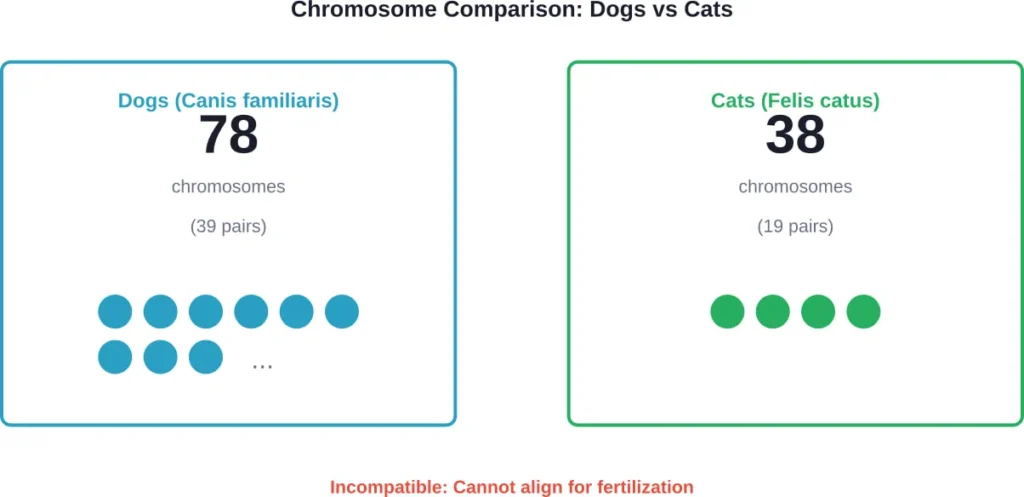
Here’s where things get technical, but it’s the core reason why dog-cat breeding won’t work. Chromosomes carry genetic information and must pair up correctly during fertilization for reproduction to succeed.
Dogs have 78 chromosomes (39 pairs), while cats have only 38 chromosomes (19 pairs). This massive difference makes it impossible for their genetic material to combine properly. Even if sperm met egg, the chromosomes wouldn’t align, and no viable embryo could form.
Reproductive System Incompatibility
Beyond chromosomes, the reproductive anatomy and physiology of dogs and cats are fundamentally different. Research from the National Institutes of Health examining carnivore reproduction highlights these critical differences.
Cats and dogs have different gestation periods, estrus cycles, and mating requirements. Female cats are induced ovulators—they only release eggs in response to mating. Dogs, by contrast, ovulate spontaneously during their heat cycles.
The physical structures don’t match up either. Reproductive tract anatomy differs significantly between the species, making successful mating virtually impossible even if behavioral factors weren’t in the way.
What About Animal Hybrids?
You might be thinking: “But what about mules? Or ligers?” Those exist, so why not cat-dog hybrids?
Good question. But here’s the thing—successful hybrids only occur between very closely related species within the same genus or family. Mules result from horses and donkeys, both members of the genus Equus. Ligers come from lions and tigers, both in the genus Panthera.
Research published in the Journal of Heredity (2023) examining hybridization in landfowl (order: Galliformes) provides insights into interspecific hybrid compatibility in domesticated animals, finding that even closely related species often produce sterile offspring or face significant reproductive barriers. According to the study, successful hybridization requires relatively recent evolutionary divergence and compatible chromosome structures.
Dogs and cats don’t meet these criteria. They’re not even in the same taxonomic family, let alone the same genus.
| Hybrid Animal | Parent Species | Taxonomic Relationship | Fertile Offspring? |
|---|---|---|---|
| Mule | Horse × Donkey | Same genus (Equus) | No (sterile) |
| Liger | Lion × Tiger | Same genus (Panthera) | Rarely |
| Beefalo | Cow × Bison | Same family (Bovidae) | Yes |
| Cat-Dog | Cat × Dog | Different families entirely | Impossible—cannot breed |
Mating Behaviors: Dogs and Cats Don’t Speak the Same Language
Even if the biology somehow worked, behavioral barriers would still prevent reproduction. Dogs and cats have completely different courtship and mating signals.
Female cats in heat display specific behaviors: rolling, vocalizing, and raising their hindquarters. Male cats respond with neck biting and a specific mating posture. Dogs have entirely different rituals involving scent marking, posturing, and social behaviors that cats simply don’t recognize or respond to appropriately.
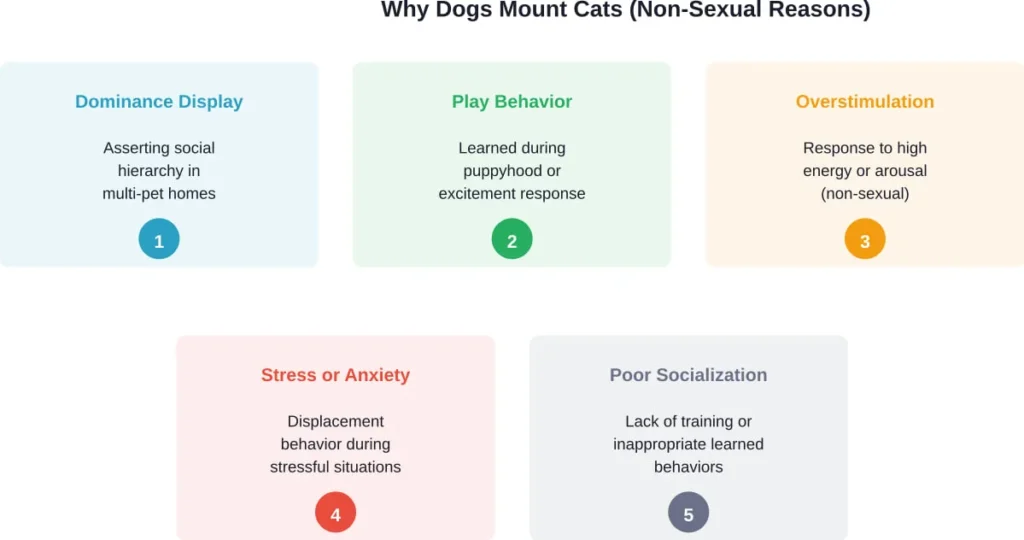
When a dog mounts a cat, it’s not actually attempting reproduction in a biological sense. Mounting behavior in dogs serves multiple functions: dominance display, play behavior, excitement, or even anxiety. It’s a behavioral quirk, not a genuine mating attempt.
So Why Do Dogs Mount Cats?
This behavior understandably concerns pet owners, but it’s rarely sexual in nature. Dogs mount other animals—including other dogs, cats, furniture, and even people—for several non-reproductive reasons.
Dominance and social hierarchy play a role. Dogs may mount to assert status or control in multi-pet households. Excitement and overstimulation can also trigger mounting, especially in younger or poorly socialized dogs.
Some dogs mount out of stress or anxiety. Others simply learned the behavior during play and haven’t been trained otherwise.
Managing Multi-Pet Households
While reproduction isn’t a concern, mounting behavior can still stress your cat and create household tension. Here’s how to manage it.
Training is your first line of defense. Teach a solid “leave it” or “off” command. Redirect mounting behavior immediately and consistently. Reward your dog for calm, appropriate interactions with the cat.
Provide separate spaces where your cat can retreat safely. Cats need vertical territory—install cat trees or shelves where they can escape unwanted attention. Baby gates can create dog-free zones.
Exercise matters. A tired dog is a well-behaved dog. Increase physical activity and mental stimulation to reduce excess energy that might manifest as mounting.
If the behavior persists despite training, consult a veterinary behaviorist. Mounting can sometimes indicate underlying anxiety or behavioral issues that need professional intervention.
The Role of Spaying and Neutering
According to veterinary research, population control through spaying and neutering is crucial for managing companion animal overpopulation. These procedures also impact mounting behavior.
Neutering male dogs often reduces mounting frequency, though it won’t eliminate learned or non-sexual mounting entirely. The earlier the procedure, the more effective it tends to be at preventing the behavior from becoming habitual.
Research examining non-surgical contraceptive methods in cats and dogs notes that population control approaches are important for managing companion animal behavior and welfare.
Common Myths About Cat-Dog Hybrids
Internet folklore is full of supposed “cat-dog” hybrids. Let’s debunk a few persistent myths.
Myth: Some exotic breeds are part cat, part dog.
Reality: No recognized breed has DNA from both species. Some dogs or cats may have unusual appearances, but they’re 100% one species or the other.
Myth: Laboratory science has created cat-dog hybrids.
Reality: No credible research institution has successfully hybridized these species. The genetic barriers make it impossible even with advanced reproductive technology.
Myth: Ancient breeds might have mixed ancestry.
Reality: Dogs and cats evolved separately for millions of years. There’s never been a time when they could interbreed.
What Veterinary Science Says
Veterinary research consistently confirms the impossibility of dog-cat reproduction. Studies examining reproductive compatibility between domestic carnivores emphasize the multiple, redundant barriers preventing cross-species breeding.
Research on carnivore oocyte development notes that even within a single species like cats, in vitro embryo production faces significant challenges. Metaphase II maturation rates in cats reach around 60%, compared to 90% in cattle. Cross-species fertilization with animals as divergent as dogs and cats simply cannot occur.
The Journal of Feline Medicine and Surgery research on reproductive management confirms that feline and canine reproductive biology operates on fundamentally different principles, from hormone cycling to embryonic development.
Frequently Asked Questions
While a dog might mount a cat, true mating cannot occur. Their reproductive anatomies are incompatible, they don’t recognize each other’s mating signals, and even if physical contact occurred, fertilization is genetically impossible due to chromosome incompatibility.
No. There has never been a scientifically verified cat-dog hybrid. Any claims of such hybrids are either misidentifications, hoaxes, or refer to unusual-looking purebred animals. Genetic testing consistently shows that supposed “hybrids” are 100% one species.
This mounting behavior is almost never sexual. Dogs mount for dominance, play, excitement, stress relief, or out of habit. It doesn’t indicate reproductive intent and poses no pregnancy risk, though it may stress your cat and should be redirected through training.
No. Both cats and dogs can only reproduce with members of their own species or, in rare cases, very closely related species within their own taxonomic family. No animal serves as a genetic bridge between Felidae (cats) and Canidae (dogs).
Intervene immediately with training commands like “off” or “leave it.” Provide your cat with escape routes and safe spaces. Increase your dog’s exercise and mental stimulation. If the behavior persists, consult a professional dog trainer or veterinary behaviorist for personalized strategies.
Absolutely. Many households successfully keep cats and dogs together. Proper introductions, respecting each species’ needs, providing separate resources, and consistent training create harmonious multi-species homes. The key is understanding that they’re different species with different communication styles and needs.
Current reproductive technology cannot overcome the fundamental genetic incompatibility between cats and dogs. Even advanced techniques like in vitro fertilization require compatible chromosomes and cellular machinery. The species are too divergent for hybridization, even with human intervention.
The Bottom Line
Can a dog get a cat pregnant? Definitively, no. The biological barriers are insurmountable—different chromosome counts, incompatible reproductive systems, unrecognized mating signals, and millions of years of evolutionary separation make it impossible.
When dogs mount cats, it’s behavioral, not reproductive. Understanding this helps pet owners respond appropriately without unnecessary worry about unwanted cross-species offspring.
If you’re managing a multi-pet household, focus on training, providing species-appropriate spaces, and ensuring both your dog and cat have their needs met. That’s the real key to harmony—not worrying about biological impossibilities.
Got concerns about your pets’ behavior? Consult your veterinarian or a certified animal behaviorist. They can provide personalized guidance for your specific situation and help create a peaceful, stress-free home for all your animals.