

Quick Summary: While humans cannot develop traditional superpowers like flight or telekinesis, scientific research shows we can develop extraordinary abilities through genetics, training, and brain optimization. Real-world examples include the Bajau people’s evolved diving capabilities, mental athletes with photographic memory, and enhanced pattern recognition documented by the NIH. Through neuroplasticity, cognitive enhancement, and physical conditioning, humans continue to push the boundaries of what’s biologically possible.
The question isn’t whether humans can shoot lasers from their eyes or fly without assistance. That’s comic book territory.
But can humans develop abilities so extraordinary they’d seem like superpowers to previous generations? Science says absolutely. And some people are already doing it.
According to research from the National Institutes of Health, what distinguishes humans from other species isn’t just brain size—it’s our exceptional number of cortical neurons that enable superior pattern processing and cognitive abilities. This neurological foundation gives humans unique potential for developing skills that appear superhuman.
The Science Behind Human Superpowers
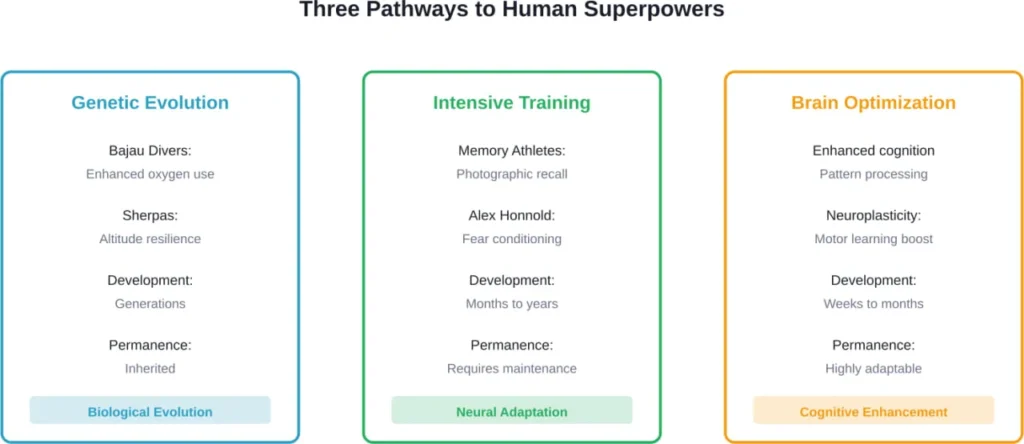
Real-world superpowers don’t come from radioactive spider bites. They emerge from three primary sources: genetic evolution, intensive training, and brain optimization.
The NIH’s research on human brain evolution reveals that humans possess superior pattern processing capabilities compared to all other species. This cognitive advantage forms the biological basis for developing extraordinary abilities through deliberate practice and neural adaptation.
Here’s the thing though—human brains are remarkably plastic. Research published in Nature demonstrates that cortical excitability and neuroplasticity can be significantly enhanced, leading to improved motor learning and cognitive performance.
Genetic Superpowers Already Exist
Scientists confirm that through genetics, some humans have already evolved superhuman abilities. The most striking example comes from the Bajau people of the Philippines, Malaysia, and Indonesia.
These “sea nomads” have genetically adapted to use oxygen more efficiently, making them exceptional free divers. This isn’t just practice—it’s evolutionary adaptation that’s altered their physiology.
Another documented case involves Sherpas, who’ve developed enhanced resilience to high-altitude environments. Research shows humans are still actively evolving, developing genetic advantages that would’ve seemed impossible just generations ago.
Real People With Documented Superpowers
National Geographic reports on several individuals who’ve developed abilities so extreme they qualify as superhuman. These aren’t tricks—they’re documented capabilities that push biological boundaries.
Super Memory: Mental Athletes
Memory champions can memorize the order of multiple shuffled card decks in minutes. This isn’t genetic—it’s trained.
Research on cognitive enhancement acceptance predictors revealed two main factors through factor analysis, with both Bartlett’s test of sphericity and Kaiser-Meyer-Olkin analysis indicating the data were adequate for analysis. Research on human electrophysiology indicates relationships between neurotransmitter systems and brain mechanisms, including acetylcholine’s role in P300 generation and memory-related processes.
Super Fearlessness: Conditioned Response
Free solo climber Alex Honnold has developed what neuroscientists describe as conditioned fearlessness. Psychologists use similar conditioning methods to help people overcome phobias.
Brain imaging studies show that through repeated exposure and mental training, the amygdala’s fear response can be significantly reduced. This isn’t recklessness—it’s neural rewiring.
Super Agility: Samurai Precision
Isao Machii, a modern samurai, has demonstrated exceptional agility and precision in slicing projectiles with a sword. His reaction time and hand-eye coordination exceed normal human limits.
This demonstrates what NIH research calls superior pattern processing—the ability to predict movement trajectories and execute precise motor responses faster than conscious thought.
| Ability Type | Real-World Example | Scientific Basis | Achievable By Others |
|---|---|---|---|
| Enhanced Oxygen Use | Bajau divers | Genetic adaptation | No (genetic) |
| Photographic Memory | Memory athletes | Neural training | Yes (with training) |
| Fear Resistance | Alex Honnold | Amygdala conditioning | Yes (gradual exposure) |
| Extreme Precision | Isao Machii | Pattern processing | Yes (intensive practice) |
| Altitude Resilience | Sherpa populations | Genetic evolution | No (genetic) |
How Neuroplasticity Creates Superpowers
The brain’s ability to reorganize itself—neuroplasticity—is the secret weapon behind trainable superpowers.
Nature’s research on cortical excitability demonstrates that neuroplasticity can be enhanced through specific interventions. When cortical facilitation increases and inhibition decreases, motor learning and cognitive performance improve dramatically.
Studies on human brain physiology show that larger, faster pyramidal neurons associate with higher intelligence. But here’s the crucial part: neural connections strengthen with use.
Research on superior pattern processing indicates that the evolved human brain excels at pattern processing, a capability that appears central to human cognitive advantage. The hippocampus and associated cortical structures involved in sensory (particularly vision and olfaction) integration have been shown to change in response to spatial experience and learning.
The Role of Chronotype in Performance
Research published in Nature reveals an often-overlooked factor: timing matters. Cortical excitability and cognitive performance vary based on circadian rhythms.
Studies published in Nature show that motor learning and cognitive performance (working memory and attention) along with their electrophysiological components are significantly enhanced at circadian-preferred times compared to non-preferred times. Training during optimal hours accelerates skill development.
The Future of Human Enhancement
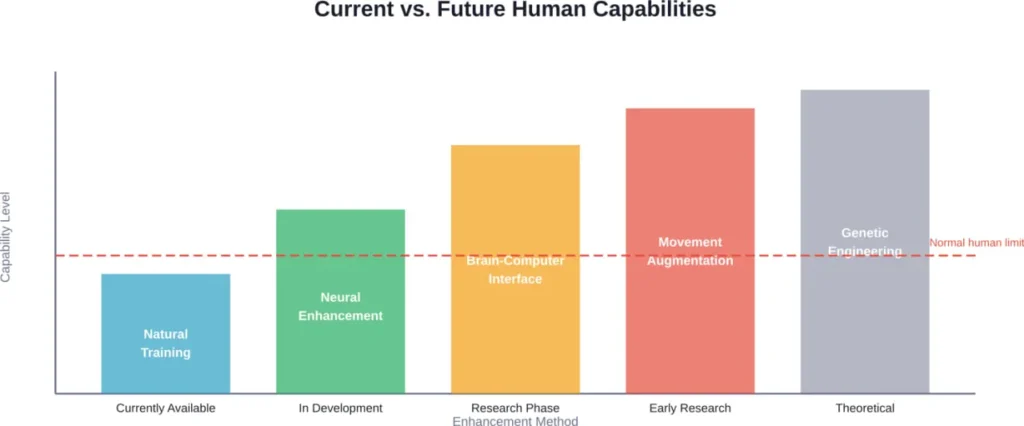
Community discussions in transhumanism forums increasingly focus on whether technological enhancement will create the next generation of human superpowers.
Research on cognitive enhancement acceptance predictors revealed two main factors through factor analysis, with both Bartlett’s test of sphericity and Kaiser-Meyer-Olkin analysis indicating the data were adequate for analysis. These findings indicate growing scientific interest in understanding what drives acceptance of methods like brain stimulation, nootropics, and working memory training.
Nature’s research on human movement augmentation explores how artificial limbs controlled concurrently with natural limbs could revolutionize human capabilities. This isn’t science fiction anymore—it’s active research with real applications.
Limitations and Ethical Considerations
Not all “superpowers” are scientifically valid. Research from Berkeley’s Understanding Science project confirms that claims of extrasensory perception (ESP) lack credible scientific evidence despite decades of testing.
A UC Davis review of government “psychic spying” research noted that while some statistically significant results appeared, interpretation remains controversial. The scientific consensus: extraordinary claims require extraordinary evidence.
NIH research on ESP beliefs found that cognitive and motivational factors—not actual psychic abilities—explain why some people believe in paranormal powers. A survey conducted on a representative sample of the US public found that 60% of participants expressed belief in ESP, but scientific studies consistently fail to replicate claimed phenomena.
Real human superpowers are constrained by biology, physics, and neurology. They’re extensions of natural capabilities, not violations of natural law.
How to Develop Your Own Superpowers
Based on scientific research, here’s what actually works:
Optimize Your Timing: Nature’s chronotype research shows cognitive performance peaks at specific times. Identify your circadian preference and schedule demanding tasks accordingly.
Use Deliberate Practice: NIH research on pattern processing confirms that targeted, repetitive training strengthens neural pathways. Random practice doesn’t create superpowers—structured training does.
Enhance Neuroplasticity: Studies show that learning new skills, particularly those requiring motor coordination and sensory integration, promotes neural reorganization. Challenge multiple brain systems simultaneously.
Condition Fear Response: Gradual exposure to controlled stress situations can reduce amygdala reactivity. Start small and progressively increase difficulty.
Train Working Memory: Research confirms that specific memory techniques and training protocols can significantly improve recall abilities beyond baseline performance.
| Training Method | Target Ability | Time to Results | Scientific Support |
|---|---|---|---|
| Memory palace technique | Enhanced recall | 3-6 months | Strong (NIH) |
| Graduated exposure | Fear reduction | 6-12 months | Strong (Psychology) |
| Pattern recognition drills | Faster processing | 2-4 months | Strong (NIH) |
| Chronotype optimization | Peak performance | Immediate | Strong (Nature) |
| Motor skill practice | Precision movement | 1-3 years | Strong (Neuroscience) |
Frequently Asked Questions
Humans can develop extraordinary abilities that appear superhuman through genetic adaptation, intensive training, and neural optimization. Real-world examples include the Bajau people’s enhanced diving capabilities, memory athletes with photographic recall, and individuals with exceptional fear conditioning. However, powers that violate physics (like flight or telekinesis) remain impossible.
Enhanced memory and pattern recognition are the most accessible superpowers, backed by NIH research showing that working memory training and mnemonic techniques can dramatically improve recall abilities. Mental athletes demonstrate that photographic memory is achievable through structured practice over several months.
Yes. Scientists confirm that genetic adaptations like the Bajau people’s enhanced oxygen efficiency and Sherpa altitude resilience are inherited traits developed over generations. These evolutionary adaptations represent permanent biological changes passed to offspring.
Timeline varies by ability type. Chronotype optimization provides immediate benefits, pattern recognition improvements appear within 2-4 months, memory enhancement requires 3-6 months, while fear conditioning takes 6-12 months. Extreme precision skills like samurai-level agility may require years of dedicated practice.
NIH research shows brain stimulation can enhance neuroplasticity and cortical excitability, improving motor learning and cognitive performance. However, these techniques are still in development and require medical supervision. Natural training methods remain safer and more accessible for most people.
No credible scientific evidence supports ESP or psychic abilities. Berkeley’s research confirms that despite decades of testing, studies consistently fail to demonstrate extrasensory perception. A UC Davis review of government psychic research found controversial results with no reproducible evidence.
Research from Nature on movement augmentation and brain-computer interfaces shows promise for technologically-enhanced human capabilities. Early-stage research explores artificial limbs controlled concurrently with natural limbs and neural enhancement devices, though widespread availability remains years away.
The Reality of Human Superpowers
So can humans have superpowers? Absolutely—just not the comic book kind.
Scientific research from the NIH, Nature, and leading neuroscience institutions confirms that humans possess remarkable capacity for developing extraordinary abilities. Through genetic evolution, neuroplasticity, and deliberate training, people have already achieved feats that previous generations would’ve considered superhuman.
The Bajau divers hold their breath for impossible durations. Memory athletes recall information with photographic precision. Free climbers conquer their neurological fear response. Samurai masters react faster than conscious thought.
These aren’t myths or tricks. They’re documented human achievements based on optimizing biology, neurology, and training methodology.
The future promises even more. Research into brain-computer interfaces, movement augmentation, and cognitive enhancement suggests the next generation of human capabilities will make today’s superpowers look ordinary.
Real talk: humans have barely scratched the surface of their potential. The question isn’t whether superpowers are possible—it’s which ones will become commonplace in the coming decades.
Ready to develop your own superhuman abilities? Start with scientifically-validated training methods, optimize your circadian timing, and commit to deliberate practice. The research proves extraordinary human capabilities aren’t just possible—they’re achievable.