
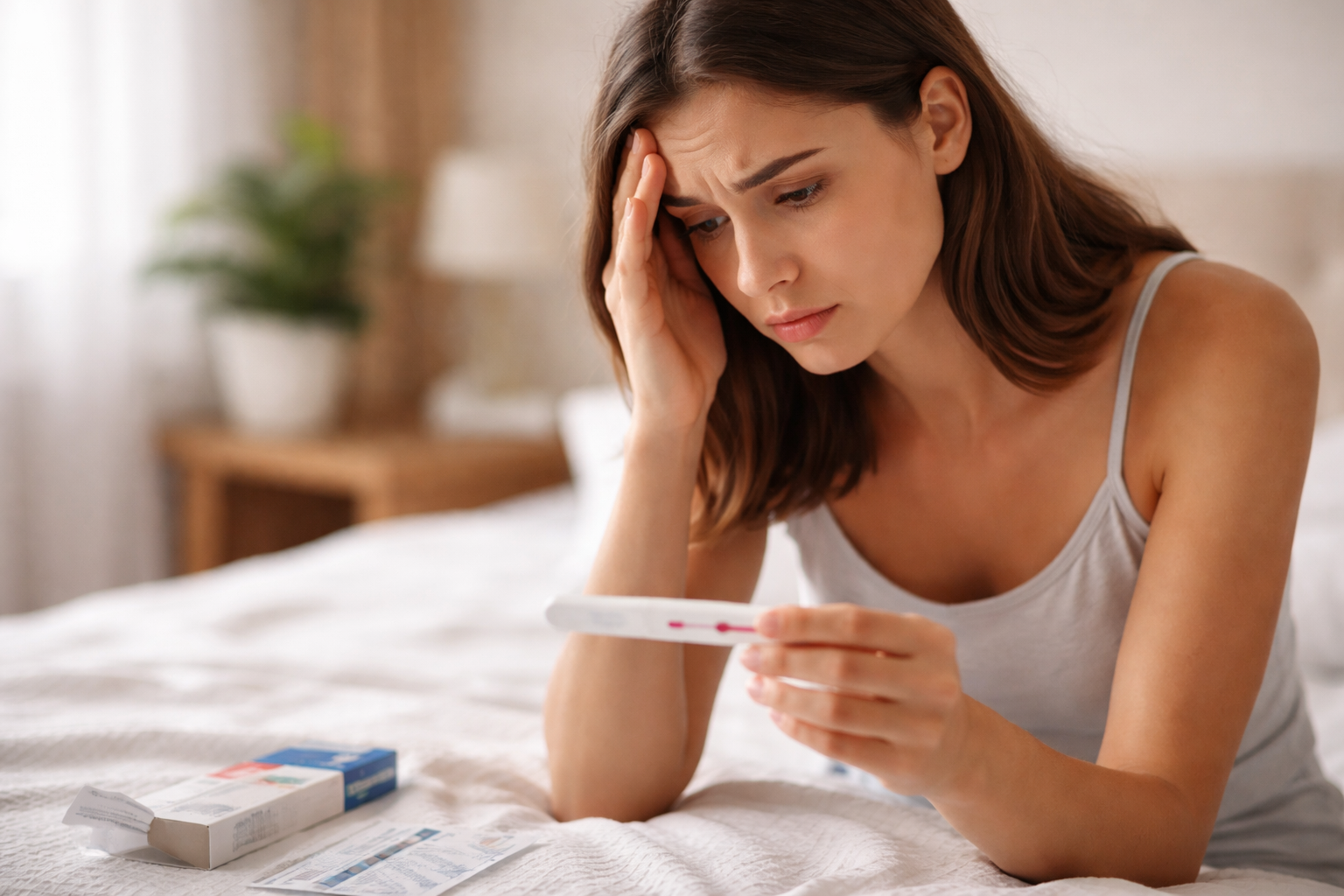
Quick Summary: False positive pregnancy tests are rare but possible, occurring in roughly 1 in 1,000 to 1 in 10,000 tests according to medical research. Common causes include testing too soon after pregnancy loss, certain medications containing hCG, rare medical conditions, and chemical pregnancies. User error like misreading results or checking tests outside the time window also contributes to false positives.
A positive pregnancy test can trigger an avalanche of emotions. Relief, excitement, fear, confusion—sometimes all at once.
But what happens when that positive result doesn’t align with reality? False positive pregnancy tests exist, though they’re far less common than most people think.
Here’s what medical research actually shows about false positives, why they happen, and what to do if something feels off.
How Accurate Are Home Pregnancy Tests?
Most home pregnancy tests claim 99% accuracy on their packaging. That sounds reassuring, right?
The reality is a bit more nuanced. These tests detect human chorionic gonadotropin (hCG)—a hormone produced during pregnancy. When used correctly, they’re highly reliable for detecting hCG presence.
But here’s the thing: detecting hCG doesn’t always mean a viable pregnancy is progressing normally. According to medical research published in peer-reviewed journals, false positive results occur in approximately 1 in 1,000 to 1 in 10,000 tests.
That’s genuinely rare. Yet when it happens, it creates significant emotional and medical confusion.
Washington University School of Medicine research found that up to 5% of pregnancy tests can return false negative results—indicating no pregnancy when one exists. False positives are considerably less common than false negatives.
What Causes a False Positive Pregnancy Test?
Several medical and technical factors can trigger a positive result when no viable pregnancy exists. Some are straightforward user errors, while others involve complex biological processes.
1. Recent Pregnancy Loss or Abortion
After a miscarriage, abortion, or childbirth, hCG levels don’t drop to zero immediately. The hormone can remain detectable in the body for days or even weeks.
According to CDC data, the likelihood of ovulation is low for ≤7 days after an abortion. But hCG can persist longer than that timeframe, creating a window where tests show positive despite no current pregnancy.
The timeframe varies by individual and how far along the previous pregnancy progressed. Testing too soon after pregnancy loss is one of the most common causes of false positive results.
2. Chemical Pregnancy
Chemical pregnancies represent very early miscarriages—often occurring before a missed period or shortly after.
The embryo implants briefly, hCG production begins, then the pregnancy fails. According to a 2017 study, chemical pregnancies account for roughly 8% to 33% of miscarriages.
From a testing perspective, this creates a genuine positive result initially. The test isn’t technically “wrong”—pregnancy occurred. But it doesn’t progress, making the positive result misleading for someone expecting a continuing pregnancy.
Many chemical pregnancies go unnoticed because they happen so early. Home pregnancy tests have become increasingly sensitive, detecting these brief pregnancies that previous generations never knew existed.
3. Ectopic Pregnancy
Ectopic pregnancies occur when a fertilized egg implants outside the uterus—usually in a fallopian tube.
These pregnancies produce hCG and will trigger positive test results. However, they’re not viable and require immediate medical attention as they can cause life-threatening complications.
An ectopic pregnancy isn’t a false positive in the technical sense—pregnancy exists. But the positive result doesn’t indicate a healthy, progressing pregnancy. This is why follow-up medical care after positive home tests matters.
4. Medications Containing hCG
Some fertility treatments involve hCG injections to trigger ovulation or support early pregnancy. These medications can cause positive pregnancy test results unrelated to actual conception.
Common fertility drugs that contain hCG include Pregnyl, Novarel, and Ovidrel. Healthcare providers typically advise waiting 7-14 days after the last injection before testing to avoid false positives from medication interference.
5. Rare Medical Conditions
Certain tumors and medical conditions can produce hCG, triggering positive pregnancy tests in people who aren’t pregnant.
Molar pregnancies represent one such condition—abnormal tissue growth in the uterus that produces hCG despite no viable embryo developing. Academic research has documented cases of gastrointestinal stromal tumors causing false positive results through ectopic hCG expression.
According to medical literature, conditions affecting the pituitary gland can also cause hCG production. Research published by the American College of Obstetricians and Gynecologists notes that pituitary hCG levels can be elevated in postmenopausal individuals, with prevalence as high as 8% in those aged 55 or older using a cutoff of more than 5 international units per liter.
6. Antibody Interference
This gets technical, but it’s fascinating. Some people have antibodies that interfere with pregnancy test chemistry, creating what’s called “phantom hCG.”
Research on IgA deficiency found that 30% of 54 patients with this immune condition yielded positive pregnancy tests using one or more hCG assays—yet none were actually pregnant. The study identified that 39% of patient samples contained significant anti-goat antibody and 18% had anti-mouse antibody.
Human anti-mouse antibodies (HAMA) can bind to test antibodies and create false signals. Medical case reports have documented these phantom hCG scenarios causing diagnostic confusion until specialized testing ruled out actual pregnancy.
7. Evaporation Lines and User Error
Not all false positives stem from biological causes. User error plays a significant role.
Reading test results outside the recommended timeframe causes confusion. As urine evaporates on the test strip, faint lines can appear that aren’t true positive results—these are evaporation lines.
FDA guidance for over-the-counter hCG tests recommends using first-morning urine specimens because hCG concentration peaks at that time. Testing with diluted urine later in the day can produce ambiguous results.
Misinterpreting faint lines, checking results too late, or using expired tests all contribute to false positive confusion.
8. Defective or Contaminated Tests
Manufacturing defects or contamination can cause false results, though quality control makes this uncommon.
Improper storage—like exposure to heat or moisture—can damage tests and affect accuracy. This is why tests should remain sealed until use and stored according to package instructions.

When to See a Healthcare Provider
Any positive pregnancy test—even if suspected to be false—warrants professional follow-up.
Healthcare providers can perform quantitative blood tests that measure exact hCG levels. These tests are more sensitive and specific than home urine tests.
According to the American College of Obstetricians and Gynecologists, ultrasound confirmation is essential for ruling out ectopic pregnancy and confirming intrauterine pregnancy location.
If hCG levels remain positive but no pregnancy is visible on ultrasound, further investigation is needed. This could indicate ectopic pregnancy, recent pregnancy loss, or one of the rare medical conditions that produce hCG.
Don’t try to diagnose a false positive yourself. Professional evaluation protects your health and provides definitive answers.
False Positives vs. False Negatives
While this article focuses on false positives, false negative results—showing negative when pregnancy exists—are actually more common.
Testing too early is the primary culprit. hCG levels need time to rise after implantation. Testing before a missed period increases false negative risk.
Washington University research found that a design flaw in many home tests can produce false negatives in up to 5% of cases. The study tested 11 major pregnancy test brands and found seven were somewhat susceptible to this flaw, two were highly susceptible, and only two were not susceptible.
The researchers noted this was particularly problematic for the test giving false negatives in 5% of urine samples from confirmed pregnant women.
| Result Type | Frequency | Common Causes | What It Means |
|---|---|---|---|
| False Positive | 1 in 1,000 to 1 in 10,000 tests | Recent pregnancy loss, chemical pregnancy, medications, medical conditions, user error | Test shows positive but no viable pregnancy exists |
| False Negative | Up to 5% of tests | Testing too early, diluted urine, test design flaws, expired tests | Test shows negative but pregnancy exists |
| True Positive | Majority of positive results | Actual pregnancy with detectable hCG | Pregnancy confirmed—requires follow-up care |
| True Negative | Majority of negative results | No pregnancy, no hCG present | Not pregnant—retest if period doesn’t arrive |
How to Minimize Testing Errors
While some causes of false positives are beyond individual control, certain practices improve accuracy:
- Wait until at least the first day of a missed period before testing
- Use first-morning urine for highest hCG concentration
- Read results within the timeframe specified in instructions—typically 3-5 minutes
- Don’t use expired or improperly stored tests
- If testing after fertility treatments, follow timing guidance from the healthcare provider
- Consider testing with multiple brands if results seem questionable
The FDA provides guidance that freshly voided first-morning urine specimens yield the most reliable results because hCG concentration peaks during that timeframe.
The Emotional Impact of False Results
False positive results carry significant emotional weight regardless of whether someone was trying to conceive.
For those hoping for pregnancy, a false positive followed by confirmation of no viable pregnancy mirrors the grief of early pregnancy loss. For those not trying to conceive, the initial panic followed by relief creates its own emotional whiplash.
Anecdotal reports reveal how disorienting false positives feel. People question their sanity, worry about underlying health conditions, and struggle with the uncertainty between initial test and professional confirmation.
This emotional component is why immediate follow-up matters. Prolonged uncertainty amplifies distress.
The Bottom Line on False Positive Tests
Real false positive pregnancy tests happen, but they’re legitimately rare—roughly 1 in 1,000 to 1 in 10,000 tests according to medical literature.
Most “false positives” aren’t false in the technical sense. They detect hCG that’s actually present due to recent pregnancy loss, chemical pregnancy, medications, or medical conditions. The positive result is biochemically accurate even if it doesn’t reflect a current viable pregnancy.
True false positives from antibody interference or test defects represent a tiny fraction of positive results.
If a home test shows positive, don’t dismiss it as false without professional evaluation. Schedule an appointment with a healthcare provider for blood testing and ultrasound. Those diagnostic tools provide definitive answers and rule out conditions requiring medical attention—like ectopic pregnancy.
Trust the test enough to follow up, but don’t consider it final confirmation without professional verification.
Frequently Asked Questions
No. Stress doesn’t cause the body to produce hCG or interfere with pregnancy test chemistry. While stress affects many aspects of health and reproductive function, it cannot create a false positive result. Positive tests indicate hCG presence from pregnancy, recent pregnancy loss, medications, or medical conditions—not psychological stress.
This varies significantly based on how far along the pregnancy was. hCG levels typically drop by half every 24-48 hours after pregnancy loss. Early losses may show negative tests within a few days, while losses after 8-10 weeks can show positive tests for several weeks. Healthcare providers often monitor hCG levels to ensure they return to zero after miscarriage or abortion.
No. Drinking water dilutes urine and can cause false negative results by lowering hCG concentration below the test’s detection threshold. However, water cannot create hCG where it doesn’t exist or cause a false positive. This is why first-morning urine—which is most concentrated—produces the most reliable results.
This scenario suggests a very early pregnancy loss between the two tests, or interference in the urine test from antibodies. Blood tests are more specific and less susceptible to interference than urine tests. If blood tests are consistently negative while urine tests remain positive, antibody interference creating phantom hCG is likely. Additional specialized testing can diagnose this condition.
No. Standard birth control pills contain estrogen and progestin—not hCG. These hormones don’t trigger positive pregnancy tests. However, some fertility medications used before attempting conception do contain hCG and can cause false positives if taken too close to testing.
Injectable hCG used for fertility treatments typically clears the system within 7-14 days depending on dosage. Healthcare providers usually advise waiting at least 14 days after the last hCG injection before taking a pregnancy test to avoid false positives from medication rather than conception.
True evaporation lines are typically colorless or gray—just an indent in the test strip where the dye would appear. If a line has color matching the test’s positive indicator color, it’s more likely a valid positive result, even if faint. However, reading tests outside the recommended timeframe makes interpretation unreliable regardless of color.
Moving Forward After a Positive Test
Whether a positive pregnancy test brings joy, fear, or confusion depends entirely on individual circumstances and what was wanted or expected.
What remains constant is the need for follow-up. Home tests provide preliminary screening—not diagnostic confirmation.
Schedule an appointment with a healthcare provider within a few days of a positive result. Blood tests and ultrasound confirm pregnancy location, viability, and rule out medical conditions requiring intervention.
If the positive result turns out to be false, that follow-up provides answers and peace of mind. If it’s a true positive, that medical care is essential for a healthy pregnancy.
Don’t wait in uncertainty. Professional evaluation transforms a confusing home test result into clear medical information and appropriate next steps.