

Quick Summary: Building muscle in a calorie deficit is possible, especially for beginners, overweight individuals, and those returning after a break. Success depends on adequate protein intake (2.4g per kg bodyweight), proper resistance training, and a moderate deficit. Research shows higher protein diets preserve lean mass during weight loss when combined with strength training.
The idea that you need to eat more calories to build muscle has dominated fitness culture for decades. Bulk up, then cut down. Rinse and repeat.
But what if you want to lose fat and build muscle at the same time? Is that even possible, or are you destined to pick one goal and stick with it?
The short answer: yes, you can build muscle in a calorie deficit. But the long answer is more nuanced—and far more useful.
Understanding Caloric Deficits and Muscle Growth
A calorie deficit means consuming fewer calories than your body burns. This forces your body to tap into stored energy—primarily fat—to make up the difference.
Muscle growth, on the other hand, is an energy-intensive process. Your body synthesizes new protein structures, repairs damaged muscle fibers, and adapts to training stress. All of this requires energy.
So naturally, these two goals seem to contradict each other. And in many cases, they do.
Here’s the thing though—your body doesn’t operate in simple black-and-white terms. Under the right conditions, it can simultaneously burn fat for energy while building new muscle tissue.
Who Can Build Muscle in a Deficit?
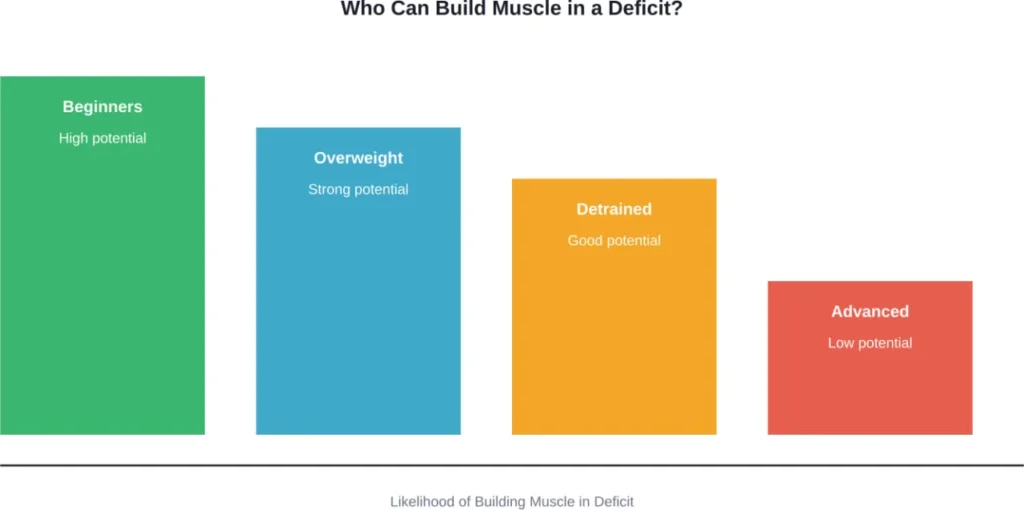
Not everyone will experience the same results. Certain populations have a much better shot at building muscle while losing fat.
Beginners
If you’re new to resistance training, your body is primed for rapid adaptation. The stimulus is novel, and your muscles respond aggressively—even without a calorie surplus.
Community discussions consistently highlight beginners making impressive strength and muscle gains while cutting fat. The “newbie gains” phenomenon is real.
Overweight or Obese Individuals
Carrying excess body fat provides an internal energy reservoir. Your body can pull from these fat stores to fuel muscle protein synthesis while you’re in a deficit.
Research demonstrates that individuals with higher body fat percentages can achieve significant body recomposition—losing fat while maintaining or even gaining lean mass—during resistance training.
Detrained Lifters
Took a few months off from the gym? Your muscles have “muscle memory”—the ability to regain lost size and strength faster than it took to build initially.
During this regaining phase, you can add muscle even in a deficit. Your body is essentially restoring what was already there, which requires less energy than building new tissue from scratch.
Advanced Lifters: The Reality Check
Experienced lifters with low body fat face the toughest challenge. According to research published in the European Journal of Applied Physiology, caloric restriction can induce anabolic resistance to resistance exercise in trained athletes.
That doesn’t mean it’s impossible. But progress will be slower, require more precision, and demand a smaller deficit.
The Critical Role of Protein Intake
If there’s one non-negotiable factor for building muscle in a deficit, it’s protein intake. And not just any amount—you need significantly more than the standard recommendations.
Research on protein intake during energy deficit and resistance training compared higher protein intake (2.4g/kg) versus lower protein intake (1.2g/kg). Higher protein intake was associated with better outcomes for muscle preservation and fat loss during weight loss with training.
Why does protein matter so much? Skeletal muscle mass is regulated by the balance between muscle protein synthesis and muscle protein breakdown. In a deficit, your body naturally shifts toward breakdown. High protein intake combats this by providing the raw materials for synthesis and triggering anabolic signaling pathways.
How Much Protein Do You Actually Need?
For building muscle in a deficit, aim for 2.0-2.4 grams per kilogram of bodyweight daily. For a 180-pound person, that’s roughly 164-218 grams of protein per day.
That’s significantly higher than maintenance recommendations. But when energy is limited, protein becomes even more critical for preserving and building lean tissue.
| Bodyweight | Minimum Protein (2.0g/kg) | Optimal Protein (2.4g/kg) |
|---|---|---|
| 150 lbs (68 kg) | 136g | 163g |
| 180 lbs (82 kg) | 164g | 197g |
| 200 lbs (91 kg) | 182g | 218g |
| 220 lbs (100 kg) | 200g | 240g |
Resistance Training: Don’t Reduce Volume
Many athletes reduce training volume during a cut, assuming they won’t recover properly with fewer calories. This is a mistake.
Research on lean mass sparing in resistance-trained athletes during caloric restriction demonstrates the importance of maintaining resistance training volume as an anabolic stimulus. When volume drops, so does the signal for your body to maintain muscle.
During a deficit, maintaining training volume becomes even more important. Your body needs a strong reason to hold onto metabolically expensive muscle tissue when energy is scarce. High-volume resistance training provides that reason.
Now, this doesn’t mean adding more volume indefinitely. But it does mean keeping your training load similar to what you’d do in maintenance or a surplus.
How Large Should Your Calorie Deficit Be?
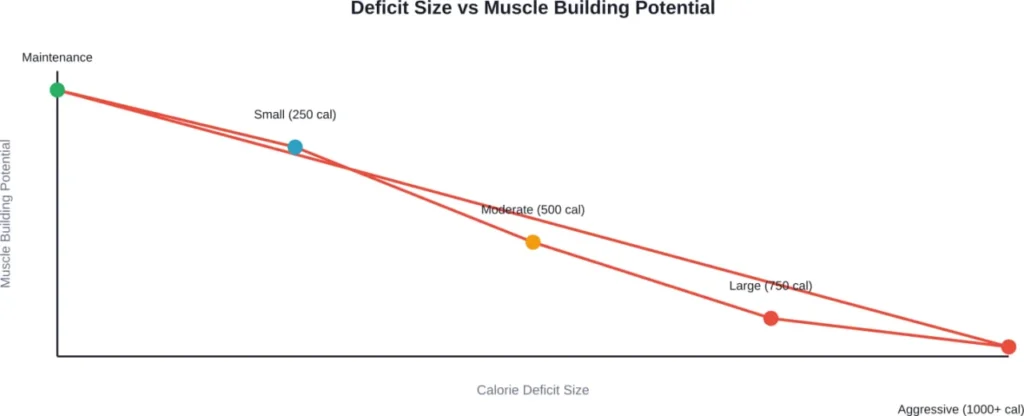
The size of your deficit matters enormously. Too aggressive, and you’ll lose muscle along with fat. Too conservative, and fat loss will stall.
According to analysis from Stronger by Science, lifters with relatively high body-fat levels can maintain satisfactory progress while losing up to roughly 0.5% of body mass per week. For a 200-pound person, that’s about 1 pound per week.
Leaner individuals should aim for slower rates—closer to 0.5-0.7 pounds per week. This translates to a deficit of roughly 250-500 calories below maintenance.
Aggressive deficits (1,000+ calories) might work for rapid fat loss, but they severely compromise muscle-building potential. Research on lean mass sparing shows that diet-only interventions result in a higher proportion of weight loss coming from lean tissue compared to combined diet and exercise approaches. The Weinheimer et al. study cited in medical literature found that 24% of diet-only weight loss and 11% of diet-plus-exercise weight loss were attributed to lean tissue reduction.
What About Very Low-Calorie Diets?
Very low-calorie diets present unique challenges. Research on the impact and utility of these approaches notes concerns about negative effects on lean mass, despite their effectiveness for rapid weight loss.
If your goal includes building muscle, very low-calorie approaches aren’t the right tool. Moderate deficits give your body enough energy flexibility to support muscle protein synthesis.
Managing Expectations: What Results Look Like
Let’s be realistic. Building muscle in a deficit is slower than building muscle in a surplus. Much slower.
Building muscle in a deficit progresses more slowly than in a surplus. Exact rates depend on training status, protein intake, deficit size, and individual factors.
For advanced lifters, the gains will be even more modest. But the fat loss will be visible, leading to a leaner, more defined physique even if the scale doesn’t move much.
This is body recomposition: simultaneously losing fat and gaining muscle, resulting in improved body composition without dramatic weight changes.
Common Mistakes That Kill Progress
Even with the right approach, several pitfalls can sabotage your results.
Insufficient Protein
Hitting 2.0-2.4 grams per kilogram isn’t easy. It requires planning and consistency. Research on self-monitoring accuracy shows that adults trying to lose weight largely underreport their food intake by up to 47%, according to ACSM-published research.
Track your intake meticulously, at least initially, to ensure you’re actually hitting your protein targets.
Excessive Cardio
Cardio can support fat loss, but too much interferes with recovery from resistance training. Excessive cardio also increases overall calorie expenditure, which can deepen your deficit beyond optimal levels.
Limit cardio to 2-3 sessions per week, focusing on low-to-moderate intensity to preserve recovery capacity.
Slashing Training Volume
As mentioned earlier, maintaining training volume is critical. Don’t reduce your lifting just because you’re eating less. Your muscles need that stimulus to justify their existence.
Creating Too Aggressive a Deficit
Patience is hard. But losing 2-3 pounds per week will almost certainly cost you muscle mass. Slow and steady wins this race.
Practical Implementation: Your Action Plan
Ready to put this into practice? Here’s your step-by-step approach.
Step 1: Calculate your maintenance calories. Use an online calculator or track your intake for a week while maintaining your current weight.
Step 2: Create a moderate deficit of 250-500 calories below maintenance.
Step 3: Set protein intake at 2.0-2.4 grams per kilogram of bodyweight.
Step 4: Fill remaining calories with carbohydrates and fats. Prioritize carbs around your training sessions for performance.
Step 5: Maintain your current resistance training volume. Train 3-5 days per week, hitting each major muscle group twice weekly.
Step 6: Monitor your progress weekly. Track weight, measurements, and performance in the gym.
Step 7: Adjust as needed. If you’re losing more than 0.5-1% of bodyweight weekly, increase calories slightly. If weight isn’t moving after 2-3 weeks, reduce calories by 100-200.
| Priority | Action | Target |
|---|---|---|
| 1 | Protein Intake | 2.0-2.4g per kg bodyweight |
| 2 | Calorie Deficit | 250-500 calories below maintenance |
| 3 | Training Volume | Maintain current volume |
| 4 | Rate of Loss | 0.5-1% bodyweight per week |
| 5 | Cardio | 2-3 sessions weekly, moderate intensity |
Frequently Asked Questions
Absolutely. Beginners have the best potential for building muscle in a deficit due to the novelty of training stimulus. Combined with adequate protein and proper resistance training, beginners can achieve significant body recomposition.
Research supports 2.0-2.4 grams of protein per kilogram of bodyweight daily. This higher intake helps preserve lean mass and supports muscle protein synthesis during energy restriction.
Not necessarily. With sufficient protein intake, maintained training volume, and a moderate deficit, most people can preserve muscle mass. Some populations can even gain muscle. Aggressive deficits and inadequate protein increase muscle loss risk.
Moderate cardio is fine—2-3 sessions weekly at low-to-moderate intensity. Excessive cardio can interfere with recovery from resistance training and create too large a deficit, compromising muscle building potential.
Fat loss typically becomes visible within 2-4 weeks. Muscle gains take longer to notice—expect 6-8 weeks before changes become apparent. Body recomposition is a slower process than pure fat loss or muscle gain alone.
It’s much more challenging for advanced lifters with lower body fat. Research shows caloric restriction can induce anabolic resistance in trained athletes. Advanced lifters may maintain muscle well but should expect minimal to no muscle gain in a deficit.
A moderate deficit of 250-500 calories below maintenance works best. This typically results in 0.5-1% bodyweight loss per week, which allows for fat loss while preserving the energy needed for muscle protein synthesis.
The Bottom Line
Building muscle in a calorie deficit isn’t just possible—it’s achievable for most people with the right approach. But it requires precision, patience, and realistic expectations.
Prioritize protein intake at 2.0-2.4 grams per kilogram daily. Maintain your resistance training volume. Create a moderate deficit that allows for steady fat loss without compromising recovery.
The process is slower than traditional bulking and cutting phases. But the result—simultaneous fat loss and muscle gain—eliminates the need for extended bulk-and-cut cycles.
Ready to transform your physique? Start by calculating your protein needs and setting up a sustainable deficit today. Track your progress consistently, adjust based on results, and trust the process.