

Quick Summary: Yes, it is possible to control your dreams through a phenomenon called lucid dreaming, where you become aware that you’re dreaming while still asleep. Research from Northwestern University and other institutions shows that techniques like targeted lucidity reactivation can increase lucid dreaming success rates from 17% to 42%. While lucid dreaming occurs naturally for about 50% of people at least once in their lifetime, specific practices can help develop this skill more consistently.
Ever woken up from a dream wishing things had gone differently? Maybe wondering if there’s a way to steer your dreams instead of being a passive passenger?
The short answer: absolutely. And the science behind it is fascinating.
What seems like something from movies like Inception turns out to be a well-documented psychological phenomenon. Neuroscientists have been studying dream control for decades, and recent breakthroughs are making it more accessible than ever.
What Is Lucid Dreaming?
Lucid dreaming refers to the phenomenon of becoming aware that you’re dreaming while the dream is still happening. In this state, dreamers often gain the ability to influence or even direct the content of their dreams.
According to research published by the National Institutes of Health, lucid dreams are defined as dreams in which the dreamer is aware that they’re dreaming. The phenomenon has been physiologically validated for decades, though the complete neurobiology remains under investigation.
Here’s the thing though—lucid dreaming isn’t some rare superpower. Representative samples show that approximately 50% of people report experiencing at least one lucid dream during their lifetime. In student populations, that percentage reaches even higher levels.
But awareness alone doesn’t guarantee control. Some people become conscious during dreams yet can’t manipulate anything. Others develop remarkable abilities to shape entire dream worlds, from flying to conjuring specific people or places.
The Brain Activity Behind Dream Control
What’s actually happening in the brain during lucid dreams?
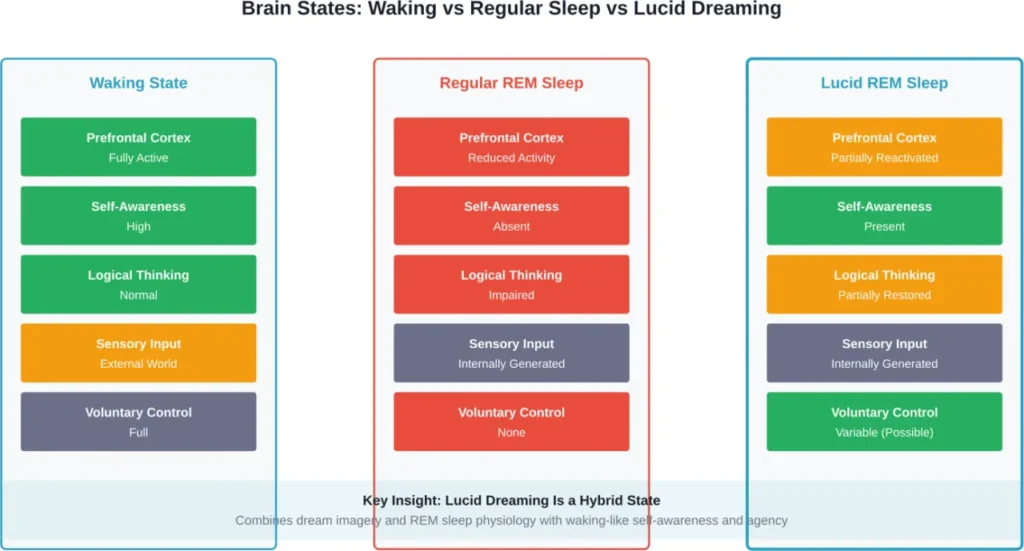
Research from the University of Wisconsin-Madison reveals that lucid dreaming shows a unique brain signature. EEG studies demonstrate that REM periods with lucid dreaming display increased brain activation, especially in the prefrontal cortex, compared to regular REM sleep without lucidity.
This matters because the prefrontal cortex handles executive functions like self-awareness, decision-making, and conscious thought. During normal dreams, this region shows reduced activity. During lucid dreams, it partially reactivates—creating a hybrid state with features of both waking and dreaming.
Studies published in Sleep journal describe this as a dissociated state combining aspects of waking and dreaming in ways that suggest specific alterations in brain physiology. The activated EEG patterns during lucid REM sleep differ markedly from non-lucid dreaming.
The History of Dream Control
The concept of lucid dreaming isn’t new.
Ancient references exist in philosophical texts. According to historical records cited in research, Aristotle discussed instances of self-awareness during dream states, noting: “If the sleeper perceives that he is asleep, and is conscious of the sleeping state during which the perception comes before his mind, it presents itself still, but something within him speaks.”
But scientific validation came much later. Researchers developed methods for lucid dreamers to signal from inside dreams using predetermined eye movements—visible on EEG recordings. This breakthrough proved that lucid dreaming represented a genuine, measurable state of consciousness rather than false memories or post-wake confabulation.
Does Lucid Dreaming Actually Work?
The evidence is solid.
Recent research from Northwestern University published in 2024 provides the first systematic evidence that targeted lucidity reactivation—combining pre-sleep training with sensory cues—can successfully induce lucid dreams with minimal technical requirements.
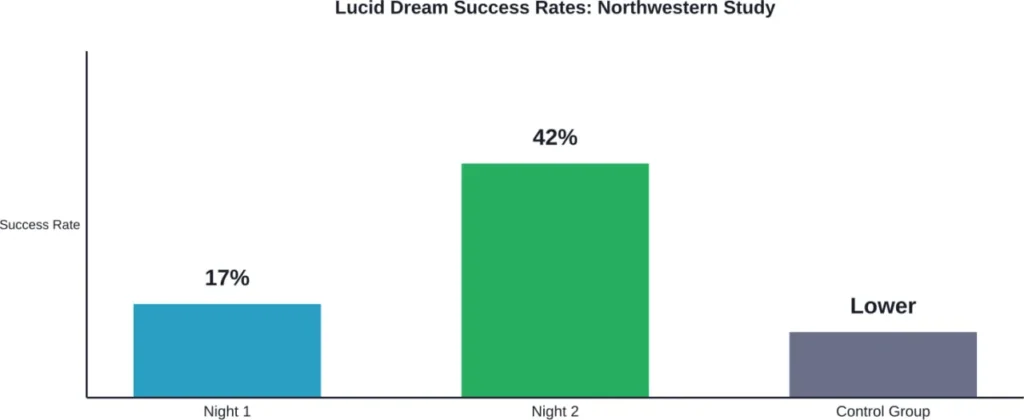
The Northwestern team adapted their method using a smartphone app that links sensory stimulation with a lucid state of mind. In their initial experiment, when all participants received the real sound cue during sleep, 17% experienced lucid dreams on the first night.
Here’s where it gets interesting. On the second night, that success rate jumped to 42% for those receiving the actual training cue. Control participants who received dummy sound cues or no cues showed significantly lower rates.
This demonstrates two critical points: lucid dreaming can be reliably induced, and the method works beyond mere placebo effects or sleep disruption.
Proven Techniques to Control Your Dreams
So how do people actually develop lucid dreaming abilities?
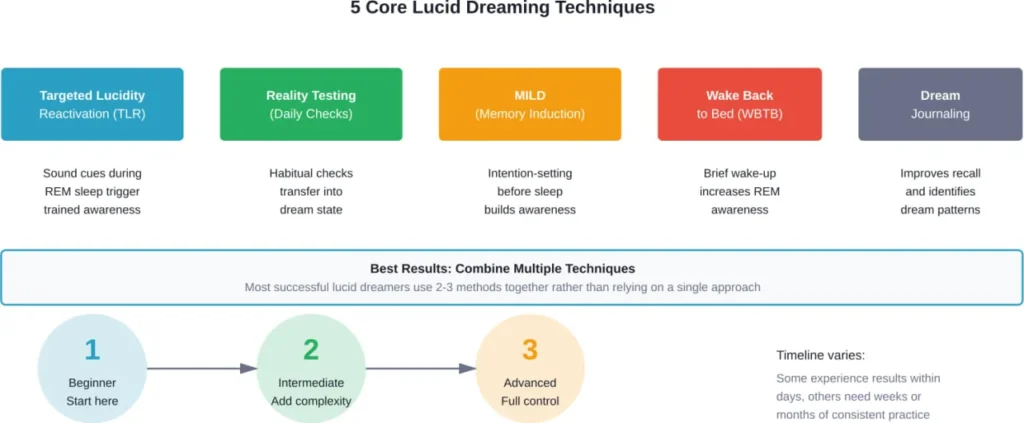
Several methods have shown effectiveness in research settings and practical applications. Not all techniques work equally well for everyone, but combining approaches tends to produce better results.
Targeted Lucidity Reactivation (TLR)
This is the method validated by Northwestern University researchers.
TLR involves training the mind before sleep while associating that training with a specific sensory cue—typically a sound. During sleep, when the person enters REM (the stage where most vivid dreaming occurs), that same sound plays. The cue triggers the trained mental state, potentially inducing lucidity.
The beauty of this method: it requires minimal equipment. A smartphone app can deliver the training protocol and administer cues based on movement patterns that suggest REM sleep.
Reality Testing
Reality testing involves regularly checking whether you’re awake or dreaming throughout the day. The habit transfers into dreams, where reality checks reveal the dream state.
Common reality tests include trying to push a finger through your palm, reading text twice to see if it changes, or checking digital clocks repeatedly. In dreams, these tests produce impossible results—fingers pass through solid palms, text morphs unpredictably, clocks show nonsensical times.
The key is consistency. Performing these checks dozens of times daily makes them automatic enough to occur spontaneously during dreams.
Mnemonic Induction of Lucid Dreams (MILD)
MILD focuses on intention-setting and memory training. Before sleep, practitioners repeatedly affirm their intention to recognize they’re dreaming. They visualize themselves becoming lucid in a recent dream and imagine what they would have done differently.
This technique leverages prospective memory—remembering to do something in the future. In this case, remembering to recognize dream signs while dreaming.
Wake Back to Bed (WBTB)
WBTB involves waking after approximately five hours of sleep, staying awake briefly, then returning to sleep with the intention of lucid dreaming.
This works because it increases the chances of entering REM sleep directly while maintaining some conscious awareness. The timing capitalizes on the sleep cycle—REM periods become longer and more frequent in the second half of the night.
Real talk: this method disrupts sleep, so it’s not ideal for nightly practice. Most practitioners use it occasionally when they specifically want to attempt lucid dreaming.
Dream Journaling
Keeping detailed dream journals serves multiple purposes. It improves dream recall, helps identify personal dream signs (recurring themes or elements that signal dreaming), and strengthens the connection between waking consciousness and dream content.
The practice involves writing down everything remembered immediately upon waking. Over time, patterns emerge that can trigger lucidity when they appear in future dreams.
Benefits of Dream Control
Why would someone want to control their dreams beyond novelty or entertainment?
Turns out, lucid dreaming offers several practical applications backed by research.
Nightmare Treatment
For people suffering from recurring nightmares—particularly those with PTSD—lucid dreaming provides a way to confront and transform frightening dream content.
When dreamers realize they’re dreaming during a nightmare, they can choose to change the scenario, face the threat with awareness of its unreality, or simply wake themselves up. This sense of agency reduces the psychological impact of nightmare content.
Research published by Northwestern University explores the therapeutic potential of lucid dreaming for nightmare disorders associated with conditions like narcolepsy. The ability to recognize and alter nightmare scenarios shows promise as a complementary treatment approach.
Skill Rehearsal and Motor Learning
Athletes and performers have explored lucid dreaming as a mental rehearsal tool.
The brain activates similar neural pathways during imagined movements as during actual physical practice. Lucid dreams provide an immersive environment for this mental rehearsal without the physical limitations of the waking world.
While research on skill improvement through lucid dreaming remains limited, anecdotal reports from athletes and musicians suggest potential benefits for technique refinement and performance anxiety reduction.
Creative Problem-Solving
The dream state offers unique cognitive conditions—reduced logical constraints, heightened associative thinking, and access to unconscious mental content.
Lucid dreamers can deliberately pose problems or questions before sleep, then explore potential solutions within the dream environment. The reduced prefrontal censorship during sleep may allow novel connections that wouldn’t occur during waking thought.
Historical anecdotes describe scientific breakthroughs and artistic inspirations emerging from dreams. Lucid dreaming potentially makes this process more intentional and directed.
Psychological Insight
Dreams reflect unconscious mental processes, concerns, and patterns. Lucid dreaming allows conscious exploration of this normally hidden content.
Some practitioners use lucid dreams to dialogue with dream characters representing aspects of themselves, explore recurring dream themes, or gain perspective on emotional issues. While not a substitute for professional therapy, this self-exploration can complement psychological work.
Mental Health Applications
Beyond nightmare treatment, research suggests broader mental health applications.
According to a 2020 study published in Clocks & Sleep journal, questions have been raised about whether lucid dreaming interferes with sleep’s recovery function, given that REM periods with lucid dreaming show increased brain activation compared to regular REM sleep.
However, the same research indicates that for most practitioners, lucid dreaming doesn’t significantly impair the feeling of being refreshed upon waking. The increased prefrontal activation occurs within sleep rather than disrupting it.
| Benefit Area | Mechanism | Research Status |
|---|---|---|
| Nightmare Reduction | Conscious control reduces fear response and transforms threatening scenarios | Well-supported; clinical trials showing effectiveness |
| Motor Skill Practice | Mental rehearsal activates similar neural pathways as physical practice | Preliminary evidence; more research needed |
| Creative Thinking | Reduced logical constraints allow novel associations | Anecdotal support; limited controlled studies |
| Psychological Exploration | Conscious access to unconscious dream content | Theoretical framework; individual reports vary |
| Anxiety Management | Sense of control generalizes beyond dreams | Emerging research; promising initial findings |
Potential Risks and Concerns
Dream control isn’t without potential downsides.
Sleep Quality Concerns
The most significant concern involves whether lucid dreaming interferes with sleep’s restorative functions.
As noted in research from the Central Institute of Mental Health, lucid REM sleep shows increased prefrontal activation compared to regular REM sleep. This raises questions about whether the brain gets adequate rest during lucid dreams.
Current evidence suggests that occasional lucid dreaming doesn’t significantly impair sleep quality for most people. However, deliberately inducing lucid dreams multiple times per week—especially using wake-back-to-bed methods that disrupt sleep—could potentially affect overall sleep architecture.
Sleep Paralysis
Some lucid dreaming techniques, particularly those involving interrupted sleep cycles, may increase the likelihood of experiencing sleep paralysis—a state where consciousness returns before the body regains movement.
While sleep paralysis is generally harmless, it can feel frightening. The sensation of being awake but unable to move, sometimes accompanied by hallucinations, causes significant distress for some people.
Dissociation and Reality Confusion
Frequent lucid dreaming might theoretically blur boundaries between waking and sleeping states for some individuals.
However, according to research published in Frontiers in Human Neuroscience, a misconception exists regarding lucid dreaming and dream control. Being aware that one is dreaming doesn’t automatically grant the ability to control dream content. These are related but distinct phenomena.
Clinical concerns about dissociation remain largely theoretical. Most lucid dreamers maintain clear distinctions between waking reality and dream experiences.
Increased Nightmare Intensity
For some people, attempting to control dreams may initially increase nightmare frequency or intensity as they become more aware of dream content without yet having control skills.
This typically resolves as control abilities develop, but it represents a potential uncomfortable transition period.
Obsessive Practice
Like any skill, lucid dreaming can become an unhealthy preoccupation. Excessive focus on dream control may detract from waking life activities or normal sleep hygiene.
Balanced practice involves viewing lucid dreaming as an occasional tool or interest rather than a consuming obsession.
The Neuroscience of Awareness During Sleep
What makes consciousness during sleep possible at all?
Research into lucid dreaming provides unique insights into the nature of consciousness itself.
According to neuroscience research from the University of Wisconsin-Madison, dreaming represents a remarkable natural experiment where the brain, disconnected from environmental input, generates entire worlds of conscious experience. Lucid dreaming adds another layer—self-awareness within that generated reality.
Brain imaging studies reveal that lucid dreaming activates regions typically associated with metacognition—thinking about thinking. The dorsolateral prefrontal cortex, which remains relatively quiet during normal REM sleep, shows increased activity during lucid dreams.
This creates what researchers describe as a hybrid state: the vivid imagery and emotional intensity of dreaming combined with the self-reflective awareness of waking consciousness.
EEG Signatures of Lucidity
Studies measuring brain wave patterns during sleep identified specific markers of lucid dreaming.
Research published in Sleep journal found that lucid dreaming correlates with increased gamma-band frequency activity (25-40 Hz) in frontal areas. This high-frequency activity suggests heightened cognitive processing occurring within the dream state.
The EEG patterns during lucid dreaming don’t simply mirror waking consciousness. Rather, they show a unique combination of features from both waking and dreaming states—supporting the concept of lucid dreaming as a distinct state of consciousness.
Development Across the Lifespan
Interestingly, lucid dreaming appears to develop with age.
According to research from the University of Wisconsin, children under the age of 7 reported dreaming only 20% of the time when awakened from REM sleep, compared with 80-90% in adults. Preschoolers’ dreams, when they occur, tend to be simpler and less vivid than adult dreams.
Lucid dreaming follows a similar developmental trajectory, becoming more common as metacognitive abilities mature. This supports the connection between self-awareness capabilities and the ability to recognize the dream state.
Current Research and Future Directions
The field of lucid dreaming research is experiencing renewed interest.
As of 2024, Northwestern University researchers successfully demonstrated that targeted lucidity reactivation can work through consumer technology—specifically smartphone apps. This makes lucid dreaming research more accessible and enables larger-scale studies than previous laboratory-based approaches.
MIT Media Lab’s Dormio project represents another innovative direction. This research explores interfaces for interacting with dreams, investigating how technology might enhance or guide dream content during the transitional state between waking and sleeping.
Researchers at institutions including Johns Hopkins University are examining dreams more broadly, investigating their psychological functions and how dream content relates to waking life experiences and mental health.
Therapeutic Applications Under Investigation
Clinical researchers are exploring lucid dreaming for several therapeutic purposes:
- PTSD treatment through nightmare reprocessing and desensitization
- Anxiety reduction by building sense of control and self-efficacy
- Depression management through positive dream experiences
- Phobia treatment through graduated exposure in safe dream environments
- Grief processing by facilitating positive interactions with deceased loved ones
These applications remain investigational. While preliminary results show promise, larger controlled studies are needed before lucid dreaming becomes standard clinical practice for these conditions.
Methodological Challenges
Dream research faces inherent difficulties.
According to a 2026 narrative review published in Annals of Medicine and Surgery, methodological hurdles include reliance on subjective self-reports prone to recall biases, and small sample sizes often involving self-selected lucid dreamers. These limitations restrict generalizability.
The subjective nature of dream experiences means researchers must depend primarily on participants’ reports rather than purely objective measurements. While physiological markers like eye movements and EEG patterns provide corroboration, they don’t capture the qualitative aspects of dream experiences.
Future research will likely combine improved wearable technology for home sleep monitoring with larger participant pools and more sophisticated analysis of dream reports.
Practical Considerations for Beginners
For those interested in exploring dream control, what’s the best approach?
Set Realistic Expectations
Lucid dreaming is a skill. Like learning any skill, it requires practice and patience.
Some people experience lucid dreams quickly—within days or weeks of starting practice. Others need months of consistent effort. Natural aptitude varies considerably.
Initial lucid dreams often last only seconds before excitement causes awakening or lucidity fades back into regular dreaming. Control develops gradually. Early lucid dreams might involve simply recognizing the dream state without any ability to manipulate content.
Start with Dream Recall
Improving dream recall creates the foundation for lucid dreaming practice.
Keeping a detailed dream journal upon waking strengthens the connection between waking consciousness and dream experiences. Even partial fragments written immediately upon waking help build this skill.
Better recall makes it easier to identify personal dream signs—recurring elements that can trigger lucidity in future dreams.
Choose Sustainable Techniques
Methods that disrupt sleep aren’t suitable for daily practice.
Reality testing and dream journaling can be incorporated into daily routines without affecting sleep. These represent good starting points.
Reserve wake-back-to-bed and similar intensive techniques for occasional use—perhaps weekends or days when sleep disruption won’t affect important activities.
Prioritize Sleep Health
Healthy sleep should always take priority over lucid dreaming practice.
Basic sleep hygiene—consistent schedules, appropriate sleep duration, comfortable sleep environments—forms the foundation for any dream work. Sacrificing sleep quality in pursuit of lucid dreams defeats the purpose.
Consider Apps and Tools
As Northwestern University’s research demonstrates, smartphone apps can effectively deliver targeted lucidity reactivation protocols.
Various consumer sleep tracking devices and lucid dreaming apps now exist. While quality varies, these tools can provide structure for beginners and automated delivery of techniques like sleep-stage-dependent sound cues.
Approach such tools with realistic expectations. They facilitate practice but don’t guarantee results.
Join Communities
Online communities dedicated to lucid dreaming provide support, technique sharing, and motivation.
Community discussions, while anecdotal rather than scientific, offer practical insights from experienced practitioners. Learning what works for others can inspire personal experimentation with different approaches.
However, maintain critical thinking. Not all advice in online forums is evidence-based or safe. Cross-reference suggestions with research when possible.
Beyond Control: The Nature of Dreams
Focusing solely on control can obscure the broader question: why do humans dream at all?
According to research published in Trends in Cognitive Sciences, dreams show that the brain, disconnected from the environment, can generate entire worlds of conscious experience by itself. This represents one of the most remarkable phenomena in psychology and neuroscience.
Multiple theories attempt to explain dream function:
- Memory consolidation and processing of emotional experiences
- Threat simulation and rehearsal of challenging scenarios
- Random neural activation that consciousness tries to interpret
- Maintenance of neural networks during reduced external input
- Integration of new information with existing knowledge structures
None of these theories completely explains all aspects of dreaming. The phenomenon likely serves multiple functions.
Lucid dreaming offers a unique perspective on this question. The ability to observe dream generation processes while they occur—from within—provides insights impossible to obtain through external measurement alone.
Misconceptions About Dream Control
Several common misunderstandings deserve clarification.
Lucidity Doesn’t Equal Control
Research published in Frontiers in Human Neuroscience emphasizes that being aware of dreaming doesn’t automatically grant control over dream content.
These are related but distinct capabilities. Lucidity refers to metacognitive awareness—recognizing the dream state. Control involves actually manipulating dream elements.
Many lucid dreams involve awareness without control. The dreamer knows they’re dreaming but can’t change what happens. With practice, control abilities often develop, but they’re not inherent to lucidity itself.
It’s Not Like the Movie Inception
Popular culture presentations of lucid dreaming—particularly films like Inception—exaggerate the level of control possible.
Real lucid dreamers rarely construct elaborate stable environments from scratch or manipulate physics with precision. Dream environments tend to shift unpredictably. Control usually manifests as influencing direction rather than total authorship.
The movie’s concept of entering others’ dreams is pure fiction. Lucid dreaming is an individual internal experience.
It Doesn’t Require Special Gifts
While natural aptitude varies, lucid dreaming isn’t a mystical ability reserved for special individuals.
The phenomenon has a neurobiological basis. Anyone with normal cognitive function can potentially develop lucid dreaming skills through appropriate practice, though success rates and ease of learning differ.
It’s Not Dangerous for Most People
Concerns about lucid dreaming interfering with sleep quality or causing psychological harm are largely overstated for typical practitioners.
People with certain sleep disorders, severe mental health conditions, or difficulty distinguishing reality from imagination should approach lucid dreaming cautiously and consult healthcare providers. For most individuals, occasional lucid dreaming poses no significant risks.
| Myth | Reality |
|---|---|
| Lucid dreaming means total dream control | Awareness and control are separate; control develops gradually with practice |
| Anyone can instantly learn it | It’s a skill requiring practice; natural aptitude varies considerably |
| It always disrupts sleep quality | Occasional lucid dreams typically don’t impair rest; excessive practice might |
| It’s the same as astral projection | Lucid dreaming is a sleep phenomenon with neurological basis; astral projection lacks scientific evidence |
| You can get stuck in a lucid dream | All dreams end naturally; lucid dreams are no exception |
| It requires expensive equipment | Basic techniques require only commitment and practice; apps are optional aids |
Frequently Asked Questions
Yes. Lucid dreaming has been validated through multiple scientific methods since the 1970s. Researchers use EEG recordings, eye movement tracking, and fMRI imaging to verify lucid dream states. Studies show distinct patterns of brain activity during lucid dreams compared to regular dreams or waking states. The phenomenon is documented in peer-reviewed journals and accepted by mainstream neuroscience.
The timeline varies considerably. Some people experience their first lucid dream within days or weeks of starting practice. Others require months of consistent effort. Northwestern University research showed 17% of participants achieved lucid dreams on their first attempt with targeted training, increasing to 42% by the second session. Individual factors like natural dream recall, metacognitive abilities, and practice consistency affect learning speed.
For most people, occasional lucid dreaming poses no significant risks. Potential concerns include temporary sleep quality disruption if using intensive induction techniques, increased likelihood of sleep paralysis, and rare cases of reality confusion in vulnerable individuals. People with severe mental health conditions or certain sleep disorders should consult healthcare providers before pursuing lucid dreaming. Balanced, occasional practice appears safe for typical individuals.
No special equipment is required. Basic techniques like reality testing, dream journaling, and MILD require only commitment and practice. However, technology can facilitate learning. Northwestern University validated smartphone apps that deliver targeted lucidity reactivation protocols. Sleep tracking devices and specialized lucid dreaming masks offer optional aids but aren’t necessary for success.
Control in lucid dreams varies widely between individuals and even between different lucid dreams for the same person. Most lucid dreamers influence rather than completely control their dreams. The dream environment often shifts unpredictably regardless of intention. With practice, control abilities generally improve, but total dream authorship like fictional portrayals is uncommon. Even experienced lucid dreamers face limitations on what they can manipulate.
Research suggests lucid dreaming can help manage nightmares, particularly for people with PTSD. Recognizing the dream state during a nightmare allows the dreamer to change scenarios, confront threats with awareness of their unreality, or wake themselves intentionally. This sense of agency reduces psychological impact. Studies exploring therapeutic applications show promise, though lucid dreaming should complement rather than replace professional treatment for nightmare disorders.
Yes, everyone with normal brain function dreams multiple times each night during REM sleep cycles. However, dream recall varies dramatically. Many people don’t remember their dreams, creating the impression they don’t dream at all. Adults typically experience dreams during 80-90% of REM awakenings, but most dreams are forgotten within minutes unless actively recalled and recorded upon waking.
Taking the Next Step
Dream control through lucid dreaming represents a fascinating intersection of neuroscience, psychology, and personal development.
The phenomenon is real, measurable, and learnable. Research continues revealing how consciousness operates during sleep and how awareness can emerge within dreams.
For those interested in exploring lucid dreaming, start with foundational practices. Keep a dream journal. Practice reality checks throughout the day. Set intentions before sleep. Be patient with the learning process.
Consider what applications interest you most. Nightmare reduction? Creative exploration? Simple curiosity about consciousness? Skill rehearsal? Let those motivations guide practice choices.
Remember that sleep health comes first. Lucid dreaming should enhance life rather than disrupt it. If practices interfere with rest or wellbeing, adjust the approach.
The science of dream control continues evolving. New techniques, applications, and insights emerge regularly. Staying informed through reputable sources helps separate evidence-based methods from unsubstantiated claims.
Whether pursuing lucid dreaming for therapeutic benefits, creative inspiration, psychological insight, or simple fascination with consciousness, the journey offers unique perspectives on the remarkable capabilities of the sleeping mind.
The question isn’t whether controlling dreams is possible—research confirms it is. The real question is what someone might discover within their own dreamscapes when awareness illuminates the sleeping world.