

Quick Summary: While boredom itself won’t directly kill you, research from University College London and other institutions suggests chronic boredom correlates with increased mortality risk. The danger isn’t the emotion—it’s the unhealthy behaviors and lifestyle patterns that often accompany long-term boredom, including social isolation, poor health choices, and in severe cases, links to mental health crises.
The phrase “I’m so bored I could die” gets tossed around casually. But could there actually be truth behind it?
Research published in the International Journal of Epidemiology examined whether boredom itself poses a genuine mortality risk. The findings might surprise you—though not in the way you’d expect.
The Short Answer: Boredom Won’t Kill You Directly
Boredom is a mental state, not a disease. According to research published in the Canadian Medical Association Journal, loneliness is an emotional state of perceived social isolation—separate from classified mental disorders like anxiety or depression.
One boring day won’t harm you. Even a boring week won’t put your life at risk.
The issue emerges with chronic, long-term boredom. That’s where the science gets interesting—and concerning.
What Research Reveals About Boredom and Mortality
Experts Annie Britton and Martin Shipley from University College London examined the relationship between boredom and early death. Their research, published in 2010, found a correlation—but with critical nuances.
Boredom alone isn’t lethal. But the lifestyle patterns and behaviors that accompany persistent boredom can be.
According to the National Institute on Aging, social isolation and loneliness in older adults create significant health risks. The connection isn’t direct causation—it’s about what happens when boredom becomes a chronic condition.
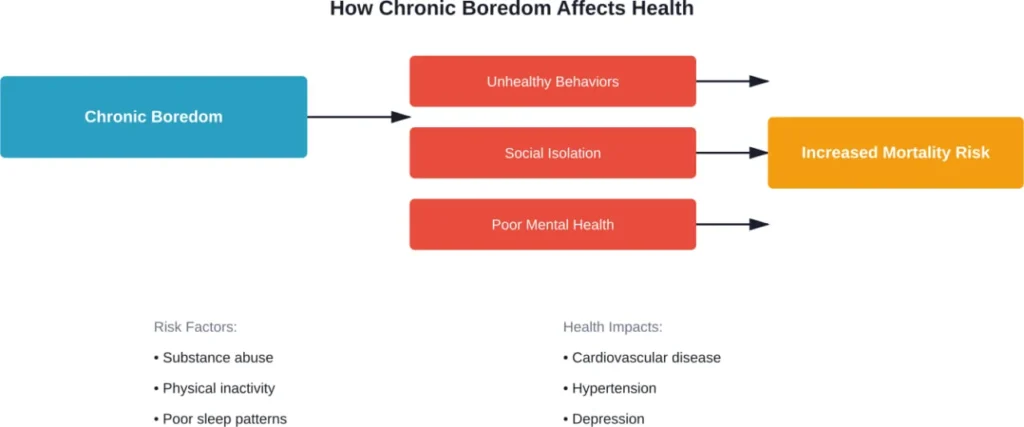
The Dangerous Behaviors That Accompany Boredom
Here’s where the risk actually materializes. Chronically bored individuals often develop patterns that genuinely threaten health:
Social Withdrawal and Isolation
Research from NIH examining loneliness and all-cause mortality found that emotional and social loneliness predicted mortality in elderly populations over a 19-year follow-up period. Living alone combined with loneliness created compounding risks.
Social isolation isn’t just unpleasant—it’s physiologically dangerous. The NIA reports that prolonged isolation affects both physical and mental health, including cognitive function.
Substance Use and Risky Behaviors
BBC Science Focus notes that boredom itself won’t kill you, but subsequent behaviors might put you at risk. Research cited in PMC literature noted that a significant percentage of participants—67% of men and 25% of women—preferred to administer electric shocks to themselves rather than experience boredom (Wilson et al., 2014).
That’s how uncomfortable the state can be. And when people seek escape from chronic boredom, they sometimes turn to harmful substances or dangerous activities.
Physical Inactivity and Poor Health Choices
Chronic boredom correlates with sedentary lifestyles. When nothing feels engaging, physical activity drops. Poor dietary choices often follow.
These aren’t trivial concerns. They’re established risk factors for cardiovascular disease, diabetes, and other conditions that genuinely shorten lifespan.
Boredom, Mental Health, and Extreme Risk
Recent research published in Frontiers in Psychiatry used artificial intelligence to examine boredom’s role in suicide behavior. The study found statistically significant associations between boredom and suicidal ideation.
| Factor | β Coefficient | P Value | Confidence Interval |
|---|---|---|---|
| Boredom | 0.1441 | 0.001 | [0.058, 0.230] |
| Wish for Something | 0.1416 | 0.001 | — |
During the COVID-19 pandemic, research published in Frontiers in Psychiatry examined psychological distress, loneliness, and boredom among the general population. The study of 961 participants in Tyrol, Austria found significant mental health challenges linked to boredom during lockdowns.
A study published in Behavioral Sciences examined adjustment disorder symptoms and boredom during COVID-19, tracking 345 participants. The research revealed how prolonged boredom during pandemic restrictions affected psychological adjustment.
Who’s Most at Risk?
Not everyone experiences boredom the same way. Certain populations face elevated risks:
- Older adults living alone, particularly those without regular social contact
- Individuals with less dopamine production or reduced dopamine receptor sensitivity
- People experiencing prolonged social isolation or quarantine
- Those with pre-existing mental health conditions
Research on loneliness in older adults published in the Canadian Medical Association Journal emphasized that loneliness is separable from other conditions but often co-occurs with depression and anxiety.
Breaking the Boredom-Risk Cycle
The good news? The connection between boredom and mortality operates through modifiable behaviors.
Maintain Social Connections
According to the National Institute on Aging, helping others through caregiving or volunteering reduces loneliness. Working for a social cause with trusted partners builds community and purpose.
Social engagement doesn’t require constant activity. Even regular phone calls or video chats provide protective benefits.
Develop Structured Routines
Structure combats the aimlessness that fuels dangerous boredom. Set regular sleep schedules, plan activities, and create daily rituals that provide rhythm and purpose.
Pursue Meaningful Engagement
The antidote to boredom isn’t constant stimulation—it’s meaningful engagement. Find activities that genuinely interest you, even if they’re simple.
Reading, puzzles, learning new skills, or creative hobbies all provide the mental stimulation that counteracts harmful boredom.
Address Underlying Issues
Sometimes chronic boredom signals depression or other mental health conditions. If persistent boredom accompanies mood changes, loss of interest in previously enjoyed activities, or thoughts of self-harm, seek professional help.
Frequently Asked Questions
No. A single boring day poses no health risk. The concerns around boredom and mortality relate exclusively to chronic, long-term boredom that persists for months or years.
Regular boredom is temporary and situational. Dangerous boredom is chronic, accompanied by social isolation, lack of purpose, and often leads to unhealthy coping behaviors like substance use or complete inactivity.
Yes. Boredom is regulated by dopamine in the brain. Some people produce less dopamine or have less sensitive dopamine receptors, making them more prone to boredom and potentially more vulnerable to its negative effects.
No, though they often overlap. Loneliness is an emotional state of perceived social isolation, while boredom is a state where nothing feels engaging or meaningful. Both pose health risks when chronic.
Research doesn’t specify an exact timeframe, but studies examining mortality risk focused on persistent patterns over months and years, not days or weeks. Chronic boredom that leads to sustained behavioral changes poses the real risk.
Simply staying busy isn’t enough—the activities need to feel meaningful. Forced busyness without purpose can actually increase stress while failing to address underlying boredom.
Boredom isn’t classified as a disease, so there’s no specific medical treatment. However, if boredom accompanies depression or other mental health conditions, treating those underlying issues often helps. Therapy, particularly cognitive behavioral approaches, can address patterns contributing to chronic boredom.
The Bottom Line
Can you die of boredom? Not directly. Boredom is a mental state, not a fatal condition.
But chronic boredom creates a cascade of behavioral and social risks that genuinely threaten health and longevity. Social isolation, unhealthy lifestyle choices, and in severe cases, mental health crises all connect to persistent boredom.
The research from University College London, the National Institutes of Health, and other institutions makes clear that the saying “bored to death” contains a kernel of truth—just not in the way most people think.
If persistent boredom is affecting quality of life, don’t dismiss it. Reach out to friends, develop new interests, establish routines, and if needed, talk to a mental health professional. Breaking the cycle of chronic boredom isn’t just about feeling better—it might actually extend your life.