

Quick Summary: Getting visible abs in 30 days is only possible for individuals already at 10-11% body fat or lower. For most people, achieving six-pack abs requires 2-6 months of dedicated training, consistent calorie deficit, and body fat reduction to below 14% for men and 17-20% for women, combined with targeted abdominal exercises.
The 30-day abs challenge floods social media with before-and-after photos that seem almost too good to be true. And here’s the thing—most of them are.
While countless fitness influencers promise shredded abs in a month, the reality depends entirely on where someone starts. For the vast majority of people, achieving visible six-pack abs in 30 days is simply not doable.
But that doesn’t mean progress is impossible. Understanding what it actually takes to reveal abdominal muscles can set realistic expectations and create a sustainable path forward.
The Body Fat Percentage Reality Check
Visible abs aren’t built in 30 days—they’re revealed. Everyone has abdominal muscles, but they remain hidden beneath subcutaneous fat until body fat drops to specific thresholds.
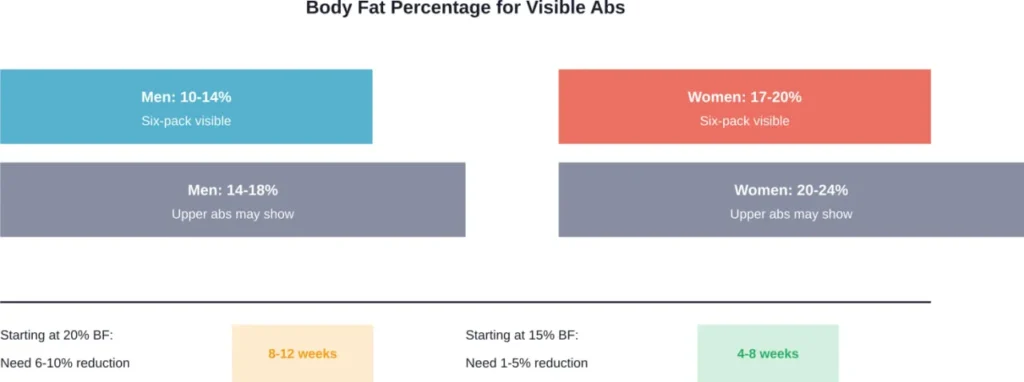
According to body composition research, men typically need to reach 10-14% body fat for visible six-pack abs, with upper abs potentially showing at slightly higher percentages. Women’s physiology requires higher essential fat levels—around 17-20% for visible abs due to higher essential fat requirements.
Here’s where the 30-day timeline becomes problematic. If someone starts at 20% body fat, they’d need to lose 6-10 percentage points in a single month. According to the CDC, healthy weight loss occurs at 1-2 pounds weekly, which translates to roughly 0.5-1% body fat reduction per week under optimal conditions.
The math simply doesn’t support dramatic transformations for most people. Someone at 15% body fat might reveal abs in 30 days. Someone at 25%? Not happening without extreme measures that compromise health.
What Actually Happens in 30 Days
So if visible abs aren’t realistic for most people in a month, what can happen?
A 12-week intensive dietary and exercise program study published in a peer-reviewed journal shows measurable changes in body composition. But 30 days represents just a quarter of that timeframe.
In four weeks of consistent training and nutrition, realistic outcomes include:
- 2-4 pounds of fat loss with proper calorie deficit
- Improved core strength and muscular endurance
- Reduced waist circumference by 1-2 inches
- Better abdominal muscle definition if already lean
- Enhanced core stability and function
A study on electrical muscle stimulation showed a 5.2±2.8 cm mean decrease in waist circumference over 12 weeks. Proportionally, 30 days might yield 1.3-1.7 cm reduction—noticeable but not transformative for most.
The key is managing expectations. Visible progress differs from visible abs. Tighter waistlines, improved posture, and measurable strength gains all occur within 30 days. But unless starting body fat is already low, the six-pack remains beneath the surface.
The Exercise Component
Training abs doesn’t burn the fat covering them. This misconception drives ineffective workout strategies focused solely on endless crunches.
Research on spot reduction and abdominal exercises indicates that targeted ab training alone does not preferentially reduce abdominal fat. Research on abdominal aerobic endurance exercise combined with core training suggests potential benefits when combined with overall calorie expenditure.
The most effective 30-day approach combines:
| Exercise Type | Frequency | Purpose |
|---|---|---|
| Core-specific training | 3-4 times weekly | Build ab muscle thickness |
| High-intensity intervals | 3-4 times weekly | Maximize calorie burn |
| Resistance training | 3-4 times weekly | Preserve muscle mass |
| Steady cardio | 2-3 times weekly | Additional calorie deficit |
According to the CDC, adults need at least 150 minutes per week of moderate-intensity aerobic activity for overall health. For weight loss and maintenance, the CDC indicates people who maintain weight loss typically engage in 60 to 90 minutes of moderate-intensity physical activity most days.
Research on exercise training intensity has found that moderate to high-intensity training can produce reductions in abdominal visceral fat. This supports incorporating challenging workouts rather than exclusively low-intensity steady cardio.
Core Exercises That Matter
Not all ab exercises deliver equal results. Movements that create spinal flexion while resisting rotation tend to activate more muscle fibers.
Effective exercises for a 30-day program include:
- Planks and side planks (anti-rotation stability)
- Dead bugs and bird dogs (coordinated core control)
- Hanging knee raises (lower ab emphasis)
- Cable crunches (progressive resistance)
- Ab wheel rollouts (full range core flexion)
- Bicycle crunches (rotation with flexion)
A study on high-intensity functional training (HIFT) examined body composition changes over 12 weeks in healthy young individuals. Scaling this to 30 days means focusing on progressive overload—adding reps, reducing rest, or increasing resistance weekly.
The Nutrition Non-Negotiable
Here’s the uncomfortable truth: abs are revealed in the kitchen far more than the gym. Exercise creates the stimulus, but nutrition controls the body fat that hides results.
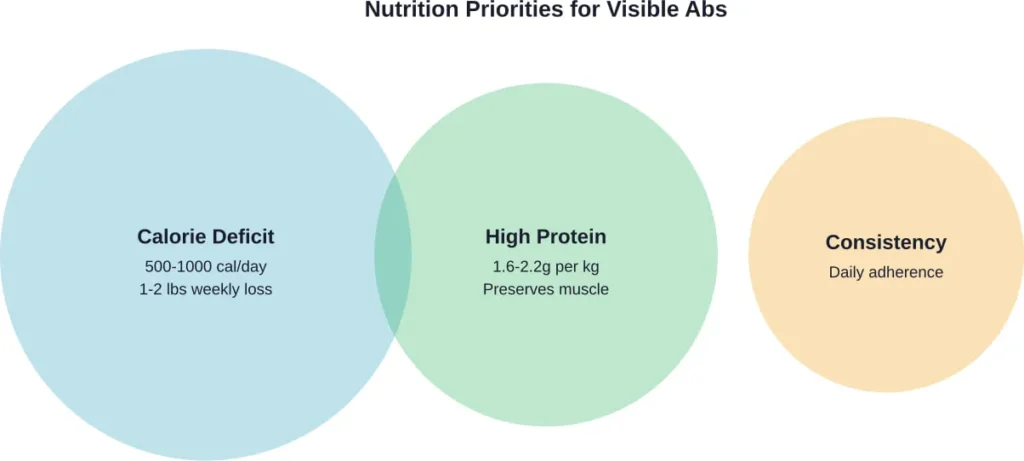
A calorie deficit of approximately 500-1000 calories daily is associated with healthy weight loss of about 1-2 pounds per week, as recommended by health authorities. For someone needing to lose 8-10 pounds to reveal abs, this represents at least 4-5 weeks of perfect adherence.
Protein becomes especially critical during calorie restriction. Research shows protein has a thermic effect of 20-30%, meaning the body burns calories digesting it. Higher protein intake (approximately 0.8-1 gram per pound of body weight, or 1.6-2.2 grams per kilogram) also preserves muscle mass during fat loss.
The CDC recommends focusing on nutrient-dense foods including vegetables, fruits, whole grains, lean proteins, and healthy fats. Processed foods, added sugars, and excessive alcohol all sabotage fat loss efforts by providing empty calories without satiety.
For a 30-day sprint toward visible abs, nutrition strategies include:
- Tracking calories and macronutrients accurately
- Eating approximately 1.6-2.2 grams of protein per kilogram of body weight (or 0.8-1 gram per pound)
- Prioritizing whole, minimally processed foods
- Limiting added sugars and refined carbohydrates
- Staying hydrated with 0.5-1 ounce of water per pound body weight
- Getting adequate sleep (7-9 hours) to support recovery and hormones
Who Can Actually Get Abs in 30 Days?
Only a narrow subset of people can realistically achieve visible six-pack abs within a month. Candidates typically share specific characteristics:
| Starting Condition | 30-Day Outcome | Realistic? |
|---|---|---|
| 10-12% body fat (men) | Full six-pack visible | Yes, with dedication |
| 18-20% body fat (women) | Upper abs visible | Possibly |
| 15-18% body fat (men) | Upper abs showing | Possibly |
| 20%+ body fat (men) | Some definition | Abs not visible |
| 25%+ body fat (women) | Improved tone | Abs not visible |
Athletes already lean from regular training might sharpen definition in 30 days. Someone who recently had visible abs but took a few months off might reveal them again quickly. But the average person starting a fitness journey from scratch? Two to six months represents a more honest timeline.
The Bigger Picture Beyond 30 Days
Fixating on 30-day transformations misses the fundamental principle: sustainable fat loss requires sustainable habits. According to CDC guidance on weight maintenance, people who successfully maintain weight loss typically continue physical activity, maintain consistent eating patterns, monitor their progress, and manage stress.
Crash approaches that might work for 30 days—extreme calorie restriction, excessive cardio, minimal rest—inevitably backfire. Metabolism adapts, energy plummets, and the body defends against further fat loss.
A more effective framework extends the timeline but produces lasting results. Twelve weeks (not four) of consistent 500-calorie daily deficits, progressive strength training, and adequate recovery will transform body composition far more effectively than any month-long extreme protocol.
Sustainable approaches to fat loss emphasize gradual progression, adequate recovery, and behavior change rather than rapid results.
Setting Realistic Expectations
The fitness industry profits from urgency. But physiology doesn’t respect marketing timelines.
For someone starting at 20% body fat, a realistic progression looks like:
- Week 4: 2-4 pounds lost, waist circumference down 1 inch, improved core strength
- Week 8: 6-10 pounds lost, noticeable reduction in abdominal fat, upper abs may start showing
- Week 12: 12-16 pounds lost, clear ab definition for most, continued strength gains
That’s not as sexy as “30 days to shredded abs.” But it’s achievable, sustainable, and won’t wreck hormones or metabolism in the process.

Frequently Asked Questions
Only if body fat is already low enough (under 14% for men, under 20% for women). Building ab muscle through training improves definition, but visible abs require fat loss for most people. Genetics also play a role—some individuals store less abdominal fat and show abs at slightly higher body fat percentages.
No. Research confirms that spot reduction through targeted exercises doesn’t work. Ab exercises build muscle and strength, but body fat is lost systemically through calorie deficit. The combination of resistance training, cardiovascular exercise, and proper nutrition creates the deficit needed for fat loss across the entire body.
Three to four times weekly provides sufficient stimulus without overtraining. Abs recover faster than larger muscle groups, but they still need rest. Quality matters more than quantity—focused, progressive sessions beat daily high-rep burnouts. Research on training frequency suggests adequate recovery between sessions maximizes strength and hypertrophy adaptations.
Men typically need 10-14% body fat for a visible six-pack, with 12% being the sweet spot. Women need 17-20% due to higher essential fat requirements. Upper abs appear first at slightly higher percentages, while lower abs require the leanest condition. Individual genetics affect these numbers by 2-3 percentage points in either direction.
Rapid fat loss above 2 pounds weekly risks muscle loss, metabolic slowdown, hormonal disruption, and nutritional deficiencies. The CDC recommends 1-2 pounds weekly as safe and sustainable. Extreme approaches might produce short-term results but often lead to rebound weight gain and potential health complications.
Theoretically yes, if diet creates sufficient calorie deficit. But research shows cardiovascular exercise enhances fat loss, improves metabolic health, and helps maintain lean muscle mass. The combination of resistance training and cardio produces better body composition changes than either alone.
Fat distribution patterns. Most people lose subcutaneous fat from the upper abdomen first, with lower abs and obliques being the last areas to lean out. This requires reaching the lowest body fat percentages—typically 10-12% for men and 17-19% for women. Genetics determine individual fat storage patterns, making lower abs the final frontier for nearly everyone.
The Bottom Line
Can someone get abs in a month? For the vast majority—no. But that’s not a reason for discouragement.
Thirty days of dedicated training and nutrition creates meaningful progress: fat loss, strength gains, improved definition, and established habits. Those foundations set up the next 30 days, and the 30 after that.
The real question isn’t whether abs appear in four weeks. It’s whether someone commits to the process regardless of timeline. Because whether it takes one month, three months, or six months, consistency always wins.
Stop chasing marketing promises. Start tracking body fat percentage. Commit to a modest calorie deficit. Train with progressive intensity. Prioritize protein and sleep. Then measure progress in weeks and months, not days.
The abs will come. Just probably not by day 30.