

Quick Summary: Working two full-time jobs is legally possible in most cases, as federal labor laws don’t prohibit multiple employment. However, success depends on managing employer agreements, avoiding conflicts of interest, and maintaining productivity without exceeding safe working hours. According to Bureau of Labor Statistics data from 2024-2025, approximately 8-9 million Americans hold multiple jobs, though most combine full-time and part-time work rather than two full-time positions.
Working two full-time jobs used to be a virtual impossibility, particularly before widespread remote work adoption. Commuting between physical locations, clocking in and out, and fitting 80+ hours into a week left little room for anything else.
But remote work changed everything.
Now, the question isn’t whether it’s physically possible—it’s whether it’s legal, sustainable, and worth the tradeoff. The answer? It’s complicated.
Is Working Two Full-Time Jobs Legal?
Here’s the thing: federal labor law doesn’t prohibit holding multiple jobs. According to the U.S. Department of Labor’s Fair Labor Standards Act (FLSA), covered nonexempt workers must receive at least the minimum wage of not less than $7.25 per hour and overtime pay of not less than one and one-half times their regular rates of pay for hours worked beyond 40 per week. But the FLSA doesn’t restrict how many employers can hire the same person.
That said, legality and permission are different things.
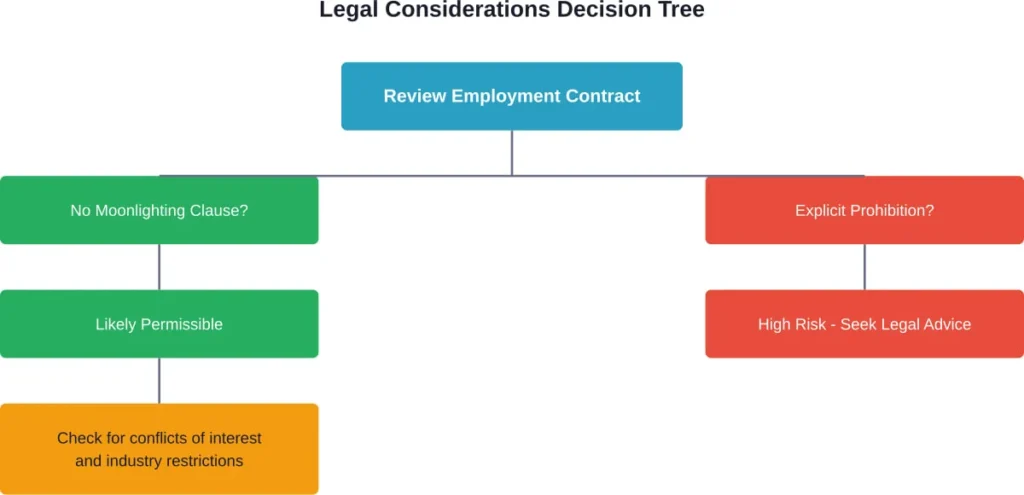
Most employment contracts include clauses about conflicts of interest, moonlighting policies, and intellectual property rights. Some employers explicitly prohibit outside employment. Others require disclosure and approval before taking a second job.
What the Law Actually Says
The Department of Labor confirms that employers must keep records on wages and hours worked, and employees must receive at least one and one-half times their regular rate for overtime hours. However, this applies per employer—not across multiple jobs.
If someone works 40 hours for Employer A and 40 hours for Employer B, neither employer owes overtime unless the employee exceeds 40 hours for that specific company in a given week.
Rest periods of short duration, usually 20 minutes or less, are customarily paid for as working time under FLSA guidelines. But managing break schedules across two jobs? That’s where things get messy.
Employment Contract Restrictions
Many contracts include non-compete clauses, confidentiality agreements, or explicit moonlighting prohibitions. Violating these terms can lead to termination—and potentially legal action.
Before taking a second full-time role, review:
- Employment agreements for both positions
- Company handbooks and policy manuals
- Non-disclosure and intellectual property clauses
- Industry-specific regulations (healthcare, finance, and government sectors often have stricter rules)
How Many People Actually Do This?
According to Bureau of Labor Statistics data from 2024-2025, approximately 8-9 million Americans held multiple jobs. However, the vast majority combined full-time and part-time work rather than two full-time positions.
The multiple jobholder rate has fluctuated in recent years, with various demographic groups showing different patterns. Community discussions suggest the trend of working two remote full-time jobs simultaneously has grown since 2020, though exact figures remain difficult to track.
Why the increase? Remote work eliminated commute time and physical location requirements. Someone can theoretically attend meetings for Job A in the morning and Job B in the afternoon—all from the same home office.
The Real Benefits of Dual Employment
Beyond the obvious financial boost, working two full-time jobs offers several advantages.
Financial Security and Income Diversification
Two paychecks mean two sources of income. If one employer faces layoffs or budget cuts, the other job provides a safety net. This diversification reduces financial vulnerability during economic uncertainty.
According to a study published by the Society of Human Resource Management (SHRM) and Handshake, 69% of students and recent college graduates said job security was a priority—a concern that dual employment partially addresses.
Skill Development and Career Flexibility
Different roles build different skill sets. Someone might maintain a stable corporate position while pursuing entrepreneurial work on the side. Or combine technical work with creative projects.
This career diversification creates options. Not locked into a single industry or role, dual employment workers can pivot more easily when opportunities arise.
Benefits Stacking
Two employers often mean access to two benefits packages. While healthcare typically requires choosing one primary plan, other perks—retirement matching, professional development stipends, wellness programs—can sometimes be utilized from both positions.
| Benefit Category | Single Job | Two Jobs |
|---|---|---|
| Income Potential | $60,000-$120,000 | $120,000-$240,000 |
| Job Security | Single point of failure | Diversified risk |
| Skill Development | Limited to one role | Multiple skill tracks |
| Benefits Access | One package | Potential for dual perks |
| Career Flexibility | Moderate | High |
The Downsides Nobody Talks About
But here’s where things get real.
Burnout and Mental Health Impacts
Research from the National Institutes of Health indicates that job burnout leads to serious consequences for individuals and organizations. A study on work-family conflict found that longer working hours directly correlated with sleep disturbance and burnout.
The odds ratios of the direct effects of long working hours on sleep disturbance were 1.64 (95% CI 1.39–1.95) for 49–54 h/week and 1.66 (95% CI 1.37–2.01) for ≥55 h/week. Working two full-time jobs easily pushes hours into this high-risk category.
OSHA warns that decreased alertness from worker fatigue contributed to major industrial disasters, including the 2005 Texas City BP refinery explosion and the Chernobyl nuclear accident. While office workers face different risks than industrial employees, the cognitive impairment from sustained overwork remains dangerous.
Physical Health Consequences
Research on occupational fatigue shows that extended work hours negatively impact well-being. One study found that multitasking—common when juggling two jobs—increases job stress, which in turn reduces workplace wellbeing.
Fatigue also correlates with work productivity loss and health-related job loss, particularly for workers aged 50-64.
Relationship and Personal Life Strain
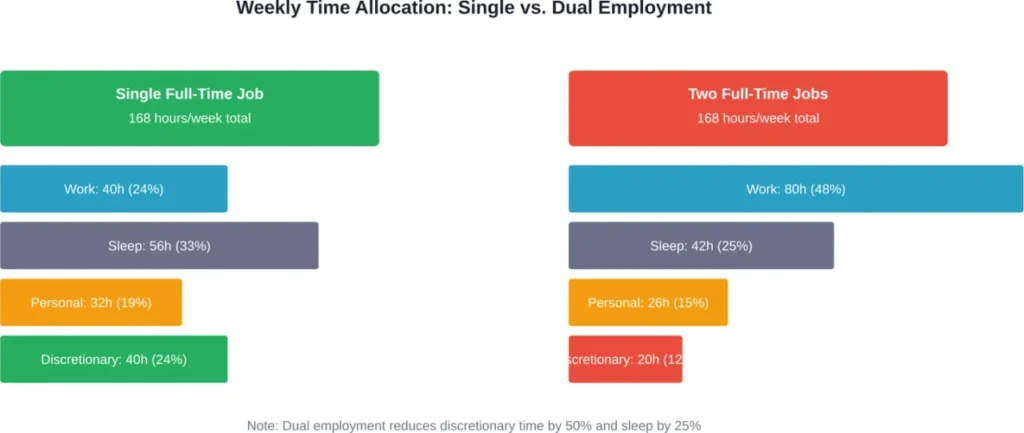
Eighty hours of work per week leaves little time for family, friends, or personal projects. Community discussions frequently mention anxiety about maintaining relationships while managing dual employment.
Work-family conflict mediates the relationship between long working hours and mental health outcomes. The more hours worked, the stronger both direct and indirect negative effects on sleep and burnout.
Practical Strategies for Managing Two Jobs
If the benefits outweigh the risks, here’s how to make it work.
Set Clear Boundaries
Dedicate specific hours to each employer. Block calendars to prevent meeting conflicts. Use separate devices or browser profiles for each job to maintain clear separation.
Establish non-negotiable personal time. Without protected hours for sleep, meals, and relationships, burnout becomes inevitable.
Prioritize Communication
Be transparent with both employers about availability—without necessarily disclosing the second job unless required. Set realistic expectations about response times and project deadlines.
Community discussions emphasize that honesty about capacity prevents overpromising and underdelivering.
Optimize for Remote Work
Two remote positions offer the most flexibility. Eliminating commute time reclaims 5-15 hours weekly. Choose roles with asynchronous communication cultures when possible.
Look for positions with flexible schedules, minimal mandatory meeting times, and results-oriented performance metrics.
Monitor Your Health
Track sleep quality, stress levels, and physical symptoms. Research consistently links extended work hours with health problems—don’t ignore warning signs.
Schedule regular check-ins with yourself. If productivity drops, relationships suffer, or health declines, reassess whether dual employment remains sustainable.
Have an Exit Strategy
Know which job stays if one must go. Define financial goals and timelines. Many people pursue dual employment temporarily—to pay off debt, build savings, or launch a side business.
As noted in industry reports, with persistence and an open mind, these situations can have happy endings—but they require clear objectives and realistic planning.
When Is This Actually Worth It?
Working two full-time jobs makes sense in specific scenarios:
- Short-term financial goals (debt elimination, home down payment)
- Career transition periods (maintaining stability while building new skills)
- Testing entrepreneurial ventures while keeping steady income
- Industries with seasonal or project-based work that naturally separates
It’s less viable for:
- Parents with young children requiring significant care time
- Jobs requiring on-call availability or unpredictable hours
- Roles with strict non-compete agreements or conflict-of-interest concerns
- Careers where reduced sleep impairs safety or decision-making
| Factor | High Feasibility | Low Feasibility |
|---|---|---|
| Work Location | Both remote | Either requires office presence |
| Schedule Flexibility | Asynchronous, flexible hours | Fixed schedules, mandatory meetings |
| Industry Overlap | Different industries | Direct competitors |
| Contract Terms | No moonlighting clauses | Explicit prohibitions |
| Personal Obligations | Minimal caregiving duties | Dependent care responsibilities |
| Health Status | Good physical/mental health | Pre-existing health concerns |
Alternatives to Consider
Before committing to dual full-time employment, explore other options:
Negotiate a raise at your current job. The energy required to manage two roles might be better spent advancing within one organization.
Pursue freelance or consulting work. Project-based income offers flexibility without the commitment of a second full-time position.
Develop passive income streams. Investments, rental properties, or digital products generate revenue without hourly time commitments.
Consider a single higher-paying role. Switching to a better-compensated position might achieve financial goals without doubling workload.
Frequently Asked Questions
In most U.S. states with at-will employment, employers can terminate employees for nearly any legal reason, including holding a second job. However, termination risk depends on employment contracts, company policies, and whether the second job creates conflicts of interest. Review employment agreements and company handbooks before accepting dual employment.
Disclosure requirements vary by contract and company policy. Some employers require written notification and approval for outside employment. Others prohibit secondary work entirely. Even without explicit requirements, undisclosed conflicts of interest can lead to termination. Always review employment agreements before accepting additional work.
Each employer withholds taxes based only on that job’s income, potentially under-withholding overall. This can result in tax bills at year-end. Consider adjusting W-4 withholdings or making quarterly estimated tax payments. Consult a tax professional to avoid surprises and ensure compliance with IRS requirements.
Research consistently shows that working 80 hours weekly increases risks of burnout, sleep disturbance, and health problems. Studies indicate that working 49+ hours per week significantly elevates odds of sleep issues and mental health impacts. While short-term dual employment may be manageable, most people cannot sustain this schedule indefinitely without health consequences.
Remote-first industries with flexible schedules and asynchronous communication work best. Technology, writing, design, consulting, and administrative roles often offer the flexibility needed. Avoid industries with on-call requirements, strict scheduling, or regulatory restrictions on outside employment such as healthcare, finance, or government positions.
Block calendars proactively to prevent scheduling conflicts. When conflicts arise, prioritize based on job importance and meeting criticality. Record meetings when possible for later review. Some people maintain separate devices for each job, muting one during the other’s meetings—though this risks divided attention and reduced performance.
Generally, unemployment benefits are based on earnings from the job lost. If one full-time position ends but another continues, benefits may be reduced or denied because employment continues. State unemployment offices evaluate each situation individually based on earnings, hours, and circumstances of job loss.
The Bottom Line
Working two full-time jobs is possible—but that doesn’t mean it’s right for everyone.
Federal law doesn’t prohibit dual employment, but employment contracts might. The financial benefits can be substantial, but the health and relationship costs are real. Success requires careful planning, strict boundaries, and honest assessment of personal capacity.
According to Bureau of Labor Statistics data, millions of Americans hold multiple jobs, though most combine full-time and part-time work rather than two full-time positions. The rise of remote work has made dual full-time employment more feasible than ever before—but feasibility and sustainability are different things.
Before taking on a second full-time role, review employment contracts, assess health capacity, and define clear goals. Know what success looks like and when to walk away.
Ready to explore dual employment? Start by auditing current commitments, researching employment contract restrictions, and identifying roles with compatible schedules. The opportunity exists—but only careful planning determines whether it’s worth pursuing.