
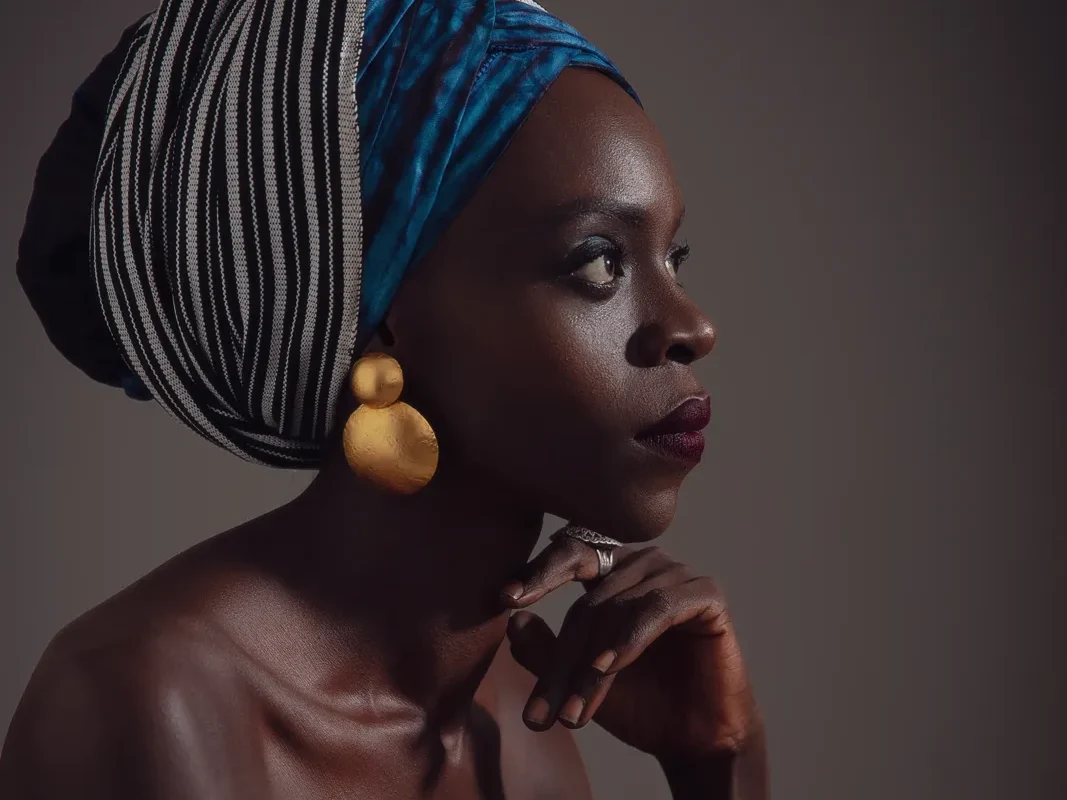
Luxury is usually measured by what can be added to it. Eliane Sarr, CEO and Creative Director of Savanna, judges it by what refuses to be lost. She makes clothes out of memory and material and rejects fashion’s habit of wiping the slate clean. Her work starts beyond the fabric itself — with the hands that wove it, the cultures that formed it and the stories that a fast-moving industry would rather discard. At Savanna, preserving things isn’t nostalgia. It is a radical way of building a business.
Lara Palmer: You call Back to Roots II a collection that pays tribute to heritage while committing to responsible design. Thinking back to growing up in Dakar, what in that world of colours and culture still shapes your work in ways you are only recognising now?
Eliane Sarr: Dakar lives in my work in ways I didn’t grasp when I was younger. What I remember is colour, texture, movement — and above all how personally people dressed. Clothes and identity were bound together: a fabric was never only a fabric, it spoke of an occasion, a status, a memory, a culture. Being surrounded by that gave me an instinctive love of textiles and handwork that never left. Now, when I choose a traditional cloth or an unexpected pairing of colour and texture, I often realise I am going back to those first images. Back to Roots II is about exactly that kind of return — not copying the past, but letting what made me grow into something of today.
L. P.: Savanna stands on four pillars — Consciousness, Upcycling, Community and Culture. Did they emerge slowly, or did you have a moment of revelation?
E. S.: Slowly, definitely — though there were moments when everything suddenly fell into place. At the beginning I was simply in love with beautiful textiles and wanted to make clothes with personality and a story. The more I travelled, collected cloth and got to know the people who made it, the more I felt the responsibility that comes with fashion. I began asking: who made this, where did it come from, what happens to the leftovers, and how do I create beauty without adding needless waste? Those questions became the brand’s foundations. The four pillars describe how I want to live and work — curiously, respectfully, consciously, and with deep regard for people and their cultures.
L. P.: Every design of yours starts with the fabric, which you allow to lead. What changes when a textile carries centuries of West African or Central Asian tradition? What does it tell you that a history book can’t?
E. S.: For me the fabric is the starting point and almost a co-author. With a textile that has a long cultural history, I don’t want to force a design on it before I know its character. I look at the weave, the weight, the little flaws, the way it holds light and moves on a body. Those details reveal what no book can — the hands behind it, the place it comes from, the patience built into the technique. My task isn’t to cover that story up but to place it in a new context. The finished piece should feel completely contemporary and still let the soul of the cloth show through. That dialogue between heritage and the present is what Savanna is really about.
L. P.: After France and Senegal you set up Savanna in Dubai eight years ago. What brought you here, and how has the city changed your work and the conversations your clothes take part in?
E. S.: Dubai felt like the natural crossroads of everything that shaped me — very international, yet firmly connected to its own culture and the region. When I arrived I was amazed by how many worlds existed side by side: women of every background, each wearing and interpreting fashion her own way. That influenced Savanna enormously. The city pushed me to be braver and to stop thinking of luxury in a single way. It also taught me the value of versatility. One woman may wear the same piece to a gallery opening, a family celebration, a business dinner and a wedding abroad, and it has to feel right every time. Savanna grew out of that exchange between cultures rather than belonging to any one of them.
L. P.: You draw on West Africa, Central Asia and Southeast Asia, but your home is the Gulf. How do women here read your pieces, and what dialogue has grown between you?
E. S.: What excites me is that women often give my clothes a life I never planned for. I may see a textile or a cut through my own heritage, but a woman in Dubai brings her own culture, history and style. That exchange enriches everything. I have learned that luxury doesn’t need to follow one aesthetic; it can be completely personal. Women here mix cultures, textures and traditions with confidence and aren’t afraid to make a piece their own. So it really is a conversation: I offer the story and the craft of the cloth, and the woman wearing it writes the next chapter.
L. P.: Dubai is now a fashion capital that speaks both a global language and a local one. Where does Savanna’s idea of femininity fit?
E. S.: Femininity, to me, is presence rather than a rulebook. I don’t design for one type of woman or tell her how to look; I want her to feel confident, sensual and entirely herself. Dubai is fascinating for that because women here glide between cultures and occasions — they love refinement and glamour, but also individuality and self-expression. Savanna lives in that space. We combine craftsmanship and cultural references with modern silhouettes, so the clothes feel luxurious without being stiff or formal. In the end I want a Savanna woman to walk into a room and feel her clothes are saying something about her — not that the clothes are wearing her.
L. P.: You buy from artisans whose knowledge is intimate and often passed down for generations. How do you respect that expertise and still meet modern standards of production and precision?
E. S.: It starts with respect and patience. Traditional craft doesn’t always work at the speed or with the uniformity of modern manufacturing, and I don’t think it should be forced to. The slight variations, the irregularities, the human trace are frequently what make a textile special. Our job is to protect those qualities while bringing precision to everything else — the cutting, construction, finish and fit. That takes a lot of communication and sometimes a readiness to change our own expectations. I would rather take longer and do it properly than damage the integrity of the craft just to work faster.
L. P.: Zero waste and upcycling clash with fashion’s usual speed. How have you organised the business so that sustainability and commercial success support each other rather than compete?
E. S.: We had to question the assumption that fashion must always move fast. At Savanna I want pieces to last longer, both in style and in wear. Upcycling is unpredictable — you never know exactly what material you’ll find or how much — so we build in flexibility. Sometimes the fabric decides how many pieces we make; sometimes it changes the design completely. Commercially that means planning collections and production more carefully instead of producing just to fill a calendar. I don’t see sustainability and luxury as opposites. Real luxury actually asks us to think harder about what we make, how we make it and why it deserves to exist.
L. P.: You work with weavers on three continents. What does a genuinely transformative economic partnership look like, and how do you keep it fair and long-lasting?
E. S.: It has to be much more than buying a beautiful cloth. The relationship needs continuity and mutual respect. I want artisans to know where their work ends up, to be paid properly for their skill and to feel their expertise is valued rather than simply mined for inspiration. Whenever I can, I build relationships over years instead of always chasing something new; the trust that grows from working together again and again is precious. Ultimately Savanna’s success has to create value for the people whose knowledge and hands make the collections possible. If the designer grows while the artisan remains invisible or underpaid, the partnership has failed.
L. P.: You say your collections are born from dreams and visions. What shape do they take — do they arrive whole, or appear through your hands?
E. S.: Almost never whole. It usually begins with a feeling, an image, a colour or a piece of fabric I can’t stop thinking about. Sometimes I see a silhouette very clearly; other times I just know the mood I want. Then it becomes physical: I touch the fabrics, drape them, move them around, try odd combinations and let the design emerge. Some of my favourite pieces came from experimenting rather than from a perfect sketch. Very often the hands understand something before the mind finds words for it.
L. P.: “Art-à-Porter” implies you won’t separate the artistic from the wearable. Where is the line in practice? Has any piece ever felt too personal or precious to sell?
E. S.: Yes, definitely. Some pieces become so tied to a memory, a textile or a moment that they feel more like objects than clothes, and I keep them or archive them. But I also believe fashion only really lives when someone wears it. That is the lovely tension in Art-à-Porter: I want a garment to have the emotional and visual force of art, yet a woman must still be able to move, live and make memories in it. The challenge is to create something extraordinary that isn’t untouchable.
L. P.: And when no vision comes — when the fabric fights back or inspiration dries up — what do you do?
E. S.: I have learned not to force it. Often the best thing is to leave the studio: go somewhere quiet, spend time in nature, travel, see an exhibition, look at buildings or simply watch people. I also go back to fabrics — I can spend hours with textiles without trying to design anything, and something nearly always starts to take shape. Creativity needs air. If you constantly demand ideas from yourself, you lose the joy of finding them.
L. P.: Building a fashion house while keeping a private life takes careful management of time and attention. How do you separate Eliane the designer from Eliane the person — or is that distinction pointless?
E. S.: I have never been very good at keeping them fully apart. Savanna is deeply personal, so naturally it comes home with me sometimes. But I am much more deliberate now about protecting the parts of my life that have nothing to do with fashion. Family, friends, travel, slow mornings — they don’t distract from creativity, they feed it. I have also realised that being reachable all the time doesn’t make you a better entrepreneur. Sometimes you need to step back from the business to see it clearly again.
L. P.: Your work comes from your own multicultural life and aesthetic beliefs. Does that make criticism hurt more, or have you learned to keep some distance?
E. S.: It can hurt more, because so much of me is in it. Over time, though, I have learned to separate criticism of a piece from criticism of me. A collection is one moment in a creative journey; it doesn’t define who I am. I welcome thoughtful critique because it makes me question things and sometimes leads me somewhere new. What I protect is the intention. I am open to changing how the work is expressed, but not to losing the values that brought me to it.
L. P.: Savanna is so obviously an extension of your vision. How do you see it developing as it grows — what might it become?
E. S.: I’d love Savanna to become a house with a very distinctive point of view, known for outstanding craftsmanship, cultural storytelling and conscious luxury. Growth shouldn’t simply mean getting bigger; I want us to go deeper — more meaningful collaborations, stronger ties with artisans, more exploration of textiles and perhaps, one day, spaces where people can experience the world behind the clothes. I see Savanna becoming an archive as much as a fashion house, a place where techniques, stories and wonderful materials keep living and changing.
L. P.: Back to Roots II both returns to and moves on from the first edition. What became clearer in between, and which questions raised by the first collection are you answering now?
E. S.: The first Back to Roots showed me how much you can discover when you slow down and really listen to a textile. The second is more confident about that idea. I became less interested in simply showing where something comes from and more interested in asking how heritage can still matter today. How do you preserve a tradition without freezing it? How do you honour an artisan and still allow a designer to reinterpret their work? How do you create something modern without losing the spirit of its origins? Back to Roots II explores those questions rather than offering neat answers.
L. P.: You use rare handwoven textiles in an age of mass production. How do you find them — through which networks or instincts?
E. S.: Through relationships, research and intuition together. Some fabrics come from artisans I have worked with for years; others I find through conversations, trips, markets, little workshops or a tip from someone who understands what I am after. One discovery usually leads to another. I am always curious about the story behind a textile, so I ask a lot of questions — where was it made, by whom, is the technique still alive, what does it mean? Sometimes I come across something technically imperfect but full of character, and I know immediately it is special. Those are often the most thrilling finds.
L. P.: Fashion’s dominant story celebrates disruption and endless novelty; you move towards continuity, preservation and memory. Is that a deliberate position — resistance — or simply who you are?
E. S.: Probably a bit of both, though I wouldn’t say Savanna is deliberately rebellious. It is just how I see fashion. I have never wanted to make something new only because newness is expected. I am far more fascinated by what already exists — a technique, a fabric, a story — and by what happens when you look at it differently. Continuity is powerful. In a world where everything moves so fast, keeping something alive can actually be radical. For me it isn’t about resisting change; it’s about making sure change doesn’t erase what came before.
L. P.: Dubai’s fashion scene has changed hugely since you arrived. Where do you see Savanna in ten years, and what role would you like it to play?
E. S.: I’d like Savanna to be one of the voices that shows the richness of fashion from this region — global in outlook, culturally aware and deeply rooted in craft. Dubai has grown enormously as a fashion city, and there is now room to tell more nuanced stories about what luxury can mean here. I want Savanna to add to that through our approach to textiles, artisanship and conscious design. Over the next decade I hope we build a house that is recognised internationally while staying very clear about where its values come from.
L. P.: If you could fund the preservation or revival of one textile tradition, with no commercial or practical limits, which would you choose and why?
E. S.: West African handweaving — particularly the techniques that are becoming hard to find, and the knowledge that surrounds them. It isn’t only their beauty that draws me but the depth of understanding in the process: the bond between weaver, materials, colours and community. Those textiles hold so much history, yet their visual language feels completely modern. I would love to see these traditions protected not as museum pieces but as living crafts that keep evolving, support livelihoods and inspire the next generations. For me that is preservation in its most meaningful form — keeping a tradition alive by giving it a future.