
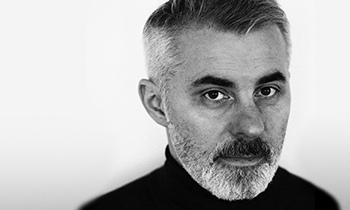
One of the most inspiring phenomena of our time is the return of the successful adult to the classroom. The object of study may be history, mathematics, philosophy, psychology, drawing, or agronomics. Whether honing self-understanding, broadening in outlook, developing in business, or beginning a new career, the reasons are as individual as the students. Below is a soliloquy, given by Vadim Dymov, businessman and Moscow State University graduate student, on Respublika (his literature and lifestyle chain), on reflections of Russian history, and on the demands of justice.
Even though I’m interested in modern technologies, I’m not ready to sacrifice the period of my life that occurred during a different era. Digital technologies are soulless. A digital photo fails to transmit the essence of its subject; it’s like an MRI of the brain. It shows a medical image, but doesn’t show you what’s really inside. Traditional photos are more personal, not only with regard to the subject, but also for the photographer. They have soul, feeling; that’s what I like about them.
I like openness in relationships. I like directness in conversation, clarity in speech. I love hearing people’s stories, their emotions. Not things scanned and copied, but experienced, heard, even retold through another person’s interpretation, as long as the context and the feelings experienced at the time clearly come across.
With age, one’s understanding of the value of context deepens, as does the necessity of learning the connection between all things. Case in point, what’s going on today in Russia’s government cannot be understood without knowledge of history.
That’s why I’m glad to be studying for my master’s at MSU, even though it’s not easy. I am focused on Russia in the 19th and early 20th centuries, the most vivid and well-documented period in our history. Through these documents, you can get closer to the figures of that time, and see how each of their personalities has been reflected in Russian history. There were many behavioral patterns then that are specific to a particular type of person now. Thus, despite the emigration following the 1917 Soviet Revolution, and the annihilation of the nobility, there really does exist a generational continuity.
The relationship of the intelligentsia and the authorities is, as a rule, complex, especially in Russia. The regime tries to break away, while the liberal community attempts to expose it. This dynamic doesn’t lead to anything good.
Throughout Russian his- tory, there has been a palpable rift between the intelligentsia and the common people. Over time there have been numerous attempts to narrow this gap; there was even a revolution. Yet today, we are repeating the same mistakes, not listening to one another, failing to reach common ground. We often say things like, “I’ve been to France; the French do it this way.” The French are building their own country; they’re compromising and listening to each other, so they can organise a comfortable way of life in a harmonious environment. Russia is different, as a large multiethnic state, with its own assets and idiosyncrasies. In my opinion, we have a deficit of historical dialogue. We need to try to come together, and to be tolerant of each other. It’s not easy. But dialogue is always better than conflict.
The relationship of the intelligentsia and the authorities is, as a rule, complex, especially in Russia. The regime tries to break away, while the liberal community attempts to expose it. This dynamic doesn’t lead to anything good. The French, conversely, don’t automatically presume the government is in the wrong; if an official commits bad deeds, society reacts, and that official is punished. However, Russians, from the outset, distrust the government, because in the current regime, there always seems to be something untrustworthy. More than anything, this is because the deeds of our government officials, at all levels, are so rarely connected to any consequences. You can be part of a major scandal, and yet keep your seat. It undermines the public’s faith in the government and directly contradicts the expectation of justice, the one thing that has always been the principal requirement in Russia. Not mercy, not democracy, but justice.
The reason I’m pursuing a history degree is so I can figure out these eternal Russian issues that have always interested me. My friends think I’m crazy because I study full-time. They always ask me if I’ve sold my business. How do I find time for a master’s degree? For me, there is no conflict here. There are no problems in learning and growth. By learning about my predecessors, I learn more about myself. I’ve always been fascinated by politics, and I think I will return to them. This is also why I need knowledge of history. A profound understanding of the past is a requirement for those who would seek to shape the future of their country.
Incidentally, the public is rather interested in history at the moment. At Respublika, there’s always a desire to expand the history shelf, though first in line are memoirs, research, and popular literature, of course — Uzefovich, Akunin. The mainstream is also important.
People think that the youth no longer read books, that when they do it’s mostly in digital formats, and thus, Respublika was destined to fail. And for a while, we didn’t make any money, which upset me a little, but making money was not the priority. First and foremost, I wanted to create what I had in mind. It was drawn up, and I wanted to bring it to life. It worked.
I would never have been able to build Respublika without investing myself. If you’re not willing to invest, you can’t be repaid — whether in appreciation, respect, or love.
For the past five years, Respublika has been fully independent, operating on its own funds, so I’ve stopped investing my own assets into it. I know their whole line of books, and practically, which shelves they occupy. I can’t recite the top twenty most popular books, but I’m aware of all of the new releases. For me, it’s not just a store, it’s home. I can’t imagine a place having a better interior design. I think that Respublika is the best job for a young person. If I were 18, I would want to work there, even just on the salesfloor. We have a little rule: we ask the guys only to talk to people about what they really love, what they really know well. Now more than ever, I would encourage people to read history books.
I would never have been able to build Respublika without investing myself. If you’re not willing to invest, you can’t be repaid — whether in appreciation, respect, or love.