

Quick Summary: The best full stack development companies in 2026 combine expertise across frontend and backend technologies to deliver end-to-end digital solutions. This comprehensive list features 15 top agencies selected based on verified client reviews, technical capabilities, and successful project portfolios spanning diverse industries and tech stacks.
Finding the right full stack development company isn’t just about technical skills anymore. It’s about finding a partner who understands both the frontend experience users see and the backend infrastructure that powers it all—without missing a beat between the two.
The landscape has shifted dramatically. Companies now demand developers who can navigate React and Node.js with equal fluency, who understand database architecture and UI/UX principles simultaneously. That’s a tall order.
But here’s the thing—not all agencies claiming full stack expertise actually deliver on both ends. Some lean heavily toward frontend polish while neglecting backend scalability. Others build robust server architectures but ship interfaces that feel like they’re from 2015.
This guide cuts through the noise. After analyzing verified client reviews, examining project portfolios, and evaluating technical capabilities across hundreds of agencies, we’ve identified the 15 full stack development companies that consistently deliver exceptional results across the entire technology stack.
What Defines a Top Full Stack Development Company in 2026
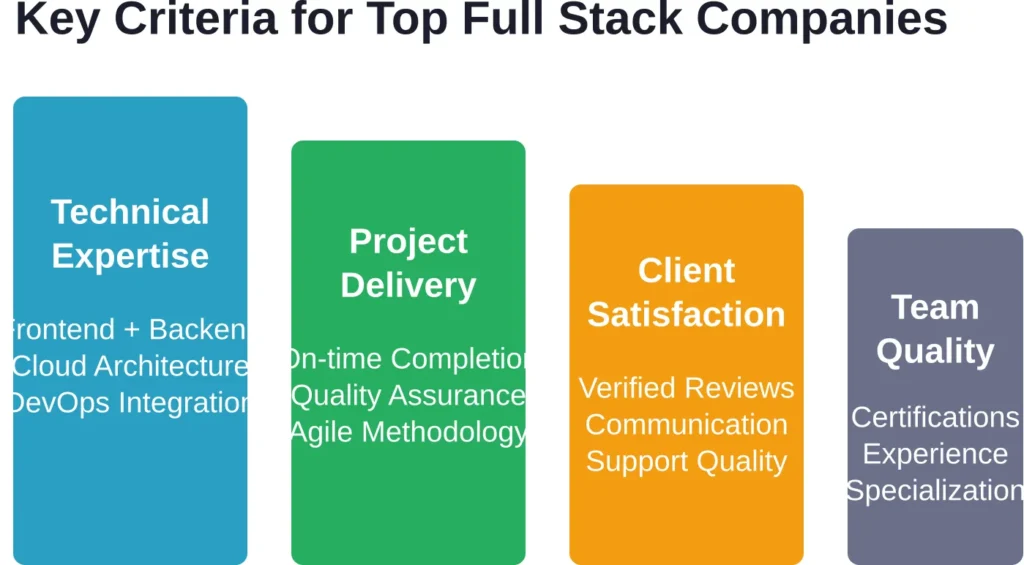
Full stack development has evolved beyond simply knowing frontend and backend languages. The best companies now demonstrate mastery across multiple dimensions that directly impact project success.
Technical breadth matters first. Leading agencies maintain expertise in modern JavaScript frameworks like React, Vue, and Angular on the frontend, paired with Node.js, Python, or Java on the backend. They’re comfortable with both SQL and NoSQL databases, understand containerization with Docker, and can architect cloud infrastructure on AWS, Azure, or Google Cloud Platform.
But technical skills alone don’t make the list. Real-world project delivery separates great agencies from average ones.
The companies featured here have proven track records managing complex builds from initial planning through deployment and maintenance. They understand DevOps practices, implement CI/CD pipelines, and build with security and scalability baked in from day one.
Client satisfaction provides another critical filter. According to industry analyses, the most successful partnerships stem from agencies that communicate transparently, meet deadlines consistently, and adapt to changing requirements without derailing timelines.
Team composition also signals quality. Advanced tier services on platforms like AWS require teams to maintain certified professionals across technical and business domains. This certification requirement ensures agencies maintain current expertise as technologies evolve.
The 15 Best Full Stack Development Companies in 2026
These agencies represent the top tier of full stack development providers based on verified client reviews, technical capabilities, and proven project delivery across diverse industries and technology stacks.
1. Gilzor

Gilzor positions itself as a reliable full stack development partner specializing in custom digital products for startups, small and medium businesses, and product studios. The company delivers complete solutions from idea validation through launch and long-term support.
Their teams provide full-cycle web and mobile development services, covering everything from UI/UX design and architecture decisions to implementation, quality assurance, and post-launch maintenance. This end-to-end approach minimizes the need for multiple vendors.
Gilzor emphasizes clean, scalable architectures and user-centric design that improves conversion rates and user satisfaction. They work across various industries, delivering web applications, mobile apps for iOS and Android, and complex digital platforms.
The company maintains strong expertise in research and development, helping clients build Proofs of Concept and implement modern technologies. Their support and maintenance services ensure products remain up-to-date and continue evolving based on user feedback and business needs.
Clients particularly value Gilzor’s structured process that includes business analysis, go-to-market strategy support, and a focus on delivering functional, attractive products that connect effectively with target audiences.
Contact Information:
- Website: www.gilzor.com
- Email: [email protected]
- Address: Poland, Warsaw, Office 58, street Adama Mickiewicza 37, 01-625
- LinkedIn: www.linkedin.com/company/gilzor-softwaredevelopment
2. Oski
Oski delivers well-engineered full stack software solutions for tech-forward enterprises and ambitious startups. The company focuses on designing, developing, deploying, and maintaining robust digital platforms that drive business transformation.
Their technical capabilities span modern frontend frameworks such as React, Vue, Angular, and Next.js alongside strong backend and cloud architectures including Node.js, .NET, and major cloud platforms. This versatility allows them to build scalable, high-performance applications.
Oski’s teams excel at creating seamless user experiences while implementing complex business logic on the server side. They integrate artificial intelligence capabilities, cloud infrastructure, and DevOps practices to deliver solutions that scale efficiently and operate reliably.
The company serves multiple industries including fintech, e-commerce, logistics, education, travel, and insurance. Each project benefits from their experience in building secure, maintainable systems that support both customer-facing interfaces and internal operational needs.
What sets Oski apart is their AI-accelerated engineering approach combined with deep expertise across the entire stack — from intuitive frontend interfaces to robust, secure backend systems and cloud infrastructure.
Contact Information:
- Website: oski.site
- Phone: +48571282759
- Email: [email protected]
- Address: Kaupmehe tn 7, 10114 Tallinn, Estonia
- LinkedIn: www.linkedin.com/company/oski-solutions
3. A-Listware

A-Listware operates as a trusted software development and consulting partner, providing full stack development expertise through dedicated teams and custom solutions. The company focuses on delivering high-quality, secure, and responsive digital products.
Their full stack capabilities cover custom software development, cloud application development, enterprise software solutions, and legacy modernization projects. Teams handle both frontend and backend responsibilities while maintaining clean architecture and documentation standards.
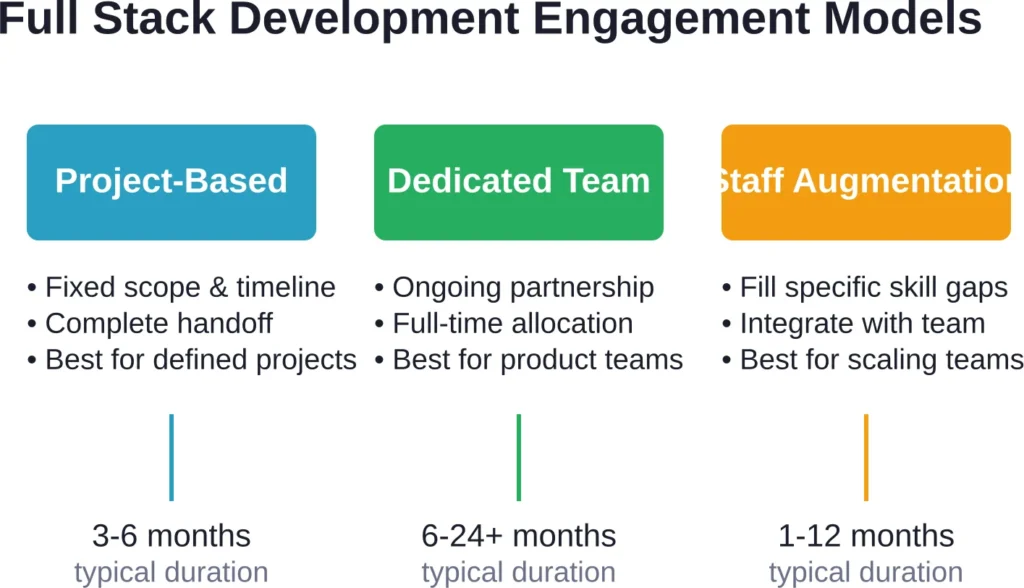
A-Listware offers flexible engagement models including dedicated development teams, team augmentation, and complete project outsourcing. This adaptability allows clients to scale technical capacity while keeping full control over direction and quality.
The company delivers solutions across enterprise applications, ERP, CRM, and various B2B and B2C platforms. Their technical expertise includes cloud solutions, data analytics, UI/UX design, and modern development practices that ensure long-term maintainability.
Clients benefit from seamless integration with their internal teams and consistent delivery of secure, scalable full stack applications that directly support business growth objectives.
Contact Information:
- Website: a-listware.com
- Phone: +1 (888) 337 93 73
- Email: info@a-listware.com
- Address: North Bergen, NJ 07047, USA
- LinkedIn: www.linkedin.com/company/a-listware
- Facebook: www.facebook.com/alistware
4. Mobian Studio

Mobian Studio specializes in building dedicated full stack engineering teams that deliver production-ready software for companies in IT, healthcare, fintech, and logistics. The company offers both end-to-end project delivery and outstaffing models.
Their teams manage complete development cycles — from architecture and UI/UX design through backend implementation, mobile development, cloud infrastructure, and quality assurance. This comprehensive coverage eliminates coordination challenges between multiple specialists.
Mobian emphasizes clean architecture, well-documented code, and scalable systems designed to grow from hundreds to tens of thousands of users without requiring complete rebuilds. They bring particular strength in integrating AI components and complex domain-specific requirements.
The studio delivers mobile applications, web platforms, AI-powered systems, and enterprise backends while maintaining strong focus on regulatory compliance and industry-specific needs. Projects benefit from their experience in legacy integration and post-launch support.
What distinguishes Mobian is their commitment to senior-level execution, dedicated focus on single projects or client teams, and the ability to deliver full stack solutions that are both technically excellent and closely aligned with business outcomes.
Contact Information:
- Website: mobian.studio
- Phone: [email protected]
- Address: Harju maakond, Tallinn, Kesklinnalinnaosa, Masina tn 22, 10113
- LinkedIn: www.linkedin.com/company/mobian-studio
5. Lengreo

Lengreo has built its reputation as a complete marketing and technology partner that delivers integrated digital solutions from strategy through technical implementation and ongoing optimization. The company combines deep marketing expertise with hands-on website and application development capabilities.
Their development process emphasizes discovery, business analysis, and research before moving into prototyping, design, and full implementation. This approach ensures that every technical solution aligns directly with business objectives and lead-generation goals.
Lengreo’s technical teams build eCommerce platforms, business websites, portfolio sites, and high-converting landing pages. They focus on creating digital experiences that drive measurable results such as increased client acquisition, lower cost per lead, and higher conversion rates for their partners.
The agency maintains strong capabilities in both frontend and backend development while integrating these with comprehensive digital marketing channels. Their solutions support B2B companies looking for websites that function as effective lead-generation engines rather than simple online brochures.
What distinguishes Lengreo is their focus on end-to-end accountability — from initial strategy and website development to performance optimization and continuous improvement based on real business outcomes.
Contact Information:
- Website: Lengreo.com
- Phone: +31 686 147 566
- Email: [email protected]
- Address: Vrijstraat 9 C/D, 5611 AT Eindhoven, Netherlands
- LinkedIn: Lengreo
- Twitter: @Lengreo
- Instagram: @lengreo
6. Upwork (Full Stack Development Specialists)
While Upwork operates as a broader freelance marketplace rather than a traditional agency, numerous full stack development specialists and boutique firms maintain strong presences on the platform.
The platform’s advanced filtering capabilities allow precise searches by service type, technical skills, project size, and client focus. Organizations can filter by specific frontend frameworks, backend languages, database experience, and cloud platform expertise.
Verified client reviews provide transparency into developer capabilities and reliability. The review system includes detailed feedback on communication quality, technical skills, deadline adherence, and overall satisfaction—critical factors for successful partnerships.
Budget flexibility represents another advantage. The platform accommodates organizations with varying budgets, from startups seeking cost-effective solutions to enterprises requiring premium expertise. Analyses indicate typical ranges fall between various tiers based on experience and specialization.
The challenge lies in vetting quality. Unlike curated networks, Upwork requires more client effort to evaluate candidates, review portfolios, and conduct technical assessments. But for organizations with technical leadership capable of evaluation, the platform provides access to global talent.
7. Clutch-Verified Agencies
Clutch operates as a B2B ratings and reviews platform rather than a single agency, but it deserves inclusion as perhaps the most valuable resource for identifying vetted full stack development companies.
The platform hosts extensive verified reviews from actual clients who’ve completed projects with listed agencies. Unlike testimonials on agency websites, Clutch conducts structured interviews to gather detailed feedback on project scope, outcomes, challenges, and satisfaction.
Advanced search capabilities allow filtering by service offerings, technical expertise, industry experience, project size, and geographic location. Organizations can drill down by specific requirements—React and Node.js expertise, healthcare industry experience, minimum team size, or specific budget ranges.
The verified review methodology provides confidence in feedback authenticity. Clutch confirms reviewer identities and project details before publishing reviews, reducing the fake review problem plaguing many platforms.
Comparison tools enable side-by-side evaluation of multiple agencies. Organizations can review service offerings, client feedback, project portfolios, and team compositions simultaneously—streamlining the selection process considerably.
8. Elsner Technologies
Elsner Technologies has built expertise across web development disciplines while maintaining strong full stack capabilities. Their teams handle everything from simple business websites to complex enterprise applications.
The company maintains particular strength in e-commerce development, having built custom shopping platforms and implemented major e-commerce frameworks. This specialization means they understand both the technical architecture requirements and business logic specific to online retail.
Their full stack teams work across PHP, Python, and JavaScript ecosystems. They’re equally comfortable with traditional monolithic architectures and modern microservices patterns, allowing them to recommend approaches aligned with specific project requirements and organizational capabilities.
Elsner emphasizes responsive design principles ensuring applications work seamlessly across devices. Their frontend developers collaborate with backend engineers to optimize performance—implementing lazy loading, efficient caching strategies, and progressive enhancement patterns.
The agency offers ongoing maintenance and support services beyond initial development. This long-term partnership approach ensures applications remain secure, performant, and compatible as technologies evolve and user needs change.
9. CloudTech Solutions
CloudTech Solutions specializes in full stack development with particular emphasis on cloud-native architectures. Their projects leverage AWS, Azure, and Google Cloud Platform capabilities from initial design through deployment.
The company’s teams include certified cloud architects alongside full stack developers. This combination ensures applications take full advantage of cloud services—managed databases, serverless functions, content delivery networks, and auto-scaling capabilities.
Their approach to full stack development emphasizes infrastructure as code. They implement Terraform or CloudFormation templates that define entire application environments, enabling consistent deployments across development, staging, and production environments.
CloudTech has delivered particularly strong results for clients migrating from on-premises infrastructure to cloud platforms. Case data from cloud migrations shows implementations can achieve significant improvements in deployment efficiency and latency reductions.
Security represents a core focus throughout their development process. They implement identity and access management, encryption at rest and in transit, network security controls, and comprehensive logging—building security into applications rather than bolting it on afterward.
10. DevSquad Partners
DevSquad Partners rounds out this list with a collaborative approach to full stack development. They position themselves as an extension of client teams rather than an external vendor.
The company’s model involves embedding developers directly into client workflows. DevSquad team members participate in stand-ups, sprint planning, and retrospectives alongside internal staff—creating genuine partnership rather than transactional relationships.
Their technical expertise spans modern JavaScript frameworks, Python and Node.js backends, and contemporary database technologies. They emphasize clean code practices, comprehensive testing, and thorough documentation that enables knowledge transfer.
DevSquad maintains flexible engagement models accommodating different organizational needs. Some clients prefer complete project teams handling all aspects of development. Others want specific specialists—a senior React developer or a DevOps engineer—to fill capability gaps in existing teams.
The agency has particular strength in agile methodologies and iterative development. Rather than lengthy waterfall projects, they prefer delivering working software in short cycles, gathering feedback, and adjusting course based on real user input.
11. Bridge Global
Bridge Global has built its reputation on delivering comprehensive full stack solutions that span from initial concept through long-term maintenance. The company specializes in building scalable web applications using modern JavaScript frameworks paired with robust backend architectures.
Their development approach emphasizes cross-functional teams where frontend specialists collaborate directly with backend engineers throughout the project lifecycle. This integration eliminates the common handoff bottlenecks that plague many software projects.
The agency maintains deep expertise in React and Angular for frontend development, complemented by Node.js and Python capabilities on the backend. Their teams regularly implement microservices architectures that allow applications to scale efficiently as user bases grow.
Bridge Global’s portfolio spans fintech platforms, healthcare management systems, and enterprise resource planning tools. Each project demonstrates their ability to handle complex business logic while maintaining intuitive user experiences.
What sets them apart is their emphasis on technical documentation and knowledge transfer. Clients receive comprehensive documentation that enables internal teams to maintain and extend applications long after initial deployment.
12. FATbit Technologies
FATbit Technologies has established itself as a versatile full stack provider serving startups, SMBs, and large enterprises across multiple industries. With a Clutch rating of 4.8 out of 5, they’ve demonstrated consistent client satisfaction across hundreds of projects.
The company offers expertise across a broad technology spectrum including JavaScript frameworks, Python, PHP, and Java. This versatility allows them to match technology choices to specific project requirements rather than forcing clients into a one-size-fits-all approach.
Their project portfolio includes e-commerce platforms, on-demand service marketplaces, and custom enterprise applications. They’ve successfully delivered solutions for bakeries expanding online, consulting firms digitizing operations, and established businesses undergoing digital transformation.
FATbit’s team structure supports both project-based engagements and dedicated developer models. This flexibility accommodates different client preferences—some organizations prefer complete project handoff, while others want integrated team members working alongside internal staff.
The agency has developed several product accelerators that reduce time-to-market for common application types. These pre-built frameworks provide tested foundations for marketplace platforms, booking systems, and social networking applications.
13. ScienceSoft
As an IT industry veteran, ScienceSoft brings decades of experience to full stack development projects. Their longevity in the market reflects an ability to evolve with technology shifts while maintaining engineering excellence.
The company’s full stack teams work across healthcare, retail, manufacturing, and financial services sectors. This cross-industry experience means they bring best practices from one domain to solve challenges in another—a significant advantage for complex projects.
ScienceSoft emphasizes thorough discovery and planning phases before code development begins. Their requirements gathering process involves technical architects, business analysts, and UX designers working collaboratively to identify potential challenges early.
Their technical stack includes modern frontend frameworks paired with enterprise-grade backend technologies. They’re equally comfortable building greenfield applications and modernizing legacy systems through incremental refactoring approaches.
The agency maintains specialized practices around data security and compliance. For healthcare and financial services clients, they implement HIPAA and PCI-DSS compliant architectures that satisfy regulatory requirements without sacrificing user experience.
14. Limeup
Founded in 2017 and headquartered in London, Limeup has rapidly established itself as a leading full stack development company specializing in end-to-end solutions that bridge frontend and backend advancement seamlessly.
The company positions itself as technology architects rather than just developers. This perspective means they approach projects holistically—considering infrastructure, security, scalability, and maintainability alongside feature development.
Limeup’s teams excel at building progressive web applications that deliver native-app experiences through browsers. They leverage modern capabilities like service workers, offline functionality, and push notifications to create engaging experiences without app store friction.
Their backend architectures favor microservices patterns deployed on cloud infrastructure. According to research on microservices-driven automation in full-stack development, this approach bridges efficiency and innovation by allowing teams to develop, deploy, and scale services independently.
The agency maintains strong expertise in API design and integration. They build RESTful and GraphQL APIs that serve web, mobile, and third-party consumers efficiently while maintaining security and performance standards.
15. Toptal
Toptal operates differently than traditional agencies—they maintain a curated network of freelance developers rather than employing full-time staff. But this model delivers unique advantages for certain project types.
The platform claims to connect clients with the top 3% of developers after rigorous screening. Community discussions note their 98% trial-to-hire success rate, suggesting their vetting process effectively identifies high-performing talent.
For mission-critical projects requiring deep expertise in specific technologies, Toptal provides rapid access to senior developers. Organizations can typically engage developers within days rather than the weeks or months required for traditional hiring.
The trade-off comes in premium costs compared to traditional agencies or direct hiring. But for short-term projects requiring specialized skills, or for organizations needing to scale teams quickly during peak periods, the model proves cost-effective.
Toptal developers span the full technology stack—frontend specialists, backend engineers, DevOps experts, and full stack generalists. Clients can assemble custom teams matching their specific technology requirements and project complexity.
Core Technologies Used by Leading Full Stack Companies
The technology landscape for full stack development has consolidated around several dominant stacks, though the best companies maintain flexibility to recommend technologies matching specific project requirements.
Frontend Frameworks and Libraries
React continues dominating frontend development for complex applications. Its component-based architecture, virtual DOM performance, and massive ecosystem make it the default choice for many projects. Leading agencies maintain teams of React specialists who understand not just the framework but the broader ecosystem—Redux for state management, Next.js for server-side rendering, and React Native for mobile development.
Vue.js provides a lighter-weight alternative that’s gained significant traction. Its gentler learning curve and excellent documentation make it particularly popular for teams transitioning from jQuery or vanilla JavaScript. Vue’s progressive adoption model allows incremental implementation rather than all-or-nothing rewrites.
Angular remains strong in enterprise environments, particularly for large-scale applications requiring comprehensive structure. Its opinionated approach and TypeScript foundation appeal to organizations prioritizing consistency and maintainability over flexibility.
Backend Technologies and Frameworks
Node.js has become the de facto standard for JavaScript-centric full stack development. Using JavaScript across frontend and backend reduces context switching and enables code sharing between client and server. Express.js provides the minimal framework most Node projects build upon, while Next.js increasingly handles both frontend and backend concerns in unified applications.
Python maintains strong positioning particularly for data-intensive applications and machine learning integration. Django offers comprehensive batteries-included functionality for rapid development, while Flask provides minimalist flexibility for custom architectures. Python’s extensive scientific computing libraries make it ideal when applications involve complex calculations or data analysis.
Java continues serving enterprise applications requiring extreme reliability and performance. Spring Boot has modernized Java development considerably, enabling rapid application development while maintaining the language’s strong typing and extensive tooling ecosystem.
Database Technologies
PostgreSQL has emerged as the preferred relational database for many full stack projects. Its robust feature set, excellent performance, and true open-source licensing make it attractive for organizations wanting to avoid vendor lock-in while maintaining enterprise capabilities.
MongoDB leads NoSQL adoption for applications requiring flexible schemas or document-oriented data models. Its JSON-like document structure aligns naturally with JavaScript development, simplifying data flow from database through API to frontend.
Redis serves as the ubiquitous caching layer and session store. Nearly every high-performance full stack application leverages Redis to reduce database load and improve response times.
Cloud and DevOps Tools
AWS maintains dominant market position, and the best full stack companies maintain certified expertise across its services. AWS partner tiers require maintaining trained and certified technical individuals, with requirements increasing by tier level.
Docker containerization has become standard practice for consistent deployments across environments. Leading agencies containerize applications from initial development, eliminating the classic “works on my machine” problems.
Kubernetes orchestrates containerized applications in production, handling scaling, health monitoring, and rolling updates. While Kubernetes adds complexity, it proves essential for applications requiring high availability and efficient resource utilization.
CI/CD pipelines automate testing and deployment, enabling rapid iteration without sacrificing quality. GitHub Actions, GitLab CI, and Jenkins handle automated testing, security scanning, and deployment orchestration—allowing developers to ship code confidently.
| Technology Layer | Popular Options | Best Use Cases |
|---|---|---|
| Frontend Framework | React, Vue, Angular | Complex UIs, SPAs, Progressive Web Apps |
| Backend Runtime | Node.js, Python, Java | APIs, business logic, data processing |
| Database (SQL) | PostgreSQL, MySQL | Structured data, complex queries, transactions |
| Database (NoSQL) | MongoDB, DynamoDB | Flexible schemas, document storage, high scale |
| Caching | Redis, Memcached | Session storage, performance optimization |
| Cloud Platform | AWS, Azure, GCP | Hosting, managed services, global scale |
How to Evaluate Full Stack Development Companies
Selecting the right full stack development partner requires systematic evaluation across multiple dimensions. The wrong choice costs time, money, and opportunity—but the right partnership accelerates digital initiatives considerably.
Verify Technical Expertise
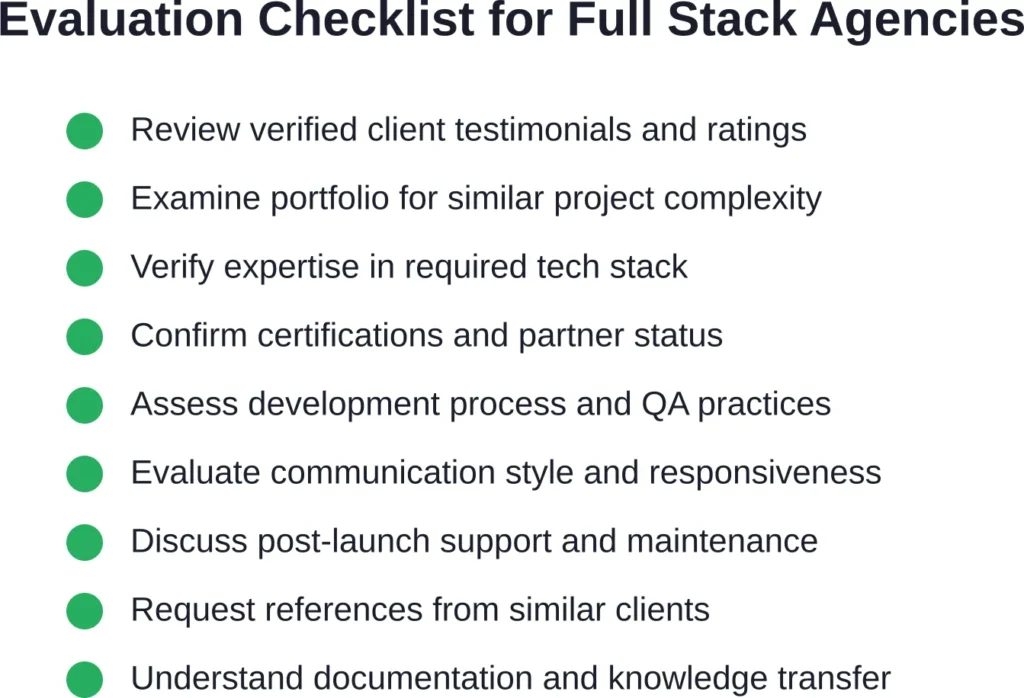
Start by confirming the agency maintains current expertise in technologies relevant to the project. Don’t just accept marketing claims—request specific examples of recent projects using those technologies.
Ask about their development processes. Strong agencies implement code reviews, automated testing, and continuous integration from project inception. These practices separate professional development from amateur execution.
Inquire about their approach to technical debt. Every project accumulates some technical debt through pragmatic shortcuts. Good agencies acknowledge this reality and plan regular refactoring to keep codebases maintainable.
Certifications provide one signal of expertise. AWS partner tiers require maintaining trained and certified technical individuals, with requirements increasing by tier level.
Review Project Portfolios Thoroughly
Portfolio quality matters more than quantity. Look for projects similar in scope and complexity to yours. An agency with 50 simple brochure websites won’t necessarily excel at complex SaaS platforms.
Pay attention to project outcomes beyond technical implementation. Did the application achieve business objectives? Did it scale successfully? Is it still maintained and actively used?
Request case studies that discuss challenges encountered and how the agency addressed them. Every complex project hits obstacles—the response to difficulties reveals agency capabilities more than success stories.
When possible, contact previous clients directly. Platform reviews provide valuable input, but direct conversations often reveal insights that don’t appear in formal feedback.
Assess Communication and Project Management
Technical skills alone don’t guarantee successful partnerships. Communication quality often determines project outcomes as much as coding ability.
During initial conversations, evaluate how well the agency listens and asks clarifying questions. Strong partners seek to understand business objectives before proposing technical solutions.
Discuss their project management approach. Agile methodologies dominate modern software development, but implementation varies widely. Some agencies practice rigorous Scrum with defined ceremonies and roles. Others adopt loosely agile approaches without structured processes.
Understand their communication cadence and tools. Will there be dedicated project managers? How frequently will they provide updates? What tools will they use for project tracking and collaboration?
Consider Long-term Partnership Potential
Software development rarely ends at initial launch. Applications require ongoing maintenance, feature additions, and infrastructure updates.
Evaluate agencies based on their willingness and capability to support long-term relationships. Some specialize in greenfield development and prefer moving to new projects after launch. Others excel at sustained product development over years.
Discuss knowledge transfer and documentation practices. If the relationship ends, can internal teams maintain and extend what was built? Comprehensive documentation and clear code enable smoother transitions.
Consider cultural fit alongside technical capabilities. Teams that share similar values around quality, communication, and collaboration tend to navigate challenges more effectively than those with fundamental cultural misalignment.
Benefits of Partnering with Full Stack Development Companies
Organizations choosing full stack development partners over specialized frontend or backend agencies gain several strategic advantages that impact both project delivery and long-term success.
Unified Accountability and Communication
Working with a single full stack team eliminates the coordination overhead inherent in managing separate frontend and backend vendors. There’s one point of contact, one project manager, and unified accountability for outcomes.
This integration becomes particularly valuable when challenges arise. Rather than finger-pointing between frontend and backend teams about where a bug originates or whose responsibility a performance issue falls under, full stack teams own the entire solution.
Communication flows more efficiently within integrated teams. Frontend developers understand backend constraints because they work alongside backend engineers. Backend developers consider frontend needs because they see how data flows to users. This collaboration prevents the mismatches that plague siloed development.
Faster Development Cycles
Full stack teams iterate more quickly than fragmented approaches. When frontend and backend development happens simultaneously by coordinated teams, features move from concept to deployed functionality faster.
The handoff delays that slow traditional approaches—frontend team waiting for backend APIs, backend team waiting for frontend mockups—largely disappear. Teams work in parallel with continuous integration rather than sequential phases with formal handoffs.
Streamlined processes can achieve significant improvements in pipeline velocity. While research on similar acceleration patterns focused on sales, the same principles of removing friction and accelerating cycles apply equally to development processes.
Consistent Technical Architecture
Full stack agencies design unified architectures where frontend and backend complement each other. Data models match frontend needs efficiently. APIs provide exactly the data and operations frontends require without unnecessary overhead.
This architectural cohesion improves performance. When the same team designs database schemas, API contracts, and frontend data consumption, they optimize the entire data flow rather than suboptimizing individual layers.
Security benefits from holistic design as well. Full stack teams implement defense-in-depth strategies that protect data from database through API to frontend display. They understand the complete attack surface rather than just securing individual components.
Cost Efficiency Through Reduced Coordination
While full stack developers often command higher rates than specialized developers, total project costs frequently come in lower. The coordination overhead, duplicate work, and rework from miscommunication between separate frontend and backend teams often exceeds any individual rate differences.
Full stack approaches also reduce the number of people required on projects. Rather than needing separate frontend developers, backend developers, and integration specialists, smaller full stack teams deliver complete features end-to-end.
Organizations save time and money during the vendor selection process itself. Evaluating one comprehensive full stack partner requires less effort than vetting and coordinating multiple specialized vendors.
Simplified Maintenance and Evolution
After launch, full stack partnerships simplify ongoing maintenance. There’s one team to contact for bug fixes, performance issues, or feature additions—regardless of whether problems originate in frontend code, backend logic, or the integration between them.
As applications evolve, full stack teams can refactor holistically. They might move processing from client to server for better performance, or vice versa for better user experience, without coordination challenges between separate frontend and backend vendors.
Knowledge retention improves when the same team that built an application maintains it. Context about why specific design decisions were made, where technical debt exists, and how components interact doesn’t get lost across vendor transitions.
Industry Trends Shaping Full Stack Development in 2026
The full stack development landscape continues evolving rapidly as new technologies mature and development practices advance. Several trends are reshaping how leading companies approach projects.
Microservices Architecture Adoption
Microservices patterns have moved from bleeding-edge to mainstream adoption. Rather than building monolithic applications where all code deploys as a single unit, teams increasingly build collections of small, independently deployable services.
According to technical research on microservices-driven automation in full-stack development, this approach bridges efficiency and innovation by allowing teams to develop, test, and deploy services independently. Changes to one service don’t require redeploying the entire application.
The best full stack companies now design systems as microservices from inception. They define clear service boundaries, implement inter-service communication patterns, and architect for independent scaling and deployment.
But microservices add complexity. Distributed systems require careful attention to service discovery, load balancing, fault tolerance, and distributed monitoring. Leading agencies bring expertise in the supporting infrastructure—service meshes, API gateways, distributed tracing—that makes microservices practical.
AI and Machine Learning Integration
Artificial intelligence capabilities are being woven into applications across industries. Full stack developers now commonly integrate pre-trained models for image recognition, natural language processing, recommendation engines, and predictive analytics.
Case data from cloud migrations and AI-powered implementations shows implementations can achieve significant improvements in deployment efficiency and pipeline creation from AI-driven approaches. These results are driving rapid adoption across sectors.
Full stack teams integrate AI capabilities through APIs to services like OpenAI, AWS SageMaker, or Google Cloud AI. They don’t necessarily train models from scratch but rather incorporate machine learning as another backend service alongside databases and message queues.
The challenge lies in building responsible AI systems. Leading agencies implement monitoring for model drift, bias detection, and explainability—ensuring AI features enhance applications without introducing unintended consequences.
Serverless and Edge Computing
Serverless architectures continue gaining traction for specific use cases. Rather than managing servers, developers deploy functions that execute on-demand in response to events—with cloud providers handling all infrastructure concerns.
This model particularly suits applications with variable load. Organizations pay only for actual compute time rather than maintaining idle server capacity. Auto-scaling happens automatically without configuration.
Edge computing pushes processing closer to users. Content delivery networks now run code at edge locations, enabling sub-millisecond response times for certain operations. Full stack developers leverage edge computing for personalization, A/B testing, and security enforcement.
The combination of serverless backend functions and edge computing creates new architectural possibilities. Applications can deliver incredibly fast user experiences while maintaining cost efficiency and global scale.
Enhanced Development Tools and Automation
Developer tooling has advanced dramatically. Modern IDEs provide sophisticated code completion, real-time error detection, and automated refactoring. These tools particularly benefit full stack developers who work across multiple languages and frameworks.
GitHub Copilot and similar AI-assisted coding tools are changing development workflows. They can generate boilerplate code, suggest implementations, and even write tests—allowing developers to focus on complex logic and architecture rather than repetitive code.
Infrastructure as code has become standard practice. Full stack teams define entire application environments—servers, databases, load balancers, security groups—in version-controlled templates. This enables consistent environments, simplified disaster recovery, and infrastructure changes through standard development workflows.
Performance optimization research highlights the importance of large-scale web architecture strategies. Leading companies now implement comprehensive monitoring, automated performance testing, and continuous optimization practices from initial development through ongoing operation.
Common Pitfalls When Hiring Full Stack Development Companies
Organizations frequently make predictable mistakes when selecting and working with full stack development partners. Avoiding these pitfalls significantly improves project success rates.
Prioritizing Cost Over Value
The lowest bid rarely delivers the best outcome. Development quality varies enormously—cheap developers often produce code that works initially but becomes increasingly difficult to maintain, extend, and scale.
Technical debt accumulates invisibly until it suddenly becomes crushing. Applications built quickly and cheaply often require expensive rewrites within months because the codebase becomes too fragile to modify safely.
Instead of optimizing for minimum cost, optimize for value. What’s the total cost of ownership including maintenance? How quickly can the application adapt to changing requirements? Will it scale as the user base grows?
Better developers cost more per hour but often complete projects faster with higher quality—resulting in lower total costs and better long-term outcomes.
Insufficient Requirements Definition
Vague requirements lead to mismatched expectations. When organizations describe what they want in general terms without detailed specifications, developers make assumptions that frequently don’t align with actual needs.
The best agencies insist on thorough discovery and requirements gathering before development begins. They invest time understanding business objectives, user needs, technical constraints, and success criteria.
Organizations should prepare for this process. Document existing workflows, identify pain points, prioritize features, and consider edge cases. The more thoroughly requirements are defined upfront, the more closely final deliverables match expectations.
That said, perfect requirements are impossible. Agile methodologies acknowledge this reality through iterative development and continuous feedback. The goal isn’t complete upfront specification but sufficient clarity to begin productively.
Neglecting Post-Launch Planning
Launch is a beginning, not an end. Applications require ongoing maintenance, security updates, performance optimization, and feature evolution. Organizations that don’t plan for this reality face deteriorating applications and technical emergencies.
Discuss post-launch support during vendor selection. What maintenance services does the agency offer? What response times do they guarantee for different issue severities? How are feature requests prioritized and implemented?
Budget appropriately for ongoing costs. A common rule of thumb allocates 15-20% of initial development costs annually for maintenance and evolution. Organizations that don’t budget adequately often watch applications decay as security patches don’t get applied and compatibility issues accumulate.
Ignoring Cultural and Communication Fit
Technical skills matter, but so does working relationship quality. Teams that communicate poorly, miss deadlines, or clash culturally cause project stress regardless of coding ability.
During evaluation, pay attention to communication quality. Do they respond promptly? Do they ask good questions? Do they explain technical concepts clearly without condescension?
Consider time zone differences for distributed teams. Real-time collaboration becomes challenging when teams have minimal working hour overlap. Asynchronous communication works for some projects but complicates others requiring frequent discussion.
Trust your instincts about relationship dynamics. If something feels off during sales conversations, it likely won’t improve during high-pressure development phases.
| Common Pitfall | Consequence | Prevention Strategy |
|---|---|---|
| Choosing lowest bidder | Low-quality code, expensive rewrites | Evaluate value and total cost of ownership |
| Vague requirements | Mismatched expectations, rework | Invest in thorough discovery and documentation |
| No post-launch plan | Deteriorating application, security risks | Budget 15-20% annually for maintenance |
| Ignoring communication fit | Project friction, missed deadlines | Evaluate communication during selection |
| Unrealistic timelines | Rushed development, technical debt | Accept realistic estimates from experienced teams |
Questions to Ask Full Stack Development Companies
Strategic questioning during vendor evaluation reveals capabilities and approach more effectively than reviewing marketing materials. These questions help differentiate genuinely capable agencies from those making unsupported claims.
About Technical Approach
“Walk me through your typical development process from requirements through deployment.” This open-ended question reveals their methodology. Strong answers mention discovery phases, iterative development, testing strategies, and deployment practices.
“How do you handle technical architecture decisions?” Listen for collaborative approaches involving client stakeholders, documentation of decisions and rationales, and consideration of both immediate needs and future scalability.
“What’s your approach to code quality and testing?” Look for mentions of code reviews, automated testing, continuous integration, and specific quality metrics they track.
“How do you manage technical debt?” Every project accumulates some technical debt through pragmatic shortcuts. Good agencies acknowledge this, track it explicitly, and schedule regular refactoring to keep it manageable.
About Team and Expertise
“Who specifically would work on my project?” Insist on meeting the actual developers, not just sales representatives. Evaluate their communication skills and technical depth directly.
“What certifications or training do your developers maintain?” Technical certifications provide one signal of current expertise, particularly for cloud platforms and enterprise technologies.
“Can you show examples of projects similar to mine?” Portfolio breadth matters less than relevant depth. One highly similar successful project proves more than dozens of unrelated ones.
“What happens if key team members leave during the project?” Understand their bench depth and knowledge transfer practices. Projects shouldn’t depend on single individuals.
About Project Management
“How do you handle changing requirements?” Requirements always evolve during projects. Strong agencies have clear processes for evaluating, estimating, and incorporating changes without derailing timelines.
“What’s your communication cadence and format?” Understand how often they’ll provide updates, what formats those updates take, and who participates in various meetings.
“How do you handle situations when projects go off track?” All projects hit obstacles. The question reveals how agencies respond to challenges—proactive communication, problem-solving approaches, and accountability.
“What project management tools do you use?” Their tools reveal something about their processes. Look for modern collaboration platforms rather than email-based communication.
About Business Relationship
“What post-launch support do you provide?” Understand what’s included in initial contracts versus what costs extra. Clarify response time expectations for different issue types.
“How do you handle intellectual property and code ownership?” Ensure contracts clearly transfer ownership of custom code to clients. Some agencies retain ownership or limit usage rights.
“Can you provide references from similar clients?” Contact references directly and ask about communication quality, deadline adherence, problem-solving, and overall satisfaction.
“What are your payment terms?” Understand milestone structures, deposit requirements, and payment schedules. Be wary of agencies requiring large upfront payments or offering payment terms far outside industry norms.
Frequently Asked Questions
Full stack development refers to building complete web applications covering both frontend (what users see and interact with) and backend (server logic, databases, and APIs). It matters because having unified teams handle both layers eliminates coordination overhead, accelerates development cycles, and ensures architectural cohesion between client and server components. Organizations working with full stack development companies gain single-point accountability rather than managing separate frontend and backend vendors.
Rates vary considerably based on geographic location, team experience, and project complexity. Industry data shows typical ranges from various rate structures based on engagement type and developer seniority. However, organizations should focus on total project value rather than hourly rates—experienced developers charging premium rates often deliver projects faster with higher quality, resulting in lower total costs than cheaper alternatives that take longer and require extensive rework.
Project timelines depend heavily on scope and complexity. Simple applications with basic functionality might complete in 6-12 weeks. Medium complexity projects typically require 3-6 months. Complex enterprise applications often span 6-12 months or longer. The best agencies provide realistic estimates during discovery phases after understanding specific requirements. Be wary of agencies promising unusually fast delivery—rushed development inevitably creates technical debt that becomes expensive later.
Both can deliver excellent results depending on project needs. Large agencies offer deep bench strength, diverse expertise, and capacity to handle multiple simultaneous projects. They’re often better suited for complex enterprise projects requiring specialized skills. Smaller boutique firms typically provide more personalized attention, greater flexibility, and often more competitive rates. They excel at projects where close collaboration and rapid iteration matter more than breadth of capabilities. Evaluate based on specific project requirements rather than size alone.
Verify competence through multiple signals: examine their portfolio for projects similar in scope and complexity to yours; review verified client testimonials on platforms like Clutch rather than relying on website testimonials; check for relevant certifications and partner status with technology vendors; request and contact references directly; evaluate the technical depth of developers you’ll actually work with during initial conversations. Strong agencies welcome scrutiny and provide transparent information about capabilities, processes, and past performance.
Full stack approaches integrate frontend and backend development within unified teams where developers understand and work across both layers. Separate frontend/backend approaches divide work between specialized teams, each focusing on their domain. Full stack integration typically delivers faster development cycles, better architectural cohesion, simplified communication, and unified accountability. Separate teams can provide deeper specialization in each layer but require careful coordination and often move more slowly due to handoff delays between teams.
Involvement requirements vary by engagement model and organizational preferences. Most successful projects benefit from regular client participation—providing feedback on iterations, answering questions about business logic, and validating that development aligns with objectives. Expect to commit several hours weekly for project updates, sprint reviews, and decision-making. Some agencies offer more hands-off approaches where they work more independently, but this requires exceptionally thorough upfront requirements and carries higher risk of misalignment. Active collaboration generally produces better outcomes than passive oversight.
Making Your Final Decision
Selecting a full stack development company represents a significant commitment with long-lasting implications. The partner chosen will influence not just initial delivery but the application’s maintainability, scalability, and evolution for years.
Start by defining success criteria clearly. What business outcomes should the application enable? What technical requirements are non-negotiable? What budget and timeline constraints exist? Clear criteria enable more objective evaluation than gut-feel assessments.
Create a structured evaluation process. Develop a consistent set of questions and criteria applied to all candidates. Document responses, collect artifacts like proposals and sample code, and maintain evaluation scorecards that track how agencies perform against defined criteria.
Don’t rush the decision. The cost of choosing wrong—failed projects, expensive rewrites, missed market opportunities—vastly exceeds any time savings from faster selection. Invest weeks in thorough evaluation rather than days in hasty decisions.
Consider starting small. Rather than committing to a massive long-term engagement immediately, some organizations begin with smaller proof-of-concept projects. This allows evaluating agency capabilities with limited risk before expanding the relationship.
Trust matters enormously in development partnerships. Teams will encounter challenges, requirements will evolve, and difficult decisions will arise. Partner with agencies demonstrating integrity, transparency, and collaborative problem-solving during the sales process—these characteristics become even more important during project execution.
Look beyond technical capabilities to relationship dynamics. The best code in the world doesn’t compensate for poor communication, missed deadlines, or misaligned expectations. Evaluate both technical competence and relationship fit.
The Future of Full Stack Development
Full stack development will continue evolving as technologies mature and new capabilities emerge. Several developments will likely shape the landscape over coming years.
AI-assisted development will become ubiquitous. Tools that generate code, suggest implementations, identify bugs, and automate testing will make developers more productive. But they won’t replace human developers—the judgment required for architecture decisions, requirement interpretation, and business logic remains distinctly human.
Low-code and no-code platforms will handle increasingly sophisticated applications. These tools won’t eliminate custom development but will shift it toward more complex, differentiated applications while commodity solutions move to configuration rather than coding.
Cloud-native development will become the default approach. Applications will be designed from inception to leverage cloud services, serverless functions, managed databases, and global content delivery. On-premises deployment will become the exception rather than the norm.
Security will receive even greater emphasis as cyber threats evolve and regulatory requirements expand. Full stack developers will need deeper security expertise, and agencies will be expected to implement comprehensive security practices by default rather than as optional add-ons.
Specialization within full stack will increase. Rather than generalists who know a little about everything, the market increasingly values developers with deep expertise in specific stacks—JavaScript ecosystem specialists, Python data application experts, or mobile-focused full stack developers.
The companies listed in this guide represent the current state of excellence in full stack development. But technology moves quickly. Revisit partner evaluations periodically to ensure agencies maintain current expertise as the landscape evolves.
Taking the Next Step
The full stack development companies featured in this guide represent verified expertise across frontend and backend technologies, proven project delivery capabilities, and demonstrated client satisfaction. Each brings unique strengths suited to different project types and organizational needs.
Bridge Global excels at comprehensive solutions spanning concept through maintenance. FATbit Technologies brings versatility serving diverse industries and company sizes. ScienceSoft leverages decades of IT industry experience. Limeup positions itself as technology architects for holistic solutions. Toptal provides rapid access to elite freelance talent. Upwork offers platform flexibility for various budgets and requirements. Clutch serves as an invaluable resource for discovering and evaluating agencies. Elsner Technologies brings e-commerce specialization. CloudTech Solutions emphasizes cloud-native architectures. DevSquad Partners offers collaborative team augmentation.
The right choice depends on specific project requirements, organizational culture, technical needs, and budget realities. No single agency suits every situation—but one of these partners likely aligns well with particular needs.
Begin the selection process by clarifying objectives and requirements. Define what success looks like, identify technical constraints, establish budget parameters, and determine timeline expectations. This foundation enables productive conversations with potential partners.
Reach out to multiple agencies for initial discussions. Most offer free consultations where they learn about projects and provide preliminary recommendations. Use these conversations to evaluate communication quality, technical depth, and cultural fit alongside their formal proposals.
Check the official websites of featured companies for current service offerings, as capabilities evolve continuously. Review their latest case studies and client testimonials. Contact their references directly to gather insights beyond formal reviews.
Remember that the cheapest option rarely delivers the best value. Focus on total cost of ownership, long-term maintainability, and business outcomes rather than optimizing for minimum initial cost. Quality development costs more upfront but proves far more economical over application lifecycles.
The digital products built by these full stack development companies will shape how organizations serve customers, operate internally, and compete in increasingly digital markets. Choose thoughtfully, partner collaboratively, and build applications that deliver lasting business value.