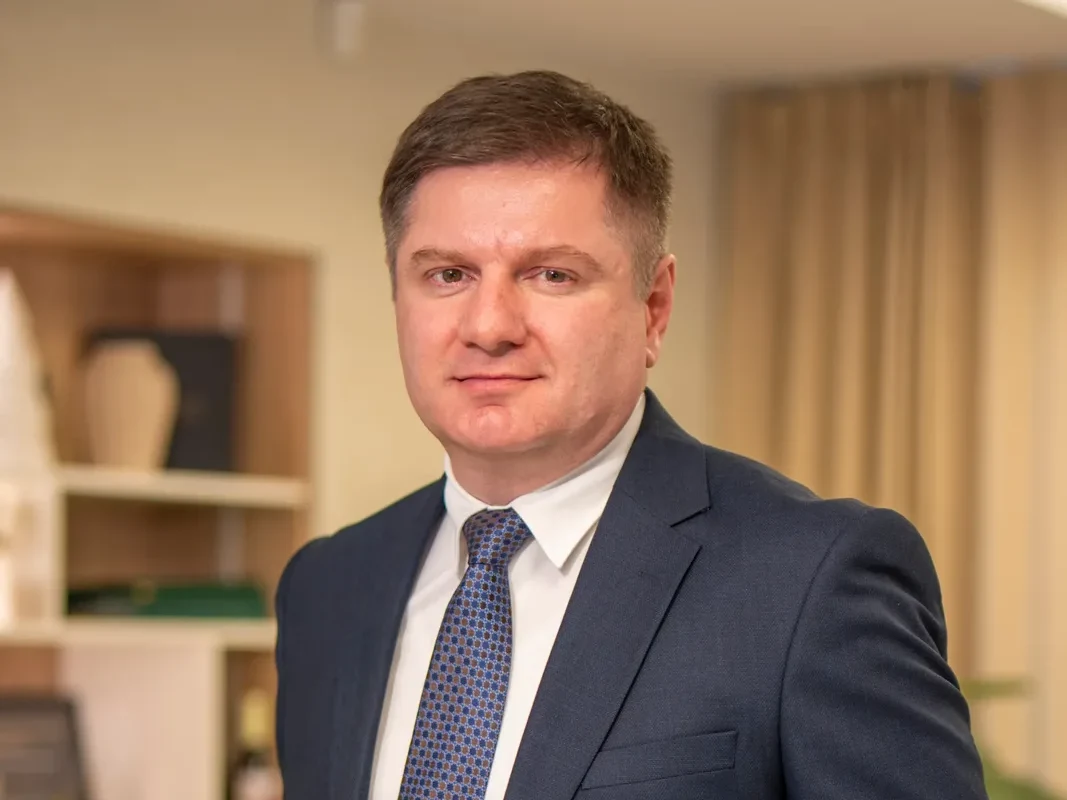
We tend to think of success as the reward for effort, yet it can just as easily pin you down. Recognition tempts you to stop, and stopping is often where growth ends. Gocha Kamkia, chief executive of the Ambassadori Island project in Batumi, spotted that danger in his own career. A leading lawyer, he closed the door on consulting to take personal responsibility for the decisions behind an artificial island in the Black Sea. Here he describes how a habit of reinventing himself led to a project aimed at investors from the UAE and well beyond.
The first time I wondered whether my best years were already behind me, I was 33. The law firm I had built had become one of Georgia’s most recognised names, advising major Georgian companies and international investors. By any measure, my career was a success.
And that was exactly what unsettled me. If this was the peak, what was left? I feared that the rest of my life would simply be a rerun, and I wanted to throw myself at something I wasn’t yet prepared for.
So I left my family in Batumi for a while and went to Chicago to study for a master’s degree in US, international and transnational law. Much later, when Ambassadori Island got under way, the same urge returned, and I enrolled in Harvard Business School’s Program for Leadership Development, which gives full HBS alumni status. To me, studying isn’t a phase of life but a habit. It makes me keep questioning how I work and what might come next. If you want to change the world around you, you have to begin by changing yourself.
No leader can assume that yesterday’s knowledge will do. When people see you developing, they realise that change is possible in their own work as well.
Before the island I spent years in legal and business consulting for international investors and large Georgian companies. That taught me how to build relationships, how partners think and how to recognise risks early on. We examined the legal landscape and foresaw the difficulties a client might face — and I use those skills every day now with the island’s investors.
As an adviser, I made recommendations and helped investors understand possible scenarios. Today the decisions are mine, and so are the consequences. They arrive fast and in quick succession, and I answer for each one. That is impossible without a strong team. Nobody can be an expert in everything, so you need people beside you who know their subject better than you do — and you must trust them enough to delegate.
Our team is full of highly experienced specialists and engineers, and for many of them the island has turned into the project of a lifetime. They feel they are leaving a legacy and pour everything they know into it. My role is to take the strategic decisions, bring government agencies and the development team into alignment and steer investment, construction and all the rest, while keeping sight of the whole and keeping risk under control.
I have been involved since before the project had a name. I sat in the working group that launched it, and together we debated every early question: which risks we were willing to take, what the island should become and whether it could be built at all. It has been part of my life for a very long time.
The founder of Ambassadori Group, Buba Keburia, is still its principal shareholder and has worked in Georgian hospitality for about 30 years. Launching Ambassadori Island was his strategic decision, and he remains its driving force. In the early years of independence the company opened one of the first five-star hotels in central Tbilisi. A golf club in Kakheti followed, then the ski business and two five-star hotels in Goderdzi, and later the move to Batumi, where another luxury hotel is about to open. Altogether the group has delivered projects worth more than half a billion US dollars in Georgia — experience that counts when you take on something this large.
We wanted to invest more in Adjara, but there was almost no suitable land left in Batumi. Investors had carved up the seafront, there was little state or private land available, and many plots were already built on or close to completion. Meanwhile, the city kept expanding.
That is why we turned our attention to the sea off Batumi. Studies showed that the water depth at one location could make land reclamation feasible, and that is how Ambassadori Island Batumi took shape: two peninsulas and an island, 120 hectares in all — to our knowledge the first mixed-use urban development on reclaimed land anywhere in the Black Sea. For Georgia, it is the first time the country has gained new land from the sea.
Batumi is a historic city with a settled architectural identity. We wanted to create a setting for fresh ideas about urban life, business and daily living, bringing together investment, homes, leisure and all the services a modern city requires. That is what the name The Address of the Black Sea stands for.
A project on this scale required close cooperation with the Georgian state, and we are grateful to the government for its trust and support. Around 40 public bodies took part. We needed four or five legislative amendments and more than a dozen meetings at government level. The authorities also secured direct access to the natural materials required for reclamation, such as stone and gravel. For us it is an example of what public and private sectors can do together at scale.
Environmental work started before any design. The assessment was based on more than 40 Georgian and international studies. In August 2024 Georgia’s National Environmental Agency issued its environmental decision, and in October the construction permit for the two peninsulas and the island followed. Experts were involved throughout, and the review took nine months.
We undertook to monitor the environment throughout construction and for ten years after it is finished, and to provide premises for an environmental department so that monitoring can continue beyond that.
Fishermen have started gathering near the island, which suggests that fish are coming too. Environmental specialists attribute this to the natural materials used in construction and to a new ecosystem taking shape. We keep watching, because the impact of a project like this can only be judged over many years.
To estimate how large Batumi will grow, we commissioned Colliers, with teams in London and Tbilisi, and appointed Arup as master planner. The feasibility study projected that the population could rise from 260,000 to 360,000 within a decade, and our infrastructure planning was built on that forecast.
The island has room for roughly 60,000 residents and could become a new city centre. We calculated how much housing and commercial space it could support, what residents would need and how much load the infrastructure would carry. The island had to be designed as a single organism.
Selling plots alone was never the idea. Working with the American firm SHoP Architects, we produced architectural proposals for each zone, fixed limits on building volumes and defined possible uses. From my legal practice I know how much time investors spend on early analysis, choosing a concept and obtaining approvals; the analysis alone frequently takes a year or two. With our approach, it takes one or two months.
So we assembled investment packages that combine concept, strategy, business plan and plot. Investors can adapt them, and our team supports them through the next stages, including preparation of the building permit. All the required procedures still apply, but partners can see what has already been done and who will be involved next.
The masterplan includes a shopping mall, a medical centre, an international school, hotels, apartments, villas, shops, an aqua park, a yacht club and a runway for private jets. Our agreement with IG Development covers a shopping centre of around 170,000 square metres — up from 160,000 in the original plan — and City Mall Batumi is due to open in 2029.
There will be a multipurpose events venue for at least 5,000 people, hosting concerts, exhibitions and business events, linked to the yacht club. Half of the territory is reserved for public space, with a nine-hectare park and 3.5 kilometres of footpaths, and we are developing the smart-city concept together with Arup.
The private-aviation runway will sit at the end of the breakwater, about 1,250 metres beyond the tip of the peninsula. Helipads and a future base for drone services are also being considered, and the railway station is close by. For now, though, the priority is a comfortable place in which to live and work.
Renderings rarely show infrastructure, but a project like this stands or falls by it. Agreements with the authorities cover power, water and sewage. Design and internal utility networks have been entrusted to the Turkish company Yüksel Proje, which worked on the Ordu-Giresun and Rize-Artvin airports — both built on reclaimed land in the Black Sea — and its experience helped us weigh up the engineering challenges here.
Dubai is a natural partner. It is only about two and a half hours away by air, and UAE investors understand the potential of places at the very start of their growth. Many remember how Palm Jumeirah developed and how property values changed as it took shape. We use that story as a familiar reference, while every investor makes their own judgement about the risks and terms.
Georgia is an emerging market and one of the fastest-growing economies in its region: growth was 9.7% in 2024 and 7.5% in 2025, and the IMF forecasts more than 7% this year. Returns may be higher than in mature markets. We offer ready-made concepts and sites so that partners can get to the substance quickly, and we have built in the business discipline and scale that Dubai investors expect.
Some of Georgia’s advantages are hard to fit into a presentation. Mountains and sea are close neighbours. The country embraced Christianity in the fourth century, and some of its churches are around 1,500 years old. In November you can occasionally swim and ski on the same day. Georgia sits between Europe and Asia, on a sea that connects the Caucasus, Turkey and the wider region. We want the island to turn Georgia into a meeting place for that region rather than a transit point — a project that is unmistakably Georgian and open to the international market.
International hotel brands such as Hilton, Sheraton, Wyndham and Le Méridien are already present in Batumi, and hotel management is home ground for Ambassadori Group, which has built five luxury hotels and knows what this segment expects. Market studies helped us gauge how many properties the infrastructure can sustain — figures that matter to anyone buying a home or an investment to let.
Reclamation has moved forward step by step. By the end of 2025 about 48 hectares had been created in the sea, and in 2026 the government formally accepted the full 48 hectares for use and transferred them into the company’s ownership. Building permits for individual high-rise projects have followed. The land is no longer a drawing: it is registered, owned and ready for vertical construction, and international investors are already building on it.
A separate permit for the first mixed-use complex was issued in October 2025. By early 2026 all 158 piles were in and the foundations finished, and by mid-year The First Tower had risen above ground level. The 58-storey building will contain apartments, a hotel and service facilities. The project has moved from reclamation into construction.
Eight major Georgian and international investors are on board so far, among them a project under the Tonino Lamborghini brand, Dubai-based HOLM Developments, ONE Development, AFK Development and IG Development. Origami Holding, which has built over 200,000 square metres in Batumi and has worked on a project in New York, is preparing a mixed-use complex on the island. The other two are international investors whose names will be announced soon.
Existing partners have already raised their commitments. In August 2026 Origami Holding announced a project worth $200 million, and in October, at the LIVEX exhibition in Abu Dhabi, Ambassadori Island Batumi signed an agreement with ONE Development, which intends to invest $200 million in a mixed-use complex with integrated artificial intelligence. These are commitments, not funds already spent; the money will follow as construction advances. The first phase and core infrastructure are scheduled for 2029, but on a project of this scale every timetable depends on the pace of construction and approvals, so that date is a plan rather than a promise.
People sometimes ask how it feels to redraw Georgia’s coastline. It is inspiring, but most of all it is a huge responsibility. Land taken from the sea will outlast every one of us, so each decision carries a weight that is hard to compare with anything else. Ambassadori Island exists because a team believed it was possible and also thought deeply about what future residents would need to feel at home. They obsessed over details to create a place where daily life is easy and pleasant, and I hope the people who settle here will sense that care in the community growing around them.
Ambassadori Group started the project, but it is being built by engineers, architects, investors, civil servants and construction crews, each with their own responsibilities and their own vision of what this place could be. Success once made me restless because I was afraid of standing still. Now I am moved by how many people are prepared to invest in something that never existed before.
With a runway, helipads and drone services on the drawing board, clients sometimes joke that a rocket launch pad must be next. We laugh along, but we intend to stay firmly on the ground and build a place where people can live well. To me that is the right benchmark: ambition can be bold, but its results must be felt in everyday life.