

Quick Summary: The best headless CMS development companies in 2026 combine platform expertise across multiple systems (Contentful, Sanity, Strapi, Storyblok), proven migration capabilities, structured content modeling skills, and documented editorial outcomes. Leading agencies include WeframeTech, Bits Orchestra, The Frontend Company, Webstacks, Focus Reactive, Naturaliy, Commerce-UI, ScienceSoft, NascentCure, and RBMSoft, each specializing in different verticals and technical approaches.
The headless CMS market reached USD 816.9 million in 2024 and is projected to grow at 22.6% CAGR through 2035. Headless CMS grows 2.4x faster than traditional CMS (22.6% vs 8.14% CAGR).
But here’s the thing: picking a headless CMS development partner isn’t about finding who works with the trendiest platform. It’s about finding a team that recommends the right platform for your context, not the one they’re most comfortable with.
Most agencies push whatever CMS they’ve built muscle memory around. The best ones ask about your editorial workflows first, your frontend stack second, and platform preferences third.
This guide ranks 15 headless CMS development companies based on verifiable platform expertise, migration track records, content modeling capabilities, and documented outcomes for real clients. No fluff, no affiliate bias—just agencies that ship production systems.
Why Headless CMS Adoption Is Accelerating in 2026
According to Gartner’s prediction, at least 70% of businesses will use composable DXPs instead of monolithic suites in 2026. The shift means faster time-to-market and improved performance and security.
Traditional monolithic CMSs bundle content storage, templating, and frontend rendering into one system. That worked fine when “website” meant one responsive site.
Now brands publish to web, mobile apps, voice interfaces, digital kiosks, smartwatches, and channels that don’t exist yet. A headless CMS decouples content storage (the backend) from presentation (the frontend), delivering content via APIs to any channel.
Many shoppers are less likely to buy from brands with inconsistent experiences. A headless architecture makes omnichannel consistency achievable instead of aspirational.
The technical benefits matter too. Headless systems let frontend teams work in React, Vue, Svelte, or whatever framework makes sense, while editorial teams manage content in purpose-built interfaces. Deployments get faster. Core Web Vitals improve. Security surfaces shrink.
And businesses can swap frontends or backends independently. That modularity is why the global CMS market is experiencing significant growth with headless solutions capturing outsized share—is seeing headless platforms capture outsized growth.
15 Best Headless CMS Development Companies in 2026
1. Oski
Oski specializes in enterprise web solutions with dedicated expertise in CMS implementations, particularly Umbraco and WordPress. The company delivers tailored content management systems that combine usability, scalability, and stability for complex digital experiences.
Their approach begins with deep business analysis and discovery to align technical architecture with organizational content workflows and goals. Oski configures CMS platforms to support real editorial needs rather than forcing default structures.
The team excels at building reliable CMS environments for websites, e-commerce, and large-scale enterprise deployments. Projects emphasize seamless frontend integration, performance optimization, and long-term maintainability.
Client work spans travel, logistics, e-commerce, education, fintech, and insurance industries. Notable strengths include custom CMS development, content personalization, and solutions that enhance digital operations while maintaining intuitive editorial interfaces.
Contact Information:
- Website: oski.site
- Phone: +48571282759
- Email: [email protected]
- Address: Kaupmehe tn 7, 10114 Tallinn, Estonia
- LinkedIn: www.linkedin.com/company/oski-solutions
2. Lengreo
Lengreo acts as a complete marketing and tech partner, delivering website development services that include custom CMS-powered platforms for business, e-commerce, and portfolio sites. Their implementations focus on driving measurable growth through optimized digital experiences.
The agency starts with discovery, business analysis, and research before moving into prototyping, design, and full implementation. This ensures every CMS solution aligns with client objectives and supports effective content management.
Lengreo combines website development with integrated SEO, content strategy, and lead generation capabilities. Their CMS projects incorporate strong technical foundations for search performance, conversion optimization, and ongoing support.
They work with software development companies, architecture firms, event tech providers, sports tech, and IT organizations. Key strengths include websites that generate qualified leads, improve conversion rates, and deliver clear ROI through integrated digital marketing layers.
Contact Information:
- Website: Lengreo.com
- Phone: +31 686 147 566
- Email: [email protected]
- Address: Vrijstraat 9 C/D, 5611 AT Eindhoven, Netherlands
- LinkedIn: Lengreo
- Twitter: @Lengreo
- Instagram: @lengreo
3. Gilzor
Gilzor builds custom digital products with strong capabilities in full-cycle web development and content-focused solutions. Their approach supports organizations needing scalable web platforms with robust content management and user experience at the core.
The company follows a structured process beginning with idea validation, business analysis, and UI/UX design before development and QA. This methodology produces web solutions that meet user needs while providing efficient editorial and content delivery capabilities.
Gilzor emphasizes secure, high-performance web applications with ongoing support and maintenance. Their solutions often include custom architectures that facilitate content management alongside business automation and user engagement features.
Projects serve startups, SMBs, product studios, and various industries including airlines and e-commerce. The team delivers functional, attractive web platforms that connect effectively with target audiences while supporting long-term growth and iteration.
Contact Information:
- Website: www.gilzor.com
- Email: [email protected]
- Address: Poland, Warsaw, Office 58, street Adama Mickiewicza 37, 01-625
- LinkedIn: www.linkedin.com/company/gilzor-softwaredevelopment
4. A-listware
A-listware provides software development and consulting with expertise in building enterprise applications, web portals, and content management solutions. Their dedicated teams deliver high-quality, secure digital platforms tailored to complex organizational requirements.
The company offers end-to-end services including custom software development, UX/UI design, and application maintenance. This comprehensive approach ensures CMS and web solutions integrate seamlessly with broader IT ecosystems and business processes.
A-listware supports team augmentation and dedicated development models, allowing clients to extend their capabilities with experienced engineers. Their implementations focus on scalability, performance, and maintainable codebases suitable for enterprise content environments.
They partner with enterprise organizations, small and medium businesses, and startups. Strengths include enterprise software, e-commerce platforms, web portals, and solutions that streamline content delivery alongside operational efficiency.
Contact Information:
- Website: a-listware.com
- Phone: +1 (888) 337 93 73
- Email: [email protected]
- Address: North Bergen, NJ 07047, USA
- LinkedIn: www.linkedin.com/company/a-listware
- Facebook: www.facebook.com/alistware
5. Mobian
Mobian builds dedicated engineering teams specializing in full-stack digital products, including web platforms and content-rich applications for demanding industries. Their delivery model ensures production-ready solutions with clean architecture and strong focus on scalability.
The agency operates through outsourcing and outstaffing models, providing end-to-end development from concept to post-launch support. This flexibility allows seamless integration of web and CMS components into existing systems or new builds.
Mobian emphasizes scalable architecture, legacy integration, and documented, maintainable code. Their solutions support complex content needs while incorporating modern technologies for enhanced user experiences and operational performance.
Client projects target IT, healthcare, fintech, and logistics sectors. Key strengths include full-stack delivery, AI-enhanced web solutions, and architectures designed for sustained growth without major future rebuilds.
Contact Information:
- Website: mobian.studio
- Phone: [email protected]
- Address: Harju maakond, Tallinn, Kesklinnalinnaosa, Masina tn 22, 10113
- LinkedIn: www.linkedin.com/company/mobian-studio
6. Naturaliy

Best for: Agencies and in-house teams that need headless CMS strategy consulting and implementation support rather than full project delivery.
Platform expertise: Sanity, Contentful, Strapi, with consulting-first engagement model.
Naturaliy works as strategic advisors and implementation partners rather than traditional agency delivery. Their engagements involve platform selection consulting, content modeling workshops, and technical guidance for in-house teams.
They run discovery sessions that map organizational workflows, editorial team structures, and technical constraints to platform capabilities. The output is a recommendation report that includes platform comparisons, estimated effort, and phased implementation roadmaps.
For implementations, Naturaliy pairs with client engineering teams, providing architecture guidance, code review, and knowledge transfer. They document patterns, train developers, and ensure internal teams can maintain and extend systems post-launch.
Their content modeling process involves cross-functional workshops with editorial, marketing, design, and engineering stakeholders. They facilitate consensus around content types, field definitions, and relationship structures before configuration begins.
Why they rank here: Consulting-first model that empowers internal teams, platform-agnostic recommendations based on organizational fit, and knowledge transfer that prevents long-term vendor dependency.
7. Commerce-UI

Best for: Ecommerce brands that need headless CMS integration with Shopify, BigCommerce, or composable commerce platforms.
Platform expertise: Contentful, Sanity, Storyblok, with specialization in commerce integration.
Commerce-UI builds headless storefronts where content and commerce data merge seamlessly. Their projects pair headless CMS (for editorial content, landing pages, blog posts) with ecommerce platforms (for product data, inventory, checkout).
They architect systems where product content lives in commerce platforms while editorial content lives in CMSs. That separation prevents duplication while giving marketing teams control over storytelling, campaigns, and content experiences.
Commerce-UI’s content modeling process maps customer journeys to content types, then designs schemas that support personalization, recommendations, and dynamic merchandising. They integrate with analytics platforms to measure content performance and commerce conversion.
Their frontend work delivers fast, conversion-optimized experiences. They optimize image delivery, implement lazy loading, configure edge caching, and measure performance throughout development. Post-launch, they monitor Core Web Vitals and adjust as needed.
Why they rank here: Specialization in commerce integration, clean architectural patterns that separate editorial content from product data, and conversion-focused delivery that produces measurably faster, higher-converting storefronts.
8. ScienceSoft
Best for: Enterprise organizations with complex requirements, compliance needs, and multi-year digital transformation roadmaps.
Platform expertise: Contentful, Adobe Experience Manager, Sitecore, Drupal, WordPress, with 30+ years in enterprise software delivery.
ScienceSoft brings decades of enterprise software experience to headless CMS projects. Their engagements involve large-scale migrations, multi-site implementations, and integration with legacy enterprise systems.
They run discovery phases that audit existing systems, document workflows, identify integration points, and map content governance requirements. The output includes detailed technical specifications, architecture diagrams, and phased implementation plans.
ScienceSoft’s content modeling process involves stakeholder workshops, content inventory audits, and schema design sessions. They document content types, validation rules, workflow states, and permission structures before configuration begins.
Their delivery methodology follows enterprise software practices: requirements documentation, change management processes, QA protocols, and phased rollouts that minimize disruption. They support post-launch with maintenance, training, and ongoing optimization.
Why they rank here: Enterprise experience, structured delivery methodology, and proven capability handling complex migrations for regulated industries with compliance requirements.
9. NascentCure
Best for: Mid-market companies that need reliable headless CMS implementation without enterprise overhead or startup experimentation.
Platform expertise: Contentful, Strapi, with practical approach to platform selection and delivery.
NascentCure works with mid-market companies that need modern CMS capabilities without enterprise complexity or cost. Their projects balance ambition with budget realities.
They run compact discovery phases that identify requirements, evaluate platforms, and propose solutions that fit budget and timeline constraints. Recommendations prioritize proven patterns over bleeding-edge experimentation.
NascentCure’s content modeling process involves stakeholder interviews, content audits, and schema design workshops. They design content types that match editorial workflows and document relationships between content elements.
Their frontend delivery uses established patterns—Next.js with Vercel hosting, or Gatsby with Netlify. They configure CI/CD pipelines, preview environments, and editorial workflows that reduce friction for content teams.
Why they rank here: Practical approach that balances capability with budget, proven delivery patterns that reduce risk, and focus on mid-market segment often underserved by enterprise-focused agencies or startup-oriented shops.
10. RBMSoft

Best for: Organizations that need headless CMS expertise paired with broader digital transformation consulting.
Platform expertise: Sanity, Contentful, Strapi, integrated with broader digital strategy and transformation services.
RBMSoft approaches headless CMS as one component of larger digital transformation initiatives. Their engagements involve CMS implementation alongside CRM modernization, marketing automation, analytics platforms, and customer data infrastructure.
They run discovery phases that map business objectives to technology capabilities, then design integrated systems where CMS, commerce, CRM, and analytics platforms work together. That holistic view prevents siloed implementations.
RBMSoft’s content modeling process considers how content flows across systems. They design schemas that support personalization engines, recommendation systems, and customer data platforms, ensuring content structure aligns with broader data architecture.
Their delivery methodology includes change management, training programs, and post-launch support. They measure outcomes against business KPIs (conversion rates, engagement metrics, publishing velocity) rather than just technical milestones.
Why they rank here: Holistic approach that integrates CMS with broader digital ecosystem, focus on business outcomes over technical features, and change management capability that improves adoption rates.
11. WeframeTech

Best for: Funded SaaS companies and B2B manufacturers (typically $1M+ revenue) needing structured content modeling and clean API integrations.
Platform expertise: Contentful, Sanity, Strapi, Storyblok, with frontend delivery through Next.js and React.
WeframeTech works primarily with venture-backed SaaS platforms and enterprise B2B manufacturers. Their approach prioritizes content architecture before technology selection.
Case studies include Certify ($50M funded), Directus ($7M funded), and Skin Laundry, among others. Projects typically involve migrating off legacy .NET or WordPress installations while maintaining SEO rankings and URL structures.
Their content modeling workshops map business requirements to structured content types before any CMS gets configured. That upfront work prevents the schema debt that accumulates when editorial teams retrofit content types after launch.
WeframeTech’s frontend teams build with Next.js and React, integrating headless CMS APIs with ecommerce platforms, CRMs, and marketing automation tools. They document integration patterns and handoff clean codebases with CI/CD pipelines configured.
Why they rank here: Verifiable work with funded companies, documented migration outcomes, and a content-first discovery process that maps to business goals before platform selection.
12. Bits Orchestra
Best for: Complex migrations off legacy CMS platforms where uptime, SEO preservation, and performance matter more than speed-to-launch.
Platform expertise: Contentful, Sanity, Strapi, with architecture-first approach to system design.
Bits Orchestra specializes in migrations that other agencies turn down. Their projects involve moving enterprise content from Sitecore, Adobe Experience Manager, or custom .NET systems to modern headless platforms without traffic loss or ranking drops.
They architect migrations in phases, running old and new systems in parallel during transition periods. That minimizes risk and gives editorial teams time to adapt to new workflows before the old system gets decommissioned.
Their content modeling process involves auditing existing content structures, identifying redundancy and inconsistency, then designing cleaner schemas that map to how editors actually work. They document content types, field validation rules, and relationship logic before configuration begins.
Bits Orchestra’s frontend work focuses on Core Web Vitals and performance. They optimize image delivery, implement incremental static regeneration where appropriate, and configure CDN caching strategies that balance freshness with speed.
Why they rank here: Proven track record with complex enterprise migrations, architecture-first methodology, and documented outcomes showing preserved SEO rankings and improved performance post-migration.
13. The Frontend Company

Best for: Teams that need frontend-led headless CMS integration with documented multi-platform experience.
Platform expertise: Contentful, Sanity, Strapi, Directus—multi-platform practice with no single-vendor lock-in.
The Frontend Company approaches headless CMS projects from the presentation layer backward. Their process starts with frontend requirements (framework, design system, performance targets) then selects the CMS that integrates cleanest.
They maintain documented integration patterns for Contentful, Sanity, Strapi, and Directus, paired with Next.js, Nuxt, Astro, and SvelteKit frontends. That platform breadth means recommendations align with project requirements, not agency preferences.
Their content modeling workshops involve frontend developers alongside content strategists. That cross-functional approach surfaces integration friction early—before content types get locked in and become expensive to refactor.
The Frontend Company documents editorial workflows during discovery, then designs CMS interfaces that match how teams actually work. Custom preview environments, workflow automations, and publishing interfaces get configured to reduce editorial friction.
Why they rank here: Multi-platform expertise, frontend-first methodology that prevents integration debt, and documented patterns that accelerate delivery without sacrificing quality.
14. Webstacks

Best for: B2B SaaS marketing sites that need fast deployment, scalable architecture, and tight integration with marketing automation platforms.
Platform expertise: Contentful, Sanity, with specialization in marketing technology integration.
Webstacks works primarily with B2B SaaS companies building marketing sites, product documentation portals, and content hubs. Their projects integrate headless CMS with HubSpot, Marketo, Salesforce, and analytics platforms.
They run discovery workshops that map buyer journeys to content types, then design CMS schemas that support personalization, A/B testing, and lead capture workflows. Content models include fields for SEO metadata, Open Graph tags, and structured data markup.
Webstacks delivers projects on Next.js with optimized hosting on Vercel or Netlify. They configure preview environments, staging workflows, and CI/CD pipelines that let marketing teams publish without engineering involvement.
Their content migration process includes URL mapping, redirect configuration, and SEO validation. They monitor traffic and rankings during cutover periods and adjust as needed to prevent losses.
Why they rank here: Specialization in B2B SaaS marketing sites, documented integration patterns with marketing platforms, and a delivery process optimized for speed without sacrificing performance or SEO.
15. Focus Reactive
Best for: React and Next.js projects that need cutting-edge frontend architecture paired with headless CMS backends.
Platform expertise: Sanity, Contentful, with deep React ecosystem integration.
Focus Reactive specializes in modern React applications with headless CMS backends. Their projects use Next.js, Remix, or Gatsby paired with Sanity or Contentful APIs.
They architect content-driven applications where editorial content flows alongside dynamic application data. Their content modeling process distinguishes between “content” (managed in the CMS) and “data” (managed in databases or services), then designs clean integration patterns between the two.
Focus Reactive’s frontend work emphasizes performance. They implement incremental static regeneration, optimize bundle sizes, configure edge caching, and measure Core Web Vitals throughout development.
Their CMS configurations include custom preview modes, real-time collaboration features, and editorial interfaces tailored to how content teams actually work. They train teams on structured content principles and document workflows before handoff.
Why they rank here: Deep React ecosystem expertise, clean architectural patterns that separate content from data, and performance-focused delivery that produces measurably fast sites.
Key Headless CMS Platforms These Agencies Work With
The agencies ranked above work with multiple platforms, but four systems dominate headless CMS implementations in 2026.
Contentful
Contentful pioneered the commercial headless CMS category. Their platform emphasizes structured content, flexible APIs, and enterprise-grade infrastructure.
Contentful’s partner ecosystem helps digital brands build, launch, and ship websites and content faster. Partners help organizations unlock full value and make digital products successful.
The platform works well for enterprise organizations with complex content governance, multilingual requirements, and integration needs. Editorial interfaces are powerful but require training—this isn’t WordPress-level simplicity.
Sanity
Sanity takes a developer-first approach. Content schemas are defined in code (TypeScript or JavaScript), giving engineering teams full control over content structure.
The platform includes 20 free seats, schema-as-code configuration, and strong support for AI-driven content workflows. Sanity’s real-time collaboration and customizable editorial interfaces make it popular with product teams.
Sanity works well for developer-heavy teams building content-driven applications where content structure needs to evolve frequently. The learning curve is steeper than GUI-based systems, but the flexibility pays dividends on complex projects.
Strapi
Strapi is open-source and self-hostable. Teams can run it free on their own infrastructure or use Strapi Cloud for managed hosting.
The plugin ecosystem enables extensive customization. Strapi works well for MVPs, startups with tight budgets, and teams that want full control over their CMS infrastructure.
Because it’s open-source, Strapi avoids vendor lock-in. But self-hosting means managing infrastructure, security patches, and scaling. Strapi Cloud handles that, but at a cost.
Storyblok
Storyblok emphasizes visual editing. Their interface includes a visual editor, component-based content architecture, and real-time preview.
The 2025 Partner Awards recognized nine standout companies driving innovation, revenue growth, and enterprise success with Storyblok across global and regional markets.
Storyblok works well for marketing teams that want more control over page layout without engineering involvement. The visual approach reduces time-to-publish and improves collaboration between designers and content creators.
| Platform | Best For | Key Strength | Consideration |
|---|---|---|---|
| Contentful | Enterprise content governance | Mature ecosystem, robust APIs | Steeper learning curve |
| Sanity | Developer teams, AI workflows | Schema-as-code, real-time collab | Requires coding knowledge |
| Strapi | Startups, self-hosting needs | Open-source, full control | Infrastructure management |
| Storyblok | Visual editing, marketing teams | WYSIWYG interface, fast publishing | Less developer flexibility |
What to Look for in a Headless CMS Development Partner
Not every agency that claims headless CMS expertise actually delivers strategic value. Here’s what separates competent implementers from true partners.
Platform Breadth, Not Platform Bias
The best agencies work with multiple platforms. If an agency only delivers Contentful projects, they’ll recommend Contentful. If they only know Sanity, every problem looks like a Sanity-shaped solution.
Look for documented experience across at least three platforms. Ask which platform they recommend for your specific context and why. The answer should reference your editorial workflows, technical constraints, and business requirements—not platform features in a vacuum.
Content Modeling Process
Content modeling determines whether your CMS becomes a strategic asset or a maintenance burden. Good agencies lead structured workshops that map business requirements to content types before any platform gets configured.
Ask about their content modeling process. Do they audit existing content? Do they involve editorial stakeholders? Do they document content relationships and validation rules? Do they design schemas that editors actually understand?
If the answer is “we’ll figure it out during development,” keep looking.
Migration Experience
Most headless CMS projects involve migrating off legacy systems. Migration is where implementations fail or succeed.
Ask about their migration process. How do they preserve URLs? How do they handle redirects? How do they validate SEO preservation? Do they run old and new systems in parallel during transition? How do they train editorial teams on new workflows?
Agencies with documented migration track records will have answers. Agencies that mostly build greenfield sites will struggle with these questions.
Frontend Integration Patterns
Headless CMS lives at the intersection of content management and frontend development. The integration between the two determines editorial experience, site performance, and long-term maintainability.
Ask about frontend patterns. Which frameworks do they use? How do they handle preview? How do they implement incremental static regeneration? How do they optimize Core Web Vitals? How do they configure CI/CD pipelines?
Good agencies document patterns, show code samples, and explain tradeoffs between approaches.
Post-Launch Support and Training
CMS implementations don’t end at launch. Editorial teams need training. Systems need monitoring. Content models need iteration as business requirements evolve.
Ask about post-launch support. Do they offer training for editorial teams? Do they document content workflows? Do they monitor performance metrics? Do they provide ongoing optimization?
Agencies focused on project delivery will hand off and move on. Strategic partners stick around to ensure adoption and outcomes.
Headless CMS Development Cost Considerations in 2026
Headless CMS projects vary widely in cost. Understanding what drives cost helps set realistic budgets.
Discovery and Planning
Requirements gathering, legacy CMS audits, content modeling workshops, and solution design typically account for 10-15% of project budgets. Skipping this phase to save money almost always costs more downstream when content models need refactoring or migrations fail.
CMS Licensing and Hosting
Platform costs vary. Strapi is free to self-host but requires infrastructure management. Contentful, Sanity, and Storyblok charge based on usage, seats, or content entries. Commercial platforms typically start around $300 per month and scale from there.
Content Migration
Migrating content from legacy systems involves mapping old structures to new schemas, extracting content, transforming formats, validating data, and configuring redirects. Migration complexity drives cost more than content volume—10,000 clean records are easier to migrate than 1,000 inconsistent ones.
Frontend Development
Building the presentation layer—the website, app, or digital experience that consumes CMS APIs—typically represents the largest cost component. Frontend complexity, design requirements, performance targets, and integration needs drive scope.
Integration and APIs
Connecting headless CMS with CRM, ecommerce, marketing automation, analytics, and other systems requires API development, webhook configuration, and data synchronization logic. Integration scope typically accounts for 20-30% of project budgets.
Community discussions suggest CMS costs that are “$0 today but $300 next month when you add your fifth user” catch startups off guard most often. Understanding platform pricing models before selecting helps avoid surprise costs.
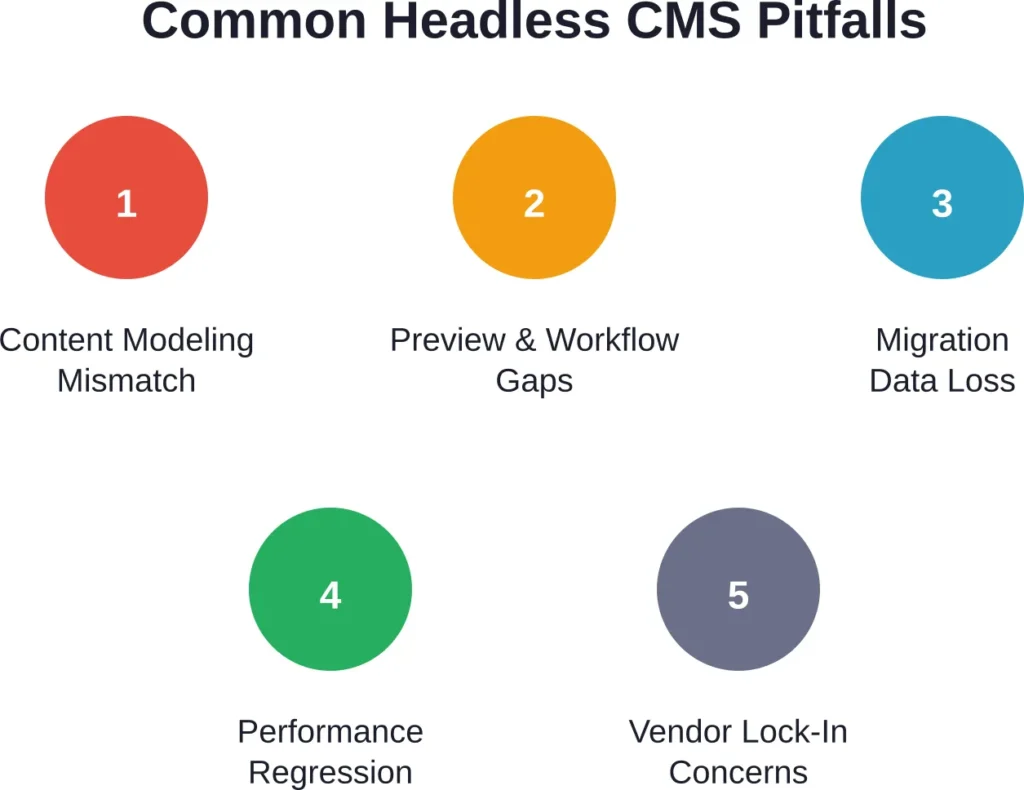
Common Headless CMS Implementation Challenges
Even well-planned headless CMS projects hit predictable obstacles. Knowing them upfront helps.
Content Modeling Mismatch
Teams often design content models that reflect how developers think about content structure rather than how editors actually work. That mismatch creates friction during publishing, leading to workarounds, inconsistent content, and eventually schema debt.
The solution: involve editorial stakeholders early, validate content models with real publishing workflows, and iterate based on feedback.
Preview and Workflow Gaps
Editorial teams expect WYSIWYG preview. Headless systems decouple content from presentation, making preview technically complex. Poor preview experiences slow publishing and reduce editorial confidence.
Good implementations configure robust preview environments that show content in production-like contexts before publishing. That requires frontend work, CMS configuration, and webhook integration—but it’s not optional if editors need to publish confidently.
Migration Data Loss
Legacy CMS systems accumulate content debt—duplicate entries, broken relationships, inconsistent metadata, and orphaned assets. Migrating everything creates problems in the new system.
Smart migrations audit content first, identify what’s actually used, clean data before migration, and leave legacy cruft behind. That requires discipline and stakeholder buy-in, but it prevents importing problems.
Performance Regression
Moving to headless CMS should improve performance. But poor frontend implementation, unoptimized images, excessive API calls, or misconfigured caching can make sites slower.
Agencies that measure Core Web Vitals during development catch performance issues early. Teams that treat performance as a post-launch optimization usually ship slow sites.
Vendor Lock-In Concerns
Proprietary platforms create lock-in risk. If Contentful raises prices 300% or changes terms, migrating off is expensive and disruptive.
Mitigation strategies include choosing platforms with data export capabilities, designing content models that aren’t platform-specific, and maintaining clean separation between CMS and frontend. Open-source options like Strapi reduce vendor risk but increase infrastructure responsibility.
Questions to Ask Before Hiring a Headless CMS Agency
These questions surface whether an agency has real experience or just marketing claims.
- How many headless CMS platforms have you delivered projects on? One platform means narrow expertise. Three or more suggests genuine platform-agnostic capability.
- Can you show case studies with documented outcomes? Features don’t matter—outcomes do. Ask for metrics: publishing velocity improvements, performance gains, SEO preservation during migration.
- What’s your content modeling process? If they skip discovery or design schemas without editorial input, they’ll deliver systems editors hate using.
- How do you handle migration? Detailed answers about URL preservation, redirect strategies, parallel system operation, and validation testing indicate real migration experience.
- Which frontend frameworks do you work with? Headless CMS requires strong frontend capability. Agencies that only do one framework have limited architectural flexibility.
- How do you configure preview environments? Editorial teams need preview. Vague answers suggest they haven’t solved this problem well.
- What post-launch support do you provide? Training, documentation, monitoring, and ongoing optimization matter as much as initial delivery.
Frequently Asked Questions
A headless CMS separates content management (the backend) from content presentation (the frontend). Content is stored and managed in the CMS then delivered via APIs to websites, mobile apps, voice interfaces, or any digital channel. Companies use headless architecture for omnichannel consistency, frontend flexibility, better performance, and the ability to swap systems independently without full rebuilds.
Costs vary widely based on project scope. Discovery and planning typically account for 10-15% of budgets. Content migration, frontend development, and API integration represent the largest costs. Platform licensing ranges from free (self-hosted Strapi) to usage-based pricing starting around $300 per month for commercial systems. Total project costs depend on complexity, integration requirements, and content volume.
No single platform is universally best. Contentful works well for enterprise content governance. Sanity suits developer-first teams building AI-driven workflows. Strapi fits startups needing full control and low cost. Storyblok serves marketing teams wanting visual editing. The best platform depends on editorial workflows, technical constraints, budget, and business requirements—not feature checklists.
Timelines vary by scope. Greenfield projects with simple content models can launch in 8-12 weeks. Complex migrations from legacy enterprise CMSs with extensive integrations often take 6-12 months. Discovery and content modeling phases typically take 2-4 weeks. Frontend development and integration account for most timeline. Phased rollouts reduce risk and shorten time-to-value.
Yes. Headless CMS platforms provide APIs that integrate with CRM systems, ecommerce platforms, marketing automation tools, analytics, and other enterprise software. Integration complexity depends on how many systems need connections and whether APIs already exist. Well-architected integrations use webhooks, message queues, and data synchronization patterns to keep systems aligned.
SEO preservation requires careful planning. Good migrations map old URLs to new ones, configure 301 redirects for changed URLs, preserve metadata and structured data, maintain internal linking structures, and monitor rankings during cutover. Agencies with migration experience validate SEO before and after launch, monitoring traffic and adjusting as needed to prevent ranking losses.
Not necessarily, but it depends on the platform and configuration. Storyblok and Contentful provide visual interfaces suitable for non-technical editors. Sanity’s schema-as-code approach requires more technical literacy. Good implementations customize editorial interfaces to match how teams actually work, provide training, document workflows, and configure preview environments that reduce publishing friction. Adoption depends more on interface design than platform choice.
Conclusion: Choosing the Right Headless CMS Development Partner
The headless CMS market is growing 2-3x faster than the overall CMS market for good reason. Brands need omnichannel content delivery, frontend flexibility, and the ability to evolve systems without monolithic rebuilds.
But technology alone doesn’t deliver those outcomes. The development partner matters as much as the platform.
The best headless CMS agencies recommend platforms based on your context, not their preferences. They lead content modeling workshops that involve editorial stakeholders. They have documented migration experience with SEO preservation and uptime guarantees. They build performant frontends that measure Core Web Vitals. And they provide training and support that ensures adoption.
The 15 agencies ranked here—WeframeTech, Bits Orchestra, The Frontend Company, Webstacks, Focus Reactive, Naturaliy, Commerce-UI, ScienceSoft, NascentCure, and RBMSoft—each excel in different contexts. Funded SaaS companies need different capabilities than enterprise retailers or mid-market manufacturers.
Start by mapping your requirements: editorial workflows, technical constraints, integration needs, budget, and timeline. Then talk to agencies whose specialization aligns with your context. Ask about content modeling process, migration experience, frontend patterns, and post-launch support.
The right partner will ask as many questions as they answer. Because successful headless CMS implementations start with understanding your business, not pushing a platform.
Ready to explore headless CMS for your organization? Start with content modeling workshops and platform evaluation—before any code gets written or systems get selected. That upfront work determines whether your CMS becomes a strategic asset or a maintenance burden.