
Quick Summary: 3D BIM costs range from $3,150/year for Revit software licenses to over $200,000 for large-project coordination. Modeling services typically cost $0.50–$10+ per square foot, depending on complexity and LOD requirements. Training adds $799–$2,399 per participant, while hardware investments run around $3,000 per workstation. ROI potential is significant: a $200,000 BIM coordination investment can generate $2,500,000 in returns through clash detection and rework prevention.
The question “how much does 3D BIM cost” doesn’t have a single answer. And that’s because BIM implementation is not a one-time purchase—it’s an ecosystem of software, hardware, training, and ongoing services.
Some firms spend $3,000 getting a single workstation up and running. Others invest hundreds of thousands on comprehensive coordination for a hospital or airport expansion.
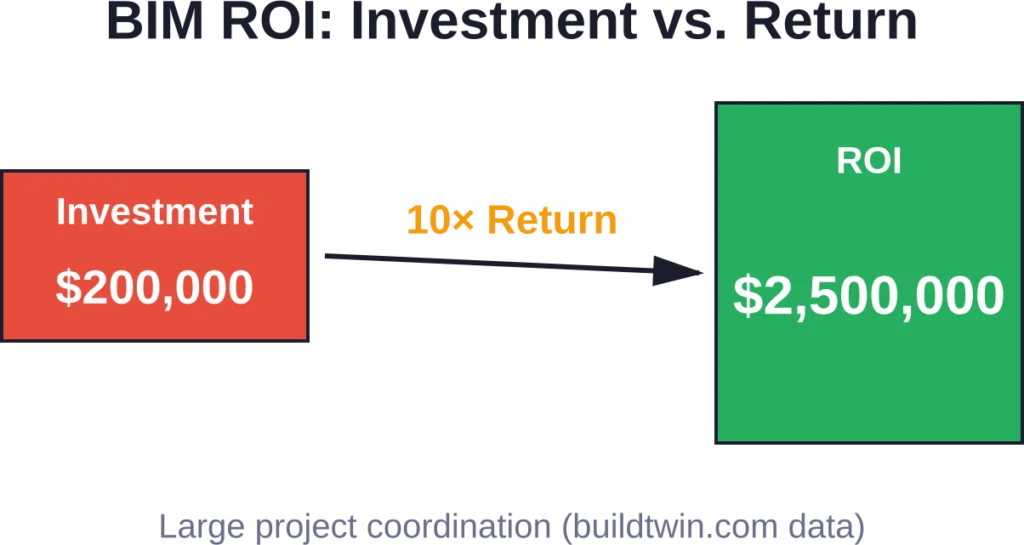
Here’s the thing though—cost alone doesn’t tell the full story. What matters is how BIM investments translate into efficiency gains, clash detection, rework prevention, and ultimately, ROI. According to buildtwin.com, a $200,000 BIM coordination investment on a large project can generate $2,500,000 in returns—a 10× multiplier.
This guide breaks down the real numbers for 2026: software subscriptions, modeling service rates, training programs, hardware setups, and the hidden costs that catch teams off guard. Data comes from verified sources including snaptrude.com, buildingsmart.org, and graduateschool.edu pricing schedules.
BIM Software Licensing Costs
Software is the foundation of any BIM workflow. Costs vary wildly depending on the tool, seat count, and whether teams opt for annual subscriptions or multi-year agreements.
Autodesk Revit Pricing
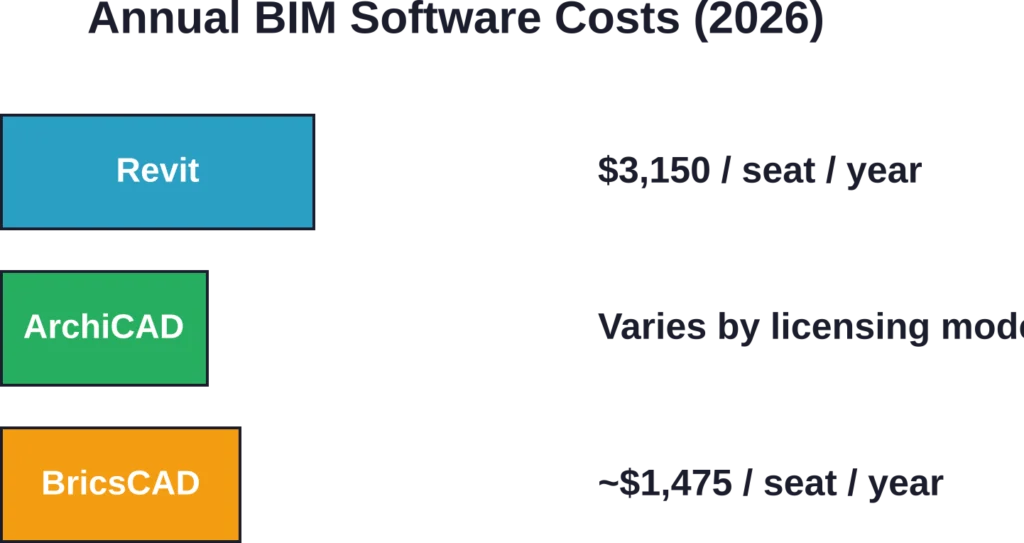
Revit remains the most widely adopted BIM platform for architecture, structure, and MEP coordination. As of 2026 pricing data from snaptrude.com, Autodesk Revit costs approximately $3,150 per seat annually.
That’s for the full version. Revit LT, a lighter edition without some advanced features, runs around $560/year according to competitor analysis—but it’s rarely sufficient for serious BIM work on multi-discipline projects.
For large firms managing dozens of licenses, Autodesk offers enterprise agreements with volume discounts. Real talk: don’t expect transparent pricing on those—contact sales directly.
ArchiCAD and Alternatives
Graphisoft ArchiCAD pricing varies by licensing model (specific annual cost not provided in verified sources). That said, ArchiCAD has a loyal following among design-focused practices and is generally considered a cost-effective alternative to Revit.
BricsCAD BIM runs around $1,475/year—roughly half of Revit’s annual cost. It’s a solid option for smaller teams that need BIM capability without the Autodesk ecosystem lock-in.
But wait. Software cost is just the starting line. The bigger hidden expense? Onboarding time. Industry sources indicate significant onboarding time is required for Revit proficiency. That translates to months before a new hire becomes fully productive—factor that labor cost into your total.
Cloud Collaboration Add-Ons
Modern BIM workflows demand cloud coordination tools. These aren’t included in base software licenses.
Cloud collaboration add-on costs vary by platform and service tier, with options ranging from entry-level solutions to comprehensive coordination platforms. These tools handle model versioning, clash detection coordination, issue tracking, and field data integration. For distributed teams working on active construction sites, cloud coordination capability is essential.
BIM Modeling Services: What You’ll Actually Pay
Not every firm builds models in-house. Many outsource to specialized BIM service providers—especially for retrofit work, scan-to-BIM conversions, or overflow capacity during peak project loads.
Per-Square-Foot Pricing Models
Modeling service rates are usually quoted per square foot, with massive variation based on building type and Level of Development (LOD).
Competitor analysis shows typical ranges:
| Building Type | Complexity | LOD Target | Price Range ($/sq ft) |
|---|---|---|---|
| Industrial Shell | Low | LOD 200 | $0.10 – $0.30 |
| Commercial Office | Medium | LOD 300 | $0.40 – $1.20 |
| Heritage / Retail | High | LOD 300-350 | $0.80 – $2.50 |
| MEP / Plant Rooms | Extreme | LOD 350-400 | $3.00 – $10.00+ |
That $10+ ceiling for dense MEP isn’t a typo. Mechanical rooms, data centers, and process plants pack hundreds of components per square foot. A 500-square-foot server room can cost $5,000+ to model accurately.
Moving from LOD 200 to LOD 300 typically increases modeling complexity and labor requirements for the same area. More detail means more labor—simple as that.
Scan-to-BIM Project Costs
Scan-to-BIM combines on-site laser scanning with point-cloud-to-model conversion. Total project costs vary enormously.
Competitor sources report typical U.S. ranges from $2,500 to over $200,000 for complete scan-to-BIM projects. Small projects (1,500 sq ft or less) typically have minimum mobilization fees starting around $2,500–$3,500. Large facilities (hospitals, airports, industrial plants) can easily hit six figures.
Scanning fees alone often start around $2,000 for mobilization and basic data capture. Modeling costs stack on top, typically $2,000 to $50,000+ depending on asset size and complexity.
The shift in 2026? Many providers are moving away from fixed per-square-foot rates toward day-rate or fixed-lump-sum pricing for complex or active sites. Why? Because MEP density and access challenges matter more than raw floor area.
Training and Enablement Expenses
Software licenses are useless without trained operators. Training is where hidden costs accumulate fast.
Formal Certification Programs
Graduate School USA offers structured Revit training with verified pricing:
- Intro to Revit Course (30 hours): $799 per participant
- Revit Certification program: $2,399 per participant
Both include 30 days of software access, project-based exercises, and digital certificates. For a team of five, that’s $4,000–$12,000 just for initial onboarding.
Competitor data shows in-person workshops from providers like Ace Industrial Academy range from $200 to $2,000 per participant. Online alternatives run $200 to $1,500 per course—more cost-effective for time-starved teams.
Ongoing Learning and Updates
BIM tools evolve constantly. Annual refresher training isn’t optional if teams want to leverage new features like generative design, AI-assisted detailing, or enhanced interoperability standards.
Budget at minimum $500–$1,000 per active user per year for ongoing enablement. Larger firms often hire dedicated BIM managers or consultants to run internal training—that’s another salary line item.
Get 3D BIM Support for Design and Coordination
Powerkh works with project teams that need BIM support across design, coordination, and construction stages. Its services include BIM modelling, clash coordination, detailing, and technical documentation for complex building projects.
Need 3D BIM Support for a Project?
Talk with Powerkh to:
- build BIM models for design and coordination
- support structural and MEP project delivery
- prepare coordinated construction documentation
- improve model readiness before construction starts
Talk with Powerkh about BIM delivery support for your project.
Hardware and Workstation Investments
BIM software demands serious computing power. Revit, ArchiCAD, and Navisworks choke on outdated hardware.
Recommended Workstation Specs
According to corroborated BIM industry data, a typical BIM workstation setup costs around $3,000 per unit. That includes:
- Multi-core CPU (Intel i7/i9 or AMD Ryzen 7/9)
- 32 GB RAM minimum (64 GB preferred for large models)
- Dedicated GPU with 6–8 GB VRAM (NVIDIA RTX series)
- NVMe SSD storage (1 TB+)
- Dual monitors (24″ minimum)
Cloud workstations are gaining traction as an alternative. Services like Autodesk’s cloud computing allow teams to offload rendering and simulation without investing in physical hardware upfront. Subscription costs vary, but they eliminate the $3,000 per-seat capital expense.
For a 10-person team going the traditional route, expect $30,000+ in hardware before anyone opens a model.
Implementation and Consultancy Fees
Standing up a BIM workflow from scratch requires more than software and training. Firms often hire BIM consultants to develop execution plans, set standards, configure templates, and establish coordination protocols.
Typical Consultant Rates
Corroborated SERP data shows typical hourly/project rates for BIM professionals:
| Role | Scope | Typical Rate ($/month or project) |
|---|---|---|
| BIM Consultant | Strategic planning, BEP development, standards | $8,000 – $10,000 |
| BIM Manager | Team coordination, quality control, clash resolution | $5,000 – $8,000 |
| BIM Modeller | 3D modeling, documentation, coordination drawings | $4,000 – $5,000 |
For short-term implementation projects (3–6 months), budget $25,000–$60,000 for consultant fees. Ongoing BIM management often becomes a full-time internal role as projects scale.
Real-World ROI: When BIM Costs Pay Off
Okay, so what about the return side of the equation?
Authoritative data from buildtwin.com shows that BIM coordination on large projects delivers measurable value:
- $200,000 investment → $2,500,000 ROI (10× return)
- 50% rework prevention through automated clash detection
- 17% cost savings on typical projects from clash detection implementation
- 35% operational energy savings in healthcare facilities using BIM energy simulation
Buildingsmart.org reports real savings from the Guangzhou Baiyun International Airport Terminal 3 project:
- ¥2,600,000 in cost savings through spatial optimization in preliminary design
- 5–8× human efficiency improvement with wall plastering robots using IFC models
- 100% improvement in construction efficiency with digital equipment integration
Those aren’t marginal gains. BIM doesn’t just digitize drawings—it fundamentally reshapes how teams identify conflicts, sequence work, and manage asset data post-construction.
Hidden Costs Teams Often Miss
Beyond the obvious line items, several hidden expenses catch firms off guard.
Interoperability and Data Exchange
Not all project stakeholders use the same BIM platform. IFC (Industry Foundation Classes) file exchange is supposed to solve this, but in practice, data loss and translation errors still occur.
Teams often spend hours cleaning up imported models, re-mapping properties, and verifying geometry. That labor cost doesn’t appear in software quotes, but it’s real.
Model Maintenance and Updates
BIM models aren’t static deliverables. They require continuous updates as design evolves, RFIs are answered, and field conditions change.
For design-build or IPD projects, expect ongoing modeling costs throughout construction—sometimes 10–20% of the initial modeling budget per year.
Low-Quality Model Risks
Cheapest bid isn’t always the best bid. Competitor sources warn that low-quality scan-to-BIM models can cost more in the long run:
- Inaccurate dimensions requiring field rework
- Missing or mis-classified elements breaking clash detection
- Non-standard naming conventions preventing automated data extraction
- Bloated file sizes that slow collaboration and clash coordination
Paying $0.30/sq ft instead of $0.80/sq ft sounds great—until the model fails during coordination and requires a complete rebuild.
How to Budget for BIM: Practical Frameworks
So how should firms actually plan BIM budgets?
Small Firms (1–10 People)
Minimum viable setup:
- 2–3 software seats: $6,000–$9,000/year
- 3 workstations: $9,000 one-time
- Initial training (2 people): $1,600–$4,800
- Cloud collaboration: $1,800–$3,000/year
Year-one total: ~$18,000–$26,000
Ongoing annual cost (software + cloud + refresher training): $10,000–$15,000
Mid-Size Firms (10–50 People)
- 10–15 software seats: $30,000–$45,000/year
- 12 workstations: $36,000 one-time
- Training (10 people): $8,000–$24,000
- BIM manager (part-time or consultant): $30,000–$60,000/year
- Cloud collaboration: $9,000–$15,000/year
Year-one total: ~$113,000–$180,000
Ongoing annual cost: $70,000–$120,000
Large Firms or Major Projects
Enterprise implementations can easily exceed $500,000 in year one when including:
- 30+ seats across disciplines
- Full-time BIM department (manager + coordinators + modelers)
- Custom template and standards development
- Integration with ERP, project management, and facility management systems
- Ongoing consultant support
But as the buildtwin.com data shows, a $200,000 coordination investment can return $2,500,000. At that scale, BIM shifts from cost center to competitive advantage.
How to Get Accurate Quotes
Generic pricing guides help, but every project is different. Here’s how to get reliable quotes from BIM service providers:
Provide Detailed Scope Information
- Total square footage and number of floors
- Building type and occupancy classification
- Desired LOD for each discipline (arch, struct, MEP)
- Existing documentation (CAD files, PDF drawings, point cloud data)
- Deliverable format requirements (Revit, IFC, Navisworks, PDFs)
- Project timeline and milestone deadlines
The more specific the scope, the tighter the quote. Vague RFPs get padded bids.
Request Sample Deliverables
Ask for sample models from past projects of similar type and complexity. This reveals modeling standards, family quality, and level of detail before you commit.
Clarify What’s Included vs. Extra
Does the quote include clash detection runs? Model coordination meetings? Revisions based on RFIs? Delivery of IFC files in addition to native formats?
Assumptions buried in fine print become change orders later.
FAQ
Autodesk Revit costs approximately $3,150 per seat annually as of 2026 pricing data from snaptrude.com. Revit LT, a lighter version, runs around $560/year but lacks advanced features needed for multi-discipline coordination.
BIM modeling services typically cost $0.50 to $10+ per square foot, depending on building type, complexity, and LOD requirements. Simple industrial shells at LOD 200 may cost $0.10–$0.30/sq ft, while dense MEP plant rooms at LOD 350–400 can exceed $10/sq ft.
Total scan-to-BIM project costs range from $2,500 to over $200,000 in the U.S. market. Small projects (1,500 sq ft or less) typically have minimum mobilization fees starting around $2,500–$3,500, while large facilities (hospitals, airports) can hit six figures due to scanning mobilization, data processing, and detailed modeling.
Hidden costs include ongoing training ($500–$1,000/user/year), model maintenance during construction (10–20% of initial modeling cost annually), interoperability troubleshooting, and low-quality model rework. Teams should also account for significant onboarding time required for new Revit users.
Authoritative data from buildtwin.com shows BIM coordination can deliver a 10× ROI—a $200,000 investment generating $2,500,000 in returns. Benefits include 50% rework prevention, 17% project cost savings from clash detection, and 35% operational energy savings in healthcare facilities. At scale, BIM transforms from expense to competitive advantage.
Formal Revit training from Graduate School USA costs $799 for a 30-hour introductory course or $2,399 for a certification program. In-person workshops range from $200–$2,000 per participant; online courses run $200–$1,500. Budget at least $1,000–$2,500 per team member for initial onboarding.
A typical BIM workstation costs around $3,000 and includes a multi-core CPU (Intel i7/i9 or AMD Ryzen 7/9), 32–64 GB RAM, a dedicated GPU with 6–8 GB VRAM (NVIDIA RTX series), and NVMe SSD storage. Cloud workstations are emerging as an alternative to upfront capital expense.
Conclusion
So, how much does 3D BIM cost? The honest answer: it depends on scope, scale, and how seriously a firm commits to the technology.
Small teams can get started for $18,000–$26,000 in year one. Mid-size firms should budget $113,000–$180,000. Enterprise implementations and major project coordination easily reach six figures.
But the ROI data is compelling. A $200,000 BIM coordination investment can return $2,500,000. Clash detection prevents 50% of rework. Energy simulation cuts operational costs by 35% in healthcare facilities. Spatial optimization saved ¥2,600,000 in preliminary design on the Guangzhou airport expansion.
The real question isn’t whether BIM costs money—it’s whether firms can afford not to invest. In 2026, BIM capability is table stakes for competitive bidding on complex projects. Clients expect it. Contractors demand it. Facility managers rely on it post-handover.
Start with accurate quotes. Clarify scope, LOD requirements, and deliverable formats. Budget for training and ongoing enablement, not just software seats. And remember: the cheapest bid often costs the most in rework and coordination failures.
Ready to explore BIM implementation for your next project? Request detailed quotes from at least three providers, compare sample deliverables, and factor in the full lifecycle cost—not just the sticker price.