
Quick Summary: 3D scanning costs vary widely based on project scope and technology. Professional services typically range from $1,000 for single-room scans to $50,000+ for large facilities, with hourly rates between $150-$500. Purchasing equipment ranges from $300 for hobbyist scanners to $100,000+ for industrial-grade systems. Most commercial projects fall between $3,000-$15,000.
The 3D scanning market has reached a critical inflection point. According to MarketsandMarkets, the global 3D printing market was estimated at USD 16.16 billion in 2025 and is projected to hit USD 35.79 billion by 2030, growing at a CAGR of 17.2%. This explosive growth reflects one reality: precise spatial data has become non-negotiable for modern businesses.
But here’s what nobody tells professionals researching scanning costs — the pricing structure is intentionally opaque. Service providers quote wildly different rates. Equipment manufacturers bury actual costs behind “contact sales” forms.
This guide cuts through that noise with verified pricing data from multiple market sources and real project examples.
Understanding 3D Scanning Technology and Its Cost Drivers
3D scanning technology captures physical objects or environments and converts them into digital models. The cost varies dramatically based on which technology the project demands.
Laser scanning uses time-of-flight or phase-shift technology to measure millions of points per second. Photogrammetry reconstructs 3D models from 2D photographs using computational algorithms. Structured light projects patterns onto surfaces to calculate depth and geometry.
Each technology carries different accuracy thresholds, capture speeds, and equipment costs. A manufacturing tolerance inspection requiring ±0.01mm accuracy demands different (read: expensive) equipment than architectural documentation accepting ±5mm variance.
Market Growth Context
The North American market specifically reached USD 5.95 billion in 2025 and is forecast to grow to USD 12.02 billion by 2030 at a 15.1% CAGR. The United States holds 85.6% of that regional market share, driving most pricing standards and service availability.
That growth brings both opportunities and challenges. More providers mean competitive pricing, but also greater variation in quality and capabilities.
Professional Service Pricing: What Projects Actually Cost
Professional scanning services bill either hourly or per-project. The industry has settled into reasonably consistent pricing tiers, though regional variations exist.
Based on comprehensive market research, hourly rates typically range from $150 to $500. That spread reflects equipment sophistication, operator expertise, deliverable complexity, and geographic market dynamics.
Project-Based Pricing Breakdown
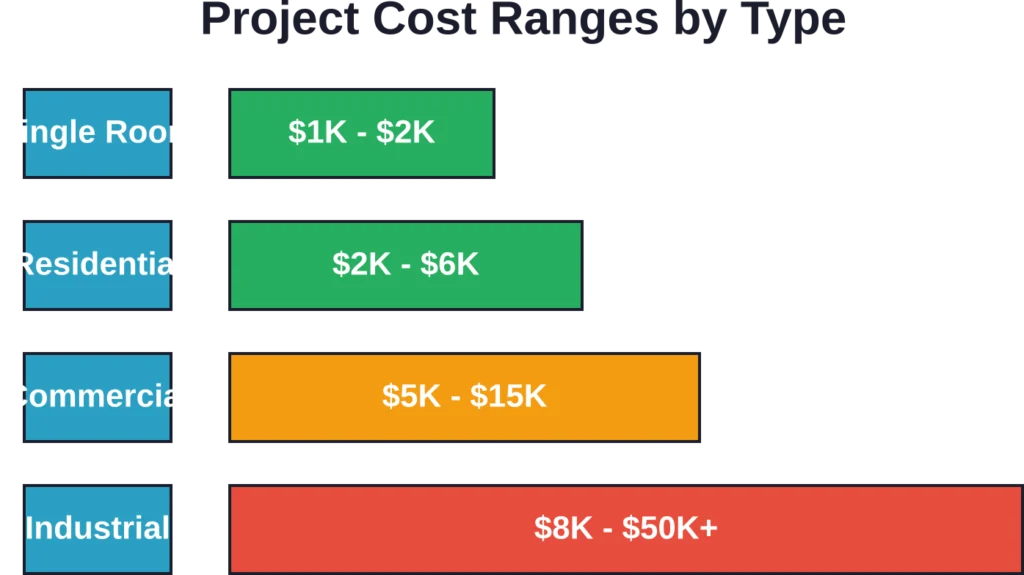
Most commercial clients prefer fixed project quotes over hourly billing. Here’s what different project types actually cost:
| Project Type | Typical Cost Range | Per Square Foot Rate | Timeline |
|---|---|---|---|
| Single room/small area | $1,000 – $2,000 | N/A (minimum project) | 1-2 hours |
| Residential (full home) | $2,000 – $6,000 | $0.40 – $0.70/sqft | 1 day |
| Small commercial space | $3,000 – $8,000 | $0.30 – $0.60/sqft | 1-2 days |
| Single building construction | $5,000 – $15,000 | $0.25 – $0.50/sqft | 2-4 days |
| Industrial facility section | $8,000 – $20,000 | $0.20 – $0.45/sqft | 3-7 days |
| Large multi-structure campus | $50,000+ | $0.15 – $0.40/sqft | 2-4 weeks |
Real talk: these ranges represent typical mid-market providers using professional-grade equipment. Budget providers exist at 20-30% below these rates, but accuracy and deliverable quality often suffer accordingly.
Object and Component Scanning
Product development and reverse engineering projects follow different pricing models since they measure parts rather than buildings.
- Small objects or components: $150 – $500
- Medium-sized parts or assemblies: $500 – $2,000
- Large objects (vehicles, machinery, architectural elements): $2,000 – $10,000+
These projects often require metrology-grade accuracy. That precision demands specialized equipment and experienced operators, which pushes rates toward the higher end of quoted ranges.
Equipment Purchase Costs: Buy vs. Outsource Analysis
Purchasing scanning equipment makes sense for organizations with recurring needs. But the upfront investment requires careful analysis.
Entry-level handheld scanners start around $300 for hobbyist-grade devices. Community discussions on forums indicate that prosumer-grade scanners cost between $1,500 and $2,000, offering decent accuracy for basic applications.
Professional scanners range from $5,000 to $30,000 for mid-tier systems. Industrial metrology-grade equipment exceeds $100,000 — and that’s before factoring in annual calibration, maintenance, and software licensing fees.
Cost-Effectiveness Threshold
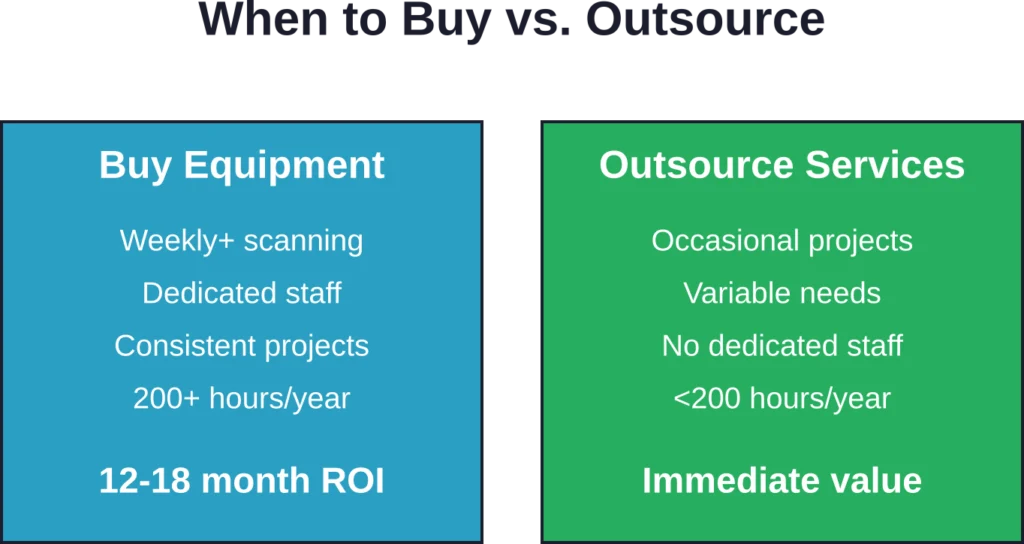
Here’s the math most companies miss: at $150-$500 per hour for professional services versus $100,000+ for industrial equipment, the break-even point sits somewhere between 200-700 scanning hours.
For the average company scanning 2-3 projects per year, outsourcing remains dramatically more cost-effective. Organizations scanning weekly or more should explore equipment purchase.
| Scanner Category | Price Range | Typical Accuracy | Best Use Case |
|---|---|---|---|
| Hobbyist/Consumer | $300 – $1,000 | ±2-5mm | Basic 3D printing, art projects |
| Prosumer | $1,500 – $5,000 | ±0.5-2mm | Small business, education |
| Professional | $5,000 – $30,000 | ±0.1-0.5mm | Architecture, manufacturing |
| Industrial/Metrology | $30,000 – $100,000+ | ±0.01-0.1mm | Quality inspection, aerospace |
Hidden Costs and Additional Expenses
Published rates rarely include the full cost picture. Several additional expenses can significantly impact total project costs.
Data processing and deliverable preparation often cost 30-50% of scan time. A four-hour site scan might require six additional hours of office processing to deliver clean CAD models or BIM-ready files.
Travel and mobilization fees apply for service providers. Expect $150-$500 for local travel, more for regional projects requiring overnight stays or equipment shipping.
Scan-to-BIM Services
Converting raw point clouds into intelligent Building Information Models requires specialized expertise. This specialized service typically costs between $0.50 and $10.00 per square foot, depending on model detail level and complexity.
That wide range reflects LOD (Level of Development) requirements. Basic LOD 200 models cost substantially less than highly detailed LOD 400 models with full parametric components.
Key Factors Driving Cost Variation
Understanding what actually drives costs helps evaluate quotes and budget appropriately.
Project Complexity and Site Conditions
Occupied buildings cost more than empty ones. Active construction sites require additional safety protocols and coordination. Hazardous environments demand specialized equipment and operator certifications.
Architectural complexity matters enormously. A 10,000-square-foot warehouse scans faster and cheaper than a 5,000-square-foot building with intricate facades, multiple levels, and dense mechanical systems.
Required Accuracy and Deliverable Format
Accuracy requirements directly correlate with cost. ±10mm accuracy for basic documentation uses different (less expensive) equipment and workflows than ±1mm precision for manufacturing integration.
Deliverable format impacts processing time. Raw point clouds deliver fastest and cheapest. Cleaned and registered point clouds cost more. Full CAD models or BIM integration multiply costs significantly.
Geographic Location
Regional market dynamics create significant pricing variation. Urban markets with multiple providers tend toward competitive rates. Rural or remote locations command premium pricing due to limited provider availability and travel costs.
The North American market shows particular concentration. Major metros like New York, Chicago, Los Angeles, and Toronto offer abundant provider options and competitive pricing. Secondary markets often see 20-30% premium rates.
Get 3D Scanning and Existing Conditions Support
Powerkh supports construction and design teams with laser scanning, point cloud processing, and existing conditions modelling. Its services help teams work from accurate site data before design and construction begin.
Need 3D Scanning Support for a Project?
Talk with Powerkh to:
- capture existing building conditions
- process point cloud data for BIM workflows
- prepare accurate existing conditions models
- support renovation, retrofit, and coordination projects
Discuss laser scanning and existing conditions requirements with Powerkh.
Industry-Specific Applications and Pricing
Different industries have developed specialized scanning workflows with corresponding pricing norms.
Architecture and Construction
Construction documentation represents the largest commercial application. Projects typically bill per-square-foot with rates from $0.20 to $0.70 depending on complexity, accuracy requirements, and deliverable detail.
As-built documentation for renovation projects sits at the lower end. New construction progress documentation with BIM integration costs more. Historic preservation requiring extreme detail commands premium rates.
Manufacturing and Reverse Engineering
Manufacturing applications demand higher accuracy, driving costs upward. Reverse engineering a single component might cost $500-$2,000 depending on size and complexity.
Quality inspection and dimensional analysis projects often bill hourly at $200-$500 due to metrology-grade equipment requirements and specialized expertise.
Healthcare and Dental Applications
The dental 3D printing market is projected to reach USD 10.06 billion by 2030 from USD 3.96 billion in 2025, at a CAGR of 20.5%. That growth reflects widespread adoption of intraoral scanners and digital workflows.
Intraoral scanner costs range from $15,000 to $40,000 for practice-owned equipment. Per-scan service fees through third-party providers run $50-$200 depending on application complexity.
Evaluating Service Providers: What Actually Matters
Low bids often hide quality compromises that cost more in the long run. Several factors separate professional providers from budget operators.
Equipment calibration and maintenance records matter. Uncalibrated scanners deliver inaccurate data that creates costly errors downstream. Professional providers maintain documented calibration schedules and quality control protocols.
Operator experience and certification significantly impact deliverable quality. The cheapest quote usually comes from the newest operator with the least experience.
Deliverable Quality and File Standards
Point cloud density, noise levels, and registration accuracy separate professional work from amateur output. Request sample deliverables and technical specifications before committing.
File format compatibility matters for downstream workflows. Ensure providers deliver formats compatible with intended software systems — incompatible formats create expensive rework.
Technology Trends Affecting 2026 Pricing
Several emerging technologies are reshaping cost structures and capability expectations.
Smartphone-integrated lidar has reached surprising capability levels. Recent smartphone LiDAR technology has reached surprising capability levels, with some research suggesting consumer-grade systems approaching professional-grade results. This democratization will pressure pricing at the entry and mid-market levels.
AI-powered automation increasingly handles data processing tasks that previously required manual labor. This reduces processing time and costs, though high-end providers capture those savings as margin rather than passing them to clients.
Cloud Processing and Collaboration
Cloud-based processing platforms reduce hardware requirements and enable distributed collaboration. Providers leveraging these platforms can offer faster turnaround and lower costs compared to traditional desktop processing workflows.
But wait. Not all cloud platforms deliver equivalent quality or security. Healthcare, defense, and other regulated industries often require on-premise processing for data security compliance, which maintains traditional cost structures.
Return on Investment Considerations
Scanning costs should be evaluated against the value they create, not just the invoice amount.
Accurate as-built documentation prevents costly field conflicts during construction. Industry analyses indicate that early clash detection through scan-based coordination saves 10-15% of total project costs by preventing rework.
Manufacturing applications show even stronger ROI. Reverse engineering legacy components eliminates expensive downtime waiting for obsolete parts. Quality inspection catches defects before they reach production, preventing warranty claims and product recalls.
Budgeting and Cost Planning Strategies
Accurate budgeting requires understanding the full project lifecycle, not just scan acquisition costs.
Plan for 1.5x to 2x the base scanning quote when budgeting total project costs. This accounts for data processing, quality verification, format conversions, and revision rounds that inevitably emerge during project execution.
Request detailed scope documents before committing. Vague scopes create change orders and cost overruns. Professional providers document exactly what’s included: scan resolution, deliverable formats, processing level, revision allowances, and timeline.
Competitive Bidding Best Practices
Lowest bid rarely delivers best value. Evaluate quotes on technical merit, not just price. Compare equipment specifications, operator qualifications, sample deliverables, and project timelines alongside cost.
Request references from similar projects. A provider’s residential portfolio doesn’t qualify them for complex industrial work, regardless of competitive pricing.
Future Market Outlook and Pricing Trends
Market dynamics suggest continued downward pressure on entry-level and mid-market pricing through 2030, while premium services maintain or increase rates.
Technology democratization through smartphone integration and consumer-grade scanners will compress pricing at the low end. Professional and industrial segments will likely see stable or increasing rates as complexity and accuracy requirements rise.
The fragmented competitive landscape — where top players hold only 20-35% collective market share in specialized segments like dental 3D printing — prevents pricing consolidation. Regional and emerging players holding 65-80% of market share maintain competitive pressure on rates.
Frequently Asked Questions
Residential homes typically cost $2,000 to $6,000 for complete 3D laser scanning, averaging $0.40-$0.70 per square foot. Final costs depend on home size, architectural complexity, furniture density, and required deliverable detail. Single-room scans start around $1,000, while large estates can exceed $10,000.
Outsourcing makes financial sense for most organizations. Equipment costs $5,000-$100,000+ for professional systems, with additional maintenance, calibration, and software licensing. At typical service rates of $150-$500 per hour, break-even requires 200-700 scanning hours. Organizations scanning less than weekly should outsource.
Price differences primarily reflect equipment accuracy, operator expertise, and deliverable quality. Budget providers often use entry-level scanners with ±2-5mm accuracy, while premium services deploy metrology-grade systems achieving ±0.01-0.1mm precision. Processing quality, file cleanliness, and technical support also vary significantly across price tiers.
Industrial scanning services typically charge $200-$500 per hour depending on accuracy requirements and equipment sophistication. Manufacturing tolerance inspections requiring metrology-grade precision cost more than general documentation work. These rates include operator expertise, calibrated equipment, and basic data processing but often exclude advanced deliverable preparation.
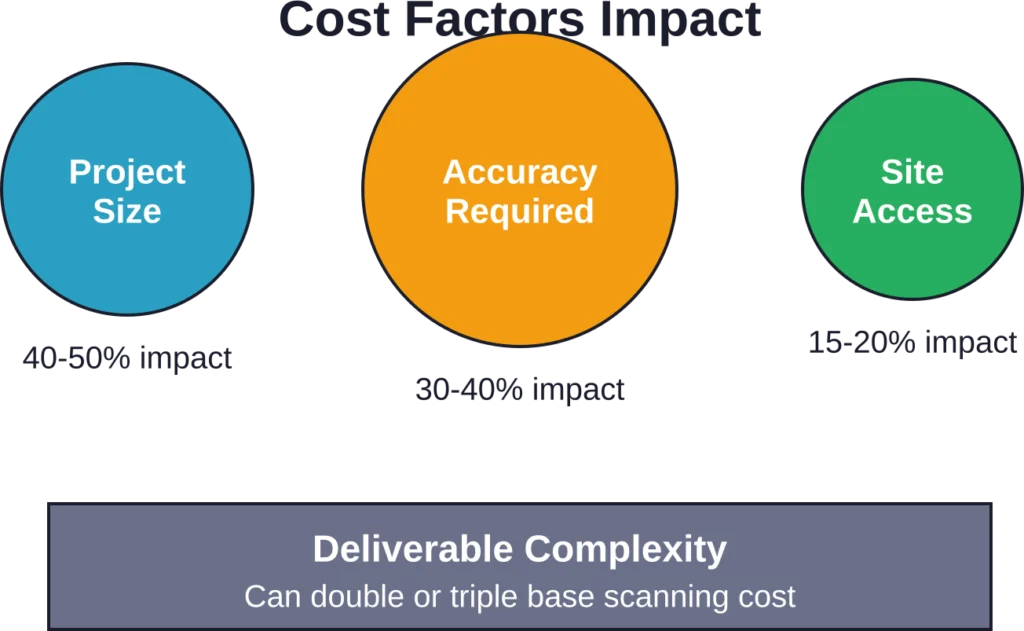
Required accuracy drives costs more than any other factor — metrology-grade precision can double or triple base rates. Project complexity, site access challenges, deliverable format requirements, and processing detail also significantly impact final costs. Converting raw scans to BIM models adds $0.50-$10.00 per square foot depending on detail level.
Smartphone-based scanning works for basic applications but can’t replace professional services for most commercial needs. Smartphone LiDAR technology has produced surprisingly capable systems, though accuracy, range, and data quality remain far below professional-grade equipment required for construction documentation, manufacturing, or quality inspection.
Scan-to-BIM services typically cost $0.50 to $10.00 per square foot depending on model detail level. Basic LOD 200 models cost substantially less than highly detailed LOD 400 models with full parametric components. This specialized service requires significant manual modeling work beyond basic scan processing, which drives the premium pricing.
Making the Right Investment Decision
3D scanning costs span an enormous range because applications, accuracy requirements, and project complexity vary just as widely. Understanding what drives those costs helps evaluate quotes, budget appropriately, and select providers who deliver value rather than just low prices.
The market continues rapid growth — USD 16.16 billion in 2025 expanding to USD 35.79 billion by 2030 — driven by increasing recognition that accurate spatial data prevents costly errors and enables workflows impossible with traditional methods.
For most organizations, professional services deliver better value than equipment purchase. The break-even point sits around 200-700 hours of annual scanning, which exceeds typical project volumes for all but dedicated scanning operations or large manufacturing facilities.
So here’s the thing: focus budget discussions on project value and ROI rather than just acquisition costs. A $5,000 scan that prevents a $50,000 construction conflict delivers extraordinary value. A $500 budget scan with insufficient accuracy that creates rework costs far more than the savings.
Request detailed scopes, compare technical capabilities alongside pricing, and verify provider qualifications before committing to any 3D scanning project.