
Quick Summary: Drinking non-alcoholic beer every day is generally safe for most people and may offer cardiovascular benefits, but it depends on individual circumstances. Non-alcoholic beer contains up to 0.5% alcohol by volume, which is negligible for the general population but may pose risks for pregnant women, those in recovery from alcohol use disorder, or people taking certain medications. Research suggests moderate daily consumption (1-2 servings) can support heart health through polyphenol content, though individuals should consider their personal health goals and consult healthcare providers when appropriate.
The non-alcoholic beer market has exploded over the past few years. Walk into any grocery store and you’ll find shelves stocked with craft NA options that actually taste good.
But here’s the question everyone’s asking: is it actually okay to drink this stuff every single day?
The answer isn’t as straightforward as you might hope. While non-alcoholic beer offers some legitimate health benefits backed by research, it’s not a free pass for unlimited consumption. Context matters—your health history, your relationship with alcohol, and your daily habits all play a role.
Let’s break down what science actually says about daily non-alcoholic beer consumption, who should avoid it, and what health benefits (or risks) you might encounter.
What Actually Qualifies as Non-Alcoholic Beer?
First things first: non-alcoholic beer isn’t completely alcohol-free in most cases.
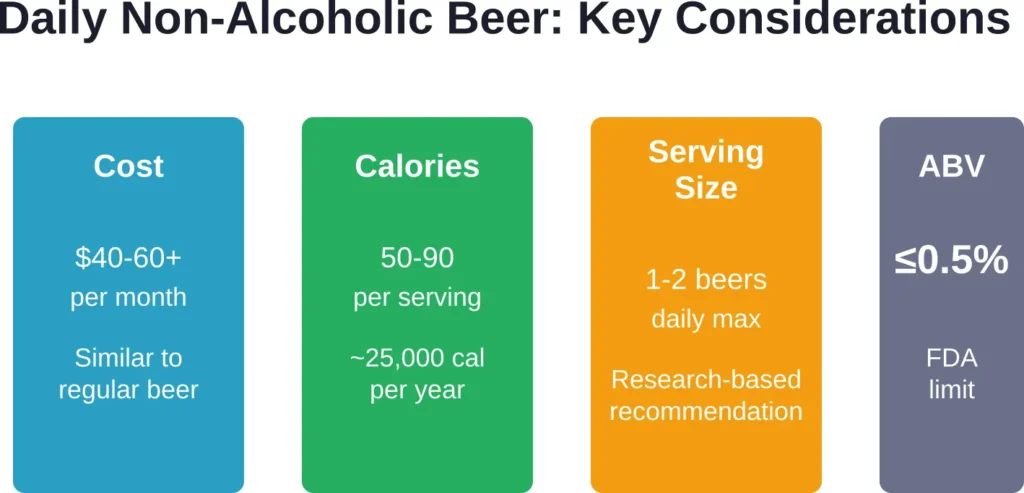
According to FDA regulations, beverages labeled “non-alcoholic” can contain up to 0.5% alcohol by volume. That’s the legal threshold. Most non-alcoholic beers fall between 0.4–0.5% ABV, though some brands now produce true 0.0% options.
To put that in perspective, regular beer typically contains 3.5% to 10% alcohol by volume. A standard 5% ABV beer has roughly ten times the alcohol content of a 0.5% non-alcoholic version.
The trace amounts in non-alcoholic beer are so minimal that you’d need to drink an absurd quantity in a very short time to feel any intoxicating effects. Some everyday foods contain comparable alcohol levels—ripe bananas, certain fruit juices, and bread can all have trace amounts of naturally occurring alcohol.
That said, “trace amounts” still matter for specific populations. Pregnant women, individuals in recovery from alcohol use disorder, and those with certain medical conditions need to weigh whether even 0.5% ABV poses a risk worth taking.
The Research on Daily Non-Alcoholic Beer Consumption
Now for the good news: there’s actual scientific research exploring what happens when people drink non-alcoholic beer regularly.
Cardiovascular Benefits
Multiple studies have examined how non-alcoholic beer affects heart health, and the results look promising.
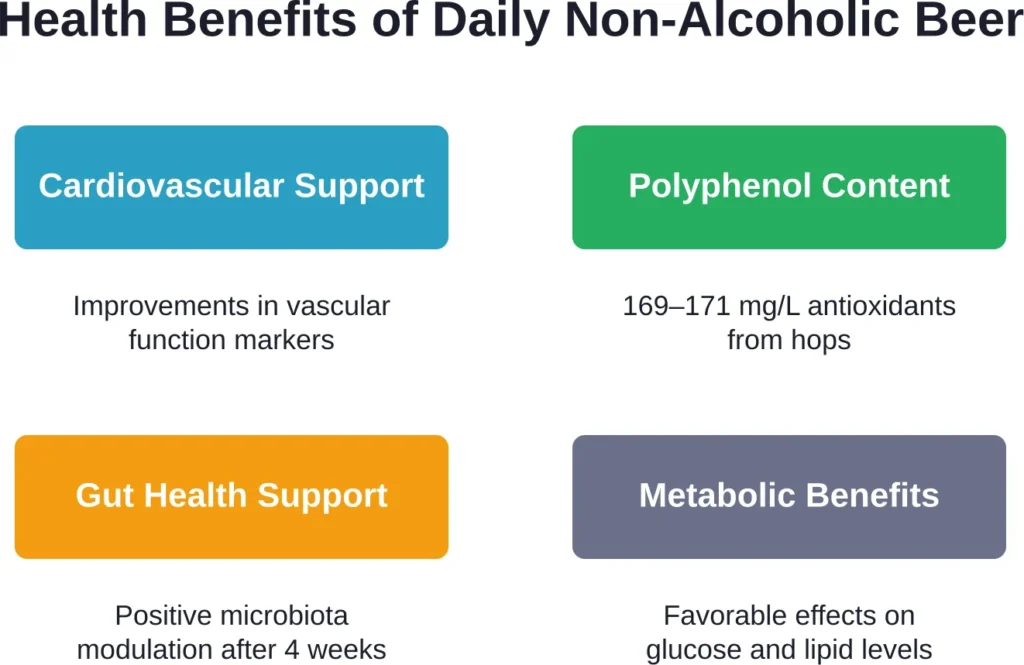
Research has examined how non-alcoholic beer affects endothelial function and cardiovascular health. Studies have documented improvements in vascular function markers in participants consuming non-alcoholic beer daily, though specific improvement percentages vary by study design and population.
Research has examined serum lipids and inflammatory markers in participants consuming beer. Polyphenol content in beer, derived from hops and ranging in similar amounts in both alcoholic and non-alcoholic varieties, has been identified as a potential mechanism for cardiovascular benefits.
Polyphenols come primarily from hops, the bittering and flavoring agent used in beer production. These compounds have antioxidant properties and may help reduce inflammation, improve blood vessel function, and support overall cardiovascular health.
The takeaway? Daily non-alcoholic beer consumption in moderate amounts (we’re talking 1-2 beers, not six-packs) might actually support heart health.
Gut Microbiota and Metabolic Effects
A 4-week randomized, double-blind trial compared the effects of 330 mL daily servings of alcoholic beer (with alcohol) versus non-alcoholic beer on gut microbiota composition.
Both types of beer influenced gut bacteria populations, though the mechanisms and specific changes differed. The study suggests that compounds in beer beyond alcohol—including polyphenols and other plant-derived substances—interact with the microbiome in potentially beneficial ways.
Research on glucose and lipid metabolism found that non-alcoholic beer consumption influenced body composition and metabolic markers in healthy young adults. The studies are still emerging, but early data suggests daily moderate consumption doesn’t negatively impact metabolic health and may offer modest benefits.
That’s not a green light to replace water with non-alcoholic beer. But it does suggest that incorporating it into a balanced diet isn’t cause for concern for most people.
How Much Is Safe to Drink Daily?
Here’s where moderation becomes key.
Research studies typically use servings of 330 mL (about 11 ounces) of non-alcoholic beer. Most studies showing health benefits involved one serving per day, occasionally two.
The recommended daily limit based on available research is 1–2 non-alcoholic beers. That’s the range where studies have documented benefits without significant downsides.
What about drinking more than that? There’s no research suggesting that three, four, or more non-alcoholic beers daily provides additional benefits. In fact, you’d be adding unnecessary calories and potentially displacing other nutritious beverages from your diet.
A typical non-alcoholic beer contains 50-90 calories per serving, compared to 150-180 calories in regular beer. That’s significantly lower, but it still adds up. Drinking four non-alcoholic beers daily could add 200-360 calories to your diet—roughly equivalent to an extra meal.
Non-alcoholic beer also contains carbohydrates, typically 10-20 grams per serving. For people managing blood sugar or following low-carb diets, this matters.
| Component | Regular Beer (12 oz) | Non-Alcoholic Beer (12 oz) |
|---|---|---|
| Calories | 150-180 | 50-90 |
| Carbohydrates | 10-15g | 10-20g |
| Protein | 1-2g | 1-2g |
| Alcohol | 14g (5% ABV) | 0.7g (0.5% ABV) |
Who Should Avoid Daily Non-Alcoholic Beer?
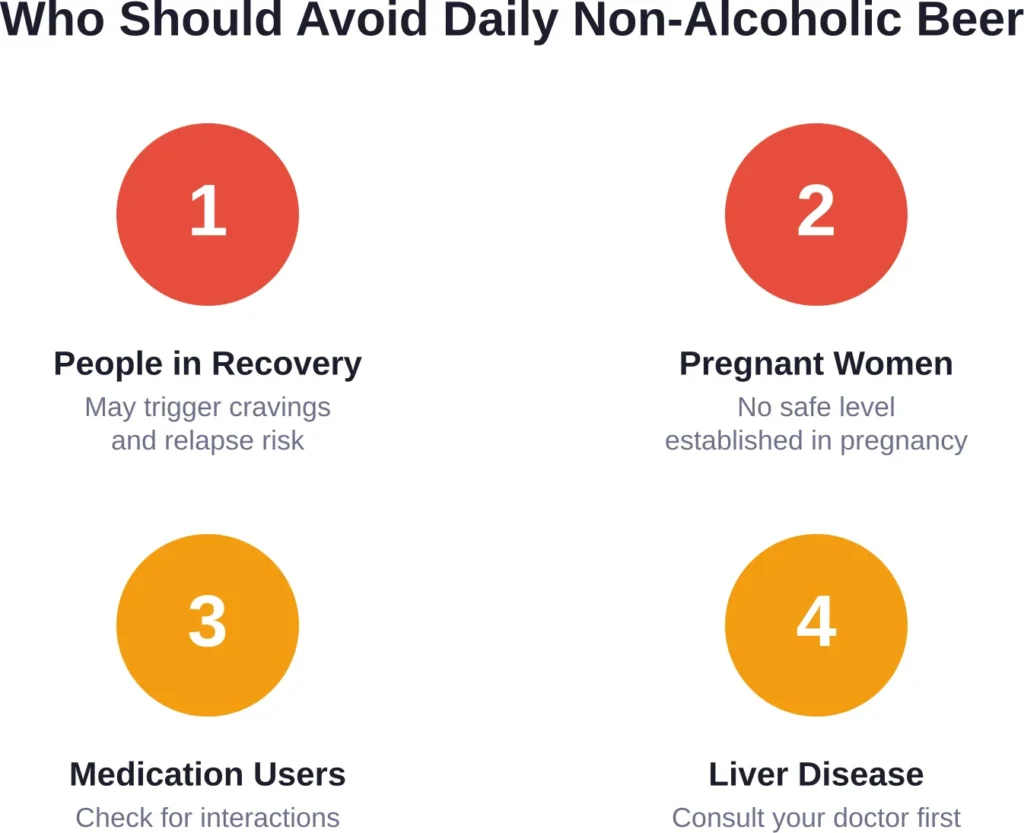
Non-alcoholic beer isn’t universally safe for everyone. Several populations need to exercise caution or avoid it entirely.
People in Recovery from Alcohol Use Disorder
This is where things get complicated.
The taste, smell, and ritual of drinking non-alcoholic beer can activate the same brain regions as regular alcohol in people with alcohol use disorder. These sensory cues can potentially trigger cravings and normalize drinking rituals that individuals in recovery are trying to leave behind.
Some people in recovery find non-alcoholic beer helpful as a substitute in social situations. Others report that it increases their cravings for real alcohol and ultimately led to relapse.
There’s no universal answer. Recovery is highly individual. Some people navigate this successfully; others find it too risky.
What the research does show: non-alcoholic beer may trigger false positives on alcohol breathalyzer tests for a brief period after consumption. For anyone in recovery who’s subject to regular testing (court-ordered monitoring, workplace testing, etc.), this presents a genuine problem.
The psychological component matters just as much. If you’re working through recovery, whether non-alcoholic beer helps or hinders depends entirely on your personal triggers, coping mechanisms, and support system.
Pregnant Women
The CDC indicates that excessive alcohol use can have immediate and long-term effects, and that no safe level of alcohol consumption during pregnancy has been established.
While the 0.5% ABV in non-alcoholic beer is minimal, many healthcare providers recommend complete avoidance during pregnancy. The trace amounts probably won’t cause harm, but there’s no established safe threshold.
Why risk it when water, juice, and truly alcohol-free beverages are available?
People Taking Certain Medications
Some medications interact negatively with even small amounts of alcohol. Antibiotics, antidepressants, anti-anxiety medications, and pain relievers can all have interactions.
If you’re on medication that warns against alcohol consumption, check with your healthcare provider before incorporating non-alcoholic beer into your daily routine. The 0.5% ABV is probably fine, but “probably” isn’t good enough when medication interactions are involved.
Individuals with Liver Conditions
Non-alcoholic beer doesn’t pose the same liver risks as alcoholic beer. The minimal alcohol content shouldn’t cause additional liver damage in people with liver disease.
That said, if you have liver disease, any alcohol exposure—even trace amounts—should be discussed with your doctor. Individual circumstances vary, and what’s safe for one person with liver disease may not be safe for another.
Does Non-Alcoholic Beer Break Sobriety?
This question comes up constantly in recovery communities, and it doesn’t have a one-size-fits-all answer.
From a strict chemical standpoint, consuming 0.5% ABV means consuming alcohol—just in trace amounts. Some people in recovery define sobriety as complete abstinence from any substance containing alcohol, which would exclude non-alcoholic beer.
Others define sobriety more broadly, focusing on abstinence from intoxication and the destructive behaviors associated with alcohol use disorder. By this definition, non-alcoholic beer doesn’t break sobriety because it doesn’t cause intoxication.
Community discussions reveal a wide range of perspectives. Some people in recovery use non-alcoholic beer successfully as a tool to navigate social situations without feeling isolated. Others find that the ritual of drinking beer—even without alcohol—keeps them mentally tied to their old habits.
The World Health Organization has stated that no level of alcohol consumption is safe for health, a position published in 2023. This acknowledges that even small amounts of alcohol carry some health risks, particularly regarding cancer and cardiovascular disease in the general population.
But context matters. For someone who previously drank heavily and is now choosing non-alcoholic beer instead, the harm reduction is massive even if trace alcohol remains.
If sobriety is important to you, the answer depends on how you define it, what your recovery program recommends, and what your personal triggers are. There’s no wrong answer—just the answer that works for your situation.
Can You Get Drunk on Non-Alcoholic Beer?
Short answer: no.
Longer answer: technically yes, but you’d need to drink an absurd amount in an impossibly short time.
At 0.5% ABV, you’d need to drink ten non-alcoholic beers to equal the alcohol content of one regular 5% ABV beer. To reach legal intoxication (0.08% blood alcohol concentration), you’d need to consume them faster than your liver can metabolize the alcohol.
The liver processes roughly 0.015% BAC per hour. You’d need to drink multiple non-alcoholic beers per hour, sustain that rate for several hours, and overcome the massive fluid volume you’re ingesting (which would make you feel sick long before you felt drunk).
Could someone theoretically get tipsy from non-alcoholic beer? Maybe, under extreme circumstances. Is it a realistic concern? Not at all.
Comparing Non-Alcoholic Beer to Other Beverage Options
Non-alcoholic beer sits in an interesting middle ground between plain water and traditional beer.
Water remains the gold standard for hydration. It has zero calories, zero sugar, no additives, and no trace alcohol. If your primary goal is hydration, water wins.
But here’s the thing: people don’t always choose beverages purely for hydration. Taste, social context, and the desire for variety all matter.
Compared to regular beer, non-alcoholic beer eliminates most of the health risks associated with alcohol consumption. According to the CDC, excessive alcohol use can harm the liver, increase cancer risk, and contribute to injuries and premature death. Even moderate drinking may increase certain health risks compared to not drinking at all.
By choosing non-alcoholic beer, you’re avoiding those risks while still enjoying the taste and social aspects of beer drinking.
Compared to soda and other sweetened beverages, non-alcoholic beer often has fewer calories and less sugar. Many craft non-alcoholic beers contain no added sugars, getting their carbohydrate content from malted grains.
Compared to juice, non-alcoholic beer typically has lower sugar content and similar calorie counts, plus the added polyphenol benefits from hops.
| Beverage | Calories (12 oz) | Alcohol Content | Sugar Content |
|---|---|---|---|
| Water | 0 | 0% | 0g |
| Non-Alcoholic Beer | 50-90 | 0.0-0.5% | 0-5g |
| Regular Beer | 150-180 | 4-6% | 0-2g |
| Soda | 140-170 | 0% | 35-40g |
| Orange Juice | 110-130 | 0% | 20-25g |
The Role of Non-Alcoholic Beer in Social Settings
One of the biggest advantages of non-alcoholic beer is social, not medical.
In many cultures, alcohol consumption is deeply embedded in social rituals—after-work drinks, backyard barbecues, sporting events, celebrations. People who choose not to drink often feel isolated or face constant questions about why they’re not drinking.
Non-alcoholic beer offers a solution. It looks like beer, tastes like beer (or close enough), and comes in a bottle or can that fits the social context. Nobody questions what’s in your hand.
That matters for people who:
- Are reducing alcohol intake for health reasons but don’t want to explain their medical history to everyone
- Are designated drivers who want to participate socially without drinking
- Are trying to cut back on drinking but still enjoy the taste of beer
- Have early morning commitments the next day and want to avoid hangovers
The World Health Organization has noted the expanding market for no- and low-alcohol beverages, though they’ve also questioned whether these products actually reduce overall alcohol consumption or simply attract new consumers who wouldn’t have drunk alcohol anyway.
The jury’s still out on the population-level effects. But at the individual level, non-alcoholic beer clearly provides a tool for people who want to participate in drinking culture without consuming significant alcohol.
What About the Taste and Quality?
Let’s be real: non-alcoholic beer used to taste terrible.
Early versions were watery, overly sweet, or had weird off-flavors from the dealcoholization process. They were the beverages you choked down if you had no other choice.
That’s changed dramatically. Modern brewing techniques—including vacuum distillation and reverse osmosis—remove alcohol while preserving the flavor compounds that make beer taste like beer.
Craft breweries have entered the non-alcoholic market with the same attention to quality they bring to their regular beers. You can now find non-alcoholic IPAs with legitimate hop flavor, non-alcoholic stouts with roasted malt character, and non-alcoholic wheat beers that taste like actual beer.
Will non-alcoholic beer taste identical to the full-alcohol version? No. Alcohol contributes to beer’s body, mouthfeel, and flavor. But the gap has narrowed significantly.
For someone who’s never had regular beer, many modern non-alcoholic beers taste perfectly fine—like beer, not like a weird substitute. For someone comparing directly to full-alcohol versions, you’ll notice differences, but they’re increasingly minor.
Daily Non-Alcoholic Beer: Practical Considerations
Beyond health and safety, there are practical factors to consider if you’re thinking about making non-alcoholic beer a daily habit.
Cost
Non-alcoholic beer typically costs roughly the same as regular beer, sometimes slightly more due to the additional dealcoholization processing required.
If you’re buying craft non-alcoholic six-packs, that’s $10-15 per six-pack in most markets. Drinking one per day means spending $40-60+ per month on non-alcoholic beer.
That’s not prohibitive, but it’s not free either. Compare that to water (essentially free) or even premium coffee (which also costs daily but at least provides caffeine).
Availability
Non-alcoholic beer availability has improved dramatically, but it’s still not universal. Small convenience stores might carry one token non-alcoholic option. Larger grocery stores typically stock several brands.
If you want specific craft non-alcoholic beers, you might need to order online or visit specialty stores. That’s changing as demand grows, but it’s still more effort than buying regular beer or soda.
Storage and Refrigeration
Non-alcoholic beer requires the same storage as regular beer—cool, dark places for unopened bottles, refrigeration for optimal taste. If you’re drinking daily, you’ll need refrigerator space for a steady supply.
Not a huge deal, but it’s more logistical overhead than, say, keeping a water filter pitcher in your fridge.
Calories in Your Overall Diet
This deserves emphasis: 50-90 calories per day from non-alcoholic beer might not sound like much, but it adds up.
Over a year, that’s 18,000-33,000 calories—roughly 5-9 pounds of potential weight gain if those calories aren’t offset by reducing calories elsewhere or increasing activity.
If you’re actively managing weight, those daily calories matter. If you’re generally active and maintain weight easily, they probably don’t.
Alternatives to Non-Alcoholic Beer
Non-alcoholic beer isn’t the only option for people looking to avoid alcohol while maintaining social participation or enjoying flavorful beverages.
Kombucha offers probiotic benefits and complex flavors, though it can also contain trace alcohol (typically 0.5% or less, similar to non-alcoholic beer). It’s fermented, which gives it a tangy, slightly effervescent quality that some people find beer-like.
Sparkling water with fruit or hops (yes, hopped sparkling water exists now) provides the carbonation and botanical flavors without calories or alcohol. Brands have started adding hops to sparkling water specifically to appeal to people who like beer flavor without wanting a beer-adjacent product.
Alcohol-free spirits and mocktails offer variety beyond beer flavor. The non-alcoholic spirits market has exploded, with distilled botanical beverages that mimic gin, whiskey, and other spirits without alcohol.
Herbal teas and infusions—hot or iced—provide flavor complexity and various health benefits without calories or alcohol.
The point: if non-alcoholic beer doesn’t work for you (taste, triggers, cost, whatever), plenty of other options exist for avoiding alcohol while still drinking something more interesting than plain water.
Frequently Asked Questions
Non-alcoholic beer doesn’t pose significant liver risks for healthy individuals. The minimal alcohol content (0.5% ABV or less) is too low to cause liver damage in people with normal liver function. However, individuals with existing liver disease should consult their healthcare provider before consuming any product containing trace alcohol, even in minimal amounts.
Non-alcoholic beer may trigger false positives on breathalyzer tests for a brief period after consumption due to residual alcohol in the mouth and throat. This dissipates quickly, but it matters for anyone subject to immediate testing. Standard urine drug tests don’t typically screen for alcohol metabolites, but specialized alcohol testing (like EtG tests) might detect trace amounts if consumed in large quantities shortly before testing.
Non-alcoholic beer is hydrating, but not quite as effectively as plain water. The minimal alcohol content has negligible diuretic effects, unlike regular beer. However, the calories, carbohydrates, and other compounds mean it doesn’t hydrate quite as purely as water. It’s fine for hydration purposes, but water remains optimal for pure hydration needs.
Legally, non-alcoholic beer can often be purchased by minors since it falls below the alcohol threshold for regulated beverages (this varies by jurisdiction). However, many parents and health experts recommend against it. The concern isn’t the minimal alcohol content—it’s normalizing beer-drinking behaviors and creating mental associations between beer and social situations for children and teenagers. There’s no health benefit that would justify introducing beer-adjacent beverages to kids.
Research suggests non-alcoholic beer may actually have anti-inflammatory properties due to its polyphenol content. Studies examining inflammatory markers found that moderate non-alcoholic beer consumption didn’t increase inflammation and potentially reduced certain inflammatory biomarkers. The hops and other botanical compounds in beer provide antioxidants that may counteract inflammation rather than cause it.
Yes, drinking non-alcoholic beer while driving is legal and safe. The trace alcohol content won’t impair driving ability or push blood alcohol concentration above legal limits. However, drinking any beverage while actively operating a vehicle creates distraction risk—that’s true whether it’s non-alcoholic beer, coffee, or soda. The beverage itself is fine; the distraction while driving is the issue.
Non-alcoholic beer has a shelf life similar to regular beer—typically 6-9 months when stored properly in cool, dark conditions. It won’t become unsafe to drink after expiration, but the flavor degrades. Hops lose their aromatic qualities, and the beer develops stale, cardboard-like flavors. Refrigeration extends freshness. Once opened, non-alcoholic beer goes flat within 24-48 hours, just like regular beer.
The Bottom Line: Is Daily Non-Alcoholic Beer Right for You?
So, is it okay to drink non-alcoholic beer every day?
For most healthy adults, yes—with some caveats.
Research supports moderate daily consumption (1-2 servings of 330 mL) and has documented cardiovascular benefits, favorable effects on gut microbiota, and metabolic neutrality or slight benefits. The minimal alcohol content (up to 0.5% ABV) poses negligible risk for the general population.
But “most people” isn’t everyone. Pregnant women should avoid it. People in recovery from alcohol use disorder need to carefully consider whether the taste and ritual create relapse risks. Anyone taking medications that interact with alcohol should check with their healthcare provider first. People with liver disease should consult their doctor.
Beyond health considerations, practical factors matter: cost, calories, availability, and whether you’re actually enjoying it or just drinking it out of habit.
The CDC’s research on alcohol consumption emphasizes that drinking less is better for health than drinking more, and not drinking at all eliminates alcohol-related health risks entirely. Even moderate alcohol consumption carries some risks compared to abstinence. By choosing non-alcoholic beer over regular beer, you’re eliminating most of those risks while preserving the social and gustatory aspects of beer drinking.
The WHO’s 2023 statement that no level of alcohol consumption is safe provides important context, but it primarily addresses regular alcohol consumption, not beverages with trace amounts like non-alcoholic beer.
Real talk: if you like the taste of beer, enjoy having a beer with dinner or while watching sports, and want to avoid alcohol’s health risks, daily non-alcoholic beer is a reasonable choice for most people. It’s not a miracle health drink, but it’s not harmful either.
Just keep it moderate, stay aware of your individual health circumstances, and don’t expect it to replace water as your primary hydration source.
If you’re considering adding daily non-alcoholic beer to your routine, try it for a few weeks and pay attention to how you feel. Do you genuinely enjoy it, or has it become a mindless habit? Are you within the 1-2 beer range, or has it crept up? Are you noticing any unexpected effects—digestive changes, energy shifts, or anything else?
Your body will tell you whether daily non-alcoholic beer works for you. Listen to it.