
Quick Summary: Drinking sink water (tap water) is generally safe in the United States thanks to EPA regulations requiring public water systems to meet strict standards for over 90 contaminants. However, safety depends on factors like local infrastructure, building plumbing age, and potential contamination between the treatment plant and your faucet. Testing your water and using certified filters can provide additional protection, especially in homes with older pipes or private wells.
The question of whether it’s okay to drink water straight from the sink might seem simple, but the answer involves understanding public water systems, federal regulations, and what happens to water between the treatment plant and your glass.
According to the CDC, the quality of drinking water depends on where it came from and how it has been treated. Public water utilities remove harmful germs and chemicals to make tap water safe to drink, but contamination can still occur in distribution systems and building plumbing.
How Safe Is U.S. Sink Water?
Most tap water from public water systems in the United States meets federal safety standards. The EPA sets legal limits on over 90 contaminants in drinking water under the Safe Drinking Water Act (SDWA).
These regulations establish maximum contaminant levels for bacteria, viruses, chemicals, and heavy metals. For example, surface water treatment systems must achieve 99.9% removal or inactivation of Giardia lamblia and 99.99% removal or inactivation of viruses.
But here’s the thing—meeting EPA standards doesn’t automatically mean every tap in America delivers perfectly safe water. The quality of sink water varies from place to place depending on the source, treatment processes, and infrastructure condition.
Where Public Confidence Stands
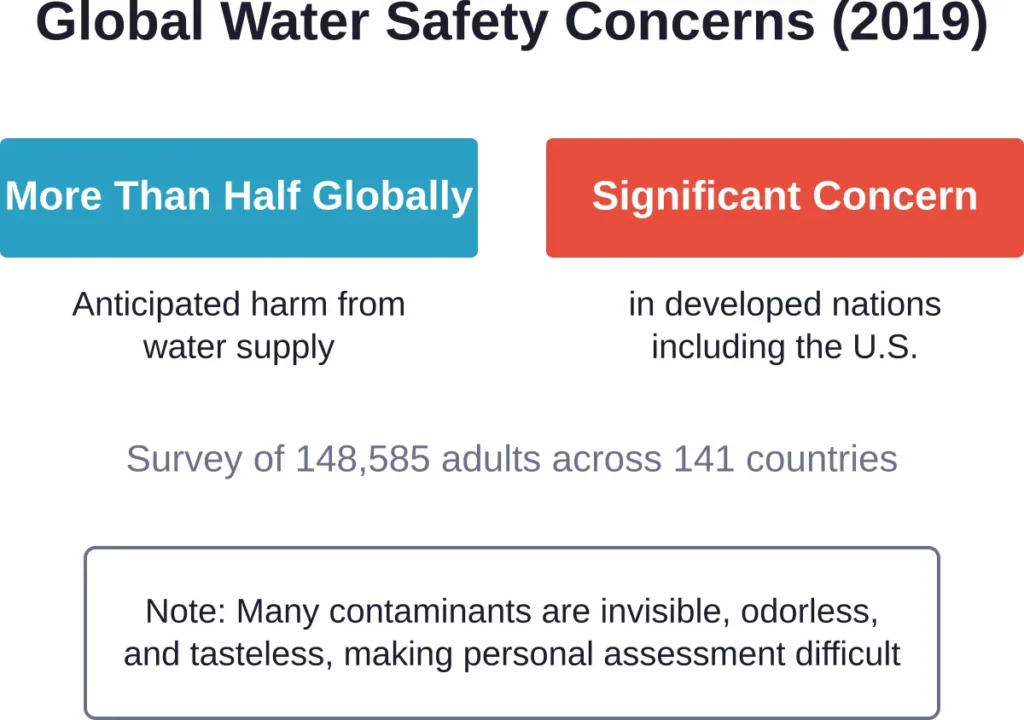
Research from a 2019 global study surveying 148,585 adults across 141 countries found that more than half anticipated harm from their water supply, with significant concern in developed nations including the United States.
That’s a significant percentage expressing concern, even in a country with relatively strong water quality regulations. The researchers noted that many contaminants are invisible, odorless, and tasteless, making it difficult for individuals to judge water safety without testing.
What Contaminants Can Be in Sink Water?
The EPA regulates numerous contaminants, but some still make their way into tap water through various pathways. According to the CDC, germs and chemicals can contaminate tap water at the source, during water treatment and storage, or in distribution pipes and building plumbing.
Lead Contamination
Lead remains one of the most serious concerns. The EPA notes that lead pipes are more likely to be found in older cities and homes built before 1986. The Safe Drinking Water Act has progressively reduced the maximum allowable lead content—currently 0.25% (weighted average) in pipes and plumbing fittings and 0.2% in solder and flux.
But even these regulations can’t eliminate risk entirely. Lead leaches from pipes, especially when water sits stagnant or has certain chemical properties. And there’s no known safe level of lead in a child’s blood, according to the EPA and CDC.
Microbial Threats
Bacteria and other microorganisms pose health risks when treatment fails or distribution systems become compromised. The EPA sets a maximum contaminant level of zero for Legionella, which causes Legionnaire’s Disease, a serious type of pneumonia.
Total coliforms can’t exceed 5.0% of monthly samples. These bacteria indicate that other disease-causing organisms might be present.
Chemical Pollutants
From agricultural runoff to industrial discharge, various chemicals can enter water supplies. PFAS (per- and polyfluoroalkyl substances), pesticides, and disinfection byproducts represent ongoing concerns that regulators continue to address through updated standards.
| Contaminant Type | Common Sources | Health Concerns |
|---|---|---|
| Lead | Old pipes, solder, fixtures (pre-1986) | Developmental delays, brain damage (children) |
| Bacteria (Legionella, E. coli) | Biofilms, stagnant water, system breaks | Gastroenteritis, pneumonia, serious infections |
| Chlorine byproducts (TTHMs) | Disinfection process, organic matter | Long-term cancer risk |
| Nitrates | Agricultural runoff, septic systems | Blue baby syndrome (infants) |
Building Plumbing Changes Water Quality
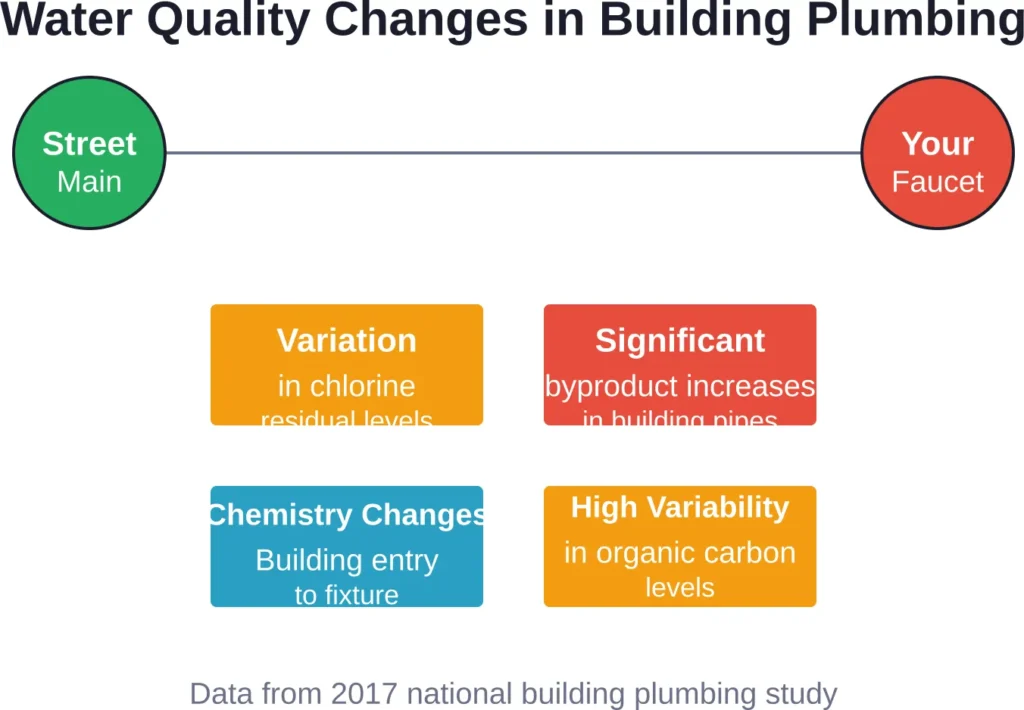
Here’s what many people don’t realize: water quality can deteriorate significantly between the street and the faucet. Research from a 2017 study on building plumbing found some eye-opening results.
Building plumbing research documented that water quality can change significantly as it travels through building systems, including variations in disinfectant residual levels. Chlorine protects against microbial growth, so variations in residual levels create potential risk.
Building plumbing research documented measurable changes in water chemistry between building entry and plumbing fixtures. Research has documented that disinfection byproduct levels can increase significantly inside building plumbing systems.
Building plumbing research documented significant variability in organic carbon levels between water entering buildings and water at fixtures, with cold water showing particularly high variability.
What does this mean? The pipes, fixtures, and water heater in your home or building can significantly alter water chemistry and safety, even when the utility delivers compliant water to the property line.
When Sink Water Requires Extra Caution
The CDC identifies situations where tap water that’s generally safe to drink might still cause problems.
Contact lens users should avoid tap water for rinsing. Even treated water can harbor microorganisms that cause serious eye infections. Nasal irrigation and humidifier filling also present risks—water-borne bacteria can survive in these applications and cause illness.
Infants and immunocompromised individuals face higher vulnerability. Water that poses minimal risk to healthy adults might harm those with weakened immune systems.
If local authorities issue a boil water advisory, follow it without exception. Utilities must notify residents within 24 hours when an immediate health risk is detected. For non-immediate risks, notification timelines are longer, which means periodic contamination could occur between annual water quality reports.
How to Know If Your Sink Water Is Safe
Testing provides the most reliable answer. Contact your water utility for the annual Consumer Confidence Report, which details contaminants found and whether levels exceeded EPA standards.
For private wells or additional peace of mind, independent laboratory testing can identify specific contaminants. Test for lead if your home was built before 1986, and consider testing after major plumbing work or if water taste, odor, or appearance changes.
Visual and sensory clues sometimes indicate problems. Cloudy water, strange tastes, metallic odors, or discoloration warrant investigation. However, remember that many dangerous contaminants produce no sensory warning.
Filtration Options
Certified water filters can remove specific contaminants, but effectiveness varies by technology and target pollutant. Activated carbon filters reduce chlorine, some organic chemicals, and improve taste. Reverse osmosis systems remove a broader range of contaminants including lead, fluoride, and many dissolved solids.
Look for NSF/ANSI certification matching your specific concerns. Not all filters remove all contaminants—a filter certified for chlorine reduction might do nothing for lead.
Maintenance matters. Filters lose effectiveness over time and can harbor bacteria if not replaced according to manufacturer guidelines.
| Filter Type | What It Removes | What It Doesn’t Remove |
|---|---|---|
| Activated Carbon | Chlorine, pesticides, organic compounds, odors | Minerals, salts, most inorganics |
| Reverse Osmosis | Lead, fluoride, dissolved solids, bacteria, viruses | Some pesticides (requires carbon stage) |
| Distillation | Heavy metals, minerals, microorganisms | Volatile organic compounds (evaporate with water) |
| UV Treatment | Bacteria, viruses, protozoa | Chemicals, metals, particles |
The Bottom Line on Drinking Sink Water
Most U.S. tap water from public systems meets federal safety standards and is okay to drink. The EPA regulates over 90 contaminants, and utilities must test regularly and report results annually.
But infrastructure age, building plumbing condition, and local compliance issues create variability. What’s safe at the treatment plant might change by the time water reaches your glass.
Testing provides certainty. Annual utility reports, independent lab tests, and attention to boil water advisories help ensure safety. For additional protection, certified filtration systems tailored to specific contaminants offer peace of mind.
So is it okay to drink sink water? Generally yes, with awareness of local conditions and infrastructure age. When in doubt, test. When concerned, filter.
Frequently Asked Questions
Yes, sink water and tap water refer to the same thing—water that comes from your faucet connected to a municipal supply or private well. The terms are interchangeable, though “tap water” is more commonly used.
In most modern homes with updated plumbing, bathroom and kitchen sink water come from the same source and are equally safe. However, older homes might have different pipe materials or conditions in different areas. Bathroom fixtures sometimes have longer pipe runs where water sits stagnant, potentially increasing lead leaching or bacterial growth.
Flushing the tap for 30 seconds to 2 minutes can reduce lead and other contaminants that accumulate when water sits stagnant in pipes. This is especially important for the first use in the morning or after the water hasn’t been used for several hours. Use cold water for drinking and cooking, as hot water dissolves more lead from pipes.
Boiling kills bacteria, viruses, and parasites, making water microbiologically safe. However, boiling doesn’t remove chemical contaminants like lead, nitrates, or pesticides—it actually concentrates them as water evaporates. Boil water only when microbial contamination is the concern, such as during boil water advisories.
Filter value depends on specific water quality issues. Test your water first to identify actual contaminants, then choose a filter certified to remove those specific substances. An inexpensive filter that addresses your actual problems provides more value than an expensive system targeting contaminants not present in your water.
Municipal water customers should review the annual Consumer Confidence Report from their utility. Additional testing makes sense if the home was built before 1986 (test for lead), after major plumbing work, when pregnant or with infants in the home, or if taste, odor, or appearance changes. Private well owners should test annually at minimum, and more frequently if contamination sources exist nearby.
It depends on the contaminant type and concentration. Some bacteria and viruses can cause illness from a single exposure. Chemical contaminants like lead typically cause harm through repeated exposure over time. If local authorities issue an immediate health risk notification, they’re concerned about acute effects from short-term exposure.