

Quick Summary: Rotating tires every 10,000 miles is acceptable for many vehicles, though most manufacturers and tire experts recommend intervals between 5,000 and 7,500 miles for optimal tire life and safety. Extending to 10,000 miles won’t typically cause immediate harm but may accelerate uneven wear patterns, especially on front-wheel-drive vehicles where front tires wear significantly faster.
Tire rotation remains one of those maintenance tasks that confuses many car owners. The dealership says every 5,000 miles. The owner’s manual mentions 7,500 miles. And then there’s that voice in your head asking whether you can stretch it to 10,000 miles to save a trip to the shop.
Here’s the thing—tire rotation intervals aren’t arbitrary numbers designed to get more money out of vehicle owners. They’re based on how tires actually wear during normal driving. But that doesn’t mean the standard recommendation fits every situation perfectly.
Let’s break down what actually happens when tires go longer between rotations and whether that 10,000-mile mark is really the point where problems begin.
What Tire Rotation Actually Accomplishes
Tire rotation moves tires from one position on the vehicle to another—typically front to rear or in a cross pattern. The goal? Evening out wear patterns that naturally develop based on each tire’s position.
Front tires on most vehicles experience dramatically different forces than rear tires. Steering input, braking load distribution, and cornering forces all concentrate on the front axle. According to Michelin, front tires tend to wear faster due to these factors, whereas rear tires wear more evenly.
Without regular rotation, these differences become increasingly apparent. Uneven tread depth develops, grip becomes inconsistent, and the overall tire lifespan shortens. That’s the core reason rotation matters—not as a revenue generator for shops, but as actual preventive maintenance.
Industry Standard Recommendations vs. Real-World Practice
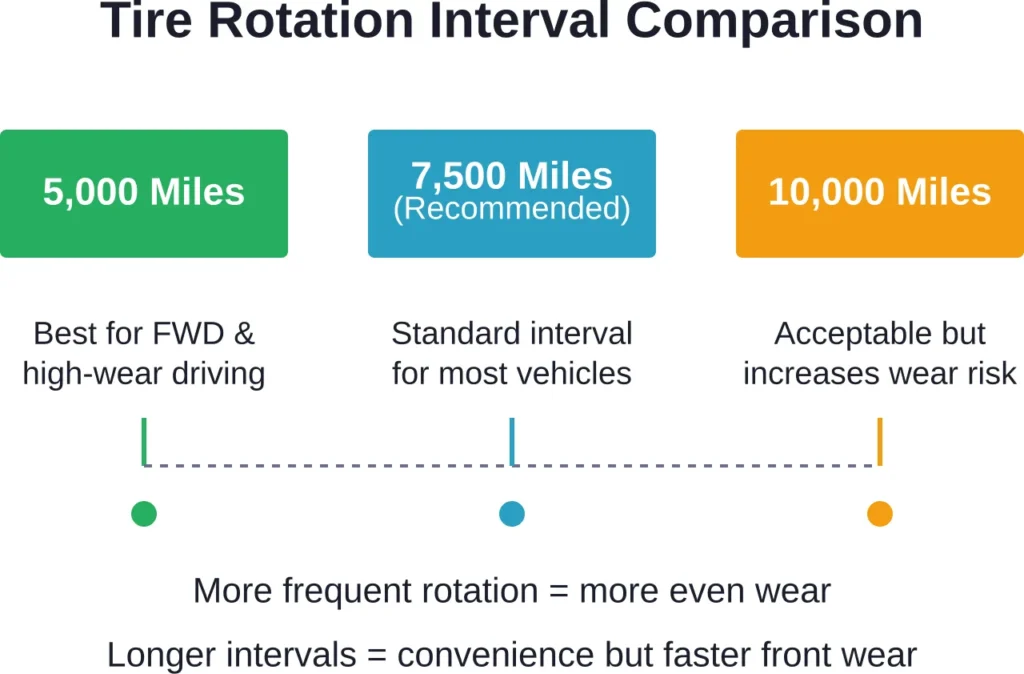
Most tire manufacturers and automotive experts land on a similar interval. Consumer Reports recommends tire rotation every 5,000 to 7,500 miles as a standard practice. This aligns with many manufacturer guidelines found in owner’s manuals.
But look at actual driving patterns and you’ll find plenty of variation. Some drivers rotate religiously at 5,000 miles. Others wait until their oil change—which might be 7,500 miles with synthetic oil, or even 10,000 miles on vehicles with extended service intervals.
Community discussions reveal that many drivers successfully run 10,000-mile rotation intervals without catastrophic results. One driver noted they typically rotate once halfway through the tire’s life—when about 40 percent of usable tread has worn off—rather than following strict mileage intervals.
That approach might work fine on rear-wheel-drive vehicles where wear distributes more evenly. Front-wheel-drive cars? That’s where stretching the interval gets dicier.
What Happens When You Wait Until 10,000 Miles
So what’s the actual consequence of pushing rotation to 10,000 miles? It’s not like tires spontaneously fail at 10,001 miles if they haven’t been rotated.
The real issue is accelerated differential wear. Front tires on front-wheel-drive vehicles tend to wear faster than rear tires due to steering input, braking, and cornering forces. Wait too long to rotate, and that gap widens. By the time the rotation finally happens, the front tires have lost significantly more tread depth than the rear ones.
This creates two problems. First, overall tire lifespan decreases because the fronts wear out while the rears still have plenty of life left. Second, handling characteristics change as grip levels become mismatched between axles.
According to automotive advice, tire rotation is commonly performed at 10,000-mile intervals, acknowledging this as a common service interval. But just because it’s common doesn’t make it optimal for every vehicle or driving situation.
All-wheel-drive vehicles face even stricter requirements. Uneven tire diameters caused by differential wear can stress the drivetrain components. Michelin specifically provides guidance for AWD vehicles about maintaining even tread wear through more frequent rotation.
When 10,000 Miles Makes Sense (And When It Doesn’t)
Look, not every vehicle and driver combination demands 5,000-mile rotation intervals. Context matters.
Good candidates for 10,000-mile intervals:
- Rear-wheel-drive vehicles with relatively even wear patterns between front and rear
- Highway-dominant driving with minimal stop-and-go traffic
- Vehicles with tire pressure monitoring systems that get checked regularly
- Drivers who inspect tread depth periodically and catch uneven wear early
Bad candidates for extended intervals:
- Front-wheel-drive vehicles, especially with aggressive driving
- All-wheel-drive systems sensitive to tire diameter differences
- Performance tires with softer compounds that wear faster
- Vehicles used for towing or carrying heavy loads
- City driving with frequent hard braking and cornering
The driving environment changes everything. Someone putting 10,000 highway miles on a rear-drive sedan will see completely different wear patterns than someone grinding through 10,000 miles of urban stop-and-go in a front-drive crossover.
Cost-Benefit Analysis: More Frequent Rotation vs. Earlier Tire Replacement
Here’s where the math gets interesting. Tire rotation typically costs $20 to $50 at most shops. Some dealerships charge more—a Volvo dealer quoted $50 for tire rotation at 8,500 miles, which falls within typical market rates.
Compare that to premature tire replacement. A set of decent all-season tires runs $400 to $800 or more. If skipping rotations cuts tire life by even 20 percent, that’s $80 to $160 lost—equivalent to three or four rotation services.
| Scenario | Rotation Cost | Tire Lifespan | Total Cost Over 60,000 Miles |
|---|---|---|---|
| Rotate every 5,000 miles | $30 × 12 | 60,000 miles | $960 (rotation + tires) |
| Rotate every 7,500 miles | $30 × 8 | 60,000 miles | $840 (rotation + tires) |
| Rotate every 10,000 miles | $30 × 6 | 50,000 miles (early replacement) | $900+ (rotation + early tire replacement) |
The sweet spot typically lands around 7,500 miles for most drivers—frequent enough to prevent premature wear, but not so often that rotation costs pile up unnecessarily.
That said, many shops include rotation with oil changes or offer it free for tires purchased there. If rotation essentially costs nothing, more frequent intervals make obvious sense.
Rotation Patterns Matter As Much As Timing
Stretching to 10,000 miles becomes less problematic when paired with the correct rotation pattern. Using the wrong pattern might actually accelerate uneven wear even with frequent service.
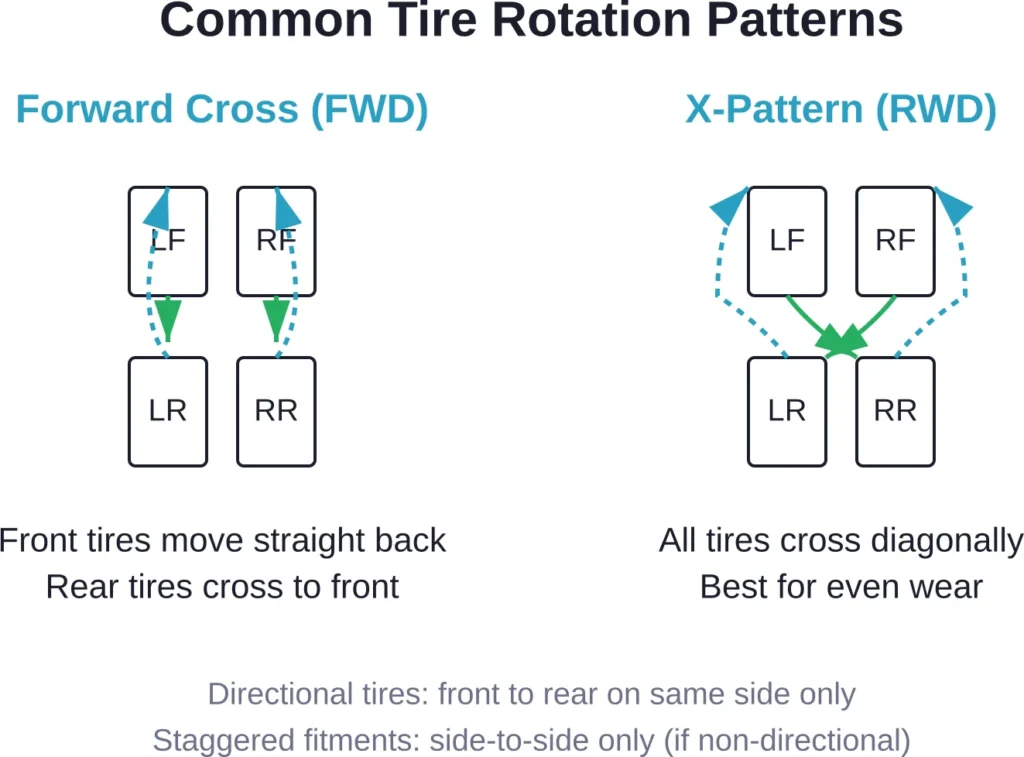
Bridgestone provides clear guidance on rotation patterns based on tire type and vehicle configuration. For uniform-size non-directional tires—the most common setup—a cross pattern typically works best, moving front tires to opposite rear positions and rear tires forward.
Directional tires only rotate front-to-back on the same side. Staggered fitments (different front and rear sizes) can only swap side-to-side if they’re non-directional, or can’t rotate at all if they’re directional.
Using the wrong pattern wastes the entire rotation. Worse, it might create new wear issues. Always check the owner’s manual or tire sidewall markings before rotating.
Signs You’ve Waited Too Long Between Rotations
How do you know if 10,000 miles has crossed from acceptable into problematic territory? The tires tell the story.
Visible tread depth differences between front and rear tires signal delayed rotation. Most tire shops use tread depth gauges, but the penny test works in a pinch—insert a penny with Lincoln’s head upside down into the tread. If the top of his head remains visible, tread depth has dropped below 2/32 inch, the legal minimum.
Check all four tires. If fronts measure 4/32 inch while rears still show 7/32 inch, rotation should’ve happened sooner.
Other warning signs include:
- Vibration or pulling to one side during driving
- Increased road noise, especially from the front
- Visible wear patterns like center wear, edge wear, or cupping
- Steering feel changes as front tire grip decreases
None of these mean immediate tire failure, but they do indicate that waiting longer between rotations would be unwise.
Combining Rotation With Other Service Intervals
The practical reason many drivers stretch to 10,000 miles? Oil change schedules. Modern synthetic oils often last 7,500 to 10,000 miles, and combining tire rotation with oil changes eliminates a separate trip.
This makes perfect sense from a convenience standpoint. The vehicle’s already on the lift, labor is already paid for, and the incremental cost of rotation drops to nearly nothing.
But here’s where it gets tricky. Some manufacturers recommend more frequent tire rotation than oil changes. If oil changes happen every 10,000 miles but tire rotation should occur every 7,500 miles, combining them means accepting longer rotation intervals or making a dedicated tire rotation trip mid-cycle.
For most drivers, the compromise makes sense. Rotating at 10,000 miles alongside oil changes beats not rotating at all because it’s too much hassle.
The Bottom Line: Finding Your Optimal Interval
So is 10,000 miles okay? The honest answer: it depends.
For many vehicles and driving conditions, 10,000-mile rotation intervals fall into acceptable territory. They’re not optimal—that still lands around 5,000 to 7,500 miles for most situations—but they won’t destroy tires or create dangerous conditions overnight.
The key is understanding where your specific vehicle and driving pattern fall on the spectrum. Front-wheel-drive with city driving? Err toward shorter intervals. Rear-wheel-drive with highway miles? Ten thousand might work fine.
Check tread depth periodically regardless of mileage. If front-to-rear differences exceed 2/32 inch, rotation is overdue no matter what the odometer says.
And remember that tire rotation represents a small investment protecting a much larger one. Extending rotation intervals to save $30 rarely makes financial sense if it results in premature tire replacement costing $400-$800 or more.
Frequently Asked Questions
Pushing to 12,000 miles increases the risk of uneven wear, especially on front-wheel-drive vehicles. While tires won’t immediately fail, differential wear between front and rear becomes more pronounced, potentially shortening overall tire life by 15-25 percent. If you’ve already reached 12,000 miles without rotation, get it done as soon as possible and return to shorter intervals going forward.
Yes. AWD systems are sensitive to tire diameter differences caused by uneven wear. Most AWD manufacturers recommend rotation every 5,000 miles to prevent drivetrain stress. Extending to 10,000 miles on AWD vehicles risks damaging transfer case or differential components, which costs far more than tire rotation.
Absolutely. Regular rotation can extend tire life by 20-40 percent compared to never rotating. Front tires on front-wheel-drive vehicles tend to wear faster than rear tires due to steering input, braking, and cornering forces. Without rotation, fronts wear out while rears retain significant tread, forcing premature replacement of the entire set.
DIY rotation is possible with a jack, jack stands, and a lug wrench, but shops offer advantages. Professional equipment ensures proper torque specs, and mechanics inspect for wear patterns, alignment issues, and other problems during the service. If rotation costs less than $30 or comes free with other services, professional service makes sense.
Tires will develop severe uneven wear. Front tires might need replacement at 25,000-30,000 miles while rears still have 50-60 percent tread remaining. Handling becomes unpredictable as grip levels vary between axles. In extreme cases, uneven wear creates vibration, noise, and reduced wet-weather traction.
More frequent rotation rarely causes problems but offers diminishing returns. Rotating every 3,000 miles costs more without significantly improving tire life compared to 5,000-mile intervals. The 5,000 to 7,500-mile range represents the sweet spot between wear prevention and cost-effectiveness for most drivers.
Directional tires follow the same mileage intervals but require front-to-rear rotation on the same side only, since the tread pattern is designed for one direction of rotation. This limits rotation options compared to non-directional tires but doesn’t change the recommended frequency. Some drivers with directional tires dismount and remount for full cross-pattern rotation, but this adds significant cost.
Making the Right Decision for Your Situation
Tire rotation isn’t complicated maintenance, but it matters more than many drivers realize. The difference between 7,500-mile and 10,000-mile intervals might seem minor, but over the life of multiple tire sets, it adds up to thousands in either savings or unnecessary replacement costs.
The 10,000-mile mark isn’t a hard line between safe and dangerous. Think of it more as the edge of the acceptable range—fine for some situations, pushing limits in others.
Evaluate your specific circumstances. Check your owner’s manual recommendations. Consider your drivetrain layout and driving conditions. Inspect tread depth regularly. And remember that a $30 rotation service beats a $600 premature tire purchase every single time.
Still uncertain about the right interval for your vehicle? Ask during your next oil change. Most shops will inspect tread wear and provide honest feedback about whether your current rotation schedule is working. That five-minute conversation might save hundreds down the road.